, um zu prüfen, ob Sie einen Vollzugriff auf diese Publikation haben.
Zeitschrift Teilzugriff
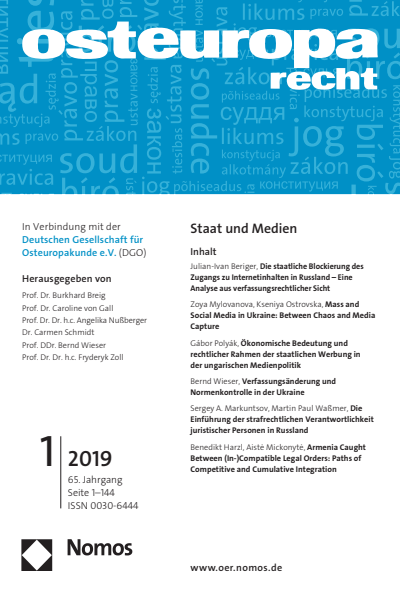
OER Osteuropa Recht
Osteuropa Recht
Herausgeber:innen:
Prof. Dr. Burkhard Breig | Prof. DDr. Dr. h.c. Bernd Wieser | AkadOR’in Dr. Carmen Schmidt | Prof. Dr. Dr. h.c. Angelika Nußberger, M.A | Professor Dr. Dr. h.c. Fryderyk Zoll
Along with the common scholarly classification of government systems as parliamentary systems, presidential systems, semi-presidential systems or their respective derivatives, often the terms of the so-called “super-presidentialism” or...
In their current constitutions, both the Czech Republic and the Slovak Republic share common roots owed to their 74-year history of one nation. Following independence, however, there are noticeable differences in the further development of their...
In the history of the state as well as in their legal history, Poland and Hungary have many parallel aspects in common. This article aims to analyze the position of the head of state in these two, often-referred to as central-eastern European...
In 2013, Armenia abandoned the plan to sign the Association Agreement and to establish a Deep and Comprehensive Free Trade Area (DCFTA) with the EU. Instead, it acceded to the Eurasian Economic Union (EAEU). Against this U-turn in Armenia’s...
This article examines considerations in the context of the introduction of criminal liability for legal entities - which is currently being discussed in Russia. It provides an historical overview of the discussions in this respect, and further sheds...
Since 2012, the legal possibilities for state blocking of web content in Russia have been largely expanded by amendments to the Federal Information Act (Art. 15.1.-15.8. Federal law of 27 July 2006 No. 149-FZ). Therefore, Internet censorship has...