Politische und gesellschaftliche Transformationen unter dem Radar: Ein Irrlicht namens »Arabischer Frühling«
Inhaltsverzeichnis
Bibliographische Infos
Vollzugriff
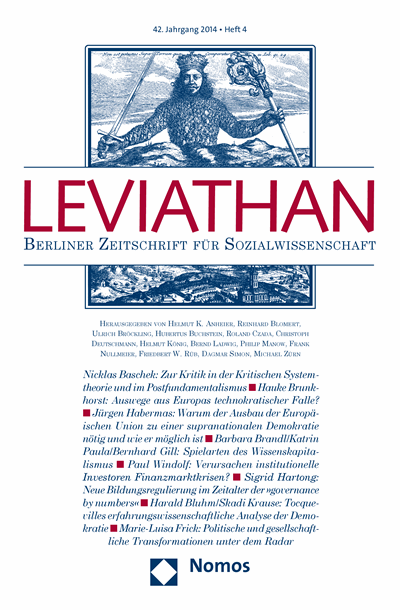
Leviathan
Jahrgang 42 (2014), Heft 4
- Autor:innen:
- Verlag
- Nomos, Baden-Baden
- Copyrightjahr
- 2014
- ISSN-Online
- 1861-8588
- ISSN-Print
- 0340-0425
Kapitelinformationen
Vollzugriff
Jahrgang 42 (2014), Heft 4
Politische und gesellschaftliche Transformationen unter dem Radar: Ein Irrlicht namens »Arabischer Frühling«
- Autor:innen:
- ISSN-Print
- 0340-0425
- ISSN-Online
- 1861-8588
- Kapitelvorschau:
Der „Arabische Frühling“ zeigt, wie schwer es sein kann, „oberflächliche“ Phänomene wie Demonstrationen und Aufstände zu tiefreichenden politischen und gesellschaftlichen Transformationen in Beziehung zu setzen. Hintergrundannahmen, Erwartungshaltungen sowie prekäre Begriffsschablonen verhinderten gelungene Komplexitätsbewältigung. Anhand der Beispiele Ägypten und Syrien werden Fremd- und Selbstbilder durchleuchtet und epistemische Reflexion und Sorgfalt angemahnt.
Literaturverzeichnis
Es wurden keine Treffer gefunden. Versuchen Sie einen anderen Begriff.
- Agha, Hussein; Malley, Robert 2013. „Das ist keine Revolution“, in Internationale Politik Jan/Feb 2013. https://zeitschrift-ip.dgap.org/de/ip-die-zeitschrift/archiv/jahrgang-2013/januar-februar/das-ist-keine-revolution (Zugriff vom 04.12.2013). Google Scholar öffnen DOI: 10.5771/0340-0425-2014-4-657
- Allawi, Ali A. 2009. „Islamic civilization in peril“, in Chronicle of Higher Education 55. http://chronicle.com/article/Islamic-Civilization-in-Peril/46964 (Zugriff vom 25.09.2014). Google Scholar öffnen DOI: 10.5771/0340-0425-2014-4-657
- An-Naʽim, Abdullahi Ahmed 1990. Toward an Islamic reformation. Civil liberties, human rights, and international law. New York: Syracuse University Press. Google Scholar öffnen DOI: 10.5771/0340-0425-2014-4-657
- Bank, André; Mohns, Erik 2013. „Die syrische Revolte. Protestdynamik, Regimerepression und Internationalisierung“, in Arabellions. Zur Vielfalt von Protest und Revolte im Nahen Osten und Nordafrika, hrsg. v. Jünemann, Annette; Zorob, Anja, S. 95-105. Wiesbaden: Springer VS. Google Scholar öffnen DOI: 10.5771/0340-0425-2014-4-657
- BBC 2012. „Comparison of Egypt’s suspended and draft constitution“, in BBC News vom 30. November 2012. www.bbc.com/news/world-middle-east-20555478 <http://www.bbc.com/news/world-middle-east-20555478> (Zugriff vom 20.01.2013). Google Scholar öffnen DOI: 10.5771/0340-0425-2014-4-657
- Beck, Martin; Hüser, Simone 2013. „Politischer Wandel im Nahen Osten. Versuch einer Analyse des ‚Arabischen Frühlings‘“, in Arabellions. Zur Vielfalt von Protest und Revolte im Nahen Osten und Nordafrika, hrsg. v. Jünemann, Annette; Zorob, Anja, S. 197-227. Wiesbaden: Springer VS. Google Scholar öffnen DOI: 10.5771/0340-0425-2014-4-657
- Bergmann, Kristina 2012. Tausendundeine Revolution. Ägypten im Umbruch. Basel: Lenos. Google Scholar öffnen DOI: 10.5771/0340-0425-2014-4-657
- Bøås, Morten; Torheim, Liv Elin 2103. „The trouble in Mali - corruption, collusion, resistance“, in Third World Quarterly 34, 7, S. 1279-1292. Google Scholar öffnen DOI: 10.5771/0340-0425-2014-4-657
- Bowie, Nile 2012. Geopolitical destabilization and regional war: the road to Teheran goes through Damascus. www.globalresearch.ca/geopolitical-destabilization-and-regional-war-the-road-to-tehran-goes-through-damascus/29285 <http://www.globalresearch.ca/geopolitical-destabilization-and-regional-war-the-road-to-tehran-goes-through-damascus/29285> (Zugriff vom 08.12.2013). Google Scholar öffnen DOI: 10.5771/0340-0425-2014-4-657
- Brill, Heinz 2013. „Die neue geopolitische Rolle der Türkei“, in Österreichische Militärische Zeitschrift 4, S. 406-415. Google Scholar öffnen DOI: 10.5771/0340-0425-2014-4-657
- Camus, Albert 1961 [1951]. Der Mensch in der Revolte. Reinbek bei Hamburg: Rowohlt. Google Scholar öffnen DOI: 10.5771/0340-0425-2014-4-657
- Commins, David 2009. The Wahhabi mission and Saudi Arabia. London: I.B. Tauris. Google Scholar öffnen DOI: 10.5771/0340-0425-2014-4-657
- Darke, Diane 2014. My house in Damascus. An inside view of the Syrian revolution. London: Haus Publishing. Google Scholar öffnen DOI: 10.5771/0340-0425-2014-4-657
- Dorsey, James M. 2013. „The struggle for Egypt: Saudi Arabia’s regional role“, in Huffingtonpost vom 16. Juli 2013. Google Scholar öffnen DOI: 10.5771/0340-0425-2014-4-657
- Egypt Independent 2012. „Egypt’s draft constitution translated“, in Egypt Independent vom 2. Dezember 2012. Google Scholar öffnen DOI: 10.5771/0340-0425-2014-4-657
- El Fadl, Khaled Abou 2004. Islam and the challenge of democracy. Princeton: Princeton University Press. Google Scholar öffnen DOI: 10.5771/0340-0425-2014-4-657
- Esposito, John L. 2010. „Contemporary Islam: reformation or revolution“, in Comparative political theory, hrsg. v. Dallmayr, Fred, S. 71-83. New York: Palgrave. Google Scholar öffnen DOI: 10.5771/0340-0425-2014-4-657
- Frick, Marie-Luisa; Oberprantacher, Andreas 2011. „Shared is not yet sharing, or: what makes social network services public?“, in International Review of Information Ethics 15, S. 18-23. Google Scholar öffnen DOI: 10.5771/0340-0425-2014-4-657
- Fukuyama, Francis 2006. The end of history and the last man. New York: Free Press. Google Scholar öffnen DOI: 10.5771/0340-0425-2014-4-657
- Gadamer, Hans-Georg 1975 [1960]. Wahrheit und Methode. Grundzüge einer philosophischen Hermeneutik. Tübingen: Mohr Siebeck. Google Scholar öffnen DOI: 10.5771/0340-0425-2014-4-657
- Gersh, Alain 2012. „Die Golfstaaten und die Muslimbrüder - Ende einer Freundschaft“, in Le Monde Diplomatique vom 9. November 2012. www.monde-diplomatique.de/pm/2012/11/09.mondeText.artikel,a0039.idx,10 <http://www.monde-diplomatique.de/pm/2012/11/09.mondeText.artikel,a0039.idx,10> (Zugriff vom 2.6.2013) Google Scholar öffnen DOI: 10.5771/0340-0425-2014-4-657
- Gouges, Marie Olympe de 1791. Déclaration des droits de la femme et de la citoyenne. Paris. Google Scholar öffnen DOI: 10.5771/0340-0425-2014-4-657
- Harders, Cilja 2013. „Revolution I und II - Ägypten zwischen Transformation und Restauration“, in Arabellions. Zur Vielfalt von Protest und Revolte im Nahen Osten und Nordafrika, hrsg. v. Jünemann, Annette; Zorob, Anja, S. 19-42. Wiesbaden: Springer VS. Google Scholar öffnen DOI: 10.5771/0340-0425-2014-4-657
- Harnischfeger, Johannes 2012. „Rivalität unter Eliten. Der Boko-Haram-Aufstand in Nigeria“, in Leviathan 40, 4, S. 491-516. Google Scholar öffnen DOI: 10.5771/0340-0425-2014-4-657
- Harrer, Gudrun 2012. „Zwischen arabischem Frühling und saudi-arabischem Winter“, in Österreichische Zeitschrift für Politikwissenschaft 41, 1, S. 85-93. Google Scholar öffnen DOI: 10.5771/0340-0425-2014-4-657
- Heinsohn, Gunnar 2008. Söhne und Weltmacht. Terror im Aufstieg und Fall der Nationen. München: Piper. Google Scholar öffnen DOI: 10.5771/0340-0425-2014-4-657
- Hersh, Seymour M. 2007. „The redirection. Is the administration’s new policy benefiting our enemies in the war on terrorism?“, in The New Yorker vom 5. März 2007. Google Scholar öffnen DOI: 10.5771/0340-0425-2014-4-657
- Human Rights Watch 2014. Egypt: Rabʼa killings likely crimes against humanity. www.hrw.org/news/2014/08/12/egypt-rab-killings-likely-crimes-against-humanity <http://www.hrw.org/news/2014/08/12/egypt-rab-killings-likely-crimes-against-humanity> (Zugriff vom 18.08.2014) Google Scholar öffnen DOI: 10.5771/0340-0425-2014-4-657
- Husserl, Edmund 1992 [1913]. Ideen zu einer reinen Phänomenologie und phänomenologischen Philosophie. Gesammelte Schriften 5. Hamburg: Felix Meiner. Google Scholar öffnen DOI: 10.5771/0340-0425-2014-4-657
- Jones, Jonathan 2011. „Tahrir square aflame: the visual basis of an imaginary revolution“, in The Guardian vom 9. Dezember 2011. Google Scholar öffnen DOI: 10.5771/0340-0425-2014-4-657
- Köchler, Hans 2009 a. „The global war on terror and the metaphysical enemy“, in Hans Köchler: World order - vision and reality, hrsg. v. Armstrong, David, Kapitel 5. New Dehli: IPO/Manak. Google Scholar öffnen DOI: 10.5771/0340-0425-2014-4-657
- Köchler, Hans 2009 b. „The ‚clash of civilizations‘, the problem of terrorism and strategies towards peaceful co-existence among nations“, in Hans Köchler: World order - vision and reality, hrsg. v. Armstrong, David, Kapitel 31. New Dehli: IPO/Manak. Google Scholar öffnen DOI: 10.5771/0340-0425-2014-4-657
- Köchler, Hans 2014. „The middle east in the emerging global order“, in People’s Friendship University of Russia Bulletin on International Relations 3 (im Erscheinen). Google Scholar öffnen DOI: 10.5771/0340-0425-2014-4-657
- Krämer, Gudrun 1986. Ägypten unter Mubarak: Identität und nationales Interesse. Baden-Baden: Nomos. Google Scholar öffnen DOI: 10.5771/0340-0425-2014-4-657
- Krämer, Gudrun 2011. Demokratie im Islam. Der Kampf für Toleranz und Freiheit in der arabischen Welt. München: C. H. Beck. Google Scholar öffnen DOI: 10.5771/0340-0425-2014-4-657
- Krämer, Gudrun 2013. „Modern but not secular: religion, identity and the ordre public in the Arab Middle East“, in International Sociology 28, 6, S. 629-644. Google Scholar öffnen DOI: 10.5771/0340-0425-2014-4-657
- Lübben, Ivesa 2013. „Welche Rolle für den Islam? Die Herausbildung eines islamischen Parteienspektrums im post-revolutionären Ägypten - Eine Annäherung“, in Arabellions. Zur Vielfalt von Protest und Revolte im Nahen Osten und Nordafrika, hrsg. v. Jünemann, Annette; Zorob, Anja, S. 279-305. Wiesbaden: Springer VS. Google Scholar öffnen DOI: 10.5771/0340-0425-2014-4-657
- Matzken, Heino 2013. „Muslimbrüder als Alternative im Nahen Osten?“, in Österreichische Militärische Zeitschrift 1, S. 60-64. Google Scholar öffnen DOI: 10.5771/0340-0425-2014-4-657
- Merkel, Reinhard 2013. „Der Westen ist schuldig“, in Frankfurter Allgemeine Zeitung vom 2. August 2013. Google Scholar öffnen DOI: 10.5771/0340-0425-2014-4-657
- Mernissi, Fatima 2002. Islam und Demokratie. Die Angst vor der Moderne. Freiburg: Herder. Google Scholar öffnen DOI: 10.5771/0340-0425-2014-4-657
- Muzaffar, Chandra 2013. „A nation bleeds“, in JUST Commentary vom 26. August 2013. Google Scholar öffnen DOI: 10.5771/0340-0425-2014-4-657
- Neumann, Peter 2014. „Suspects into collaborators“, in London Review of Books 36, 7, S. 19-21. Google Scholar öffnen DOI: 10.5771/0340-0425-2014-4-657
- Oba, Abdulmumini A. 2013. „New muslim perspectives in the human rights debate“, in Islam and international law. Engaging self-centrism from a plurality of perspectives, hrsg. v. Frick, Marie-Luisa; Müller, Andreas T., S. 219-243. Leiden: Brill. Google Scholar öffnen DOI: 10.5771/0340-0425-2014-4-657
- Ouaissa, Rachid 2013. „Blockierte Mittelschichten als Motor der Veränderungen in der arabischen Welt?“, in Arabellions. Zur Vielfalt von Protest und Revolte im Nahen Osten und Nordafrika, hrsg. v. Jünemann, Annette; Zorob, Anja, S. 257-277. Wiesbaden: Springer VS. Google Scholar öffnen DOI: 10.5771/0340-0425-2014-4-657
- Pabst, Martin 2013. „Ist Algerien immun gegenüber dem arabischen Umbruch?“, in Österreichische Militärische Zeitschrift 4, S. 396-405. Google Scholar öffnen DOI: 10.5771/0340-0425-2014-4-657
- Phares, Walid 2008. The confrontation. Winning the war against future jihad. New York: Palgrave Macmillan. Google Scholar öffnen DOI: 10.5771/0340-0425-2014-4-657
- Preysing, Domenica 2013. „Tunesien: Vorreiter des Aufbruchs, Vorbild des Westens“, in Arabellions. Zur Vielfalt von Protest und Revolte im Nahen Osten und Nordafrika, hrsg. v. Jünemann, Annette; Zorob, Anja, S. 43-66. Wiesbaden: Springer VS. Google Scholar öffnen DOI: 10.5771/0340-0425-2014-4-657
- Ramsauer, Petra 2012. Mit Allah an die Macht. Wien: Ueberreuter. Google Scholar öffnen DOI: 10.5771/0340-0425-2014-4-657
- Roberts, Hugh 2013. „Ägypten ohne Revolution“, in Lettre International 102, S. 34-43. Google Scholar öffnen DOI: 10.5771/0340-0425-2014-4-657
- Roll, Stephan 2013. „Ist Mursi wirklich so schlimm?“, in DIE ZEIT vom 30. Januar 2013. Google Scholar öffnen DOI: 10.5771/0340-0425-2014-4-657
- Rosiny, Stephan 2013. „Diktaturen, Bürgerkriege und Machtteilung in fragmentierten Gesellschaften“, in Der Arabische Frühling. Hintergründe und Analysen, hrsg. v. Schneiders, Thorsten G., S. 65-79. Wiesbaden: Springer VS. Google Scholar öffnen DOI: 10.5771/0340-0425-2014-4-657
- Schwedler, Jillian 2011. „Can islamists become moderates? Rethinking the inclusion-moderation hypothesis“, in World Politics 63, 2, S. 347-376. Google Scholar öffnen DOI: 10.5771/0340-0425-2014-4-657
- Schwedler, Jillian 2013. „Spatial dynamics of the arab uprisings“, in Political Science et Politics 46, 2, S. 230-234. Google Scholar öffnen DOI: 10.5771/0340-0425-2014-4-657
- Skelton, Rose 2013. „Mali: religious schisms threaten ideological war“, in The Africa Report, April 2013. www.theafricareport.com/West-Africa/mali-religious-schisms-threaten-ideological-war.html (Zugriff vom 25.09.2014). Google Scholar öffnen DOI: 10.5771/0340-0425-2014-4-657
- Soroush, Abdolkarim 2000. Reason, freedom, and democracy in Islam. Essential writings of Abdolkarim Soroush. Oxford: Oxford University Press. Google Scholar öffnen DOI: 10.5771/0340-0425-2014-4-657
- Spindel, Chad 2011. „The people want to topple the regime: exploring the Arab spring in Egypt, Syria, and Jordan“, in Sage Open 1, 3, S. 1-7. Google Scholar öffnen DOI: 10.5771/0340-0425-2014-4-657
- Sternberg, Troy 2012. „Chinese draught, bread and the Arab spring“, in Applied Geography 34, S. 519-524. Google Scholar öffnen DOI: 10.5771/0340-0425-2014-4-657
- The Independent 2013. „UN’s Carla del Ponte says there is evidence ‚rebels may have used sarin‘ in Syria“, in The Independent vom 6. Mai 2013. Google Scholar öffnen DOI: 10.5771/0340-0425-2014-4-657
- Thumann, Michael 2013. „Islamismus: Die Köpfe des radikalen Islam“, in DIE ZEIT vom 24. Januar 2013. Google Scholar öffnen DOI: 10.5771/0340-0425-2014-4-657
- UN 2005. Eliminating femal genital mutilation. An interagency statement. www.un.org/womenwatch/daw/csw/csw52/statements_missions/Interagency_Statement_on_Eliminating_FGM.pdf <http://www.un.org/womenwatch/daw/csw/csw52/statements_missions/Interagency_Statement_on_Eliminating_FGM.pdf> (Zugriff vom 10.12.2013). Google Scholar öffnen DOI: 10.5771/0340-0425-2014-4-657
- Walzer, Michael 2014. „After the Arab spring“, in Philosophy et Social Criticism 40, 4-5, S. 421-429. Google Scholar öffnen DOI: 10.5771/0340-0425-2014-4-657
- Wehrey, Frederic, Bishop, David; Alrababa’h, Ala’ 2014. Backdrop to an intervention. Sources of Egyptian-Libyan border tensions. <http://carnegieendowment.org/2014/08/27/backdrop-to-intervention-sources-of-egyptian-libyan-border-tension/hmdk> (Zugriff vom 08.09.2014). Google Scholar öffnen DOI: 10.5771/0340-0425-2014-4-657
- Wolfsfeld, Gadi et al. 2013. „Social media and the Arab spring: politics comes first“, in The International Journal of Press/Politics 18, 2, S. 115-137. Google Scholar öffnen DOI: 10.5771/0340-0425-2014-4-657
- Zimmermann, Ekkart 2013. „Der ‚Arabische‘ Frühling in vergleichender Revolutionsanalyse“, in Zeitschrift für Friedens- und Konfliktforschung 2, S. 209-245. Google Scholar öffnen DOI: 10.5771/0340-0425-2014-4-657
