Cover der Ausgabe: JEEMS Journal of East European Management Studies Jahrgang 26 (2021), Heft 1
Ausgabe Open Access Vollzugriff

Jahrgang 26 (2021), Heft 1

JEEMS Journal of East European Management Studies
Autor:innen:
Zeitschrift:
JEEMS Journal of East European Management Studies
Verlag:
 2021

Publikation durchsuchen


Bibliographische Angaben

ISSN-Print
0949-6181
ISSN-Online
1862-0019
Verlag
Nomos, Baden-Baden
Sprache
Englisch
Produkttyp
Ausgabe

Artikel

Cover der Ausgabe: JEEMS Journal of East European Management Studies Jahrgang 26 (2021), Heft 1
Artikel
Kein Zugriff

Seite 1 - 3
Nomos Verlagsgesellschaft mbH & Co. KG, Baden-Baden 2021

Cover der Ausgabe: JEEMS Journal of East European Management Studies Jahrgang 26 (2021), Heft 1
Artikel
Vollzugriff

Seite 4 - 6
Nomos Verlagsgesellschaft mbH & Co. KG, Baden-Baden 2021

Cover der Ausgabe: JEEMS Journal of East European Management Studies Jahrgang 26 (2021), Heft 1
Artikel
Vollzugriff

Seite 7 - 9
Nomos Verlagsgesellschaft mbH & Co. KG, Baden-Baden 2021

Cover der Ausgabe: JEEMS Journal of East European Management Studies Jahrgang 26 (2021), Heft 1
Artikel
Vollzugriff

Seite 10 - 43
Nomos Verlagsgesellschaft mbH & Co. KG, Baden-Baden 2021
Autor:innen:

Cover der Ausgabe: JEEMS Journal of East European Management Studies Jahrgang 26 (2021), Heft 1
Artikel
Kein Zugriff

Seite 44 - 72
Nomos Verlagsgesellschaft mbH & Co. KG, Baden-Baden 2021
Autor:innen:

Cover der Ausgabe: JEEMS Journal of East European Management Studies Jahrgang 26 (2021), Heft 1
Artikel
Kein Zugriff

Seite 73 - 99
The definition of a successful company is not uniform in the scientific literature, and the determinants of a company’s success can vary from one business sector to another. Based on a study of 16 Czech engineering companies, this paper defines...
Nomos Verlagsgesellschaft mbH & Co. KG, Baden-Baden 2021
Autor:innen:

Cover der Ausgabe: JEEMS Journal of East European Management Studies Jahrgang 26 (2021), Heft 1
Artikel
Kein Zugriff

Seite 100 - 116
Nomos Verlagsgesellschaft mbH & Co. KG, Baden-Baden 2021
Autor:innen:

Cover der Ausgabe: JEEMS Journal of East European Management Studies Jahrgang 26 (2021), Heft 1
Artikel
Kein Zugriff

Seite 117 - 146
Nomos Verlagsgesellschaft mbH & Co. KG, Baden-Baden 2021
Autor:innen:

Cover der Ausgabe: JEEMS Journal of East European Management Studies Jahrgang 26 (2021), Heft 1
Artikel
Kein Zugriff

Seite 147 - 176
Nomos Verlagsgesellschaft mbH & Co. KG, Baden-Baden 2021
Autor:innen:

Cover der Ausgabe: JEEMS Journal of East European Management Studies Jahrgang 26 (2021), Heft 1
Artikel
Kein Zugriff

Seite 177 - 190
Nomos Verlagsgesellschaft mbH & Co. KG, Baden-Baden 2021
Autor:innen:

Literaturverzeichnis (544 Einträge)

  1. Mulry-Liggan, M. H. (1983): A comparison of a random digit dialing survey and the current population survey, in: Survey Research Methods, 214–219. Google Scholar öffnen doi.org/10.5771/0949-6181-2021-1-177
  2. WEF. (2016): The Future of Jobs: Annual Report, Geneva: World Economic Forum. Google Scholar öffnen doi.org/10.5771/0949-6181-2021-1-177
  3. Wachenheim C.J./Lesch W.C. (2002): Assessing New-Graduate Applicants: Academic Perceptions and Agribusiness Realities, in: Journal of Agribusiness, 20(2), 163–173. Google Scholar öffnen doi.org/10.5771/0949-6181-2021-1-177
  4. Urutyan,V. E./Litzenberg, K. (2010): Skills, Qualities and Experiences Needed for Future Leaders in Food and Agribusiness Industries of Armenia, in: International Food and Agribusiness Management Review, 13(3), 1–16. Google Scholar öffnen doi.org/10.5771/0949-6181-2021-1-177
  5. Thornberry, O. T. (1987): An Experimental Comparison of Telephone and Personal Health Interview Surveys, Hyattsville: US Department of Health and Human Services, Public Health Service, National Center for Health Statistics. Google Scholar öffnen doi.org/10.5771/0949-6181-2021-1-177
  6. Thomas, R./Wood, E. (2014): Innovation in tourism: Re-conceptualising and measuring the absorptive capacity of the hotel sector, in: Tourism Management, 45, 39–48. Google Scholar öffnen doi.org/10.5771/0949-6181-2021-1-177
  7. Tether, B./Mina A./Consoli D./Gagliardi D. (2005): A Literature Review on Skills and Innovation. How Does Successful Innovation Impact on the Demand for Skills and How Do Skills Drive Innovation? : ESRC Centre for Research on Innovation and Competition, University of Manchester. Google Scholar öffnen doi.org/10.5771/0949-6181-2021-1-177
  8. Tajeddini, K./Trueman, M. (2012): Managing Swiss Hospitality: How cultural antecedents of innovation and customer-oriented value systems can influence performance in the hotel industry, in: International Journal of Hospitality Management, 31, 1119- 1129. Google Scholar öffnen doi.org/10.5771/0949-6181-2021-1-177
  9. Tajeddini, K. (2010): Effect of customer orientation and entrepreneurial orientation on innovativeness: evidence from the hotel industry in Switzerland, in: Tourism Management, 31, 221–231. Google Scholar öffnen doi.org/10.5771/0949-6181-2021-1-177
  10. Roscoe, J.T. (1975): Fundamental Research Statistics for the Behavioral Science, in: International Series in Decision Process. 2nd Ed: Holt, Rinehart and Winston, Inc., New York. Google Scholar öffnen doi.org/10.5771/0949-6181-2021-1-177
  11. Pfeffer, J. (1994): Competitive advantage through people: Unleashing the power of the workforce: Harvard Business School Press, Boston. Google Scholar öffnen doi.org/10.5771/0949-6181-2021-1-177
  12. OECD. (2011): Skills for Innovation and Research: OECD Publishing. Google Scholar öffnen doi.org/10.5771/0949-6181-2021-1-177
  13. Nunnally, J. C. (1978): Psychometric theory. 2nd Ed: Mcgraw-Hill. Google Scholar öffnen doi.org/10.5771/0949-6181-2021-1-177
  14. Noel, J./ Qenani, E. (2013): New Age, New Learners, New Skills: What Skills Do Agribusiness Graduates Need to Succeed in the Knowledge Economy, in: International Food and Agribusiness Management Review, 16(3), 17–36. Google Scholar öffnen doi.org/10.5771/0949-6181-2021-1-177
  15. Domi, S./Capelleras, J.L./Musabelliu, B. (2020): Customer orientation and SME performance in Albania: A case study of the mediating role of innovativeness and innovation behavior, in: Journal of Vacation Marketing, 26(1), 130–146. Google Scholar öffnen doi.org/10.5771/0949-6181-2021-1-177
  16. Litzenberg, K.K./Schneider V.E. (1987): Competencies and Qualities of Agricultural Economics Graduates Sought by Agribusiness Employers, in: American Journal of Agricultural Economics. 69(5), 1031–1036. Google Scholar öffnen doi.org/10.5771/0949-6181-2021-1-177
  17. Leoni, R. (2014): Graduate employability and the development of competencies. The incomplete reform of the “Bologna process”, in: International Journal of Manpower, 35(4), 448–469. Google Scholar öffnen doi.org/10.5771/0949-6181-2021-1-177
  18. Lans, T./Bergevoet, R./ Mulder, M./Van Woerkum, C. (2005): Identification and measurement of competences of entrepreneurs in agribusiness: Selected papers from the 8th Ph.D, in: Conference on Business Economics, Management and Organization Science, PREBEM/NOBEM, Enschede, 81–95. Google Scholar öffnen doi.org/10.5771/0949-6181-2021-1-177
  19. Lans, T./Wesselink, R./Biemans, H.J.A./Mulder, M. (2004): Work-related lifelong learning for entrepreneurs in the agri-food sector, in: International Journal of Training and Development, 8(1), 72–88. https://doi.org/10.1111/j.1360-3736.2004.00197.x. Google Scholar öffnen doi.org/10.5771/0949-6181-2021-1-177
  20. Kaiser, H. F. (1974): An index of factorial simplicity, in: Psychometrika, 39, 31–36. Google Scholar öffnen doi.org/10.5771/0949-6181-2021-1-177
  21. Ionescu, A. M./Cuza, A. I. (2012): How does education affect labour market outcomes, in: Review of Applied Socio-Economic Research, 4(2), 130–144. Google Scholar öffnen doi.org/10.5771/0949-6181-2021-1-177
  22. IDM. (2016): Agriculture and Agro-Processing, Skills for Jobs: Final Report, by the Institute for Democracy and Mediation, Albania. Google Scholar öffnen doi.org/10.5771/0949-6181-2021-1-177
  23. Holt R./Winsto.Sin, M./Alan, B./Tse, V., Heung, S./Yim, K. (2005): An analysis of the relationship between market orientation and business performance in the hotel industry, in: International Journal of Hospitality Management, 24(4), 555–577. Google Scholar öffnen doi.org/10.5771/0949-6181-2021-1-177
  24. Field, A. (2009): Discovering Statistics Using SPSS: 3rd Ed, London: SAGE Publications Ltd. Google Scholar öffnen doi.org/10.5771/0949-6181-2021-1-177
  25. Esposto, A. (2008): Skill: An Elusive and Ambiguous Concept in Labor Market Studies, in: Australian Bulletin of Labour, 34(1), 100–124. Google Scholar öffnen doi.org/10.5771/0949-6181-2021-1-177
  26. Dooley, F.J./Fulton, J.R. (1999): The State of Agribusiness Teaching, Research, and Extension at the Turn of the Millennium, in: American Journal Agricultural Economics, 81(5), 1042–1049, https://doi.org/10.2307/1244081. Google Scholar öffnen doi.org/10.5771/0949-6181-2021-1-177
  27. Domi, S./Keco, R./Capelleras, J.L./Mehmeti, G. (2019): Effects of innovativeness and innovation behavior on tourism SMEs performance: The case of Albania, in: Economics & Sociology, 12(3), 67–85. Google Scholar öffnen doi.org/10.5771/0949-6181-2021-1-177
  28. Aaker, J./Fournier, S./Brasel, S. A. (2004): When good brands do bad, in: Journal of Consumer Research, 31, 1, 1-16. Google Scholar öffnen doi.org/10.5771/0949-6181-2021-1-10
  29. AKOS, Communications Networks and Services Agency of the Republic of Slovenia. (2018). Poročilo o razvoju trga elektronskih komunikacij za četrto četrtletje 2017. Retreived on June 24th of 2018 from https://www.akos-rs.si/files/Telekomunikacije/Porocila_in_raziskave/Cetrtletna_porocila/2017/Cetrtletno-porocilo-Q4-2017.pdf Google Scholar öffnen doi.org/10.5771/0949-6181-2021-1-10
  30. Allen, A. M./Brady, M. K./Robinson, S. G./Voorhees, C. M. (2015): One firm’s loss is another’s gain: capitalizing on other firms’ service failures, in: Journal of the Academy of Marketing Science, 43, 5, 648-662. Google Scholar öffnen doi.org/10.5771/0949-6181-2021-1-10
  31. Altman, I./Taylor, D. A. (1973). Social penetration: The development of interpersonal relationships Oxford, England: Holt, Rinehart & Winston. Google Scholar öffnen doi.org/10.5771/0949-6181-2021-1-10
  32. Ambrose, M./Hess, R. L./Ganesan, S. (2007): The Relationship between Justice and Attitudes: An Examination of Justice Effects on Event and System-Related Attitudes, in: Organizational Behavior and Human Decision Processes, 103, 1, 21-36. Google Scholar öffnen doi.org/10.5771/0949-6181-2021-1-10
  33. Anderson, J. C./Gerbing, D. W. (1988): Structural Equation Modeling in Practice: A Review and Recommended Two-Step Approach, in: Psychological Bulletin, 103, 3, 411-423. Google Scholar öffnen doi.org/10.5771/0949-6181-2021-1-10
  34. Andreassen, T. W. (2000): Antecedents to satisfaction with service recovery, in: European Journal of Marketing, 34, 1/2, 156-175. Google Scholar öffnen doi.org/10.5771/0949-6181-2021-1-10
  35. Andreassen, T. W. (2001): From Disgust to Delight: Do Customers Hold a Grudge?, in: Journal of Service Research, 4, 1, 39-49. Google Scholar öffnen doi.org/10.5771/0949-6181-2021-1-10
  36. Aurier, P./N’Goala, G. (2010): The differing and mediating roles of trust and relationship commitment in service relationship maintenance and development, in: Journal of the Academy of Marketing Science, 38, 3, 303-325. Google Scholar öffnen doi.org/10.5771/0949-6181-2021-1-10
  37. Babin, B. J./Griffin, M./Hair, J. F. (2016): Heresies and sacred cows in scholarly marketing publications, in: Journal of Business Research, 69, 8, 3133-3138. Google Scholar öffnen doi.org/10.5771/0949-6181-2021-1-10
  38. Bagozzi, R. P. (2011): Measurement and Meaning in Information Systems and Organizational Research: Methodological and Philosophical Foundations, in: MIS Quarterly, 35, 2, 261-292. Google Scholar öffnen doi.org/10.5771/0949-6181-2021-1-10
  39. Bagozzi, R. P./Yi, Y. (2012): Specification, evaluation, and interpretation of structural equation models, in: Journal of the Academy of Marketing Science, 40, 1, 8-34. Google Scholar öffnen doi.org/10.5771/0949-6181-2021-1-10
  40. Balaji, M. S. (2015): Investing in customer loyalty: the moderating role of relational characteristics, in: Service Business, 9, 1, 17-40. Google Scholar öffnen doi.org/10.5771/0949-6181-2021-1-10
  41. Bearden, W. O./Teel, J. E. (1983): Selected Determinants of Consumer Satisfaction and Complaint Reports, in: Journal of Marketing Research, 20, 1, 21-28. Google Scholar öffnen doi.org/10.5771/0949-6181-2021-1-10
  42. Bernerth, J. B./Aguinis, H. (2016): A Critical Review and Best-Practice Recommendations for Control Variable Usage, in: Personnel Psychology, 69, 1, 229-283. Google Scholar öffnen doi.org/10.5771/0949-6181-2021-1-10
  43. Bies, R. J./Moag, J. F. (1986). Interactional Justice: Communication Criteria of Fairness. In R. J. Lewicki, B. H. Sheppard & M. H. Bazerman (Eds.), Research on Negotiations in Organizations, (Vol. 1, pp. 43-55). Greenwich: JAI Press. Google Scholar öffnen doi.org/10.5771/0949-6181-2021-1-10
  44. Blodgett, J. G./Li, H. (2007): Assessing the Effects of Post-Purchase Dissatisfaction and Complaining Behavior on Profitability: a Monte Carlo Simulation, in: Journal of Consumer Satisfaction, Dissatisfaction & Complaining Behavior, 20, 1, 1-14. Google Scholar öffnen doi.org/10.5771/0949-6181-2021-1-10
  45. Bock, D. E./Folse., J. A. G./Black, W., C. (2016): Gratitude in service encounters: implications for building loyalty, in: Journal of Services Marketing, 30, 3, 341-358. Google Scholar öffnen doi.org/10.5771/0949-6181-2021-1-10
  46. Bodlaj, M. (2012): Do managers at two hierarchical levels differ in how they assess their company's market orientation?, in: Journal for East European Management Studies, 17, 3, 292-312. Google Scholar öffnen doi.org/10.5771/0949-6181-2021-1-10
  47. Bolton, R. N./Lemon, K. N. (1999): A Dynamic Model of Customers’ Usage of Services: Usage as an Antecedent and Consequence of Satisfaction, in: Journal of Marketing Research, 36, 2, 171-186. Google Scholar öffnen doi.org/10.5771/0949-6181-2021-1-10
  48. Bradley, G./Sparks, B. (2012): Explanations: if, when, and how they aid service recovery, in: Journal of Services Marketing, 26, 1, 41-51. Google Scholar öffnen doi.org/10.5771/0949-6181-2021-1-10
  49. Brady, M./Knight, G./Cronin, J. J./Tomas, G./Hult, M./Keillor, B. (2005): Removing the contextual lens: A multinational, multi-setting comparison of service evaluation models, in: Journal of Retailing, 81, 3, 215-230. Google Scholar öffnen doi.org/10.5771/0949-6181-2021-1-10
  50. Broetzmann, S. M. (2013). Will We Ever Learn?: The Sad State Of Customer Care In America Results From The 2013 Customer Rage (pp. 57). Alexandria: Customer Care Measurement & Consulting. Google Scholar öffnen doi.org/10.5771/0949-6181-2021-1-10
  51. Bügel, M. S./Verhoef, P. C./Buunk, A. P. (2011): Customer intimacy and commitment to relationships with firms in five different sectors: Preliminary evidence, in: Journal of Retailing and Consumer Services, 18, 4, 247-258. Google Scholar öffnen doi.org/10.5771/0949-6181-2021-1-10
  52. Byrne, B. M. (2013). Structural Equation Modeling with Mplus New York: Routledge. Google Scholar öffnen doi.org/10.5771/0949-6181-2021-1-10
  53. Cambra-Fierro, J./Melero-Polo, I./Sese, J. (2015): Does the nature of the relationship really matter? An analysis of the roles of loyalty and involvement in service recovery processes, in: Service Business, 9, 2, 297-320. Google Scholar öffnen doi.org/10.5771/0949-6181-2021-1-10
  54. Cantor, V. J. M./Li, R. C. (2018): Matching service failures and recovery options toward satisfaction, in: The Service Industries Journal, 1-24. Google Scholar öffnen doi.org/10.5771/0949-6181-2021-1-10
  55. Chan, K. W./Wan, E. W. (2012): How Can Stressed Employees Deliver Better Customer Service? The Underlying Self-Regulation Depletion Mechanism, in: Journal of Marketing, 76, 1, 119-137. Google Scholar öffnen doi.org/10.5771/0949-6181-2021-1-10
  56. Chang, H. H./Lai, M.-K./Hsu, C.-H. (2012): Recovery of online service: Perceived justice and transaction frequency, in: Computers in Human Behavior, 28, 2199-2208. Google Scholar öffnen doi.org/10.5771/0949-6181-2021-1-10
  57. Chen, W./Lee, H.-C. (2018): How to explain service failure? Impacts of justifications, in: Service Business, 12, 2, 331-356. Google Scholar öffnen doi.org/10.5771/0949-6181-2021-1-10
  58. Choi, J. (2008): Event justice perceptions and employees' reactions: Perceptions of social entity justice as a moderator, in: Journal of Applied Psychology, 93, 3, 513-528. Google Scholar öffnen doi.org/10.5771/0949-6181-2021-1-10
  59. Colquitt, J. A. (2001): On the Dimensionality of Organizational Justice: A Construct Validation of a Measure, in: Journal of Applied Psychology, 86, 3, 386-400. Google Scholar öffnen doi.org/10.5771/0949-6181-2021-1-10
  60. Colquitt, J. A./Conlon, D. E./Wesson, M. J./Porter, C. O. L. H./Ng, K. Y. (2001): Justice at the Millennium: A Meta-Analytic Review of 25 Years of Organizational Justice Research, in: Journal of Applied Psychology, 86, 3, 425-445. Google Scholar öffnen doi.org/10.5771/0949-6181-2021-1-10
  61. Colquitt, J. A./Scott, B. A./Rodell, J. B./Long, D. M./Zapata, C. P./Conlon, D. E./Wesson, M. J. (2013): Justice at the millennium, a decade later: A meta-analytic test of social exchange and affect-based perspectives, in: Journal of Applied Psychology, 98, 199-236. Google Scholar öffnen doi.org/10.5771/0949-6181-2021-1-10
  62. Conlon, D. E./Murray, N. M. (1996): Customer Perceptions of Corporate Responses to Product Complaints: The Role of Explanations, in: The Academy of Management Journal, 39, 4, 1040-1056. Google Scholar öffnen doi.org/10.5771/0949-6181-2021-1-10
  63. Cropanzano, R./Byrne, Z. S./Bobocel, D. R./Rupp, D. E. (2001): Moral virtues, fairness heuristics, social entities, and other denizens of organizational justice, in: Journal of Vocational Behavior, 58, 2, 164-209. Google Scholar öffnen doi.org/10.5771/0949-6181-2021-1-10
  64. Curtis, T./Abratt, R./Rhoades, D. L./Dion, P. (2011): Customer Loyalty, Repurchase and Satisfaction: A Meta-Analytical Review, in: Journal of Consumer Satisfaction, Dissatisfaction and Complaining Behavior, 24, 1-26. Google Scholar öffnen doi.org/10.5771/0949-6181-2021-1-10
  65. Davidow, M. (2003): Organizational Responses to Customer Complaints: What Works and What Doesn’t, in: Journal of Service Research, 5, 3, 225-250. Google Scholar öffnen doi.org/10.5771/0949-6181-2021-1-10
  66. Davidow, M. (2014): The A-Craft Model of Organizational Responses to Customer Complaints and Their Impact on Post-Complaint Customer Behavior, in: Journal of Consumer Satisfaction, Dissatisfaction & Complaining Behavior, 27, 1, 69-88. Google Scholar öffnen doi.org/10.5771/0949-6181-2021-1-10
  67. de Matos, C. A./Henrique, J. L./Rossi, C. A. V. (2007): Service Recovery Paradox: A Meta-Analysis, in: Journal of Service Research, 10, 1, 60-77. Google Scholar öffnen doi.org/10.5771/0949-6181-2021-1-10
  68. de Matos, C. A./Vieira, V. A./Veiga, R. T. (2012): Behavioural responses to service encounter involving failure and recovery: the influence of contextual factors, in: The Service Industries Journal, 32, 14, 2203-2217. Google Scholar öffnen doi.org/10.5771/0949-6181-2021-1-10
  69. del Río-Lanza, A. B./Vázquez-Casielles, R./Díaz-Martín, A. M. (2009): Satisfaction with service recovery: Perceived justice and emotional responses, in: Journal of Business Research, 62, 8, 775-781. Google Scholar öffnen doi.org/10.5771/0949-6181-2021-1-10
  70. Dwyer, F. R./Schurr, P. H./Oh, S. (1987): Developing Buyer-Seller Relationships, in: Journal of Marketing, 51, 2, 11-27. Google Scholar öffnen doi.org/10.5771/0949-6181-2021-1-10
  71. Estelami, H. (2000): Competitive and Procedural Determinants of Delight and Disappointment in Consumer Complaint Outcomes, in: Journal of Service Research, 2, 3, 285-300. Google Scholar öffnen doi.org/10.5771/0949-6181-2021-1-10
  72. European Commission. (2009). Consumer Redress in the EU: Consumer Experiences, Perceptions and Choices. Retreived on May 13th 2018 from http://aplicacio.consum.gencat.cat/doc/doc_80769222_1.pdf Google Scholar öffnen doi.org/10.5771/0949-6181-2021-1-10
  73. European Commission. (2017). Consumer conditions scoreboard: consumers at home in the single market – 2017 edition. Retreived on May 13h 2018 from https://ec.europa.eu/info/sites/info/files/consumer-conditions-scoreboard-2017-edition_en.pdf Google Scholar öffnen doi.org/10.5771/0949-6181-2021-1-10
  74. European Commission. (2018). 2018 Consumer Markets Scoreboard: trust of Europeans in services still needs improvement. Google Scholar öffnen doi.org/10.5771/0949-6181-2021-1-10
  75. European Commission. (2019). Consumers' attitudes towards cross-border trade and consumer protection 2018. Retreived on May 26th 2019 from https://ec.europa.eu/info/sites/info/files/consumer_survey_2018_main_report.pdf Google Scholar öffnen doi.org/10.5771/0949-6181-2021-1-10
  76. Fatima, J. K./Di Mascio, R. (2018): Reversing the dependency-trust relationship in B2C services, in: Journal of Retailing and Consumer Services, 41, 1-10. Google Scholar öffnen doi.org/10.5771/0949-6181-2021-1-10
  77. Fornell, C. (1981): Increasing the Organizational Influence of Corporate Consumer Affairs Departments, in: The Journal of Consumer Affairs, 15, 2, 191-213. Google Scholar öffnen doi.org/10.5771/0949-6181-2021-1-10
  78. Fornell, C./Wernerfelt, B. (1987): Defensive Marketing Strategy by Customer Complaint Management: A Theoretical Analysis, in: Journal of Marketing Research, 24, 3, 337-346. Google Scholar öffnen doi.org/10.5771/0949-6181-2021-1-10
  79. Fornell, C./Wernerfelt, B. (1988): A Model for Customer Complaint Management, in: Marketing Science, 7, 3, 287-298. Google Scholar öffnen doi.org/10.5771/0949-6181-2021-1-10
  80. Garín-Muñoz, T./Pérez-Amaral, T./Gijón, C./López, R. (2016): Consumer complaint behaviour in telecommunications: The case of mobile phone users in Spain, in: Telecommunications Policy, 40, 8, 804-820. Google Scholar öffnen doi.org/10.5771/0949-6181-2021-1-10
  81. Gelbrich, K./Roschk, H. (2011): A Meta-Analysis of Organizational Complaint Handling and Customer Responses, in: Journal of Service Research, 14, 1, 24-43. Google Scholar öffnen doi.org/10.5771/0949-6181-2021-1-10
  82. Gohary, A./Hamzelu, B./Alizadeh, H. (2016): Please explain why it happened! How perceived justice and customer involvement affect post co-recovery evaluations: A study of Iranian online shoppers, in: Journal of Retailing and Consumer Services, 31, 127-142. Google Scholar öffnen doi.org/10.5771/0949-6181-2021-1-10
  83. Goodwin, C./Ross, I. (1992): Consumer responses to service failures: Influence of procedural and interactional fairness perceptions, in: Journal of Business Research, 25, 2, 149-163. Google Scholar öffnen doi.org/10.5771/0949-6181-2021-1-10
  84. Grainer, M./Noble, C. H./Bitner, M. J./Broetzmann, S. M. (2014): What Unhappy Customers Want, in: MIT Sloan Management Review, 55, 3, 31-35. Google Scholar öffnen doi.org/10.5771/0949-6181-2021-1-10
  85. Greenberg, J. (1993). The social side of fairness: Interpersonal and informational classes of organizational justice. In R. S. Cropanzano (Ed.), Justice in the workplace: Approaching fairness in human resource management. (pp. 79-103). Hillsdale: Erlbaum. Google Scholar öffnen doi.org/10.5771/0949-6181-2021-1-10
  86. Grégoire, Y./Tripp, T. M./Legoux, R. (2009): When Customer Love Turns into Lasting Hate:The Effects of Relationship Strength and Time on Customer Revenge and Avoidance, in: Journal of Marketing, 73, 6, 18-32. Google Scholar öffnen doi.org/10.5771/0949-6181-2021-1-10
  87. Grewal, D./Roggeveen, A./Tsiros, M. (2008): The Effect of Compensation on Repurchase Intentions in Service Recovery, in: Journal of Retailing, 84, 4, 424-434. Google Scholar öffnen doi.org/10.5771/0949-6181-2021-1-10
  88. Gruber, T./Szmigin, I./Voss, R. (2009): Developing a deeper understanding of the attributes of effective customer contact employees in personal complaint‐handling encounters, in: Journal of Services Marketing, 23, 6, 422-435. Google Scholar öffnen doi.org/10.5771/0949-6181-2021-1-10
  89. Hair, J. F./Black, W. C./Babin, B. J./Anderson, R. E. (2014). Multivariate Data Analysis (7th ed.) Harlow: Pearson. Google Scholar öffnen doi.org/10.5771/0949-6181-2021-1-10
  90. Hart, C. W. L./Heskett, J. L./Sasser, W. E. (1990): The Profitable Art of Service Recovery, in: Harvard Business Review, 68, 4, 148-156. Google Scholar öffnen doi.org/10.5771/0949-6181-2021-1-10
  91. Hess, R. L./Ganesan, S./Klein, N. M. (2003): Service Failure and Recovery: The Impact of Relationship Factors on Customer Satisfaction, in: Journal of the Academy of Marketing Science, 31, 2, 127. Google Scholar öffnen doi.org/10.5771/0949-6181-2021-1-10
  92. Hofstede Insights. (2020). Slovenia. Retrieved on December 19th 2020 from https://www.hofstede-insights.com/country/slovenia/. Google Scholar öffnen doi.org/10.5771/0949-6181-2021-1-10
  93. Homans, G. C. (1958): Social Behavior as Exchange, in: American Journal of Sociology, 63, 6, 597-606. Google Scholar öffnen doi.org/10.5771/0949-6181-2021-1-10
  94. Homburg, C./Fürst, A. (2005): How Organizational Complaint Handling Drives Customer Loyalty: An Analysis of the Mechanistic and the Organic Approach, in: Journal of Marketing, 69, 3, 95-114. Google Scholar öffnen doi.org/10.5771/0949-6181-2021-1-10
  95. Homburg, C./Fürst, A. (2007): See no evil, hear no evil, speak no evil: a study of defensive organizational behavior towards customer complaints, in: Journal of the Academy of Marketing Science, 35, 4, 523-536. Google Scholar öffnen doi.org/10.5771/0949-6181-2021-1-10
  96. Homburg, C./Koschate, N./Hoyer, W. D. (2005): Do Satisfied Customers Really Pay More? A Study of the Relationship Between Customer Satisfaction and Willingness to Pay, in: Journal of Marketing, 69, 2, 84-96. Google Scholar öffnen doi.org/10.5771/0949-6181-2021-1-10
  97. Hsiao, Y.-H./Chen, L.-F./Choy, Y. L./Su, C.-T. (2016): A novel framework for customer complaint management, in: The Service Industries Journal, 36, 13-14, 675-698. Google Scholar öffnen doi.org/10.5771/0949-6181-2021-1-10
  98. Hu, L. t./Bentler, P. M. (1999): Cutoff criteria for fit indexes in covariance structure analysis: Conventional criteria versus new alternatives, in: Structural Equation Modeling: A Multidisciplinary Journal, 6, 1, 1-55. Google Scholar öffnen doi.org/10.5771/0949-6181-2021-1-10
  99. Jones, M. A./Suh, J. (2000): Transaction‐specific satisfaction and overall satisfaction: an empirical analysis, in: Journal of Services Marketing, 14, 2, 147-159. Google Scholar öffnen doi.org/10.5771/0949-6181-2021-1-10
  100. Karatepe, O. M. (2006): Customer complaints and organizational responses: the effects of complainants’ perceptions of justice on satisfaction and loyalty, in: International Journal of Hospitality Management, 25, 1, 69-90. Google Scholar öffnen doi.org/10.5771/0949-6181-2021-1-10
  101. Keaveney, S. M. (1995): Customer Switching Behavior in Service Industries: An Exploratory Study, in: Journal of Marketing, 59, 2, 71-82. Google Scholar öffnen doi.org/10.5771/0949-6181-2021-1-10
  102. Keltner, D./Young, R. C./Heerey, E. A./Oemig, C./Monarch, N. D. (1998): Teasing in hierarchical and intimate relations, in: Journal of Personality and Social Psychology, 75, 5, 1231-1247. Google Scholar öffnen doi.org/10.5771/0949-6181-2021-1-10
  103. Kim, M. G./Wang, C./Mattila, A. S. (2010): The Relationship Between Consumer Complaining Behavior and Service Recovery: An Integrative Review, in: International Journal of Contemporary Hospitality Management, 22, 7, 975-991. Google Scholar öffnen doi.org/10.5771/0949-6181-2021-1-10
  104. Kim, W./Ok, C./Canter, D. D. (2012): Moderating role of a priori customer–firm relationship in service recovery situations, in: The Service Industries Journal, 32, 1, 59-82. Google Scholar öffnen doi.org/10.5771/0949-6181-2021-1-10
  105. Knox, G./Van Oest, R. (2014): Customer complaints and recovery effectiveness: A customer base approach, in: Journal of Marketing, 78, 5, 42-57. Google Scholar öffnen doi.org/10.5771/0949-6181-2021-1-10
  106. Koza, K. L./Dant, R. P. (2007): Effects of relationship climate, control mechanism, and communications on conflict resolution behavior and performance outcomes, in: Journal of Retailing, 83, 3, 279-296. Google Scholar öffnen doi.org/10.5771/0949-6181-2021-1-10
  107. Krishna, A./Dangayach, G. S./Jain, R. (2011): Service recovery: Literature review and research issues, in: Journal of Service Science Research, 3, 1, 71. Google Scholar öffnen doi.org/10.5771/0949-6181-2021-1-10
  108. La, S./Choi, B. (2012): The role of customer affection and trust in loyalty rebuilding after service failure and recovery, in: The Service Industries Journal, 32, 1, 105-125. Google Scholar öffnen doi.org/10.5771/0949-6181-2021-1-10
  109. Lapidus, R. S./Pinkerton, L. (1995): Customer Complaint Situations: An Equity Theory Perspective, in: Psychology & Marketing, 12, 2, 105-122. Google Scholar öffnen doi.org/10.5771/0949-6181-2021-1-10
  110. Lee, K./Joshi, K./Kim, Y. K. (2011): Identification of the four-factor structure of customers’ perceived fairness, in: Journal of Targeting, Measurement and Analysis for Marketing, 19, 2, 113-126. Google Scholar öffnen doi.org/10.5771/0949-6181-2021-1-10
  111. Li, C.-Y./Fang, Y.-H. (2016): How online service recovery approaches bolster recovery performance? A multi-level perspective, in: Service Business, 10, 1, 179-200. Google Scholar öffnen doi.org/10.5771/0949-6181-2021-1-10
  112. Lin, H.-H./Wang, Y.-S./Chang, L.-K. (2011): Consumer responses to online retailer's service recovery after a service failure: A perspective of justice theory, in: Managing Service Quality, 21, 5, 511-534. Google Scholar öffnen doi.org/10.5771/0949-6181-2021-1-10
  113. Little, R. J. (1988): A Test of Missing Completely at Random for Multivariate Data with Missing Values, in: Journal of the American Statistical Association, 83, 404, 1198-1202. Google Scholar öffnen doi.org/10.5771/0949-6181-2021-1-10
  114. Loi, R./Yang, J./Diefendorff, J. M. (2009): Four-factor justice and daily job satisfaction: A multilevel investigation, in: Journal of Applied Psychology, 94, 3, 770-781. Google Scholar öffnen doi.org/10.5771/0949-6181-2021-1-10
  115. Mattila, A. S. (2006): The power of explanations in mitigating the ill‐effects of service failures, in: Journal of Services Marketing, 20, 7, 422-428. Google Scholar öffnen doi.org/10.5771/0949-6181-2021-1-10
  116. Mattila, A. S./Cranage, D. (2005): The impact of choice on fairness in the context of service recovery, in: Journal of Services Marketing, 19, 5, 271-279. Google Scholar öffnen doi.org/10.5771/0949-6181-2021-1-10
  117. Maxham, J. G./Netemeyer, R. G. (2002a): A Longitudinal Study of Complaining Customers' Evaluations of Multiple Service Failures and Recovery Efforts, in: Journal of Marketing, 66, 4, 57-71. Google Scholar öffnen doi.org/10.5771/0949-6181-2021-1-10
  118. Maxham, J. G./Netemeyer, R. G. (2002b): Modeling customer perceptions of complaint handling over time: the effects of perceived justice on satisfaction and intent, in: Journal of Retailing, 78, 4, 239-252. Google Scholar öffnen doi.org/10.5771/0949-6181-2021-1-10
  119. Maxham, J. G./Netemeyer, R. G. (2003): Firms Reap What They Sow: The Effects of Shared Values and Perceived Organizational Justice on Customers' Evaluations of Complaint Handling, in: Journal of Marketing, 67, 1, 46-62. Google Scholar öffnen doi.org/10.5771/0949-6181-2021-1-10
  120. Mongeau, P./Henningsen, M. (2008). Stage theories of relationship development: charting the course of interpersonal communication. In L. A. Baxter & D. O. Braithwaite (Eds.), Engaging theories in interpersonal communication: Multiple perspectives (pp. 363-376). Thousand Oaks: Sage. Google Scholar öffnen doi.org/10.5771/0949-6181-2021-1-10
  121. Nefat, A./Belazić, D./Alerić, D. (2012): Antecedents and Outcomes of Service Recovery Satisfaction in Telecommunications in Croatia Along with the Role of Image and Perceived Switching Costs, in: Economic Research-Ekonomska Istraživanja, 25, 4, 1051-1066. Google Scholar öffnen doi.org/10.5771/0949-6181-2021-1-10
  122. Nikbin, D./Ismail, I./Marimuthu, M. (2013): The relationship between informational justice, recovery satisfaction, and loyalty: the moderating role of failure attributions, in: Service Business, 7, 3, 419-435. Google Scholar öffnen doi.org/10.5771/0949-6181-2021-1-10
  123. Nikbin, D./Ismail, I./Marimuthu, M./Armesh, H. (2012): Perceived justice in service recovery and switching intention: Evidence from Malaysian mobile telecommunication industry, in: Management Research Review, 35, 3/4, 309-325. Google Scholar öffnen doi.org/10.5771/0949-6181-2021-1-10
  124. Nyer, P. U. (2000): An investigation into whether complaining can cause increased consumer satisfaction, in: Journal of Consumer Marketing, 17, 1, 9-19. Google Scholar öffnen doi.org/10.5771/0949-6181-2021-1-10
  125. Oliver, R. L. (1980): A Cognitive Model of the Antecedents and Consequences of Satisfaction Decisions, in: Journal of Marketing Research, 17, 4, 460-469. Google Scholar öffnen doi.org/10.5771/0949-6181-2021-1-10
  126. Oliver, R. L./DeSarbo, W. S. (1988): Response Determinants in Satisfaction Judgments, in: Journal of Consumer Research, 14, 4, 495-507. Google Scholar öffnen doi.org/10.5771/0949-6181-2021-1-10
  127. Oliver, R. L./Swan, J. E. (1989a): Consumer Perceptions of Interpersonal Equity and Satisfaction in Transactions: A Field Survey Approach, in: Journal of Marketing, 53, 2, 21-35. Google Scholar öffnen doi.org/10.5771/0949-6181-2021-1-10
  128. Oliver, R. L./Swan, J. E. (1989b): Equity and Disconfirmation Perceptions as Influences on Merchant and Product Satisfaction, in: Journal of Consumer Research, 16, 3, 372-383. Google Scholar öffnen doi.org/10.5771/0949-6181-2021-1-10
  129. Olsen, L. L./Johnson, M. D. (2003): Service Equity, Satisfaction, and Loyalty: From Transaction-Specific to Cumulative Evaluations, in: Journal of Service Research, 5, 3, 184-195. Google Scholar öffnen doi.org/10.5771/0949-6181-2021-1-10
  130. Orsingher, C./Valentini, S./de Angelis, M. (2010): A meta-analysis of satisfaction with complaint handling in services, in: Journal of the Academy of Marketing Science, 38, 2, 169-186. Google Scholar öffnen doi.org/10.5771/0949-6181-2021-1-10
  131. Palmatier, R. W./Houston, M. B./Dant, R. P./Grewal, D. (2013): Relationship Velocity: Toward a Theory of Relationship Dynamics, in: Journal of Marketing, 77, 1, 13-30. Google Scholar öffnen doi.org/10.5771/0949-6181-2021-1-10
  132. Prasongsukarn, K./Patterson, P. G. (2012): An extended service recovery model: the moderating impact of temporal sequence of events, in: Journal of Services Marketing, 26, 7, 510-520. Google Scholar öffnen doi.org/10.5771/0949-6181-2021-1-10
  133. Preacher, K. J./Hayes, A. F. (2008): Asymptotic and resampling strategies for assessing and comparing indirect effects in multiple mediator models, in: Behavior Research Methods, 40, 3, 879-891. Google Scholar öffnen doi.org/10.5771/0949-6181-2021-1-10
  134. Roschk, H./Gelbrich, K. (2014): Identifying Appropriate Compensation Types for Service Failures: A Meta-Analytic and Experimental Analysis, in: Journal of Service Research, 17, 2, 195-211. Google Scholar öffnen doi.org/10.5771/0949-6181-2021-1-10
  135. Roschk, H./Kaiser, S. (2013): The nature of an apology: An experimental study on how to apologize after a service failure, in: Marketing Letters, 24, 3, 293-309. Google Scholar öffnen doi.org/10.5771/0949-6181-2021-1-10
  136. Rosenmayer, A./McQuilken, L./Robertson, N./Ogden, S. (2018): Omni-channel service failures and recoveries: refined typologies using Facebook complaints, in: Journal of Services Marketing, 32, 3, 269-285. Google Scholar öffnen doi.org/10.5771/0949-6181-2021-1-10
  137. Rupp, D. E./Shao, R./Jones, K. S./Liao, H. (2014): The utility of a multifoci approach to the study of organizational justice: A meta-analytic investigation into the consideration of normative rules, moral accountability, bandwidth-fidelity, and social exchange, in: Organizational Behavior and Human Decision Processes, 123, 2, 159-185. Google Scholar öffnen doi.org/10.5771/0949-6181-2021-1-10
  138. Schoefer, K. (2008): The role of cognition and affect in the formation of customer satisfaction judgements concerning service recovery encounters, in: Journal of Consumer Behaviour, 7, 3, 210-221. Google Scholar öffnen doi.org/10.5771/0949-6181-2021-1-10
  139. Schoefer, K./Diamantopoulos, A. (2008): The Role of Emotions in Translating Perceptions of (In)Justice into Postcomplaint Behavioral Responses, in: Journal of Service Research, 11, 1, 91-103. Google Scholar öffnen doi.org/10.5771/0949-6181-2021-1-10
  140. Simon, F. (2013): The influence of empathy in complaint handling: Evidence of gratitudinal and transactional routes to loyalty, in: Journal of Retailing and Consumer Services, 20, 6, 599-608. Google Scholar öffnen doi.org/10.5771/0949-6181-2021-1-10
  141. Singh, J. (1988): Consumer Complaint Intentions and Behavior: Definitional and Taxonomical Issues, in: Journal of Marketing, 52, 1, 93-107. Google Scholar öffnen doi.org/10.5771/0949-6181-2021-1-10
  142. Smith, A. K./Bolton, R. N./Wagner, J. (1999): A Model of Customer Satisfaction with Service Encounters Involving Failure and Recovery, in: Journal of Marketing Research, 36, 3, 356-372. Google Scholar öffnen doi.org/10.5771/0949-6181-2021-1-10
  143. Stauss, B. (2002): The dimensions of complaint satisfaction: process and outcome complaint satisfaction versus cold fact and warm act complaint satisfaction, in: Managing Service Quality: An International Journal, 12, 3, 173-183. Google Scholar öffnen doi.org/10.5771/0949-6181-2021-1-10
  144. Stephens, N. (2000). Complaining. In T. A. Swartz & D. Iacobucci (Eds.), Handbook of Services Marketing & Management (pp. 287-298). Thousand Oaks: SAGE Publications. Google Scholar öffnen doi.org/10.5771/0949-6181-2021-1-10
  145. Swan, J. E./Oliver, R. L. (1989): Postpurchase Communications by Consumers, in: Journal of Retailing, 65, 4, 516. Google Scholar öffnen doi.org/10.5771/0949-6181-2021-1-10
  146. Szymanski, D. M./Henard, D. H. (2001): Customer Satisfaction: A Meta-Analysis of the Empirical Evidence, in: Journal of the Academy of Marketing Science, 29, 1, 16-35. Google Scholar öffnen doi.org/10.5771/0949-6181-2021-1-10
  147. Tax, S. S./Brown, S. (1998): Recovering and Learning from Service Failure, in: MIT Sloan Management Review, 40, 1, 75-88. Google Scholar öffnen doi.org/10.5771/0949-6181-2021-1-10
  148. Tax, S. S./Brown, S. W./Chandrashekaran, M. (1998): Customer Evaluations of Service Complaint Experiences: Implications for Relationship Marketing, in: Journal of Marketing, 62, 2, 60-76. Google Scholar öffnen doi.org/10.5771/0949-6181-2021-1-10
  149. Thibaut, J. W./Walker, L. (1975). Procedural Justice: A Psychological Analysis Hillsdale: Erlbaum. Google Scholar öffnen doi.org/10.5771/0949-6181-2021-1-10
  150. Tsai, C.-T./Su, C.-S. (2009): Service failures and recovery strategies of chain restaurants in Taiwan, in: The Service Industries Journal, 29, 12, 1779-1796. Google Scholar öffnen doi.org/10.5771/0949-6181-2021-1-10
  151. Tsarenko, Y./Tojib, D. R. (2011): A transactional model of forgiveness in the service failure context: a customer‐driven approach, in: Journal of Services Marketing, 25, 5, 381-392. Google Scholar öffnen doi.org/10.5771/0949-6181-2021-1-10
  152. Van Vaerenbergh, Y./Orsingher, C. (2016): Service Recovery: An Integrative Framework and Research Agenda, in: Academy of Management Perspectives, 30, 3, 328-346. Google Scholar öffnen doi.org/10.5771/0949-6181-2021-1-10
  153. Van Vaerenbergh, Y./Orsingher, C./Vermeir, I./Lariviere, B. (2014): A Meta-Analysis of Relationships Linking Service Failure Attributions to Customer Outcomes, in: Journal of Service Research, 17, 4, 381-398. Google Scholar öffnen doi.org/10.5771/0949-6181-2021-1-10
  154. Van Vaerenbergh, Y./Varga, D./De Keyser, A./Orsingher, C. (2019): The Service Recovery Journey: Conceptualization, Integration, and Directions for Future Research, in: Journal of Service Research, 22, 2, 103–119. Google Scholar öffnen doi.org/10.5771/0949-6181-2021-1-10
  155. Varela‐Neira, C./Vázquez‐Casielles, R./Iglesias, V. (2010): Explaining customer satisfaction with complaint handling, in: International Journal of Bank Marketing, 28, 2, 88-112. Google Scholar öffnen doi.org/10.5771/0949-6181-2021-1-10
  156. Vázquez-Casielles, R./Iglesias, V./Varela-Neira, C. (2012): Service recovery, satisfaction and behaviour intentions: analysis of compensation and social comparison communication strategies, in: The Service Industries Journal, 32, 1, 83-103. Google Scholar öffnen doi.org/10.5771/0949-6181-2021-1-10
  157. Vázquez-Casielles, R./Suárez Álvarez, L./Díaz Martín, A. M. (2010): Perceived Justice of Service Recovery Strategies: Impact on Cstomer satisfaction and Quality Relationship, in: Psychology & Marketing, 27, 5, 487-509. Google Scholar öffnen doi.org/10.5771/0949-6181-2021-1-10
  158. Verhoef, P. C./Franses, P. H./Hoekstra, J. C. (2002): The effect of relational constructs on customer referrals and number of services purchased from a multiservice provider: Does age of relationship matter?, in: Journal of the Academy of Marketing Science, 30, 3, 202. Google Scholar öffnen doi.org/10.5771/0949-6181-2021-1-10
  159. Wang, C. y./Mattila, A. S./Bartlett, A. (2009): An examination of explanation typology on perceived informational fairness in the context of air travel, in: Journal of Travel & Tourism Marketing, 26, 8, 795-805. Google Scholar öffnen doi.org/10.5771/0949-6181-2021-1-10
  160. Watson, G. F./Beck, J. T./Henderson, C. M./Palmatier, R. W. (2015): Building, measuring, and profiting from customer loyalty, in: Journal of the Academy of Marketing Science, 43, 6, 790-825. Google Scholar öffnen doi.org/10.5771/0949-6181-2021-1-10
  161. West, R./Turner, L. (2013). Introducing Communication Theory Analysis and Application New York: McGraw-Hill. Google Scholar öffnen doi.org/10.5771/0949-6181-2021-1-10
  162. Westbrook, R. A./Oliver, R. L. (1991): The Dimensionality of Consumption Emotion Patterns and Consumer Satisfaction, in: Journal of Consumer Research, 18, 1, 84-91. Google Scholar öffnen doi.org/10.5771/0949-6181-2021-1-10
  163. Yagil, D./Luria, G. (2016): Customer forgiveness of unsatisfactory service: manifestations and antecedents, in: Service Business, 10, 3, 557-579. Google Scholar öffnen doi.org/10.5771/0949-6181-2021-1-10
  164. Yeung, M. C. H./Ramasamy, B./Chen, J./Paliwoda, S. (2013): Customer satisfaction and consumer expenditure in selected European countries, in: International Journal of Research in Marketing, 30, 4, 406-416. Google Scholar öffnen doi.org/10.5771/0949-6181-2021-1-10
  165. Zhao, X./Lynch, J./Chen, Q. (2010): Reconsidering Baron and Kenny: Myths and Truths about Mediation Analysis, in: Journal of Consumer Research, 37, 2, 197-206. Google Scholar öffnen doi.org/10.5771/0949-6181-2021-1-10
  166. Anýžová, P. / Matějů, P. (2018). Beauty still matters: The role of attractiveness in labour market outcomes. International Sociology, 33(3), 269–291. Google Scholar öffnen doi.org/10.5771/0949-6181-2021-1-44
  167. Bacolod, M. P. / Blum, B. S. (2010). Two Sides of the Same Coin: U.S. “Residual” Inequality and the Gender Gap. The Journal of Human Resources, 45(1), 197–242. Google Scholar öffnen doi.org/10.5771/0949-6181-2021-1-44
  168. Baert, S. / Decuypere, L. (2014). Better sexy than flexy? A lab experiment assessing the impact of perceived attractiveness and personality traits on hiring decisions. Applied Economics Letters, 21(9), 597–601. Google Scholar öffnen doi.org/10.5771/0949-6181-2021-1-44
  169. Balcar, J. / Hedija, V. (2019). Influence of female managers on gender wage gap and returns to cog-nitive and non‐cognitive skills. Gender, Work & Organization, 26(5), 722–737. Google Scholar öffnen doi.org/10.5771/0949-6181-2021-1-44
  170. Balcar, J. (2016). Is it better to invest in hard or soft skills? The Economic and Labour Relations Re-view, 27(4), 453–470. Google Scholar öffnen doi.org/10.5771/0949-6181-2021-1-44
  171. Barrick, M. R. / Mount, M. K. (1991). The Big Five personality dimensions and job performance: A meta- analysis. Personnel Psychology, 44(1), 1–26. Google Scholar öffnen doi.org/10.5771/0949-6181-2021-1-44
  172. Biddle, J. E. / Hamermesh, D. S. (1994). Beauty and the Labor Market. American Economic Review, 84(5), 1174–94. Google Scholar öffnen doi.org/10.5771/0949-6181-2021-1-44
  173. Biddle, J. E. / Hamermesh, D. S. (1998). Beauty, Productivity, and Discrimination: Lawyers' Looks and Lucre. Journal of Labor Economics, 16(1), 172–201. Google Scholar öffnen doi.org/10.5771/0949-6181-2021-1-44
  174. Bilsky, W. / Schwartz, S. H. (1994). Values and personality. European Journal of Personality, 8(3), 163–181. Google Scholar öffnen doi.org/10.5771/0949-6181-2021-1-44
  175. Black, S. E. / Spitz-Oener, A. (2010). Explaining Women’s Success: Technological Change and the Skill Content of Women’s Work. The Review of Economics and Statistics, 92(1), 187–194. Google Scholar öffnen doi.org/10.5771/0949-6181-2021-1-44
  176. Bóo, F. L. / Rossi, M. A., Urzúa, S. S. (2013). The labor market return to an attractive face: Evidence from a field experiment. Economics Letters, 118(1), 170–172. Google Scholar öffnen doi.org/10.5771/0949-6181-2021-1-44
  177. Boyd, A. / Synnott, J. / Nugent, Ch. / Elliott, D. / Kelly, J. (2017). Community-based trials of mobile solutions for the detection and management of cognitive decline. Healthcare Technology Letters, 4(3), 93–96. Google Scholar öffnen doi.org/10.5771/0949-6181-2021-1-44
  178. Borghans, L. / Weel, B. ter / Weinberg, B. A. (2014). People Skills and the Labor-Market Outcomes of Underrepresented Groups. Industrial and Labor Relations Review, 67(2). Google Scholar öffnen doi.org/10.5771/0949-6181-2021-1-44
  179. Borghans, L. / Weel, B. ter / Weinberg, B. A. (2008). Interpersonal Styles and Labor Market Out-comes. Journal of Human Resources, 43(4), 815–858. Google Scholar öffnen doi.org/10.5771/0949-6181-2021-1-44
  180. Borland, J. / Leigh, A. (2014), Unpacking the Beauty Premium: What Channels Does It Operate Through, and Has It Changed Over Time? Economic Record, 90, 17–32. Google Scholar öffnen doi.org/10.5771/0949-6181-2021-1-44
  181. Bysenkova, M. / Simonek, G. / Glazunov, V. (2017). Using color-word association technique in the career planning of young people. In The Youth of the 21st Century: Education, Science, Innovations: Proceedings of IV International Conference for Students, Postgraduates and Young Scientists. Vi-tebsk: Vitebsk State University. ISBN 978–985–517–642–9 Google Scholar öffnen doi.org/10.5771/0949-6181-2021-1-44
  182. Caki, N. / Solmaz, B. (2013). The effects of facial beauty in personnel selection: a field work in retail sector. Procedia – Social and Behavioral Sciences, No. 84, pp. 1203–1206. Google Scholar öffnen doi.org/10.5771/0949-6181-2021-1-44
  183. Caliendo, M. / Cobb-Clark, D. A. / Uhlendorff, A. (2015). Locus of Control and Job Search Strategies. Review of Economics and Statistics, 97(1), 88–103. Google Scholar öffnen doi.org/10.5771/0949-6181-2021-1-44
  184. Carneiro, P. / Crawford, C. / Goodman, A. (2007). The Impact of Early Cognitive and Non-Cognitive Skills on Later Outcomes. CEE Discussion Papers, No. 92. Google Scholar öffnen doi.org/10.5771/0949-6181-2021-1-44
  185. Cedefop (2015). Skill shortages and gaps in European enterprises: striking a balance between voca-tional education and training and the labour market. Luxembourg: Publications Office. Google Scholar öffnen doi.org/10.5771/0949-6181-2021-1-44
  186. Chomová, P. / Doležalová, G. / Vojtěch, J. et al. (2014). Absolventi středních škol a trh práce. Odvětví: Elektrotechnika. Prague: Národní ústav odborného vzdělávání. Google Scholar öffnen doi.org/10.5771/0949-6181-2021-1-44
  187. Cobb-Clark, D. A. / Tan, M. (2011). Noncognitive skills, occupational attainment, and relative wages. Labour Economics, 18(1), 1–13. Google Scholar öffnen doi.org/10.5771/0949-6181-2021-1-44
  188. Coneus, K. / Gernandt, J. / Saam, M. (2008). Noncognitive Skills, Internet Use and Educational Dropout. ZEW – Centre for European Economic Research Discussion Paper Series, No. 08–044. Google Scholar öffnen doi.org/10.5771/0949-6181-2021-1-44
  189. Cuesta, M. B. / Budría, S. (2017). Unemployment persistence: How important are non-cognitive skills? Journal of Behavioural and Experimental Economics, 69, 29–37. Google Scholar öffnen doi.org/10.5771/0949-6181-2021-1-44
  190. Dechter, E. K. (2015). Physical appearance and earnings, hair color matters. Labour Economics, 32, 15–26. Google Scholar öffnen doi.org/10.5771/0949-6181-2021-1-44
  191. Dohmen, T. / Falk, A. / Huffman, D. / Sunde, U. (2009). Homo Reciprocans: Survey Evidence on Be-havioural Outcomes. The Economic Journal, 119(536), 592–612. Google Scholar öffnen doi.org/10.5771/0949-6181-2021-1-44
  192. Doležalová, G. / Vojtěch, J. et al. (2017a). Absolventi středních škol a trh práce. Odvětví: Strojí-renství. Prague: Národní ústav odborného vzdělávání. Google Scholar öffnen doi.org/10.5771/0949-6181-2021-1-44
  193. Doležalová, G. / Vojtěch, J., et al. (2017b). Absolventi středních škol a trh práce. Odvětví: Stavebnic-tví. Prague: Národní ústav odborného vzdělávání. Google Scholar öffnen doi.org/10.5771/0949-6181-2021-1-44
  194. Drago, F. (2011). Self-esteem and earnings. Journal of Economic Psychology, 32(3), 480–488. Google Scholar öffnen doi.org/10.5771/0949-6181-2021-1-44
  195. European Commission (2018). Labour shortages and surpluses 2017: A comparison of shortage and surplus occupations based on analyses of data from the European Public Employment Services and Labour Force Surveys. Luxembourg: Publications Office of the European Union. Google Scholar öffnen doi.org/10.5771/0949-6181-2021-1-44
  196. European Commission (2016). Bottleneck Vacancies 2015. Luxembourg: Publications Office of the European Union. Google Scholar öffnen doi.org/10.5771/0949-6181-2021-1-44
  197. European Commission (2014). Mapping and Analysing Bottleneck Vacancies in EU Labour Markets. Luxembourg: Publications Office of the European Union. Available at http://ec.europa.eu/social/BlobServlet?docId=12626&langId=en Google Scholar öffnen doi.org/10.5771/0949-6181-2021-1-44
  198. Feingold, A. (1992). Good-looking people are not what we think. Psychological Bulletin, 111(2), 304–341. Google Scholar öffnen doi.org/10.5771/0949-6181-2021-1-44
  199. Fialová, B. / Šimonek, J. / Šťastná, M. / Pirker-Binder, I. (2017). Mental profile: stress and energy – a diagnostic method: the CA method and its use in practice. In Pirker-Binder, I. (ed.) Mindful Preven-tion of Burnout in Workplace Health Management. Springer International Publishing AG, e-ISBN 978–3–319–61337–6, ISBN 978–3–319–61336–9. Google Scholar öffnen doi.org/10.5771/0949-6181-2021-1-44
  200. Fletcher, J. M. (2013). The effects of personality traits on adult labor market outcomes: Evidence from siblings. Journal of Economic Behavior & Organization, 89, 122–135. Google Scholar öffnen doi.org/10.5771/0949-6181-2021-1-44
  201. Fletcher, J. M. (2009). Beauty vs. brains: Early labor market outcomes of high school graduates. Eco-nomics Letters, 105(3), 321–325. Google Scholar öffnen doi.org/10.5771/0949-6181-2021-1-44
  202. French, M. T. (2002) Physical appearance and earnings: further evidence. Applied Economics, 34(5), 569–572. Google Scholar öffnen doi.org/10.5771/0949-6181-2021-1-44
  203. Furnham, A. / Cheng, H. (2013). Factors influencing adult earnings: Findings from a nationally repre-sentative sample. The Journal of Socio-Economics, 44, 120–125. Google Scholar öffnen doi.org/10.5771/0949-6181-2021-1-44
  204. Galarza, F. B. / Yamada, G. (2017). Triple penalty in employment access: The role of beauty, race, and sex. Journal of Applied Economics, 20(1), 29–47. Google Scholar öffnen doi.org/10.5771/0949-6181-2021-1-44
  205. Gallo, W. T. / Endrass, J. / Bradley, E. H. / Hell, D. / Kasl, S. V. (2003). The influence of internal control on the employment status of German workers. Schmollers Jahrbuch, 123(1), 71–81. Google Scholar öffnen doi.org/10.5771/0949-6181-2021-1-44
  206. Gallup Organization (2010). Employers’ perception of graduate employability. Flash Eurobarometer Series, No. 304. Google Scholar öffnen doi.org/10.5771/0949-6181-2021-1-44
  207. Gehrsitz, M. (2014). Looks and Labor: Do Attractive People Work More? Labour, 28(3), 269–287. Google Scholar öffnen doi.org/10.5771/0949-6181-2021-1-44
  208. Guéguen, N. (2012). Hair color and wages: Waitresses with blond hair have more fun. The Journal of Socio-Economics, 41(4), 370–372. Google Scholar öffnen doi.org/10.5771/0949-6181-2021-1-44
  209. Guéguen, N. / Jacob, C. (2012). Lipstick and tipping behavior: When red lipstick enhance waitresses tips. International Journal of Hospitality Management, 31(4), 1333–1335. Google Scholar öffnen doi.org/10.5771/0949-6181-2021-1-44
  210. Hamermesh, D. S. / Abrevaya, J. (2013). Beauty is the promise of happiness? European Economic Review, 64, 351–368. Google Scholar öffnen doi.org/10.5771/0949-6181-2021-1-44
  211. Harper, B. (2000), Beauty, Stature and the Labour Market: A British Cohort Study. Oxford Bulletin of Economics and Statistics, 62, 771–800. Google Scholar öffnen doi.org/10.5771/0949-6181-2021-1-44
  212. Heckman, J. J. / Kauts, T. (2013). Fostering and Measuring Skills: Interventions That Improve Charac-ter and Cognition. NBER Working Paper, No. 19656. Google Scholar öffnen doi.org/10.5771/0949-6181-2021-1-44
  213. Heckman, J. J. / Rubinstein, Y. (2001). The Importance of Noncognitive Skills: Lessons from the GED Testing Program. The American Economic Review, 91(2), 145–149. Google Scholar öffnen doi.org/10.5771/0949-6181-2021-1-44
  214. Heckman, J. J. / Stixrud, J. / Urzua, S. (2006). The Effects of Cognitive and Noncognitive Abilities on Labor Market Outcomes and Social Behavior. Journal of Labor Economics, 24(3), 411–482. Google Scholar öffnen doi.org/10.5771/0949-6181-2021-1-44
  215. Heineck, G. / Anger, S. (2010). The returns to cognitive abilities and personality traits in Germany. Labour Economics, 17(3), 535–546. Google Scholar öffnen doi.org/10.5771/0949-6181-2021-1-44
  216. Humphries, J. E. / Kosse, F. (2017). On the interpretation of non-cognitive skills – What is being measured and why it matters. Journal of Economic Behavior & Organization, 136, 174–185. Google Scholar öffnen doi.org/10.5771/0949-6181-2021-1-44
  217. Jackson, L. A. / Hunter, J. E. / Hodge, C. N. (1995). Physical Attractiveness and Intellectual Compe-tence: A Meta-Analytic Review. Social Psychology Quarterly, 58(2), 108–122. Google Scholar öffnen doi.org/10.5771/0949-6181-2021-1-44
  218. Judge, T. A. / Erez, A. (2007). Interaction and intersection: The constellation of emotional stability and extraversion in predicting performance. Personnel Psychology, 60(3), 573–596. Google Scholar öffnen doi.org/10.5771/0949-6181-2021-1-44
  219. Judge, T. A. / Heller, D. / Mount, M. K. (2002). Five-factor model of personality and job satisfaction: a meta-analysis. Journal of Applied Psychology, 87(3), 530–541. Google Scholar öffnen doi.org/10.5771/0949-6181-2021-1-44
  220. Karásek et al. (2011). Transferable competences across economic sectors: Role and importance for Employment at European level. Luxembourg: Publications Office of the European Union. ISBN 978–92–79–20946–8. Google Scholar öffnen doi.org/10.5771/0949-6181-2021-1-44
  221. Kautz, T. D. / Heckman, J. / Diris, R. / ter Weel, B. / Borghans, L. (2014). Fostering and measuring skills: Improving cognitive and non-cognitive skills to promote lifetime success. NBER Working Paper Series, No. 20749. Google Scholar öffnen doi.org/10.5771/0949-6181-2021-1-44
  222. Kuhn, P. / Weinberger, C. (2005). Leadership Skills and Wages. Journal of Labor Economics, 23(3), 395–436. Google Scholar öffnen doi.org/10.5771/0949-6181-2021-1-44
  223. Lancaster, B. P. (1999). Defining and interpreting suppressor effects: Advantages and limitations. In B. Thompson (Ed.), Advances in social science methodology, 5, 139–148, Stamford, CT: JAI. Google Scholar öffnen doi.org/10.5771/0949-6181-2021-1-44
  224. Liu, X. / Sierminska, E. (2014). Evaluating the Effect of Beauty on Labor Market Outcomes: A Review of the Literature. IZA Discussion Paper series, No. 8526. Google Scholar öffnen doi.org/10.5771/0949-6181-2021-1-44
  225. Maassen, G. H. / Bakker, A. B. (2001). Suppressor Variables in Path Models: Definitions and Inter-pretations, Sociological methods & research, 30(2), 241–270. Google Scholar öffnen doi.org/10.5771/0949-6181-2021-1-44
  226. Malcik, M. / Kantor, C. (2014). Knowmap as a New System in the Assessment and Management of Knowledge, International Journal of Computer and Information Technology, 3(4), 799–804. Google Scholar öffnen doi.org/10.5771/0949-6181-2021-1-44
  227. Meisner, G. B. (2016). Meisner Beauty Guide for Golden Ratio Facial Analysis. Retrieved June 2019 from https://www.goldennumber.net/meisner-beauty-guide-golden-ratio-facial-analysis/ Google Scholar öffnen doi.org/10.5771/0949-6181-2021-1-44
  228. Merikangas, K. R. / Stevens, D. E. / Angst, J. (1993). Headache and personality: Results of a commu-nity sample of young adults. Journal of Psychiatric Research, 27(2), 187–196. Google Scholar öffnen doi.org/10.5771/0949-6181-2021-1-44
  229. Mladenović, M. (2019). Elite athletes’ assessment of mental state for competition in individual and team sports. Sports science and health, 9(2), 102–113. Google Scholar öffnen doi.org/10.5771/0949-6181-2021-1-44
  230. Mladenović, M. (2016a). Sportska motivacija. Beograd: Zaduzbina Andrejevic. ISBN 978–86–525–0274–5. Google Scholar öffnen doi.org/10.5771/0949-6181-2021-1-44
  231. Mladenović, M. (2016b). New methods in sports diagnostics: The color association method. SPORT – Science & Practice, 6(1&2), 23–30. Google Scholar öffnen doi.org/10.5771/0949-6181-2021-1-44
  232. Mobius, M. M. / Rosenblat, T. S. (2006). Why Beauty Matters. The American Economic Review, 96(1), 222–235. Google Scholar öffnen doi.org/10.5771/0949-6181-2021-1-44
  233. MPSV (2014). Unemployment statistics. Available at https://portal.mpsv.cz/sz/stat Google Scholar öffnen doi.org/10.5771/0949-6181-2021-1-44
  234. Orel, M. / Facová, V. et al. (2009). Člověk, jeho mozek a svět. 1st ed. Prague: Grada Publishing. ISBN 978–80–247–2617–5. Google Scholar öffnen doi.org/10.5771/0949-6181-2021-1-44
  235. Pallett, P. M. / Link, S. / Lee, K. (2010). New “golden” ratios for facial beauty. Vision Research, 50(2), 149–154. Google Scholar öffnen doi.org/10.5771/0949-6181-2021-1-44
  236. Paterová, P. / Doležalová, G. / Vojtěch, J. et al. (2015). Absolventi středních škol a trh práce. Odvětví: Doprava a spoje. Prague: Národní ústav odborného vzdělávání. Google Scholar öffnen doi.org/10.5771/0949-6181-2021-1-44
  237. Pfeifer, Ch. (2012). Physical attractiveness, employment and earnings. Applied Economics Letters, 19(6), 505–510. Google Scholar öffnen doi.org/10.5771/0949-6181-2021-1-44
  238. Pytliková, M. et al. (2012). Gender wage gap and discrimination in the Czech Republic. Ostrava: VŠB-TUO, pp. 188 s. ISBN 978–80–248–2940–1. Google Scholar öffnen doi.org/10.5771/0949-6181-2021-1-44
  239. Richter, P. / Diebold, K. / Schützwohl, M. (1993). The personality of unipolar depressive and bipolar manic-depressive patients. Nervenarzt, 64(9), 572–577. Google Scholar öffnen doi.org/10.5771/0949-6181-2021-1-44
  240. Ruffle, B. J. / Shtudiner, Z. (2015). Are Good-Looking People More Employable? Management Sci-ence, 61(8), 1760–1776. Google Scholar öffnen doi.org/10.5771/0949-6181-2021-1-44
  241. Schuelka, M. / Sherab, K. / Yangzome Nidup, T. (2018). Gross National Happiness, British values, and non-cognitive skills: The role and perspective of teachers in Bhutan and England. Educational Re-view, 71(6), 748–766. Google Scholar öffnen doi.org/10.5771/0949-6181-2021-1-44
  242. Thiel, H. / Thomsen, S. L. (2013). Noncognitive skills in economics: Models, measurement, and em-pirical evidence. Research in Economics, 67(2), 189–214. Google Scholar öffnen doi.org/10.5771/0949-6181-2021-1-44
  243. Thompson, F. T. / Levine, D. U. (1997). Examples of easily explainable suppressor variables in multi-ple regression research. Multiple Linear Regression Viewpoints, 24(1), 11–13. Google Scholar öffnen doi.org/10.5771/0949-6181-2021-1-44
  244. Uysal, S. D. / Pohlmeier, W. (2011). Unemployment duration and personality. Journal of Economic Psychology, 32(6), 980–992. Google Scholar öffnen doi.org/10.5771/0949-6181-2021-1-44
  245. Viinikainen, J. / Kokko, K. (2012). Personality traits and unemployment: Evidence from longitudinal data. Journal of Economic Psychology, 33, 1204–1222. Google Scholar öffnen doi.org/10.5771/0949-6181-2021-1-44
  246. Weinberger, C. J. (2014). The Increasing Complementarity between Cognitive and Social Skills. The Review of Economics and Statistics, 96(5), 849–861. Google Scholar öffnen doi.org/10.5771/0949-6181-2021-1-44
  247. Wilson, R. K. / Eckel, C. C. (2006). Judging a Book by its Cover: Beauty and Expectations in the Trust Game. Political Research Quarterly, 59(2), 189–202. Google Scholar öffnen doi.org/10.5771/0949-6181-2021-1-44
  248. Wolfe, R. N. / Johnson, S. D. (1995). Personality as a predictor of college performance. Educational and Psychological Measurement, 55(2), 177–185. Google Scholar öffnen doi.org/10.5771/0949-6181-2021-1-44
  249. Zhou, K. (2017). Non‐cognitive skills: Potential candidates for global measurement. European Jour-nal of Education, 52(4), 487–497. Google Scholar öffnen doi.org/10.5771/0949-6181-2021-1-44
  250. Abrams, Rhodna M. (2014): Successful business plan secrets & strategies: in: America's best-selling business plan guide!. 6th edition. Palo alto, CA: Planningshop, ISBN: 9781933895468. Google Scholar öffnen doi.org/10.5771/0949-6181-2021-1-73
  251. Allias, Zarnina/Zawawi E. M. A./Yusof, Khalid/Aris, N. M. (2014): Determining Critical Success Factors of Project Management Practice: A Conceptual Framework, in: Procedia – Social and Behavioral Sciences, 2014, vol. 153, pp. 61–69. Doi: 10.1016/j.sbspro.2014.10.041. Google Scholar öffnen doi.org/10.5771/0949-6181-2021-1-73
  252. Al-Mahrouq, M. (2010): Success Factors of small and medium-sized enterprises: The case of Jordan. in: Journal of social science, 2010, vol. 10, no. 1. pp. 1 – 16, ISSN 1549–3652. Google Scholar öffnen doi.org/10.5771/0949-6181-2021-1-73
  253. Ambler, Tim (2002): Market metrics: What should we tell the shareholders?, in: Balance Sheet, 2002, vol. 10, iss. 1, pp. 47–50. DOI: 10.1108/09657960210697418. Google Scholar öffnen doi.org/10.5771/0949-6181-2021-1-73
  254. Amuda-Yusuf, Ganiyu (2018): Critical Success Factors for Building Information Modelling Implementation, in: Construction Economics and Building, 2018, vol. 18, iss. 3, pp. 55–47. ISSN 2204–9029. Google Scholar öffnen doi.org/10.5771/0949-6181-2021-1-73
  255. Arcić, Siniša (2018): Key Factors of Project Success in Family Small and Medium-Sized Companies: the Theoretical Review, in: Journal of Sustainable Business and Management Solution in Emerging Economies, 2018, vol. 23, iss. 1, pp. 33–40. DOI: 10.7595/management.fon.2017.0013. Google Scholar öffnen doi.org/10.5771/0949-6181-2021-1-73
  256. Clarke, Angela (1999): A practical use of key success factors to improve the effectiveness of project management, in: International Journal of Project Management, 1999, vol. 17, iss. 3, pp. 139–145, DOI: 10.1016/S0263–7863(98)00031–3. Google Scholar öffnen doi.org/10.5771/0949-6181-2021-1-73
  257. Cowling, Marc (2007): Early stage survival and growth, in: The Life Cycle of Entrepreneurial Ventures. 2007, vol. 3, no. 6, pp. 479–506. ISBN 978–0–387–32313–8. Google Scholar öffnen doi.org/10.5771/0949-6181-2021-1-73
  258. Dedouchová, Marcela (2001): Strategy of Enterprise. 1st edition. Prague: C.H. Beck, 2001. ISBN 80–717–9603–4. Google Scholar öffnen doi.org/10.5771/0949-6181-2021-1-73
  259. Fairlie, Robert W./Robb, Alicia M. (2009): Gender differences in business performance: Evidence from the characteristics of business owners survey, in: Small Business Economics, 2009 vol. 33, no. 4, pp. 375–395, DOI: 10.1007/s11187–009–9207–5. Google Scholar öffnen doi.org/10.5771/0949-6181-2021-1-73
  260. Fibitz, Alexandra/Ulrich, Patrick (2018): Determinig Success Factors for Business Model Innovation, in: The International Society for Professional Innovation Management, Proceedings of ISPIM Conferences 2018, pp. 1–19. SN: 130639898. Google Scholar öffnen doi.org/10.5771/0949-6181-2021-1-73
  261. Fortune, Joyce/White, Diana (2006): Framing of project critical success factors by systems model, in: International Journal of Project Management, 2006, vol. 24, iss 1, pp. 53–65. DOI: 10.1016/j.ijproman.2005.07.004. Google Scholar öffnen doi.org/10.5771/0949-6181-2021-1-73
  262. Hamel, Gary/Breen, Bill (2008): Future of Management. Prague: Management Press, 2008, 248 pages. Knihovna světového managementu. ISBN 9788072611881. Google Scholar öffnen doi.org/10.5771/0949-6181-2021-1-73
  263. Halachmi, Arie (2005): Performance measurement is only one way of managing performance, in: International Journal of Productivity and Performance Management, 2005, vol. 54, iss. 7, pp. 502–516. Available from: https://doi.org/10.1108/174104005. Google Scholar öffnen doi.org/10.5771/0949-6181-2021-1-73
  264. Hammer, Michael/Škapová, Hana (2012): Agenda 21: what must every enterprise do for success in 21. century. 1st edition. Prague: Management Press, 2012. 258 pages. Knihovna světového managementu. ISBN 978–80–7261–244–4. Google Scholar öffnen doi.org/10.5771/0949-6181-2021-1-73
  265. Häuser, Stanislav (2004): Darwin´s evolution in leading of competition, in: HSG: Produkty [online]. HÄUSER-SILMA GRADIENT s.r.o., 6. 12. 2004 [cit. 2013–03- 02]. Available from: http://www.silmahsg.cz/clanek-darwinovaevoluce.htm. Google Scholar öffnen doi.org/10.5771/0949-6181-2021-1-73
  266. Horne, Martin/Lloyd, Peter/Pay, John/Roe, Philip (1992): Understanding the competitive process: a guide to effective intervention in the small firms sector. in: European Journal of Operational Research, 1992, vol. 56, no. 1, pp. 54- 66, ISSN 0377–2217. Google Scholar öffnen doi.org/10.5771/0949-6181-2021-1-73
  267. Chittithaworn, Chuthamas/ Islam, Aminul /Keawchana, Thiyada /Dayang H. M. Yusuf (2011): Factors Affecting Business Success of Small and Medium Enterprises (SMEs) in Thailand, in: Asian Social Science, 2011, vol. 7, no. 5, ISSN 1911–2025, DOI 10.5539/ass.v7n5pl80. Google Scholar öffnen doi.org/10.5771/0949-6181-2021-1-73
  268. Chong, Yinf Wei (2012): Critical Success Factors of Small and Medium Enterprises: Perceptions of Entrepreneurs in Urban Malaysia. In: Journal of Business and Policy Research, 2012, vol. 7, iss. 4, pp. 204–215. Available from: http://www.jbprpapers.com/uploads/2012/December/1362901692_14.%20Wei.pdf. Google Scholar öffnen doi.org/10.5771/0949-6181-2021-1-73
  269. Chua, D. K. H./Kog Y. C./Loh, P. K. (1999): Critical success factors for different project objectives. In: Journal of Construction Engineering Management, 1999, vol. 125, iss 3, pp. 142–150. DOI: 10.1061/(ASCE)0733–9364(1999)125:3(142). Google Scholar öffnen doi.org/10.5771/0949-6181-2021-1-73
  270. Chung, Kae H. (1987): Management: Critical Success Factors. Allyn and Bacon, 1987, 760 s., ISBN 020510323. Google Scholar öffnen doi.org/10.5771/0949-6181-2021-1-73
  271. Indarti, Nurul/Langenberg, Marja (2004): Factors affecting business success among SMEs: empirical evidences from Indonesia. 2004, vol. 19, iss. 20,21, pp. 1–15. Available from: http://www.academia.edu/2952584/FACTORS_AFFECTING_BUSINESS_SUCCESS_AMONG_SMES_EMPIRICAL_EVIDENCES_FROM_INDONESIA1. Google Scholar öffnen doi.org/10.5771/0949-6181-2021-1-73
  272. Jakubíková, Dagmar (2013): Strategic marketing: strategy and trends. Extended 2nd edition. Prague: Grada, 2013. Expert (Grada). ISBN 978–80–247–4670–8. Google Scholar öffnen doi.org/10.5771/0949-6181-2021-1-73
  273. Jasra, Mahmood Javed/Khan, Asid Muhammad/Hunjra, Imran Ahmed/ Rehman, Ur Aziz Rana/Azam, I Rauf (2011): Determinants of Business Success of Small and Medium Enterprises. in: International Journal of Busness and Social Science, 2011, vol. 2, iss. 20, pp. 274–280. ISSN 2219–6021. Available from: https://papers.ssrn.com/sol3/papers.cfm?abstract_id=2130356. Google Scholar öffnen doi.org/10.5771/0949-6181-2021-1-73
  274. Johanson, Gerry/Scholes, Kevan (2000): Journeys to successful enterprise: setting goals: technics of decision-making. Praha: Computer Press, 2000. Business books (Computer Press). 803 s. ISBN 80–7226–220–3. Google Scholar öffnen doi.org/10.5771/0949-6181-2021-1-73
  275. Johnson, Thomas H./Kaplan, Robert S. (1991): Relevance Lost: The Rise and Fall of Management Accounting. Boston: Harvard Business School Press, 1991, 269 s., ISBN 08–758–4254–2. Google Scholar öffnen doi.org/10.5771/0949-6181-2021-1-73
  276. Keller, Kevin L./Richey, Keith (2006): The importance of corporate brand personality traits to a successful 21st century business, in Journal of Brand Management, 2006, vol. 14, iss 1–2, pp. 74–81, ISSN 1479–1803. Google Scholar öffnen doi.org/10.5771/0949-6181-2021-1-73
  277. Keřkovský, Miloslav/Vykypěl, Oldřich (2002): Strategic leading. theory for practice. 1st edition. Prague: C.H. Beck, 2002, 172 pages. ISBN 80–7179–578-X. Google Scholar öffnen doi.org/10.5771/0949-6181-2021-1-73
  278. Kislingerová, Eva/Nový, Jan (2005): Enterprise behaviour in the globalizing environment. Prague: C.H. Beck, 2005. 422 pages. Ekonomie (C.H. Beck). ISBN 80–7179–847–9. Google Scholar öffnen doi.org/10.5771/0949-6181-2021-1-73
  279. Kubíčková, Lea/Marková, Šárka (2011): Identification of the key success factors of the internationalization of SMEs operating in the field of engineering, in: Trends Economics and Management, 2011, vol. 5, iss 9, pp. 24–32. Available at: https://trends.fbm.vutbr.cz/index.php/trends/article/view/103/89. Google Scholar öffnen doi.org/10.5771/0949-6181-2021-1-73
  280. Kubíčková, Lea/Toulová, Martina/Votoupalová, Marcela (2015): Specifics of the Internationalization Process of Czech Engineering SMEs, in: Acta Universitatis Agriculturae Et Silviculturae Mendelianae Brunensis, 2015, vol. 63, iss. 3, pp. 947–957. DOI: 10.11118/actaun201563030947. Google Scholar öffnen doi.org/10.5771/0949-6181-2021-1-73
  281. Leidecker, Joel K./Bruno, Albert V. (1984): Identifying and using critical success factors, in: International Journal of Project Management, 1984, vol. 17, iss. 1, pp. 23–32. Copyright © 1984 Published by Elsevier Ltd. DOI: 10.1016/0024–6301(84)90163–8. Google Scholar öffnen doi.org/10.5771/0949-6181-2021-1-73
  282. Lin, Carol Y.-Y. (1998): Success Factors of Small- and Medium- Sized Enterprises in Taiwan: An Analysis of Cases, in: Journal of Small Business Management, 1998, vol. 36, no. 4, pp. 43–56, ISSN 1540–627X. Google Scholar öffnen doi.org/10.5771/0949-6181-2021-1-73
  283. Mahanti, Rupa (2018): Data Governance Implementation: Critical Success Factors, in: Software Quality Professional, 2018, vol. 20, iss. 4, pp. 4–21. ISSN: 1040–9602. Google Scholar öffnen doi.org/10.5771/0949-6181-2021-1-73
  284. Man, Thomas W. Y./Lau Theresa/Chan, K. F. (2002): The competitiveness of small and medium enterprises: a conceptualization with focus on entrepreneurial competencies, in: Journal of Business Venturing, 2002, vol. 17, no. 2, pp. 123–142, ISSN 0883–9026. Google Scholar öffnen doi.org/10.5771/0949-6181-2021-1-73
  285. Masuo, Diane (et al.) (2001): Factors Associated with Business and Family Success: A Comparison of Single Manager and Dual Manager Family Business Households, in: Journal of Family and Economic Issues, 2001, vol. 22, iss. 1, pp. 55–73, ISSN 1573–3475, DOI: 10.1023/A:1009492604067. Google Scholar öffnen doi.org/10.5771/0949-6181-2021-1-73
  286. Milichovský, František (2017): Efektiveness of Marketing Mix Activities in Engineering Companies in the Czech Republic, in: DANUBE: Law and Economics Review, 2017, vol. 8, iss. 1, pp. 45–55. DOI: 10.1515/danb-2017–0004. Google Scholar öffnen doi.org/10.5771/0949-6181-2021-1-73
  287. Milosevic, Dragan/Patanakul., Peerasit (2005): Standardized project management may increase development projects success, in: International Journal of Project Management, 2005, vol, 23, pp. 181–192. DOI 10.1016/j.ijproman.2004.11.002. Google Scholar öffnen doi.org/10.5771/0949-6181-2021-1-73
  288. Chowdhury, Mohammed S./Alam, Zahurul/Arif, Md. Ifrrekhar (2013): Success Factors of Entrepreneurs of Small and Medium Sized Enterprises: Evidence from Bangladesh, in: Business and Economic Research, 2013, vol. 3, iss. 2, pp. 38–52. ISSN 2162–4860 DOI: 10.5296/ber.v3i2.4127. Available from: http://dx.doi.org/10.5296/ber.v3i2.4127. Google Scholar öffnen doi.org/10.5771/0949-6181-2021-1-73
  289. Mullins, J. W. (2010): Plan B: How to make a successful entrepreneurial model or change good model to great. Bratislava: Eastone Books, 2010. 257 pages. ISBN 978–80–8109–134–6. Google Scholar öffnen doi.org/10.5771/0949-6181-2021-1-73
  290. Nieuwenhuizen, Cecile/Kroon, Jaap (2003): The relationship between financing criteria and the Access factors of entrepreneurs in small and medium enterprises. In: Development Southern Africa, 2003, vol. 20, no. 1, pp. 129–142, ISSN 0376–835X. Google Scholar öffnen doi.org/10.5771/0949-6181-2021-1-73
  291. O´Farrell, Patric/Hitchens, David/Moffa, Lindsay (1992): The Competitiveness of Business Service Firms: A Matched Comparison between Scotland and the South East of England. In: Regional Studies, 1992, vol. 26, no. 6, pp. 519–533, ISSN 1360–0591. Google Scholar öffnen doi.org/10.5771/0949-6181-2021-1-73
  292. Peters, T. J./Waterman, R. H. (1992): Finding of perfection. Enlightenment from the best guided American companies. Svoboda-Libertas, Prague 1992. ISBN 8020503137. Google Scholar öffnen doi.org/10.5771/0949-6181-2021-1-73
  293. Philip, Marthew (2010): Factors affecting business success of Small & Medium Enterprises (SMEs). In: Asia Pacific Journal of Research in Business Management, 2010, vol. 1, iss. 2, p. 118 – 136, ISSN 2229–4104. Google Scholar öffnen doi.org/10.5771/0949-6181-2021-1-73
  294. Pticar, Stjepan (2016): Financing As One Of The Key Success Factors Of Small And Medium-Sized Enterprises. In: Creatice and Knowledge Society, De Gruyter, 2016, vol. 6, iss. 2, pp. 36–47. DOI: 10.1515/cks-2016–0010. Google Scholar öffnen doi.org/10.5771/0949-6181-2021-1-73
  295. Radujković, Mladen/Sjekavice, Mariela (2017): Project Management Success Factors. In: Procedia Engineering, 2017, vol. 196, s. 607–615. DOI: 10.1016/j.proeng.2017.08.048. Google Scholar öffnen doi.org/10.5771/0949-6181-2021-1-73
  296. Ratnaningsih, Anik et al. (2010): Analysis of internal and external factors for competitive advantage of indonesian contractors. In: Journal of Economics and Engineering, 2010, iss. 4, p. 51, ISSN 2078–0346. Google Scholar öffnen doi.org/10.5771/0949-6181-2021-1-73
  297. Richardson, Linda (1992): Strategy of success. 1st edition. B.m: Victoria Publishing, 1992. 134 pages. ISBN 80–85605–21-X. Google Scholar öffnen doi.org/10.5771/0949-6181-2021-1-73
  298. Rose, Raduan Ch./Naresh, Kumar/Lim, L. Yen (2006): Entrepreneurs Success Factors and Escalation of Small and Medium-Sized Enterprises in Malaysia. In: Journal of Social Sciences, 2006, vol. 2, no. 3, pp. 74–80, ISSN 15493652. Google Scholar öffnen doi.org/10.5771/0949-6181-2021-1-73
  299. Swierczek, Fredric W./Thai T., Ha (2003): Entrepreneurial orientation, uncertainty avoidance and firm performance: an analysis of Thai and Vietnamese SMEs. In: International Journal of Entrepreneurship and Innovation, 2003, vol. 4, no. 1, pp 46–58, ISSN 1465–7503. Google Scholar öffnen doi.org/10.5771/0949-6181-2021-1-73
  300. Tarricone, Pina/Luca, Joe (2002): Employees, teamwork and social interdependence – a formula for successful business?, In: Team Performance Management: An International Journal, 2002, vol. 8 Iss. 3/4, pp. 54–59. DOI: 10.1108/13527590210433348. Google Scholar öffnen doi.org/10.5771/0949-6181-2021-1-73
  301. Tichá, Ivana/Hron, Jan (2016): Strategical leading. Prague: Credit, Česká zemědělská univerzita v Praze, 2016. 219 pages. ISBN 978–80–213–0922–7. Google Scholar öffnen doi.org/10.5771/0949-6181-2021-1-73
  302. Veber, Jaromír (2011): Management: basics, modern manager admissions, efficiency and prosperity. Updated 2nd edition. Prague: Management Press, 2011, 734 pages. ISBN 978–80–7261–200–0. Google Scholar öffnen doi.org/10.5771/0949-6181-2021-1-73
  303. Vodáček, Leo/Vodáčková, Oľga (2009): Modern management in theory and practice. Extended 2nd edition. Prague: Management Press, 2009, 324 pages. ISBN 978–80–7261–197–3. Google Scholar öffnen doi.org/10.5771/0949-6181-2021-1-73
  304. Weckert, Helmut (1992): Creating and implementing strategy of prosperity. 1st edition. Prague: Profit, 1992, pp 64–84. ISBN 80–85603–17–9. Google Scholar öffnen doi.org/10.5771/0949-6181-2021-1-73
  305. Weinzimmer, Larry, G./Manmadhan, A. (2009): Small business success metrics: The gap betweentheory and practice, In: International Journal Of Business Research, 2009, vol. 9, iss. 7, pp. 166–173, ISSN 1555–1296. Google Scholar öffnen doi.org/10.5771/0949-6181-2021-1-73
  306. Wronka, Martyna (2013): Analyzing the Success of Social Enterprises – Critical Success Factors Perspective, In: Management, Knowledge and Learning – Internation Conference 2013, pp. 593–605. Available from: https://www.iicie.com/uploads/White-Paper/1468682643ANALYZING%20THE%20SUCCESS%20OF%20SOCIAL%20ENTERPRISES%20-%20CRITICAL.pdf. Google Scholar öffnen doi.org/10.5771/0949-6181-2021-1-73
  307. Yusof, Sha´ri M./Aspinwall, Elaine (1999): Critical Success Factors for Total Quality Management Implementation in Small and Medium Enterprises, In: Total Quality Management, 1999, vol. 10, no. 4–5, ISSN 09544127. Google Scholar öffnen doi.org/10.5771/0949-6181-2021-1-73
  308. Zuzák, Roman (2011): Strategical enterprise leading. Prague: Grada, 2011. 176 pages. Expert (Grada). ISBN 978–80–247–4008–9. Google Scholar öffnen doi.org/10.5771/0949-6181-2021-1-73
  309. Arif, M./Katafygioutou, M./Mazroei, A./Kaushik, A./Alsarrag, E. (2016): Impact of indoor environmental quality on occupant well-being and comfort: A review of the literature, in: International Journal of Sustainable Built Environment, 5, 1–11. Google Scholar öffnen doi.org/10.5771/0949-6181-2021-1-100
  310. Arnold, K. A. (2017): Transformational leadership and employee psychological well-being: A review and directions for future research, in: Journal of Occupational Health Psychology, 22, 3, 381–93. Google Scholar öffnen doi.org/10.5771/0949-6181-2021-1-100
  311. Bakker, A. B./Demerouti, E. (2018): Multiple levels in job demands-resources theory: Implications for employee well-being and performance, in: Diener, E./Oishi, S./Tay, L. (eds.): Handbook of well-being. Salt Lake City, UT. Google Scholar öffnen doi.org/10.5771/0949-6181-2021-1-100
  312. Barr, P. (2018): The five‐factor model of personality, work stress and professional quality of life in neonatal intensive care unit nurses, in: Journal of Advanced Nursing, 74, 6, 1349–58. Google Scholar öffnen doi.org/10.5771/0949-6181-2021-1-100
  313. Bass, B./Avolio, B. (1990): Developing transformational leadership: 1992 and beyond, in: European Journal of Training and Development, 14, 5, 21–37. Google Scholar öffnen doi.org/10.5771/0949-6181-2021-1-100
  314. Bass, B./Avolio, B./Jung, D./Berson, Y. (2003): Predicting unit performance by assessing transformational and transactional leadership, in: Journal of Applied Psychology, 88, 2, 207–18. Google Scholar öffnen doi.org/10.5771/0949-6181-2021-1-100
  315. Bass, B. M./Riggio, R. E. (2006): Transformational leadership. New York, NY: Lawrence Earlbaum, Mahwah. Google Scholar öffnen doi.org/10.5771/0949-6181-2021-1-100
  316. Berson, Y/Oreg, S./Dvir, T. (2008): CEO values, organizational culture and firm outcomes, in: Journal of Organizational Behavior, 29, 5, 615–33. Google Scholar öffnen doi.org/10.5771/0949-6181-2021-1-100
  317. Bono, J. E./Judge, T. A. (2004): Personality and transformational and transactional leadership: A meta-analysis, in: Journal of Applied Psychology, 89, 5, 901–10. Google Scholar öffnen doi.org/10.5771/0949-6181-2021-1-100
  318. Carolan, S./Harris, P. R./Cavanagh, K. (2017): Improving Employee Well-Being and Effectiveness: Systematic Review and Meta-Analysis of Web-Based Psychological Interventions Delivered in the Workplace, in: Journal of Medical Internet Research, 19, 7, e271. Google Scholar öffnen doi.org/10.5771/0949-6181-2021-1-100
  319. Caruso, C. C./Baldwin, C.M./Berger, A./Chasens, E. R./Landis, C./Redeker, N. S./Scott, L. D./Trinkoff, A. (2017): Position statement: Reducing fatigue associated with sleep deficiency and work hours in nurses, in: Nursing Outlook, 6, 6, 766–8. Google Scholar öffnen doi.org/10.5771/0949-6181-2021-1-100
  320. Casida, J./Parker, J. (2011): Staff nurse perceptions of nurse manager leadership styles and outcomes, in: Journal of Nursing Management, 19, 4, 478–86. Google Scholar öffnen doi.org/10.5771/0949-6181-2021-1-100
  321. Diener, E. (2013): The remarkable changes in the science of subjective well-being, in: Perspectives on Psychological Science, 8, 6, 663–6. Google Scholar öffnen doi.org/10.5771/0949-6181-2021-1-100
  322. Deinert, A./Homan, A. C./Boer, D./Voelpel, S. C./Gutermann, D. (2015): Transformational leadership sub-dimensions and their link to leaders' personality and performance, in: The Leadership Quarterly, 26, 6, 1095–120. Google Scholar öffnen doi.org/10.5771/0949-6181-2021-1-100
  323. Dinh, J. E./Lord, R. G./Gardner, W. L./Meuser, J. D./Liden, R. C./Hu, J. (2014): Leadership theory and research in the new millennium: Current theoretical trends and changing perspectives, in: The Leadership Quarterly, 25, 1, 36–62. Google Scholar öffnen doi.org/10.5771/0949-6181-2021-1-100
  324. Dodge, R./Daly, A. P./Huyton, J./Sanders, L.D. (2012): The challenge of defining well-being, in: International Journal of Wellbeing, 2, 3, 222–35. Google Scholar öffnen doi.org/10.5771/0949-6181-2021-1-100
  325. Durkin, M./Beaumont, E./Hollins Martin, C. J./Carson, J. (2016): A pilot study exploring the relationship between self-compassion, self-judgement, self-kindness, compassion, professional quality of life and well-being among U.K. community nurses, in: Nurse Education Today, 46, 109–14. Google Scholar öffnen doi.org/10.5771/0949-6181-2021-1-100
  326. Gamble, D. N. (2011): Advanced Concentration Macro Competencies for Social Work Practitioners: Identifying Knowledge, Values, Judgment and Skills to Promote Human Well-Being, in: Patient Education and Counseling, 99, 5, 672–88. Google Scholar öffnen doi.org/10.5771/0949-6181-2021-1-100
  327. Goethals, G./Sorenson, G./Burns, J. (2004): Encyclopedia of leadership. Thousand Oaks, CA: SAGE Publications. Google Scholar öffnen doi.org/10.5771/0949-6181-2021-1-100
  328. Grawitch, M. J./Trares, S./Kohler, J.M. (2007): Healthy workplace practices and employee outcomes, in: International Journal of Stress Management, 14, 3, 275–93. Google Scholar öffnen doi.org/10.5771/0949-6181-2021-1-100
  329. Gyu Park, J./Sik Kim, J./Yoon, S. W./Joo, B.K. (2017): The effects of empowering leadership on psychological well-being and job engagement, in: Leadership & Organization Development Journal, 38, 3, 350–67. Google Scholar öffnen doi.org/10.5771/0949-6181-2021-1-100
  330. Huang, L./Ahlstrom, D./Lee, A. Y./Chen., S./Hsieh, M. J. (2016): High performance work systems, employee well-being, and job involvement: an empirical study, in: Personnel Review, 45, 2, 296–314. Google Scholar öffnen doi.org/10.5771/0949-6181-2021-1-100
  331. Hunter, D. J. (2009): Leading for health and well-being: the need for a new paradigm, in: Journal of Public Health, 3,2, 202–4. Google Scholar öffnen doi.org/10.5771/0949-6181-2021-1-100
  332. Huppert, F. A. (2009): Psychological well-being: Evidence regarding its causes and consequences, in: Applied Psychology: Health and Well-being, 1, 2, 137–64. Google Scholar öffnen doi.org/10.5771/0949-6181-2021-1-100
  333. Inceoglu, I./Thomas, G./Chu, C./Plans, D./Gerbasi, A. (2018): Leadership behavior and employee well-being: An integrated review and a future research agenda, in: The Leadership Quarterly, 29, 1, 179–202. Google Scholar öffnen doi.org/10.5771/0949-6181-2021-1-100
  334. Jeffrey, K./Mahoney, S./Michelson, J. (2014), Well-being at work: A review of the literature. New Economics Foundation. Retrieved from: https://b.3cdn.net/nefoundation/71c1bb59a2ce151df7_8am6bqr2q.pdf, 18.01. 2020. Google Scholar öffnen doi.org/10.5771/0949-6181-2021-1-100
  335. Kállay, É./Rus, C. (2014): Psychometric Properties of the 44-Item Version of Ryff's Psychological Well-Being Scale, in: European Journal of Psychological Assessment, 30, 1, 15–21. Google Scholar öffnen doi.org/10.5771/0949-6181-2021-1-100
  336. Kauhanen, M./Nätti, J. (2015): Involuntary Temporary and Part-Time Work, Job Quality and Well-Being at Work, in: Social Indicators Research, 120, 3, 783–99. Google Scholar öffnen doi.org/10.5771/0949-6181-2021-1-100
  337. Kirkwood, T./Bond, J./May, C./McKeith, I.eh, M-M. (2010). Mental capital and well-being through life: Future challenges, in: Cooper, C. L./Field, J./Goswami, U./Jenkins, R.& Sahakian, B. J. (eds.). Mental capital and well-being. Chichester, UK: Wiley-Blackwell, 3–53. Google Scholar öffnen doi.org/10.5771/0949-6181-2021-1-100
  338. Kossek, E. E./Petty, R. A./Bodner, T. E./Perrigino, M. B./Hammer, L. B./Yragui, N. L./Michel, J. S (2018): Lasting Impression: Transformational Leadership and Family Supportive Supervision as Resources for Well-Being and Performance, in: Occupational Health Sciences, 2, 1, 1–24. Google Scholar öffnen doi.org/10.5771/0949-6181-2021-1-100
  339. Kowalski, T. H. P./Loretto, W. (2017): Well-being and HRM in the changing workplace, in: The International Journal of Human Resource Management, 28, 16, 2229–55. Google Scholar öffnen doi.org/10.5771/0949-6181-2021-1-100
  340. Kumar, P./Gupta, V. (2017): Workplace Stress, Well-Being, and Quality of Work Life: A Study on BPO Employees, in: Journal of Enterpreneurship & Management, 6, 2, 20–8. Google Scholar öffnen doi.org/10.5771/0949-6181-2021-1-100
  341. Lorber, M./Skela-Savič, B. (2011): Perceptions of managerial competencies, style, and characteristics among professionals in nursing, in: Croatian Medical Journal, 52, 2, 198–204. Google Scholar öffnen doi.org/10.5771/0949-6181-2021-1-100
  342. Lornudd, C./Tafvelin, S./von Thiele Schwarz, U./Bergman, D. (2015): The mediating role of demand and control in the relationship between leadership behaviour and employee distress: a cross-sectional study, in: International Journal of Nursing Studies, 52, 2, 543–54. Google Scholar öffnen doi.org/10.5771/0949-6181-2021-1-100
  343. Lussier, R./Achua, C. (2007): Effective leadership (3rd ed). Mason, OH: Thomson Higher Education. Google Scholar öffnen doi.org/10.5771/0949-6181-2021-1-100
  344. Marshall, E. S. (2011): Transformational leadership in nursing: From expert clinician to influental leader. New York: Springer Publishing Company. Google Scholar öffnen doi.org/10.5771/0949-6181-2021-1-100
  345. Marquis, B. L./Huston, C. J. (2017): Leadership roles and management functions in nursing. Philadelphia: Wolters Kluwer Health. Google Scholar öffnen doi.org/10.5771/0949-6181-2021-1-100
  346. McCleskey, J. A. (2014): Situational, transformational, and transactional leadership and leadership developmentin, in: Journal of Business Studies Quarterly, 5, 4, 117- 30. Google Scholar öffnen doi.org/10.5771/0949-6181-2021-1-100
  347. McKee, M. C./Driscol, C./Kelloway, E. K./Kelley, E. (2011): Exploring linkages among transformational leadership, workplace spirituality and well-being in health care workers, in: Journal of Management Spirituality & Religion Spirituality & Religion, 8, 3, 233–55. Google Scholar öffnen doi.org/10.5771/0949-6181-2021-1-100
  348. Mencl, J./Wefald, A. J./van Ittersum, K. W. (2016): Transformational leader attributes: interpersonal skills, engagement, and well-being, in: Leadership and Organization Development Journal, 37, 5, 635–57. Google Scholar öffnen doi.org/10.5771/0949-6181-2021-1-100
  349. Montes-Berges, B./Augusta-Landa, J.M. (2014): Emotional intelligence and affective intensity as life satisfaction and psychological well-being predictors on nursing professionals, in: Journal of professional nursing, 30, 1, 80–8. Google Scholar öffnen doi.org/10.5771/0949-6181-2021-1-100
  350. Musek, J. (1997): Znanstvena podoba osebnosti. Ljubljana, Slovenia: Educy d. o. o. Google Scholar öffnen doi.org/10.5771/0949-6181-2021-1-100
  351. National Health Service. (2009): NHS Health and Well-being. Final report. Retrieved from: http://www.healthyregions.eu/uk/Boorman%20NHS%20HWB%20Final%20Report%20Nov%2009.pdf, 19.01.2020. Google Scholar öffnen doi.org/10.5771/0949-6181-2021-1-100
  352. Ng, E. C. W./Fisher, A. T. (2013): Understanding well-being in multi-levels: a review, in: Health, 5, 1, 308–23. Google Scholar öffnen doi.org/10.5771/0949-6181-2021-1-100
  353. Nielsen, K./Nielsen, M. B./Ogbonnaya, C./Kansala, M./Saari, E./Isaksson, K. (2017): Workplace resources to improve both employee well-being and performance: A systematic review and meta-analysis, in: Work & Stress, 31, 2, 101–10. Google Scholar öffnen doi.org/10.5771/0949-6181-2021-1-100
  354. Nikolaev, B./Boudreaux, C. J./Wood, M. (2019): Entrepreneurship and Subjective Well-Being: The Mediating Role of Psychological Functioning. Interpreneurship Theory and Practice Retrieved from: https://journals.sagepub.com/doi/abs/10.1177/1042258719830314?journalCode=etpb, 19.01.2020. Google Scholar öffnen doi.org/10.5771/0949-6181-2021-1-100
  355. Ozylmaz, A./Erdogan, B./Karaeminogullari. A. (2018): Trust in organization as a moderator of the relationship between self-efficacy and workplace outcomes: A social cognitive theory-based examination, in: Journal of Occupational and Organizational Psychology, 91, 1, 181–204. Google Scholar öffnen doi.org/10.5771/0949-6181-2021-1-100
  356. Peiró, J. M./Kozusznik, M. W./Rodríguez-Molina, I./Tordera, N. (2019): The Happy-Productive Worker Model and Beyond: Patterns of Wellbeing and Performance at Work, in: International Journal of Environmental Research and Public Health, 16, 3, pii479. Google Scholar öffnen doi.org/10.5771/0949-6181-2021-1-100
  357. Pinck, A. S./Sonnetag. S. (2018): Leader Mindfulness and Employee Well-Being: The Mediating Role of Transformational Leadership, in: Mindfulness, 9, 884–996. Google Scholar öffnen doi.org/10.5771/0949-6181-2021-1-100
  358. Pineau Stam, L. M./Spence Laschinger, H. K./Regan, S./Wong, C. A. (2015): The influence of personal and workplace resources on new graduate nurses' job satisfaction, in: Journal of Nursing Management, 23, 2, 190–9. Google Scholar öffnen doi.org/10.5771/0949-6181-2021-1-100
  359. Pomery, A./Schofield, P./Xilaga, M./Gough, K. (2016): Skills, knowledge and attributes of support group leaders: A systematic review, in: Patient Education and Counseling, 99, 5, 672–88. Google Scholar öffnen doi.org/10.5771/0949-6181-2021-1-100
  360. Rivkin, W./Diestel, S./Schmidt, K.H. (2015): Affective commitment as a moderator of the adverse relationships between day-specific self-control demands and psychological well-being, in: Journal of Vocational Behavior, 88, 185–94. Google Scholar öffnen doi.org/10.5771/0949-6181-2021-1-100
  361. Ryff, C. D./Keyes, S. C. L. (1995): The structure of psychological well-being revisited, in: Journal of Personality and Social Psychology, 69, 4, 719–27. Google Scholar öffnen doi.org/10.5771/0949-6181-2021-1-100
  362. Ryff, C. D./Singer, B. H. (2006): Best news yet on the six-factor model of well-being, in: Social Science Research, 35, 4, 1103–19. Google Scholar öffnen doi.org/10.5771/0949-6181-2021-1-100
  363. Ryff, C. D. (2016): Psychological well-being revisited: advances in the science and practice of eudaimonia, in: Psychotherapy and Psychosomatics, 83, 1, 10–28. Google Scholar öffnen doi.org/10.5771/0949-6181-2021-1-100
  364. Ryff, C. D. (2017): Eudaimonic well-being, inequality, and health: Recent findings and future directions, in: International Review of Economics, 64, 159–78. Google Scholar öffnen doi.org/10.5771/0949-6181-2021-1-100
  365. Scheepers, R. A./Boerebach, B. C./Arah, O. A./Heineman, M. J./Lombarts, K. M. (2015): A Systematic Review of the Impact of Physicians' Occupational Well-Being on the Quality of Patient Care, in: International Journal of Behavioral Medicine, 22, 6, 683–98. Google Scholar öffnen doi.org/10.5771/0949-6181-2021-1-100
  366. Schneider, A./Wehler, M./Weigl, M. (2019): Effects of work conditions on provider mental well-being and quality of care: a mixed-methods intervention study in the emergency department, in: BMC Emergency Medicine, 19, 1, 1–12. Google Scholar öffnen doi.org/10.5771/0949-6181-2021-1-100
  367. Schulte, P. A./Guerin, R. J./Schill, A. L./ Bhattacharya, A./Cunningham, T. R./Pandalai, S. P./Eggerth, D./Stephenson, C. M. (2015): Considerations for Incorporating "Well-Being" in Public Policy for Workers and Workplaces, in: American Journal of Public Health, 105, 8, e31–44. Google Scholar öffnen doi.org/10.5771/0949-6181-2021-1-100
  368. Schultz, P. P./Ran, R. M./Niemiec, C. P./Legate, N./Williams, G.C. (2015): Mindfulness, Work Climate, and Psychological Need Satisfaction in Employee Well-being, in: Mindfulness, 6, 971–85. Google Scholar öffnen doi.org/10.5771/0949-6181-2021-1-100
  369. Shir, N./Nikolaev, B. N./Wincent, J. (2019): Entrepreneurship and well-being: The role of psychological autonomy, competence, and relatedness, in: Journal of Business Venturing, 34, 5, 105875. Google Scholar öffnen doi.org/10.5771/0949-6181-2021-1-100
  370. Sudha, K.S./Shahnawaz, G./Farhat, A. (2016): Leadership Styles, Leaders Effectiveness and Well-being: Exploring Collective Efficacy as a Mediator, in: Vision-The Journal of Business Perspective, 20, 2, 111–20. Google Scholar öffnen doi.org/10.5771/0949-6181-2021-1-100
  371. Tahghighi, M./Rees, C. S./Brown, J. A./Breen, L. J./Hegney, D. (2017): What is the impact of shift work on the psychological functioning and resilience of nurses? An integrative review, in: Journal of Advanced Nursing, 73, 9, 2065–83. Google Scholar öffnen doi.org/10.5771/0949-6181-2021-1-100
  372. Tarcan, M./Hikmet, N./Schooley, B./Top, M./Yorgancioglu Tarcan, G. (2017): An analysis of the relationship between burnout, socio-demographic and workplace factors and job satisfaction among emergency department health professionals, in: Applied Nursing Research, 43, 40–7. Google Scholar öffnen doi.org/10.5771/0949-6181-2021-1-100
  373. Tavfelin, S./Armelius, K./Westberger, K. (2011): Toward Understanding the Direct and Indirect Effects of Transformational Leadership on Well-Being: A Longitudinal Study, in: Journal of Leadership & Organizational Studies, 18, 4, 480–92. Google Scholar öffnen doi.org/10.5771/0949-6181-2021-1-100
  374. Van der Heijden, B. I. J. M./Mulder, R. H./König, C./Anselmann, V. (2017): Toward a mediation model for nurses' well-being and psychological distress effects of quality of leadership and social support at work, in: Medicine, 96, 15, e6505. Google Scholar öffnen doi.org/10.5771/0949-6181-2021-1-100
  375. Volmer, J./Koch, I. K./Göritz, A. S. (2016): The bright and dark sides of leaders' dark triad traits: Effects on subordinates' career success and well-being, in: Personality and Individual Differeneces, 101, 413–8. Google Scholar öffnen doi.org/10.5771/0949-6181-2021-1-100
  376. Williams, G.M./Smith, A.P. (2016): Using Single-Item Measures to Examine the Relationships between Work, Personality, and Well-Being in the Workplace, in: Psychology, 7, 753–67. Google Scholar öffnen doi.org/10.5771/0949-6181-2021-1-100
  377. Zhao, X. R./Ghiselli, R./Law, R./Ma, J. (2016): Motivating frontline employees: Role of job characteristics in work and life satisfaction, in: Journal of Hospitality and Tourism Management, 27, 27–38. Google Scholar öffnen doi.org/10.5771/0949-6181-2021-1-100
  378. WHO. (2014): Mental health: a state of well-being. Retrieved from: http://www.who.int/features/factfiles/mental_health/en/,.18..01.2020. Google Scholar öffnen doi.org/10.5771/0949-6181-2021-1-100
  379. Yepes-Baldó, M./Romeo, M./Westerberg, K./Nordin, M. (2018): Job Crafting, Employee Well-being, and Quality of Care, in: Western Journal of Nursing Research, 40, 1, 53–66. Google Scholar öffnen doi.org/10.5771/0949-6181-2021-1-100
  380. Alburnus Maior (2015): available at: https://www.linkedin.com/in/salvatirosiamontana (accessed 18 November 2016). Google Scholar öffnen doi.org/10.5771/0949-6181-2021-1-117
  381. Black, L. (2013): The Social License to Operate: Your Management Framework for Complex Times, Publisher. Oxford: Do Sustainability. Google Scholar öffnen doi.org/10.5771/0949-6181-2021-1-117
  382. Bran, P. (2003): Raportul Comisiei din Academia de Studii Economice, Bucuresti privitor la probleme economice, financiare, sociale, de mediu şi de durabilitate ale proiectului minier Roșia Montană [Report of the Commission of the Academy of Economic Studies, Bucharest on economic, financial, social, environmental and sustainability issues of the Roșia Montană mining project], available at: http://s1.ziareromania.ro/?mmid=022ed1649d5c846c06 (accessed 05.12.2018). Google Scholar öffnen doi.org/10.5771/0949-6181-2021-1-117
  383. Branten, E./Purju, A. (2014): Estonia maritime sector stakeholders and their reactions patterns, in: Procedia Social and Behavioural Studies, 156, 227–230. Google Scholar öffnen doi.org/10.5771/0949-6181-2021-1-117
  384. Brown, G./de Bie, K./Weber, D. (2015): Identifying public land stakeholders’ perspectives for implementing place-based land management, in: Landscape and Urban Planning, 139, 1–15. Google Scholar öffnen doi.org/10.5771/0949-6181-2021-1-117
  385. Chamber of Deputies (CDEP) (2009): available at: http://www.cdep.ro/informatii_publice/forum.dispPost?subid=1 (accessed 20 December 2016). Google Scholar öffnen doi.org/10.5771/0949-6181-2021-1-117
  386. Cheng, W.L.C./Ahmad, J. (2010): Incorporating stakeholder approach in corporal social responsibility (CSR): a case study at multinational corporations (MNCs), in: Social Responsibility Journal, 6, 4, 593–610. Google Scholar öffnen doi.org/10.5771/0949-6181-2021-1-117
  387. Chifan, A. (2007): Roșia Montană, reflexie a statului de drept România [Roșia Montană, a reflection of the rule of law in Romania], SOROS Foundation, April, available at: http://www.cdep.ro/img/rosiam/pdfs/reflexie.pdf (accessed 06.01.2019). Google Scholar öffnen doi.org/10.5771/0949-6181-2021-1-117
  388. Clarkson, M.B.E. (1995): A stakeholder framework for analysis and evaluating corporate social performance, in: Academy of Management Journal, 20, 1, 92–117. Google Scholar öffnen doi.org/10.5771/0949-6181-2021-1-117
  389. Collier, P.M. (2008): Stakeholder accountability, in: Accounting, Auditing and Accountability Journal, 21, 7, 933–954. Google Scholar öffnen doi.org/10.5771/0949-6181-2021-1-117
  390. Deegan, C./Blomquist, C. (2006): Stakeholder influence on corporate reporting: an exploration of the interaction between WWF-Australia and the Australian minerals industry, in: Accounting, Organizations and Society, 3, 343–372. Google Scholar öffnen doi.org/10.5771/0949-6181-2021-1-117
  391. Donaldson, T./Preston, L.E. (1995): The stakeholder theory of the corporation: concepts, evidence, and implications, in: Academy of Management Review, 20, 1, 65–91. Google Scholar öffnen doi.org/10.5771/0949-6181-2021-1-117
  392. Economic Commission of the Romanian Senat (ECS) (2013): available at: http://www.senat.ro/Legis%5CPDF%5C2013%5C13L304S1.pdf (accessed 14.01.2016). Google Scholar öffnen doi.org/10.5771/0949-6181-2021-1-117
  393. Foster, D./Jonker, J. (2005): Stakeholder relationship: the dialogue of engagement, in: Corporate Governance, 5, 5, 51–57. Google Scholar öffnen doi.org/10.5771/0949-6181-2021-1-117
  394. Freeman, R. E./Harrison, J. S./Wicks, A. C./Parmar, B. L./ de Colle, S. (2010): Stakeholder theory: The state of the art. New York: Cambridge University Press. Google Scholar öffnen doi.org/10.5771/0949-6181-2021-1-117
  395. Friedman, A.L./Miles, S. (2002): Developing stakeholder theory, in: Journal of Management Studies, 39, 1, 1–22. Google Scholar öffnen doi.org/10.5771/0949-6181-2021-1-117
  396. Frooman, J. (1999): Stakeholder influence strategies, in: Academy of Management Review, 24, 2, 191–205. Google Scholar öffnen doi.org/10.5771/0949-6181-2021-1-117
  397. Hörisch, J./Freeman, E./Schaltegger, S. (2014): Applying stakeholder theory in sustainability management. Links, similarities, dissimilarities, and conceptual framework, in: Organization & Environment, 27, 4, 328 – 346. Google Scholar öffnen doi.org/10.5771/0949-6181-2021-1-117
  398. Good, G./Thorpe, A. (2019): The nature of organizing: a relational approach to understanding business sustainability, in: Organization & Environment, 1–25. Google Scholar öffnen doi.org/10.5771/0949-6181-2021-1-117
  399. International Centre for Settlement of Investment Disputes (ICSID) (2016): available at: https://icsid.worldbank.org/en/Pages/cases/AdvancedSearch.aspx (accessed 04 January 2017). Google Scholar öffnen doi.org/10.5771/0949-6181-2021-1-117
  400. Jankowski, P. (2009): Towards participatory geographic information systems community-based environmental decision making, in: Journal of Environmental Management, 90, 6, 1966–1971. Google Scholar öffnen doi.org/10.5771/0949-6181-2021-1-117
  401. Kent, B./Kaval, P./Berry, J./Retzlaff, M./Hormaechea, D./Shields, D. (2003): A role for stakeholder objectives in USDA Forest White River Best Service plan revisions: A case study on the White River National Forest, in: International Transactions in Operational Research, 10, 515–542. Google Scholar öffnen doi.org/10.5771/0949-6181-2021-1-117
  402. Key, S. (1999): Toward a new theory of the firm: a critique of stakeholder theory, in: Management Decision, 37, 4, 317–328. Google Scholar öffnen doi.org/10.5771/0949-6181-2021-1-117
  403. Lafreniere, K.C./Deshpandes, S./Bjornlund, H./Hunter, M.G. (2013): Extending stakeholder theory to promote resource management initiatives to key stakeholders: A case study of water transfers in Alberta, Canada, in: Journal of Environmental Management, 129, 81–91. Google Scholar öffnen doi.org/10.5771/0949-6181-2021-1-117
  404. Lastarnau, C./Oyarzun, J./Maturana, H./Soto, G./Senoret, M./Soto, M./Rotting, T.S./Amezaga J.M./Oyarzum, R. (2011): Stakeholder participation within the public environmental system in Chile: major gaps between theory and practice, in: Journal of Environmental Management, 92, 2470–2478. Google Scholar öffnen doi.org/10.5771/0949-6181-2021-1-117
  405. Marin, I. (1931): Contribuțiuni la istoricul industriei miniere din România [Contributions to the history of mining in Romania]. București: Tipografia Cartea Medicală. Google Scholar öffnen doi.org/10.5771/0949-6181-2021-1-117
  406. Mihai, A./Marincea, A./Ekenberg, L. (2015): Analiza procesului decizional în cazul Rosia Montană [Analysis of decision-making for the Rosia Montana]. Median Research Centre, available at: http://www.openpolitics.ro/wp-content/uploads/raport_rosia_montana.pdf (accessed 14.11.2017). Google Scholar öffnen doi.org/10.5771/0949-6181-2021-1-117
  407. Mitchell, R.K./Agle, B.R./Wood, D.J. (1997): Toward theory of stakeholders’ identification and salience: defining the principle of who and what really counts, in: Academy of Management Review, 22, 4, 853–886. Google Scholar öffnen doi.org/10.5771/0949-6181-2021-1-117
  408. Mustață, C. (2012): Conspirația vuvuzeilor, Băsescu vrea să ”ciuruiască” și Roșia Montană [Vuvuzelas’ conspiracy, Băsescu wants to destroy Roșia Montană]. Cluj-Napoca: Remus. Google Scholar öffnen doi.org/10.5771/0949-6181-2021-1-117
  409. Nouzari, E./Hartmann, T./Spit, T. (2019): The usefulness of interactive governance for underground planning, in: Nature and Culture, 14, 2, 147–167. Google Scholar öffnen doi.org/10.5771/0949-6181-2021-1-117
  410. Otto, J. (2009): Romanian Mining Taxation System: Rosia Montana Mine Financial Model, available at: http://www.rmgc.ro/Content/uploads/evenimente/Prof-James-Otto-RM-mine-financial-model.pdf (accessed 02.02.2018). Google Scholar öffnen doi.org/10.5771/0949-6181-2021-1-117
  411. Pascaru, M. (2013): Globalizare românească. Impactul comunitar al proiectului Rosia Montană Gold Corporation [Romanian globalization. Community impact of the project Rosia Montana Gold Corporation]. Cluj-Napoca: Limes. Google Scholar öffnen doi.org/10.5771/0949-6181-2021-1-117
  412. Polonsky, M.J./Scott, D. (2005): An empirical examination of the stakeholder strategy matrix, in: European Journal of Marketing, 39, 9/10, 1199–1215. Google Scholar öffnen doi.org/10.5771/0949-6181-2021-1-117
  413. Reed, M.S./Groves, A./Dandy, N./Posthumus, H./Hubacek, K./Morris, J./Prell, C./Quinn, C.H./Stringer, L.C. (2009): Who’s in and why? A typology stakeholders analysis methods for natural resources management, in: Journal of Environmental Management, 90, 5, 1933–1949. Google Scholar öffnen doi.org/10.5771/0949-6181-2021-1-117
  414. Revista Capital (2013): available at: http://www.capital.ro/sondaj-sociopol-romanii-sustin-proiectul-rosia-montana-si-exploatarea-gazelor-de-sist-18608.html (accessed 20 December 2016). Google Scholar öffnen doi.org/10.5771/0949-6181-2021-1-117
  415. Revista Capital (2017): Canadienii ne cer 4.4 mld $ pentru Roșia Montană [Canadians are asking us 4.4 bil. $ for Roșia Montană], no. 3–9 July: available at: www.capital.ro (accessed 01 November 2019). Google Scholar öffnen doi.org/10.5771/0949-6181-2021-1-117
  416. Radio France International Romania (RFI) (2018): available at: https://www.rfi.ro/social-103864-manifestatie-pro-rosia-montana (accessed 26 November 2019). Google Scholar öffnen doi.org/10.5771/0949-6181-2021-1-117
  417. Ritvala, T./Salmi, A. (2011): Network mobilizers and target firms: the case of saving of Baltic Sea, in: Industrial Marketing Management, 40, 887–898. Google Scholar öffnen doi.org/10.5771/0949-6181-2021-1-117
  418. Romanian Television (TVR) (2013): available at: http://m.stiri.tvr.ro/article/34444 (accessed 08 January 2017). Google Scholar öffnen doi.org/10.5771/0949-6181-2021-1-117
  419. Romanian Union of Architects (RUA). (2010): available at: Google Scholar öffnen doi.org/10.5771/0949-6181-2021-1-117
  420. https://www.uniuneaarhitectilor.ro/pozitia-uar-privind-proiectul-rosia-montana-gold-corporation. Accessed 12.01.2016. Google Scholar öffnen doi.org/10.5771/0949-6181-2021-1-117
  421. Roșca, I. G. (ed.) (2010): Adevarul despre proiectul Rosia Montană [The truth about Rosia Montană Project], available at: http://www.romaniacurata.ro/spaw2/uploads/files/Adevarul%20despre%20proiectul%20Rosia%20Montana%2016%20iulie%202010.pdf (accessed 12 January 2017). Google Scholar öffnen doi.org/10.5771/0949-6181-2021-1-117
  422. Sambell, R./Andrew, L./Godrich, S./Wolfgang, J./Vandenbroeck, D./Stubley, K./Rose, N./Newman, L./Horwitz, P./Devine, A. (2019): Local challenges and successes associated with transitioning to sustainable food system practices for a West Australian context: multi-sector stakeholder perceptions, in: International Journal of Environmental Research and Public Health, 16, 2051. Google Scholar öffnen doi.org/10.5771/0949-6181-2021-1-117
  423. Savage, G.T./Nix, T.W./Whitehead, C.J./Blair, J.D. (1991): Strategies for assessing and managing stakeholder, in: Academy of Management Executive, 5, 61–75. Google Scholar öffnen doi.org/10.5771/0949-6181-2021-1-117
  424. Simian, Șt. (2006): Slăbiciunile autorităţilor favorizează proiectul Gabriel Resources [The weaknesses of the authorities favor the Gabriel Resources project], in: Revista 22, 870, Supl. Cianura face legea la Roşia Montană, available at: http://www.cdep.ro/img/rosiam/pdfs/rosia_montana_rev22.pdf (accessed 06.01.2019). Google Scholar öffnen doi.org/10.5771/0949-6181-2021-1-117
  425. Slob, A.F.L./Ellen, G.J./Gerrits, L. (2008): Sediment management and stakeholder involvement, in: Sustainable Management of Sediment Resources, 4, 199–216. Google Scholar öffnen doi.org/10.5771/0949-6181-2021-1-117
  426. Societatea Academică din România (SAR), initiator of the project Clean Romania: available at: http://www.romaniacurata.ro/gabriel-resources-controleaza-in-totalitate-proiectul-rosia-montanaarc-va-prezinta-felul-in-care-a-fost-pacalit-statul-roman-in-proiectul-rosia-montana/ (accessed 25 November 2019). Google Scholar öffnen doi.org/10.5771/0949-6181-2021-1-117
  427. Steclaci, A. (2011): Rosia Montană – Masivul Cetate in Memoriam [Rosia Montana – The Cetate Massif in Memoriam]. București: Heritage. Google Scholar öffnen doi.org/10.5771/0949-6181-2021-1-117
  428. Televiziunea Liberă. (2013): available at: http://www.nasul.tv/geologul-ubb-ioan-marza-ce-pierdem-la-rosia-montana-pentru-un-pumn-de-dolari (accessed 04 January 2016). Google Scholar öffnen doi.org/10.5771/0949-6181-2021-1-117
  429. Tuokuu, F.X.D./Idemudiab, U./Grubera, J.S./Kayira, J. (2019): Linking stakeholder perspectives for environmental policy development and implementation in Ghana’s gold mining sector: Insights from a Q methodology study, in: Environmental Science and Policy, 97, 106–115. Google Scholar öffnen doi.org/10.5771/0949-6181-2021-1-117
  430. University December 1 1918 Alba-Iulia (UAB) (2007): Economic and social impact of the Rosia Montană Project, available at: http://en.rmgc.ro/Content/uploads/evenimente/UAB-STUDY.pdf (accessed 12 October 2016). Google Scholar öffnen doi.org/10.5771/0949-6181-2021-1-117
  431. Wang, W./Liu W./Mingers J. (2015): A systemic method for organisational stakeholder identification and analysis using Soft Systems Methodology, in: European Journal of Operational Research, 246, 562–574. Google Scholar öffnen doi.org/10.5771/0949-6181-2021-1-117
  432. Wilson, A./Mattingly, D./Dawson M., (2011): Statement of significance, Roșia Montană, Cârnic Massif, Oxford University, Leicester University and CGMS Consulting joint report, available at: http://users.ox.ac.uk/~corp0057/Raport-Oxford-Rosia-Montana-MD1.pdf (accessed 06.01.2019). Google Scholar öffnen doi.org/10.5771/0949-6181-2021-1-117
  433. Agrawal, A./ Knoeber, C.R. (1996): Firm performance and mechanisms to control agency problems between managers and shareholders, in: Journal of financial and quantitative analysis, 31,3, 377–397. Google Scholar öffnen doi.org/10.5771/0949-6181-2021-1-147
  434. Alie, R.E. (1982): Professionalization in a rationally managed corporate organization, in: Journal of Management, 8, 2, 65–81. Google Scholar öffnen doi.org/10.5771/0949-6181-2021-1-147
  435. Alpay, G./Bodur, M./Yılmaz, C./Çetinkaya, S./Arıkan, L. (2008): Performance implications of institutionalization process in family-owned businesses: Evidence from an emerging economy, in: Journal of World Business, 43, 4, 435–448. Google Scholar öffnen doi.org/10.5771/0949-6181-2021-1-147
  436. Altman, E.I. (1968): Financial Ratios, Discriminant Analysis and Prediction of Corporate Bankruptcy, in: The Journal of Finance, 23, 4, 589–609. Google Scholar öffnen doi.org/10.5771/0949-6181-2021-1-147
  437. Ameer, R./ Ramli, F./Zakaria, H. (2010): A new perspective on board composition and firm performance in an emerging market, in: Corporate Governance: The international journal of business in society, 10, 5, 647–661. Google Scholar öffnen doi.org/10.5771/0949-6181-2021-1-147
  438. Anderson, R.C./ Reeb, D.M. (2003): Founding-family ownership and firm performance: evidence from the S&P 500, in: The journal of finance, 58, 3, 1301–1328. Google Scholar öffnen doi.org/10.5771/0949-6181-2021-1-147
  439. Andres, C. (2008): Large shareholders and firm performance- An empirical examination of founding-family ownership, in: Journal of Corporate Finance, 14, 4, 431–445. Google Scholar öffnen doi.org/10.5771/0949-6181-2021-1-147
  440. Arora, A./Sharma, C. (2016): Corporate governance and firm performance in developing countries: evidence from India, in: Corporate Governance, 16, 2, 420–436. Google Scholar öffnen doi.org/10.5771/0949-6181-2021-1-147
  441. Arosa, B./ Iturralde, T./ Maseda, A. (2010): Outsiders on the board of directors and firm performance: Evidence from Spanish non-listed family firms, in: Journal of Family Business Strategy, 1,4, 236–245. Google Scholar öffnen doi.org/10.5771/0949-6181-2021-1-147
  442. Astrachan, J.H./ Klein, S.B./ Smyrnios, K.X. (2002): The F-PEC scale on family influence: A proposal for solving the family business definition problem1, in: Family business review, 1, 45–58. Google Scholar öffnen doi.org/10.5771/0949-6181-2021-1-147
  443. Ates, M.R. (2013): Aile Şirketleri için Büyüme Stratejileri. İstanbul: Doğan Yayıncılık, Google Scholar öffnen doi.org/10.5771/0949-6181-2021-1-147
  444. Basco, R. (2015): Family business and regional development-A theoretical model of regional familiness, in: Journal of Family Business Strategy, 6, 4, 259–271. Google Scholar öffnen doi.org/10.5771/0949-6181-2021-1-147
  445. Berry, B. (1975): The development of organization structure in the family firm, in: Journal Of General Management, 3, 1, 42–60. Google Scholar öffnen doi.org/10.5771/0949-6181-2021-1-147
  446. Binz, C.A./Ferguson, K.E./Pieper, T.M./Astrachan, J.H. (2017): Family business goals, corporate citizenship behavior and firm performance: disentangling the connections, in: International Journal of Management and Enterprise Development, 16, (1–2), 34–56. Google Scholar öffnen doi.org/10.5771/0949-6181-2021-1-147
  447. Block, J. (2010): Family Management, Family Ownership, and Downsizing: Evidence From S&P 500 Firms, in: Family Business Review, 23, 2, 109–130. Google Scholar öffnen doi.org/10.5771/0949-6181-2021-1-147
  448. Carmines, E.G./Zeller, R.A. (1979): Reliability and validity assessment. California, CA: Sage Publications. Google Scholar öffnen doi.org/10.5771/0949-6181-2021-1-147
  449. Carney, M./Duran, P./van Essen, M./Shapiro, D. (2017): Family firms, internationalization, and national competitiveness: Does family firm prevalence matter, in: Journal of Family Business Strategy, 8, 123–136. Google Scholar öffnen doi.org/10.5771/0949-6181-2021-1-147
  450. Chen, S./Chen, X.I.A./Cheng, Q. (2008): Do family firms provide more or less voluntary disclosure?, in: Journal of Accounting Research, 46, 3, 499–536. Google Scholar öffnen doi.org/10.5771/0949-6181-2021-1-147
  451. Chen, Z./ Cheung, Y.L./ Strouraitis, A./Wong, A.W. (2005): Ownership concentration, firm performance, and dividend policy in Hong Kong, in: Pacific-Basin Finance Journal, 13, 4, 431–449. Google Scholar öffnen doi.org/10.5771/0949-6181-2021-1-147
  452. Chu, W. (2011): Family ownership and firm performance: Influence of family management, family control and firm size, in: Asia Pacific Journal of Management, 28, 4, 833–851. Google Scholar öffnen doi.org/10.5771/0949-6181-2021-1-147
  453. Churchill Jr, G.A. (1979): A paradigm for Developing Better Measures of Marketing Constructs, in: Journal of Marketing Research, 16, 1, 64–73. Google Scholar öffnen doi.org/10.5771/0949-6181-2021-1-147
  454. Coad, A./Holm, J.R./Krafft, J./Quatraro, F. (2018): Firm age and performance, in: Journal of Evolutionary Economics, 28, 1, 1–11. Google Scholar öffnen doi.org/10.5771/0949-6181-2021-1-147
  455. Coltman, T./Devinney, T.M./Midgley, D.F./Venaik, S. (2008): Formative versus Reflective Measurement Models: Two Applications of Formative Measurement, in: Journal of Business Research, 61, 12, 1250–1262. Google Scholar öffnen doi.org/10.5771/0949-6181-2021-1-147
  456. Cortina, J.M. (1993): What is Coefficient Alpha? An Examination of Theory and Applications, in: Journal of Applied Psychology, 78, 1, 98–104. Google Scholar öffnen doi.org/10.5771/0949-6181-2021-1-147
  457. Cuervo-Cazurra, A./Dau, L.A. (2009): Promarket reforms and firm profitability in developing countries, in: Academy of Management Journal, 52, 6, 1348–1368. Google Scholar öffnen doi.org/10.5771/0949-6181-2021-1-147
  458. Damadoran, A. (2007): Return on Capital (Roc), Return on Invested Capital (Roic) and Return on Equity (ROE): Measurement and Implications in: Working Paper of Stern School of Business, 1–69. Google Scholar öffnen doi.org/10.5771/0949-6181-2021-1-147
  459. Danes, S.M./Stafford, K./Haynes, G./Amarapurkar, S.S. (2009): Family capital of family firms: Bridging human, social and financial capital, in: Family Business Review, 22, 3, 199–215. Google Scholar öffnen doi.org/10.5771/0949-6181-2021-1-147
  460. Davis, P.S./Desai, A.B./Francis, J.D. (2000): Mode of Entry International Entry: An Isomorphism Perspective, in: Journal of International Business Studies, 31, 2, 239–258. Google Scholar öffnen doi.org/10.5771/0949-6181-2021-1-147
  461. Di Maggio, P.J./Powell, W.W. (1983): The Iron Cage Revisited: Institutional Isomorphism and Collective Rationality in Organizational Fields, in: American Socilogical Review, 48, 2, 147–160. Google Scholar öffnen doi.org/10.5771/0949-6181-2021-1-147
  462. Dekker, J./Lybaert, N./Steijvers, T./Depaire, B. (2015): The Effect of Family Business Professionalization as a Multidimensional Construct on Firm Performance, in: Journal Of Small Business Management, 53, 2, 516–538. Google Scholar öffnen doi.org/10.5771/0949-6181-2021-1-147
  463. De Vries, M.F.K. (1993): The Dynamics of Family Controlled Firms: The Good and The Bad News, in: Organisational Dynamics, 21, 3, 59–71. Google Scholar öffnen doi.org/10.5771/0949-6181-2021-1-147
  464. Donaldson, L. (2002): Damned by our own theories: contradiction between theories and management education, in: Academy of Management Learning and Education, 1, 1, 96–106. Google Scholar öffnen doi.org/10.5771/0949-6181-2021-1-147
  465. Fleck, D. (2007): Institutionalization and organizational long-term success, in: BAR-Brazilian Administration Review, 4, 2, 64–80. Google Scholar öffnen doi.org/10.5771/0949-6181-2021-1-147
  466. Ford, J.D./Schellenberg, D.A. (1982): Conceptual Issues of Linkage in the Assessment of Organizational Performance, in: Academy of Management Review, 7, 1, 49–58. Google Scholar öffnen doi.org/10.5771/0949-6181-2021-1-147
  467. Fornell, C./Larcker, D. (1981): Evaluating Structural Equation Models with Unobservable Variables and Measurement Error, in: Journal of Marketing Research, 18, 1, 39–50. Google Scholar öffnen doi.org/10.5771/0949-6181-2021-1-147
  468. Garcia-Ramos, R./ Garica-Olalla, M. (2011): Board characteristics and firm performance in public founder-and nonfounder-led family businesse, in: Journal of Family Business Strategy, 2, 4, 220–231. Google Scholar öffnen doi.org/10.5771/0949-6181-2021-1-147
  469. Gombola, M.J./Ketz, J.E. (1983): A Note on Cash Flow and Classification Patterns of Financial Ratios, in: The Accounting Review, 58, 1, 105–114. Google Scholar öffnen doi.org/10.5771/0949-6181-2021-1-147
  470. Grace, M./ Andy, I./Dunstan, K. (1995): Board composition, non-executive directors’ characteristics and corporate financial performance, in: Asia-Pacific Journal of Accounting, 2, 1, 121–137. Google Scholar öffnen doi.org/10.5771/0949-6181-2021-1-147
  471. Hall, M./Weiss, L. (1967): Firm size and profitability, in: The Review of Economics and Statistics, 49, 3, 319–331. Google Scholar öffnen doi.org/10.5771/0949-6181-2021-1-147
  472. Hiebl, M.R./ Feldbauer-Durstmüller, B./ Duller, C./Neubauer, H. (2012): Institutionalisation of Management Accounting in Family Businesses-Empirical Evidence From Austria and Germany, in: Journal of Enterprising Culture, 20, 4, 405–436. Google Scholar öffnen doi.org/10.5771/0949-6181-2021-1-147
  473. Hirsch, P.M./Lounsbury, M. (1997): Ending the family quarrel: Toward a reconciliation of old and new institutionalisms, in: American Behavioral Scientists, 40, 4, 406–418. Google Scholar öffnen doi.org/10.5771/0949-6181-2021-1-147
  474. Jennings, J.E./Breitkreuz, R.S./James, A.E. (2014): Theories from family science: A review and roadmap for family business research, in: Melin, L./Nordqvist, M./Sharma, P. (eds.): The SAGE handbook of family business, London: Sage Publications, 25–46. Google Scholar öffnen doi.org/10.5771/0949-6181-2021-1-147
  475. Jepperson, R.L. (1991): Institutions, institutional effects, and institutionalism, in: Powell, W.W./ DiMaggio P.J. (eds.): The new institutionalism in organizational analysis, Chicago: Chicago University Press, 143–163. Google Scholar öffnen doi.org/10.5771/0949-6181-2021-1-147
  476. Jewell, J. J./Mankin, J. A. (2011): What is your ROA? An investigation of the many formulas for calculating return on assets, in: Academy of Educational Leadership Journal, 15, 79–91 Google Scholar öffnen doi.org/10.5771/0949-6181-2021-1-147
  477. Jones, G. (2012): Organizational Theory, Design, and Change. New York, NY: Pearson. Google Scholar öffnen doi.org/10.5771/0949-6181-2021-1-147
  478. Jones, T. (2003): The governance and accountability of policing, in: Newburn, T. (eds.): Handbook of Policing, London: Routledge, 603–627. Google Scholar öffnen doi.org/10.5771/0949-6181-2021-1-147
  479. Kabasakal, H./ Bodur, M. (2002): Arabic cluster: a bridge between East and West, in: Journal of World Business, 37, 1, 40–54. Google Scholar öffnen doi.org/10.5771/0949-6181-2021-1-147
  480. Kaplan, R.S./Norton, D.P. (1996): The Balanced Scorecard. New York, NY: Harvard Business Press. Google Scholar öffnen doi.org/10.5771/0949-6181-2021-1-147
  481. Keown, A.J./ Martin, J.D./ Petty, J.W./ Scott Jr. D.F. (2006): Foundations of finance: The Logic and practice of financial management. New Jersey, NJ: Prentice Hall. Google Scholar öffnen doi.org/10.5771/0949-6181-2021-1-147
  482. Kidwell, R.E./Kellermanns, F.W./Eddleston, K.A. (2012): Harmony, justice, confusion, and conflict in family firms: Implications for ethical climate and the fredo effect, in: Journal of business ethics, 106, 4, 503–517. Google Scholar öffnen doi.org/10.5771/0949-6181-2021-1-147
  483. King, M.R./ Santor, E. (2008): Family values: Ownership structure, performance and capital structure of Canadian Firms, in: Journal of Banking & Finance, 32, 11, 2423–2432. Google Scholar öffnen doi.org/10.5771/0949-6181-2021-1-147
  484. Kobrin, S.J. (2000): Development after industrialization: poor countries in an electronically integrated global economy, in: Hood, N./Young, S. (eds.): The Globalization of multinational enterprise activity and economic development, London: Palgrave Macmillan, 133–154. Google Scholar öffnen doi.org/10.5771/0949-6181-2021-1-147
  485. Kor, Y.T. (2003): Experience-based top management team competence and sustained growth, in: Organization Science, 14, 707–719. Google Scholar öffnen doi.org/10.5771/0949-6181-2021-1-147
  486. Kuo, Y.P./ Hung, J.H. (2012): Family control and investment-cash flow sensitivity: Moderating effects of excess control rights and board independence, in: Corporate Governance: An International Review, 20, 3, 253–266. Google Scholar öffnen doi.org/10.5771/0949-6181-2021-1-147
  487. Laing, D./ Weir, C.M. (1999): Governance structures, size and corporate performance in UK firms, in: European Business Review, 13, 2, 86–95. Google Scholar öffnen doi.org/10.5771/0949-6181-2021-1-147
  488. Lam, T.Y./ Lee, S.K. (2012): Family ownership, board committees and firm performance: evidence from Hong Kong, in Corporate Governance: The international journal of business in society, 12, 3, 353–366. Google Scholar öffnen doi.org/10.5771/0949-6181-2021-1-147
  489. Leffort, F./ Urzua, F. (2008): Board independence, firm performance and ownership concentration: Evidence from Chile, in: Journal of Business Research, 61, 6, 615–622. Google Scholar öffnen doi.org/10.5771/0949-6181-2021-1-147
  490. Lei, P.W./Wu, Q. (2007): Introduction to structural equation modeling: Issues and practical considerations, in: Educational Measurement: Issues and Practice, 26, 3, 33–43. Google Scholar öffnen doi.org/10.5771/0949-6181-2021-1-147
  491. Liang, D./Lu, C.C./Tsai, C.F./Shih, G.A. (2016): Financial ratios and corporate governance indicators in bankruptcy prediction: A comprehensive study, in: European Journal of Operational Research, 252, 2, 561–572. Google Scholar öffnen doi.org/10.5771/0949-6181-2021-1-147
  492. Liesz, T.J./Maranville, S.J. (2008): Ratio Analysis featuring the Dupont Method: An overlooked topic in the finance module of small business management and entrepreneurship courses, in: Small Business Institute Journal, 1, 1, 17–34. Google Scholar öffnen doi.org/10.5771/0949-6181-2021-1-147
  493. Liu, W., Yang, H., & Zhang, G. (2012): Does family business excel in firm performance? An institution-based view, in: Asia Pacific Journal of Management, 29, 4, 965–987. Google Scholar öffnen doi.org/10.5771/0949-6181-2021-1-147
  494. Luo, X.R./Chung, C.N. (2013): Filling or Abusing the Institutional Void? Ownership and Management Control of Public Family Businesses in an Emerging Market, in: Organization Science, 24, 2, 591–613. Google Scholar öffnen doi.org/10.5771/0949-6181-2021-1-147
  495. Margaritis, D./Psillaki, M. (2010): Capital structure, equity ownership and firm performance, in: Journal of Banking and Finance, 34, 3, 621–632. Google Scholar öffnen doi.org/10.5771/0949-6181-2021-1-147
  496. Martinez, M./Aldrich, H. (2014): Sociological theories applied to family businesses, in: Melin, L./Nordqvist, M./Sharma, P. (eds.): The Sage handbook of Family Business, California: Sage Publishing, 83–99. Google Scholar öffnen doi.org/10.5771/0949-6181-2021-1-147
  497. Mason, C./Kirkbride, J./Bryde, D. (2007): From stakeholders to institutions: the changing face of social enterprise governance theory, in: Management Decision, 45, 2, 284–301. Google Scholar öffnen doi.org/10.5771/0949-6181-2021-1-147
  498. Melin., L./Nordqvist, M. (2007): The reflexive dynamics of institutionalization: The case of the family business, in: Strategic Organization, 5, 3, 321–333. Google Scholar öffnen doi.org/10.5771/0949-6181-2021-1-147
  499. Meyer, J.W./Rowan, B. (1977): Institutionalized organizations: Formal structure as myth and ceremony, in: American Journal of Sociology, 83, 2, 340–363. Google Scholar öffnen doi.org/10.5771/0949-6181-2021-1-147
  500. Miller, D./ Lee, J./ Chang, S. /Le-Breton-Miller, I. (2009): Filling the institutional void: The social behavior and performance of family vs non-family technology firms in emerging markets, in: Journal of International Business Studies, 40, 5, 802–817. Google Scholar öffnen doi.org/10.5771/0949-6181-2021-1-147
  501. Mintzberg, H. (1979): The Stucturing of Organizations: A Synthesis of the Research. New Jersey, NJ: Prentice- Hall. Google Scholar öffnen doi.org/10.5771/0949-6181-2021-1-147
  502. Mishra, R./ Kapil, S. (2017): Effect of ownership structure and board structure on firm value: evidence from India, in: Corporate Governance: The International Journal of Business in Society, 17, 4, 700–726. Google Scholar öffnen doi.org/10.5771/0949-6181-2021-1-147
  503. Nakano, M.,/Nguyen, P. (2012): Board Size and Corporate Risk Taking: Further Evidence from Japan, in: Corporate Governance: An International Review, 20, 4, 369–387. Google Scholar öffnen doi.org/10.5771/0949-6181-2021-1-147
  504. Neubauer, F./Lank, A.G. (2016): The Family Business: Its governance for sustainability. London: Springer. Google Scholar öffnen doi.org/10.5771/0949-6181-2021-1-147
  505. Niemann, M./Schmidt, J. H./Neukirchen, M. (2008): Improving performance of corporate rating prediction models by reducing financial ratio heterogeneity, in: Journal of Banking & Finance, 32, 3, 434–446. Google Scholar öffnen doi.org/10.5771/0949-6181-2021-1-147
  506. Nordqvist, M./Melin, L. (2010): The promise of the strategy as practice perspective for family business strategy research, in: Journal of Family Business Strategy, 1,1, 15–25. Google Scholar öffnen doi.org/10.5771/0949-6181-2021-1-147
  507. Oliver, C. (1997): The Influence of Institutional and Task Environment Relationships on Organizational Performance: The Canadian Construction Industry, in: Journal of Management Studies, 34, 1, 99–124. Google Scholar öffnen doi.org/10.5771/0949-6181-2021-1-147
  508. Parsons, T. (1956): Suggestions for a Sociological Approach to the Theory of Organizations II, in: Administrative Science Quarterly, 1, 2, 225–239. Google Scholar öffnen doi.org/10.5771/0949-6181-2021-1-147
  509. Peng, M.W./Sun, W./Vlas, C./Minichilli, A./Corbetta, G. (2018): An institution-based view of large family firms: A recap and overview, in: Entrepreneurship Theory and Practice, 42, 2, 187–205. Google Scholar öffnen doi.org/10.5771/0949-6181-2021-1-147
  510. Peterson, R.A./Kim, Y. (2013): On the Relationship Between Coefficient Alpha and Composite Reliability, in: Journal of Applied Psychology, 98, 1, 194–198. Google Scholar öffnen doi.org/10.5771/0949-6181-2021-1-147
  511. Pindado, J./Requejo, I. (2015): Family Business Performance from a Governance Perspective: A Review of Empirical Research, in: International Journal of Management Reviews, 17, 279–311. Google Scholar öffnen doi.org/10.5771/0949-6181-2021-1-147
  512. Punnett, B.J. (2004): The developing World: Toward a managerial understanding, in: Lane, H.W./Maznevski, M.L./Mendenhall, M.E./McNett, J. (eds.): The handbook of global management: A guide to managing complexity, UK: Blackwell Publishing, 387–406. Google Scholar öffnen doi.org/10.5771/0949-6181-2021-1-147
  513. Rajan, R.G./Zingales, L. (1995): What do we know about capital structure? Some evidence from international data, in: The journal of Finance, 50, 5, 1421–1460. Google Scholar öffnen doi.org/10.5771/0949-6181-2021-1-147
  514. Rappaport, A. (1986): Creating shareholder value: The new standard for business performance. Michigan: Free Press. Google Scholar öffnen doi.org/10.5771/0949-6181-2021-1-147
  515. Richard, P.J./Devinney, T.M/Yip, G.S./Johnson, G. (2009): Measuring organizational performance: Towards methodological best practice, in: Journal of Management, 35, 3, 718–804. Google Scholar öffnen doi.org/10.5771/0949-6181-2021-1-147
  516. Robert, P.W./Greenwood, R. (1997): Integrating Transaction Cost and Institutional Theories: Toward a Constrained-efficiency Framework for Understanding Organizational Design Adaptation, in: Academy of Management Review, 22, 2, 346–373. Google Scholar öffnen doi.org/10.5771/0949-6181-2021-1-147
  517. Sacristan-Navarro, M./ Gomez-Anson, S./ Cabeza-Garcia, L. (2011): Family ownership and control, the presence of other large shareholders and firm performance: Further evidence, in: Family Business Review, 24, 1, 71–93. Google Scholar öffnen doi.org/10.5771/0949-6181-2021-1-147
  518. Schulze, W.S./ Lubatkin, M.H./Dino, R. (2003): Toward a theory of agency and altruism in family firms, in: Journal of Business Venturing, 18, 4, 473–490. Google Scholar öffnen doi.org/10.5771/0949-6181-2021-1-147
  519. Scott, R.W. (1987): The adolescence of institutional theory, in: Administrative Science Quarterly, 32, 493–511. Google Scholar öffnen doi.org/10.5771/0949-6181-2021-1-147
  520. Sekaran, U./Bougie, R. (2013): Research Methods For Business: A Skill Building Approach. West Sussex: John Wiley & Sons. Google Scholar öffnen doi.org/10.5771/0949-6181-2021-1-147
  521. Selling, T.I./Stickney, C.P. (1989): The effects of business environment and strategy on a firm’s rate of return on assets, in: Financial Analysts Journal, 45, 1, 43–52. Google Scholar öffnen doi.org/10.5771/0949-6181-2021-1-147
  522. Selznick, P. (1949). TVA and the Grass Roots. Berkley: University of California Press. Google Scholar öffnen doi.org/10.5771/0949-6181-2021-1-147
  523. Selznick, P. (1957). Leadership in Administration. New York: Harper & Row. Google Scholar öffnen doi.org/10.5771/0949-6181-2021-1-147
  524. Selznick, P. (1996): Institutionalism Old and New, in: Administrative Science Quarterly, 41, 2, 270–277. Google Scholar öffnen doi.org/10.5771/0949-6181-2021-1-147
  525. Siddiqui, J. (2010): Development of corporate governance regulations: The case of an emerging economy, in: Journal of Business Ethics, 91, 2, 253–274. Google Scholar öffnen doi.org/10.5771/0949-6181-2021-1-147
  526. Smyrnios, K.X./Romano, C.A./ Tanewski, G.A./ Karofsky, P.I./ Millen, I./ Yilmaz, M.R. (2003): Work-family conflict: A study of American and Australian family businesses, in: Family business review, 16, 1, 35–51. Google Scholar öffnen doi.org/10.5771/0949-6181-2021-1-147
  527. Songini, L./Gnan, L. (2009): Women, Glass Ceiling, and Professionalization in Family SMEs: A Missed Link, in: Journal of Enterprising Culture, 17, 4, 497–525. Google Scholar öffnen doi.org/10.5771/0949-6181-2021-1-147
  528. Sorenson, R.L./Goodpaster, K.E./Hedberg, P.R./Yu, A. (2009): The family point of view, family social capital and firm performance: An exploratory test, in: Family Business Review, 22, 3, 239–253. Google Scholar öffnen doi.org/10.5771/0949-6181-2021-1-147
  529. Starr, J.A./MacMillan, I.C. (1990): Resource Cooptation Via Social Contracting: Resource Acquisition Strategies for New Ventures, in: Strategic Management Journal, 11, 79–92. Google Scholar öffnen doi.org/10.5771/0949-6181-2021-1-147
  530. Stinchcombe, A.L. (1997): On the virtues of old institutionalism, in: Annual Review of Sociology, 23, 1–18. Google Scholar öffnen doi.org/10.5771/0949-6181-2021-1-147
  531. Tolbert, P.S./Zucker, L.G. (1996): The institutionalization of institutional theory, in: Clegg, S.R./Hardy, C./Nord, W.R. (eds.): Handbook of institutional studies, London: Sage Publications, 175–190. Google Scholar öffnen doi.org/10.5771/0949-6181-2021-1-147
  532. Vallejo, M.C. (2008): Is the culture of family firms really different? A value-based model for its survival through generations, in: Journal of Business Ethics, 81, 2, 261–279. Google Scholar öffnen doi.org/10.5771/0949-6181-2021-1-147
  533. Waddock, S.A./Bodwell, C./Graves, S.B. (2002): Responsibility: The new business imperative, Academy of Management Perspectives, 16, 2, 132–148. Google Scholar öffnen doi.org/10.5771/0949-6181-2021-1-147
  534. Ward, J. (2016): Keeping the family business healthy: How to plan for continuing growth, profitability and family leadership. New York: Palgrave Macmillan. Google Scholar öffnen doi.org/10.5771/0949-6181-2021-1-147
  535. Yermack, D. (1996): Higher market valuation of companies with a small board of directors, in: Journal of Financial Economics, 40, 185–211. Google Scholar öffnen doi.org/10.5771/0949-6181-2021-1-147
  536. Zaheer, A./McEvily, B./Perrone, V. (1998): Does trust matter? Exploring the effects of interorganizational and interpersonal trust on performance, in: Organization science, 9, 2, 141–159. Google Scholar öffnen doi.org/10.5771/0949-6181-2021-1-147
  537. Zellweger, T.M./Nason, R.S. (2008): A stakeholder perspective on family firm performance, in: Family Business Review, 21, 3, 203–216. Google Scholar öffnen doi.org/10.5771/0949-6181-2021-1-147
  538. Akridge, J.T. (2004): National Commission on Food and Agribusiness Management Education Report, in: The Chain Letter, 3(2), 3–4. Google Scholar öffnen doi.org/10.5771/0949-6181-2021-1-177
  539. Boehlje, M./Roucan-Kane, M. /Broring, S. (2011): Future Agribusiness Challenges: Strategic Uncertainty, Innovation and Structural Change, in: International Food and Agribusiness Management Review, 14(5), 53 – 81. Google Scholar öffnen doi.org/10.5771/0949-6181-2021-1-177
  540. Boland, M.A./Akridge. J.T. (2004): Undergraduate Agribusiness Programs: Focus or Falter, in: Review of Agricultural Economics, 26(4), 564–578. Google Scholar öffnen doi.org/10.5771/0949-6181-2021-1-177
  541. Byrne, B. (2010): Structural Equation Modeling with AMOS. New York, NY 10016: Routledge. Google Scholar öffnen doi.org/10.5771/0949-6181-2021-1-177
  542. Gawrycka, M./Kujawska, J./Tomczak, T. M. (2020): Competencies of graduates as future labour market participants – preliminary study, in: Economic Research- ekonomska istra zivanja, 33(1), 1095–1107. Google Scholar öffnen doi.org/10.5771/0949-6181-2021-1-177
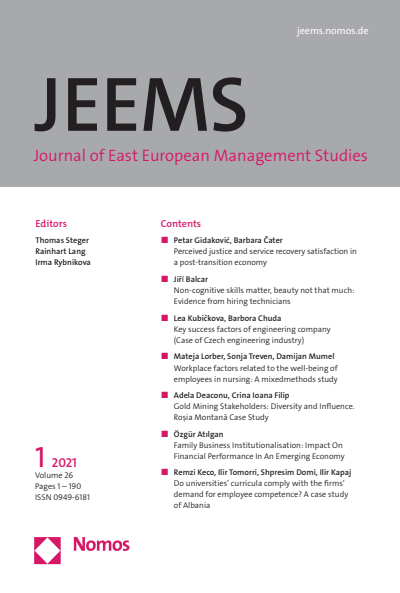
  543. Gunderson, M.A./Detre J./Briggeman B./Wilson, Ch. (2008): Ag Lending, The Next Generation, in: Agricultural Finance Review, 71(3), 280–294. Google Scholar öffnen doi.org/10.5771/0949-6181-2021-1-177
  544. Cronbach, L. J. (1951): Coefficient alpha and the internal structure of tests, in: Psychometrika, 22(3), 297–334. Google Scholar öffnen doi.org/10.5771/0949-6181-2021-1-177
Neuesten Ausgaben

JEEMS Journal of East European Management Studies
Alle Ausgaben anzeigen
Cover der Ausgabe: JEEMS Journal of East European Management Studies Jahrgang 29 (2024), Heft 4
Ausgabe Vollzugriff
JEEMS Journal of East European Management Studies
Jahrgang 29 (2024), Heft 4
Cover der Ausgabe: JEEMS Journal of East European Management Studies Jahrgang 29 (2024), Heft 3
Ausgabe Vollzugriff
JEEMS Journal of East European Management Studies
Jahrgang 29 (2024), Heft 3
Cover der Ausgabe: JEEMS Journal of East European Management Studies Jahrgang 29 (2024), Heft 2
Ausgabe Vollzugriff
JEEMS Journal of East European Management Studies
Jahrgang 29 (2024), Heft 2
Cover der Ausgabe: JEEMS Journal of East European Management Studies Jahrgang 29 (2024), Heft 1
Ausgabe Vollzugriff
JEEMS Journal of East European Management Studies
Jahrgang 29 (2024), Heft 1
Cover der Ausgabe: JEEMS Journal of East European Management Studies Jahrgang 28 (2023), Heft 4
Ausgabe Vollzugriff
JEEMS Journal of East European Management Studies
Jahrgang 28 (2023), Heft 4