The Carpet Crawlers: Quanten in den Internationalen Beziehungen
Inhaltsverzeichnis
Bibliographische Infos
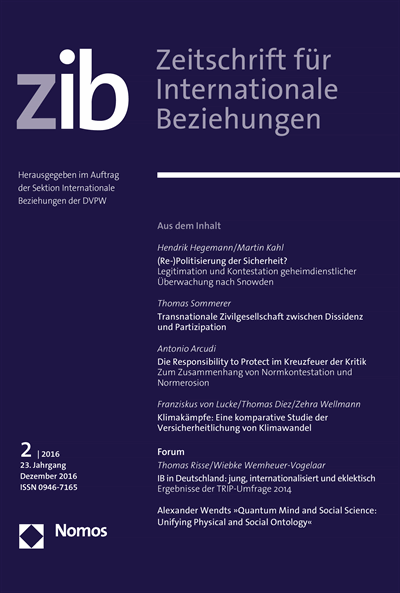
Zeitschrift für Internationale Beziehungen
Jahrgang 23 (2016), Heft 2
- Autor:innen:
- Verlag
- Nomos, Baden-Baden
- Erscheinungsjahr
- 2016
- ISSN-Online
- 2942-1233
- ISSN-Print
- 0946-7165
Kapitelinformationen
Jahrgang 23 (2016), Heft 2
The Carpet Crawlers: Quanten in den Internationalen Beziehungen
- Autor:innen:
- ISSN-Print
- 0946-7165
- ISSN-Online
- 2942-1233
- Kapitelvorschau:
Nach über zehn Jahren Bearbeitungszeit ist das neue Buch von Alexander Wendt, »Quantum Mind and Social Science: Unifying Physical and Social Ontology«, erschienen. Während »Social Theory of International Politics« eine Tour de Force durch die Landschaft der Sozialtheorie war, stellt »Quantum Mind« eine Tour de Force zur aktuellen Philosophie der Naturwissenschaften dar. Da Letzteres das Leib-Seele-Problem zu einem zentralen Baustein erhoben hat, lässt sich zeigen, wie sich die beiden Bücher zwar unterscheiden, aber in der Anlage auch ähnlich sind. Anhand dieser Problematik verweist dieser Beitrag auf zwei weiterführende Fragen: Zum einen wird der ontologische Status von Quanten, zum anderen das sich verändernde Verhältnis von Naturwissenschaft und Sozialwissenschaft diskutiert.
Literaturverzeichnis
Es wurden keine Treffer gefunden. Versuchen Sie einen anderen Begriff.
- Blyth, Mark M. 1997: Any More Bright Ideas? The Ideational Turn of Comparative Political Economy, in: Comparative Politics 29: 2, 229-250. Google Scholar öffnen doi.org/10.2307/422082
- Goldstein, Judith/Keohane, Robert O. 1993: Ideas and Foreign Policy. Beliefs, Institutions, and Political Change, Ithaca, NY. Google Scholar öffnen
- Kessler, Oliver 2007: From Agents and Structures to Minds and Bodies. Of Supervenience, Quantum, and the Linguistic Turn, in: Journal of International Relations and Development 10: 3, 243-271. Google Scholar öffnen doi.org/10.1057/palgrave.jird.1800131
- King, Gary/Keohane, Robert O./Verba, Sidney 1994: Designing Social Inquiry. Scientific Inference in Qualitative Research. Princeton, NJ. Google Scholar öffnen
- Kratochwil, Friedrich 1989: Rules, Norms, and Decisions. On the Conditions of Practical and Legal Reasoning in International Relations and Domestic Affairs, Cambridge. Google Scholar öffnen doi.org/10.1017/CBO9780511559044
- Kratochwil, Friedrich 2000: Constructing a New Orthodoxy? Wendt’s »Social Theory of International Politics« and the Constructivist Challenge, in: Millennium 29: 4, 73-101. Google Scholar öffnen doi.org/10.1177/03058298000290010901
- Luhmann, Niklas 1988: Wirtschaft der Gesellschaft, Frankfurt a. M. Google Scholar öffnen
- Serres, Michel 1987: Der Parasit, Frankfurt a. M. Google Scholar öffnen
- Risse-Kappen, Thomas 1994: Ideas Do Not Float Freely. Transnational Coalitions, Domestic Structures, and the End of the Cold War, in: International Organization 48: 2, 185-214. Google Scholar öffnen doi.org/10.1017/S0020818300028162
- Wendt, Alexander 1999: Social Theory of International Politics, Cambridge. Google Scholar öffnen doi.org/10.1017/CBO9780511612183.001
- Wendt, Alexander 2006: Social Theory as Cartesian Science. An Auto-critique from a Quantum Perspective, in: Guzzini, Stefano/Leander, Anna (Hrsg.): Constructivism and International Relations: Alexander Wendt and his Critics, London, 181-219. Google Scholar öffnen doi.org/10.4324/9780203401880_chapter_10
- Wendt, Alexander 2015: Quantum Mind and Social Science: Unifying Physical and Social Ontology, Cambridge. Google Scholar öffnen doi.org/10.1017/CBO9781316005163
- Yee, Albert S. 1996: The Causal Effects of Ideas on Policies, in: International Organization 50: 1, 69-108. Google Scholar öffnen doi.org/10.1017/S0020818300001673
- Zehfuß, Maja 1998: Sprachlosigkeit schränkt ein. Zur Bedeutung von Sprache in konstruktivistischen Theorien, in: Zeitschrift für Internationale Beziehungen 5: 1, 109-137. Google Scholar öffnen