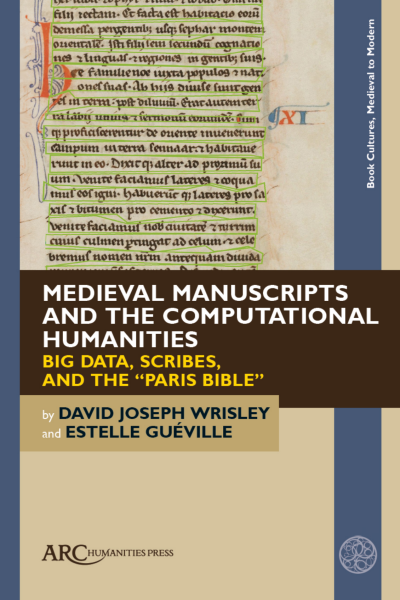
Medieval Manuscripts and the Computational Humanities
Big Data, Scribes, and the “Paris Bible”- Autor:innen:
- |
- Verlag:
- 2026
Zusammenfassung
This book examines the transformations in medieval studies—and the humanities more broadly—enabled by decades of digitization and advances in computational methods. Centring on the Paris Bible, a widely copied thirteenth- and fourteenth-century manuscript genre, we demonstrate how automated transcription produces scribal data at a scale once inaccessible, and how automation can support new approaches to localizing, dating, and contextualizing manuscripts. We argue that bringing machine learning and artificial intelligence to medieval studies not only requires re-centring expert human intelligence within computational systems, but also raises the question of the infrastructures needed for equitable, collaborative scholarship across the field. The book models how medieval studies might rethink interpretation, highlighting both the promise and risks of computational methods in manuscript research.
Publikation durchsuchen
Bibliographische Angaben
- Auflage
- 1/2026
- Copyrightjahr
- 2026
- ISBN-Print
- 978-1-80270-243-9
- ISBN-Online
- 978-1-80270-448-8
- ePub ISBN
- 9781802704488
- Verlag
- Arc Humanities Press, Yorkshire
- Reihe
- Book Cultures, Medieval to Modern Borderliners
- Sprache
- Englisch
- Seiten
- 196
- Produkttyp
- Monographie
Inhaltsverzeichnis
- Contents
- List of Illustrations
- Acknowledgements
- Abbreviations
- IntroductionSeiten 1 - 10 Download Kapitel (PDF)
- Chapter 1. Do the Humanities Dream of Patterns?Seiten 11 - 42 Download Kapitel (PDF)
- Chapter 2. Transcription, Scribal Modelling, and Artificial Intelligence in Medieval StudiesSeiten 43 - 82 Download Kapitel (PDF)
- Chapter 3. Assessing Manuscript Co-Creation Using Computational MethodsSeiten 83 - 116 Download Kapitel (PDF)
- Chapter 4. Towards a Future of Collaborative Medieval StudiesSeiten 117 - 154 Download Kapitel (PDF)
- ConclusionSeiten 155 - 160 Download Kapitel (PDF)
- BibliographySeiten 161 - 178 Download Kapitel (PDF)
- IndexSeiten 179 - 184 Download Kapitel (PDF)