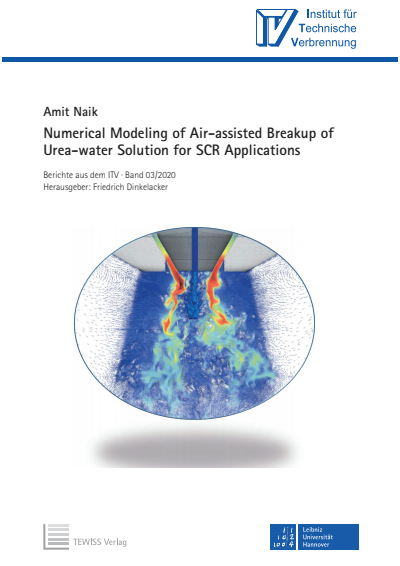
To simulate the air-assisted breakup of the urea-water-solution for the after treatment of NOx of large scale ship engines, two time-dependent numerical approaches using 3D CFD methods have been developed. The first approach is based on the Volume-of-Fluid (VOF) method combined with a high-resolution interface capturing scheme. The approach was able to investigate the detailed spray breakup phenomenon, as being compared with detailed atomization experiments carried out at a hot gas test-rig at Leibniz University Hannover. The simulation facilitates a detailed investigation of spray characteristics, such as the liquid jet penetration, spray angle, droplet spectrum, and the possibility of deposit formation on the injector. Another approach based on the Lagrangian particle tracking model allows the complete SCR simulations for large bore ship engines. The method can predict the diameter and velocity distribution of droplets produced from the atomization of the urea-water-solution jet. The approach was also able to predict the risk of urea-film formation in SCR systems, as has been compared with measurements from MAN Energy Solutions SE, Augsburg.
Schlagworte
Publikation durchsuchen
Bibliographische Angaben
Auflage
1/2020
Copyrightjahr
2020
ISBN-Online
978-3-95900-497-8
Verlag
TEWISS, Garbsen
Reihe
Berichte aus dem ITV
Sprache
Deutsch
Seiten
124
Produkttyp
Monographie
Inhaltsverzeichnis
KapitelSeiten
Acknowledgement Kein Zugriff
Abstract Kein Zugriff
Zusammenfassung Kein Zugriff
Contents Kein Zugriff
List of Figures Kein Zugriff
List of Tables Kein Zugriff
Nomenclature Kein Zugriff
1.1 Exhaust gas after-treatment for large bore engines Kein Zugriff
1.2 Current status of spray generation and investigationstudies on efficient SCR functioning Kein Zugriff
1.3 Contribution of the work Kein Zugriff
2.1 Air-assisted breakup using Volume-of-fluid method Kein Zugriff
2.2 Air-assisted breakup using Lagrangian-particle-tracking method Kein Zugriff
2.3 Wall-Film prediction Kein Zugriff
3.1 Hot gas test-rig Kein Zugriff
3.2 Diesel engine test-bench Kein Zugriff
4.1 Simulation approach Kein Zugriff
4.2 Results and discussion Kein Zugriff
4.3 Summary and conclusions Kein Zugriff
5.1 Simulation approach Kein Zugriff
5.2 Results and discussion Kein Zugriff
5.3 Summary and conclusions Kein Zugriff
6.1 Simulation approach Kein Zugriff
6.2 Results and discussion Kein Zugriff
6.3 Summary and conclusions Kein Zugriff
7 Summary Kein Zugriff Seiten 103 - 104
8 Outlook Kein Zugriff Seiten 105 - 106
A Benchmarking of Simulation Tools Kein Zugriff Seiten 107 - 110