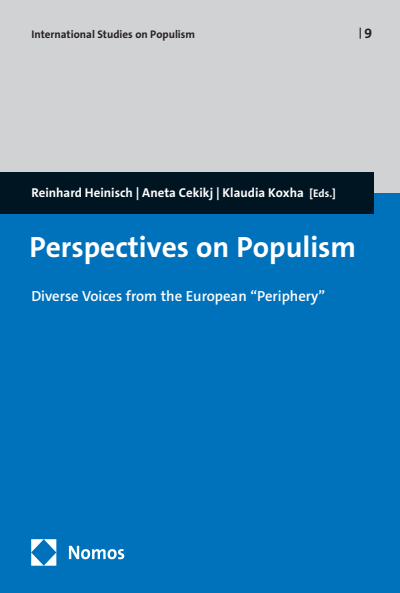
Perspectives on Populism
Diverse Voices from the European “Periphery”- Herausgeber:innen:
- | |
- Reihe:
- International Studies on Populism, Band 9
- Verlag:
- 2024
Zusammenfassung
Während die Welle des Populismus im Westen große öffentliche Aufmerksamkeit erregt hat, sind Länder, die oft als europäische "Peripherie" betrachtet werden, sowohl dem wissenschaftlichen als auch dem allgemeinen Interesse weitgehend entgangen. Die politischen Entwicklungen in Armenien, Albanien, Bosnien, Georgien, Mazedonien, Montenegro und Serbien werden politisch kaum verstanden und sind für Nicht-Fachleute oft undurchsichtig. Dennoch sind die Gesellschaft, die Wirtschaft, die Politik und die Hoffnungen der Menschen in diesen Ländern nach wie vor eng mit dem restlichen Europa und seiner Entwicklung verwoben. Aus der Perspektive von Wissenschaftler:innen aus der Region bietet dieser Band eine fundierte Einschätzung der Rolle des Populismus, seiner Ursachen und politischen Folgen in Bereichen, die wichtige, aber oft vernachlässigte Teile der europäischen politischen Landschaft sind. Mit Beiträgen vonAshot Aleksanyan | Nane Aleksanyan | Aneta Cekikj | Simon Clarke | Ruben Elamiryan | Reinhard Heinisch | Despot Kovačević | Klaudia Koxha | David Matsaberidze | Slaviša Orlović | Maja Savić-Bojanić | Avdi Smajljaj | Daniel Smilov | Ruzha Smilova | Nemanja Stankov
Schlagworte
Publikation durchsuchen
Bibliographische Angaben
- Copyrightjahr
- 2024
- ISBN-Print
- 978-3-7560-1200-8
- ISBN-Online
- 978-3-7489-1728-1
- Verlag
- Nomos, Baden-Baden
- Reihe
- International Studies on Populism
- Band
- 9
- Sprache
- Englisch
- Seiten
- 318
- Produkttyp
- Sammelband
Inhaltsverzeichnis
- Titelei/InhaltsverzeichnisSeiten 1 - 26 Download Kapitel (PDF)
- Autor:innen: | |Download Kapitel (PDF)
- 1. Introduction
- 2. Why focus on the ‘periphery’?
- 3. The challenges of the concept of populism
- 4. Populism as a symptom of a crisis of legitimacy
- 5. Introducing the book’s authors and chapters
- Works cited
- Autor:innen: |Download Kapitel (PDF)
- 1. Introduction
- 2.1. Centrist populism: supply-side characteristics
- 2.2. Radical populism: supply-side characteristics
- 2.3. Centrist populism: demand-side characteristics
- 2.4. Radical populism: demand-side characteristics
- 3. An alternative theory of radicalization of centrist populism
- 4. The intrinsic limits of ideological and strategic radicalization
- 5. Conclusion
- Works cited
- Autor:innen: |Download Kapitel (PDF)
- 1. Introduction
- 2. The leap from post-Soviet sovereignty to a European transit periphery
- 3. Sources and dimension of political populism
- 4. The ruling party as a populist phenomenon
- 5. Conclusion
- Works cited
- Autor:innen:Download Kapitel (PDF)
- 1. Introduction
- 2. Understanding populism
- 3. Mapping populism(s)
- 4. A populist revolutionary
- 5. A right-wing populist
- 6. The populist map in Armenia
- 7. Discussion
- 8. Conclusion
- Works cited
- Autor:innen:Download Kapitel (PDF)
- 1. Introduction
- 2. Populism as a concept
- 3. Populism in the post-Soviet space
- 4. Populism in Armenia
- 5. The Armenian Renaissance Association and the OEK
- 6. Conclusion
- Works cited
- Autor:innen:Download Kapitel (PDF)
- 1. Introduction
- 2.1 Zviad Gamsakhurdia: The cause of independence
- 2.2 Eduard Shevardnadze: order and stability
- 2.3. Mikheil Saakashvili: state-building and nation-building
- 2.4. Giorgi Margvelashvili vs. prime ministers: Functioning state to the people vs. dignity of the people
- 3. Bridging politics and populism: the case of Georgia
- 4. The contextual rhetoric of presidents and the transformative populist discourses
- 5. Conclusion
- Works cited
- Autor:innen:Download Kapitel (PDF)
- 1. Introduction
- 2. Populists in government
- 3. Defining populism
- 4. The populism of Vetëvendosje!
- 5. The LVV’s rise to power
- 6. The populist LVV in public office
- 7. Conclusion
- Works cited
- Autor:innen:Download Kapitel (PDF)
- 1. Introduction
- 2. The absence of populism in Montenegro
- 3. The ruling political elites: Democratic Party of Socialists
- 4. Populist flirtation of Democrats in Montenegro
- 5. Anti-establishment of Movement for Change
- 6. Voting behavior in Montenegro
- 7. Data, measurement, and methods
- 8. Results
- 9. Discussion
- 10. Conclusion
- Works cited
- Autor:innen: |Download Kapitel (PDF)
- 1. Introduction
- 2. Historical and political context
- 3. Theory and argument
- 4.1 Case study – Local elections of 2019
- 4.2 Populism and authoritarianism
- 5. Conclusion
- Works cited
- Autor:innen: |Download Kapitel (PDF)
- 1. Introduction
- 2. Historical and political context
- 3. Theory and argument
- 4. Case description
- 5. Analysis
- 6. Conclusion
- Works cited
- Autor:innen:Download Kapitel (PDF)
- 1. Introduction
- 2. Politics in North Macedonia: political parties and ethnic dynamics during transition to democracy
- 3. Approaches to populism relevant for the case of North Macedonia
- 4. Structural conditions and demand for populism in North Macedonia
- 5.1 Why did IMRO-DPMNU adopt a populist strategy?
- 5.2 Constructing the populist leader
- 5.3 Constructing ‘the people’
- 6.1 Fight against the lazy and corrupt (communist) elites
- 6.2 IMRO-DPMU as a protector of national identity – the use of history
- 7. Social benefits for ‘the people’ and policies of punishment for ‘the elites’
- 8. Conclusion
- Works cited
- Autor:innen:Download Kapitel (PDF)
- 1. Introduction
- 2. The approach
- 3.1 The role of the “people”
- 3.2 The leader and charisma
- 3.3 Playing with emotions through linguistic simplicity: an expression of revolt in an ethno-nationalist context
- 4. Conclusion
- Works cited