, um zu prüfen, ob Sie einen Vollzugriff auf diese Publikation haben.
Lehrbuch Kein Zugriff
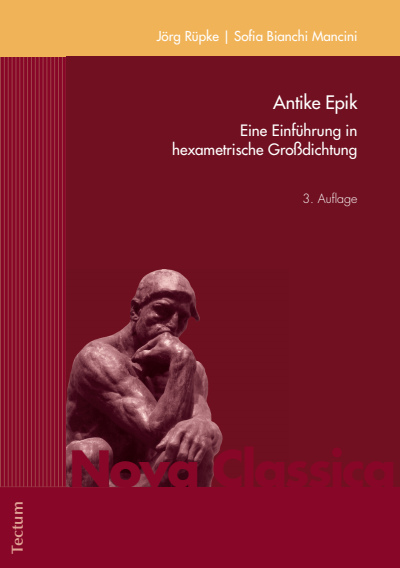
Antike Epik
Eine Einführung in hexametrische Großdichtung- Autor:innen:
- |
- Reihe:
- Nova Classica. Marburger Fundus für Studium und Forschung in der Altertumswissenschaft, Band 1
- Verlag:
- 2023
Zusammenfassung
Epen sind die ältesten verschriftlichten Großtexte vieler Sprachen. Sie erheben den Anspruch, grundlegende Ereignisse darzustellen und wollen ihrer Version durch formale Gestaltung Geltung verschaffen. Dieser Band gibt einen Überblick über die griechischen und lateinischen Epen von Homer bis in die Spätantike. Vor allem aber fragt er: Wie wurden sie zu Gehör gebracht? Wer wollte sie lesen oder hören? Und wie veränderte das die Texte? Die Professionalisierung solcher Großwerke führte auch zu Konkurrenz, Überbietung, aber auch Parodie oder Verdichtung der Texte. Erstmals wird in diesem Buch ein breiter Überblick konsequent aus einer solchen Perspektive gegeben.
Schlagworte
Publikation durchsuchen
Bibliographische Angaben
- Copyrightjahr
- 2023
- ISBN-Print
- 978-3-8288-4923-5
- ISBN-Online
- 978-3-8288-5057-6
- Verlag
- Tectum, Baden-Baden
- Reihe
- Nova Classica. Marburger Fundus für Studium und Forschung in der Altertumswissenschaft
- Band
- 1
- Sprache
- Deutsch
- Seiten
- 248
- Produkttyp
- Lehrbuch
Inhaltsverzeichnis
KapitelSeiten
- Titelei/Inhaltsverzeichnis Kein Zugriff Seiten I - X
- 0.1 Eine weite Welt Kein Zugriff
- 0.2 Fragen Kein Zugriff
- 0.3 Epos Kein Zugriff
- 0.4 Gattung Kein Zugriff
- 0.5 Das Ziel Kein Zugriff
- 1.1 Homer Kein Zugriff
- 1.2 Der Text Kein Zugriff
- 1.3.1 Oral poetry Kein Zugriff
- 1.3.2 Schriftlichkeit Kein Zugriff
- 1.3.3 Leistungen der Verschriftlichung Kein Zugriff
- 1.4 Das Publikum Kein Zugriff
- 1.5 Die ersten Epen Kein Zugriff
- 1.6.1 Inhalt Kein Zugriff
- 1.6.2 Struktur Kein Zugriff
- 1.6.3 Charakteristika Kein Zugriff
- 1.6.4 Troja und die Quellenfrage Kein Zugriff
- 1.7.1 Inhalt Kein Zugriff
- 1.7.2 Struktur Kein Zugriff
- 1.8 Wirkungsgeschichte Kein Zugriff
- 1.9.1 Die Theogonie Kein Zugriff
- 1.9.2 Werke und Tage Kein Zugriff
- 1.9.3 Der epische Dichter als »Moralist« Kein Zugriff
- 2 Hellenistische Epik Kein Zugriff Seiten 59 - 62
- 3.1 Griechische Einflüsse in der vorliterarischen Epoche Kein Zugriff
- 3.2 Der Befund Kein Zugriff
- 3.3 Das Problem Kein Zugriff
- 3.4 Vorgehen Kein Zugriff
- 3.5 Inventar und Verortung mündlicher Literatur Kein Zugriff
- 3.6 Ergänzungen zum Sitz im Leben Kein Zugriff
- 3.7 Kristallisationskerne des Verschriftlichungsprozesses Kein Zugriff
- 3.8 Epen Kein Zugriff
- 3.9 Veränderungen im Gesamtsystem literarischer Kommunikation Kein Zugriff
- 3.10 Die Leistung des verschriftlichten Epos Kein Zugriff
- 4.1.1 Zu Person und Werk Kein Zugriff
- 4.1.2 Die Annales Kein Zugriff
- 4.1.3 Kontext Kein Zugriff
- 4.2 Die weitere römische Entwicklung Kein Zugriff
- 4.3 Rom Kein Zugriff
- 5 Catullus Kein Zugriff Seiten 107 - 110
- 6.1 Expositorische Dichtung Kein Zugriff
- 6.2 Der Epikureer Kein Zugriff
- 6.3 Werkübersicht Kein Zugriff
- 6.4 Aussage Kein Zugriff
- 7.1 Biographie Kein Zugriff
- 7.2 Grundentscheidungen Kein Zugriff
- 7.3 Inhalt Kein Zugriff
- 7.4.1 Vergil und die europäische Literaturgeschichte Kein Zugriff
- 7.4.2 Zeitgenössische Rezeption Kein Zugriff
- 7.5.1 Hauptperson der Aeneis ist Vergil Kein Zugriff
- 7.5.2 Gegenstand der Aeneis ist das zeitgenössische Rom Kein Zugriff
- 7.5.3 Kein Götter-, sondern ein Menschenapparat in der Aeneis Kein Zugriff
- 7.5.4 Die Aeneis ist nicht Helden-, sondern Proletarierepos Kein Zugriff
- 8.1 Rezeption Kein Zugriff
- 8.2 Zur Person Kein Zugriff
- 8.3 Metamorphosen: Ein erster Zugang Kein Zugriff
- 8.4 Augusteische Epik Kein Zugriff
- 8.5.1 Metamorphosen Kein Zugriff
- 8.5.2 Großepos Kein Zugriff
- 8.5.3 Systematisierung Kein Zugriff
- 8.5.4 Handlungsführung Kein Zugriff
- 8.5.5 Ovid und seine Vorgänger Kein Zugriff
- 8.5.6 Erzählen im Epos Kein Zugriff
- 8.5.7 Einzelmotive Kein Zugriff
- 8.5.8 Gelebte Parodie Kein Zugriff
- 9.1 Historie in griechischer Sprache Kein Zugriff
- 9.2 Lateinische Epen Kein Zugriff
- 9.2 Lukan Kein Zugriff
- 9.3.1 Titel und Quellen Kein Zugriff
- 9.3.2 Inhalt Kein Zugriff
- 9.3.3 Gehalt Kein Zugriff
- 9.4 Silius Italicus Kein Zugriff
- 9.5 Ausblick Kein Zugriff
- 10.1 Griechische Epen und Lehrdichtung Kein Zugriff
- 10.2 Valerius Flaccus Kein Zugriff
- 10.3.1 Zur Person Kein Zugriff
- 10.3.2 Thebais: Inhalt Kein Zugriff
- 10.3.3 Komposition Kein Zugriff
- 10.3.4 Einheitlichkeit Kein Zugriff
- 11.1.1 Historischer Überblick Kein Zugriff
- 11.1.2 Der literaturgeschichtliche Einschnitt Kein Zugriff
- 11.1.3 Präzisierung 1: Christentum Kein Zugriff
- 11.1.4 Präzisierung 2: Epyllia Kein Zugriff
- 11.1.5 Relativierung: Griechische Epik Kein Zugriff
- 11.1.6 Entwicklungsstränge Kein Zugriff
- 11.2.1 Allgemeines Kein Zugriff
- 11.2.2 Claudius Claudianus Kein Zugriff
- 11.3.1 Anfangsphase Kein Zugriff
- 11.3.2 Hauptphase Kein Zugriff
- 12 Epilog Kein Zugriff Seiten 231 - 232
- 0 Allgemeines Kein Zugriff
- 1 Homer und der Kyklos, Hesiod Kein Zugriff
- 2 Hellenistische und frühe römische Epik: Livius, Naevius, Ennius Kein Zugriff
- 3 Catullus Kein Zugriff
- 4 Das antike Lehrgedicht: Lukrez Kein Zugriff
- 5 Vergil Kein Zugriff
- 6 Ovid Kein Zugriff
- 7 Lukan (Petron) Kein Zugriff
- 8 Flavische Epik: Silius Italicus, Valerius Flaccus Kein Zugriff
- 9 Statius Kein Zugriff
- 10 Spätantike Kein Zugriff
- 11 Claudian Kein Zugriff
- 12 Christliche Epik Kein Zugriff
Literaturverzeichnis (199 Einträge)
Es wurden keine Treffer gefunden. Versuchen Sie einen anderen Begriff.
- Adamietz, Joachim. Zur Komposition der Argonautica des Valerius Flaccus. Zetemata 67. München: Beck, 1976. 128 S. Google Scholar öffnen DOI: 10.5771/9783828850576
- Ahl, Frederick. »Statius’ ›Thebaid‹: A Reconsideration.« In: Temporini, Hildegard; Haase, Wolfgang (Hgg.). Aufstieg und Niedergang der römischen Welt II.32 (5). Berlin: de Gruyter, 1986. S. 2803–2912. Google Scholar öffnen DOI: 10.5771/9783828850576
- Akmqvist, Olaf. Chaos, Cosmos and Creation in Early Greek Theogonies: An Ontological Exploration. London: Bloomsbury, 2022. 238 S. Google Scholar öffnen DOI: 10.5771/9783828850576
- Albrecht, Michael von. »Tradition und Originalität bei Silius Italicus.« In: Castagna, Luigi; Galimberti Biffino, Giovanna; Riboldi, Chiara (Hgg.). Studi su Silio Italico: Atti del Convegno su Silio Italico e i suoi Tempi. Milano: Vita & Pensiero, 2011. S. 89–109. Google Scholar öffnen DOI: 10.5771/9783828850576
- Albrile, Ezio; Bernabé Pajares, Alberto; Casadesús Bordoy, Francisco J. Orfeo y la tradición órfica: Un reencuentro. 2 vols. Akal universitaria. Madrid: Akal, 2008. 1803 S. Google Scholar öffnen DOI: 10.5771/9783828850576
- Ambühl, Annemarie. »Narrative Hexameter Poetry.« In: Clauss, James J.; Cuypers, Martine (Hgg.). A Companion to Hellenistic Literature. Blackwell companions to the ancient world. Malden, Mass.: Wiley-Blackwell, 2010. S. 151–165. Google Scholar öffnen DOI: 10.5771/9783828850576
- Anderson, William S. »Form Changed: Ovid’s Metamorphoses.« In: Boyle, Anthony J. (Hg.). Roman Epic. London: Routledge, 1993. S. 108–124. Google Scholar öffnen DOI: 10.5771/9783828850576
- Angelucci, Paolo. La tecnica poetica di Aratore. Roma: Herder, 1990. 344 S. Google Scholar öffnen DOI: 10.5771/9783828850576
- Armstrong, Rebecca. Cretan Women: Pasiphae, Ariadne, and Phaedra in Latin Poetry. Oxford: Oxford University Press, 2006. 351 S. Google Scholar öffnen DOI: 10.5771/9783828850576
- Auffarth, Christoph. Der drohende Untergang: »Schöpfung« in Mythos und Ritual im Alten Orient und in Griechenland am Beispiel der Odyssee und des Ezechielbuches. Religionsgeschichtliche Versuche und Vorarbeiten 39. Berlin: de Gruyter, 1991. 655 S. Google Scholar öffnen DOI: 10.5771/9783828850576
- Bailey, Cyril. Titi Lucreti Cari De rerum natura libri sex. 3 vols. Ed. with proleg., crit. app., trsl. and comm. Oxford: Clarendon, 1947–1953. 1758 S. Google Scholar öffnen DOI: 10.5771/9783828850576
- Barchiesi, Alessandro. »L’epos.« In: Cavallo, Guglielmo; Fedeli, Paolo; Giardina, Andrea (Hgg.). Lo spazio letterario di Roma antica 1: La produzione del testo. Roma: Salerno, 1993. S. 115–141. Google Scholar öffnen DOI: 10.5771/9783828850576
- Barchiesi, Alessandro. Il poeta e il principe: Ovidio e il discorso Augusteo. Roma: Laterza, 1994. 340 S. Google Scholar öffnen DOI: 10.5771/9783828850576
- Barchiesi, Marino. Nevio Epico: Storia, interpretazione, edizione critica dei frammenti del primo epos latino. Padova: CEDAM, 1962. 594 S. Google Scholar öffnen DOI: 10.5771/9783828850576
- Bartsch, Shady. Ideology in Cold Blood: A Reading of Lucan’s Civil War. Cambridge, Mass.: Harvard University Press, 1997. 224 S. Google Scholar öffnen DOI: 10.5771/9783828850576
- Baumbach, Manuel; Bär, Silvio (Hgg.). Brill’s Companion to Greek and Latin Epyllion and Its Reception. Brill’s companions in classical studies. Leiden: Brill, 2012. 640 S. Google Scholar öffnen DOI: 10.5771/9783828850576
- Beaulieu, Marie-Claire. »L’Héroisation du Poète Hésiode en Grèce Ancienne.« Kernos 17 (2004), S. 103–117. Google Scholar öffnen DOI: 10.5771/9783828850576
- Beissinger, Margaret; Tylus, Jane; Wofford, Susanne (Hgg.). Epic Traditions in the Contemporary World: The Poetics of Community. Berkeley: University of California Press, 1999. 314 S. Google Scholar öffnen DOI: 10.5771/9783828850576
- Benaissa, Amin. Dionysius: The Epic Fragments. Cambridge classical texts and commentaries 56. Cambridge: Cambridge University Press, 2018. 352 S. Google Scholar öffnen DOI: 10.5771/9783828850576
- Bernabé Pajares, Alberto. La voz de Orfeo: Religión y poesía. Colección Excelencia. Córdoba: Universidad de Córdoba, 2019. 456 S. Google Scholar öffnen DOI: 10.5771/9783828850576
- Bernabé Pajares, Alberto. Poetae epici Graeci 2,3: testimonia et fragmenta. Musaeus, Linus, Epimenides, Papyrus Derveni, Indices. Bibliotheca scriptorum Graecorum et Romanorum Teubneriana. Berlin: de Gruyter, 2007. 465 S. Google Scholar öffnen DOI: 10.5771/9783828850576
- Bernabé Pajares, Alberto; Jiménez San Cristóbal, Ana I. Instructions for the Netherworld: The orphic gold tablets. Religions in the Graeco-Roman world 162. Leiden: Brill, 2008. 379 S. Google Scholar öffnen DOI: 10.5771/9783828850576
- Bershadsky, Natasha. »A Picnic, a Tomb, and a Crow.« Harvard Studies in Classical Philology 106 (2011), S. 1–45. Google Scholar öffnen DOI: 10.5771/9783828850576
- Bessone, Federica. La Tebaide di Stazio: Epica e Potere. Materiali e discussioni per l’analisi dei testi classici 24. Pisa: Fabrizio Serra, 2011. 272 S. Google Scholar öffnen DOI: 10.5771/9783828850576
- Bettenworth, Anja. Gastmahlszenen in der antiken Epik von Homer bis Claudian: Diachrone Untersuchungen zur Szenentypik. Hypomnemata 153. Göttingen: Vandenhoeck & Ruprecht, 2004. 543 S. Google Scholar öffnen DOI: 10.5771/9783828850576
- Biggs, Thomas. Poetics of the first Punic War. Ann Arbor: University of Michigan Press, 2020. 247 S. Google Scholar öffnen DOI: 10.5771/9783828850576
- Billerbeck, Margarethe. »Die Unterweltsbeschreibung in den ›Punica‹ des Silius Italicus.« Hermes 111 (1983), S. 326–338. Google Scholar öffnen DOI: 10.5771/9783828850576
- Boeft, Jan den; Hilhorst, A. (Hgg.). Early Christian poetry: A collection of essays. Virgiliae Christianae Supplement 22. Leiden: Brill, 1993. 318 S. Google Scholar öffnen DOI: 10.5771/9783828850576
- Boyd, Barbara Weiden (Hg.). Brill’s Companion to Ovid. Brill’s companions in classical studies. Leiden: Brill, 2002. 533 S. Google Scholar öffnen DOI: 10.5771/9783828850576
- Boyle, Anthony J. (Hg.). Roman Epic. London: Routledge, 1993. 352 S. Google Scholar öffnen DOI: 10.5771/9783828850576
- Brandt, Paul. Corpusculum poesis epicae graecae ludibundae 1: Parodorum epicorum Graecorum et Archestrati reliquiae. Leipzig: Teubner, 1888. 228 S. Google Scholar öffnen DOI: 10.5771/9783828850576
- Brommer, Frank. Odysseus: Die Taten und Leiden des Helden in der antiken Kunst und Literatur. Darmstadt: Wissenschaftliche Buchgesellschaft, 1983. 132 S. Google Scholar öffnen DOI: 10.5771/9783828850576
- Burck, Erich (Hg.). Das römische Epos. Grundriß der Literaturgeschichte nach Gattungen. Darmstadt: Wissenschaftliche Buchgesellschaft, 1979. 419 S. Google Scholar öffnen DOI: 10.5771/9783828850576
- Burck, Erich. Historische und epische Tradition bei Silius Italicus. Zetemata 80. München: Beck, 1984. 179 S. Google Scholar öffnen DOI: 10.5771/9783828850576
- Burgess, Jonathan S. The Tradition of the Trojan War in Homer and the Epic Cycle. Baltimore: Johns Hopkins University Press, 2001. 295 S. Google Scholar öffnen DOI: 10.5771/9783828850576
- Cairns, Douglas L. Aidōs: The Psychology and Ethics of Honour and Shame in Ancient Greek Literature. Oxford, Berlin: Clarendon Press, 1993. 474 S. Google Scholar öffnen DOI: 10.5771/9783828850576
- Cairns, Francis. Virgil’s Augustan Epic. Cambridge: Cambridge University Press, 1989. 280 S. Google Scholar öffnen DOI: 10.5771/9783828850576
- Cameron, Alan. Claudian: Poetry and Propaganda at the Court of Honorius. Oxford: Clarendon Press, 1970. 508 S. Google Scholar öffnen DOI: 10.5771/9783828850576
- Cancik-Lindemaier, Hildegard. »›Aus so großer Finsternis ein so helles Licht‹: Die Religionskritik des Lukrez im Rahmen der antiken Aufklärung.« In: Faber, Richard; Wehinger, Brunhilde (Hgg.). Aufklärung in Geschichte und Gegenwart. Würzburg: Königshausen & Neumann, 2010. S. 61–83. Google Scholar öffnen DOI: 10.5771/9783828850576
- Carratello, Ugo. Livio Andronico. Roma: Cadmo, 1979. 142 S. Google Scholar öffnen DOI: 10.5771/9783828850576
- Casali, Sergio. »Killing the Father: Ennius, Naevius and Virgil’s Julian Imperialism.« In: Fitzgerald, William; Gowers, Emily (Hgg.). Ennius Perennis: The Annals and Beyond. Cambridge classical journal supplementary volume 31. Cambridge: Cambridge Philological Society, 2007. S. 103–128. Google Scholar öffnen DOI: 10.5771/9783828850576
- Clark, Elizabeth A.; Hatch, Diane F. The Golden Bough, the Oaken Cross: the Virgilian Cento of Faltonia Betitia Proba. Chico, Calif.: Scholars Press, 1981. 249 S. Google Scholar öffnen DOI: 10.5771/9783828850576
- Clauss, James Joseph; Cuypers, Martine; Kahane, Ahuvia (Hgg.). The gods of Greek hexameter poetry: From the archaic age to late antiquity and beyond. Potsdamer altertumswissenschaftliche Beiträge 56. Stuttgart: Steiner, 2016. 458 S. Google Scholar öffnen DOI: 10.5771/9783828850576
- Clay, Diskin. Lucretius and Epicurus. Ithaca, NY: Cornell University Press, 1983. 361 S. Google Scholar öffnen DOI: 10.5771/9783828850576
- Clay, Jenny S. Hesiod’s Cosmos. Cambridge: Cambridge University Press, 2003. 202 S. Google Scholar öffnen DOI: 10.5771/9783828850576
- D’Alessandro Behr, Francesca. Feeling History: Lucan, Stoicism, and the Poetics of Passion. Columbus: Ohio State University Press, 2007. 259 S. Google Scholar öffnen DOI: 10.5771/9783828850576
- Dominik, William. The Mythic Voice of Statius: Power and Politics in the Thebaid. Mnemosyne Supplement 136. Leiden: Brill, 1994. 198 S. Google Scholar öffnen DOI: 10.5771/9783828850576
- Du Quesnay, Ian; Woodman, Tony (Hgg.). The Cambridge Companion to Catullus. Cambridge: Cambridge University Press, 2021. 404 S. Google Scholar öffnen DOI: 10.5771/9783828850576
- Effe, Bernd. »Entstehung und Funktion »personaler« Erzählweisen in der Erzählliteratur der Antike.« Poetica 7 (1975), S. 135–157. Google Scholar öffnen DOI: 10.5771/9783828850576
- Effe, Bernd. Dichtung und Lehre: Untersuchungen zur Typologie des antiken Lehrgedichts. Zetemata 69. München: Beck, 1977. 270 S. Google Scholar öffnen DOI: 10.5771/9783828850576
- Eidinow, Esther; Kindt, Julia (Hgg.). The Oxford handbook of ancient Greek religion. Oxford: Oxford University Press, 2017. 708 S. Google Scholar öffnen DOI: 10.5771/9783828850576
- Elliott, Jackie. Ennius and the Architecture of the Annales. Cambridge: Cambridge University Press, 2013. 590 S. Google Scholar öffnen DOI: 10.5771/9783828850576
- Elm von der Osten, Dorothee. Liebe als Wahnsinn: Die Konzeption der Göttin Venus in den ›Argonautica‹ des Valerius Flaccus. Potsdamer altertumswissenschaftliche Beiträge 20. Stuttgart: Steiner, 2007. 204 S. Google Scholar öffnen DOI: 10.5771/9783828850576
- Elm von der Osten, Dorothee; Rüpke, Jörg; Waldner, Katharina (Hgg.). Literatur als Medium und Reflexion von Religion im römischen Reich. Potsdamer altertumswissenschaftliche Beiträge 14. Stuttgart: Steiner, 2006. 261 S. Google Scholar öffnen DOI: 10.5771/9783828850576
- Erskine, Andrew (Hg.). A Companion to the Hellenistic World. Blackwell companions to the ancient world. Oxford: Blackwell, 2003. 588 S. Google Scholar öffnen DOI: 10.5771/9783828850576
- Esposito, Paolo. »Lucano e il carme 64 di Catullo.« Paideia 74 (2019), S. 763–789. Google Scholar öffnen DOI: 10.5771/9783828850576
- Esposito, Paolo. »Silius Italicus between Epos and Historiography.« In: Augoustakis, Antony; Fucecchi, Marco (Hgg.). Silius Italicus and the Tradition of the Roman Historical Epos. Mnemosyne Supplement 458. Leiden, Boston: Brill, 2022. S. 37–52. Google Scholar öffnen DOI: 10.5771/9783828850576
- Fabre-Serris, Jacqueline. »The Argonautica of Valerius Flaccus and the Latin Tradition on the Beginning and End of History (Catullus, Virgil, Seneca).« In: Bessone, Francesca; Fucecchi, Marco (Hgg.). The Literary Genres in the Flavian Age: Canons, Transformations, Reception. Trends in Classics 51. Berlin, Boston: de Gruyter, 2017. S. 187–200. Google Scholar öffnen DOI: 10.5771/9783828850576
- Fantuzzi, Marco; Tsagalis, Christos (Hgg.). The Greek Epic Cycle and its Ancient Reception: A Companion. Cambridge: Cambridge University Press, 2015. 678 S. Google Scholar öffnen DOI: 10.5771/9783828850576
- Farell, Joseph; Damon, Cynthia (Hgg.). Ennius’ Annals: Poetry and History. Cambridge; New York: Cambridge University Press, 2020. 351 S. Google Scholar öffnen DOI: 10.5771/9783828850576
- Farrell, Joseph. Juno’s Aeneid: A Battle for Heroic Identity. Martin classical lectures. Princeton, Oxford: Princeton University Press, 2021. 360 S. Google Scholar öffnen DOI: 10.5771/9783828850576
- Farrell, Joseph. Vergil’s Georgics and the Traditions of Ancient Epic: The Art of Allusion in Literary History. New York: Oxford University Press, 1991. 389 S. Google Scholar öffnen DOI: 10.5771/9783828850576
- Feeney, Denis C. The Gods in Epic: Poets and Critics of the Classical Tradition. Oxford: Clarendon, 1991. 449 S. Google Scholar öffnen DOI: 10.5771/9783828850576
- Feeney, Denis. Beyond Greek: The beginnings of Latin Literature. Cambridge, Massachusetts: Harvard University Press, 2016. 377 S. Google Scholar öffnen DOI: 10.5771/9783828850576
- Feldherr, Andrew. Playing Gods: Ovid’s Metamorphoses and the Politics of Fiction. Princeton: Princeton University Press, 2010. 377 S. Google Scholar öffnen DOI: 10.5771/9783828850576
- Fitzgerald, William. Catullan provocations: Lyric poetry and the drama of position. Berkeley: University of California Press, 1995. 310 S. Google Scholar öffnen DOI: 10.5771/9783828850576
- Foley, John Miles (Hg.). A Companion to Ancient Epic. Blackwell companions to the ancient world. 2. Aufl. [12005]. Malden, Mass.: Wiley-Blackwell, 2009. 664 S. Google Scholar öffnen DOI: 10.5771/9783828850576
- Foley, John Miles. The Theory of Oral Composition: History and Methodology. Bloomington: Indiana University Press, 1988. 170 S. Google Scholar öffnen DOI: 10.5771/9783828850576
- Fowler, Robert. The Cambridge Companion to Homer. Cambridge: Cambridge University Press, 2008. 419 S. Google Scholar öffnen DOI: 10.5771/9783828850576
- Gagarin, Michael. »Dikē in the Works and Days.« Classical Philology 68 (1973), S. 81–94. Google Scholar öffnen DOI: 10.5771/9783828850576
- Gale, Monica. Myth and Poetry in Lucretius. Cambridge: Cambridge University Press, 1994. 260 S. Google Scholar öffnen DOI: 10.5771/9783828850576
- Galinsky, Karl. Augustan Culture: An Interpretive Introduction. Princeton, NJ: Princeton University Press, 1996. 474 S. Google Scholar öffnen DOI: 10.5771/9783828850576
- Garani, Myrto. Empedocles REDIVIVUS: Poetry and Analogy in Lucretius. London: Routledge, 2007. 324 S. Google Scholar öffnen DOI: 10.5771/9783828850576
- Glei, Reinhold F. Der Vater der Dinge: Interpretationen zur politischen, literarischen und kulturellen Dimension des Krieges bei Vergil. Bochumer Altertumswissenschaftliches Colloquium 7. Trier: Wissenschaftlicher Verlag Trier, 1991. 410 S. Google Scholar öffnen DOI: 10.5771/9783828850576
- Goldberg, Sander M. »Early Republican Epic.« In: Foley, John Miles (Hg.). A Companion to Ancient Epic. Blackwell companions to the ancient world. 2. Aufl. [12005]. Malden, Mass.: Wiley-Blackwell, 2009. S. 429–439. Google Scholar öffnen DOI: 10.5771/9783828850576
- Goldberg, Sander M. Constructing Literature in the Roman Republic: Poetry and its Reception. Cambridge: Cambridge University Press, 2005. 249 S. Google Scholar öffnen DOI: 10.5771/9783828850576
- Goldberg, Sander M. Epic in Republican Rome. New York: Oxford University Press, 1995. 196 S. Google Scholar öffnen DOI: 10.5771/9783828850576
- Goldschmidt, Nora. Shaggy Crows: Ennius’ Annales and Vergil’s Aeneid. Oxford, New York: Oxford University Press, 2013. 258 S. Google Scholar öffnen DOI: 10.5771/9783828850576
- Goody, Jack. Die Logik der Schrift und die Organisation von Gesellschaft. Übers. von Uwe Opolka. Frankfurt a. M.: Suhrkamp, 1990. 323 S. Google Scholar öffnen DOI: 10.5771/9783828850576
- Granobs, Roland. Studien zur Darstellung römischer Geschichte in Ovids Metamorphosen. Studien zur klassischen Philologie 108. Frankfurt a. M.: Lang, 1997. 174 S. Google Scholar öffnen DOI: 10.5771/9783828850576
- Green, Roger P. H. Latin Epics of the New Testament: Juvencus, Sedulius, Arator. Oxford: Oxford University Press, 2006. 443 S. Google Scholar öffnen DOI: 10.5771/9783828850576
- Griffin, Miriam T. Nero: The End of a Dynasty. London: Routledge, 2001. 320 S. Google Scholar öffnen DOI: 10.5771/9783828850576
- Grimal, Pierre. La guerre civile de Pétrone dans ses rapports avec la Pharsale. Paris: Les Belles Lettres 1977. 377 S. Google Scholar öffnen DOI: 10.5771/9783828850576
- Griset, Emanuele. »Lucanea I: Le due Farsaglie.« Rivista di Studi Classici 2 (1954), S. 109–113. Google Scholar öffnen DOI: 10.5771/9783828850576
- Gualandri, Isabella. »Il classicismo claudianeo: aspetti e problemi.« In: Garzya, Antonio (Hg.). Metodologie della ricerca sulla tarda antichità. Atti del primo covegno dell’Associazione di studi tardoantichi. Associazione di studi tardoantichi: Atti dei convegni 1. Napoli: D’Auria, 1989. S. 25–48. Google Scholar öffnen DOI: 10.5771/9783828850576
- Hadjittofi, Fotini; Lefteratou, Anna (Hgg.). The genres of Late Antique Christian poetry: between modulations and transpositions. Trends in Classics 86. Berlin: de Gruyter, 2020. 335 S. Google Scholar öffnen DOI: 10.5771/9783828850576
- Haffter, Heinz. »Dem schwanken Zünglein lauschend wachte Cäsar dort.« Musem Helveticum 14 (1957), S. 118–126. Google Scholar öffnen DOI: 10.5771/9783828850576
- Hägg, Tomas. Eros und Tyche: Der Roman in der antiken Welt. Übers. von Kai Brodersen. Kulturgeschichte der antiken Welt 36. Mainz: Zabern, 1987. 311 S. Google Scholar öffnen DOI: 10.5771/9783828850576
- Hall, John B. Claudian; De raptu Proserpinae. Cambridge Classical Texts and Commentaries 11. Cambridge: Cambridge University Press, 1969. 252 S. Google Scholar öffnen DOI: 10.5771/9783828850576
- Hardie, Philip R. Virgil’s Aeneid: Cosmos and Imperium. Oxford: Oxford University Press, 1986. 405 S. Google Scholar öffnen DOI: 10.5771/9783828850576
- Harmon, D. P. »Nostalgia for the Age of Heroes in Catullus 64.« Latomus 32 (1973), S. 311–331. Google Scholar öffnen DOI: 10.5771/9783828850576
- Harvey, Susan Ashbrook (Hg.). The Oxford handbook of early Christian studies. Oxford handbooks in religion and theology. Oxford: Oxford University Press, 2011. 1020 S. Google Scholar öffnen DOI: 10.5771/9783828850576
- Häussler, Reinhard. Das historische Epos der Griechen und Römer bis Vergil. 2 Bde. Studien zum historischen Epos der Antike 1–2. Bibliothek der klassischen Altertumswissenschaften 2, NF 59. Heidelberg: Winter, 1976–1978. 304 S. Google Scholar öffnen DOI: 10.5771/9783828850576
- Häussler, Reinhard. Das historische Epos von Lucan bis Silius und seine Theorie: Geschichtliche Epik nach Vergil. Studien zum historischen Epos der Antike 2. Bibliothek der klassischen Altertumswissenschaften 2, NF 60. Heidelberg: Winter, 1978. 304 S. Google Scholar öffnen DOI: 10.5771/9783828850576
- Havelock, Eric A. The Muse Learns to Write: Reflections on Orality and Literacy from Antiquity to the Present. New Haven: Yale University Press, 1986. 144 S. Google Scholar öffnen DOI: 10.5771/9783828850576
- Heinze, Richard. Virgils epische Technik. 5. Aufl. [11903; 21908; 31915; 41928] Darmstadt: Wissenschaftliche Buchgesellschaft, 1957. 502 S. Google Scholar öffnen DOI: 10.5771/9783828850576
- Helzle, Martin. Der Stil ist der Mensch: Redner und Reden im römischen Epos. Beiträge zur Altertumskunde 73. Stuttgart: Teubner, 1996. 349 S. Google Scholar öffnen DOI: 10.5771/9783828850576
- Hoekstra, Arjen Y. »Hésiode et la Tradition Orale.« Mnemosyne 10 (1957), S. 193–225. Google Scholar öffnen DOI: 10.5771/9783828850576
- Hofmann, Heinz. Die lateinische Versepik des 4. Jahrhunderts. Schriften zur Geschichte und Kultur der Antike 28. Berlin: Akademie-Verlag, 1989. 281 S. Google Scholar öffnen DOI: 10.5771/9783828850576
- Holmes, Nigel. »Nero and Caesar: Lucan 1.33–66.« Classical Philology 94 (1999), S. 75–81. Google Scholar öffnen DOI: 10.5771/9783828850576
- Hölscher, Uvo. Die Odyssee: Epos zwischen Märchen und Roman. München: Beck, 2000. 360 S. Google Scholar öffnen DOI: 10.5771/9783828850576
- Holzberg, Niklas. Der antike Roman: Eine Einführung. Artemis Einführungen 25. München: Artemis, 1986. 135 S. Google Scholar öffnen DOI: 10.5771/9783828850576
- Hose, Martin. »Cicero als hellenistischer Epiker.« Hermes 123 (1995), S. 455–469. Google Scholar öffnen DOI: 10.5771/9783828850576
- Hutchinson, Gregory. »Hellenistic Epic and Homeric Form.« In: Clarke, Michael J.; Currie, Bruno G.F.; Lyne, Richard Oliver A.M. (Hgg.). Epic Interactions: Perspectives on Homer, Virgil, and the Epic Tradition Presented to Jasper Griffin by Former Pupils. Oxford: Oxford University Press, 2006. S. 105–129. Google Scholar öffnen DOI: 10.5771/9783828850576
- Janko, Richard. Homer, Hesiod, and the Hymns: Diachronic Development in Epic Diction. Cambridge: Cambridge University Press, 1982. 322 S. Google Scholar öffnen DOI: 10.5771/9783828850576
- Kartschoke, Dieter. Bibeldichtung: Studien zur Geschichte der epischen Bibelparaphrase von Iuvencus bis Otfried von Weißenburg. München: Fink, 1975. 354 S. Google Scholar öffnen DOI: 10.5771/9783828850576
- Kessler, Jeremy. »The Irony of Assassination: On the Ideology of Lucan’s Invocation to Nero.« Studi Italiani di Filologia Classica 1 (2011), S. 129–144. Google Scholar öffnen DOI: 10.5771/9783828850576
- Knauer, Georg Nicolaus. Die Aeneis und Homer: Studien zur poetischen Technik Vergils mit Listen der Homerzitate in der Aeneis. Hypomnemata 7. Göttingen: Vandenhoeck & Ruprecht, 1964. 549 S. Google Scholar öffnen DOI: 10.5771/9783828850576
- Kolb, Frank. Tatort »Troia«: Geschichte – Mythen – Politik. Paderborn: Schöningh, 2010. 310 S. Google Scholar öffnen DOI: 10.5771/9783828850576
- Koning, Hugo. »The Hesiodic Question.« In: Loney, Alexander C.; Schully, Stephen (Hgg.). The Oxford Handbook of Hesiod. New York: Oxford University Press, 2018. S. 17–30. Google Scholar öffnen DOI: 10.5771/9783828850576
- Konstan, David. »Neoteric Epic: Catullus 64.« In: Boyle, Anthony J. (Hg.). Roman Epic. London: Routledge, 1993. S. 59–78. Google Scholar öffnen DOI: 10.5771/9783828850576
- Konstan, David. Catullus’ Indictment of Rome: The Meaning of Catullus 64. Amsterdam: Hakkert, 1977. 149 S. Google Scholar öffnen DOI: 10.5771/9783828850576
- Konstan, David; Raaflaub, Kurt A. (Hgg.). Epic and History. The ancient world: comparative histories. Malden, Mass.: Wiley-Blackwell, 2010. 442 S. Google Scholar öffnen DOI: 10.5771/9783828850576
- Koster, Severin. Antike Epostheorien. Palingenesia 5. Wiesbaden: Steiner, 1970. 181 S. Google Scholar öffnen DOI: 10.5771/9783828850576
- Lapidge, Michael. »Lucan’s Imagery of Cosmic Dissolution.« Hermes 107 (1979), S. 344–370. Google Scholar öffnen DOI: 10.5771/9783828850576
- Latacz, Joachim (Hg.). Homer: Der erste Dichter des Abendlands. 4., überarb. und durchgehend akt. Aufl. [11985; 21989; 31997]. München: Artemis, 2003. 214 S. Google Scholar öffnen DOI: 10.5771/9783828850576
- Latacz, Joachim (Hg.). Homers Ilias: Gesamtkommentar (Basler Kommentar/BK); auf der Grundlage der Ausgabe von Ameis-Hentze-Cauer (1868–1913). München/Berlin: Saur/de Gruyter, 2000–. Google Scholar öffnen DOI: 10.5771/9783828850576
- Lebek, Wolfgang Dieter. Lucans Pharsalia: Dichtungsstruktur und Zeit-bezug. Hypomnemata 44. Göttingen: Vandenhoeck & Ruprecht, 1976. 307 S. Google Scholar öffnen DOI: 10.5771/9783828850576
- Leigh, Matthew. Lucan: Spectacle and Engagement. Oxford: Clarendon, 1997. 366 S. Google Scholar öffnen DOI: 10.5771/9783828850576
- Lewis, Clive S. A preface to Paradise Lost. London: William Collins, 2022. 180 S. Google Scholar öffnen DOI: 10.5771/9783828850576
- Lóio, ana. Editing and Commenting on Statius’ Silvae. Mnemosyne Supplement 464. Leiden: Brill, 2023. 257 S. Google Scholar öffnen DOI: 10.5771/9783828850576
- Loney, Alexander; Schully, Stephen (Hgg.). The Oxford Handbook of Hesiod. New York: Oxford University Press, 2018. 529 S. Google Scholar öffnen DOI: 10.5771/9783828850576
- Lovatt, Helen. »Epic Games and Real Games in Virgil’s Aeneid 5 and Statius’ Thebaid 6.« In: Bell, Sinclair (Hg.). Games and Festivals in Classical Antiquity. Oxford: Archaeopress, 2004. S. 107–114. Google Scholar öffnen DOI: 10.5771/9783828850576
- Lyne, Richard O. A. M. Further Voices in Vergil’s Aeneid. Oxford: Clarendon, 1987. 252 S. Google Scholar öffnen DOI: 10.5771/9783828850576
- Lyons, Malcolm C. The Arabian Epic: Heroic and Oral Story-Telling. 1: Introduction. 2: Analysis. 3: Texts. 3 vols. Cambridge: Cambridge University Press, 1995. 1335 S. Google Scholar öffnen DOI: 10.5771/9783828850576
- Manuwald, Gesine. »Silius Italicus and the Conventions of Historical Epic at Rome.« In: Augoustakis, Antony; Fucecchi, Marco (Hgg.). Silius Italicus and the Tradition of the Roman Historical Epos. Mnemosyne Supplement 458. Leiden, Boston: Brill, 2022. S. 19–36. Google Scholar öffnen DOI: 10.5771/9783828850576
- Marcović, Daniel. The Rhetoric of Explanation in Lucretius’ De Rerum Natura. Mnemosyne Supplements 294. Leiden, Boston: Brill, 2008. 176 S. Google Scholar öffnen DOI: 10.5771/9783828850576
- Masters, Jamie. Poetry and Civil War in Lucan’s »Bellum civile«. Cambridge Classical Studies. Cambridge: Cambridge University Press, 1992. 271 S. Google Scholar öffnen DOI: 10.5771/9783828850576
- Matthews, John. »The Poetess Proba and Fourth-Century Rome: Questions of Interpretation.« In: Christol, Michel et al. (Hgg.). Institutions, société et vie politique dans l’empire romain au IVe siècle ap. J.-C. Collection de l’École française de Rome 159. Roma: École française de Rome, 1992. S. 277–304. Google Scholar öffnen DOI: 10.5771/9783828850576
- Maul, Stefan. Das Gilgamesch-Epos. München: Beck, 2020. 192 S. Google Scholar öffnen DOI: 10.5771/9783828850576
- Merli, Elena. Arma canant alii: Materia epica e narrazione elegica nei fasti di Ovidio. Studi e Testi 16. Firenze: M.U.R.S.T., 2000. 356 S. Google Scholar öffnen DOI: 10.5771/9783828850576
- Montanari, Franco; Rangakos, Antonios; Tsagalis, Christos (Hgg.). Brill’s Companion to Hesiod. Brill’s companions in classical studies. Leiden, Boston: Brill, 2009. 430 S. Google Scholar öffnen DOI: 10.5771/9783828850576
- Mori, Masaki. Epic Grandeur: Toward a Comparative Poetics of World Epic. Albany: State Universtiy of New York Press, 1997. 261 S. Google Scholar öffnen DOI: 10.5771/9783828850576
- Nethercut, Jason S. Ennius Noster: Lucretius and the Annales. Oxford: Oxford University Press, 2021. 260 S. Google Scholar öffnen DOI: 10.5771/9783828850576
- Newlands, Carole. Statius’ Silvae and the Poetics of Empire. Cambridge: Cambridge University Press, 2004. 356 S. Google Scholar öffnen DOI: 10.5771/9783828850576
- Nill, Hans-Peter. Gewalt und Unmaking in Lucans Bellum Civile. Textanalysen aus narratologischer wirkungsästhetischer und gewaltsoziologischer Perspektive. Amsterdam studies in classical philology 27. Leiden, Boston: Brill, 2018. 403 S. Google Scholar öffnen DOI: 10.5771/9783828850576
- Norden, Eduard. P. Vergilius Maro: Aeneis Buch VI. 3. Aufl. [11903; 21916]. Leipzig: Teubner, 1926. 485 S. Google Scholar öffnen DOI: 10.5771/9783828850576
- Papaioannou, Sophia. »Temporality and Ekphrastic Narrative in the Aeneid.« In: Faure, Richard; Valli, Simon-Pierre; Zucker, Arnauld (Hgg.). Conceptions of Time in Greek and Roman Antiquity. Berlin, Boston: de Gruyter, 2022. S. 119–139. Google Scholar öffnen DOI: 10.5771/9783828850576
- Papakonstantinou, Zinon. Lawmaking and Adjudication in Archaic Greece. London: Bristol Classical Press, 2012. 233 S. Google Scholar öffnen DOI: 10.5771/9783828850576
- Parry, Milman. The making of Homeric verse: the collected papers of Milman Parry. Oxford: Clarendon Press, 1971. 483 S. Google Scholar öffnen DOI: 10.5771/9783828850576
- Pichon, René. Les sources de Lucain. Paris: Leroux, 1912. 279 S. Google Scholar öffnen DOI: 10.5771/9783828850576
- Powell, A. (Hg.). Roman Poetry and Propaganda in the Age of Augustus. London: Bristol Classical Press 1994. 181 S. Google Scholar öffnen DOI: 10.5771/9783828850576
- Putnam, Michael C. J. Virgil’s Aeneid: Interpretation and Influence. Chapel Hill: University of North Carolina Press, 1995. 332 S. Google Scholar öffnen DOI: 10.5771/9783828850576
- Rainer, Friedrich. Postoral Homer: Orality and Literacy in the Homer Epic. Hermes, Einzelschriften, Band 112. Stuttgart: Steiner, 2019. 276 S. Google Scholar öffnen DOI: 10.5771/9783828850576
- Raymond, Marks. »Searching for Ovid at Cannae: A Contribution to the Reception of Ovid in Silius Italicus’ Punica.« In: Coffee, Neil; Forstall, Chris; Galli Milić, Laura; Nelis, Damien (Hgg.). Intertextuality in Flavian Epic: Contemporary Approaches. Trends in Classics 64. Berlin, Boston: de Gruyter, 2020. S. 87–106. Google Scholar öffnen DOI: 10.5771/9783828850576
- Ready, Jonathan L. Orality, Textuality, & the Homeric Epics: An Interdisciplinary Study of Oral Texts, Dictated Texts, and Wild Texts. Oxford: Oxford University Press, 2019. 358 S. Google Scholar öffnen DOI: 10.5771/9783828850576
- Rebbeggiani, Stefano. The Fragility of Power: Statius, Domitian and the Politics of the Thebaid. New York, NY: Oxford University Press, 2018. 321 S. Google Scholar öffnen DOI: 10.5771/9783828850576
- Reitz, Christiane. »Silius als Epitomator?« In: Schaffenrath, Florian (Hg.). Silius Italicus: Akten der Innsbrucker Tagung vom 19.–21. Juni 2008. Frankfurt a. M.: Lang, 2010. S. 99–109. Google Scholar öffnen DOI: 10.5771/9783828850576
- Reitz, Christiane; Finkmann, Simone (Hgg.). Structures of epic poetry. 4 vols. Berlin: de Gruyter, 2019. 2727 S. DOI 10.1515/9783110492590 Google Scholar öffnen DOI: 10.5771/9783828850576
- Roberts, Michael. Biblical Epic and Rhetorical Paraphrase in Late Antiquity. ARCA 16. Liverpool: Cairns, 1985. 253 S. Google Scholar öffnen DOI: 10.5771/9783828850576
- Robinson, Timothy J. »Under the Cover of Epic: Pretexts, Subtexts and Textiles in Catullus’ Carmen 64.« Ramus 35 (2006), S. 29–62. Google Scholar öffnen DOI: 10.5771/9783828850576
- Rüpke, Jörg (Hg.). Von Menschen und Göttern erzählen: Formkonstanzen und Funktionswandel vormoderner Epik. Potsdamer altertumswissenschaftliche Beiträge 4. Stuttgart: Steiner, 2001. 200 S. Google Scholar öffnen DOI: 10.5771/9783828850576
- Rüpke, Jörg. »Kulturtransfer als Rekodierung: Zum literaturgeschichtlichen und sozialen Ort der frühen römischen Epik.« In: Ders. (Hg.). Von Menschen und Göttern erzählen: Formkonstanzen und Funktionswandel vormoderner Epik. Potsdamer altertumswissenschaftliche Beiträge 4. Stuttgart: Steiner, 2001. S. 42–64. Google Scholar öffnen DOI: 10.5771/9783828850576
- Rüpke, Jörg. »Ovids Kalenderkommentar: Zur Gattung der libri fastorum.« Antike und Abendland 40 (1994), S. 125–136. Google Scholar öffnen DOI: 10.5771/9783828850576
- Rüpke, Jörg. »Räume literarischer Kommunikation in der Formierungsphase römischer Literatur.« In: Braun, Maximilian; Mutschler, Fritz-Heiner (Hgg.). Moribus antiquis res stat Romana: Römische Werte und römische Literatur im dritten und zweiten Jahrhundert vor Christus, München: Saur, 2000. S. 31–52. Google Scholar öffnen DOI: 10.5771/9783828850576
- Rüpke, Jörg. Pantheon: Geschichte der antiken Religionen. München: Beck, 2016. 559 S. Google Scholar öffnen DOI: 10.5771/9783828850576
- Rüpke, Jörg. Rationalization and Religious Change in Republican Rome, Philadelphia: University of Pennsylvania Press, 2012. 320 S. Google Scholar öffnen DOI: 10.5771/9783828850576
- Rüpke, Ulrike und Jörg. 101 Fragen: Antike Götter und Mythen. München: Beck, 2010. 160 S. Google Scholar öffnen DOI: 10.5771/9783828850576
- Schadewaldt, Wolfgang. Der Aufbau der Ilias: Strukturen und Konzeptionen. Frankfurt a. M.: Insel, 1975. 99 S. Google Scholar öffnen DOI: 10.5771/9783828850576
- Schelske, Oliver. Orpheus in der Spätantike: Studien und Kommentar zu den Argonautika des Orpheus. Ein literarisches, religiöses und philosophisches Zeugnis. Beiträge zur Altertumskunde 296. Berlin: de Gruyter, 2011. 442 S. Google Scholar öffnen DOI: 10.5771/9783828850576
- Schindler, Claudia. »Tradition – Transformation – Innovation: Claudians Panegyriken und das Epos.« In: Ehlers, Widu-Wolfgang (Hg.). Aetas Claudianea. München: Saur, 2004. S. 18–37. Google Scholar öffnen DOI: 10.5771/9783828850576
- Schmidt, Peter Lebrecht. Politik und Dichtung in der Panegyrik Claudians. Konstanzer Universitätsreden 55. Konstanz: Universitätsverlag, 1976. 67 S. Google Scholar öffnen DOI: 10.5771/9783828850576
- Schwind, Johannes. Arator-Studien. Hypomnemata 94. Göttingen: Vandenhoeck & Ruprecht, 1990. 257 S. Google Scholar öffnen DOI: 10.5771/9783828850576
- Scodel, Ruth. »Hesiod Redivivus.« Greek, Roman, and Byzantine Studies 21 (1980), S. 301–320. Google Scholar öffnen DOI: 10.5771/9783828850576
- Seaford, Richard. Reciprocity and Ritual: Homer and Tragedy in the Developing City-State. Oxford: Clarendon, 1994. 455 S. Google Scholar öffnen DOI: 10.5771/9783828850576
- Segal, Charles. Lucretius on Death and Anxiety: Poetry and Philosophy in De rerum natura. Princeton, NJ: Princeton University Press, 1990. 279 S. Google Scholar öffnen DOI: 10.5771/9783828850576
- Skinner, Marilyn B. (Hg.). A Companion to Catullus. Blackwell companions to the ancient world. Malden, Mass.: Blackwell, 2007. 590 S. Google Scholar öffnen DOI: 10.5771/9783828850576
- Skutsch, Otto. The Annals of Q. Ennius. Ed. with introd. and comm. Oxford: Clarendon, 1985. 848 S. Google Scholar öffnen DOI: 10.5771/9783828850576
- Springer, Carl P. E. The Gospel as Epic in Late Antiquity: The Paschale carmen of Sedulius. Vigiliae Christianae Supplement 2. Leiden: Brill, 1988. 168 S. Google Scholar öffnen DOI: 10.5771/9783828850576
- Suerbaum, Werner. »Zum Umfang der Bücher in der archaischen lateinischen Dichtung: Naevius, Ennius, Lukrez und Livius Andronicus auf Papyrus-Rollen.« Zeitschrift für Papyrologie und Epigraphik 92 (1992), S. 153–173. Google Scholar öffnen DOI: 10.5771/9783828850576
- Sullivan, John P. Literature and Politics in the Age of Nero. Ithaca, London: Cornell University Press, 1985. 218 S. Google Scholar öffnen DOI: 10.5771/9783828850576
- Taegert, Werner. Claudius Claudianus, Panegyricus dictus Olybrio et Probino consulibus: Text, Übersetzung, Kommentar. Zetemata 85. München: Beck, 1988. 280 S. Google Scholar öffnen DOI: 10.5771/9783828850576
- Taylor, Barnaby. Lucretius and the Language of Nature. Oxford classical monographs. Oxford, New York: Oxford University Press, 2020. 223 S. Google Scholar öffnen DOI: 10.5771/9783828850576
- Toohey, Peter. Epic Lessons: An Introduction to Ancient Didactic Poetry. London: Routledge, 1996. 288 S. Google Scholar öffnen DOI: 10.5771/9783828850576
- Toohey, Peter. Epic Lessons: An Introduction to Ancient Didactic Poetry. London: Routledge, 1996. 288 S. Google Scholar öffnen DOI: 10.5771/9783828850576
- Toohey, Peter. Reading Epic: An Introduction to the Ancient Narratives. London: Routledge, 1992. 248 S. Google Scholar öffnen DOI: 10.5771/9783828850576
- Tracy, Jonathan. »Internal Evidence for the Completeness of the Bellum Civile« In: Asso, Paolo (Hg.). Brill’s Companion to Lucan. Brill’s companions in classical studies. Leiden, Boston: Brill, 2011. S. 33–53. Google Scholar öffnen DOI: 10.5771/9783828850576
- Trimble, Gail. »Catullus 64: The Perfect Epyllion?« In: Baumbach, Manuel; Bär, Silvio (Hgg.), Brill’s Companion to Greek and Latin Epyllion and Its Reception. Brill’s companions in classical studies. Leiden; Boston: Brill, 2012. S. 55–79. Google Scholar öffnen DOI: 10.5771/9783828850576
- Trimble, Gail. »Narrative and Lyric Levels in Catullus.« In: Matzner, Sebastian; Trimble, Gail (Hgg.). Metalepsis: Ancient Texts, New Perspectives. Oxford: Oxford University Press, 2020. S. 119–146. Google Scholar öffnen DOI: 10.5771/9783828850576
- Tsagalis, Christos. Early Greek Epic Fragments. Trends in Classics Supplement 129. Berlin: de Gruyter, 2022. 261 S. Google Scholar öffnen DOI: 10.5771/9783828850576
- Tsagalis, Christos. Early Greek Epic: Language, Interpretation, Performance. Trends in Classics 138. Berlin, Boston: de Gruyter, 2023. 637 S. Google Scholar öffnen DOI: 10.5771/9783828850576
- Usener, Knut. Beobachtungen zum Verhältnis der Odyssee zur Ilias. ScriptOralia 21. Tübingen: Narr, 1990. 254 S. Google Scholar öffnen DOI: 10.5771/9783828850576
- Vernant, Jean-Pierre. »Le mythe hésiodique des races: Essai d’analyse structurale.« Révue de l’Histoire des Religions 157 (1960), S. 21–54. Google Scholar öffnen DOI: 10.5771/9783828850576
- Viredaz, Antoine. Fragmenta Saturnia Heroica: Introduction, Traduction et Commentaire des Fragments de ›l’Odyssée‹ Latine de Livius Andronicus et de la ›Guerra Punique‹ de Cn. Naevius. Schweizerische Beiträge zur Altertumswissenschaft 47. Basel, Berlin: Schwabe Verlag, 2020. 473 S. Google Scholar öffnen DOI: 10.5771/9783828850576
- Volk, Katharina. The Poetics of Latin Didactic: Lucretius, Vergil, Ovid, Manlius. Oxford: Oxford University Press, 2002. 288 S. Google Scholar öffnen DOI: 10.5771/9783828850576
- Warden, John. »Catullus 64: Structure and Meaning.« The Classical Journal 93 (1998), S. 397–415. Google Scholar öffnen DOI: 10.5771/9783828850576
- West, Martin L. (Hg.). Hesiod: Theogony. Oxford: Clarendon Press, 1966. 459 S. Google Scholar öffnen DOI: 10.5771/9783828850576
- West, Martin L. The Orphic poems. Oxford: Clarendon Press, 1983. 275 S. Google Scholar öffnen DOI: 10.5771/9783828850576
- Whitmarsh, Tim. Greek literature and the Roman Empire: The politics of imitation. Oxford: Oxford University Press, 2001. 378 S. Google Scholar öffnen DOI: 10.5771/9783828850576
- Williams, Gareth. On Ovid’s Metamorphoses. Core knowledge. New York: Columbia University Press, 2023. 175 S. Google Scholar öffnen DOI: 10.5771/9783828850576
- Wilthire, Susan Ford. Public and Private in Vergil’s »Aeneid«. Amherst, Mass.: University of Massachusetts Press, 1989. 184 S. Google Scholar öffnen DOI: 10.5771/9783828850576
- Wiseman, Timothy P. Catullan Questions. Leicester University Press, 1969. 70 S. Google Scholar öffnen DOI: 10.5771/9783828850576
- Wiseman, Timothy P. Catullus and his world. Cambridge: Cambridge University Press, 1985. 287 S. Google Scholar öffnen DOI: 10.5771/9783828850576
- Wolf, Alois. Heldensage und Epos: Zur Konstituierung einer mittelalterlichen volkssprachlichen Gattung im Spannungsfeld von Mündlichkeit und Schriftlichkeit. ScriptOralia 68. Tübingen: Narr, 1995. 463 S. Google Scholar öffnen DOI: 10.5771/9783828850576
- Wolf, Friedrich A. Prolegomena ad Homerum sive de operum Homericorum prisca et genuina forma variisque mutationibus et probabili ratione emendandi scripsit Frid. Aug. Wolfius. Halis Saxonum: Orphanotropheum, 1795. 280 S. Google Scholar öffnen DOI: 10.5771/9783828850576
- Wray, David. »Wood: Statius’s Silvae and the Poetics of Genius.« Arethusa 40 (2007), S. 127–143. Google Scholar öffnen DOI: 10.5771/9783828850576
- Zimmermann, Bernhard; Renkakos, Antōnios (Hgg.). Die pagane Literatur der Kaiserzeit und Spätantike. Handbuch der Altertumswissenschaft VII.3.1. München: Beck, 2022. 1202 S. Google Scholar öffnen DOI: 10.5771/9783828850576
- Zisson, Andrew. »Generic Attire: Hypsipyle’s Cloaks in Valerius Flaccus and Apollonius Rhodius.« In: Bessone, Francesca; Fucecchi, Marco (Hgg.). The Literary Genres in the Flavian Age: Canons, Transformations, Reception. Trends in Classics 51. Berlin, Boston: de Gruyter, 2017. S. 201–228. Google Scholar öffnen DOI: 10.5771/9783828850576
- Zwierlein, Otto. »Der Ruhm der Dichtung bei Ennius und seinen Nachfolgern.« Hermes 110 (1982), S. 85–102. Google Scholar öffnen DOI: 10.5771/9783828850576