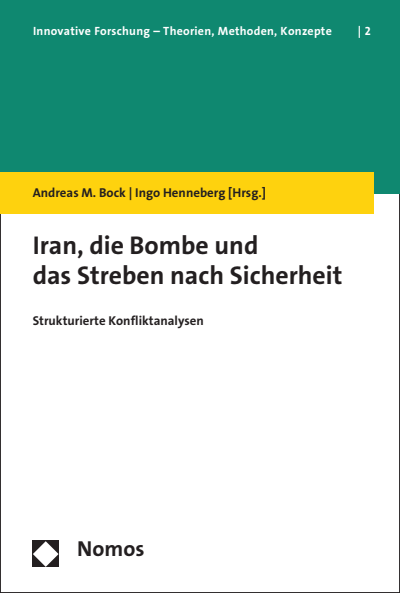
Iran, die Bombe und das Streben nach Sicherheit
Strukturierte Konfliktanalysen- Herausgeber:innen:
- |
- Reihe:
- Innovative Forschung - Theorien, Methoden, Konzepte, Band 2
- Verlag:
- 2014
Zusammenfassung
This volume introduces to the structured conflict analysis as a tool of social science research and uses this instrument exemplarily to analyze systematically and on a broad basis the various conflicts that are associated with Iran both domestically and in foreign policy – beyond popular stereotypes such as the "bomb".
The 13 contributions draw a complex picture of the conflicts with and in Iran and reflect the various aspects of these conflicts from different perspectives and at a high methodological and theoretical level.
The nuclear program is examined, inter alia through the eyes of four major theories of International Relations. In addition, the analyses are concerned with the regional security dimension, the relationship USA–Iran, the role of national preferences, and the effect of national processes to the Iranian foreign policy.
With Contributions by
Payam Ghalehdar, Katharina Götsch, Laleh Gomari-Luksch, Mischa Hansel, Ingo Henneberg, Lukas Kasten, Mirijam Koch, Simon Koschut, Hubert Mayer, Witold Mucha, Michael Nann, Antje Nötzold, Friedrich Plank, Eva Mareike Schmitt, Miriam Shabafrouz, David Summe, Till Florian Tömmel, Christoph Weller, Judith Wiesinger, and Azadeh Zamirirad.
Publikation durchsuchen
Bibliographische Angaben
- Copyrightjahr
- 2014
- ISBN-Print
- 978-3-8487-0802-4
- ISBN-Online
- 978-3-8452-4995-7
- Verlag
- Nomos, Baden-Baden
- Reihe
- Innovative Forschung - Theorien, Methoden, Konzepte
- Band
- 2
- Sprache
- Deutsch
- Seiten
- 340
- Produkttyp
- Sammelband
Inhaltsverzeichnis
- Titelei/Inhaltsverzeichnis Kein Zugriff Seiten 1 - 6
- Iran und die strukturierte Konfliktanalyse Kein Zugriff Seiten 7 - 14 Andreas M. Bock, Ingo Henneberg
- Konfliktanalyse in der Konfliktforschung Kein Zugriff Seiten 15 - 32 Christoph Weller
- Die Anwendungspotenziale der strukturierten Konfliktanalyse in den Internationalen Beziehungen Kein Zugriff Seiten 33 - 44 Friedrich Plank, Ingo Henneberg
- Das iranische Nuklearprogramm und die Regionalordnung im Nahen Osten und am Persischen Golf: Perspektiven des (Neo-)Realismus Kein Zugriff Seiten 45 - 68 Hubert Mayer, Till Florian Tömmel
- 4. Der intraelitäre Konflikt um die Nukleardiplomatie in der Islamischen Republik Iran Kein Zugriff Seiten 69 - 90 Azadeh Zamirirad
- The Power of the Domestic: A Liberal Analysis of US Foreign Policy with Iran Kein Zugriff Seiten 91 - 110 Mirijam Koch
- Das Non-Proliferationsregime: Stolperstein oder Wegweiser zur Lösung des Nuklearkonflikts mit Iran? Kein Zugriff Seiten 111 - 132 Antje Nötzold
- Die USA und das iranische Atomprogramm: Eine konstruktivistische Konfliktanalyse Kein Zugriff Seiten 133 - 156 Simon Koschut
- Die Effekte nuklearer Proliferation in Krisenregionen: Was lässt sich aus der Geschichte lernen? Kein Zugriff Seiten 157 - 180 Mischa Hansel
- 9. Die Rolle Irans im Syrienkonflikt unter Berücksichtigung der regionalen Sicherheitsdimension Kein Zugriff Seiten 181 - 204 Katharina Götsch, Judith Wiesinger
- Der traumatische Verlust eines Verbündeten: Warum die Vereinigten Staaten die Islamische Republik nicht anerkennen Kein Zugriff Seiten 205 - 224 Payam Ghalehdar
- An Eye for an Eye: Bargaining Theory, Mistrust, and the Iranian Nuclear Crisis Kein Zugriff Seiten 225 - 248 Lukas Kasten, Laleh Gomari-Luksch
- „Like a ton of bricks“ – Die Sanktionen als Hürde auf Irans Weg zur Wirtschaftsmacht Kein Zugriff Seiten 249 - 270 Miriam Shabafrouz
- Function follows form? Forenpräferenzen und -divergenzen der Ordnungsmächte in Hinblick auf das iranische Nuklearprogramm Kein Zugriff Seiten 271 - 294 Eva Schmitt
- A spring that would not come: Why the Green Movement did not blossom in Iran, 2009-2010 Kein Zugriff Seiten 295 - 316 Witold Mucha
- „Zwei Seelen wohnen ach in meiner Brust...“ – Konfligierende Identitäten in Iran und ihr Einfluss auf die Außenpolitik Kein Zugriff Seiten 317 - 340 David Summe, Michael Nann