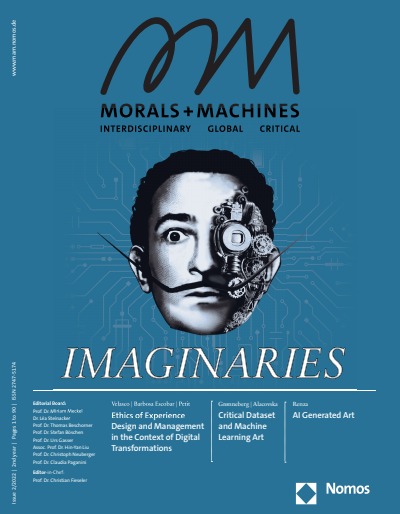
The scientific journal Morals & Machines addresses the question of how algorithms in general and artificial intelligence (AI) especially change society, the economy and the working world, the media, the healthcare system, technology, language, gender relations, and art and culture in a pluralistic manner. It investigates the questions of which ethical risks arise from general and artificial intelligence, what potential they offer and what challenges they pose to legal systems worldwide in relation to technological applications, robotics and the integration of AI. The journal examines these questions from an interdisciplinary, global and critical perspective at the interface between the humanities, social science, law and computer science.
There is growing interest in explanations as an ethical and technical solution to the problem of 'opaque' AI systems. In this essay we point out that technical and ethical approaches to Explainable AI (XAI) have different assumptions and aims....
Advances in AI technology affect knowledge work in diverse fields, including healthcare, engineering, and management. Although automation and machine support can increase efficiency and lower costs, it can also, as an unintended consequence, deskill...
The use of digital technologies for workplace monitoring renders organizational responsibilities murky and opaque. However, clear responsibility for monitoring practices is key for both legal compliance and potential liability, as well as for...
In this paper I will approach the problem of machine opacity in law, according to an understanding of it as a problem revolving around the underlying philosophical tension between description and prescription in law and legal theory. I will use the...
Over recent years, the EU has increasingly looked at the regulation of various forms of automation and the use of algorithms. For recommender systems specifically, two recent legislative proposals by the European Commission, the Digital Services Act...
What does the gambling industry have in common with the digital economy? Silicon Valley has learned from Las Vegas to drive “user engagement” on platforms, such as Facebook and Twitter, and in gaming. These platforms rely on the same...
In this intervention, we discuss to what extent the term “decision” serves as an adequate terminology for what algorithms actually do. Although calculations of algorithms might be perceived as or be an important basis for a decision, we argue,...
This article explores the use of participatory art and technology workshops as an approach to create more diverse and inclusive modes of engagement in the design of digital technologies. Taking the starting point in diverse works of science fiction,...