, um zu prüfen, ob Sie einen Vollzugriff auf diese Publikation haben.
Lehrbuch Kein Zugriff
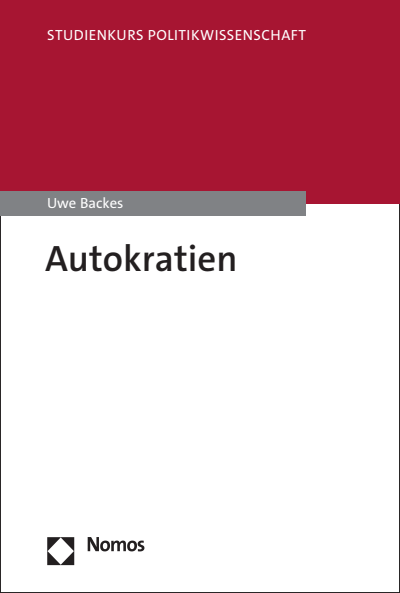
Autokratien
- Autor:innen:
- Verlag:
- 2022
Schlagworte
Publikation durchsuchen
Bibliographische Angaben
- Copyrightjahr
- 2022
- ISBN-Print
- 978-3-8487-8003-7
- ISBN-Online
- 978-3-7489-2395-4
- Verlag
- Nomos, Baden-Baden
- Reihe
- Studienkurs Politikwissenschaft
- Sprache
- Deutsch
- Seiten
- 205
- Produkttyp
- Lehrbuch
Inhaltsverzeichnis
KapitelSeiten
- Titelei/Inhaltsverzeichnis Kein Zugriff Seiten 1 - 10
- I. Einführung Kein Zugriff Seiten 11 - 14
- 1. Konzepte und Theorien Kein Zugriff
- 2. Methoden Kein Zugriff
- 3. Daten Kein Zugriff
- III. Autokratien in der Staatsformenlehre Kein Zugriff Seiten 37 - 42
- 1. Analysekategorien Kein Zugriff
- 2. Typologie Kein Zugriff
- 1. Historisch-terminologische Einordnung Kein Zugriff
- 2. Herrschaftslegitimation Kein Zugriff
- 3. Herrschaftsstrukturen Kein Zugriff
- 1. Historisch-terminologische Einordnung Kein Zugriff
- 2. Herrschaftslegitimation Kein Zugriff
- 3. Herrschaftsstrukturen Kein Zugriff
- 1. Historisch-terminologische Einordnung Kein Zugriff
- 2. Herrschaftslegitimation Kein Zugriff
- 3. Herrschaftsstrukturen Kein Zugriff
- 1. Historisch-terminologische Einordnung Kein Zugriff
- 2. Herrschaftslegitimation Kein Zugriff
- 3. Herrschaftsstrukturen Kein Zugriff
- 1. Begrifflich-konzeptionelle Grundlagen Kein Zugriff
- 2. Herrschaftslegitimation Kein Zugriff
- 3. Herrschaftsstrukturen Kein Zugriff
- 1. Begrifflich-konzeptionelle Grundlagen Kein Zugriff
- 2.1 Dedemokratisierung Kein Zugriff
- 2.2 Despotisierung Kein Zugriff
- 2.3 Detotalisierung und Retotalisierung Kein Zugriff
- 2.4 Hybridisierung Kein Zugriff
- 2.5 Transitorischer Autoritarismus und Liberalisierung Kein Zugriff
- XI. Bilanz und Ausblick: Autokratien im 21. Jahrhundert Kein Zugriff Seiten 151 - 156
- Literaturverzeichnis Kein Zugriff Seiten 157 - 190
- Sachregister Kein Zugriff Seiten 191 - 194
- Personenregister Kein Zugriff Seiten 195 - 202
- Bereits erschienen in der Reihe STUDIENKURS POLITIKWISSENSCHAFT (ab 2017) Kein Zugriff Seiten 203 - 205
Literaturverzeichnis (724 Einträge)
Es wurden keine Treffer gefunden. Versuchen Sie einen anderen Begriff.
- Abdel Jelil, Mohamed/Bhatia, Kartika/Brockmeyer, Anne/Do, Quy-Toan/Joubert, Clément (2018): Unemployment and Violent Extremism. Evidence from Daesh Foreign Recruits, World Bank Policy Research Working Paper 8381, Washington D.C.: World Bank. Google Scholar öffnen DOI: 10.5771/9783748923954
- Acemoglu, Daron/Robinson, James A. (2000): Why Did the West Extend the Franchise? Democracy, Inequality, and Growth in Historical Perspective, in: Quarterly Journal of Economics 115, S. 1167–1199. Google Scholar öffnen DOI: 10.5771/9783748923954
- Acemoglu, Daron/Robinson, James A. (2006): Economic Origins of Dictatorship and Democracy, Cambridge: Cambridge University Press. Google Scholar öffnen DOI: 10.5771/9783748923954
- Ackeret, Markus (2021): Das Pamphlet eines großrussischen Nationalisten, in: Neue Zürcher Zeitung vom 16. 7. 2021. Google Scholar öffnen DOI: 10.5771/9783748923954
- Ackeret, Markus (2021a): Nawalny enthüllt Details zu Putins angeblichem „Palast“, in: Neue Zürcher Zeitung vom 21. 1. 2021. Google Scholar öffnen DOI: 10.5771/9783748923954
- Addio, Mario d‘ (1986): Problemi sociologici, politici e istituzionali in Luigi Sturzo e nella tradizione del popolarismo, in: Sociologia 20:2–3, S. 67–102. Google Scholar öffnen DOI: 10.5771/9783748923954
- Al-Gaddafi, Muammar (1977): Das Grüne Buch, hrsg. vom Weltzentrum für das Studium und die Erforschung des Grünen Buchs, Tripolis: Volks-Dschamahirija. Google Scholar öffnen DOI: 10.5771/9783748923954
- Almond, Gabriel A. (1956): Comparative Political Systems, in: The Journal of Politics 18, S. 391–409. Google Scholar öffnen DOI: 10.5771/9783748923954
- Almond, Gabriel A./Powell, G. Bingham (1966): Comparative Politics. A Developmental Approach, Boston/Toronto: Little, Brown. Google Scholar öffnen DOI: 10.5771/9783748923954
- Almond, Gabriel A./Powell, G. Bingham (1988): Comparative Politics Today. A World View, Glenview: Pearson. Google Scholar öffnen DOI: 10.5771/9783748923954
- Almond, Gabriel A./Verba, Sidney (1963): The Civic Culture. Political Attitudes and Democracy in Five Nations, Princeton, N.J.: Princeton University Press. Google Scholar öffnen DOI: 10.5771/9783748923954
- Almond, Gabriel A./Verba, Sidney (1980): The Civic Culture Revisited, Boston/Toronto: Little, Brown. Google Scholar öffnen DOI: 10.5771/9783748923954
- Al-Rasheed, Madawi (2021): Son King. Reform and Repression in Saudi Arabia, Oxford: Oxford University Press. Google Scholar öffnen DOI: 10.5771/9783748923954
- Altrichter, Helmut (2000): Kleine Geschichte der Sowjetunion, 1917–1991, 2. Aufl., München: C.H Beck. Google Scholar öffnen DOI: 10.5771/9783748923954
- Altrichter, Helmut (2019): Die Chimäre vom Rätestaat, in: Backes, Uwe/Heydemann, Günther/Vollnhals, Clemens (Hrsg.): Staatssozialismen im Vergleich. Staatspartei – Sozialpolitik – Opposition, Göttingen: Vandenhoeck & Ruprecht, S. 29–43. Google Scholar öffnen DOI: 10.5771/9783748923954
- Aly, Götz (2003): Rasse und Klasse. Nachforschungen zum deutschen Wesen, Frankfurt a. M.: S. Fischer Verlag. Google Scholar öffnen DOI: 10.5771/9783748923954
- Ambrosio, Thomas (2021): Russia’s Effects on a Consolidated Democracy. The Erosion of Democracy in Hungary and the Putin Model, in: Kneuer, Marianne/Demmelhuber, Thomas (Hrsg.): Authoritarian Gravity Centers. A Cross-Regional Study of Autoritarian Promotion and Diffusion, New York/London: Routledge, S. 175–202. Google Scholar öffnen DOI: 10.5771/9783748923954
- Amendola, Giovanni (1923): Maggioranza e minoranza, in: Il Mondo vom 12. 5. 1923. Google Scholar öffnen DOI: 10.5771/9783748923954
- Angermüller, Johannes u.a. (2014) (Hrsg.): Diskursforschung. Ein interdisziplinäres Handbuch, 2 Bde., Bielefeld: transcript. Google Scholar öffnen DOI: 10.5771/9783748923954
- Apor, Balázs/Behrends, Jan C. u.a. (2004) (Hrsg.): The Leader Cult in Communist Dictatorships. Stalin and the Eastern Bloc, Basingstoke: Palgrave Macmillan. Google Scholar öffnen DOI: 10.5771/9783748923954
- Aquarone, Alberto (1965): L’organizzazione dello Stato totalitario, Turin: Einaudi. Google Scholar öffnen DOI: 10.5771/9783748923954
- Arendt, Hannah (1951): The Origins of Totalitarianism, New York: Schocken. Google Scholar öffnen DOI: 10.5771/9783748923954
- Arendt, Hannah (1992): Vita activa oder Vom tätigen Leben, 7. Aufl., München: Piper. Google Scholar öffnen DOI: 10.5771/9783748923954
- Arendt, Hannah (2005): Elemente und Ursprünge totaler Herrschaft. Antisemitismus, Imperialismus, Totalitarismus, München/Zürich: Piper. Google Scholar öffnen DOI: 10.5771/9783748923954
- Arendt, Hannah/Voegelin, Eric (2015): Disput über den Totalitarismus. Texte und Briefe, hrsg. vom Hannah-Arendt-Institut in Zusammenarbeit mit dem Voegelin-Zentrum, Göttingen: Vandenhoeck & Ruprecht. Google Scholar öffnen DOI: 10.5771/9783748923954
- Aristoteles (1909): Politica, nach Franz Susemihl neu hrsg. von Otto Immich, Leipzig: Verlag B. G. Teubner. Google Scholar öffnen DOI: 10.5771/9783748923954
- Aristoteles (1955): Politik und Staat der Athener, eingeleitet und neu übertragen von Olof Gigon, Zürich: Artemis-Verlag. Google Scholar öffnen DOI: 10.5771/9783748923954
- Aron, Raymond (1958): Sociologie des sociétés industrielles. Esquisse d’une théorie des régimes politiques, Paris: Centre de Documentation Universitaire. Google Scholar öffnen DOI: 10.5771/9783748923954
- Asch, Ronald G./Duchhardt, Heinz (1996): Der Absolutismus – ein Mythos? Strukturwandel monarchischer Herrschaft in West- und Mitteleuropa (ca. 1550–1700), Köln/Weimar/Wien: Böhlau. Google Scholar öffnen DOI: 10.5771/9783748923954
- Baberowski, Jörg (2017): Nikita Khrushchev and De-Stalinization in the Soviet Union 1953–1964, in: Naimark, Norman u.a. (Hrsg.): The Cambride History of Communism, Bd. 1, Cambridge: Cambridge University Press, S. 113–138. Google Scholar öffnen DOI: 10.5771/9783748923954
- Bach, Maurizio/Breuer, Stefan (2010): Die faschistischen Herrschaftsstrukturen im Vergleich, in: Bach, Maurizio/Breuer, Stefan, Faschismus als Bewegung und Regime, Wiesbaden: Springer VS, S. 413–419. Google Scholar öffnen DOI: 10.5771/9783748923954
- Backes, Uwe (2004): Staatsformen im 19. Jahrhundert, in: Gallus, Alexander/Jesse, Eckhard (Hrsg.): Staatsformen. Modelle politischer Ordnung von der Antike bis zur Gegenwart. Ein Handbuch, Köln/Weimar/Wien: Böhlau, S. 187–222. Google Scholar öffnen DOI: 10.5771/9783748923954
- Backes, Uwe (2009): Totalitarismus und Transformation – Eine Einführung, in: Backes, Uwe/Jaskułowski, Tytus/Polese, Abel (Hrsg.): Totalitarismus und Transformation. Defizite der Demokratiekonsolidierung in Mittel- und Osteuropa, Göttingen: Vandenhoeck & Ruprecht, S. 13–26. Google Scholar öffnen DOI: 10.5771/9783748923954
- Backes, Uwe (2009a): Geschichtspolitik als Kernelement der Herrschaftslegitimation autokratischer Systeme, in: Totalitarismus und Demokratie 6:2, S. 271–292. Google Scholar öffnen DOI: 10.5771/9783748923954
- Backes, Uwe (2009b): Hybrides System des untergehenden Staates: Die DDR 1989–1990, in: Macków, Jerzy (Hrsg.): Autoritarismus in Mittel- und Osteuropa, Wiesbaden: VS Verlag für Sozialwissenschaften, S. 57–85. Google Scholar öffnen DOI: 10.5771/9783748923954
- Backes, Uwe (2013): Vier Grundtypen der Autokratie und ihre Legitimierungsstrategien, in: Kailitz, Steffen/Köllner, Patrick (Hrsg.): Autokratien im Vergleich, Sonderheft der Politischen Vierteljahresschrift 47, Baden-Baden: Nomos, S. 157–175. Google Scholar öffnen DOI: 10.5771/9783748923954
- Backes, Uwe (2014): „Ideokratie“ – eine begriffsgeschichtliche Skizze, in: Backes, Uwe/Kailitz, Steffen (Hrsg.): Ideokratien im Vergleich. Legitimation – Kooptation – Repression, Göttingen: Vandenhoeck & Ruprecht, S. 19–45. Google Scholar öffnen DOI: 10.5771/9783748923954
- Backes, Uwe (2015): Luigi Sturzo. Begründer und früher Wegbereiter des Totalitarismuskonzepts, in: Schale, Frank/Thümmler, Ellen (Hrsg.): Den totalitären Staat denken, Baden-Baden: Nomos, S. 31–50. Google Scholar öffnen DOI: 10.5771/9783748923954
- Backes, Uwe (2017): Liberale Hegemonie vor 1914 und das Überleben von Demokratien der Zwischenkriegszeit, in: Kailitz, Steffen (Hrsg.): Nach dem „Großen Krieg“. Vom Triumph zum Desaster der Demokratie 1918/19 bis 1939, Göttingen: Vandenhoeck & Ruprecht, S. 51–67. Google Scholar öffnen DOI: 10.5771/9783748923954
- Backes, Uwe/Heydemann, Günther (2018): Einleitung der Herausgeber, in: Sturzo, Luigi, Über italienischen Faschismus und Totalitarismus, Göttingen: Vandenhoeck & Ruprecht, S. 7–48. Google Scholar öffnen DOI: 10.5771/9783748923954
- Backes, Uwe/Heydemann, Günther/Vollnhals, Clemens (2019) (Hrsg.): Staatssozialismen im Vergleich. Staatspartei – Sozialpolitik – Opposition, Göttingen: Vandenhoeck & Ruprecht. Google Scholar öffnen DOI: 10.5771/9783748923954
- Backes, Uwe/Jaskułowski, Tytus/Polese, Abel (2009) (Hrsg.): Totalitarismus und Transformation. Defizite der Demokratiekonsolidierung in Mittel- und Osteuropa, Göttingen: Vandenhoeck & Ruprecht. Google Scholar öffnen DOI: 10.5771/9783748923954
- Backes, Uwe/Jesse, Eckhard (1984): Totalitarismus – Extremismus – Terrorismus. Ein Literaturführer und Wegweiser im Lichte deutscher Erfahrung, Opladen: Leske & Budrich. Google Scholar öffnen DOI: 10.5771/9783748923954
- Backes, Uwe/Kailitz, Steffen (2014) (Hrsg.): Ideokratien im Vergleich. Legitimation – Kooptation – Repression, Göttingen: Vandenhoeck & Ruprecht. Google Scholar öffnen DOI: 10.5771/9783748923954
- Backes, Uwe/Kailitz, Steffen (2016) (Hrsg.): Ideocracies in Comparison. Legitimation – co-optation – repression, London/New York: Routledge. Google Scholar öffnen DOI: 10.5771/9783748923954
- Backes, Uwe/Moreau, Patrick (2021): Europas moderner Rechtsextremismus. Ideologien, Akteure, Erfolgsbedingungen und Gefährdungspotentiale, Göttingen: Vandenhoeck & Ruprecht. Google Scholar öffnen DOI: 10.5771/9783748923954
- Bader, Julia/Hackenesch, Christine (2021): Networking with Chinese Characteristics: China’s Party-to-Party Relations in Asia, in: Kneuer, Marianne/Demmelhuber, Thomas (Hrsg.): Authoritarian Gravity Centers. A Cross-Regional Study of Authoritarian Promotion and Diffusion, New York/London: Routledge, S. 225–248. Google Scholar öffnen DOI: 10.5771/9783748923954
- Bader, Julia/Kästner, Antje (2013): Externe Autokratieförderung? Das autokratiefördernde Potenzial russischer und chinesischer Außenpolitik, in: Kailitz, Steffen/Köllner, Patrick (Hrsg.): Autokratien im Vergleich, Baden-Baden: Nomos, S. 564–586. Google Scholar öffnen DOI: 10.5771/9783748923954
- Balík, Stanislav (2019): Die Staatspartei der Tschechoslowakei, in: Backes, Uwe/Heydemann, Günther/Vollnhals, Clemens (Hrsg.): Staatssozialismen im Vergleich. Staatspartei – Sozialpolitik – Opposition, Göttingen: Vandenhoeck & Ruprecht, S. 135–149. Google Scholar öffnen DOI: 10.5771/9783748923954
- Balík, Stanislav/Kubát, Michal (2015): Undemokratische Regime. Theoretische Verortung und Fallbeispiele, Opladen/Berlin/Toronto: Verlag Barbara Budrich. Google Scholar öffnen DOI: 10.5771/9783748923954
- Bank, André/Richter, Thomas (2010): Neopatrimonialism in the Middle East and North Africa: Overview, Critique and Alternative Conceptualization, Hamburg: German Institute of Global and Area Studies. Google Scholar öffnen DOI: 10.5771/9783748923954
- Bank, André/Richter, Thomas (2013): Autoritäre Monarchien im Nahen Osten. Bedingungen für Überleben und Zusammenbruch seit 1945, in: Kailitz, Steffen/Köllner, Patrick (Hrsg.): Autokratien im Vergleich, Sonderheft der Politischen Vierteljahresschrift 47, Baden-Baden: Nomos, S. 384–417. Google Scholar öffnen DOI: 10.5771/9783748923954
- Bank, André/Weyland, Kurt (2017): Clusters of Authoritarian Diffusion and Cooperation: The Role of Interests vs. Ideology?, in: Democratization, Special Issue, 24:7. Google Scholar öffnen DOI: 10.5771/9783748923954
- Basedau, Matthias/Köllner, Patrick (2007): Area studies, comparative area studies, and the study of politics. Context, substance, and methodological challenges, in: Zeitschrift für Vergleichende Politikwissenschaft 1:1, S. 105–124. Google Scholar öffnen DOI: 10.5771/9783748923954
- Bauer, Yehuda (2003): Der dritte Totalitarismus, in: Die Zeit vom 31. 7. 2003. Google Scholar öffnen DOI: 10.5771/9783748923954
- Beblawi, Hazem/Luciani, Giacomo (1987) (Hrsg.): The Rentier State: Nation, State and Integration in the Arab World, London: Croom Helm. Google Scholar öffnen DOI: 10.5771/9783748923954
- Becker, Manuel (2009): Ideologiegeleitete Diktaturen in Deutschland. Zu den weltanschaulichen Grundlagen im „Dritten Reich“ und in der DDR, Bonn: Bouvier. Google Scholar öffnen DOI: 10.5771/9783748923954
- Becker, Manuel (2011): Die Ideokratie als Herrschaftsform. Potentiale eines vergessenen Begriffs in der aktuellen Autokratieforschung, in: Zeitschrift für Politik 58, S. 148–169. Google Scholar öffnen DOI: 10.5771/9783748923954
- Bedford, Sofie (2021): The 2020 Presidential Election in Belarus: Erosion of Authoritarian Stability and Re-politicization of Society, in: Nationalities Papers 49:5, S. 808–819. Google Scholar öffnen DOI: 10.5771/9783748923954
- Beetham, David (1991): The Legitimation of Power, Houndmills: Macmillan. Google Scholar öffnen DOI: 10.5771/9783748923954
- Bell, Daniel A. (2015): The China Model: Political Meritocracy and the Limits of Democracy, Princeton: Princeton University Press. Google Scholar öffnen DOI: 10.5771/9783748923954
- Belleau, Jean-Philippe (2020): Intimacy, hostility, and state politics: François Duvalier and his Inner-circle, 1931–1971, in: History and Anthropology, Mai, S. 1–25. Google Scholar öffnen DOI: 10.5771/9783748923954
- Bellin, Eva (2004): The Robustness of Authoritarianism in the Middle East: Exceptionalism in Comparative Perspective, in: Comparative Politics 36:2, S. 139–157. Google Scholar öffnen DOI: 10.5771/9783748923954
- Bellingcat (2020): FSB Officer Inadvertently Confesses Murder Plot to Navalny, unter: https://www.bellingcat.com/news/uk-and-europe/2020/12/21/if-it-hadnt-been-for-the-prompt-work-of-the-medics-fsb-officer-inadvertently-confesses-murder-plot-to-navalny/ (21. 12. 2020). Google Scholar öffnen DOI: 10.5771/9783748923954
- Berger, Peter L./Luckmann, Thomas (2003): Die gesellschaftliche Konstruktion der Wirklichkeit. Eine Theorie der Wissenssoziologie, Frankfurt a. M.: Fischer. Google Scholar öffnen DOI: 10.5771/9783748923954
- Berg-Schlosser, Dirk (2007) (Hrsg.): Democratization. The state of the art, 2. Aufl., Opladen/Farmington Hills: Barbara Budrich Publishers. Google Scholar öffnen DOI: 10.5771/9783748923954
- Bermeo, Nancy (2016): On Democratic Backsliding, in: Journal of Democracy 27:1, S. 5–19. Google Scholar öffnen DOI: 10.5771/9783748923954
- Bernholz, Peter (1997): Ideology, Sects, State and Totalitarianism: A General Theory, in: Maier, Hans/Schäfer, Michael (Hrsg.): Totalitarismus und politische Religionen. Konzepte des Diktaturvergleichs, Bd. 2, Paderborn: Schöningh, S. 271–298. Google Scholar öffnen DOI: 10.5771/9783748923954
- Bernholz, Peter (2001): Ideocracy and Totalitarianism: A Formal Analysis Incorporating Ideology, in: Public Choice 108, S. 33–75. Google Scholar öffnen DOI: 10.5771/9783748923954
- Bernsen, Michael (2017): Gründungsmythen, in: Kühnhardt, Ludger/Mayer, Tilman (Hrsg.): Bonner Enzyklopädie der Globalität, Wiesbaden: Springer VS, S. 889–898. Google Scholar öffnen DOI: 10.5771/9783748923954
- Besier, Gerhard (2006): Das Europa der Diktaturen. Eine neue Geschichte des 20. Jahrhunderts, München: DVA. Google Scholar öffnen DOI: 10.5771/9783748923954
- Besier, Gerhard/Lambrecht, Ronald (2013): Einleitung der Herausgeber, in: Neumann, Sigmund, Permanente Revolution. Totalitarismus im Zeitalter des internationalen Bürgerkriegs, hrsg. von Gerhard Besier und Ronald Lambrecht, Berlin: LIT Verlag, S. 7–24. Google Scholar öffnen DOI: 10.5771/9783748923954
- Beyme, Klaus von (1973): Die parlamentarischen Regierungssysteme in Europa, 2. ergänzte Aufl., München: Piper. Google Scholar öffnen DOI: 10.5771/9783748923954
- Beyme, Klaus von (1988): Der Vergleich in der Politikwissenschaft, München/Zürich: Piper. Google Scholar öffnen DOI: 10.5771/9783748923954
- Beyme, Klaus von (2000): Eliten als Akteure in der Transformation Rußlands, in: Osteuropa 50:5, S. 478–491. Google Scholar öffnen DOI: 10.5771/9783748923954
- Beyme, Klaus von (2001): Russland zwischen Anarchie und Autokratie, Wiesbaden: Westdeutscher Verlag. Google Scholar öffnen DOI: 10.5771/9783748923954
- Bierling, Stephan (2020): America First. Donald Trump im Weißen Haus. Eine Bilanz, München: C. H. Beck. Google Scholar öffnen DOI: 10.5771/9783748923954
- Black, Ann (2008): Ideology and Law: The Impact of the MIB Ideology on Law and Dispute Resolution in the Sultanate of Brunei Darussalam, in: Asian Journal of Comparative Law 3:1, S. 1–41. Google Scholar öffnen DOI: 10.5771/9783748923954
- Bluntschli, Johann Caspar (1860): Ideokratie und Theokratie, in: Bluntschli, Johann Caspar/Brater, Karl (Hrsg.): Deutsches Staats-Wörterbuch, 5. Bd., Stuttgart/Leipzig: Expedition des Deutschen Staats-Wörterbuchs, S. 279–290. Google Scholar öffnen DOI: 10.5771/9783748923954
- Bluntschli, Johann Caspar (1875): Allgemeine Staatslehre, fünfte umgearbeitete Auflage des ersten Bandes des Allgemeinen Staatsrechts, Stuttgart: Cotta. Google Scholar öffnen DOI: 10.5771/9783748923954
- Böge, Friederike (2021): Sittengemälde einer hedonistischen Elite, in: Frankfurter Allgemeine Zeitung vom 11. 9. 2021, S. 7. Google Scholar öffnen DOI: 10.5771/9783748923954
- Boese, Vanessa A./Lindberg, Staffan I./Lührmann, Anna (2021): Waves of autocratization and democratization: a rejoinder, in: Democratization 28:6, S. 1202–1210. Google Scholar öffnen DOI: 10.5771/9783748923954
- Böss, Otto (1961): Die Lehre der Eurasier. Ein Beitrag zur russischen Ideengeschichte des 20. Jahrhunderts, Wiesbaden: Otto Harrassowitz. Google Scholar öffnen DOI: 10.5771/9783748923954
- Bogaards, Matthijs (2009): How to Classify Hybrid Regimes? Defective Democracy and Electoral Authoritarianism, in: Democratization 16, S. 399–423. Google Scholar öffnen DOI: 10.5771/9783748923954
- Bogaards, Matthijs (2018): De-democratization in Hungary: Diffusely Defective Democracy, in: Democratization 25:8, S. 1481–1499. Google Scholar öffnen DOI: 10.5771/9783748923954
- Bohdan, Siarhei (2013): Who Rules Belarus?, Minsk/London: Centre for Transition Studies. Google Scholar öffnen DOI: 10.5771/9783748923954
- Bohr, Annette (2003): Independent Turkmenistan: From Post-Communism to Sultanism, in: Cummings, Sally N. (Hrsg.): Oil, Transition and Security in Central Asia, London: Routledge, S. 9–24. Google Scholar öffnen DOI: 10.5771/9783748923954
- Bokler-Völkel, Evelyn (2020): Der Islamische Staat – eine politikwissenschaftliche Analyse, in: Backes, Uwe/Gallus, Alexander/Jesse, Eckhard/Thieme, Tom (Hrsg.): Jahrbuch Extremismus & Demokratie, Bd. 32, Baden-Baden: Nomos, S. 79–99. Google Scholar öffnen DOI: 10.5771/9783748923954
- Booß, Christian (2021): Vom Scheitern der kybernetischen Utopie. Die Entwicklung von Überwachung und Informationsverarbeitung im MfS, Göttingen: Vandenhoeck & Ruprecht. Google Scholar öffnen DOI: 10.5771/9783748923954
- Borkenau, Franz (1940): The Totalitarian Enemy, London: Faber and Faber. Google Scholar öffnen DOI: 10.5771/9783748923954
- Bossuet, Jacques Bénigne (1967): Politique tirée des propres paroles de l’Ecriture sainte, édition critique avec introduction et notes par Jacques Le Brun, Genf: Droz. Google Scholar öffnen DOI: 10.5771/9783748923954
- Bosworth, Richard James Boon (2002): Mussolini, London: Bloomsbury. Google Scholar öffnen DOI: 10.5771/9783748923954
- Bracher, Karl Dietrich (1955): Die Auflösung der Weimarer Republik. Eine Studie zum Problem des Machtverfalls in der Demokratie, Stuttgart/Düsseldorf: Ring Verlag. Google Scholar öffnen DOI: 10.5771/9783748923954
- Bracher, Karl Dietrich (1979): Die deutsche Diktatur. Entstehung, Struktur, Folgen des Nationalsozialismus, 6. Aufl., Frankfurt a. M.: Ullstein. Google Scholar öffnen DOI: 10.5771/9783748923954
- Bracher, Karl Dietrich (1982): Zeit der Ideologien. Eine Geschichte politischen Denkens im 20. Jahrhundert, Stuttgart: Deutsche Verlags-Anstalt. Google Scholar öffnen DOI: 10.5771/9783748923954
- Bracher, Karl Dietrich/Sauer, Wolfgang/Schulz, Gerhard (1974): Die nationalsozialistische Machtergreifung, 3 Bde., Frankfurt a. M./Berlin/Wien: Ullstein. Google Scholar öffnen DOI: 10.5771/9783748923954
- Bratton, Michael/Walle, Nicolas van de (1994): Neopatrimonial Regimes and Political Transitions in Africa, in: World Politics 46:4, S. 453–489. Google Scholar öffnen DOI: 10.5771/9783748923954
- Breuer, Stefan (1998): Der Staat. Entstehung, Typen, Organisationsstadien, Reinbek: Rowohlt. Google Scholar öffnen DOI: 10.5771/9783748923954
- Brooker, Paul (2014): Non-Democratic Regimes, 3. Aufl., Basingstoke/New York: Palgrave Macmillan. Google Scholar öffnen DOI: 10.5771/9783748923954
- Brown, Archie (2009): Aufstieg und Fall des Kommunismus, Berlin: Propyläen. Google Scholar öffnen DOI: 10.5771/9783748923954
- Browning, Christopher (2020): Ganz normale Männer. Das Reserve-Polizeibataillon 101 und die „Endlösung“ in Polen, 2. erw. Aufl., Reinbek: Rowohlt. Google Scholar öffnen DOI: 10.5771/9783748923954
- Brownlee, Jason (2007): Hereditary Succession in Modern Autocracies, in: World Politics 59, S. 595–628. Google Scholar öffnen DOI: 10.5771/9783748923954
- Brownlee, Jason (2007a): Authoritarianism in an Age of Democratization, Cambridge/New York: Cambridge University Press. Google Scholar öffnen DOI: 10.5771/9783748923954
- Brunnbauer, Ulf (2005): Alltag und Ideologie im Sozialismus: eine dialektische Beziehung, in: Berliner Osteuropa Info 23, S. 4–16. Google Scholar öffnen DOI: 10.5771/9783748923954
- Brunnbauer, Ulf (2007): „Die sozialistische Lebensweise“. Ideologie, Gesellschaft, Familie und Politik in Bulgarien (1944–1989), Wien: Böhlau Verlag. Google Scholar öffnen DOI: 10.5771/9783748923954
- Brunner, Georg (1979): Vergleichende Regierungslehre, Bd. 1, Paderborn: Schöningh. Google Scholar öffnen DOI: 10.5771/9783748923954
- Brunner, Georg (1989): Ansätze zu einem „sozialistischen Parlamentarismus“ im sowjetischen Hegemonialbereich, in: Rytlewski, Ralf (Hrsg.): Politik und Gesellschaft in sozialistischen Ländern: Ergebnisse und Probleme der Sozialistischen Länder-Forschung, Opladen: Westdeutscher Verlag, S. 151–176. Google Scholar öffnen DOI: 10.5771/9783748923954
- BTI (2020): Country Report Bahrain, unter: https://www.bti-project.org/content/en/downloads/reports/country_report_2020_BHR.pdf (12. 8. 2021). Google Scholar öffnen DOI: 10.5771/9783748923954
- BTI (2021): Wer wir sind, unter: https://bti-project.org/de/ueber-uns (1. 8. 2021). Google Scholar öffnen DOI: 10.5771/9783748923954
- Buchheim, Hans/Broszat, Martin/Jacobsen, Hans-Adolf (2005): Anatomie des SS-Staates, 8. Aufl., München: dtv. Google Scholar öffnen DOI: 10.5771/9783748923954
- Budge, Ian/Klingemann, Hans-Dieter/Volkens, Andrea/Bara, Judith/Tanenbaum, Eric (2001): Mapping Policy Preferences. Estimates for Parties, Electors, and Governments 1945–1998, Oxford: Oxford University Press. Google Scholar öffnen DOI: 10.5771/9783748923954
- Bueno de Mesquita, Bruce/Smith, Alastair/Siverson, Randolph M./Morrow, James D. (2003): The Logic of Political Survival, Cambridge: MIT Press. Google Scholar öffnen DOI: 10.5771/9783748923954
- Bueno de Mesquita, Bruce/Smith, Alastair (2011): The Dictator’s Handbook. Why Bad Behavior is Almost Always Good Politics, New York: Public Affairs. Google Scholar öffnen DOI: 10.5771/9783748923954
- Buhbe, Matthes/Makarenko, Boris I. (2007): Das Mehrparteiensystem im neuen Russland, in: Buhbe, Matthes/Gorzka, Gabriele (Hrsg.): Russland heute. Rezentralisierung des Staates unter Putin, Wiesbaden: Verlag für Sozialwissenschaften, S. 273–291. Google Scholar öffnen DOI: 10.5771/9783748923954
- Bullock, Alan (1991): Hitler und Stalin. Parallele Leben, Berlin: Siedler. Google Scholar öffnen DOI: 10.5771/9783748923954
- Bumbacher, Stephan Peter (2005): Mao-Kult, in: Auffarth, Christoph/Bernard, Jutta/Mohr, Hubert/Imhof, Agnes/Kurre, Silvia (Hrsg.): Metzler Lexikon Religion. Stuttgart: J.B. Metzler, S. 904–906. Google Scholar öffnen DOI: 10.5771/9783748923954
- Busafwan, Abbas/Rosiny, Stephan (2015): Power-Sharing in Bahrain. A Still-Absent Debate, GIGA Working Papers 280, Hamburg: German Institute of Global and Area Studies. Google Scholar öffnen DOI: 10.5771/9783748923954
- Cai Xia (2021): The Party that Failed. An Insider Breaks with Beijing, in: Foreign Affairs 12, unter: https://archive.ph/20201207012951/https://www.foreignaffairs.com/articles/china/2020-12-04/chinese-communist-party-failed (12. 4. 2021). Google Scholar öffnen DOI: 10.5771/9783748923954
- Capoccia, Giovanni (2005): Defending Democracy. Reactions to Extremism in Interwar Europe, Baltimore: Johns Hopkins University Press. Google Scholar öffnen DOI: 10.5771/9783748923954
- Carothers, Christopher (2021): The Autocrat’s Corruption Dilemma, in: Government and Opposition 56:2, S. 1–17. Google Scholar öffnen DOI: 10.5771/9783748923954
- Carothers, Thomas (2002): The End of the Transition Paradigm, in: Journal of Democracy 13:1, S. 5–21. Google Scholar öffnen DOI: 10.5771/9783748923954
- Cassani, Andrea/Tomini, Luca (2019): Autocratization in Post-Cold War Political Regimes, London: Palgrave Macmillan. Google Scholar öffnen DOI: 10.5771/9783748923954
- Castells, Manuel (2009): Communication Power, New York: Oxford University Press. Google Scholar öffnen DOI: 10.5771/9783748923954
- Cavuldak, Ahmet (2019) (Hrsg.): Die Grammatik der Demokratie. Das Staatsverständnis von Peter Graf Kielmansegg, Baden-Baden: Nomos. Google Scholar öffnen DOI: 10.5771/9783748923954
- Chang, Eric/Golden, Miriam A. (2010): Sources of Corruption in Authoritarian Regimes, in: Social Science Quarterly 91:1, S. 1–20. Google Scholar öffnen DOI: 10.5771/9783748923954
- Chang, Jung/Halliday, Jon (2005): Mao: The Unknown Story, London: Jonathan Cape. Google Scholar öffnen DOI: 10.5771/9783748923954
- Chehabi, Houchang E. (2011): Das politische System der Islamischen Republik Iran, in: Zamirirad, Azadeh (Hrsg.): Das politische System Irans, 2. Aufl., Potsdam: WeltTrends, S. 33–52. Google Scholar öffnen DOI: 10.5771/9783748923954
- Chehabi, Houchang E./Linz, Juan J. (1998) (Hrsg.): Sultanistic Regimes, Baltimore: Johns Hopkins University Press. Google Scholar öffnen DOI: 10.5771/9783748923954
- Cheibub, José Antonio/Gandhi, Jennifer/Vreeland, James Raymond (2010): Democracy and dictatorship revisited, in: Public Choice 143, S. 67–101. Google Scholar öffnen DOI: 10.5771/9783748923954
- Chepikova, Ksenia/Leiße, Olaf (2010): Russlands simulierter Föderalismus: Regionalpolitik unter Putin und Medvedev, in: Osteuropa 60:1, S. 15–26. Google Scholar öffnen DOI: 10.5771/9783748923954
- Chevallier, Jean-Jacques/Conac, Gérard (1991): Histoire des institutions et des régimes politiques de la France de 1789 à nos jours, 8. Aufl., Paris: Dalloz. Google Scholar öffnen DOI: 10.5771/9783748923954
- Chew, Phyllis Ghim-Lian (2015): From Third World to First: A Case Study of Lee Kuan Yew and Language Management in Singapore, in: Linguistics and Human Sciences 11:1, S. 31–50. Google Scholar öffnen DOI: 10.5771/9783748923954
- Chomeini, Ruhollah al-Musawi (1983): Der islamische Staat, aus dem Persischen übersetzt und hrsg. von Nader Hassan und Ilse Itscherenska, Berlin: Klaus Schwarz-Verlag. Google Scholar öffnen DOI: 10.5771/9783748923954
- Christensen, Britt/Groshek, Jacob (2020): Emerging media, political protests, and government repression in autocracies and democracies from 1995 to 2012, in: The International Communication Gazette 82:8, S. 685–704. Google Scholar öffnen DOI: 10.5771/9783748923954
- Cingranelli, David L./Richards, David L. (2010): The Cingranelli and Richards (CIRI) Human Rights Data Project, in: Human Rights Quarterly 32, S. 401–424. Google Scholar öffnen DOI: 10.5771/9783748923954
- Cobban, Alfred (1939): Dictatorship. Its History and Theory, New York: Haskell House Publishers. Google Scholar öffnen DOI: 10.5771/9783748923954
- Colas, Dominique (2002): Säubernde und gesäuberte Einheitspartei – Lenin und der Leninismus, in: Backes, Uwe/Courtois, Stéphane (Hrsg.): „Ein Gespenst geht um in Europa“. Das Erbe kommunistischer Ideologien, Köln: Böhlau Verlag, S. 147–186. Google Scholar öffnen DOI: 10.5771/9783748923954
- Collins, Robert (2012): Marked for Life: Songbun. North Korea’s Social Classification System, Washington D.C.: The Committee for Human Rights in North Korea. Google Scholar öffnen DOI: 10.5771/9783748923954
- Conteh-Morgan, Earl (2020): China in sub-Saharan Africa: Implications for democracy promotion, in: Hasenkamp, Miao-Ling Lin (Hrsg.): China and Autocracy. Political Influence and the Limits of Global Democracy, London: I.B. Tauris, S. 179–200. Google Scholar öffnen DOI: 10.5771/9783748923954
- Coppedge, Michael (2017): Eroding Regimes: What, Where, and When?, in: V-Dem Working Paper 57, unter: http://dx.doi.org/10.2139/ssrn.3066677 (12. 8. 2021). Google Scholar öffnen DOI: 10.5771/9783748923954
- Coppedge, Michael/Alvarez, Angel/Maldonado, Claudia (2008): Two Persistent Dimensions of Democracy: Contestation and Inclusiveness, in: Journal of Politics 70:3, S. 632–647. Google Scholar öffnen DOI: 10.5771/9783748923954
- Corni, Gustavo (2009): State and Society: Italy and Germany Compared, in: Bosworth, Richard J. B. (Hrsg.): The Oxford Handbook of Fascism, Oxford: Oxford University Press, S. 279–295. Google Scholar öffnen DOI: 10.5771/9783748923954
- Coser, Lewis A. (1967): Prospects for the New Nations: Totalitarianism, Authoritarianism or Democracy?, in: Coser, Lewis A.: Political Sociology, London: Harper. Google Scholar öffnen DOI: 10.5771/9783748923954
- Council of Europe (2018): Report of the Independent Investigation Body on the allegations of corruption within the Parliamentary Assembly, Straßburg: Independent Investigation Body on the allegations of corruption within the Parliamentary Assembly. Google Scholar öffnen DOI: 10.5771/9783748923954
- Courtois, Stéphane (2007): Dictionnaire du communisme, Paris: Larousse. Google Scholar öffnen DOI: 10.5771/9783748923954
- Croissant, Aurel (2016): Die Politischen Systeme Südostasiens. Eine Einführung, Wiesbaden: Springer VS. Google Scholar öffnen DOI: 10.5771/9783748923954
- Croissant, Aurel/Eschenauer, Tanja/Kamerling, Jil (2017): Militaries’ Role in Political Regimes: Introducing the PRM Data Set, in: European Political Science 16, S. 400–414. Google Scholar öffnen DOI: 10.5771/9783748923954
- Croissant, Aurel/Kuehn, David (2020): Militär und Politik in Demokratien und Autokratien, in: Aus Politik und Zeitgeschichte 70:16–17, S. 39–47. Google Scholar öffnen DOI: 10.5771/9783748923954
- Croissant, Aurel/Wurster, Stefan (2013): Performance and persistence of autocracies in comparison: introducing issues and perspectives, in: Contemporary Politics 19:1, S. 1–18. Google Scholar öffnen DOI: 10.5771/9783748923954
- Dabag, Mihran (2017): Ideologie und gestaltende Gewalt. Aspekte der Formierung genozidaler Tätergesellschaften, in: Glöckner, Olaf/Knocke, Roy (Hrsg.): Das Zeitalter der Genozide. Ursprünge, Formen und Folgen politischer Gewalt im 20. Jahrhundert, Berlin: Duncker & Humblot, S. 153–166. Google Scholar öffnen DOI: 10.5771/9783748923954
- Dahl, Robert A. (1967): Pluralist Democracy in the United States. Conflict and Consent, Chicago: Rand McNally. Google Scholar öffnen DOI: 10.5771/9783748923954
- Dahl, Robert A. (1971): Polyarchy. Participation and Opposition, New Haven: Yale University Press. Google Scholar öffnen DOI: 10.5771/9783748923954
- Demandt, Alexander (2007): Staatsformen der Antike, in: Gallus, Alexander/Jesse, Eckhard (Hrsg.): Staatsformen von der Antike bis zur Gegenwart, 2. Aufl., Köln/Weimar/Wien: Böhlau, S. 57–90. Google Scholar öffnen DOI: 10.5771/9783748923954
- Denison, Michael (2007): Führerkult in Turkmenistan, in: Osteuropa 57:8–9, S. 209–223. Google Scholar öffnen DOI: 10.5771/9783748923954
- Diamond, Larry (2002): Thinking about Hybrid Regimes, in: Journal of Democracy 13:2, S. 21–35. Google Scholar öffnen DOI: 10.5771/9783748923954
- Diamond, Larry (2010): Liberation technology, in: Journal of Democracy 21:3, S. 69–83. Google Scholar öffnen DOI: 10.5771/9783748923954
- Diamond, Larry (2015): Facing Up to the Democratic Recession, in: Journal of Democracy 26:1, S. 141–155. Google Scholar öffnen DOI: 10.5771/9783748923954
- Dikötter, Frank (2020): Diktator werden. Populismus, Personenkult und die Wege zur Macht, Stuttgart: Klett-Cotta. Google Scholar öffnen DOI: 10.5771/9783748923954
- Domínguez, Jorge I. (1998): The Batista Regime in Cuba, in: Chehabi, Houchang E./Linz, Juan J. (Hrsg.): Sultanistic Regimes, Baltimore: Johns Hopkins University Press, S. 113–131. Google Scholar öffnen DOI: 10.5771/9783748923954
- Downs, Anthony (1957): An Economic Theory of Democracy, New York: Harper. Google Scholar öffnen DOI: 10.5771/9783748923954
- Downs, William M. (2012): Political Extremism in Democracies. Combating Intolerance, London: Palgrave Macmillan. Google Scholar öffnen DOI: 10.5771/9783748923954
- Drath, Martin (1958): Totalitarismus in der Volksdemokratie, in: Richert, Ernst: Macht ohne Mandat. Der Staatsapparat in der Sowjetischen Besatzungszone Deutschlands, Köln/Opladen: Westdeutscher Verlag, S. IX–XXXIV. Google Scholar öffnen DOI: 10.5771/9783748923954
- Easton, David (1957): An Approach to the Analysis of Political Systems, in: World Politics 9:3, S. 383–400. Google Scholar öffnen DOI: 10.5771/9783748923954
- Easton, David (1965): A Systems Analysis of Political Life, New York: John Wiley & Sons. Google Scholar öffnen DOI: 10.5771/9783748923954
- Eckstein, Harry (1966): Division and Cohesion in Democracy: A Study of Norway, Princeton: Princeton University Press. Google Scholar öffnen DOI: 10.5771/9783748923954
- Edelman, Murray (1976): Politik als Ritual. Die symbolische Funktion staatlicher Institutionen und politischen Handelns, Frankfurt a. M./New York: Campus. Google Scholar öffnen DOI: 10.5771/9783748923954
- Eisenstadt, Shmuel N. (1973): Traditional Patrimonialism and Modern Neopatrimonialism, Beverly Hills/London: Sage Publications. Google Scholar öffnen DOI: 10.5771/9783748923954
- Elbers, Helmut (2008): Königswege ins 21. Jahrhundert. Die arabischen Monarchien im Vergleich, Diss. phil., Hagen: Fernuniversität Hagen. Google Scholar öffnen DOI: 10.5771/9783748923954
- Eltchaninoff, Michel (2016): In Putins Kopf. Die Philosophie eines lupenreinen Demokraten, Stuttgart: J. G. Cotta’sche Buchhandlung. Google Scholar öffnen DOI: 10.5771/9783748923954
- Ennker, Benno/Hein-Kircher, Heidi (2010) (Hrsg.): Der Führer im Europa des 20. Jahrhunderts, Marburg: Herder-Institut. Google Scholar öffnen DOI: 10.5771/9783748923954
- Erdle, Stefan (2010): Ben Ali’s „New Tunisia“ (1987–2009). A Case Study of Authoritarian Modernization in the Arab World, Berlin: De Gruyter. Google Scholar öffnen DOI: 10.5771/9783748923954
- Erdmann, Gero (2011): Decline of Democracy: Loss of Quality, Hybridisation and Breakdown of Democracy, in: Erdmann, Gero/Kneuer, Marianne (Hrsg.): Regression of Democracy?, Wiesbaden: Springer VS, S. 21–58. Google Scholar öffnen DOI: 10.5771/9783748923954
- Erdmann, Gero (2015): Neopatrimonialism and political regimes, in: Cheeseman, Nic/Anderson, David M./Scheibler, Andrea (Hrsg.): Routledge Handbook of African Politics, London: Routledge, S. 59–69. Google Scholar öffnen DOI: 10.5771/9783748923954
- Erdmann, Gero/Engel, Ulf (2006): Neopatrimonialism Revisited – Beyond a Catch-All Concept, GIGA-Working Papers 16, Hamburg: German Institute of Global and Area Studies. Google Scholar öffnen DOI: 10.5771/9783748923954
- Erdmann, Gero/Kneuer, Marianne (2014): Externe Faktoren der Demokratisierung: Forschungsperspektiven und Entwicklungspotential, in: Erdmann, Gero/Kneuer, Marianne (Hrsg.): Externe Faktoren der Demokratisierung, Baden-Baden: Nomos, S. 319–339. Google Scholar öffnen DOI: 10.5771/9783748923954
- Esen, Berk/Gümuşçü, Şebnem (2018): Building a Competitive Authoritarian Regime: State-Business Relations in the AKP’s Turkey, in: Journal of Balkan and Near Eastern Studies 20:4, S. 349–372. Google Scholar öffnen DOI: 10.5771/9783748923954
- Esen, Berk/Gumuscu, Sebnem (2020): Why did Turkish democracy collapse? A political economy account of AKP’s authoritarianism, in: Party Politics 20, S. 1–17. Google Scholar öffnen DOI: 10.5771/9783748923954
- Evans, Peter B. (1989): Predatory, Developmental, and Other Apparatuses: A Comparative Political Economy Perspective on the Third World State, in: Sociological Forum 4:4, S. 561–587. Google Scholar öffnen DOI: 10.5771/9783748923954
- Fainsod, Merle (1970): How Russia is Ruled, revised edition, Cambridge, Mass.: Harvard University Press. Google Scholar öffnen DOI: 10.5771/9783748923954
- Falter, Jürgen W. (2020): Hitlers Parteigenossen. Die Mitglieder der NSDAP 1919–1945, Frankfurt a. M./New York: Campus Verlag. Google Scholar öffnen DOI: 10.5771/9783748923954
- Finer, Samuel H. (1976): The Man on Horseback: The Role of the Military in Politics, New Jersey: Transaction Publishers. Google Scholar öffnen DOI: 10.5771/9783748923954
- Finer, Samuel H. (2003): The History of Government, Bd. 1: Ancient Monarchies and Empires, Oxford: Oxford University Press. Google Scholar öffnen DOI: 10.5771/9783748923954
- Finer, Samuel H. (2003a): The History of Government, Bd. 3: Empires, Monarchies and the Modern State, Oxford: Oxford University Press. Google Scholar öffnen DOI: 10.5771/9783748923954
- Finer, Samuel H. (2006): The History of Government, Bd. 2: The Intermediate Ages, Oxford: Oxford University Press. Google Scholar öffnen DOI: 10.5771/9783748923954
- Fitzpatrick, Sheila (1996): Signals from Below. Soviet Letters of Denunciation of the 1930s, in: Journal of Modern History 68, S. 831–866. Google Scholar öffnen DOI: 10.5771/9783748923954
- Focus Online (2018): Turkmenischer Präsident verbietet schwarze Autos, unter: https://www.focus.de/politik/ausland/repressive-ex-sowjetrepublik-turkmenischer-praesident-verbietet-schwarze-autos-weil-sie-ihm-nicht-gefallen_id_8245140.html (6. 1. 2018). Google Scholar öffnen DOI: 10.5771/9783748923954
- Foucault, Michel (2004): Geschichte der Gouvernementalität I und II, hrsg. von Michel Sennelart, Frankfurt a. M.: Suhrkamp. Google Scholar öffnen DOI: 10.5771/9783748923954
- Foucault, Michel (2005): Analytik der Macht, hrsg. von Daniel Defert und François Ewald, Frankfurt a. M.: Suhrkamp. Google Scholar öffnen DOI: 10.5771/9783748923954
- Fraenkel, Ernst (1964): Deutschland und die westlichen Demokratien, Stuttgart: Kohlhammer. Google Scholar öffnen DOI: 10.5771/9783748923954
- Fraenkel, Ernst (2001): Der Doppelstaat, 2. Aufl., hrsg. und eingeleitet von Alexander von Brünneck, Hamburg: Europäische Verlagsanstalt. Google Scholar öffnen DOI: 10.5771/9783748923954
- Franco, Francisco (1936): Proclama del Alzamiento, unter: https://www.alianzaeditorial.es/minisites/manual_web/3491170/CAPITULO4/DOCUMENTOS/11_ProclamaAlzamiento.pdf (12. 4. 2020). Google Scholar öffnen DOI: 10.5771/9783748923954
- Francois, Patrick/Rainer, Ilia/Trebbi, Francesco (2014): The Dictator’s Inner Circle, NBER Working Paper 20216, Cambridge, Mass.: National Bureau of Economic Research. Google Scholar öffnen DOI: 10.5771/9783748923954
- Frank, Rüdiger (2008): Nordkorea: Zwischen Stagnation und Veränderungsdruck, in: Heberer, Thomas/Derichs, Claudia (Hrsg.): Einführung in die politischen Systeme Ostasiens, 2. Aufl., Wiesbaden: VS Verlag, S. 351–416. Google Scholar öffnen DOI: 10.5771/9783748923954
- Frank, Rüdiger (2014): Nordkorea. Innenansichten eines totalen Staates, München: Deutsche Verlags-Anstalt. Google Scholar öffnen DOI: 10.5771/9783748923954
- Frankenberg, Günther (2020): Autoritarismus. Verfassungstheoretische Perspektiven, Berlin: Suhrkamp. Google Scholar öffnen DOI: 10.5771/9783748923954
- Frankenberger, Rolf (2013): Mikrophysik und Makrostruktur. Überlegungen zu einer Analytik der Macht in Autokratien, in: Kailitz, Steffen/Köllner, Patrick (Hrsg.): Autokratien im Vergleich, Baden-Baden: Nomos, S. 60–85. Google Scholar öffnen DOI: 10.5771/9783748923954
- Franzinelli, Mimmo (2009): Squadrism, in: Bosworth, Richard J. B. (Hrsg.): The Oxford Handbook of Fascism, Oxford: Oxford University Press, S. 91–108. Google Scholar öffnen DOI: 10.5771/9783748923954
- Freeden, Michael (1998): Is Nationalism a Distinct Ideology?, in: Political Studies XLVI, S. 748–765. Google Scholar öffnen DOI: 10.5771/9783748923954
- Freeden, Michael (2006): Ideology and political theory, in: Journal of Political Ideologies 11:1, S. 3–22. Google Scholar öffnen DOI: 10.5771/9783748923954
- Freedom House (2002): Freedom in the World 2001–2002. The Annual Survey of Political Rights and Civil Liberties, New York: Freedom House/Transaction Publishers. Google Scholar öffnen DOI: 10.5771/9783748923954
- Freedom House (2003): Freedom in the World 2003. The Annual Survey of Political Rights and Civil Liberties, New York/Washington D.C.: Rowman & Littlefield. Google Scholar öffnen DOI: 10.5771/9783748923954
- Freedom House (2015): Freedom in the World 2014. The Annual Survey of Political Rights and Civil Liberties, New York/Washington D.C.: Rowman & Littlefield. Google Scholar öffnen DOI: 10.5771/9783748923954
- Freedom House (2019): Freedom in the World 2018. The Annual Survey of Political Rights and Civil Liberties, New York/Washington D.C.: Rowman & Littlefield. Google Scholar öffnen DOI: 10.5771/9783748923954
- Freedom House (2021): Freedom in the World 2020. The Annual Survey of Political Rights and Civil Liberties, New York/Washington D.C.: Rowman & Littlefield. Google Scholar öffnen DOI: 10.5771/9783748923954
- Freedom House (2021a): Freedom in the World 2021: United States, unter: https://freedomhouse.org/country/united-states/freedom-world/2021 (12. 8. 2021). Google Scholar öffnen DOI: 10.5771/9783748923954
- Fricke, Karl Wilhelm (1990): Zur Abschaffung des Amtes für Nationale Sicherheit, in: Deutschland Archiv 23, S. 59–62. Google Scholar öffnen DOI: 10.5771/9783748923954
- Fricke, Karl-Wilhelm (1999): Die Kommunalwahl 1989, in: Kuhrt, Eberhard, in Verbindung mit Hannsjörg F. Buck und Gunter Holzweißig (Hrsg.): Opposition in der DDR von den 70er Jahren bis zum Zusammenbruch der SED-Herrschaft, Opladen: Westdeutscher Verlag, S. 467–505. Google Scholar öffnen DOI: 10.5771/9783748923954
- Frie, Ewald/Meier, Mischa (2014) (Hrsg.): Aufruhr – Katastrophe – Konkurrenz – Zerfall. Bedrohte Ordnungen als Thema der Kulturwissenschaften, Tübingen: Mohr Siebeck. Google Scholar öffnen DOI: 10.5771/9783748923954
- Friedrich, Carl Joachim (1954): The Unique Character of Totalitarian Society, in: Friedrich, Carl Joachim (Hrsg.): Totalitarianism. Proceedings of a Conference Held at the American Academy of Arts and Sciences, Cambridge, Mass.: Harvard University Press, S. 47–60. Google Scholar öffnen DOI: 10.5771/9783748923954
- Friedrich, Carl Joachim (1957), unter Mitwirkung von Zbigniew K. Brzezinski: Totalitäre Diktatur, Stuttgart: Kohlhammer. Google Scholar öffnen DOI: 10.5771/9783748923954
- Friedrich, Carl Joachim (1964) (Hrsg.): Totalitarianism, New York: Grosset & Dunlap. Google Scholar öffnen DOI: 10.5771/9783748923954
- Friedrich, Carl Joachim (1973): Pathologie der Politik. Die Funktion der Missstände: Gewalt, Verrat, Korruption, Geheimhaltung, Propaganda, Frankfurt a. M./New York: Herder & Herder. Google Scholar öffnen DOI: 10.5771/9783748923954
- Friedrich, Carl Joachim (1974): Der einzigartige Charakter der totalitären Gesellschaft, in: Seidel, Bruno/Jenkner, Siegfried (Hrsg.): Wege der Totalitarismus-Forschung, Darmstadt: Wissenschaftliche Buchgesellschaft, S. 179–196. Google Scholar öffnen DOI: 10.5771/9783748923954
- Friedrich, Carl J./Brzezinski, Zbigniew (1956): Totalitarian Dictatorship and Autocracy, Cambridge: Cambridge University Press. Google Scholar öffnen DOI: 10.5771/9783748923954
- Friedrich, Carl J./Brzezinski, Zbigniew (1965): Totalitarian Dictatorship and Autocracy, 2. Revidierte Aufl., Cambridge, Mass.: Harvard University Press. Google Scholar öffnen DOI: 10.5771/9783748923954
- Friske, Tobias (2008): Monarchien – Überblick und Systematik, in: Riescher, Gisela/Thumfart, Alexander (Hrsg.): Monarchien, Baden-Baden: Nomos, S. 14–23. Google Scholar öffnen DOI: 10.5771/9783748923954
- Fritze, Lothar (2012): Anatomie des totalitären Denkens. Kommunistische und nationalsozialistische Weltanschauung im Vergleich, München: Olzog. Google Scholar öffnen DOI: 10.5771/9783748923954
- Fritzsche, Erik/Lange, Sebastian (2017): Das politische System des Islamischen Staates, in: Totalitarismus und Demokratie 14, S. 201–232. Google Scholar öffnen DOI: 10.5771/9783748923954
- Fuchs, Dieter (1997): Kriterien demokratischer Performanz in liberalen Demokratien, Berlin: Wissenschaftszentrum Berlin für Sozialforschung. Google Scholar öffnen DOI: 10.5771/9783748923954
- Fürtig, Henner (1995): Demokratie in Saudi-Arabien? Die Al Sa‘ud und die Folgen des zweiten Golfkrieges, Berlin: Verlag Das Arabische Buch. Google Scholar öffnen DOI: 10.5771/9783748923954
- Fukuyama, Francis (1992): Das Ende der Geschichte. Wo stehen wir?, München: Kindler. Google Scholar öffnen DOI: 10.5771/9783748923954
- Fulbrook, Mary (2008): Ein ganz normales Leben. Alltag und Gesellschaft in der DDR, Darmstadt: Wissenschaftliche Buchgesellschaft. Google Scholar öffnen DOI: 10.5771/9783748923954
- Gängel, Andreas (1994): Die DDR-Justiz im Prozess der „Wende“, in: Rottleuthner, Hubert (Hrsg.): Steuerung der Justiz in der DDR. Einflussnahme der Politik auf Richter, Staatsanwälte und Rechtsanwälte, Köln: Bundesanzeiger-Verlagsgesellschaft, S. 429–446. Google Scholar öffnen DOI: 10.5771/9783748923954
- Gallus, Alexander (2007): Typologisierung von Staatsformen und politischen Systemen in Geschichte und Gegenwart, in: Gallus, Alexander/Jesse, Eckhard (Hrsg.): Staatsformen von der Antike bis zur Gegenwart, 2. Aufl., Köln/Weimar/Wien: Böhlau, S. 19–55. Google Scholar öffnen DOI: 10.5771/9783748923954
- Gallus, Alexander/Jesse, Eckhard (2007) (Hrsg.): Staatsformen von der Antike bis zur Gegenwart, 2. Aufl., Köln/Weimar/Wien: Böhlau. Google Scholar öffnen DOI: 10.5771/9783748923954
- Gallus, Alexander/Jesse, Eckhard (2007): Einleitung, in: Gallus, Alexander/Jesse, Eckhard (Hrsg.): Staatsformen von der Antike bis zur Gegenwart, 2. Aufl., Köln/Weimar/Wien: Böhlau, S. 9–18. Google Scholar öffnen DOI: 10.5771/9783748923954
- Gandhi, Jennifer (2008): Political Institutions under Dictatorship, New York: Cambridge University Press. Google Scholar öffnen DOI: 10.5771/9783748923954
- Gandhi, Jennifer/Lust-Okar, Ellen (2009): Elections under authoritarianism, in: Annual Review of Political Science 12, S. 403–422. Google Scholar öffnen DOI: 10.5771/9783748923954
- Gandhi, Jennifer/Przeworski, Adam (2007): Authoritarian Institutions and the Survival of Autocrats, in: Comparative Political Studies 40:11, S. 1279–1301. Google Scholar öffnen DOI: 10.5771/9783748923954
- Garcelon, Marc (1997): The Shadow of the Leviathan: Public and Private in Communist and Post-Communist Society, in: Weintraub, Jeff/Kumar, Krishan (Hrsg.): Public and Private in Thought and Practice, Chicago: University of Chicago Press, S. 303–332. Google Scholar öffnen DOI: 10.5771/9783748923954
- Gauchet, Marcel (2010): L’Avènement de la démocratie, Bd. III: À l’épreuve des totalitarismes, 1914–1974, Paris: Gallimard. Google Scholar öffnen DOI: 10.5771/9783748923954
- Gause, F. Gregory (1994): Oil Monarchies. Domestic and Security Challenges in the Arab Gulf States, New York: Council on Foreign Relations Press. Google Scholar öffnen DOI: 10.5771/9783748923954
- Gawrich, Andrea/Debiel, Tobias (2016): Korruptionsforschung in der vergleichenden Politikwissenschaft, in: Lauth, Hans-Joachim/Kneuer, Marianne/Pickel, Gert (Hrsg.): Handbuch Vergleichende Politikwissenschaft, Wiesbaden: Springer VS, S. 633–647. Google Scholar öffnen DOI: 10.5771/9783748923954
- Geddes, Barbara (1999): What do we know about democratization after twenty years?, in: Annual Review of Political Science 2/1, S. 115–144. Google Scholar öffnen DOI: 10.5771/9783748923954
- Geddes, Barbara (2002): The Effect of Foreign Pressure on the Collapse of Authoritarian Regimes, Paper presented at the Annual Meeting of the American Political Science Association, Boston. Google Scholar öffnen DOI: 10.5771/9783748923954
- Geddes, Barbara/Wright, Joseph/Frantz, Erica (2014): Autocratic Breakdown and Regime Transitions. A New Data Set, in: Perspectives on Politics 12:2, S. 313–331. Google Scholar öffnen DOI: 10.5771/9783748923954
- Geddes, Barbara/Wright, Joseph/Frantz, Erica (2018): How Dictatorships Work. Power, Personalization and Collapse, Cambridge: Cambridge University Press. Google Scholar öffnen DOI: 10.5771/9783748923954
- Geerts, Clifford (1995): Dichte Beschreibung. Beiträge zum Verstehen kultureller Systeme, Frankfurt a. M.: Suhrkamp. Google Scholar öffnen DOI: 10.5771/9783748923954
- Geiger, Theodor (1932): Die soziale Schichtung des deutschen Volkes. Soziographischer Versuch auf statistischer Grundlage, Stuttgart: Enke. Google Scholar öffnen DOI: 10.5771/9783748923954
- Gelius, Peter (2013): Sultanistischer Totalitarismus. Nordkorea, Rumänien und Kuba im regimetheoretischen Vergleich, Baden-Baden: Nomos. Google Scholar öffnen DOI: 10.5771/9783748923954
- Gellately, Robert (1997): Denunciations and Nazi Germany: New Insights and Methodological Problems, in: Historical Social Research 22–3/4, S. 228–239. Google Scholar öffnen DOI: 10.5771/9783748923954
- Gemilere, Jordan (2019): Political Stability in Contemporary Monarchies: The Case of Oman, All College Thesis Program, unter: https://digitalcommons.csbsju.edu/honors_thesis/69 (20. 12. 2020). Google Scholar öffnen DOI: 10.5771/9783748923954
- Genscher, Hans-Dietrich/Vodička, Karel (2014): Zündfunke aus Prag. Wie 1989 der Mut zur Freiheit die Geschichte veränderte, München: dtv. Google Scholar öffnen DOI: 10.5771/9783748923954
- Gentile, Emilio (1975): Le origini dell’ideologia fascista (1918–1925), Bari: Laterza. Google Scholar öffnen DOI: 10.5771/9783748923954
- Gentile, Emilio (1995): La via italiana al totalitarismo: il partito e lo stato nel regime fascista, Rom: La Nuova Italia Scientifica. Google Scholar öffnen DOI: 10.5771/9783748923954
- Gentile, Emilio (2021): Der Antifaschismus und die Ursprünge des faschistischen Totalitarismus (1923–1926), in: Totalitarismus und Demokratie 18, S. 33–51. Google Scholar öffnen DOI: 10.5771/9783748923954
- Gentile, Emilio/Mallett, Robert (2000): The Sacralisation of Politics: Definitions, Interpretations and Reflections on the Question of Secular Religion and Totalitarianism, in: Totalitarian Movements and Political Religions 1:1, S. 18–55. Google Scholar öffnen DOI: 10.5771/9783748923954
- Gerschewski, Johannes (2006): Die Juche-Ideologie. Zu den regimelegitimierenden Funktionen der nordkoreanischen Ideologie, in: Köllner, Patrick (Hrsg.): Korea. Politik, Wirtschaft, Gesellschaft, Hamburg: German Institute for Global and Area Studies, S. 125–156. Google Scholar öffnen DOI: 10.5771/9783748923954
- Gerschewski, Johannes (2013): The three pillars of stability: legitimation, repression, and co-optation in autocratic regimes, in: Democratization 20:1, S. 13–38. Google Scholar öffnen DOI: 10.5771/9783748923954
- Gerschewski, Johannes/Merkel, Wolfgang (2014): Stabilität autokratischer Herrschaft, in: Braml, Josef/Merkel, Wolfgang/Sandschneider, Eberhard (Hrsg.): Außenpolitik mit Autokratien, Oldenbourg: De Gruyter, S. 43–56. Google Scholar öffnen DOI: 10.5771/9783748923954
- Geyer, Michael/Fitzpatrick, Sheila (2009) (Hrsg.): Beyond Totalitarianism. Stalinism and Nazism Compared, Cambridge: Cambridge University Press. Google Scholar öffnen DOI: 10.5771/9783748923954
- Gibas, Monika (2000): Propaganda in der DDR 1949–1989, Erfurt: Landeszentrale für politische Bildung. Google Scholar öffnen DOI: 10.5771/9783748923954
- Gieseke, Jens (2000): Die hauptamtlichen Mitarbeiter der Staatssicherheit. Personalstruktur und Lebenswelt 1950–1989/90, Berlin: Christoph Links Verlag. Google Scholar öffnen DOI: 10.5771/9783748923954
- Ginsburg, Tom/Simpser, Alberto (2014): Constitutions in Authoritarian Regimes, New York: Cambridge University Press. Google Scholar öffnen DOI: 10.5771/9783748923954
- Glosemeyer, Iris (2004): Saudi Arabia: Dynamism Uncovered, in: Perthes, Volker (Hrsg.): Arab Elites. Negotiating the Politics of Change, Boulder/London: Lynne Rienner, S. 141–169. Google Scholar öffnen DOI: 10.5771/9783748923954
- Göbel, Christian (2014): Legitimation, Kooptation und Repression in der Volksrepublik China, in: Backes, Uwe/Kailitz, Steffen (Hrsg.): Ideokratien im Vergleich. Legitimation – Kooptation – Repression, Göttingen: Vandenhoeck & Ruprecht, S. 207–227. Google Scholar öffnen DOI: 10.5771/9783748923954
- Goemans, Hein E. (2008): Which Way Out? The Manner and Consequences of Losing Office, in: Journal of Conflict Resolution 52, S. 771–794. Google Scholar öffnen DOI: 10.5771/9783748923954
- Gorlizki, Yoram/Mommsen, Hans (2009): The Political (Dis)Orders of Stalinism and National Socialism, in: Geyer, Michael/Fitzpatrick, Sheila (Hrsg.): Beyond Totalitarianism. Stalinism and Nazism Compared, Cambridge: Cambridge University Press, S. 41–86. Google Scholar öffnen DOI: 10.5771/9783748923954
- Grabowsky, Ingo (2004): Agitprop in der Sowjetunion. Die Abteilung für Agitation und Propaganda 1920–1928, Bochum/Freiburg: Projekt Verlag. Google Scholar öffnen DOI: 10.5771/9783748923954
- Gräßler, Florian (2014): War die DDR totalitär? Eine vergleichende Untersuchung des Herrschaftssystems der DDR anhand der Totalitarismuskonzepte von Friedrich, Linz, Bracher und Kielmansegg, Baden-Baden: Nomos. Google Scholar öffnen DOI: 10.5771/9783748923954
- Gray, Matthew (2018): Rentierism’s Siblings: On the Linkages between Rents, Neopatrimonialism, and Entrepreneurial State Capitalism in the Persian Gulf Monarchies, in: Journal of Arabian Studies 8, S. 29–45. Google Scholar öffnen DOI: 10.5771/9783748923954
- Gray, Phillip W. (2020): Vanguardism. Ideology and Organization in Totalitarian Politics, New York/London: Routledge. Google Scholar öffnen DOI: 10.5771/9783748923954
- Greiner, Bettina/Kramer, Alan (2013) (Hrsg.): Welt der Lager: Zur „Erfolgsgeschichte“ einer Institution, Hamburg: Hamburger Edition. Google Scholar öffnen DOI: 10.5771/9783748923954
- Griffin, Roger (1991): The Nature of Fascism, London: Pinter Publishers. Google Scholar öffnen DOI: 10.5771/9783748923954
- Griffin, Roger (2014): The Legitimizing Role of Palingenetic Myth in Ideocracies, in: Backes, Uwe/Kailitz, Steffen (Hrsg.): Ideokratien im Vergleich. Legitimation – Kooptation – Repression, Göttingen: Vandenhoeck & Ruprecht, S. 279–295. Google Scholar öffnen DOI: 10.5771/9783748923954
- Guo, Sujian (2000): Post-Mao China. From Totalitarianism to Authoritarianism?, Westport/London: Praeger. Google Scholar öffnen DOI: 10.5771/9783748923954
- Gurian, Waldemar (1954): Totalitarianism as Political Religion, in: Friedrich, Carl J. (Hrsg.): Totalitarianism, New York: The Universal Library Grosset & Dunlap, S. 119–129. Google Scholar öffnen DOI: 10.5771/9783748923954
- Gurr, Ted Robert (1974): Persistence and Change in Political Systems, 1800–1971, in: American Political Science Review 68:4, S. 1482–1504. Google Scholar öffnen DOI: 10.5771/9783748923954
- Hachtmann, Rüdiger (2011): Elastisch, dynamisch und von katastrophaler Effizienz – Anmerkungen zur Neuen Staatlichkeit des Nationalsozialismus, in: Reichardt, Sven/Seibel, Wolfgang (Hrsg.): Der prekäre Staat. Herrschen und Verwalten im Nationalsozialismus, Frankfurt a. M./New York: Campus Verlag, S. 29–73. Google Scholar öffnen DOI: 10.5771/9783748923954
- Hadenius, Axel/Teorell, Jan (2006): Authoritarian Regimes: Stability, Change, and Path¬ways to Democracy, 1972–2003, Kellogg Working Paper 331, Notre Dame: Kellogg Institute for International Studies. Google Scholar öffnen DOI: 10.5771/9783748923954
- Hadenius, Axel/Teorell, Jan (2007): Pathways from authoritarianism, in: Journal of Democracy 18/1, S. 143–157. Google Scholar öffnen DOI: 10.5771/9783748923954
- Hadenius, Axel/Teorell, Jan/Wahman, Michael (2017): Authoritarian Regimes Data Set, version 6.0, unter: https://docs.google.com/document/d/1lsz3Dgo8-95kNiAXihaiHGDGOncFWJWzr4ThNAYDm3o/edit (12. 9. 2018). Google Scholar öffnen DOI: 10.5771/9783748923954
- Hale, Henry E. (2015): Patronal Politics. Eurasian Regime Dynamics in Comparative Perspective, New York: Cambridge University Press. Google Scholar öffnen DOI: 10.5771/9783748923954
- Haller, Carl Ludwig von (1808): Handbuch der allgemeinen Staatenkunde, Winterthur: Steiner. Google Scholar öffnen DOI: 10.5771/9783748923954
- Haller, Carl Ludwig von (1964): Restauration der Staatswissenschaft oder Theorie des natürlich-geselligen Zustands, der Chimäre des künstlich-bürgerlichen entgegengesetzt, Bd. 4: Makrobiotik der Patrimonialstaaten, Neudruck der 2. Aufl. Winterthur 1822, Aalen: Scientia Verlag. Google Scholar öffnen DOI: 10.5771/9783748923954
- Haller, Carl Ludwig von (1964a): Restauration der Staatswissenschaft oder Theorie des natürlich-geselligen Zustands, der Chimäre des künstlich-bügerlichen entgegengesetzt, Bd. 5: Makrobiotik der geistlichen Herrschaften oder Priesterstaaten, Neudruck der 2. Aufl. Winterthur 1834, Aalen: Scientia Verlag. Google Scholar öffnen DOI: 10.5771/9783748923954
- Hallgarten, George W. F. (1957): Dämonen oder Retter. Eine kurze Geschichte der Diktatur seit 600 v. Chr., Frankfurt a. M.: Europäische Verlagsanstalt. Google Scholar öffnen DOI: 10.5771/9783748923954
- Hartlyn, Jonathan (1998): The Trujillo Regime in the Dominican Republic, in: Chehabi, Houchang E./ Linz, Juan J. (Hrsg.): Sultanistic Regimes, Baltimore: Johns Hopkins University Press, S. 85–112. Google Scholar öffnen DOI: 10.5771/9783748923954
- Havel, Václav (1980): Versuch, in der Wahrheit zu leben. Von der Macht der Ohnmächtigen, Reinbek bei Hamburg: Rowohlt. Google Scholar öffnen DOI: 10.5771/9783748923954
- Hawk, David (2003): The Hidden GULAG. Exposing North Korea’s Prison Camps, Washington D.C.: U.S. Committee for Human Rights in North Korea. Google Scholar öffnen DOI: 10.5771/9783748923954
- Hayes, Carlton J. H. (1940): The Novelty of Totalitarianism in the History of Western Civilization, in: Proceedings of the American Philosophical Society 82:1, S. 86–100. Google Scholar öffnen DOI: 10.5771/9783748923954
- Heilmann, Sebastian (2016): Das politische System der Volksrepublik China, 3. Aufl., Wiesbaden: Springer VS. Google Scholar öffnen DOI: 10.5771/9783748923954
- Heilmann, Sebastian/Shih, Lea (2016): Die Zentralregierung, in: Heilmann, Sebastian: Das politische System der Volksrepublik China, 3. Aufl., Wiesbaden: Springer VS, S. 58–68. Google Scholar öffnen DOI: 10.5771/9783748923954
- Heilmann, Sebastian/Shih, Lea/Stepan, Matthias (2016): Kadersystem und öffentliche Verwaltung, in: Heilmann, Sebastian: Das politische System der Volksrepublik China, 3. Aufl., Wiesbaden: Springer VS, S. 100–111. Google Scholar öffnen DOI: 10.5771/9783748923954
- Heinritz, Katrin (2007): „Defekte Demokratisierung“ – ein Weg zur Diktatur? Turkmenistan und die Republik Sacha (Jakutien) in der Russischen Föderation nach dem Ende der Sowjetunion, Frankfurt a. M.: Peter Lang. Google Scholar öffnen DOI: 10.5771/9783748923954
- Helmke, Gretchen/Levitsky, Steven (2004): Informal institutions and comparative politics: A research agenda, in: Perspectives on Politics 2:4, S. 725–740. Google Scholar öffnen DOI: 10.5771/9783748923954
- Henschel, Sandro (2016): Systematische Propaganda zur Schaffung nationaler Identität in den Staaten Zentralasiens, Diss. phil., Dresden: Technische Universität Dresden. Google Scholar öffnen DOI: 10.5771/9783748923954
- Herb, Michael (1999): All in the Family. Absolutism, Revolution, and Democracy in the Middle Eastern Monarchies, New York: State University of New York Press. Google Scholar öffnen DOI: 10.5771/9783748923954
- Herb, Michael (2004): Princes and Parliaments in the Arab World, in: Middle East Journal 58:3, S. 367–384. Google Scholar öffnen DOI: 10.5771/9783748923954
- Hermet, Guy (2000): Unfree Elections, in: Rose, Richard (Hrsg.): International Encyclopedia of Elections, London: Macmillan, S. 323–329. Google Scholar öffnen DOI: 10.5771/9783748923954
- Hertle, Hans-Hermann (1992): Der Weg in den Bankrott der DDR-Wirtschaft. Das Scheitern der „Einheit von Wirtschafts- und Sozialpolitik“ am Beispiel der Schürer/Mittag-Kontroverse im Politbüro 1988, in: Deutschland Archiv 25, S. 127–142. Google Scholar öffnen DOI: 10.5771/9783748923954
- Hertog, Steffen (2006): Segmented Clientelism: the Political Economy of Saudi Economic Reform Efforts, in: Aarts, Paul/Nonneman, Gerd (Hrsg.): Saudi Arabia in the Balance – Political Economy, Society, Foreign Affairs, New York: State University of New York Press, S. 111–143. Google Scholar öffnen DOI: 10.5771/9783748923954
- Hertz, Aleksander (2014): Die Militarisierung der politischen Partei (1936), in: Hertz, Aleksander, Skizzen über den Totalitarismus, hrsg. und eingeleitet von Torsten Lorenz und Katarzyna Stokłosa, Göttingen: Vandenhoeck & Ruprecht, S. 41–86. Google Scholar öffnen DOI: 10.5771/9783748923954
- Heydemann, Günther (1998): Integraler und sektoraler Vergleich – Zur Methodologie der empirischen Diktaturforschung, in: Heydemann, Günther/Jesse, Eckhard (Hrsg.): Diktaturvergleich als Herausforderung. Theorie und Praxis, Berlin: Duncker & Humblot, S. 227–234. Google Scholar öffnen DOI: 10.5771/9783748923954
- Heydemann, Günther (2003): Die Innenpolitik der DDR, München: Oldenbourg. Google Scholar öffnen DOI: 10.5771/9783748923954
- Heydemann, Günther/Oberreuter, Heinrich (2003) (Hrsg.): Diktaturen in Deutschland – Vergleichsaspekte, Strukturen, Institutionen und Verhaltensweisen, Bonn: Bundeszentrale für politische Bildung. Google Scholar öffnen DOI: 10.5771/9783748923954
- Hilberg, Raul (1999): Die Vernichtung der europäischen Juden, 3 Bde., 14. Aufl., Frankfurt a. M.: Fischer Taschenbuch. Google Scholar öffnen DOI: 10.5771/9783748923954
- Hirschman, Albert O. (1974): Abwanderung und Widerspruch, Tübingen: Mohr Siebeck. Google Scholar öffnen DOI: 10.5771/9783748923954
- Hirschman, Albert O. (1992): Abwanderung, Widerspruch und das Schicksal der Deutschen Demokratischen Republik. Ein Essay zur konzeptuellen Geschichte, in: Leviathan 20, S. 330–358. Google Scholar öffnen DOI: 10.5771/9783748923954
- Hitler, Adolf (2016): Mein Kampf. Eine kritische Edition, im Auftrag des Instituts für Zeitgeschichte hrsg. von Christian Hartmann, Thomas Vordermayer, Othmar Plöckinger, Roman Töppel, Bd. I, München: Institut für Zeitgeschichte. Google Scholar öffnen DOI: 10.5771/9783748923954
- Hobbes, Thomas (1970): Leviathan. Erster und zweiter Teil, Übersetzung von Jacob Peter Mayer, Nachwort von Malte Diesselhorst, Stuttgart: Philipp Reclam. Google Scholar öffnen DOI: 10.5771/9783748923954
- Hobsbawm, Eric/Ranger, Terence (1983) (Hrsg.): The invention of tradition, Cambridge: Cambridge University Press. Google Scholar öffnen DOI: 10.5771/9783748923954
- Hoffer, Eric (1951): The True Believer. Thoughts on the Nature of Mass Movements, New York: Harper & Brothers. Google Scholar öffnen DOI: 10.5771/9783748923954
- Hoffmann, Bert (2009): Charismatic Authority and Leadership Change: Lessons from Cuba’s Post-Fidel Succession, in: International Political Science Review 30:3, S. 229–248. Google Scholar öffnen DOI: 10.5771/9783748923954
- Holbig, Heike (2021): Hundert Jahre Einsamkeit: Die KP Chinas probt ihren globalen Führungsanspruch, GIGA Focus Asien Nr. 4, Hamburg: German Institute for Global and Area Studies. Google Scholar öffnen DOI: 10.5771/9783748923954
- Holbig, Heike/Gilley, Bruce (2010): In Search of Legitimacy in Post-revolutionary China: Bringing Ideology and Governance Back In, GIGA Working Paper 127, Hamburg: German Institute for Global and Area Studies. Google Scholar öffnen DOI: 10.5771/9783748923954
- Holzschuh, Anneliese (1990): Die Medien proben die Pressefreiheit. Rundfunk und Fernsehen der DDR im Herbst 1989, in: Deutschland Archiv 23, S. 231–236. Google Scholar öffnen DOI: 10.5771/9783748923954
- Holzweißig, Gunter (1990): DDR-Presse im Aufbruch, in: Deutschland Archiv 23, S. 220–230. Google Scholar öffnen DOI: 10.5771/9783748923954
- Horák, Slavomír (2005): The Ideology of the Turkmenbashy Regime, in: Perspectives on European Politics and Society 6:2, S. 305–319. Google Scholar öffnen DOI: 10.5771/9783748923954
- Horák, Slavomír (2010): Changes in the Political Elite in Post-Soviet Turkmenistan, in: China and Eurasia Forum Quarterly 8:3, S. 27–46. Google Scholar öffnen DOI: 10.5771/9783748923954
- Howard, Marc Morjé/Roessler, Philip G. (2006): Liberalizing Electoral Outcomes in Competitive Authoritarian Regimes, in: American Journal of Political Science 50, S. 365–381. Google Scholar öffnen DOI: 10.5771/9783748923954
- Hudson, Michael C. (1977): Arab Politics. The Search for Legitimacy, New Haven/London: Yale University Press. Google Scholar öffnen DOI: 10.5771/9783748923954
- Hürten, Heinz (1996): Waldemar Gurian und die Entfaltung des Totalitarismusbegriffs, in: Maier, Hans (Hrsg.): Totalitarismus und Politische Religionen, Bd. 1, Paderborn u.a.: Schöningh, S. 59–73. Google Scholar öffnen DOI: 10.5771/9783748923954
- Hürter, Johannes/Wentker, Hermann (2019) (Hrsg.): Diktaturen. Perspektiven der zeithistorischen Forschung, München: De Gruyter Oldenbourg. Google Scholar öffnen DOI: 10.5771/9783748923954
- Hüttenberger, Peter (1969): Die Gauleiter. Studien zum Wandel des Machtgefüges in der NSDAP, München: Oldenbourg. Google Scholar öffnen DOI: 10.5771/9783748923954
- Hulicka, Karel (1962): The Komsomol, in: The Southwestern Social Science Quarterly 42:4, S. 363–373. Google Scholar öffnen DOI: 10.5771/9783748923954
- Human Rights Watch (2020): World Report 2020, Washington D.C.: Human Rights Watch. Google Scholar öffnen DOI: 10.5771/9783748923954
- Huntington, Samuel P. (1968): Political Order in Changing Societies, New Haven/London: Yale University Press. Google Scholar öffnen DOI: 10.5771/9783748923954
- Huntington, Samuel P. (1991): The Third Wave. Democratization in the Late Twentieth Century, Norman: University of Oklahoma Press. Google Scholar öffnen DOI: 10.5771/9783748923954
- Huntington, Samuel P. (1996): Kampf der Kulturen. Die Neugestaltung der Weltpolitik im 21. Jahrhundert, München/Wien: Europa-Verlag. Google Scholar öffnen DOI: 10.5771/9783748923954
- Huntington, Samuel P./Moore, Clement H. (1970): Authoritarian Politics in Modern Society. The Dynamics of Established One-Party Systems, New York/London: Basic Books. Google Scholar öffnen DOI: 10.5771/9783748923954
- Hurwitz, Leon (1973): Contemporary Approaches to Political Stability, in: Comparative Politics 5:3, S. 449–463. Google Scholar öffnen DOI: 10.5771/9783748923954
- Inglehart, Ronald (1977): The Silent Revolution. Changing Values and Political Styles Among Western Publics, Princeton, N.J.: Princeton University Press. Google Scholar öffnen DOI: 10.5771/9783748923954
- Isaacs, Rico/Whitmore, Sarah (2014): The Limited Agency and Life-Cycles of Personalized Dominant Parties in the Post-Soviet Space: The Cases of United Russia and Nur Otan, in: Democratization 21:4, S. 699–721. Google Scholar öffnen DOI: 10.5771/9783748923954
- Jäger, Wolfgang (1998), in Zusammenarbeit mit Michael Walter: Die Überwindung der Teilung. Der innerdeutsche Prozess der Vereinigung 1989/90, Stuttgart: DVA. Google Scholar öffnen DOI: 10.5771/9783748923954
- Jänicke, Martin (1971): Totalitäre Herrschaft. Anatomie eines politischen Begriffs, Berlin: Duncker & Humblot. Google Scholar öffnen DOI: 10.5771/9783748923954
- Jahr, Christoph/Thiel, Jens (2013): Lager vor Auschwitz. Gewalt und Integration im 20. Jahrhundert, Berlin: Metropol. Google Scholar öffnen DOI: 10.5771/9783748923954
- Jallot, Nicolas/Lesage, Laurent (1995): Haïti. 10 ans d’histoire secrète, Paris: Felin. Google Scholar öffnen DOI: 10.5771/9783748923954
- Jarausch, Konrad (2000): Implosion oder Selbstbefreiung? Zur Krise des Kommunismus und der Auflösung der DDR, in: Papenfuß, Dietrich/Schieder, Wolfgang (Hrsg.): Deutsche Umbrüche im 20. Jahrhundert, Köln/Weimar/Wien: Böhlau, S. 543–565. Google Scholar öffnen DOI: 10.5771/9783748923954
- Jaskułowski, Tytus (2009): Party System and Democratic Consolidation – Poland and East Germany in Comparison, in: Backes, Uwe/Jaskułowski, Tytus/Polese, Abel (Hrsg.): Totalitarismus und Transformation. Defizite der Demokratiekonsolidierung in Mittel- und Osteuropa, Göttingen: Vandenhoeck & Ruprecht, S. 209–221. Google Scholar öffnen DOI: 10.5771/9783748923954
- Jebnoun, Noureddine (2014): Ben Ali’s Tunisia: The Authoritarian Path of a Dystopian State, in: Jebnoun, Noureddine/Kia, Mehrdad/Kirk, Mimi (Hrsg.): Modern Middle East Authoritarianism, New York: Routledge, S. 101–122. Google Scholar öffnen DOI: 10.5771/9783748923954
- Jellinek, Georg (1920): Allgemeine Staatslehre, 3. Aufl., Berlin: Julius Springer. Google Scholar öffnen DOI: 10.5771/9783748923954
- Jesse, Eckhard (1994): War die DDR totalitär?, in: Aus Politik und Zeitgeschichte B 40, S. 12–23. Google Scholar öffnen DOI: 10.5771/9783748923954
- Jesse, Eckhard (1996): Die Totalitarismusforschung im Streit der Meinungen, in: Jesse, Eckhard (Hrsg.): Totalitarismus im 20. Jahrhundert. Eine Bilanz der internationalen Forschung, Baden-Baden: Nomos, S. 9–39. Google Scholar öffnen DOI: 10.5771/9783748923954
- Jesse, Eckhard (2010): Systemwechsel in Deutschland. 1918/19 – 1933 – 1945/49 – 1989/90, Köln/Weimar/Wien: Böhlau. Google Scholar öffnen DOI: 10.5771/9783748923954
- Jesse, Eckhard (2021): Ein Regimetypus Sui Generis. Der Autoritarismus im Verständnis des Politikwissenschaftlers Juan J. Linz (1975/2000), in: Zeithistorische Forschungen/Studies in Contemporary History 18, S. 423-429. Google Scholar öffnen DOI: 10.5771/9783748923954
- Jesse, Eckhard/Mannewitz, Tom (2018): Konzeptionelle Überlegungen, in: Jesse, Eckhard/Mannewitz, Tom (Hrsg.): Extremismusforschung. Handbuch für Wissenschaft und Praxis, Baden-Baden: Nomos, S. 11–22. Google Scholar öffnen DOI: 10.5771/9783748923954
- Jilge, Wilfried (2018): These von „einem Volk“, unter: https://dgap.org/de/forschung/publikationen/these-von-einem-volk (12. 9. 2018). Google Scholar öffnen DOI: 10.5771/9783748923954
- Kailitz, Steffen (2009): Varianten der Autokratie im 20. und 21. Jahrhundert, in: Totalitarismus und Demokratie 6, S. 209–251. Google Scholar öffnen DOI: 10.5771/9783748923954
- Kailitz, Steffen (2014): Classifying political regimes revisited: legitimation and durability, in: Croissant, Aurel/Kailitz, Steffen/Koellner, Patrick/Wurster, Stefan (Hrsg.): Comparing Autocracies in the Early Twenty-first Century, Bd. 1: Unpacking Autocracies – Explaining Similarity and Difference, London/New York: Routledge, S. 36–57. Google Scholar öffnen DOI: 10.5771/9783748923954
- Kailitz, Steffen (2014a): Charakteristika der staatlichen Einbindung von Eliten und Bevölkerung in Ideokratien, in: Backes, Uwe/Kailitz, Steffen (Hrsg.): Ideokratien im Vergleich. Legitimation – Kooptation – Repression, Göttingen: Vandenhoeck & Ruprecht, S. 313–338. Google Scholar öffnen DOI: 10.5771/9783748923954
- Kailitz, Steffen (2017) (Hrsg.): Nach dem „Großen Krieg“. Vom Triumph zum Desaster der Demokratie 1918/19 bis 1939, Göttingen: Vandenhoeck & Ruprecht. Google Scholar öffnen DOI: 10.5771/9783748923954
- Kailitz, Steffen (2017a): Nach dem „Großen Krieg“ – vom Triumph zum Desaster der Demokratie 1918/19 bis 1939, in: Kailitz, Steffen (2017) (Hrsg.): Nach dem „Großen Krieg“. Vom Triumph zum Desaster der Demokratie 1918/19 bis 1939, Göttingen: Vandenhoeck & Ruprecht, S. 27–50. Google Scholar öffnen DOI: 10.5771/9783748923954
- Kailitz, Steffen/Köllner, Patrick (2013) (Hrsg.): Autokratien im Vergleich, Sonderheft der Politischen Vierteljahresschrift 47, Baden-Baden: Nomos. Google Scholar öffnen DOI: 10.5771/9783748923954
- Kaminski, Andrzej (1990): Konzentrationslager 1896 bis heute: Geschichte, Funktion, Typologie, München: Piper. Google Scholar öffnen DOI: 10.5771/9783748923954
- Kaminski, Lukasz/Persak, Krzysztof/Gieseke, Jens (2009) (Hrsg.): Handbuch der kommunistischen Geheimdienste in Osteuropa 1944–1991, Göttingen: Vandenhoeck & Ruprecht. Google Scholar öffnen DOI: 10.5771/9783748923954
- Karl, Terry L. (1995): The hybrid regimes of Central America, in: Journal of Democracy 6:3, S. 72–86. Google Scholar öffnen DOI: 10.5771/9783748923954
- Kechichian, Joseph A. (2000): Saudi Arabia’s Will to Power, in: Middle East Policy 7:2, S. 47–60. Google Scholar öffnen DOI: 10.5771/9783748923954
- Kershaw, Ian (2011): Volksgemeinschaft. Potenzial und Grenzen eines neuen Forschungskonzepts, in: Vierteljahrshefte für Zeitgeschichte 59, S. 1–17. Google Scholar öffnen DOI: 10.5771/9783748923954
- Kielmansegg, Peter Graf (1971): Legitimität als analytische Kategorie, in: PVS 12:3, S. 367–401. Google Scholar öffnen DOI: 10.5771/9783748923954
- Kielmansegg, Peter Graf (1996): Krise der Totalitarismustheorie?, in: Jesse, Eckhard (Hrsg.): Totalitarismus im 20. Jahrhundert. Eine Bilanz der internationalen Forschung, Baden-Baden: Nomos, S. 286–304. Google Scholar öffnen DOI: 10.5771/9783748923954
- Kiernan, Ben (2002): The Pol Pot Regime. Race, Power, and Genocide in Cambodia under the Khmer Rouge, 1975–1979, New Haven: Yale University Press. Google Scholar öffnen DOI: 10.5771/9783748923954
- Kiernan, Ben (2009): Erde und Blut. Völkermord und Vernichtung von der Antike bis heute, München: Deutsche Verlags-Anstalt. Google Scholar öffnen DOI: 10.5771/9783748923954
- Kind-Kovács, Friederike/Labov, Jessie (2013): Samizdat, Tamizdat, and Beyond. Transnational Media during and after Socialism, New York: Berghahn Books. Google Scholar öffnen DOI: 10.5771/9783748923954
- Kirsch, Martin (1999): Monarch und Parlament im 19. Jahrhundert. Der monarchische Konstitutionalismus als europäischer Verfassungstyp – Frankreich im Vergleich, Göttingen: Vandenhoeck & Ruprecht. Google Scholar öffnen DOI: 10.5771/9783748923954
- Kirshner, Alexander S. (2014): A Theory of Militant Democracy. The Ethics of Combatting Political Extremism, New Haven: Yale University Press. Google Scholar öffnen DOI: 10.5771/9783748923954
- Klötzing-Madest, Ulrike (2017): Der Marxismus-Leninismus in der DDR – eine politische Religion? Eine Analyse anhand der Konzeptionen von Eric Voegelin, Raymond Aron und Emilio Gentile, Baden-Baden: Nomos. Google Scholar öffnen DOI: 10.5771/9783748923954
- Kloth, Hans Michael (2000): Vom „Zettelfalten“ zum freien Wählen. Die Demokratisierung der DDR 1989/90 und die „Wahlfrage“, Berlin: Ch. Links. Google Scholar öffnen DOI: 10.5771/9783748923954
- Klump, Brigitte (1993): Das Rote Kloster. Als Zögling in der Kaderschmiede der Stasi, Frankfurt a. M.: Ullstein Verlag. Google Scholar öffnen DOI: 10.5771/9783748923954
- Knecht, Elham Manea (2005): Überleben und Übergeben: Familienherrschaften auf der Arabischen Halbinsel, in: Fähndrich, Hartmut (Hrsg.): Vererbte Macht – Monarchien und Dynastien in der arabischen Welt, Frankfurt a. M./New York: Campus, S. 81–101. Google Scholar öffnen DOI: 10.5771/9783748923954
- Kneuer, Marianne (2009): Legitimationsstrategien autoritärer Systeme: Francos USA-Politik, in: Bracher, Karl Dietrich u.a. (Hrsg.): Politik, Geschichte und Kultur. Wissenschaft in Verantwortung für die res publica. Festschrift für Manfred Funke zum 70. Geburtstag, Bonn: Bouvier, S. 50–64. Google Scholar öffnen DOI: 10.5771/9783748923954
- Kneuer, Marianne (2012): Die Suche nach Legitimität. Außenpolitik als Legitimationsstrategie autokratischer Regime, in: Kailitz, Steffen/Köllner, Patrick (Hrsg.): Autokratien im Vergleich, Sonderheft der Politischen Vierteljahresschrift 47, Baden-Baden: Nomos, S. 212–236. Google Scholar öffnen DOI: 10.5771/9783748923954
- Kneuer, Marianne (2017): Legitimation beyond ideology: authoritarian regimes and the construction of missions, in: Zeitschrift für Vergleichende Politikwissenschaft 11, S. 181–211. Google Scholar öffnen DOI: 10.5771/9783748923954
- Kneuer, Marianne (2021): Unravelling democratic erosion: who drives the slow death of democracy, and how?, in: Democratization 28:8, S. 1442–1462. Google Scholar öffnen DOI: 10.5771/9783748923954
- Kneuer, Marianne (2021a): Democratic Erosion and Autocratization in Latin America: The Role of Venezuela as an Authoritarian Gravity Center, in: Kneuer, Marianne/Demmelhuber, Thomas (Hrsg.): Authoritarian Gravity Centers. A Cross-Regional Study of Authoritarian Promotion and Diffusion, New York/London: Routledge, S. 89–137. Google Scholar öffnen DOI: 10.5771/9783748923954
- Kneuer, Marianne/Demmelhuber, Thomas (2021) (Hrsg.): Authoritarian Gravity Centers. A Cross-Regional Study of Authoritarian Promotion and Diffusion, New York/London: Routledge. Google Scholar öffnen DOI: 10.5771/9783748923954
- Kocka, Jürgen (1994): Eine durchherrschte Gesellschaft, in: Kaelble, Hartmut/Kocka, Jürgen/Zwahr, Hartmut (Hrsg.): Sozialgeschichte der DDR, Stuttgart: Klett-Cotta, S. 547–553. Google Scholar öffnen DOI: 10.5771/9783748923954
- Köllner, Patrick (2013): Informal Institutions in Autocracies: Analytical Perspectives and the Case of the Chinese Communist Party, GIGA Papers No. 232, Hamburg: German Institute for Global and Area Studies. Google Scholar öffnen DOI: 10.5771/9783748923954
- Korte, Karl-Rudolf (1998): Deutschlandpolitik in Helmut Kohls Kanzlerschaft. Regierungsstil und Entscheidungen 1982–1989, Stuttgart: DVA. Google Scholar öffnen DOI: 10.5771/9783748923954
- Koselleck, Reinhart (1979) (Hrsg.): Historische Semantik und Begriffsgeschichte, Stuttgart: Klett-Cotta. Google Scholar öffnen DOI: 10.5771/9783748923954
- Kovács, Kriszta/Scheppele, Kim Lane (2018): The fragility of an independent judiciary: Lessons from Hungary and Poland – and the European Union, in: Communist and Post-Communist Studies 51:3, S. 189–200. Google Scholar öffnen DOI: 10.5771/9783748923954
- Krämer, Raimund (2012): Autoritarismus im 21. Jahrhundert. Gedanken zu einem aktuellen politischen Phänomen, in: WeltTrends 82, S. 7–11. Google Scholar öffnen DOI: 10.5771/9783748923954
- Krug, Wilhelm Traugott (1834): Allgemeines Handwörterbuch der philosophischen Wissenschaften, nebst ihrer Literatur und Geschichte, des fünften oder Supplement-Bandes zweite Abtheilung, 2. Aufl., Leipzig: Brockhaus. Google Scholar öffnen DOI: 10.5771/9783748923954
- Kryshtanovskaia, Olga V. (2012): Formats of Russian State Power, in: Russian Politics & Law 50:3, S. 7–17. Google Scholar öffnen DOI: 10.5771/9783748923954
- Kühl, Stefan (2014): Ganz normale Organisationen. Zur Soziologie des Holocaust, Berlin: Suhrkamp. Google Scholar öffnen DOI: 10.5771/9783748923954
- Kühl, Stefan (2017): Zur Rolle von Organisationen im Holocaust. Warum sich hunderttausende von Deutschen an der Deportation und Ermordung von Juden beteiligt haben, in: Glöckner, Olaf/Knocke, Roy (Hrsg.): Das Zeitalter der Genozide. Ursprünge, Formen und Folgen politischer Gewalt im 20. Jahrhundert, Berlin: Duncker & Humblot, S. 139–152. Google Scholar öffnen DOI: 10.5771/9783748923954
- Kuehn, David/Eschenauer-Engler, Tanja/Croissant, Aurel (2019): Das Militär entscheidet über den Ausgang von Massenprotesten, GIGA Focus Global Nr. 4, Hamburg: German Institute for Global and Area Studies. Google Scholar öffnen DOI: 10.5771/9783748923954
- Kunysz, Nicholas (2012): From sultanism to neopatrimonialism? Regionalism within Turkmenistan, in: Central Asian Survey 31:1, S. 1–16. Google Scholar öffnen DOI: 10.5771/9783748923954
- Kunze, Thomas (2006): Russlands Hinterhof: Turkmenistan – Selbstzerstörung durch Autokratie, in: KAS-Auslandsinformationen 2, S. 75–98. Google Scholar öffnen DOI: 10.5771/9783748923954
- Kunze, Thomas/Vogel, Thomas (2013) (Hrsg.): Oh Du, geliebter Führer. Personenkult im 20. und 21. Jahrhundert, Berlin: Ch. Links. Google Scholar öffnen DOI: 10.5771/9783748923954
- Landry, Pierre-François (2008): Decentralized Authoritarianism in China: The Communist Party’s Control of Local Elites in the Post-Mao Era, New York: Cambridge University Press. Google Scholar öffnen DOI: 10.5771/9783748923954
- Lange, Kai-Olaf (2001): Systemtransformation in Ostmitteleuropa. Eine erste Erfolgsbilanz, in: Aus Politik und Zeitgeschichte B 15, S. 13–21. Google Scholar öffnen DOI: 10.5771/9783748923954
- Lapp, Peter Joachim (1990): Ehemalige DDR-Blockparteien auf der Suche nach Profil und Glaubwürdigkeit, in: Deutschland Archiv 23, S. 62–68. Google Scholar öffnen DOI: 10.5771/9783748923954
- Laruelle, Marlène (2009): In the Name of the Nation. Nationalism and Politics in Contemporary Russia, New York: Palgrave Macmillan. Google Scholar öffnen DOI: 10.5771/9783748923954
- Lauth, Hans-Joachim (2000): Informal Institutions and Democracy, in: Democratization 7:4, S. 21–50. Google Scholar öffnen DOI: 10.5771/9783748923954
- Lauth, Hans-Joachim (2002): Die empirische Messung demokratischer Grauzonen: Das Problem der Schwellenbestimmung, in: Bendel, Petra/Croissant, Aurel/Rüb, Friedbert W. (Hrsg.): Zwischen Demokratie und Diktatur. Zur Konzeption und Empirie demokratischer Grauzonen, Opladen: Leske + Budrich, S. 119–138. Google Scholar öffnen DOI: 10.5771/9783748923954
- Lauth, Hans-Joachim/Pickel, Gert/Pickel, Susanne (2009): Methoden der vergleichenden Politikwissenschaft. Eine Einführung, Wiesbaden: VS Verlag für Sozialwissenschaften. Google Scholar öffnen DOI: 10.5771/9783748923954
- Lauth, Hans-Joachim/Kauff, Oliver (2012): Demokratiemessung: Der KID als aggregiertes Maß für die komparative Forschung. Empirische Befunde der Regimeentwicklung von 1996 bis 2010, Würzburg: Würzburger Arbeitspapiere zur Politikwissenschaft und Sozialforschung. Google Scholar öffnen DOI: 10.5771/9783748923954
- Lee Kuan Yew (1998): The Singapore Story. Memoirs, Singapur: Singapore Press Holdings/Times Editions. Google Scholar öffnen DOI: 10.5771/9783748923954
- Lee Kuan Yew (2000): From Third World to First. The Singapore Story: 1965–2000, Singapur: Sph/Marshall Cavendish Editions. Google Scholar öffnen DOI: 10.5771/9783748923954
- Leese, Daniel (2020): Maos langer Schatten. Chinas Umgang mit der Vergangenheit, München: C. H. Beck. Google Scholar öffnen DOI: 10.5771/9783748923954
- Lemkin, Raphael (1944): Axis Rule in Occupied Europe, Washington: Carnegie Endowment for International Peace, Division of International Law. Google Scholar öffnen DOI: 10.5771/9783748923954
- Lenin, Wladimir Iljitsch (1959): Genossen Arbeiter! Auf zum letzten, entscheidenden Kampf (August 1918), in: Lenin, Wladimir Iljitsch, Werke, hrsg. vom Institut für Marxismus-Leninismus beim Zentralkomitee der SED, Bd. 28, Berlin (Ost): Dietz Verlag, S. 40–44. Google Scholar öffnen DOI: 10.5771/9783748923954
- Lenin, Wladimir Iljitsch (1966): Auf welches Erbe verzichten wir? (1897), in: Lenin, Wladimir Iljitsch, Werke, hrsg. vom Institut für Marxismus-Leninismus beim Zentralkomitee der SED, Bd. 2, Berlin (Ost): Dietz Verlag, S. 501–547. Google Scholar öffnen DOI: 10.5771/9783748923954
- Leo, Heinrich (1833): Studien und Skizzen zu einer Naturlehre des Staates, Halle: Eduard Anton. Google Scholar öffnen DOI: 10.5771/9783748923954
- Leopold, Mark (2020): Idi Amin. The Story of Africa’s Icon of Evil, New Haven, CT: Yale University Press. Google Scholar öffnen DOI: 10.5771/9783748923954
- Leppert, Manuel (2009): Der russländische Föderationsrat: Abschied vom Parlamentarismus?, in: Leunig, Sven (Hrsg.): Handbuch Föderale Zweite Kammern, Opladen: Verlag Barbara Budrich, S. 198–214. Google Scholar öffnen DOI: 10.5771/9783748923954
- Leshchenko, Natalia (2008): The National Ideology and the Basis of the Lukashenka Regime in Belarus, in: Europe-Asia Studies 60:8, S. 1419–1433. Google Scholar öffnen DOI: 10.5771/9783748923954
- Levitsky, Steven/Way, Lucan A. (2010): Competitive Authoritarianism. Hybrid Regimes after the Cold War, Cambridge: Cambridge University Press. Google Scholar öffnen DOI: 10.5771/9783748923954
- Levitsky, Steven/Ziblatt, Daniel (2018): Wie Demokratien sterben. Und was wir dagegen tun können, München: DVA. Google Scholar öffnen DOI: 10.5771/9783748923954
- Libman, Alexander (2016): Russische Regionen: sichere Basis oder Quelle der Instabilität für den Kreml?, SWP-Studie 19, Berlin: Stiftung Wissenschaft und Politik. Google Scholar öffnen DOI: 10.5771/9783748923954
- Lindenberger, Thomas (1999): Die Diktatur der Grenzen. Zur Einleitung, in: Lindenberger, Thomas (Hrsg.): Herrschaft und Eigen-Sinn in der Diktatur. Studien zur Gesellschaftsgeschichte der DDR, Köln: Böhlau, S. 13–44. Google Scholar öffnen DOI: 10.5771/9783748923954
- Liniger-Goumaz, Max (2013): Guinée Équatoriale. Un demi-siècle de terreur et de pillage, Paris: L’Harmattan. Google Scholar öffnen DOI: 10.5771/9783748923954
- Linz, Juan J. (1964): An Authoritarian Regime: Spain, in: Allardt, Erik/Littunen, Yrjö (Hrsg.): Cleavages, Ideologies and Party Systems. Contributions to Comparative Political Sociology, Helsinki: The Academic Bookstore, S. 291–341. Google Scholar öffnen DOI: 10.5771/9783748923954
- Linz, Juan J. (1970): An Authoritarian Regime: Spain, in: Allardt, Erik/Rokkan, Stein (Hrsg.): Mass Politics: Studies in Political Sociology, New York: The Free Press, S. 251–283. Google Scholar öffnen DOI: 10.5771/9783748923954
- Linz, Juan J. (1973): Opposition in and under an authoritarian regime. The case of Spain, in: Dahl, Robert A. (Hrsg.): Regimes and Oppositions, New Haven/London: Yale University Press, S. 171–259. Google Scholar öffnen DOI: 10.5771/9783748923954
- Linz, Juan J. (1975): Totalitarian and Authoritarian Regimes, in: Greenstein, Fred I./Polsby, Nelson W. (Hrsg.): Handbook of Political Science, Bd. 3: Macropolitical Theory, Reading/Mass.: Addison-Wesley. Google Scholar öffnen DOI: 10.5771/9783748923954
- Linz, Juan J. (1978): Breakdown and Reequilibration, in: Linz, Juan J./Stepan, Alfred (Hrsg.): The Breakdown of Democratic Regimes, Bd. 1, Baltimore: Johns Hopkins University Press, S. 11–22. Google Scholar öffnen DOI: 10.5771/9783748923954
- Linz, Juan J. (2000): Totalitäre und autoritäre Regime, hrsg. von Raimund Krämer, Berlin: Berliner Debatte Wissenschaftsverlag. Google Scholar öffnen DOI: 10.5771/9783748923954
- Linz, Juan J./Stepan, Alfred (1996): Problems of Democratic Transition and Consolidation. Southern Europe, South America, and Post-Communist Europe, Baltimore/London: Johns Hopkins University Press. Google Scholar öffnen DOI: 10.5771/9783748923954
- Lipset, Seymour Martin (1959): Some Social Requisites of Democracy. Economic Development and Political Legitimacy, in: American Political Science Review 53:1, S. 69–105. Google Scholar öffnen DOI: 10.5771/9783748923954
- Lipset, Seymour Martin (1994): The Social Requisites of Democracy Revisited: 1993 Presidential Address, in: American Sociological Review 59:1, S. 1–22. Google Scholar öffnen DOI: 10.5771/9783748923954
- Lockwood, David (1969): Soziale Integration und Systemintegration, in: Zapf, Wolfgang (Hrsg.): Theorien des sozialen Wandels, Köln/Berlin: Kiepenheuer & Witsch, S. 124–137. Google Scholar öffnen DOI: 10.5771/9783748923954
- Loewenstein, Karl (1942): Brazil under Vargas, New York: The Macmillan Company. Google Scholar öffnen DOI: 10.5771/9783748923954
- Loewenstein, Karl (1952): Die Monarchie im modernen Staat, Frankfurt a. M.: Alfred Metzner Verlag. Google Scholar öffnen DOI: 10.5771/9783748923954
- Loewenstein, Karl (1959): Verfassungslehre, Tübingen: J.C.B. Mohr. Google Scholar öffnen DOI: 10.5771/9783748923954
- Loewenstein, Karl (1973): Kooptation und Zuwahl. Über die autonome Bildung privilegierter Gruppen, Frankfurt a. M.: Alfred Metzner Verlag. Google Scholar öffnen DOI: 10.5771/9783748923954
- Loewenstein, Karl (2000): Verfassungslehre, 4. Aufl., Tübingen: J.C.B. Mohr. Google Scholar öffnen DOI: 10.5771/9783748923954
- Löwenthal, Richard (2009): Faschismus – Bolschewismus – Totalitarismus. Schriften zur Weltanschauungsdiktatur im 20. Jahrhundert, hrsg. und eingeleitet von Mike Schmeitzner, Göttingen: Vandenhoeck & Ruprecht. Google Scholar öffnen DOI: 10.5771/9783748923954
- Löwenthal, Richard (2009a): Entwicklung contra Utopie. Das kommunistische Dilemma, in: Löwenthal, Richard: Faschismus – Bolschewismus – Totalitarismus, hrsg. und eingeleitet von Mike Schmeitzner, Göttingen: Vandenhoeck & Ruprecht, S. 567–596. Google Scholar öffnen DOI: 10.5771/9783748923954
- Lohmann, Heiner (2009): Strukturen mythischen Denkens im Grünen Buch Mu’ammar al-Qaddafis. Eine kommunikationstheoretische Untersuchung zur Rationalität eines soziozentrischen Weltbildes im Islam mit einer Neuübersetzung des Grünen Buches im Anhang, Münster: LIT Verlag. Google Scholar öffnen DOI: 10.5771/9783748923954
- Longerich, Peter (2008): Heinrich Himmler. Biographie, München: Siedler. Google Scholar öffnen DOI: 10.5771/9783748923954
- Luciani, Giacomo (1987): Allocation vs. Production States: A Theoretical Framework, in: Luciani, Giacomo/Beblawi, Hazem (Hrsg.): The Rentier State, London: Croom Helm, S. 63–82. Google Scholar öffnen DOI: 10.5771/9783748923954
- Lüdtke, Alf (1994): „Helden der Arbeit“ – Mühen beim Arbeiten. Zur missmutigen Loyalität von Industriearbeitern in der DDR, in: Kaelble, Hartmut/Kocka, Jürgen/Zwahr, Hartmut (Hrsg.): Sozialgeschichte der DDR, Stuttgart: Klett-Cotta, S. 188–215. Google Scholar öffnen DOI: 10.5771/9783748923954
- Ludz, Peter Christian (1974): Entwurf einer soziologischen Theorie totalitär verfasster Gesellschaft (1964), in: Seidel, Bruno/Jenkner, Siegfried (Hrsg.): Wege der Totalitarismus-Forschung, 3. Aufl., Darmstadt: Wissenschaftliche Buchgesellschaft, S. 532–599. Google Scholar öffnen DOI: 10.5771/9783748923954
- Lührmann, Anna/Lindberg, Staffan I. (2019): A Third Wave of Autocratization Is Here: What Is New About It?, in: Democratization 26:7, S. 1095–1113. Google Scholar öffnen DOI: 10.5771/9783748923954
- Luhmann, Niklas (1989): Legitimation durch Verfahren, 2. Aufl., Frankfurt a. M.: Suhrkamp. Google Scholar öffnen DOI: 10.5771/9783748923954
- Luks, Leonid (2012): Anmerkungen zum „revolutionär-traditionalistischen“ Kulturmodell der Eurasier und Neoeurasier, in: Luks, Leonid: Zeithistorische Streitfragen. Essays und Repliken, Berlin/Münster: LIT Verlag, S. 51–80. Google Scholar öffnen DOI: 10.5771/9783748923954
- Luks, Leonid (2020): Europäisch oder Eurasisch? Kontroversen um die russische Identität. Essays, Wiesbaden: Springer VS. Google Scholar öffnen DOI: 10.5771/9783748923954
- Lust-Okar, Ellen (2006): Elections under Authoritarianism: Preliminary Lessons from Jordan, in: Democratization 13:3, S. 456–471. Google Scholar öffnen DOI: 10.5771/9783748923954
- MacFarquhar, Roderick (1983): The Origins of the Cultural Revolution, Bd. 2: The Great Leap Forward, 1958–1960, New York: Columbia University Press. Google Scholar öffnen DOI: 10.5771/9783748923954
- Maćków, Jerzy (1998): Die Konstruktion politischer Stabilität: Polen und Russland in den Umbrüchen der achtziger und neunziger Jahre, Baden-Baden: Nomos. Google Scholar öffnen DOI: 10.5771/9783748923954
- Maćków, Jerzy (2004): Am Rande Europas? Nation, Zivilgesellschaft und außenpolitische Integration in Belarus, Litauen, Polen, Russland und der Ukraine, Freiburg im Brsg.: Herder. Google Scholar öffnen DOI: 10.5771/9783748923954
- Maćków, Jerzy (2005): Totalitarismus und danach. Einführung in den Kommunismus und die postkommunistische Systemtransformation, Baden-Baden: Nomos. Google Scholar öffnen DOI: 10.5771/9783748923954
- Maćków, Jerzy (2009): Autoritarismus: Noch immer das System des eingeschränkten Pluralismus, in: Maćków, Jerzy (Hrsg.): Autoritarismus in Mittel- und Osteuropa, Wiesbaden: VS Verlag für Sozialwissenschaften, S. 17–43. Google Scholar öffnen DOI: 10.5771/9783748923954
- Maćków, Jerzy/Wiest, Margarete (2005): Dimensionen autoritärer Systeme in Osteuropa, in: Totalitarismus und Demokratie 2:1, S. 179–200. Google Scholar öffnen DOI: 10.5771/9783748923954
- Madajczyk, Piotr/Popieliński, Paweł (2014) (Hrsg.): Social Engineering. Zwischen totalitärer Utopie und „Piecemeal-Pragmatismus“, Warschau: Institut für Politische Studien der Polnischen Akademie der Wissenschaften. Google Scholar öffnen DOI: 10.5771/9783748923954
- Mänicke-Gyöngyösi, Krisztina (1995): Ost- und ostmitteleuropäische Gesellschaften zwischen autonomer Gestaltung und Adaptation westlicher Modernisierungsmodelle, in: Wollmann, Hellmut/Wiesenthal, Helmut/Bönker, Frank (Hrsg.): Transformation sozialistischer Gesellschaften. Am Ende des Anfangs, Opladen: Westdeutscher Verlag, S. 30–53. Google Scholar öffnen DOI: 10.5771/9783748923954
- Magaloni, Beatriz (2006): Voting for Autocracy. Hegemonic Party Survival and Its Demise in Mexico, New York: Cambridge University Press. Google Scholar öffnen DOI: 10.5771/9783748923954
- Magaloni, Beatriz (2008): Credible Power-Sharing and the Longevity of Authoritarian Rule, in: Comparative Political Studies 41:4/5, S. 715–741. Google Scholar öffnen DOI: 10.5771/9783748923954
- Maier, Charles S. (1999): Das Verschwinden der DDR und der Untergang des Kommunismus, Frankfurt a. M.: S. Fischer. Google Scholar öffnen DOI: 10.5771/9783748923954
- Maier, Hans (1995): Totalitarismus und Politische Religionen, Bd. I: Konzepte des Diktaturvergleichs, Paderborn: Schöningh. Google Scholar öffnen DOI: 10.5771/9783748923954
- Maier, Hans (1997): Totalitarismus und Politische Religionen, Bd. II: Konzepte des Diktaturvergleichs II, Paderborn: Schöningh. Google Scholar öffnen DOI: 10.5771/9783748923954
- Maier, Hans (2003): Totalitarismus und Politische Religionen, Bd. III: Deutungsgeschichte und Theorie, Paderborn: Schöningh. Google Scholar öffnen DOI: 10.5771/9783748923954
- Mann, Michael (1986): The Sources of Social Power, Bd. 1: A history of power from the beginning to A.D. 1760, Cambridge: Cambridge University Press. Google Scholar öffnen DOI: 10.5771/9783748923954
- Mann, Michael (1993): The Sources of Social Power, Bd. 2: The rise of classes and nation-states, 1760–1914, Cambridge: Cambridge University Press. Google Scholar öffnen DOI: 10.5771/9783748923954
- Mann, Michael (2012): The Sources of Social Power, Bd. 3: Global empires and revolution, 1890–1945, Cambridge: Cambridge University Press. Google Scholar öffnen DOI: 10.5771/9783748923954
- Mann, Michael (2013): The Sources of Social Power, Bd. 4: Globalizations, 1945–2011, Cambridge: Cambridge University Press. Google Scholar öffnen DOI: 10.5771/9783748923954
- Mannewitz, Tom/Panreck, Isabelle-Christine (2020): Systemtransformatives Potenzial im deutschen Parteiensystem: Die rechtspopulistische AfD, in: Totalitarismus und Demokratie 17:1, S. 97–118. Google Scholar öffnen DOI: 10.5771/9783748923954
- Mannheim, Karl (1929): Ideologie und Utopie, Bonn: Verlag von Friedrich Cohen. Google Scholar öffnen DOI: 10.5771/9783748923954
- Mareš, Miroslaw (2008): Communist and Post-Communist Parties in the Czech Republic and in Slovakia, in: Backes, Uwe/Moreau, Patrick (Hrsg.): Communist and Post-Communist Parties in Europe, Göttingen: Vandenhoeck & Ruprecht, S. 285–310. Google Scholar öffnen DOI: 10.5771/9783748923954
- Marshall, Monty G./Elzinga-Marshall, Gabrielle (2017): Global Report 2017. Conflict, Governance, and State Fragility, Vienna, VA: Center for Systemic Peace. Google Scholar öffnen DOI: 10.5771/9783748923954
- Mayring, Philipp A. E. (1983): Qualitative Inhaltsanalyse. Grundlagen und Techniken, Weinheim: Beltz. Google Scholar öffnen DOI: 10.5771/9783748923954
- McFaul, Michael/Spector, Regine A. (2010): External Sources and Consequences of Russia’s „Sovereign Democracy“, in: Burnell, Peter/Youngs, Richard (Hrsg.): New Challenges to Democratization, London: Routledge, S. 116–133. Google Scholar öffnen DOI: 10.5771/9783748923954
- McGlinchey, Eric (2012): Central Asia Grows Wobbly, in: Current History 111, S. 275–280. Google Scholar öffnen DOI: 10.5771/9783748923954
- Mecking, Sabine/Wirsching, Andreas (2005): Stadtverwaltung im Nationalsozialismus. Systemstabilisierende Dimensionen kommunaler Herrschaft, Paderborn: Schöningh. Google Scholar öffnen DOI: 10.5771/9783748923954
- Mehler, Andreas (2016): Komparative Area-Forschung in der Vergleichenden Politikwissenschaft, in: Lauth, Hans-Joachim/Kneuer, Marianne/Pickel, Gert (Hrsg.): Handbuch Vergleichende Politikwissenschaft, Wiesbaden: Springer VS, S. 91–100. Google Scholar öffnen DOI: 10.5771/9783748923954
- Meister, Stefan (2016): Russlands Duma-Wahl 2016. Testlauf für die Präsidentschaftswahlen, DGAP kompakt 16, Berlin: Forschungsinstitut der Deutschen Gesellschaft für Auswärtige Politik e.V. Google Scholar öffnen DOI: 10.5771/9783748923954
- Meney, Patrick (1982): La Kleptocracie. La déliquance en URSS, Paris: La Table Ronde. Google Scholar öffnen DOI: 10.5771/9783748923954
- Meng, Anne (2020): Constraining Dictatorship. From Personalized Rule to Institutionalized Regimes, Cambridge: Cambridge University Press. Google Scholar öffnen DOI: 10.5771/9783748923954
- Menne, Albert (1980): Einführung in die Methodologie. Elementare allgemeine wissenschaftliche Denkmethoden im Überblick, Darmstadt: Wissenschaftliche Buchgesellschaft. Google Scholar öffnen DOI: 10.5771/9783748923954
- Merkel, Wolfgang (2009): Gegen alle Theorie? – Die Konsolidierung der Demokratie in Ostmitteleuropa, in: Backes, Uwe/Jaskułowski, Tytus/Polese, Abel (Hrsg.): Totalitarismus und Transformation. Defizite der Demokratiekonsolidierung in Mittel- und Osteuropa, Göttingen: Vandenhoeck & Ruprecht, S. 27–48. Google Scholar öffnen DOI: 10.5771/9783748923954
- Merkel, Wolfgang (2010): Systemtransformation. Eine Einführung in die Theorie und Empirie der Transformationsforschung, 2., überarb. und erw. Aufl., Wiesbaden: VS Verlag für Sozialwissenschaften. Google Scholar öffnen DOI: 10.5771/9783748923954
- Merkel, Wolfgang (2016): Systemwandel und -wechsel in der Vergleichenden Politikwissenschaft, in: Lauth, Hans-Joachim/Kneuer, Marianne/Pickel, Gert (Hrsg.): Handbuch Vergleichende Politikwissenschaft, Wiesbaden: Springer VS, S. 103–121. Google Scholar öffnen DOI: 10.5771/9783748923954
- Merkel, Wolfgang (2017): Kosmopolitismus versus Kommunitarismus. Ein neuer Konflikt in der Demokratie, in: Harfst, Philipp/Kubbe, Ina/Poguntke, Thomas (Hrsg.): Parties, Governments and Elites. The Comparative Study of Democracy, Wiesbaden: Springer VS, S. 9–23. Google Scholar öffnen DOI: 10.5771/9783748923954
- Merkel, Wolfgang/Kollmorgen, Raj/Wagener, Hans-Jürgen (2019) (Hrsg.): The Handbook of Political, Social, and Economic Transformation, Oxford: Oxford University Press. Google Scholar öffnen DOI: 10.5771/9783748923954
- Merkel, Wolfgang/Puhle, Hans-Jürgen/Croissant, Aurel/Eicher, Claudia/Thiery, Peter (2003): Defekte Demokratie, Bd. 1: Theorie, Wiesbaden: Springer Fachmedien. Google Scholar öffnen DOI: 10.5771/9783748923954
- Meuschel, Sigrid (1992): Legitimation und Parteiherrschaft. Zum Paradox von Stabilität und Revolution in der DDR, 1945–1989, Frankfurt a. M.: Suhrkamp. Google Scholar öffnen DOI: 10.5771/9783748923954
- Meuschel, Sigrid (2004): The Institutional Frame: Totalitarianism, Extermination and the State, in: Dubiel, Helmut/Motzkin, Gabriel (Hrsg.): The Lesser Evil. Moral Approaches to Genocide Practices, London/New York: Routledge, S. 109–124. Google Scholar öffnen DOI: 10.5771/9783748923954
- Mijares, Primitivo (1976): The Conjugal Dictatorship of Ferdinand and Imelda Marcos, Reprint, Washington D.C.: Tatay Jobo Elizes. Google Scholar öffnen DOI: 10.5771/9783748923954
- Mill, John Stuart (1843): A System of Logic, Ratiocinative and Inductive; being a connected view of the principles of evidence and the methods of scientific investigation, London: John W. Parker. Google Scholar öffnen DOI: 10.5771/9783748923954
- Ministry of Culture and Information (2021): Historical and Cultural Background, Rihad, unter: http://www.saudinf.com/main/b.htm (20. 5. 2021). Google Scholar öffnen DOI: 10.5771/9783748923954
- Modrow, Hans (1989): Regierungserklärung vor der Volkskammer am 17. November 1989, in: Archiv der Gegenwart 59, S. 33952. Google Scholar öffnen DOI: 10.5771/9783748923954
- Möll, Marc-Pierre (1998): Gesellschaft und totalitäre Ordnung. Eine theoriegeschichtliche Auseinandersetzung mit dem Totalitarismus, Baden-Baden: Nomos. Google Scholar öffnen DOI: 10.5771/9783748923954
- Mommsen, Hans (1976): Der Nationalsozialismus. Kumulative Radikalisierung und Selbstzerstörung des Regimes, in: Meyers Enzyklopädisches Lexikon, Bd. 16, München: Bibliographisches Institut Mannheim, S. 785–790. Google Scholar öffnen DOI: 10.5771/9783748923954
- Mommsen, Margareta (2004): Autoritarismus oder Demokratie? Putins Rußland am Scheideweg, in: Osteuropa 54:3, S. 49–53. Google Scholar öffnen DOI: 10.5771/9783748923954
- Mommsen, Margareta (2013): Prekäre Grundlagen der Stabilität und Legitimität des „Systems Putin“ in Russland, in: Köppl, Stefan (Hrsg.): Was hält Gesellschaften zusammen? Ein internationaler Vergleich, Wiesbaden: Springer VS, S. 73–94. Google Scholar öffnen DOI: 10.5771/9783748923954
- Montesquieu (1979): De l’esprit des lois, chronologie, introduction, bibliographie par Victor Goldschmidt, Paris: Garnier-Flammarion. Google Scholar öffnen DOI: 10.5771/9783748923954
- Montesquieu (1991): Persische Briefe, übersetzt und hrsg. von Peter Schunck, Stuttgart: Reclam. Google Scholar öffnen DOI: 10.5771/9783748923954
- Moreau, Patrick (1992): Die PDS. Anatomie einer postkommunistischen Partei, Bonn/Berlin: Bouvier. Google Scholar öffnen DOI: 10.5771/9783748923954
- Moreau, Patrick (2002): Politische Positionierung der PDS – Wandel oder Kontinuität?, München: Hanns Seidel Stiftung. Google Scholar öffnen DOI: 10.5771/9783748923954
- Moustafa, Tamir/Ginsburg, Tom (2009): Introduction: The Functions of Courts in Authoritarian Politics, in: Ginsburg, Tom/Moustafa, Tamir (Hrsg.): Rule by Law. The Politics of Courts in Authoritarian Regimes, Cambridge: Cambridge University Press, S. 1–22. Google Scholar öffnen DOI: 10.5771/9783748923954
- Mozaffari, Mehdi (2017): Islamism – A New Totalitarianism, Berlin/Tübingen: Verlag Hans Schiler. Google Scholar öffnen DOI: 10.5771/9783748923954
- Mudde, Cas (2019): The Far Right Today, Cambridge: Polity. Google Scholar öffnen DOI: 10.5771/9783748923954
- Müller, Dominik M. (2020): Brunei’s Shari’a Penal Code Order: Punitive Turn or Art of Non-Punishment?, in: Journal of Islamic Law, Spring, S. 167–187. Google Scholar öffnen DOI: 10.5771/9783748923954
- Münkler, Herfried (2002): Antifaschismus als Gründungsmythos der DDR. Abgrenzungsinstrument nach Westen und Herrschaftsmittel nach innen, in: Agethen, Manfred/Jesse, Eckhard/Neubert, Ehrhart (Hrsg.): Der missbrauchte Antifaschismus. DDR-Staatsdoktrin und Lebenslüge der deutschen Linken, Freiburg im Brsg.: Verlag Herder, S. 79–99. Google Scholar öffnen DOI: 10.5771/9783748923954
- Münkler, Herfried (2007): Imperien. Die Logik der Weltherrschaft – vom Alten Rom bis zu den Vereinigten Staaten, Reinbek: Rowohlt. Google Scholar öffnen DOI: 10.5771/9783748923954
- Mumay, Bülent (2021): Du gehörst mir oder der schwarzen Erde, in: Frankfurter Allgemeine Zeitung vom 20. 5. 2021, S. 9. Google Scholar öffnen DOI: 10.5771/9783748923954
- Muno, Wolfgang (2016): Klientelismus und Patronage in der Vergleichenden Politikwissenschaft, in: Lauth, Hans-Joachim/Kneuer, Marianne/Pickel, Gert (Hrsg.): Handbuch Vergleichende Politikwissenschaft, Wiesbaden: Springer VS, S. 649–662. Google Scholar öffnen DOI: 10.5771/9783748923954
- Muno, Wolfgang/Brand, Alexander/McEwen-Fial, Susan (2020): China in Latin America, in: Hasenkamp, Miao-Ling Lin (Hrsg.): China and Autocracy. Political Influence and the Limits of Global Democracy, London: I.B. Tauris, S. 159–178. Google Scholar öffnen DOI: 10.5771/9783748923954
- Muno, Wolfgang/Thiery, Peter (2002): Defekte Demokratien in Südamerika, in: Bendel, Petra/Croissant, Aurel/Rüb, Friedbert W. (Hrsg.): Zwischen Demokratie und Diktatur. Zur Konzeption und Empirie demokratischer Grauzonen, Wiesbaden: VS Verlag für Sozialwissenschaften, S. 283–307. Google Scholar öffnen DOI: 10.5771/9783748923954
- Naguib, Rabia (2020): Legitimacy and „Transitional Continuity“ in a Monarchical Regime: Case of Morocco, in: International Journal of Public Administration 43:5, S. 404–424. Google Scholar öffnen DOI: 10.5771/9783748923954
- Navumava, Svjatlana (2004): Parteien ohne Macht. Harmlose Dornen im Auge der Autokratie, in: Osteuropa 54:2, S. 31–38. Google Scholar öffnen DOI: 10.5771/9783748923954
- Neumann, Franz (2018): Behemoth. Struktur und Praxis des Nationalsozialismus, aktualisierte Neuausgabe, hrsg. von Alfons Söllner und Michael Wildt, Hamburg: Europäische Verlagsanstalt. Google Scholar öffnen DOI: 10.5771/9783748923954
- Neumann, Sigmund (1942): Permanent Revolution. The Total State in a World of War, New York: Harper and Brothers. Google Scholar öffnen DOI: 10.5771/9783748923954
- Nicholls, David (1998): The Duvalier Regime in Haiti, in: Chehabi, Houchang E./Linz, Juan J. (Hrsg.): Sultanistic Regimes, Baltimore: Johns Hopkins University Press, S. 153–181. Google Scholar öffnen DOI: 10.5771/9783748923954
- Nicolet, Claude (2004): Dictatorship in Rome, in: Baehr, Peter/Richter, Melvin (Hrsg.): Dictatorship in History and Theory. Bonapartism, Caesarism, and Totalitarianism, Cambridge: Cambridge University Press, S. 263–277. Google Scholar öffnen DOI: 10.5771/9783748923954
- Nippel, Wilfried (2019): Diktatur des Proletariats – Versuch einer Historisierung, in: Zyklos 5. Jahrbuch für Theorie und Geschichte der Soziologie, S. 71–130. Google Scholar öffnen DOI: 10.5771/9783748923954
- Noesselt, Nele (2018): Chinesische Politik. Nationale und globale Dimensionen, 2. Aufl., Baden-Baden: Nomos. Google Scholar öffnen DOI: 10.5771/9783748923954
- Nohlen, Dieter (2014): Wahlrecht und Parteiensystem. Zur Theorie und Empirie der Wahlsysteme, 7. Aufl., Opladen/Toronto: Verlag Barbara Budrich. Google Scholar öffnen DOI: 10.5771/9783748923954
- Nordlinger, Eric A. (1977): Soldiers in Politics: Military Coups and Governments, Enlewood Cliffs: Prentice-Hall. Google Scholar öffnen DOI: 10.5771/9783748923954
- Nur-tegin, Kanybek/Czap, Hans J. (2012): Corruption: Democracy, Autocracy, and Political Stability, in: Economic Analysis & Policy 41:1, S. 51–66. Google Scholar öffnen DOI: 10.5771/9783748923954
- Obinger, Herbert (2004): Politik und Wirtschaftswachstum. Ein internationaler Vergleich, Wiesbaden: Verlag für Sozialwissenschaften. Google Scholar öffnen DOI: 10.5771/9783748923954
- O’Donnell, Guillermo (1973): Modernization and Bureaucratic-Authoritarianism. Studies in South American Politics, Berkeley: Institute of International Studies. Google Scholar öffnen DOI: 10.5771/9783748923954
- O’Donnell, Guillermo (1994): Delegative Democracy, in: Journal of Democracy 5:1, S. 55–69. Google Scholar öffnen DOI: 10.5771/9783748923954
- Offe, Claus (1991): Das Dilemma der Gleichzeitigkeit: Demokratisierung und Marktwirtschaft in Osteuropa, in: Merkur 45:4, S. 279–292. Google Scholar öffnen DOI: 10.5771/9783748923954
- Oldenburg, Fred (1991): Die Implosion des SED-Regimes. Ursachen und Entwicklungsprozesse, Köln: Berichte des Bundesinstituts für ostwissenschaftliche und internationale Studien. Google Scholar öffnen DOI: 10.5771/9783748923954
- Ooyen, Robert Chr. van (2014): Integration. Die antidemokratische Staatstheorie von Rudolf Smend im politischen System der Bundesrepublik, Wiesbaden: Springer VS. Google Scholar öffnen DOI: 10.5771/9783748923954
- Opitz, Peter J. (2014): Eric Voegelin (1901–1985), in: Jesse, Eckhard/Liebold, Sebastian (Hrsg.): Deutsche Politikwissenschaftler – Werk und Wirkung. Von Abendroth bis Zellentin, Baden-Baden: Nomos, S. 767–781. Google Scholar öffnen DOI: 10.5771/9783748923954
- Oppenheim, Lois Hecht (1993): Politics in Chile. Democracy, Authoritarianism, and the Search for Development, Boulder: Westview Press. Google Scholar öffnen DOI: 10.5771/9783748923954
- Overy, Richard (2005): Die Diktatoren. Hitlers Deutschland, Stalins Russland, München: Deutsche Verlags-Anstalt. Google Scholar öffnen DOI: 10.5771/9783748923954
- Pareto, Vilfredo (1955): Allgemeine Soziologie, ausgewählt, eingeleitet und übersetzt von Carl Brinkmann, Tübingen: J.C.B. Mohr. Google Scholar öffnen DOI: 10.5771/9783748923954
- Parsons, Talcott (1991): The Social System, London: Routledge. Google Scholar öffnen DOI: 10.5771/9783748923954
- Patzelt, Werner J. (1998): Wirklichkeitskonstruktion im Totalitarismus. Eine ethnomethodologische Weiterführung der Totalitarismuskonzeption von Martin Drath, in: Siegel, Achim (Hrsg.): Totalitarismustheorien nach dem Ende des Kommunismus, Köln/Weimar: Böhlau, S. 235–271. Google Scholar öffnen DOI: 10.5771/9783748923954
- Patzelt, Werner J. (2013): Einführung in die Politikwissenschaft. Grundrisse des Faches und studiumbegleitende Orientierung, 7. Aufl., Passau: Wissenschaftsverlag Richard Rothe. Google Scholar öffnen DOI: 10.5771/9783748923954
- Patzelt, Werner J./Schirmer, Roland (2002) (Hrsg.): Die Volkskammer der DDR. Sozialistischer Parlamentarismus in Theorie und Praxis, Wiesbaden: Verlag für Sozialwissenschaften. Google Scholar öffnen DOI: 10.5771/9783748923954
- Payne, Stanley (1987): The Franco Regime, 1936–1975, Madison: University of Wisconsin Press. Google Scholar öffnen DOI: 10.5771/9783748923954
- Payne, Stanley (1999): Fascism in Spain, 1923–1977, Madison: University of Wisconsin Press. Google Scholar öffnen DOI: 10.5771/9783748923954
- Pereira, Anthony (2008): Of Judges and Generals. Security Courts under Authoritarian Regimes in Argentina, Brazil, and Chile, in: Ginsburg, Tom/Moustafa, Tamir (Hrsg.): Rule by Law. The Politics of Courts in Authoritarian Regimes, Cambridge: Cambridge University Press, S. 23–57. Google Scholar öffnen DOI: 10.5771/9783748923954
- Petersen, Jens (1999): Die Entstehung des Totalitarismusbegriffs in Italien, in: Jesse, Eckhard (Hrsg.): Totalitarismus im 20. Jahrhundert. Eine Bilanz der internationalen Forschung, 2. erw. Aufl., Baden-Baden: Nomos, S. 95–117. Google Scholar öffnen DOI: 10.5771/9783748923954
- Pfaff, Stephen (2006): Exit-Voice-Dynamics and the Collapse of East Germany. The Crisis of Leninism and the Revolution of 1989, Durham: Duke University Press. Google Scholar öffnen DOI: 10.5771/9783748923954
- Pickel, Gert (2013): Die kulturelle Verankerung von Autokratien – Bestandserhalt durch ideologische Legitimationsstrategien und ökonomische Demokratisierung?, in: Kailitz, Steffen/Köllner, Patrick (Hrsg.): Autokratien im Vergleich, Sonderheft der Politischen Vierteljahresschrift 47, Baden-Baden: Nomos, S. 176–204. Google Scholar öffnen DOI: 10.5771/9783748923954
- Pickel, Susanne (2016): Methodologische Grundlagen des Vergleichs und Vergleichsdesigns, in: Lauth, Hans-Joachim/Kneuer, Marianne/Pickel, Gert (Hrsg.): Handbuch Vergleichende Politikwissenschaft, Wiesbaden: Springer VS, S. 25–45. Google Scholar öffnen DOI: 10.5771/9783748923954
- Piekalkiewicz, Jaroslaw/Penn, Alfred Wayne (1995): Politics of Ideocracy, New York: State University of New York Press. Google Scholar öffnen DOI: 10.5771/9783748923954
- Pingel-Schliemann, Sandra (2004): Zersetzen: Strategie einer Diktatur. Eine Studie, 3. Aufl., Berlin: Robert-Havemann-Gesellschaft. Google Scholar öffnen DOI: 10.5771/9783748923954
- Plamper, Jan (2012): The Stalin Cult. A Study in the Alchemy of Power, New Haven: Yale University Press. Google Scholar öffnen DOI: 10.5771/9783748923954
- Plutarch (1954): Große Griechen und Römer, 6 Bde., Zürich: Artemis. Google Scholar öffnen DOI: 10.5771/9783748923954
- Pohlmann, Tilman (2017): Die Ersten im Kreis. Herrschaftsstrukturen und Generationen in der SED (1946–1971), Göttingen: Vandenhoeck & Ruprecht. Google Scholar öffnen DOI: 10.5771/9783748923954
- Polese, Abel/Ó Beacháin, Donnacha/Horák, Slavomír (2017): Strategies of legitimation in Central Asia: regime durability in Turkmenistan, in: Contemporary Politics 23:4, S. 427–445. Google Scholar öffnen DOI: 10.5771/9783748923954
- Polyakova, Alina/Laruelle, Marlène/Meister, Stefan/Barnett, Neil (2016): The Kremlin’s Trojan Horses. Russian Influence in France, Germany, and the United Kingdom, Washington D.C.: Atlantic Council. Google Scholar öffnen DOI: 10.5771/9783748923954
- Postert, André (2021): Die Hitlerjugend. Geschichte einer überforderten Massenorganisation, Göttingen: Vandenhoeck & Ruprecht. Google Scholar öffnen DOI: 10.5771/9783748923954
- Powell, G. Bingham (1982): Contemporary Democracies. Participation, Stability, and Violence, Cambridge: Harvard University Press. Google Scholar öffnen DOI: 10.5771/9783748923954
- Przeworski, Adam (1990): Spiel mit Einsatz. Demokratisierungsprozesse in Lateinamerika, Osteuropa und anderswo, in: Transit 1, S. 190–213. Google Scholar öffnen DOI: 10.5771/9783748923954
- Przeworski, Adam (1991): Democracy and the Market. Political and Economic Reforms in Eastern Europe and Latin America, Cambridge: Cambridge University Press. Google Scholar öffnen DOI: 10.5771/9783748923954
- Przeworski, Adam (2020): Krisen der Demokratie, Berlin: Suhrkamp. Google Scholar öffnen DOI: 10.5771/9783748923954
- Przeworski, Adam/Alvarez, Michael E./Cheibub, José Antonio/Limongi, Fernando (2000): Democracy and Development. Political Institutions and Well-Being in the World, 1950–1990, Cambridge: Cambridge University Press. Google Scholar öffnen DOI: 10.5771/9783748923954
- Przeworski, Adam/Teune, Henry (1970): The Logic of Comparative Social Inquiry, New York: Wiley-Interscience. Google Scholar öffnen DOI: 10.5771/9783748923954
- Public Library of US Diplomacy (2008): Expat Sources say that ITERA gave Turkmenistan a yacht worth 60 Million Euro, unter: https://wikileaks.org/plusd/cables/08ASHGABAT1399_a.html (30. 12. 2020). Google Scholar öffnen DOI: 10.5771/9783748923954
- Putin, Wladimir (1999): Russia at the Turn of the Millennium, unter: https://pages.uoregon.edu/kimball/Putin.htm (20. 4. 2020). Google Scholar öffnen DOI: 10.5771/9783748923954
- Putin, Wladimir (2020): The Real Lessons of the 75th Anniversary of World War II, in: National Interest vom 18. 6. 2020, unter: https://nationalinterest.org/feature/vladimir-putin-real-lessons-75th-anniversary-world-war-ii-162982?page=0%2C1 (12. 9. 2020). Google Scholar öffnen DOI: 10.5771/9783748923954
- Rashid, Ahmed (2001): Taliban. Afghanistans Gotteskrieger und der Dschihad, München: Droemer. Google Scholar öffnen DOI: 10.5771/9783748923954
- Rebentisch, Dieter (1989): Führerstaat und Verwaltung im Zweiten Weltkrieg. Verfassungsentwicklung und Verwaltungspolitik 1939–1945, Wiesbaden: Franz Steiner Verlag. Google Scholar öffnen DOI: 10.5771/9783748923954
- Reinhard, Wolfgang (1999): Geschichte der Staatsgewalt. Eine vergleichende Verfassungsgeschichte Europas von den Anfängen bis zur Gegenwart, München: C.H. Beck. Google Scholar öffnen DOI: 10.5771/9783748923954
- Rennig, Christoph/Strempel, Dieter (1997) (Hrsg.): Justiz im Umbruch. Rechtstatsächliche Studien zum Aufbau der Rechtspflege in den neuen Bundesländern, Köln: Bundesanzeiger Verlagsgesellschaft. Google Scholar öffnen DOI: 10.5771/9783748923954
- Repucci, Sarah/Slipowitz, Amy (2021): Democracy under Siege, in: Freedom House: Freedom in the World 2021. Democracy under Siege, unter: https://freedomhouse.org/report/freedom-world/2021/democracy-under-siege (1. 12. 2021). Google Scholar öffnen DOI: 10.5771/9783748923954
- Richter, Melvin (1995): The History of Political and Social Concepts. A Critical Introduction, New York/Oxford: Oxford University Press. Google Scholar öffnen DOI: 10.5771/9783748923954
- Richter, Michael (2009): Die Friedliche Revolution. Aufbruch zur Demokratie in Sachsen 1989/90, Bd. 1, Göttingen: Vandenhoeck & Ruprecht. Google Scholar öffnen DOI: 10.5771/9783748923954
- Richter, Thomas (2014): Oman: Quo vadis Märchensultanat?, GIGA Focus 10, Hamburg: German Institute of Global and Area Studies. Google Scholar öffnen DOI: 10.5771/9783748923954
- Riegel, Klaus-Georg (2005): Der Marxismus-Leninismus als “politische Religion”, in: Besier, Gerhard/Lübbe, Hermann (Hrsg.): Politische Religion und Religionspolitik. Zwischen Totalitarismus und Bürgerfreiheit, Göttingen: Vandenhoeck & Ruprecht, S. 15–48. Google Scholar öffnen DOI: 10.5771/9783748923954
- Riker, William (1962): The Theory of Political Coalitions, New Haven: Yale University Press. Google Scholar öffnen DOI: 10.5771/9783748923954
- Río, Adrián del (2020): The Origins of Elite Defections in Electoral Autocracies. A Cross-National Analysis, Florenz: European University Institute (Typoskript). Google Scholar öffnen DOI: 10.5771/9783748923954
- Roberts, David D. (2020): Totalitarianism, Cambridge/Medford: Polity Press. Google Scholar öffnen DOI: 10.5771/9783748923954
- Rød, Espen Geelmuyden/Weidmann, Nils B. (2015): Empowering activists or autocrats? The Internet in authoritarian regimes, in: Journal of Peace Research 52:3, S. 338–351. Google Scholar öffnen DOI: 10.5771/9783748923954
- Roll, Stephan (2019): Ein Staatsfonds für den Prinzen. Wirtschaftsreformen und Herrschaftssicherung in Saudi-Arabien, SWP-Studie 13, Berlin: Stiftung Wissenschaft und Politik. Google Scholar öffnen DOI: 10.5771/9783748923954
- Roller, Edeltraud (2005): The Performance of Democracies. Political Institutions and Public Policy, Oxford/New York: Oxford University Press. Google Scholar öffnen DOI: 10.5771/9783748923954
- Roller, Edeltraud (2007): Politische Performanz, in: Fuchs, Dieter/Roller, Edeltraud (Hrsg.): Lexikon Politik. Hundert Grundbegriffe, Stuttgart: Reclam, S. 226–231. Google Scholar öffnen DOI: 10.5771/9783748923954
- Roller, Edeltraud (2013): Comparing the performance of autocracies: issues in measuring types of autocratic regimes and performance, in: Contemporary Politics 19:1, S. 35–54. Google Scholar öffnen DOI: 10.5771/9783748923954
- Rose-Ackerman, Susan (1999): Corruption and Government. Causes, Consequences, and Reform, New York: Cambridge University Press. Google Scholar öffnen DOI: 10.5771/9783748923954
- Rose-Ackerman, Susan (2008): Corruption and government, in: International Peacekeeping 15:3, S. 328–343. Google Scholar öffnen DOI: 10.5771/9783748923954
- Rosiny, Stephan (2014): “Des Kalifen neue Kleider”: Der Islamische Staat in Irak und Syrien, GIGA-Focus Nahost 6, Hamburg: German Institute for Global and Area Studies. Google Scholar öffnen DOI: 10.5771/9783748923954
- Rotberg, Robert I. (2004) (Hrsg.): When States Fail. Causes and Consequences, Princeton: Princeton University Press. Google Scholar öffnen DOI: 10.5771/9783748923954
- Roth, Günther (1968): Personal Rulership, Patrimonialism, and Empire-Building in the New States, in: World Politics 20, S. 194–206. Google Scholar öffnen DOI: 10.5771/9783748923954
- Royaume du Maroc (2011): La Constitution, in: Bulletin Officiel Nr. 5964 (20. 7. 2011), S. 1903–1928. Google Scholar öffnen DOI: 10.5771/9783748923954
- RSF (2021): Rangliste der Pressefreiheit 2021: Methodische Hinweise zur Erstellung, Paris: Reporters sans Frontières. Google Scholar öffnen DOI: 10.5771/9783748923954
- Rüb, Friedbert W. (2002): Hybride Regime – Politikwissenschaftliches Chamäleon oder neuer Regimetypus? Begriffliche und konzeptionelle Überlegungen zum neuen Pessimismus in der Transitologie, in: Bendel, Petra/Croissant, Aurel/Rüb, Friedbert W. (Hrsg.): Zwischen Demokratie und Diktatur. Zur Konzeption und Empirie demokratischer Grauzonen, Opladen: Leske + Budrich, S. 93–118. Google Scholar öffnen DOI: 10.5771/9783748923954
- Rummel, Rudolph J. (2017): Power Kills: Democracy as a Method of Nonviolence, New York: Transaction Publishers. Google Scholar öffnen DOI: 10.5771/9783748923954
- Sabrow, Martin (2007): Das Charisma des Kommunismus. Überlegungen zur Anwendung des Weberschen Herrschaftstypus auf die DDR, in: Sabrow, Martin (Hrsg.): ZeitRäume. Potsdamer Almanach des Zentrum für Zeithistorische Forschung 2006, Berlin: Transit Buchverlag. Google Scholar öffnen DOI: 10.5771/9783748923954
- Safiyev, Rail (2018): Hinter der glitzernden Fassade. Über die Macht der Informalität in der Kaukasusrepublik Aserbaidschan, Bielefeld: transcript Verlag. Google Scholar öffnen DOI: 10.5771/9783748923954
- Sahm, Astrid (2001): Von der BSSR zur Republik Weißrussland – Belarus (1988–2001), in: Beyrau, Dietrich/Lindner, Rainer (Hrsg.): Handbuch der Geschichte Weißrusslands, Göttingen: Vandenhoeck & Ruprecht, S. 178–196. Google Scholar öffnen DOI: 10.5771/9783748923954
- Sandhu, Swaran (2012): Grundlagen und Kernbegriffe des Neo-Institutionalismus, in: Sandhu, Swaran: Public Relations und Legitimität. Der Beitrag des organisationalen Neo-Institutionalismus für die PR-Forschung, Wiesbaden: Springer VS, S. 73–150. Google Scholar öffnen DOI: 10.5771/9783748923954
- Sandschneider, Eberhard (1995): Stabilität und Transformation politischer Systeme. Stand und Perspektiven politikwissenschaftlicher Transformationsforschung, Opladen: Leske + Budrich. Google Scholar öffnen DOI: 10.5771/9783748923954
- Sartori, Giovanni (1976): Parties and Party Systems. A Framework for Analysis, Cambridge: Cambridge University Press. Google Scholar öffnen DOI: 10.5771/9783748923954
- Sartori, Giovanni (1999): Totalitarismus, Modellmanie und Lernen aus Irrtümern, in: Jesse, Eckhard (Hrsg.): Totalitarismus im 20. Jahrhundert. Eine Bilanz der internationalen Forschung, 2. Aufl., Baden-Baden: Nomos, S. 572–589. Google Scholar öffnen DOI: 10.5771/9783748923954
- Sassoon, Joseph (2016): Anatomy of Authoritarianism in the Arab Republics, Cambridge: Cambridge University Press. Google Scholar öffnen DOI: 10.5771/9783748923954
- Sauer, Linda (2022): Verlust politischer Urteilskraft. Hannah Arendts Politische Philosophie als Antwort auf den Totalitarismus, Göttingen: Vandenhoeck & Ruprecht. Google Scholar öffnen DOI: 10.5771/9783748923954
- Schäfer, Michael (1996): Luigi Sturzo als Totalitarismustheoretiker, in: Maier, Hans (Hrsg.): „Totalitarismus“ und „Politische Religionen“, Paderborn: Schöningh, S. 37–47. Google Scholar öffnen DOI: 10.5771/9783748923954
- Scharpf, Fritz W. (2009): Legitimacy in the Multilevel European Polity, in: European Political Science Review 1:2, S. 173–204. Google Scholar öffnen DOI: 10.5771/9783748923954
- Schedler, Andreas (2002): Elections without Democracy: The Menu of Manipulation, in: Journal of Democracy 13:2, S. 36–50. Google Scholar öffnen DOI: 10.5771/9783748923954
- Schedler, Andreas (2004): Degrees and Patterns of Party Competition in Electoral Autocracies, paper prepared for delivery at the 100th Annual Meeting of the American Political Science Association, Chicago: APSA. Google Scholar öffnen DOI: 10.5771/9783748923954
- Schedler, Andreas (2006) (Hrsg.): Electoral Authoritarianism. The Dynamics of Unfree Competition, Boulder: Lynne-Rienner. Google Scholar öffnen DOI: 10.5771/9783748923954
- Schedler, Andreas (2009): Sources of Competition under Electoral Authoritarianism, in: Lindberg, Staffan I. (Hrsg.): Democratization by Elections. A New Mode of Transition, Baltimore: Johns Hopkins University Press, S. 179–201. Google Scholar öffnen DOI: 10.5771/9783748923954
- Schedler, Andreas (2013): The Politics of Uncertainty. Sustaining and Subverting Electoral Authoritarianism, Oxford: Oxford University Press. Google Scholar öffnen DOI: 10.5771/9783748923954
- Scherbakowa, Irina/Landau, Julia (2014) (Hrsg.): Gulag – Texte und Dokumente: 1929–1956, Göttingen: Wallstein. Google Scholar öffnen DOI: 10.5771/9783748923954
- Scheugenpflug, Martin (1995): Die Überleitung der DDR-Justiz in rechtsstaatliche Strukturen. Der Aufbau in der streitigen Zivilgerichtsbarkeit und der Verwaltungsgerichtsbarkeit in den fünf neuen Ländern nach dem Währungsvertrag und dem Einigungsvertrag, Berlin: Duncker & Humblot. Google Scholar öffnen DOI: 10.5771/9783748923954
- Schieder, Wolfgang/Dipper, Christof (1984): Propaganda, in: Brunner, Otto/Conze, Werner/Koselleck, Reinhart (Hrsg.): Geschichtliche Grundbegriffe, Bd. 5, Stuttgart: Klett-Cotta, S. 69–112. Google Scholar öffnen DOI: 10.5771/9783748923954
- Schlangen, Walter (1976): Die Totalitarismus-Theorie. Entwicklung und Probleme, Stuttgart: Kohlhammer. Google Scholar öffnen DOI: 10.5771/9783748923954
- Schlumberger, Oliver (2008): Structural Reform, Economic Order, and Development: Patrimonial Capitalism, in: Review of International Political Economy 15, S. 622–649. Google Scholar öffnen DOI: 10.5771/9783748923954
- Schlumberger, Oliver/Bank, André (2002): Succession, Legitimacy, and Regime Stability in Jordan, in: The Arab Studies Journal 9/10: 2/1, S. 50–72. Google Scholar öffnen DOI: 10.5771/9783748923954
- Schluß, Henning (2007) (Hrsg.): Indoktrination und Erziehung. Aspekte der Rückseite der Pädagogik, Wiesbaden: VS Verlag für Sozialwissenschaften. Google Scholar öffnen DOI: 10.5771/9783748923954
- Schmeitzner, Mike (2009): Einleitung, in: Löwenthal, Richard, Faschismus – Bolschewismus – Totalitarismus, Göttingen: Vandenhoeck & Ruprecht, S. 9–61. Google Scholar öffnen DOI: 10.5771/9783748923954
- Schmeitzner, Mike (2012): Eine totalitäre Revolution? Richard Löwenthal und die Weltanschauungsdiktaturen im 20. Jahrhundert, Bonn: Friedrich-Ebert-Stiftung. Google Scholar öffnen DOI: 10.5771/9783748923954
- Schmeitzner, Mike (2017): Diktatur des Proletariats, in: Görres-Gesellschaft (Hrsg.): Staatslexikon. Recht – Wirtschaft – Gesellschaft, Bd. 1, 8. Aufl., Freiburg im Brsg.: Herder, S. 1420–1424. Google Scholar öffnen DOI: 10.5771/9783748923954
- Schmid, Bruno (2010): Bluntschli, Johann Caspar, in: Historisches Lexikon der Schweiz (HLS), Version vom 22. 9. 2010, unter: https://hls-dhs-dss.ch/de/articles/007303/2010-09-22/ (8. 12. 2021). Google Scholar öffnen DOI: 10.5771/9783748923954
- Schmid, Heiko (2006): Turkmenistan, in: Petri, Mario/Schnier, Ulrich/Bellers, Jürgen (Hrsg.): Handbuch der transitorischen Systeme, Diktaturen und autoritären Regime der Gegenwart, Münster: LIT, S. 491–498. Google Scholar öffnen DOI: 10.5771/9783748923954
- Schmidmayr, Michael (2009): Toothless Parliament, Powerless Courts, and Omnipotent Incumbents? The Case of Bahrain, European University Working Paper 51, Florenz: Robert Schuman Centre for Advanced Studies, Mediterranean Programme. Google Scholar öffnen DOI: 10.5771/9783748923954
- Schmidt, Dirk/Heilmann, Sebastian (2016): Regierungen auf Provinz- und Großstadt-Ebene, in: Heilmann, Sebastian: Das politische System der Volksrepublik China, 3. Aufl., Wiesbaden: Springer VS, S. 68–77. Google Scholar öffnen DOI: 10.5771/9783748923954
- Schmidt, Friedrich (2021): Der historische Putin, in: Frankfurter Allgemeine Zeitung vom 20. 7. 2021, S. 8. Google Scholar öffnen DOI: 10.5771/9783748923954
- Schmidt, Manfred G. (2003): Vergleichende Analyse politischer Systeme, in: Münkler, Herfried (Hrsg.): Politikwissenschaft. Ein Grundkurs, Reinbek: Rowohlt, S. 172–207. Google Scholar öffnen DOI: 10.5771/9783748923954
- Schmidt, Manfred G. (2006): Demokratietheorien. Eine Einführung, 3. Aufl., Wiesbaden: VS Verlag für Sozialwissenschaften. Google Scholar öffnen DOI: 10.5771/9783748923954
- Schmidt, Manfred G. (2013): Staatstätigkeit in Autokratien und Demokratien, in: Kailitz, Steffen/Köllner, Patrick (2012): Autokratien im Vergleich, Sonderheft der Politischen Vierteljahresschrift 47, Baden-Baden: Nomos, S. 418–437. Google Scholar öffnen DOI: 10.5771/9783748923954
- Schmidt, Manfred G. (2014): Legitimation durch Performanz? Zur Output-Legitimität in Autokratien, in: Backes, Uwe/Kailitz, Steffen (Hrsg.): Ideokratien im Vergleich. Legitimation – Kooptation – Repression, Göttingen: Vandenhoeck & Ruprecht, S. 297–312. Google Scholar öffnen DOI: 10.5771/9783748923954
- Schmidt, Renate (2011): Die Welayat-e Faqih, in: Zamirirad, Azadeh (Hrsg.): Das politische System Irans, 2. Aufl., Potsdam: WeltTrends, S. 53–79. Google Scholar öffnen DOI: 10.5771/9783748923954
- Schmiechen-Ackermann, Detlef (2002): Diktaturen im Vergleich, Darmstadt: Wissenschaftliche Buchgesellschaft. Google Scholar öffnen DOI: 10.5771/9783748923954
- Schmiechen-Ackermann, Detlef/Kaltenborn, Steffi (2005) (Hrsg.): Stadtgeschichte in der NS-Zeit. Fallstudien aus Sachsen-Anhalt und vergleichende Perspektiven, Münster: LIT. Google Scholar öffnen DOI: 10.5771/9783748923954
- Schmitter, Philippe C. (1994): Dangers and Dilemmas of Democracy, in: Journal of Democracy 5:2, S. 57–74. Google Scholar öffnen DOI: 10.5771/9783748923954
- Schmotz, Alexander (2019): Hybrid Regimes, in: Merkel, Wolfgang/Kollmorgen, Raj/Wagener, Hans-Jürgen (Hrsg.): The Handbook of Political, Social, and Economic Transformation, Oxford: Oxford University Press, S. 521–525. Google Scholar öffnen DOI: 10.5771/9783748923954
- Schneckener, Ulrich (2006): Fragile Staatlichkeit. „States at Risk“ zwischen Stabilität und Scheitern, Baden-Baden: Nomos. Google Scholar öffnen DOI: 10.5771/9783748923954
- Schroeder, Klaus (1998): Der SED-Staat. Geschichte und Strukturen der DDR, München: Bayerische Landeszentrale für politische Bildungsarbeit. Google Scholar öffnen DOI: 10.5771/9783748923954
- Schröder, Wilhelm Heinz (1985): Kollektive Biographien in der historischen Sozialforschung. Eine Einführung, in: Ders. (Hrsg.): Lebenslauf und Gesellschaft. Zum Einsatz von kollektiven Biographien in der historischen Sozialforschung, Stuttgart: Klett-Cotta. Google Scholar öffnen DOI: 10.5771/9783748923954
- Schützsack, Axel (1990): Exodus in die Einheit. Die Massenflucht aus der DDR 1989, Melle: Knoth. Google Scholar öffnen DOI: 10.5771/9783748923954
- Schumpeter, Joseph Alois (2005): Kapitalismus, Sozialismus und Demokratie, Tübingen/Basel: Francke. Google Scholar öffnen DOI: 10.5771/9783748923954
- Semuschin, Dmitri (2001): Wappen und Staatssymbolik der Weißrussen vom Mittelalter bis in die Gegenwart, in: Beyrau, Dietrich/Lindner, Rainer (Hrsg.): Handbuch der Geschichte Weißrusslands, Göttingen: Vandenhoeck & Ruprecht, S. 49–67. Google Scholar öffnen DOI: 10.5771/9783748923954
- Shah, Aqil (2014): Constraining consolidation: military politics and democracy in Pakistan (2007–2013), in: Democratization 21:6, S. 1007–1033. Google Scholar öffnen DOI: 10.5771/9783748923954
- Shekhovtsov, Anton (2018): Russia and the Western Far Right, London/New York: Routledge. Google Scholar öffnen DOI: 10.5771/9783748923954
- Shlapentokh, Vladimir (2001): A Normal Totalitarian Society. How the Soviet Union Functioned and How It Collapsed, Armonk/London: M. E. Sharpe. Google Scholar öffnen DOI: 10.5771/9783748923954
- Shorten, Richard (2012): Modernism and Totalitarianism. Rethinking the Intellectual Sources of Nazism and Stalinism, 1945 to the Present, London: Palgrave Macmillan. Google Scholar öffnen DOI: 10.5771/9783748923954
- Shum, Desmond (2021): Red Roulette. An Insider’s Story of Wealth, Power, Corruption, and Vengeance in Today’s China, London u.a.: Simon & Schuster. Google Scholar öffnen DOI: 10.5771/9783748923954
- Siaroff, Alan (2009): Comparing Political Regimes. A Thematic Introduction to Comparative Politics, 2. Aufl., Toronto: University of Toronto Press. Google Scholar öffnen DOI: 10.5771/9783748923954
- Siebenmorgen, Peter (1995): Fortwirkende Maßnahmen der Regierung Modrow, in: Deutscher Bundestag (Hrsg.): Materialien der Enquete-Kommission „Aufarbeitung von Geschichte und Folgen der SED-Diktatur in Deutschland“, Bd. VII/2, Baden-Baden: Nomos, S. 2008–2014. Google Scholar öffnen DOI: 10.5771/9783748923954
- Silitski, Vitali (2007): Sonderfall Lukaschenko, in: Aus Politik und Zeitgeschichte 8–9, S. 9–15. Google Scholar öffnen DOI: 10.5771/9783748923954
- Sinkkonen, Elina (2021): Dynamic dictators: improving the research agenda on autocratization and authoritarian resilience, in: Democratization 28:6, S. 1172–1190. Google Scholar öffnen DOI: 10.5771/9783748923954
- Skaaning, Svend-Erik (2020): Waves of Autocratization and Democratization. A Critical Note on Conceptualization and Measurement, in: Democratization 27:8, S. 1533–1542. Google Scholar öffnen DOI: 10.5771/9783748923954
- Skocpol, Theda (1979): States and Social Revolutions. A Comparative Analysis of France, Russia, and China, New York: Cambridge University Press. Google Scholar öffnen DOI: 10.5771/9783748923954
- Smend, Rudolf (1928): Verfassung und Verfassungsrecht, München: Duncker & Humblot. Google Scholar öffnen DOI: 10.5771/9783748923954
- Smith, Benjamin (2005): Life of the Party. The Origins of Regime Breakdown and Persistence under Single-Party Rule, in: World Politics 57, S. 421–451. Google Scholar öffnen DOI: 10.5771/9783748923954
- Snyder, Richard (1998): Paths out of Sultanistic Regimes. Combining Structural and Voluntarist Perspectives, in: Chehabi, Houchang E./Linz, Juan J. (1998) (Hrsg.): Sultanistic Regimes, Baltimore: Johns Hopkins University Press, S. 49–81. Google Scholar öffnen DOI: 10.5771/9783748923954
- Soest, Christian/Grauvogel, Julia (2017): Identity, procedures and performance: how authoritarian regimes legitimize their rule, in: Contemporary Politics 23, S. 287–305. Google Scholar öffnen DOI: 10.5771/9783748923954
- Stehnken, Franziska (2010): Kuba: Die Unsterblichkeit eines politischen Systems oder die Frage nach dem innersten Zusammenhalt, in: Albrecht, Holger/Frankenberger, Rolf (Hrsg.): Autoritarismus Reloaded. Neuere Ansätze und Erkenntnisse der Autokratieforschung, Baden-Baden: Nomos, S. 249–272. Google Scholar öffnen DOI: 10.5771/9783748923954
- St. Fleur, François (2000): Rapports sur les Finances de Jean-Claude Duvalier et Cie, Lawrence: Institute of Haitian Studies, University of Kansas. Google Scholar öffnen DOI: 10.5771/9783748923954
- Stone, Dan (2020): Concentration Camps, in: Edwards, Louise/Penn, Nigel/Winter, Jay (Hrsg.): The Cambridge World History of Violence, Bd. IV: 1800 to the Present, Cambridge: Cambridge University Press, S. 386–407. Google Scholar öffnen DOI: 10.5771/9783748923954
- Strittmatter, Kai (2018): Die Neuerfindung der Diktatur. Wie China den digitalen Überwachungsstaat aufbaut und uns damit herausfordert, 3. Aufl., München: Piper Verlag. Google Scholar öffnen DOI: 10.5771/9783748923954
- Sturzo, Luigi (1926): Italien und der Faschismus, übersetzt von L. und A. Dempf, Köln: Gilde-Verlag. Google Scholar öffnen DOI: 10.5771/9783748923954
- Sturzo, Luigi (2018): Einleitung „Staatsreform und politische Richtungen“ (1923), in: Sturzo, Luigi, Über italienischen Faschismus und Totalitarismus, hrsg. und eingeleitet von Uwe Backes und Günther Heydemann unter Mitarbeit von Giovanni de Ghantuz Cubbe und Annett Zingler, Göttingen: Vandenhoeck & Ruprecht, S. 49–79. Google Scholar öffnen DOI: 10.5771/9783748923954
- Sturzo, Luigi (2018a): Der totalitäre Staat (1935), in: Sturzo, Luigi, Über italienischen Faschismus und Totalitarismus, hrsg. und eingeleitet von Uwe Backes und Günther Heydemann unter Mitarbeit von Giovanni de Ghantuz Cubbe und Annett Zingler, Göttingen: Vandenhoeck & Ruprecht, S. 263–280. Google Scholar öffnen DOI: 10.5771/9783748923954
- Stykow, Petra (2004): Der Fall Russland: Korruption als Kollateralschaden der Transformation?, in: Vierteljahrshefte zur Wirtschaftsforschung 73:2, S. 247–262. Google Scholar öffnen DOI: 10.5771/9783748923954
- Stykow, Petra (2006): Staat und Wirtschaft in Russland. Interessenvermittlung zwischen Korruption und Konzertierung, Wiesbaden: VS Verlag für Sozialwissenschaften. Google Scholar öffnen DOI: 10.5771/9783748923954
- Stykow, Petra (2014): Elections in authoritarian regimes: the post-Soviet cases, in: Croissant, Aurel/Kailitz, Steffen/Koellner, Patrick/Wurster, Stefan (2014): Comparing Autocracies in the Early Twenty-first Century, Bd. 1: Unpacking Autocracies – Explaining Similarity and Difference, London/New York: Routledge, S. 145–175. Google Scholar öffnen DOI: 10.5771/9783748923954
- Stykow, Petra (2015): Parlamente und Legislativen unter den Bedingungen „patronaler Politik“: Die eurasischen Fälle im Vergleich, in: Zeitschrift für Parlamentsfragen 46, S. 396–425. Google Scholar öffnen DOI: 10.5771/9783748923954
- Süß, Winfried/Thießen, Malte (2017) (Hrsg.): Städte im Nationalsozialismus. Urbane Räume und soziale Ordnungen, Göttingen: Wallstein. Google Scholar öffnen DOI: 10.5771/9783748923954
- Svolik, Milan W. (2012): The Politics of Authoritarian Rule, Cambridge: Cambridge University Press. Google Scholar öffnen DOI: 10.5771/9783748923954
- Taggart, Paul/Szczerbiak, Aleks (2007): Opposing Europe?, 2 Bde., Oxford: Oxford University Press. Google Scholar öffnen DOI: 10.5771/9783748923954
- Talib, Naimah S. (2002): A Resilient Monarchy: The Sultanate of Brunei and Regime Legitimacy in an Era of Democratic Nation-States, in: New Zealand Journal of Asian Studies 4:2, S. 134–147. Google Scholar öffnen DOI: 10.5771/9783748923954
- Talmon, Jacob L. (2013): Die Geschichte der totalitären Demokratie, Bd. I: Die Ursprünge der totalitären Demokratie, hrsg. und eingeleitet von Uwe Backes unter Mitarbeit von Silke Isaak und Annett Zingler, Göttingen: Vandenhoeck & Ruprecht. Google Scholar öffnen DOI: 10.5771/9783748923954
- Tanneberg, Dag/Stefes, Christoph/Merkel, Wolfgang (2013): Hard times and regime failure: autocratic responses to economic downturns, in: Contemporary Politics 19:1, S. 115–129. Google Scholar öffnen DOI: 10.5771/9783748923954
- Tansey, Oisín/Koehler, Kevin/Schmotz, Alexander (2017): Ties to the Rest: Autocratic Linkages and Regime Survival, in: Comparative Political Studies 50:9, S. 1221–1254. Google Scholar öffnen DOI: 10.5771/9783748923954
- Thaa, Winfried (1996): Die Wiedergeburt des Politischen. Zivilgesellschaft und Legitimitätskonflikte in den Revolutionen von 1989, Opladen: Leske + Budrich. Google Scholar öffnen DOI: 10.5771/9783748923954
- Thaler, Kai M. (2017): Nicaragua: A Return to Caudillismo, in: Journal of Democracy 28:2, S. 157–169. Google Scholar öffnen DOI: 10.5771/9783748923954
- Thamer, Hans-Ulrich (1994): Verführung und Gewalt. Deutschland 1933–1945, akt. Ausgabe, Berlin: Siedler. Google Scholar öffnen DOI: 10.5771/9783748923954
- Thamer, Hans-Ulrich (2020): Die NSDAP. Von der Gründung bis zum Ende des Dritten Reiches, München: C. H. Beck. Google Scholar öffnen DOI: 10.5771/9783748923954
- Thaysen, Uwe (1990): Der Runde Tisch. Oder: Wo blieb das Volk?, Opladen: Westdeutscher Verlag. Google Scholar öffnen DOI: 10.5771/9783748923954
- Thaysen, Uwe (1995): Fortwirkende Maßnahmen der Regierung Modrow, in: Deutscher Bundestag (Hrsg.): Materialien der Enquete-Kommission „Aufarbeitung von Geschichte und Folgen der SED-Diktatur in Deutschland“, Bd. VII/2, Baden-Baden: Nomos, S. 1996–2007. Google Scholar öffnen DOI: 10.5771/9783748923954
- Thaysen, Uwe (2000) (Hrsg.): Der Zentrale Runde Tisch der DDR. Wortprotokoll und Dokumente, Bd. II: Umbruch, Wiesbaden: Verlag für Sozialwissenschaften. Google Scholar öffnen DOI: 10.5771/9783748923954
- Thaysen, Uwe/Kloth, Hans Michael (1995): Der Runde Tisch und die Entmachtung der SED. Widerstände auf dem Weg zur freien Wahl, in: Deutscher Bundestag (Hrsg.): Materialien der Enquete-Kommission „Aufarbeitung von Geschichte und Folgen der SED-Diktatur in Deutschland“, Bd. VII/2, Baden-Baden: Nomos, S. 1706–1852. Google Scholar öffnen DOI: 10.5771/9783748923954
- Thiel, Markus (2009): The Militant Democracy Principle in Modern Democracies, London: Routledge. Google Scholar öffnen DOI: 10.5771/9783748923954
- Thieme, Tom (2017): Monarchien. Auslauf- oder Zukunftsmodelle politischer Ordnung im 21. Jahrhundert?, Baden-Baden: Nomos. Google Scholar öffnen DOI: 10.5771/9783748923954
- Thiery, Peter (2014): Politische Herrschaft im revolutionären Kuba zwischen Legitimation, Kooptation und Repression, in: Backes, Uwe/Kailitz, Steffen (Hrsg.): Ideokratien im Vergleich. Legitimation – Kooptation – Repression, Göttingen: Vandenhoeck & Ruprecht, S. 249–275. Google Scholar öffnen DOI: 10.5771/9783748923954
- Thompson, Mark R. (1998): The Marcos Regime in the Philippines, in: Chehabi, Houchang E./Linz, Juan J. (Hrsg.): Sultanistic Regimes, Baltimore: Johns Hopkins University Press, S. 206–229. Google Scholar öffnen DOI: 10.5771/9783748923954
- Thompson, Mark R. (2002): Totalitarian and Post-Totalitarian Regimes in Transitions and Non-Transitions from Communism, in: Totalitarian Movements and Political Religions, 3:1, S. 79–106. Google Scholar öffnen DOI: 10.5771/9783748923954
- Tibi, Bassam (2004): Der neue Totalitarismus. „Heiliger Krieg“ und westliche Sicherheit, Darmstadt: Wissenschaftliche Buchgesellschaft. Google Scholar öffnen DOI: 10.5771/9783748923954
- Tocqueville, Alexis de (1952): L’Ancien régime et la révolution, Paris: Gallimard. Google Scholar öffnen DOI: 10.5771/9783748923954
- Tokatlı, Mahir (2020): Auf dem Weg zum „Präsidialsystem alla Turca?“. Eine Analyse unterschiedlicher Regierungsformen in der Türkei seit 1921, Baden-Baden: Nomos. Google Scholar öffnen DOI: 10.5771/9783748923954
- Tomini, Luca (2021): Don’t Think of a Wave! A Research Note about the Current Autocratization Debate, in: Democratization 28:6, S. 1191–1201. Google Scholar öffnen DOI: 10.5771/9783748923954
- Transparency International (2004): Global Corruption Report 2004, London: Pluto Press. Google Scholar öffnen DOI: 10.5771/9783748923954
- Trubetzkoy, Nikolaj S. (2005): Die Ideokratie als Gesellschaftsordnung der nächsten Zukunft nach der Lehre der Eurasier (1927/1934), in: Trubetzkoy, Nikolaj S., Russland – Europa – Eurasien. Ausgewählte Schriften zur Kulturwissenschaft, hrsg. von Fedor B. Poljakov, Wien: Verlag der Österreichischen Akademie der Wissenschaften, S. 275–284. Google Scholar öffnen DOI: 10.5771/9783748923954
- Trutkowski, Dominik (2021): Die ausgehandelten Revolutionen. Politische Kommunikation in Parlament und Öffentlichkeit beim Umbruch zur Demokratie in Spanien und Polen, Düsseldorf: Droste Verlag. Google Scholar öffnen DOI: 10.5771/9783748923954
- Tsebelis, George (2002): Veto Players. How Political Institutions Work, Princeton: Princeton University Press. Google Scholar öffnen DOI: 10.5771/9783748923954
- Tucker, Robert C. (1974): Auf dem Weg zu einer politikwissenschaftlich vergleichenden Betrachtung der „Massenbewegungsregime“ (1961), in: Seidel, Bruno/Jenkner, Siegfried (Hrsg.): Wege der Totalitarismus-Forschung, Darmstadt: Wissenschaftliche Buchgesellschaft, S. 382–404. Google Scholar öffnen DOI: 10.5771/9783748923954
- Tullock, Gordon (1987): Autocracy, Dordrecht: Kluwer Academic Publishers. Google Scholar öffnen DOI: 10.5771/9783748923954
- Turchetti, Mario (2001): Tyrannie et tyrannicide de l’Antiquité à nos jours, Paris: Presses Universitaires de France. Google Scholar öffnen DOI: 10.5771/9783748923954
- Turkmenbaschy (2005): Ruchnama. Das Goldene Buch der Turkmenen, Aschgabat: Staatlicher Verlagsdienst. Google Scholar öffnen DOI: 10.5771/9783748923954
- Ulrichsen, Kristian Coates/Sheline, Annelle R. (2019): Mohammed bin Salman and Religious Authority and Reform in Saudi Arabia, Houston: Rice University’s Baker Institute for Public Policy. Google Scholar öffnen DOI: 10.5771/9783748923954
- Vanderhill, Rachel (2021): Iran and Its Neighbors: Military Assistance as Support for Authoritarianism, in: Kneuer, Marianne/Demmelhuber, Thomas (Hrsg.): Authoritarian Gravity Centers. A Cross-Regional Study of Authoritarian Promotion and Diffusion, New York/London: Routledge, S. 203–224. Google Scholar öffnen DOI: 10.5771/9783748923954
- Vanhanen, Tatu (2003): Democratization. A Comparative Analysis of 170 Countries, London: Routledge. Google Scholar öffnen DOI: 10.5771/9783748923954
- V-Dem Institute (2021): Autocratization Turns Viral. Democracy Report 2021, Göteborg: V-Dem Institute. Google Scholar öffnen DOI: 10.5771/9783748923954
- Verfassung der Islamischen Republik Iran (1979), unter: http://www.eslam.de/manuskripte/verfassung_iri/praeambel.htm#Einleitung (11. 8. 2021). Google Scholar öffnen DOI: 10.5771/9783748923954
- Vodička, Karel (2014): Die Prager Botschaftsflüchtlinge 1989, Göttingen: V&R unipress. Google Scholar öffnen DOI: 10.5771/9783748923954
- Voegelin, Eric (1996): Die Politischen Religionen. Hrsg. und mit einem Nachwort versehen von Peter J. Opitz, 2. Aufl., München: Wilhelm Fink Verlag. Google Scholar öffnen DOI: 10.5771/9783748923954
- Voegelin, Eric (2004): Ordnung und Geschichte, Bd. 10: Auf der Suche nach Ordnung, hrsg. von Paul Caringella, München: Fink. Google Scholar öffnen DOI: 10.5771/9783748923954
- Voslensky, Michael S. (1984): Nomenklatura. Die herrschende Klasse der Sowjetunion, München: Molden. Google Scholar öffnen DOI: 10.5771/9783748923954
- Wachsmann, Nikolaus (2015): KL. A History of the Nazi Concentration Camps, London: Little, Brown. Google Scholar öffnen DOI: 10.5771/9783748923954
- Wahdat-Hagh, Wahied (2012): Der islamistische Totalitarismus. Über Antisemitismus, Anti-Bahaismus, Christenverfolgung und geschlechtsspezifische Apartheid in der „Islamischen Republik Iran“, Frankfurt a. M.: Peter Lang. Google Scholar öffnen DOI: 10.5771/9783748923954
- Wahman, Michael/Teorell, Jan/Hadenius, Axel (2013): Authoritarian regime types revisited: updated data in comparative perspective, in: Contemporary Politics 19:1, S. 19–34. Google Scholar öffnen DOI: 10.5771/9783748923954
- Weber, Max (1976): Wirtschaft und Gesellschaft. Grundriss der verstehenden Soziologie, 5., revidierte Aufl., Tübingen: Mohr. Google Scholar öffnen DOI: 10.5771/9783748923954
- Weber, Max (1992): Wissenschaft als Beruf (1917/19), Politik als Beruf (1919), Teilband I/17 der Max Weber Gesamtausgabe, hrsg. von Wolfgang J. Mommsen und Wolfgang Schluchter, in Zusammenarbeit mit Birgitt Morgenbrod, Tübingen: J.C.B. Mohr (Paul Siebeck). Google Scholar öffnen DOI: 10.5771/9783748923954
- Weber, Max (2005): Wirtschaft und Gesellschaft, Teilband 4: Herrschaft, hrsg. von Edith Hanke, Bd. 22–4 der Max Weber Gesamtausgabe, Tübingen: J.C.B. Mohr (Paul Siebeck). Google Scholar öffnen DOI: 10.5771/9783748923954
- Weeks, Jessica L. (2012): Strongmen and Straw Men: Authoritarian Regimes and the Initiation of International Conflict, in: American Political Science Review 106:2, S. 326–347. Google Scholar öffnen DOI: 10.5771/9783748923954
- Weil, Francesca (2011): Verhandelte Demokratisierung. Die Runden Tische der Bezirke 1989/90 in der DDR, Göttingen: V&R Unipress. Google Scholar öffnen DOI: 10.5771/9783748923954
- Weingast, Barry R. (1997): The Political Foundations of Democracy and the Rule of Law, in: American Political Science Review 91, S. 245–263. Google Scholar öffnen DOI: 10.5771/9783748923954
- Weinke, Annette (1999): Die DDR-Justiz in der Wende 1989/90, in: Heydemann, Günther/Mai, Gunther/Müller, Werner (Hrsg.): Revolution und Transformation in der DDR 1989/90, Berlin: Duncker & Humblot, S. 571–593. Google Scholar öffnen DOI: 10.5771/9783748923954
- Weis, Eberhard (1985): Absolutismus, in: Staats-Lexikon. Recht – Wirtschaft – Gesellschaft, hrsg. von der Görres-Gesellschaft, 7. Aufl., Bd. 1, Freiburg/Basel/Wien: Herder, Sp. 37–41. Google Scholar öffnen DOI: 10.5771/9783748923954
- Welikanowa, Olga (1993): Der Lenin-Kult in sowjetischen Museen, in: Osteuropa 43:10, S. 929–938. Google Scholar öffnen DOI: 10.5771/9783748923954
- Wendt, Hartmut (1991): Die deutsch-deutschen Wanderungen – Bilanz einer 40jährigen Geschichte von Flucht und Ausreise, in: Deutschland Archiv 24, S. 386–395. Google Scholar öffnen DOI: 10.5771/9783748923954
- Werth, Nicolas (2020): Les Grandes famines soviétiques, Paris: Que sais-je? Google Scholar öffnen DOI: 10.5771/9783748923954
- Werz, Nikolaus (2005): Lateinamerika. Eine Einführung, Baden-Baden: Nomos. Google Scholar öffnen DOI: 10.5771/9783748923954
- Weyland, Kurt (2017): Autocratic Diffusion and Cooperation: The Impact of Interests v. Ideology, in: Democratization 24:7, S. 1235–1252. Google Scholar öffnen DOI: 10.5771/9783748923954
- Whitehead, Laurence (2014): Antidemocracy Promotion. Four Strategies in Search of a Framework, in: Taiwan Journal of Democracy 10:2, S. 1–24. Google Scholar öffnen DOI: 10.5771/9783748923954
- Wiederkehr, Stefan (2007): Die eurasische Bewegung. Wissenschaft und Politik in der russischen Emigration der Zwischenkriegszeit und im postsowjetischen Russland, Köln: Böhlau. Google Scholar öffnen DOI: 10.5771/9783748923954
- Wiest, Margarete (2004): Ausgehöhlte Gewaltenteilung. Der Föderationsrat in Putins gelenkter Demokratie, in: Osteuropa 54:1, S. 17–27. Google Scholar öffnen DOI: 10.5771/9783748923954
- Wilson, Andrew (2011): Belarus. The Last Dictatorship in Europe, New Haven/London: Yale University Press. Google Scholar öffnen DOI: 10.5771/9783748923954
- Wilson, Tim (2019): State Terrorism, in: Chenoweth, Erica/English, Richard/Gofas, Andreas/Kalyvas, Stathis (Hrsg.): The Oxford Handbook of Terrorism, Oxford: Oxford University Press, S. 331–347. Google Scholar öffnen DOI: 10.5771/9783748923954
- Windelband, Wilhelm (1904): Geschichte und Naturwissenschaft. Rede zum Antritt des Rektorats der Kaiser-Wilhelms-Universität Straßburg, 3. Aufl., Straßburg: J.H.Ed. Heitz. Google Scholar öffnen DOI: 10.5771/9783748923954
- Winters, Jeffrey A. (2011): Oligarchy, Cambridge: Cambridge University Press. Google Scholar öffnen DOI: 10.5771/9783748923954
- Winters, Peter Jochen (1989): Ein neues Demokratiegefühl. Die Volkskammer ist nicht mehr sprachlos, in: Deutschland Archiv 22, S. 1331–1339. Google Scholar öffnen DOI: 10.5771/9783748923954
- Wintrobe, Ronald (1990): The Tinpot and the Totalitarian. An Economic Theory of Dictatorship, in: American Political Science Review 84, S. 849–872. Google Scholar öffnen DOI: 10.5771/9783748923954
- Wintrobe, Ronald (1998): The Political Economy of Dictatorship, Cambridge: Cambridge University Press. Google Scholar öffnen DOI: 10.5771/9783748923954
- Wintrobe, Ronald (2007): Dictatorship: Analytical Approaches, in: Boix, Carles/Stokes, Susan C. (Hrsg.): The Oxford Handbook of Comparative Politics, Oxford: Oxford University Press, S. 363–394. Google Scholar öffnen DOI: 10.5771/9783748923954
- Wolf, Eric R./Hansen, Edward C. (1967): Caudillo politics: a structural analysis, in: Comparative Studies in Society and History 9, S. 168–179. Google Scholar öffnen DOI: 10.5771/9783748923954
- Wolf, Sebastian (2016): Die Erforschung von Politik und Recht in Kleinstaat und Monarchie – Eine konzeptionelle Einführung, in: Ders. (Hrsg.): State Size Matters. Politik und Recht im Kontext von Kleinstaatlichkeit und Monarchie, Wiesbaden: Springer VS, S. 1–12. Google Scholar öffnen DOI: 10.5771/9783748923954
- Wolle, Stefan (1998): Die heile Welt der Diktatur. Alltag und Herrschaft in der DDR, 1971–1989, Bonn: Bundeszentrale für politische Bildung. Google Scholar öffnen DOI: 10.5771/9783748923954
- Wood, Geoffrey (2004): Business and Politics in a Criminal State: The Case of Equatorial Guinea, in: African Affairs 103/413, S. 547–567. Google Scholar öffnen DOI: 10.5771/9783748923954
- World Bank (2022): Data. Population, total, in: https://data.worldbank.org/indicator/SP.POP.TOTL (20. 1. 2022). Google Scholar öffnen DOI: 10.5771/9783748923954
- World Justice Project (2020): Rule of Law Index 2020, Washington D.C.: World Justice Project. Google Scholar öffnen DOI: 10.5771/9783748923954
- Wu, Hongda Harry (1992): Laogai. The Chinese Gulag, Boulder, Col.: Westview Press. Google Scholar öffnen DOI: 10.5771/9783748923954
- Wüstemeyer, Manfred (1986): Demokratische Diktatur. Zum politischen System des Bonapartismus im Zweiten Empire, Köln: Böhlau. Google Scholar öffnen DOI: 10.5771/9783748923954
- Yoon, Jiwon (2014): Ideocratic Legitimation in North Korea, in: Backes, Uwe/Kailitz, Steffen (Hrsg.): Ideokratien im Vergleich. Legitimation – Kooptation – Repression, Göttingen: Vandenhoeck & Ruprecht, S. 229–248. Google Scholar öffnen DOI: 10.5771/9783748923954
- Young, Crawford/Turner, Thomas (1985): The Rise and Decline of the Zairian State, Madison: University of Wisconsin Press. Google Scholar öffnen DOI: 10.5771/9783748923954
- Young-Bruehl, Elisabeth (2004): Hannah Arendt. Leben, Werk und Zeit, Frankfurt a. M.: S. Fischer Verlag. Google Scholar öffnen DOI: 10.5771/9783748923954
- Zapponi, Niccolò (1982): Il partito della gioventù. Le organizzazioni giovanili del fascismo 1926–1943, in: Storia contemporanea 4–5, S. 572–630. Google Scholar öffnen DOI: 10.5771/9783748923954
- Zehnpfennig, Barbara (2000): Hitlers “Mein Kampf”. Eine Interpretation, München: Wilhelm Fink Verlag. Google Scholar öffnen DOI: 10.5771/9783748923954
- Zenz, Adrian (2021): The Xinjiang Papers: An Analysis of Key Findings and Implications for the Uyghur Tribunal in London (9. 12. 2021), unter: https://uyghurtribunal.com/statements/ (13. 12. 2021). Google Scholar öffnen DOI: 10.5771/9783748923954
- Ziemer, Klaus/Matthes, Claudia-Yvette (2004): Das politische System Polens, in: Ismayr, Wolfgang (Hrsg.): Die politischen Systeme Osteuropas, 2. Aufl., Opladen: Westdeutscher Verlag, S. 189–246. Google Scholar öffnen DOI: 10.5771/9783748923954
- Zimmermann, Hartmut (1988): Machtverteilung und Partizipationschancen. Zu einigen Aspekten des politisch-sozialen Systems in der DDR, in: Glaeßner, Gert-Joachim (Hrsg.): Die DDR in der Ära Honecker. Politik – Kultur – Gesellschaft, Opladen: Westdeutscher Verlag, S. 214–283. Google Scholar öffnen DOI: 10.5771/9783748923954
- Zitelmann, Rainer (2017): Hitler. Selbstverständnis eines Revolutionärs, erweiterte Neuaufl., Reinbek: Lau Verlag. Google Scholar öffnen DOI: 10.5771/9783748923954
- Zumbrägel, Tobias (2021): Kingdom of Gravity. Autocratic Promotion and Diffusion in Saudi Arabia, in: Kneuer, Marianne/Demmelhuber, Thomas (Hrsg.): Authoritarian Gravity Centers. A Cross-Regional Study of Authoritarian Promotion and Diffusion, New York/London: Routledge, S. 55–88. Google Scholar öffnen DOI: 10.5771/9783748923954