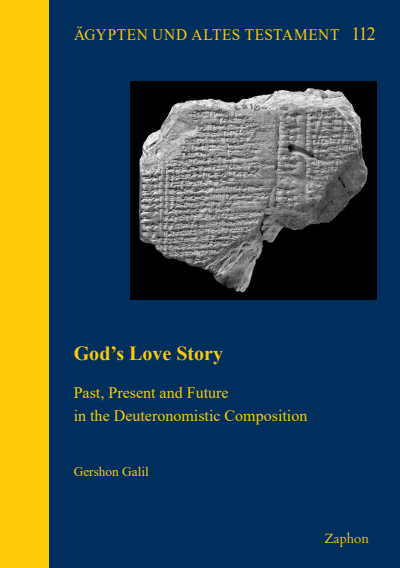
God’s Love Story
Past, Present and Future in the Deuteronomistic Composition- Autor:innen:
- Reihe:
- Ägypten und Altes Testament, Band 112
- Verlag:
- 2022
Zusammenfassung
Die Studie von Gershon Galil untersucht die Entstehung der Bücher, die in der „Deuteronomistischen Composition“ enthalten sind, und die historischen und theologischen Wahrnehmungen des Deuteronomisten (Dtr), der die „Deuteronomistische Composition“ während des babylonischen Exils verfasste und um ca. 560 v. Chr.
Nach Ansicht von Gershon Galil enthielt die „Deuteronomistische Composition“ nicht nur die Bücher Deuteronomium, Joshua-Kings, sondern auch das Buch Jeremia. Deuteronomium ist das Vorwort zu dieser Abhandlung, und Jeremia besiegelt sie; im Deuteronomium ist der Weg vorgezeichnet und die Normen festgelegt; Der Hauptteil der Komposition, nämlich die Bücher von Joshua bis Kings, präsentiert eine detaillierte Geschichte der Beziehung zwischen Gott und Israel, von der Eroberung des guten Landes bis zur Zerstörung des Tempels und dem Verlust des Landes. Das Buch Jeremia, das die Komposition abschließt, behandelt ausführlich den Niedergang und Fall Judas, analysiert die Sünden, die die Zerstörung bewirkten, und verbreitet gleichzeitig das Evangelium der Erlösung unter den Vertriebenen. Wie Moses, der Exil, aber auch Erlösung vorhersagt, ist Jeremia der Prophet der Zerstörung, aber auch der Erlösung. So untersucht Dtr die Vergangenheit nach den Prinzipien der „Tora des Mose“ (Deuteronomium) – und skizziert die Zukunft im Lichte des Wortes Gottes im Mund Seiner Propheten – hauptsächlich Moses und Jeremias.
Gottes ewige Liebe zu Israel ist der Hauptgrundsatz von Dtrs Weltanschauung. Seiner Ansicht nach ist das Band zwischen Gott und Israel endlos. Sein Anfang liegt in den Tagen der Patriarchen, aber er wird niemals enden. Da die Beziehung ewig ist, ist die Nation Israel von Natur aus göttlich: ewig und heilig. Die kreisförmige Natur der Beziehung zwischen Gott und seinem Volk impliziert im Wesentlichen eine Realität von Nähe und Distanz, Zuneigung und Zorn, Sünde und Reue, Bestrafung und Erlösung. Die Erfüllung des Wortes Gottes ist eines der zentralen Motive der „Deuteronomistischen Composition“. Da die Hauptbotschaft von Dtr darin besteht, dass Gott Israel eine Rückkehr in das Land, ewige Liebe und einen ewigen Bund verspricht, fragen sich die Menschen vielleicht, ob man Gottes Verheißungen vertrauen kann. Die Antwort kommt in vielen Schriftstellen, die die Erfüllung des Wortes Gottes betonen und lehren, dass Gottes Verheißungen immer vertraut werden kann.
Publikation durchsuchen
Bibliographische Angaben
- Auflage
- 1/2022
- Copyrightjahr
- 2022
- ISBN-Print
- 978-3-96327-178-6
- ISBN-Online
- 978-3-96327-179-3
- Verlag
- Zaphon, Münster
- Reihe
- Ägypten und Altes Testament
- Band
- 112
- Sprache
- Englisch
- Seiten
- 272
- Produkttyp
- Monographie
Inhaltsverzeichnis
- Foreword Kein Zugriff
- Contents Kein Zugriff
- I.1 The Scope of the Deuteronomistic Composition Kein Zugriff
- I.2 The Literary Structure of the Deuteronomistic Composition Kein Zugriff
- II.1 From the Exodus to the Establishment of the Temple Kein Zugriff
- II.2.1 From the Schism to Jehu’s Revolt Kein Zugriff
- II.2.2 From Jehu’s Revolt to the Fall of Samaria Kein Zugriff
- II.2.3 From the Fall of Samaria to the Fall of Jerusalem Kein Zugriff
- II.3 The Seventy-Years Era and Jehojachin’s Release Kein Zugriff
- III.1.1 Two Introductions Kein Zugriff
- III.1.2 The Borders of the Land Kein Zugriff
- III.1.3 Was Transjordan Included in the Land of Israel or in Moab? Kein Zugriff
- III.1.4 Moses: Sin and Punishment Kein Zugriff
- III.1.5 The Names of the Mountain of God Kein Zugriff
- III.1.6 The Cities of Refuge Kein Zugriff
- III.1.7 Joshua in the Book of Deuteronomy Kein Zugriff
- III.1.8 The Centralization of Worship in the Book of Deuteronomy Kein Zugriff
- III.1.9 Pillars in the Book of Deuteronomy Kein Zugriff
- III.1.10 The Relations with Edom, Moab and Ammon Kein Zugriff
- III.1.11 Exile and Redemption in the Book of Deuteronomy Kein Zugriff
- III.1.12 Deuteronomic and Deuteronomistic Phraseology in the Book of Deuteronomy Kein Zugriff
- III.2 The Layers of the Book of Deuteronomy Kein Zugriff
- III.3.1 The Choice of the Place and the Concentration of Worship Kein Zugriff
- III.3.2 The Choice of Israel and its Holiness Kein Zugriff
- III.3.3 Levites in Deuteronomy Kein Zugriff
- III.3.4 The Attitudes Towards Monarchy in Deuteronomy Kein Zugriff
- III.3.5 Concern for the Poor and Weak in the Book of Deuteronomy Kein Zugriff
- III.3.6 “The Lord, our Lord, is One Lord:” The Uniqueness and Unity of the Lord in Deuteronomy Kein Zugriff
- III.3.7 The Land in the Book of Deuteronomy Kein Zugriff
- III.3.8 A Comparison of the Laws in the Deuteronomic Code with the Laws in the Book of the Covenant, the Priestly Source and the Holiness Code Kein Zugriff
- III.3.9 Northern Sources of the Book of Deuteronomy Kein Zugriff
- III.4.1 The Opening Paragraph of the Book of Deuteronomy Kein Zugriff
- III.4.2.1 The Appointment of Judges (Deut 1:9–18) Kein Zugriff
- III.4.2.2 The Story of the Spies (Deut 1:19–46) Kein Zugriff
- III.4.2.3 From Kadesh-Barnea to Arnon River and the Conquest of Transjordan (Deut 2:1 – 3:29) Kein Zugriff
- III.4.2.4 A Preaching Sermon (Deut 4:1–40) Kein Zugriff
- III.4.3 A Deuteronomistic Opening to the Deuteronomic Code (Deut 4:44, 46–49) Kein Zugriff
- III.4.4.1 The Covenant in Transjordan (Deut 29–30) Kein Zugriff
- III.4.4.2 Joshua in Deuteronomy Kein Zugriff
- III.4.4.3 Repentance, Redemption and the Eternity of God’s Covenant with Israel Kein Zugriff
- III.4.4.4 The Book of Torah Kein Zugriff
- III.4.4.5.1 Speech No. 10 (Deut 31:1–8) Kein Zugriff
- III.4.4.5.2 Speech No. 11 (Deut 31:9–13) Kein Zugriff
- III.4.4.5.3 Speech No. 12 (Deut 31:14–23) Kein Zugriff
- III.4.4.5.4 Speech No. 13 (Deut 31:24–29) Kein Zugriff
- III.5 The Liturgical Speeches in Deuteronomy Kein Zugriff
- IV.1.1 The Conquest Kein Zugriff
- IV.1.2 The Borders of the Land Kein Zugriff
- IV.1.3 The Tribe of Judah Kein Zugriff
- IV.1.4 Joshua and Moses in the Book of Joshua Kein Zugriff
- IV.1.5 The Inheritance of the Tribe of Levi Kein Zugriff
- IV.1.6 Different Styles and More Doublets Kein Zugriff
- IV.1.7 Priests and Levites in Joshua Kein Zugriff
- IV.2.1 The First Edition of the Book of Joshua: The Conquest of the Land (The Northern Edition) Kein Zugriff
- IV.2.2 The Second Edition: The Conquest and Settlement (The Judean Edition) Kein Zugriff
- IV.2.3 The Third Edition of the Book of Joshua (The Deuteronomistic Edition) Kein Zugriff
- IV.2.4 The Fourth Edition of the Book of Joshua (The Priestly Edition) Kein Zugriff
- V.1.1 Theocracy or Monarchy Kein Zugriff
- V.1.2 The Tribe of Judah Kein Zugriff
- V.1.3 The Tribe of Benjamin Kein Zugriff
- V.1.4 The Sins of Israel Kein Zugriff
- V.1.5 “Major Judges” and “Minor Judges” Kein Zugriff
- V.2.1 The First Edition of the Book of Judges (“The Book of the Saviors”) Kein Zugriff
- V.2.2 The Second Edition of the Book of Judges (The Judahite Edition) Kein Zugriff
- V.2.3 The Third Edition of the Book of Judges (The Deuteronomistic Edition) Kein Zugriff
- V.2.4 The Fourth Edition of the Book of Judges (The Priestly Edition) Kein Zugriff
- VI.1.1 Attitudes Towards Kingship Kein Zugriff
- VI.1.2 Attitudes Towards David: Apology and Justification Versus Criticism Kein Zugriff
- VI.1.3 Attitudes Towards Saul and Benjamin: Praise Versus Polemic and Criticism Kein Zugriff
- VI.1.4 Three Versions of Saul’s Coronation Kein Zugriff
- VI.1.5 Attitudes Towards the House of Eli, Saul and Ebiathar the Priest Kein Zugriff
- VI.1.6 The Amalekites Kein Zugriff
- VI.1.7 Additional Duplications and Possible Contradictions in the Book of Samuel Kein Zugriff
- VI.2 The Book of Samuel: Sources and Editions Kein Zugriff
- VI.3.1 The Book of Saviors Kein Zugriff
- VI.3.2.1 Saul’s Election and Legitimation Kein Zugriff
- VI.3.2.2 Saul’s Victory Over the Philistines Kein Zugriff
- VI.3.2.3 Saul’s Victory Over the Amalekites Kein Zugriff
- VI.3.2.4 Summary of Saul’s Wars and Genealogy Kein Zugriff
- VI.3.3.1 The Justification of David (The Apology) Kein Zugriff
- VI.3.3.2 The Legitimacy of David and the Delegitimizing of Saul Kein Zugriff
- VI.3.3.3 Criticism of Joab Kein Zugriff
- VI.3.3.4 Emphasizing David’s Military and Political Achievements Kein Zugriff
- VI.3.3.5 Attitudes Towards the House of Eli, Saul and Ebiathar the Priest Kein Zugriff
- VI.3.4 The “Book of Jashar” Kein Zugriff
- VI.4.1 The Structure of the First Edition of the Book of Samuel Kein Zugriff
- VI.4.2.1 Attitudes Towards the House of Eli and Ebiathar the Priest Kein Zugriff
- VI.4.2.2 Attitudes Towards Saul and Benjamin Kein Zugriff
- VI.4.2.3 Polemics Against Joab Kein Zugriff
- VI.4.2.4 Attitudes Towards David and Solomon’s Elder Brothers Kein Zugriff
- VI.5 The Second Edition of the Book of Samuel (The Deuteronomistic Edition) Kein Zugriff
- VII.1 Doublets and Contradictions in the Book of Kings Kein Zugriff
- VII.2.1 The First Edition of the Book of Samuel Kein Zugriff
- VII.2.2 “The Book of the Acts of Solomon” Kein Zugriff
- VII.2.3 “The Book of the Chronicles of the Kings of Judah” Kein Zugriff
- VII.2.4 “The Book of the Chronicles of the Kings of Israel” Kein Zugriff
- VII.2.5 Northern Prophetic Sources Kein Zugriff
- VII.2.6 Southern Prophetic Sources Kein Zugriff
- VII.2.7 Other Sources Kein Zugriff
- VII.2.8 Glosses Kein Zugriff
- VII.3.1 Scope and Content Kein Zugriff
- VII.3.2 Opening Formulas Kein Zugriff
- VII.3.3 Evaluations of the Kings of Israel and Judah Kein Zugriff
- VII.3.4 Were There Several Deuteronomistic Editors of the Book of Kings or Just One? Kein Zugriff
- VII.3.5 Reward, Punishment and the Message of the Book of Kings Kein Zugriff
- VII.3.6 The Literary Structure of the Deuteronomistic Edition of the Book of Kings Kein Zugriff
- VII.4 Priestly Additions in the Book of Kings Kein Zugriff
- VIII.1.1 Attitudes Towards the Wandering in the Wilderness Kein Zugriff
- VIII.1.2 The Future of David’s House Kein Zugriff
- VIII.1.3 Jehoiakim and Jehoiachin Kein Zugriff
- VIII.1.4 “The LORD is Our Righteousness” – The Name of a King or of a City? Kein Zugriff
- VIII.1.5 Reward and Punishment in the Book of Jeremiah Kein Zugriff
- VIII.1.6 Attitudes Toward Worship in the Book of Jeremiah Kein Zugriff
- VIII.1.7 Internal Evidence for the Formation of the Book of Jeremiah Kein Zugriff
- VIII.1.8 The Greek Version and the Formation of the Book of Jeremiah Kein Zugriff
- VIII.1.9 Stylistic and Linguistic Differences in the Book of Jeremiah Kein Zugriff
- VIII.2 The Main Layers of the Book of Jeremiah Kein Zugriff
- VIII.3 The Literary Genres Kein Zugriff
- VIII.4 The Pre-Deuteronomistic Edition of the Book of Jeremiah Kein Zugriff
- VIII.5 The Deuteronomistic Edition of the Book of Jeremiah Kein Zugriff
- VIII.6 The Chronological Data in the Book of Jeremiah Kein Zugriff
- VIII.7 Struggle Against Idolatry in the Book of Jeremiah Kein Zugriff
- VIII.8 Concentration of Worship in the Book of Jeremiah Kein Zugriff
- VIII.9 Social Injustices in the Book of Jeremiah Kein Zugriff
- VIII.10 Retribution and Repentance in the Book of Jeremiah Kein Zugriff
- VIII.11 Punishment: Destruction, Death and Exile in the Book of Jeremiah Kein Zugriff
- VIII.12 Consolation and Redemption in the Book of Jeremiah Kein Zugriff
- VIII.13 The Renewal of the Rule of the House of David Kein Zugriff
- VIII.14 Post-Deuteronomistic Additions in the Book of Jeremiah Kein Zugriff
- IX.1 Dtr’s Attitude Towards his Sources Kein Zugriff
- IX.2.1 The Patriarchs Kein Zugriff
- IX.2.1 The Patriarchs Kein Zugriff
- IX.2.2.1 The Chronological Framework of Moses’ Age Kein Zugriff
- IX.2.2.2 The Exodus Kein Zugriff
- IX.2.2.3 Appointment of Judges (Deut 1:9–18) Kein Zugriff
- IX.2.2.4 The Story of the Spies (Deut 1:19–46) Kein Zugriff
- IX.2.2.5 From Kadesh-Barnea to Arnon River and the Conquest of Transjordan (Deut 2:1 – 3:29) Kein Zugriff
- IX.2.3 Joshua and the Conquest of the Land Kein Zugriff
- IX.2.4 The Age of the Judges Kein Zugriff
- IX.2.5 David Kein Zugriff
- IX.2.6 Solomon Kein Zugriff
- IX.2.7 From Jeroboam I to Omri (1 Kgs 12:1 – 16:14) Kein Zugriff
- IX.2.8 The House of Omri Kein Zugriff
- IX.2.9 The House of Jehu Kein Zugriff
- IX.2.10 Ahaz, King of Judah Kein Zugriff
- IX.2.11 The Fall of Israel Kein Zugriff
- IX.2.12 Hezekiah Kein Zugriff
- IX.2.13 Manasseh Kein Zugriff
- IX.2.14 Josiah Kein Zugriff
- IX.2.15 Destruction and Exile Kein Zugriff
- X.1 God’s Eternal Love for His People Israel Kein Zugriff
- X.2 God’s Eternal Covenant with the House of David Kein Zugriff
- X.3 Attitude Towards Monarchy Kein Zugriff
- X.4 The Temple Kein Zugriff
- X.5 The Worship of God: Centralization of Worship and Sacrifices Kein Zugriff
- X.6 Reward and Punishment Kein Zugriff
- X.7 The Struggle Against Idolatry Kein Zugriff
- X.8 Fulfillment of the Word of God Kein Zugriff
- X.9 One Torah Kein Zugriff
- X.10 Social Injustice Kein Zugriff
- A.1.1 Eternal Love and Election Kein Zugriff
- A.1.2 The Davidic Dynasty Kein Zugriff
- A.2.1 Exodus and Covenant Kein Zugriff
- A.2.2 Inheritance of the Land Kein Zugriff
- A.3.1 The Monotheistic Creed Kein Zugriff
- A.3.2 Loyalty to the Covenant and its Reward Kein Zugriff
- A.4 Centralization of Worship and the “Name” Theology Kein Zugriff
- A.5.1 Warnings Against Foreign Worship Kein Zugriff
- A.5.2 The Polemic Against Idolatry Kein Zugriff
- A.6.1 Disloyalty Kein Zugriff
- A.6.2 Punishment Kein Zugriff
- A.7 The Fulfilment of the Word of YHWH Kein Zugriff
- A.8 Rhetoric Phraseology Kein Zugriff
- A.9 The Priests the Levites Kein Zugriff
- Abbreviations Kein Zugriff Seiten 193 - 194
- Bibliography Kein Zugriff Seiten 195 - 224
- Index of Authors Kein Zugriff
- Hebrew Bible Kein Zugriff
- Babylonian Inscriptionsand Greek Writings Kein Zugriff
- Index of Subjects Kein Zugriff