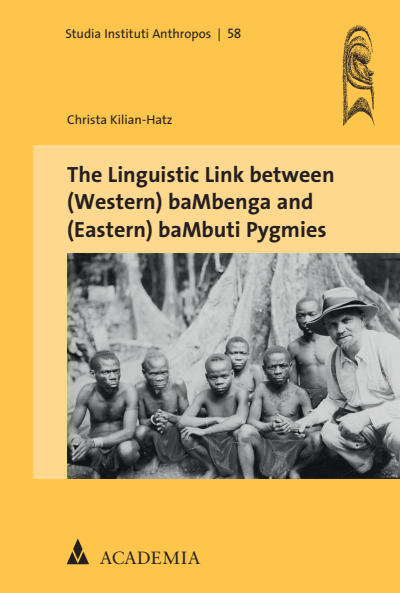
The Linguistic Link between (Western) baMbenga and (Eastern) baMbuti Pygmies
- Autor:innen:
- Reihe:
- Studia Instituti Anthropos, Band 58
- Verlag:
- 2019
Zusammenfassung
Molekulargenetische Daten belegen, dass westliche und östliche Pygmäenvölker in Afrika einst eine autochthone einheitliche „Pygmäengruppe“ bildeten. Folglich muss diese auch in einer Art Pygmäen-Protosprache kommuniziert haben. Ihr gemeinsames sprachliches Erbe schien sie jedoch im Lauf ihrer Migrationsgeschichte verloren zu haben. Da die heutigen Pygmäenvölker keine bzw. nur wenig verwandte Sprachen sprechen, bleibt zu klären, ob Reste einer solchen Protosprache existieren; und wenn ja, wird es möglich sein, auch eine solche Pygmäen-Protosprache zu rekonstruieren?
Kürzlich entdeckte lexikalische und grammatikalische Daten der Missionare Brisson, Schebesta und Vorbichler erlauben es erstmals, eine große Anzahl lexikalischer Entsprechungen der westlichen baMbenga-Pygmäen mit den östlichen baMbuti-Pygmäen sowie mit verschiedenen Sprachen zu finden, die nur im östlichen Kongobecken gesprochen werden. Die einzige logische Erklärung dafür ist, dass die westlichen Pygmäen im östlichen Kongobecken gelebt haben müssen, und dass sie zu einem bestimmten Zeitpunkt in ihrer Geschichte einen engeren sprachlichen Kontakt mit den östlichen Pygmäen und deren benachbarten Bantu- und Sudan-Bevölkerungen gehabt haben müssen.
Schlagworte
Publikation durchsuchen
Bibliographische Angaben
- Auflage
- 1/2019
- Copyrightjahr
- 2019
- ISBN-Print
- 978-3-89665-792-3
- ISBN-Online
- 978-3-89665-793-0
- Verlag
- Academia, Baden-Baden
- Reihe
- Studia Instituti Anthropos
- Band
- 58
- Sprache
- Englisch
- Seiten
- 458
- Produkttyp
- Monographie
Inhaltsverzeichnis
- Titelei/Inhaltsverzeichnis Kein Zugriff Seiten 1 - 10
- Abbreviations of languages Kein Zugriff
- Abbreviations of authors and references Kein Zugriff
- Linguistic abbreviations Kein Zugriff
- Other abbreviations and symbols Kein Zugriff
- 1.1.1 Survey of pygmy groups, populations and languages Kein Zugriff
- 1.1.2 Genetics Kein Zugriff
- The pygmies and their contact languages: Kein Zugriff
- The *Baakaa: Kein Zugriff
- Lexical comparison: Kein Zugriff
- Motives in oral literature: Kein Zugriff
- Language sample: Kein Zugriff
- 1.3 The data base Kein Zugriff
- 2.1 Cognates of the baMbenga group with Bira languages(Bantu D30) and Bamba (Bantu B60) Kein Zugriff
- 2.1.1 Cognates of Baka (and Aka) with Bantu D30 languagesand Bamba (B60) Kein Zugriff
- 2.1.2 Cognates only of Aka with Bantu D30 and Bamba Kein Zugriff
- 2.2 Cognates of the baMbenga group with East CentralSudanic (ECS) Kein Zugriff
- 2.2.1 Cognates of the baMbenga group with the Medje group Kein Zugriff
- 2.2.1.1 Cognates of Baka (and Aka) with the Medje group Kein Zugriff
- 2.2.1.2 Cognates only of Aka with the Medje group Kein Zugriff
- 2.2.2 Cognates of the baMbenga group with theLese-Mamvu group Kein Zugriff
- 2.2.2.1 Cognates of Baka (and Aka) with theLese-Mamvu group Kein Zugriff
- 2.2.2.2 Cognates only of Aka with the Lese/Mamvu group Kein Zugriff
- 2.2.3 Cognates of the baMbenga group with the Medje groupand the Lese-Mamvu group Kein Zugriff
- 2.2.3.1 Cognates of Baka (and Aka) with the Medje group andthe Lese-Mamvu group Kein Zugriff
- 2.2.3.2 Cognates only of Aka with the Medje group andthe Lese-Mamvu group Kein Zugriff
- Vowels: Kein Zugriff
- Tones: Kein Zugriff
- Derivation: Kein Zugriff
- Vowels: Kein Zugriff
- Tones: Kein Zugriff
- Derivation: Kein Zugriff
- Vowels: Kein Zugriff
- Tones: Kein Zugriff
- Derivation: Kein Zugriff
- Vowels: Kein Zugriff
- Tones: Kein Zugriff
- Derivation: Kein Zugriff
- Vowels: Kein Zugriff
- Derivation: Kein Zugriff
- 3.2.1 Sound correspondences of Baka / Aka to iButi (= Sua) Kein Zugriff
- 3.2.2 Sound correspondences of Baka / Aka to Atsoa Kein Zugriff
- 3.2.3 Sound correspondences of Baka / Aka to Efe Kein Zugriff
- 4.1 ‘Faeces’ Kein Zugriff
- Waito – Bali - Likuadebo Kein Zugriff
- The mythical water snake yoli - epi Kein Zugriff
- The ferryman Kein Zugriff
- 4.3 ‘Absurd barter of goods’ Kein Zugriff
- The fire: òkpi – mòkibò Kein Zugriff
- The spirit Lodi/Rodi vs. Dodi Kein Zugriff
- The master hunter: Aimutuma vs. tuma- Kein Zugriff
- The dance with rattles Kein Zugriff
- 4.5 ‘The fight of leopard and tortoise’ Kein Zugriff
- 4.6 ‘Transformation into an elephant’ Kein Zugriff
- 4.7 ‘Incest with the mother in law/aunt’ Kein Zugriff
- (a) The word stem tuma – the great hunters in pygmy mythology: Kein Zugriff
- (b) Waito and Bali as members of the ‘Tortoise’ clan: Kein Zugriff
- (1) Substrates exclusively with iButi: Kein Zugriff
- (2) Substrates exclusively with Atsoa: Kein Zugriff
- (3) Substrates exclusively with Efe: Kein Zugriff
- Bibliography Kein Zugriff Seiten 423 - 436
- Appendices (Schebesta’s and Vorbichler’s manuscripts) Kein Zugriff Seiten 437 - 458