Extended search
1
Subject
History
History examines events, structures, and cultural developments across epochs and regions. It provides methods, sources, interpretations, and debates—and opens new perspectives on the past’s significance for the present.


Series
Publisher: Nomos Verlagsgesellschaft mbH & Co. KG, Baden-Baden
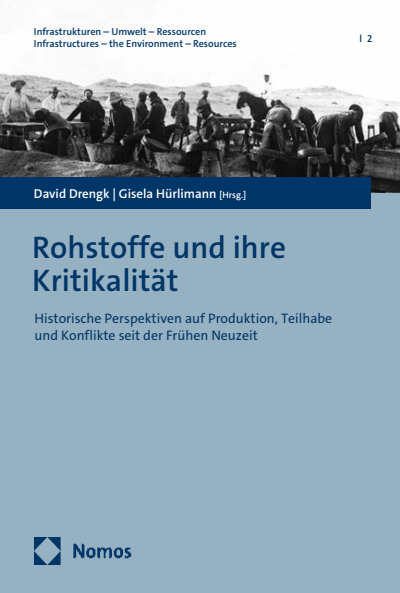
Human societies are intertwined with their natural and anthropogenic surroundings in various ways. On the one hand, the deployment of the technical infrastructures of transport, supply and disposal, energy supply and communication play a key role in this respect. On the other hand, the relationship between humans and their environment is reflected in their use of the most different types of natural resources. These two aspects are often, if not always, closely interlinked: infrastructures are used to tap and exploit resources, while the use of resources is a prerequisite for building and operating infrastructures. This series focuses above all on the relationship between society and the environment in terms of both technology and materials. It publishes works that adopt an innovative methodological approach which reflects the hybridity of society, technology and nature in an integrative manner. This includes works in the traditions of science and technology studies, new materialism and a comprehensive history of technology and the environment, including environmental humanities. The series also welcomes submissions of interdisciplinary studies from the fields of the social sciences, engineering and environmental science.
Go to series 

Series
Publisher: Ergon-Verlag, Baden-Baden
With a critical perspective on the philosophy of education, the series Erziehung, Schule, Gesellschaft publishes theoretical, cultural, social, and historical research and studies on topics related to education, teaching, and learning. Particular attention is paid to interdisciplinary and international perspectives under the conditions of cultural and epistemic change in late modernity. Apart from monographies and edited volumes, outstanding academic theses in German and English are published in the series.
Go to series 





Series
Publisher: Nomos Verlagsgesellschaft mbH & Co. KG, Baden-Baden
Science and technology are crucial drivers of societal change. Yet, a paradox is embedded in the current situation. On the one hand, it seems that societies are more dependent than ever on science and technology to solve social problems. On the other hand, scientific and technological contributions are deeply controversial, right up to the denial of their significance. It also seems that with developments like digitalisation and climate change or the environmental crisis, changes in science and technology are intimately connected with changes in society—and vice versa. The exact reach of these presumed shifts is a matter for empirical and conceptual inquiry—but already various complex phenomena, like emotive public outbursts, resistance and criticism, can be observed. Controversies and criticism about the forms, limitations and consequences of science and technology alike have become more intense. However, it also seems that there are shifts in the epistemic tectonics of contemporary societies. Against this backdrop, the series of publications entitled ‘Wissenschafts- und Technikforschung’ (Science and Technology Studies) provides a forum in which these developments can be researched in different dimensions, with diverse approaches from across the entire spectrum of science and technology studies. What kind of significant changes to scientific knowledge production and the genesis, production and application of technology can currently be observed? How could these be analysed in the best way and what scientific instruments and methods must be developed for this purpose? In order to find answers to these questions, theories and methods from various thematically relevant disciplines, especially from sociology, philosophy, social anthropology and history, will be applied. This may result in an integral or rather agonistic science and technology studies programme. In any case, it will generate a better self-understanding of science and technology studies within this series. The series provides both foundational knowledge in the all scientific disciplines involved as well as guidelines for decision makers and all those interested in this subject area.
Go to series