, to see if you have full access to this publication.
Journal Partial access
Z'GuG Zeitschrift für Gemeinwirtschaft und Gemeinwohl
Journal of Social Economy andSocial Welfare
Editors:
Prof. Dr. Susanne Elsen | Prof. Dr. Markus Gmür | Prof. Dr. Dorothea Greiling | Silke Helfrich | Prof. Dr. Winfried Kluth | Prof. Dr. Remi Maier-Rigaud | Prof. Dr. Ulf Papenfuß | Barbara Sak | Prof. Dr. Christina Schaefer | Prof. Dr. Michaela-Maria Schaffhauser-Linzatti | Prof. Dr. Frank Schulz-Nieswandt | Prof. Dr. Dieter K. Tscheulin
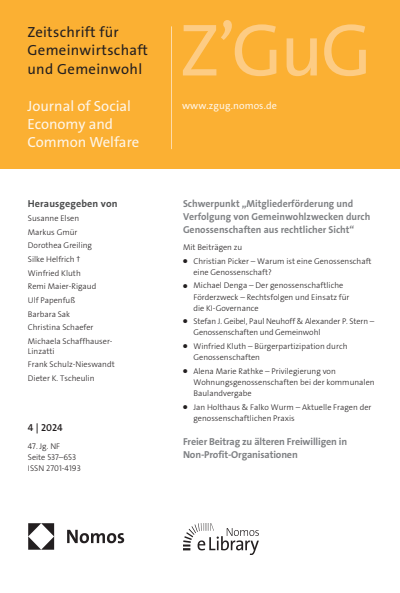
“Current issues in cooperative practice” was the title of a presentation by the first author at the 1st Cooperative Law Day on June 7, 2024 in Halle (Saale). The following remarks highlight current questions and answers from cooperative practice...
Cooperative may be used by local governments to organize sustainable participation of citizens in the field of services of general interest. There are different governance models how to organize such a cooperation. The article discusses the...
The German Registered Cooperative („eingetragene Genossenschaft“, eG) is dedicated through their specific legal form to the purpose of promoting its members specifically as customers on a user-related basis. Consequently the eG has to be...
Cooperatives do not appear to be able to pursue public welfare interests because they are dedicated through their specific legal form to the purpose of promoting their members. However, the principles of cooperatives even appear to be particularly...
The objective of this article is to demonstrate, through the use of housing cooperatives as a case study, that municipalities have the capacity and obligation to facilitate the provision of secure and affordable housing by prioritising the...