Zugang zum kulturellen Erbe und Wissenschaftskommunikation
Editors:
Prof. Dr. Katharina de la Durantaye, LL.M. (Yale) | Prof. Dr. Ellen Euler, LL.M. | Alexandra Kemmerer, LL.M. Eur. | Prof. Dr. Paul Klimpel | Andreas Nestl | Stephanie Niederalt | Prof. Dr. Benjamin Raue | Prof. Dr. Eric Steinhauer
Is accessing court decisions as easy and straightforward as legal scholars assume? Although court decisions are in the public domain according to Section 5 (1) var. 5 UrhG and a duty to publish court decisions is “tacitly” recognised in case law...
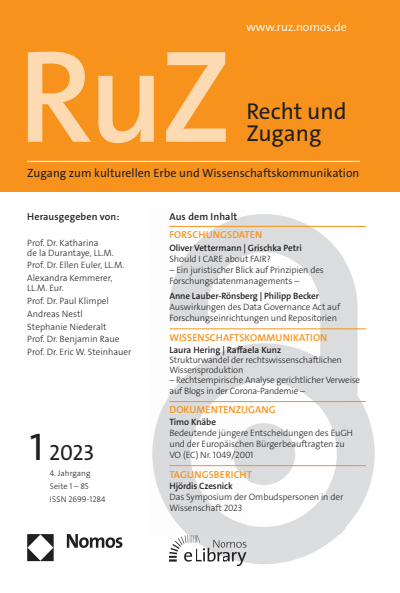
The Data Governance Act does not impose additional obligations on research institutions as a general rule, as far as can be judged at present despite all the uncertainties of interpretation, since research institutions do not fall within the scope...
In continuation of RuZ 2022, 128, this first article of the series presents select recent decisions concerning Regulation (EC) No. 1049/2001, laying down the EU secondary law right of access to documents, of the Court of Justice of the EU and,...
To discuss current topics of good research practice that affect the work of ombudspersons at research institutions, the so-called Ombudssymposium takes place in Germany every two years. Under the heading “What Can and Should Ombudspersons Do?...
The FAIR and CARE principles – as well as other sets of principles – are increasingly gaining attention in research on and within the research data lifecycle. The recent mention of these principles in calls for proposals issued by the German...
During the Corona pandemic, courts consulted and cited scholarly blogs to an unprecedented extent – this is the clear picture that emerges from a systematic evaluation of court decisions by German administrative and constitutional courts during...