, to see if you have full access to this publication.
Journal Partial access
EuCLR European Criminal Law Review
European Criminal Law Review
Editors:
Prof. Dr. Petter Asp (Universität Stockholm) | Prof. Dr. Luigi Foffani (Universität Modena und Reggio Emilia) | Prof. Dr. Maria Kaiafa-Gbandi (Aristoteles Universität Thessaloniki) | Prof. Dr. Helmut Satzger (Ludwig-Maximilians-Universität München) | Prof. Dr. Ingeborg Zerbes (Universität Bremen)
Based on estimates, it can be assumed that proceeds from crime (‘dirty money’) that circulate in the global economy total annually approximately USD 1,900–4,800 billion. It is therefore understandable that significant investments have been...
The European Parliament Resolution of 10 February 2021 on the implementation of Directive 2011/36/EU on preventing and combating trafficking in human beings and protecting victims (2020/2029(INI)), on the one hand, recalls that Member States have a...
If the use of criminal law requires that legislators carry out empirical tests to establish the inadequacy of other available enforcement systems and the necessity of resorting to the weapon of punishment, how can the Court impose direct...
Deepfakes generated by artificial intelligence (AI) are becoming a serious potential threat to democracy, particularly during electoral campaigns. The vast amount of information available, notably through social media, contributes to the danger of...
Spanish criminal and penitentiary legislation and practice relating to the crime of terrorism have undergone a further notable expansion with the emergence of jihadist terrorism. This article demonstrates how legislation and practice in this area...
The European Arrest Warrant, adopted twenty years ago, has proved to be a useful instrument for strengthening transnational cooperation between EU Member States in the field of criminal law. Still, its implementation has revealed serious problems...
Twenty-five years after the idea of establishing a European Public Prosecutor's Office (EPPO) was mooted, the office became operational in June 2021. It was intended to provide for a paradigm shift in the prosecution of serious fraud against the EU...
Prisons have become a key element in the prevention of international terrorism. To keep them from becoming a breeding ground for violent extremism, generating or fostering radicalisation, both the Council of Europe and the EU have developed prison...
Today, countries are no longer as free in shaping their penal systems as they used to be. By becoming members of a supranational organisation such as the European Union (EU), states have agreed to pursue a common criminal policy for common goals. To...
Italian criminal law regarding domestic violence has undergone only limited amendments in order to fulfil the obligations enshrined in the Istanbul Convention. This article examines the scope of the offences included in the Criminal Code, in order...
This paper focuses on Regulation 2018/1805/UE, and aims to highlight its strengths and weaknesses. After a brief overview of the legal framework concerning freezing and confiscation orders, the paper seeks to underline the possible part of the...
This article addresses the preventive custodial measures provided for by Portuguese law. First, the authors describe penal sanctions, with a special focus on the ‘relatively indeterminate sentence’, which can be regarded as a hybrid between...
The first year of operations of the European Public Prosecutor’s Office (EPPO) was basically very successful. However, also several problems came to light which the European Union’s first original prosecution authority has still to overcome. One...
In the absence of unambiguous interpretations of the concepts of slavery, servitude, forced labour and labour exploitation offered by the sociological and anthropological debate, the article analyses the same concepts from a normative point of view,...
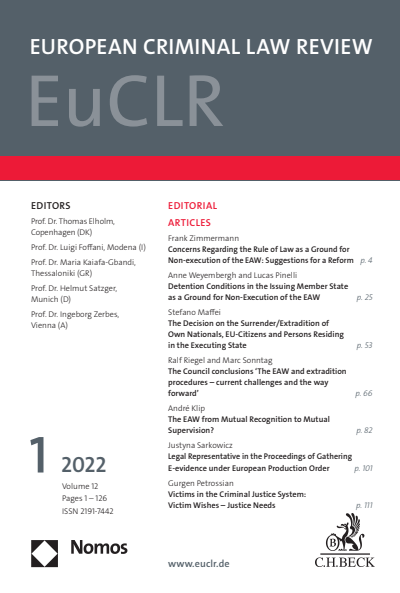
In this article, I analyse and discuss the demands of the Court of Justice of the EU to the transposition into domestic law of the grounds for optional non-execution in Articles 4 and 4a of Council Framework Decision 2002/584 on the European arrest...
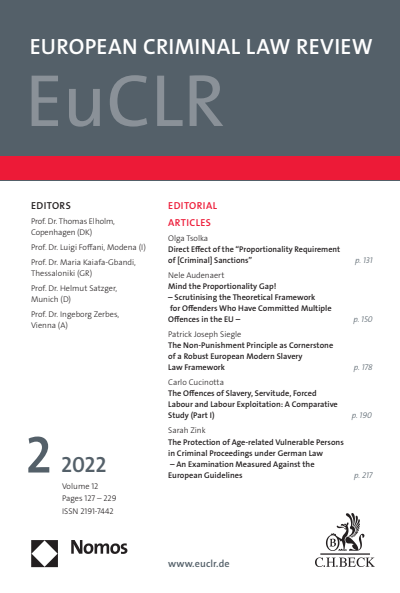
On the 8th of March 2022, the Grand Chamber of ECJ, in the case NE II, accepted the direct effect of the “proportionality requirement” of criminal nature’s sanctions provided in Art.20 of Directive 2014/67/EU, even connecting it with the...
Although it is not a secret that the precise implications of the proportionality principle in criminal law matters are still subject to debate, up until now, this has not been perceived as problematic. However, analysis reveals that the poor framing...
A significant ruling by the European Court of Human Rights (ECtHR) in 2021 (V.C.L. and A.N. v UK) reinvigorated the principle of non-punishment as a paramount tool in the prevention of modern-day slavery. This article attempts to crystallise how the...
In the absence of unambiguous interpretations of the concepts of slavery, servitude, forced labour and labour exploitation offered by the sociological and anthropological debate, the article analyses the same concepts from a normative point of view,...
Population ageing is a phenomenon that affects our societies, with both the number and proportion of older people growing across Europe. This impacts the legal capacity of vulnerable adults, who face challenges and difficulties in protecting their...
The judicial reforms in Poland, which are harshly and continuously criticised as undermining the independence of Polish courts, have brought the principle of mutual recognition and the European arrest warrant (EAW) to its limits. These unprecedented...