, to see if you have full access to this publication.
Journal Partial access
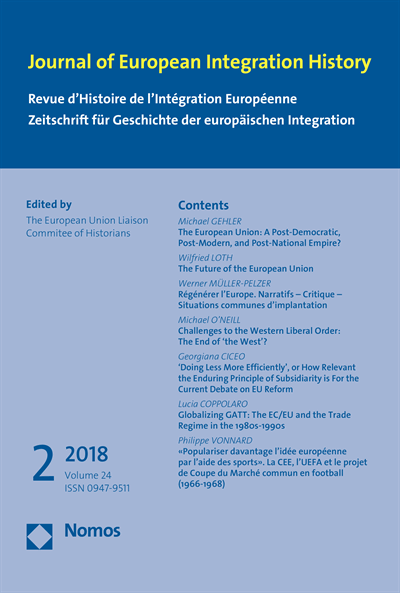
JEIH Journal of European Integration History
Revue D'Histoire de L'integration Europeene | Zeitschrift für die Geschichte der Europäischen Integration
Editors:
European Union Liaison Committee of Historians · Groupe de liaison des professeurs d'histoire contemporaine auprès de la Commission européenne · Historiker-Verbindungsgruppe bei der Europäischen Kommission
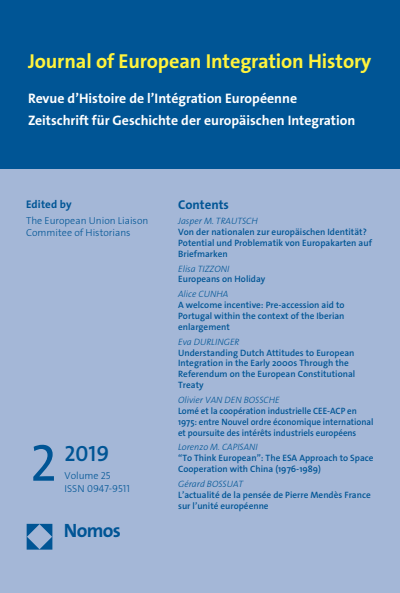
Portugal’s negotiations for accession to the European Economic Community (EEC) took place at the same time as the country negotiated and implemented the pre-accession aid programme that aimed at the development of the Portuguese economy. In a...
Aiming to provide an overview on the tourism policy implemented by the European Economic Community from the early 1960s until today, the research gives a contribution to fill a gap in current European Integration History, since Historians devoted...
In 1975, the Lomé Convention, which manages relations between the EEC and the countries of the ACP (Africa Caribbean Pacific) group, introduces a chapter on "industrial cooperation". This new policy aims to develop production sectors (industry,...
Pierre Mendès France, one of the great figures of the French political left from the 1940s to the 1970s, is mostly perceived as an anti-European or at least as a great sceptical in matters of European Unity à la Jean Monnet. Nonetheless, it would...
The cooperation between the European Space Agency and the Chinese space organizations during the Cold War is analyzed as a self-standing issue of the general Sino- European relations. From the beginning, this collaboration aimed to rely on the...
On 1st June 2005, Dutch citizens rejected the Treaty establishing a Constitution for Europe (ECT) in a referendum. Reasons for this rejection have been explored in previous studies on media framing. In these studies, scholars contend that the media...
In view of the fact that national maps were circulated in the 19th and early 20th century to strengthen people’s national consciousness, this article inquires whether the six EC founding states have in turn been using maps of Europe or the...
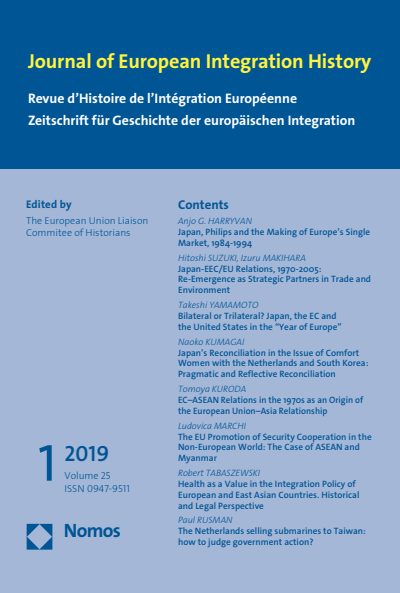
It is perhaps a little known fact that Henry Kissinger mentioned Japan several times in his [in]famous “Year of Europe” speech of 1973. He intended to include Japan in the “New Atlantic Charter”, making it a US-EC-Japan triangular framework...
Today, the relationship between EU and Asian countries is at a turning point. During the Cold War, there was quite a large gap in status between the EC and ASEAN. The EC was highly institutionalised and the most advanced regional organisation, while...
Japanese competition has been a prime factor in overcoming European economic fragmentation. In the course of the 1980s Japanese technology - especially in consumer electronics - as well as Japanese business practices were key incentives for the...
Negotiations on a Japan-EEC trade agreement faced a deadlock only three years after the launch of the common foreign trade policy in 1970. The European Commission adopted a step-by-step approach to change the climate. European business people were...
Reconciliation among states tends to be pragmatic, based on cost/benefit national interest calculation. But it can be reflective, involving the perpetrator’s responsibility and remorse and the victims’ forgiveness, thus enhancing their mutual...
The article concerns cooperation on individual and public health between EU and ASEAN countries. A specific approach of European countries towards the protection, improvement and control of health was analysed and the involvement of governments from...
This article explores the EU’s attempts at the ASEAN Regional Forum (ARF) to encourage Myanmar directly, or indirectly via the Association of Southeast Asian Nations (ASEAN), to connect with security cooperation. It argues that both ASEAN’s...
The Dutch sale of major weapons to Taiwan in 1980 ran counter to the Netherlands’ recent recognition of the People’s Republic of China as the sole representative of China. This led to a rupture of diplomatic relations, an outcome seemingly...