, to see if you have full access to this publication.
Journal Partial access
JEIH Journal of European Integration History
Revue D'Histoire de L'integration Europeene | Zeitschrift für die Geschichte der Europäischen Integration
Editors:
European Union Liaison Committee of Historians · Groupe de liaison des professeurs d'histoire contemporaine auprès de la Commission européenne · Historiker-Verbindungsgruppe bei der Europäischen Kommission
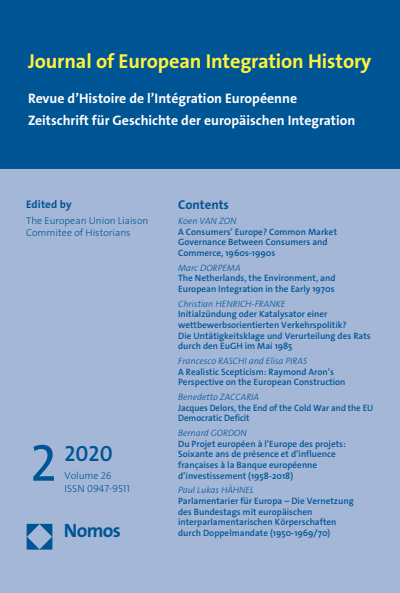
With the creation of the common market, citizens of the member states became European consumers. The history of consumer governance in the EEC therefore touches upon the legitimation of European integration. In that light, this article traces the...
The essay investigates Raymond Aron’s attitude towards European integration, through a critical analysis of primary sources, in order to problematise the interpretations recently offered by scholars working on Europeanism. The evidence offered...
This article aims to better define the vectors as well as the objectives of French influence at the European Investment Bank (EIB), a European institution created in 1957 which annually mobilises a volume of funding equivalent to the Commission’s...
The European Court of Justice condemned the EC-Council (of transport ministers) in an unprecedented process for inaction in the realisation of a common transport policy on 22nd May 1985. The Court confirmed the plaintiff’s (the European...
The present work focuses on the role played by Jacques Delors, who held the presidency of the European Commission between 1985 and 1995, in fostering public attention to the question of the so-called democratic deficit of the European Union (EU). It...
The article examines inter-parliamentary institutions as a factor for interstate cooperation in Europe in the 1950s and 1960s. For this purpose, an analysis of the relationship between the parliamentary assembly of the European Communities, the...
Focussing on the early period of environmental protection from the perspective of the Netherlands, this paper hopes to make four interventions in the historiography of European integration. First, the environment has not featured nearly as much as...
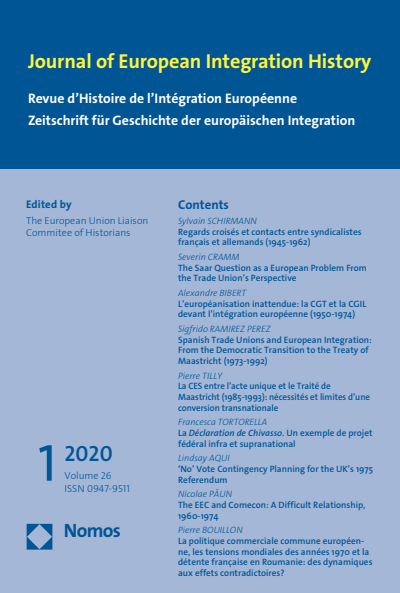
When the European Trade Union Confederation (ETUC) in the late 1980s said yes to the internal market as the EU’s pivotal project, it was accepted in consideration with the Commission's promises to deliver a strong social dimension. For the ETUC,...
During Second World War, Italian resistance fighters from the Aosta Valley and the Vaudois valleys meet in Chivasso to think about an international system for the post- war era. They defend a republican and democratic political system, and, far...
The policy of trade liberalization led by the EEC and by France towards a state-trading country like Romania proved to be a specific issue with regard to the implementation of the European common trade policy. It was all the more complicated than...
This article investigates the contingency plan developed by Harold Wilson’s Labour government for a ‘no’ vote in the UK’s 1975 referendum on European Community (EC) membership. The decision to prepare for the possibility of leaving the EC...
The animosity which often prevails among French and German trade unionists in the wake of World War I disappears in the aftermath of the Second conflict. The meetings are more numerous, certain positions converge and the demands related to specific...
The contribution of Spanish trade unions to the process of transition and consolidation of the Spanish democracy has been very much underestimated. The dominating historiographical interpretation has considered them as simple transmission belt of...
The degree of economic integration attained within Comecon never came close to the one fostered by the policies within the European Economic Community, notably the Common Commercial Policy. Moreover, the relations between the two entities were...
The Saar region did not immediately become part of the Federal Republic of Germany in 1949, but was gradually given the status of a semi-protectorate of France from 1947 onwards. The region's high-quality coal and the iron and steel industries were...