Prof. Dr. Jürgen Bast, Justus-Liebig-Universität Gießen | Prof. Dr. Brun-Otto Bryde, Justus-Liebig-Universität Gießen | Dr. Fabia Fernandes Carvalho, University of Melbourne | Prof. Dr. Philipp Dann, Humboldt Universität zu Berlin | Prof. Dr. Anuscheh Farahat, Universität Wien | Prof. Dr. Isabel Feichtner, Julius-Maximilian-Universität Würzburg | Prof. Dr. James Fowkes, Universität Münster | Prof. Dr. Michaela Hailbronner, Justus-Liebig-Universität Gießen | Prof. Dr. Florian Hoffmann, Pontifícia Universidade Católica do Rio de Janeiro, | Prof. Heinz Klug, S.J.D. J.D., B.A., University of Wisconsin-Madison | Prof. Dr. Michael Riegner, Universität Erfurt | Prof. Arun Thiruvengadam, Azim Premji University India | Prof. Dr. Axel Tschentscher, Universität Bern
In this article we focus on the impact that the mining industry has had, and continues to have, on the environment in South Africa. The country is renowned for its mineral wealth and the mining sector continues to significantly contribute to its...
By focusing on two recent developments, we argue that rule of law principles can provide a general yardstick to evaluate even these norm-building processes that occur beyond the state. First, in various discourses on governance in contexts beyond...
This article first defines the concept, aims and means of the “Sino-German Rule of Law Dialogue” (GCRLD). It then focuses on the role of GCRLD” in the promotion of the Sino-German relations, particularly in the process of promoting China to...
The present study discusses the protection of the right to health under the Constitution of the Democratic Republic of Congo. It argues that the DRC Constitution protects the right to health in a meaningful way. Indeed, not only does the...
The promulgation of several new Constitutions in Africa came with a paradigm shift in the official perception of second generational rights. For example, the Constitution of Kenya, 2010 enshrines the right to culture and family. Such a change in...
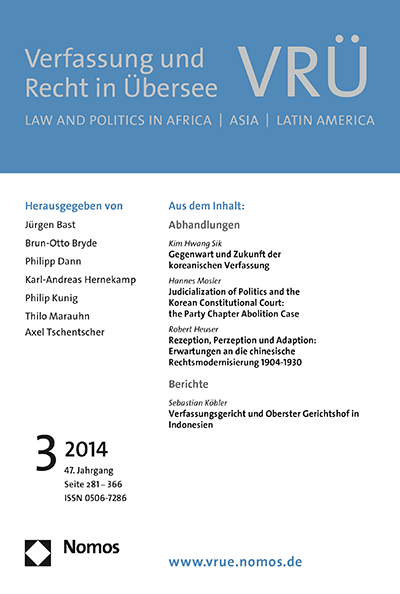
Since 1948, the Constitution of the Republic of Korea has been amended nine times. In these decades, the country saw periods of being a democratic state and of being a dictatorship before once again turning into a democracy, which has become very...
In 2004 South Korea’s Constitutional Court declared the newly revised Political Parties Act constitutional, whereby it reaffirmed the prohibition of local party organizations by law. Party chapters represent the “party on the ground” and lie...
Between the 1870ies and the outbreak of the Pacific war in 1937 Japan and China undertook fundamental changes in their traditional legal systems by way of legislation strongly following continental Europen models. These changes were not based on...
The Indonesian legal system is often described as an ‘unguided chaos’. It is characterised by Indonesia’s cultural diversity and different legal sources and traditions. On the one hand the system is based on indigenous law on the other hand it...
This paper assesses from an international law perspective the increasing use of “Do No Harm” as a principle to guide a broad array of international activities, such as state-building, human rights and climate change. Originally a medical...
Program-for-results (PforR) is an innovative instrument of World Bank financing which links disbursements to results in country-defined programs. This recently adopted instrument seeks to give recipient countries a greater sense of participation,...
The five fast-growing economies, known collectively as BRICS, have recently announced their intention to create their own development bank. The so-called BRICS Bank will be the first world multilateral development bank controlled solely by emerging...
The present article examines how the International Finance Corporation (IFC), the World Bank Group’s private sector finance institution, has integrated labour standards concerns into its environmental and social policy. Providing finance to...
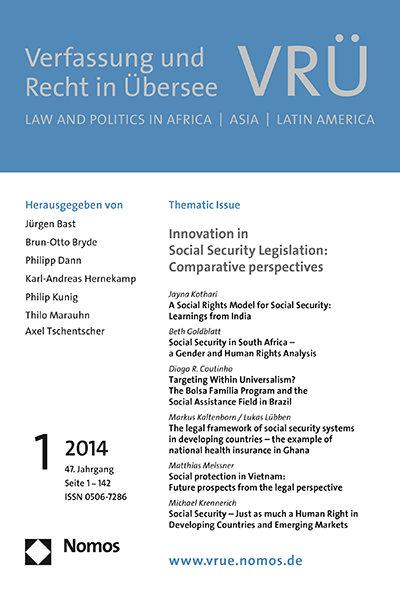
A vast majority of states have formally committed to respect, protect, and progressively fulfill the right to social security by ratifying human rights and ILO conventions. Accordingly, social security systems should guarantee indiscriminate access...