Reconfiguring the field of professional music: New doxa and known capital forms on digital platforms
Table of contents
Bibliographic information
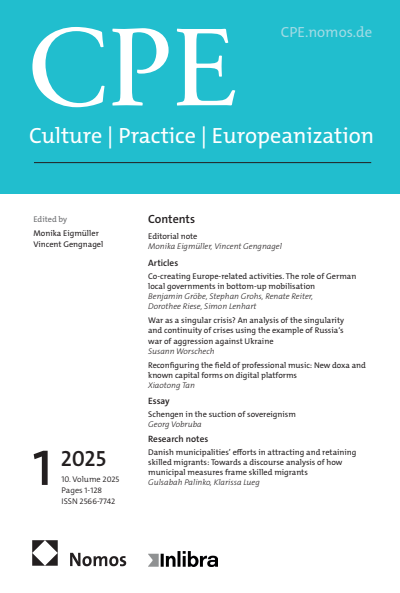
Culture, Practice & Europeanization
Volume 10 (2025), Issue 1
- Authors:
- Publisher
- Nomos, Baden-Baden
- Copyright Year
- 2025
- ISSN-Online
- 2566-7742
- ISSN-Print
- 2566-7742
Chapter information
Volume 10 (2025), Issue 1
Reconfiguring the field of professional music: New doxa and known capital forms on digital platforms
- Authors:
- ISSN-Print
- 2566-7742
- ISSN-Online
- 2566-7742
- Preview:
Digital platforms are reshaping how career success is understood in the music industry. Existing research has mainly focused on the effects of platforms on music production, visibility, and professional practices, yet it has seldom explored how career success and capital are configured in platform environments. This conceptual article uses Bourdieu’s theoretical framework to discuss how digital indicators become taken for granted makers of career success in the digital music field. It also outlines which forms of capital are performed within this context. This study argues that no new forms of capital have emerged in the digital music field and that existing forms are instead reinterpreted through digital practices. This conceptual clarification provides a foundation for applying Bourdieusian theory to research on digital cultural production.
Bibliography
No match found. Try another term.
- Airoldi, M. (2018). Ethnography and the digital fields of social media. International Journal of Social Research Methodology, 21(6), 661–673. Open Google Scholar DOI: 10.5771/2566-7742-2025-1-47
- Anacin, C. (2023). “Can you hear me? Are we live yet?”: An autoethnography of online live mu-sic performances amid the COVID-19 pandemic. Asiascape: Digital Asia, 10(3), 256–280. Open Google Scholar DOI: 10.5771/2566-7742-2025-1-47
- Anderson, T. L., Grunert, C., Katz, A., & Lovascio, S. (2010). Aesthetic capital: A research review on beauty perks and penalties. Sociology Compass, 4(8), 564–575. Open Google Scholar DOI: 10.5771/2566-7742-2025-1-47
- Arditi, D. (2020). Getting signed: Record contracts, musicians, and power in society. Palgrave Macmillan. Open Google Scholar DOI: 10.5771/2566-7742-2025-1-47
- Andreoni, J., & Petrie, R. (2008). Beauty, gender and stereotypes: Evidence from laboratory ex-periments. Journal of Economic Psychology, 29(1), 73–93. Open Google Scholar DOI: 10.5771/2566-7742-2025-1-47
- Aspers, P. (2009). Knowledge and valuation in markets. Theory and Society, 38(2), 111–131. Open Google Scholar DOI: 10.5771/2566-7742-2025-1-47
- Aspers, P. (2011). Markets. Polity Press. Open Google Scholar DOI: 10.5771/2566-7742-2025-1-47
- Aspray, W. (2008). File sharing and the music industry. In W. Aspray & P. E. Ceruzzi (Eds.), The Internet and American business (451–489). MIT Press. Open Google Scholar DOI: 10.5771/2566-7742-2025-1-47
- Barna, E. (2019). Curators as taste entrepreneurs in the digital music industries. In E. Mazierska, L. Gillon, & T. Rigg (Eds.), Popular music in the post-digital age: Politics, economy, culture and technology (253–268). Bloomsbury Academic. Open Google Scholar DOI: 10.5771/2566-7742-2025-1-47
- Bartleet, B. L., Ballico, C., Bennett, D., Bridgstock, R., Draper, P., Tomlinson, V., & Harrison, S. (2019). Building sustainable portfolio careers in music: Insights and implications for higher edu-cation. Music Education Research, 21(3), 282–294. Open Google Scholar DOI: 10.5771/2566-7742-2025-1-47
- Bataille, P., & Perrenoud, M. (2021). “One for the money”? The impact of the “disk crisis” on “ordinary musicians” income: The case of French speaking Switzerland. Poetics, 86, 101552. Open Google Scholar DOI: 10.5771/2566-7742-2025-1-47
- Baym, N. K. (2011). The Swedish model: Balancing markets and gifts in the music industry. Popu-lar Communication, 9(1), 22–38. Open Google Scholar DOI: 10.5771/2566-7742-2025-1-47
- Baym, N. K. (2013). Data not seen: The uses and shortcomings of social media metrics. First Monday, 18(10). Open Google Scholar DOI: 10.5771/2566-7742-2025-1-47
- Baym, N. K. (2018). Playing to the crowd: Musicians, audiences, and the intimate work of connec-tion. New York University Press. Open Google Scholar DOI: 10.5771/2566-7742-2025-1-47
- Bernardo, F., & Martins, L. G. (2014). Disintermediation effects on independent approaches to music business. International Journal of Music Business Research, 3(2), 7–27. Open Google Scholar DOI: 10.5771/2566-7742-2025-1-47
- Bielby, W. T., & Bielby, D. D. (1994). All hits are flukes: Institutionalized decision making and the rhetoric of network prime-time program development. American Journal of Sociology, 99(5), 1287–1313. Open Google Scholar DOI: 10.5771/2566-7742-2025-1-47
- Bonini, T., & Gandini, A. (2019). “First week is editorial, second week is algorithmic”: Platform gatekeepers and the platformization of music curation. Social Media + Society, 5(4). Open Google Scholar DOI: 10.5771/2566-7742-2025-1-47
- Bonini, T., & Magaudda, P. (2024). Artificial intelligence: Where the music of the future is head-ing. In Platformed! How streaming, algorithms and artificial intelligence are shaping music cul-tures (121–148). Palgrave Macmillan. Open Google Scholar DOI: 10.5771/2566-7742-2025-1-47
- Bourdieu, P. (1977). Outline of a theory of practice (R. Nice, Trans.). Cambridge University Press. Open Google Scholar DOI: 10.5771/2566-7742-2025-1-47
- Bourdieu, P. (1984). Distinction: A social critique of the judgement of taste (R. Nice, Trans.). Har-vard University Press. Open Google Scholar DOI: 10.5771/2566-7742-2025-1-47
- Bourdieu, P. (1986). The forms of capital. In J. G. Richardson (Ed.), Handbook of theory and re-search for the sociology of education (241–258). Greenwood Press. Open Google Scholar DOI: 10.5771/2566-7742-2025-1-47
- Bourdieu, P. (1989). Social space and symbolic power. Sociological Theory, 7(1), 14–25. Open Google Scholar DOI: 10.5771/2566-7742-2025-1-47
- Bourdieu, P., & Wacquant, L. (1992). An invitation to reflexive sociology. Polity Press. Open Google Scholar DOI: 10.5771/2566-7742-2025-1-47
- Bourdieu, P. (1998). On television (P. P. Ferguson, Trans.). The New Press. Open Google Scholar DOI: 10.5771/2566-7742-2025-1-47
- Bourdieu, P. (2000). Pascalian meditations (R. Nice, Trans.). Stanford University Press. Open Google Scholar DOI: 10.5771/2566-7742-2025-1-47
- Bourdieu, P. (2005). Principles of an economic anthropology. In N. J. Smelser & R. Swedberg (Eds.), The handbook of economic sociology (2nd ed., 75–89). Princeton University Press; Russell Sage Foundation. Open Google Scholar DOI: 10.5771/2566-7742-2025-1-47
- Breen, M. (2004). The music industry, technology and utopia: An exchange between Marcus Breen and Eamonn Forde. Popular Music, 23(1), 79–89. Open Google Scholar DOI: 10.5771/2566-7742-2025-1-47
- Brock, A., Kvasny, L., & Hales, K. (2010). Cultural appropriations of technical capital: Black wom-en, weblogs, and the digital divide. Information, Communication & Society, 13(7), 1040–1059. Open Google Scholar DOI: 10.5771/2566-7742-2025-1-47
- Bröndum, L. (2019). Where do we go from here? The future of composers in the post-digital era. In E. Mazierska, L. Gillon, & T. Rigg (Eds.), Popular music in the post-digital age: Politics, economy, culture and technology (155–170). Bloomsbury Academic. Open Google Scholar DOI: 10.5771/2566-7742-2025-1-47
- Brooks, T. (2004). Introduction: Lost, stolen, or strayed? In Lost sounds: Blacks and the birth of the recording industry, 1890–1919 (1–11). University of Illinois Press. Open Google Scholar DOI: 10.5771/2566-7742-2025-1-47
- Brown, H. (2012). Valuing independence: Esteem value and its role in the independent music scene. Popular Music and Society, 35(4), 519–539. Open Google Scholar DOI: 10.5771/2566-7742-2025-1-47
- Bucher, T. (2012). Want to be on the top? Algorithmic power and the threat of invisibility on Facebook. New Media & Society, 14(7), 1164–1180. Open Google Scholar DOI: 10.5771/2566-7742-2025-1-47
- Bucher, T. (2016). The algorithmic imaginary: Exploring the ordinary affects of Facebook algo-rithms. Information, Communication & Society, 20(1), 30–44. Open Google Scholar DOI: 10.5771/2566-7742-2025-1-47
- Bucher, T. (2018). If...then: Algorithmic power and politics. Oxford University Press. Open Google Scholar DOI: 10.5771/2566-7742-2025-1-47
- Burgess, J. (2021). Platform studies. In S. Cunningham & D. Craig (Eds.), Creator culture: An intro-duction to global social media entertainment (21–38). NYU Press. Open Google Scholar DOI: 10.5771/2566-7742-2025-1-47
- Cannizzo, F., Strong, C., & Brunt, S. (2023). Career reconstruction: Mid-career transformations in the Australian music industries. Creative Industries Journal, 18(2), 305–322. Open Google Scholar DOI: 10.5771/2566-7742-2025-1-47
- Carter, E. (2024). Poverty among riches: Understanding the contracted economy for recorded music and its impact on market actors. Journal of Cultural Economy, 17(3), 345–359. Open Google Scholar DOI: 10.5771/2566-7742-2025-1-47
- Cayari, C. (2011). The YouTube effect: How YouTube has provided new ways to consume, create, and share music. International Journal of Education & the Arts, 12(6), 1–29. Open Google Scholar DOI: 10.5771/2566-7742-2025-1-47
- Charles, C. D. (2020). Genre in practice: Categories, metadata and music-making in psytrance culture. Dancecult: Journal of Electronic Dance Music Culture, 12(1), 22–47. Open Google Scholar DOI: 10.5771/2566-7742-2025-1-47
- Charlesworth, S. J. (2000). A phenomenology of working class experience (1st ed.). Cambridge University Press. Open Google Scholar DOI: 10.5771/2566-7742-2025-1-47
- Chen, W. (2013). The implications of social capital for the digital divides in America. The Infor-mation Society, 29(1), 13–25. Open Google Scholar DOI: 10.5771/2566-7742-2025-1-47
- Chen, Y., & Wang, Y. (2025). Surviving in the digital age: The impacts of technology evolutions on classical musicians’ career development. In C. Leone (Ed.), Career development: Challenges and opportunities in contemporary societies. IntechOpen. Open Google Scholar DOI: 10.5771/2566-7742-2025-1-47
- Chircu, A. M., & Kauffman, R. J. (1999). Strategies for Internet middlemen in the intermedia-tion/disintermediation/reintermediation cycle. Electronic Markets, 9(1–2), 109–117. Open Google Scholar DOI: 10.5771/2566-7742-2025-1-47
- Cho, D., Hwang, Y., & Park, J. (2018). More buzz, more vibes: Impact of social media on concert distribution. Journal of Economic Behavior & Organization, 156, 103–113. Open Google Scholar DOI: 10.5771/2566-7742-2025-1-47
- Choi, G. Y. (2016). “Who Run the Music? Girls!”: Examining the construction of female digital musicians’ online presence. Popular Music and Society, 40(4), 474–487. Open Google Scholar DOI: 10.5771/2566-7742-2025-1-47
- Connell, K., Brown, A. R., & Baker, S. (2020). The rise and fall of professional singers: A typology of creative career stages in the performing arts. In A. de Dios & L. Kong (Eds.), Handbook on the geographies of creativity (200–215). Edward Elgar Publishing. Open Google Scholar DOI: 10.5771/2566-7742-2025-1-47
- da Silva Henrique, J., Machado, A. F., & Antigo, M. F. (2023). Work satisfaction and job perma-nence in artistic careers: The case of musicians in Belo Horizonte, Brazil. Journal of Cultural Eco-nomics, 47(4), 693–718. Open Google Scholar DOI: 10.5771/2566-7742-2025-1-47
- De Notaris, D., & Savonardo, L. (2022). The digitalization of sound: How the consumption of mu-sic changed from vinyl to hybrid experiences. Italian Sociological Review, 12(1), 159. Open Google Scholar DOI: 10.5771/2566-7742-2025-1-47
- de Zúñiga, H. G., Barnidge, M., & Scherman, A. (2018). Social media social capital, offline social capital, and citizenship: Exploring asymmetrical social capital effects. In Digital politics: Mobiliza-tion, engagement and participation (44–68). Routledge. Open Google Scholar DOI: 10.5771/2566-7742-2025-1-47
- Deldjoo, Y., Schedl, M., & Knees, P. (2024). Content-driven music recommendation: Evolution, state of the art, and challenges. Computer Science Review, 51, 100618. Open Google Scholar DOI: 10.5771/2566-7742-2025-1-47
- deWaard, A. (2021). Wall Street’s content wars: Financing media consolidation (Working paper). UC San Diego. Open Google Scholar DOI: 10.5771/2566-7742-2025-1-47
- Eiriz, V., & Leite, F. P. (2017). The digital distribution of music and its impact on the business models of independent musicians. The Service Industries Journal, 37(13–14), 875–895. Open Google Scholar DOI: 10.5771/2566-7742-2025-1-47
- Emmison, M., & Frow, J. (1998). Information technology as cultural capital. Australian Universi-ties’ Review, 41(1), 41–45. Open Google Scholar DOI: 10.5771/2566-7742-2025-1-47
- Evans, J. M., & Baym, N. K. (2022). The audacity of clout (chasing): Digital strategies of Black youth in Chicago DIY hip-hop. International Journal of Communication, 16, 2669–2687. Open Google Scholar DOI: 10.5771/2566-7742-2025-1-47
- Everts, R. (2023). Making it big in live music: A multilevel analysis of careers in live music. Cultur-al Trends, 33(5), 660–679. Open Google Scholar DOI: 10.5771/2566-7742-2025-1-47
- Everts, R., Berkers, P., & Hitters, E. (2022). Milestones in music: Reputations in the career build-ing of musicians in the changing Dutch music industry. Poetics, 92, 101647. Open Google Scholar DOI: 10.5771/2566-7742-2025-1-47
- Everts, R., Hitters, E., & Berkers, P. (2021). The working life of musicians: Mapping the work activ-ities and values of early-career pop musicians in the Dutch music industry. Creative Industries Journal, 15(1), 97–117. Open Google Scholar DOI: 10.5771/2566-7742-2025-1-47
- Florina, P., & Andreea, M. (2012). Social media and marketing of the “popcorn” music wave: The success of Romanian commercial musicians analysed through their perceived image on Face-book and YouTube. Economics & Sociology, 5(2A), 125–139. Open Google Scholar DOI: 10.5771/2566-7742-2025-1-47
- Fry, A. (2019). An echoic chamber: Algorithmic curation and personalized listening. In E. Mazi-erska, L. Gillon, & T. Rigg (Eds.), Popular music in the post-digital age: Politics, economy, culture and technology (269–290). Bloomsbury Academic. Open Google Scholar DOI: 10.5771/2566-7742-2025-1-47
- Galuszka, P., & Wyrzykowska, K. M. (2017). Artist and repertoire goes online: Evidence from Po-land. Media Industries Journal, 4(1). Open Google Scholar DOI: 10.5771/2566-7742-2025-1-47
- Gandini, A. (2016). Digital work: Self-branding and social capital in the freelance knowledge economy. Marketing Theory, 16(1), 123–141. Open Google Scholar DOI: 10.5771/2566-7742-2025-1-47
- Gerlitz, C., & Helmond, A. (2013). The like economy: Social buttons and the data-intensive web. New Media & Society, 15(8), 1348–1365. Open Google Scholar DOI: 10.5771/2566-7742-2025-1-47
- Giuffre, K. (1999). Sandpiles of opportunity: Success in the art world. Social Forces, 77(3), 815–832. Open Google Scholar DOI: 10.5771/2566-7742-2025-1-47
- Gourévitch, B. (2023). Billboard 200: The lessons of musical success in the U.S. Music & Science, 6. Open Google Scholar DOI: 10.5771/2566-7742-2025-1-47
- Graf, A., & Lueg, K. (2025). Reworking boundaries: A qualitative case study on engineers’ profes-sional identity and habitus in the face of digital transformation. Management Revue, 36(3), Arti-cle 46861. Open Google Scholar DOI: 10.5771/2566-7742-2025-1-47
- Gross, S.-A., & Musgrave, G. (2020). Can music make you sick? Measuring the price of musical ambition. University of Westminster Press. Open Google Scholar DOI: 10.5771/2566-7742-2025-1-47
- Gupta, S., Kaur, K., & Jain, S. (2024). EqBal-RS: Mitigating popularity bias in recommender sys-tems. Journal of Intelligent Information Systems, 62, 509–534. Open Google Scholar DOI: 10.5771/2566-7742-2025-1-47
- Hagen, A. N. (2021). Datafication, literacy, and democratization in the music industry. Popular Music and Society, 45(2), 184–201. Open Google Scholar DOI: 10.5771/2566-7742-2025-1-47
- Hansen, K. A., & Bickford, T. (2023). Negotiating girlhood in rock music: Nandi Bushell, prodigy discourse and adult mentor-fans. Popular Music, 42(2), 123–142. Open Google Scholar DOI: 10.5771/2566-7742-2025-1-47
- Haynes, J., & Marshall, L. (2018). Beats and tweets: Social media in the careers of independent musicians. New Media & Society, 20(5), 1973–1993. Open Google Scholar DOI: 10.5771/2566-7742-2025-1-47
- Hesmondhalgh, D. (2002). The cultural industries. SAGE. Open Google Scholar DOI: 10.5771/2566-7742-2025-1-47
- Hesmondhalgh, D. (2006). Bourdieu, the media and cultural production. Media, Culture & Socie-ty, 28(2), 211–231. Open Google Scholar DOI: 10.5771/2566-7742-2025-1-47
- Hesmondhalgh, D. (2020). Is music streaming bad for musicians? Problems of evidence and ar-gument. New Media & Society, 23(12), 3593–3615. Open Google Scholar DOI: 10.5771/2566-7742-2025-1-47
- Hesmondhalgh, D., & Meier, L. M. (2014). Popular music, independence and the concept of the alternative in contemporary capitalism. In J. Bennett & N. Strange (Eds.), Media independence: Working with freedom or working for free? (94–116). Routledge. Open Google Scholar DOI: 10.5771/2566-7742-2025-1-47
- Hesmondhalgh, D., & Meier, L. M. (2017). What the digitalisation of music tells us about capital-ism, culture and the power of the information technology sector. Information, Communication & Society, 21(11), 1555–1570. Open Google Scholar DOI: 10.5771/2566-7742-2025-1-47
- Hesmondhalgh, D., & Sun, H. (2024). How working musicians (finally) became a matter of main-stream political interest. In D. Arditi & R. Nolan (Eds.), The Palgrave handbook of critical music industry studies. Palgrave Macmillan. Open Google Scholar DOI: 10.5771/2566-7742-2025-1-47
- Hirsch, P. M. (1972). Processing fads and fashions: An organization-set analysis of cultural indus-try systems. American Journal of Sociology, 77(4), 639–659. Open Google Scholar DOI: 10.5771/2566-7742-2025-1-47
- Hodgson, T. (2021). Spotify and the democratisation of music. Popular Music, 40(1), 1–17. Open Google Scholar DOI: 10.5771/2566-7742-2025-1-47
- Holla, S., & Kuipers, G. (2016). Aesthetic capital. In L. Hanquinet & M. Savage (Eds.), Routledge international handbook of the sociology of art and culture (290–303). Routledge. Open Google Scholar DOI: 10.5771/2566-7742-2025-1-47
- Hracs, B. J. (2012). A creative industry in transition: The rise of digitally driven independent mu-sic production. Growth and Change, 43(3), 442–461. Open Google Scholar DOI: 10.5771/2566-7742-2025-1-47
- Hracs, B. J. (2016). Working harder and working smarter: The survival strategies of contemporary independent musicians. In B. J. Hracs, M. Seman, & T. E. Virani (Eds.), The production and con-sumption of music in the digital age (41–55). Routledge. Open Google Scholar DOI: 10.5771/2566-7742-2025-1-47
- Hughes, D., Keith, S., Morrow, G., Evans, M., & Crowdy, D. (2013). What constitutes artist success in the Australian music industries? International Journal of Music Business Research, 2(2), 61–80. Open Google Scholar DOI: 10.5771/2566-7742-2025-1-47
- Ignatow, G., & Robinson, L. (2017). Pierre Bourdieu: Theorizing the digital. Information, Commu-nication & Society, 20(7), 950–966. Open Google Scholar DOI: 10.5771/2566-7742-2025-1-47
- Järvekülg, M., & Wikström, P. (2022). The emergence of promotional gatekeeping and converged local music professionals on social media. Convergence: The International Journal of Research into New Media Technologies, 28(5), 1358–1375. Open Google Scholar DOI: 10.5771/2566-7742-2025-1-47
- Jerasa, S., & Burriss, S. K. (2024). Writing with, for, and against the algorithm: TikTokers’ relation-ships with AI as audience, co-author, and censor. English Teaching: Practice & Critique, 23(1), 118–134. Open Google Scholar DOI: 10.5771/2566-7742-2025-1-47
- Jones, E. (2021). The popular: Metrics, measurements and the DIY imagination. In DIY music and the politics of social media (103–119). Bloomsbury Academic. Open Google Scholar DOI: 10.5771/2566-7742-2025-1-47
- Jones, M. L. (1997). Organising pop: Why so few pop acts make pop music (Publication No. 2473824692) [Doctoral dissertation, University of Liverpool]. ProQuest Dissertations & Theses Global. Open Google Scholar DOI: 10.5771/2566-7742-2025-1-47
- Julien, C. (2015). Bourdieu, social capital and online interaction. Sociology, 49(2), 356–373. Open Google Scholar DOI: 10.5771/2566-7742-2025-1-47
- Leguina, A., & Downey, J. (2021). Getting things done: Inequalities, Internet use and everyday life. New Media & Society, 23(7), 1824–1849. Open Google Scholar DOI: 10.5771/2566-7742-2025-1-47
- Karakayali, N., Kostem, B., & Galip, I. (2018). Recommendation systems as technologies of the self: Algorithmic control and the formation of music taste. Theory, Culture & Society, 35(2), 3–24. Open Google Scholar DOI: 10.5771/2566-7742-2025-1-47
- Karizat, N., Delmonaco, D., Eslami, M., & Andalibi, N. (2021). Algorithmic folk theories and iden-tity: How TikTok users co-produce knowledge of identity and engage in algorithmic resistance. Proceedings of the ACM on Human-Computer Interaction, 5(CSCW2), 1–44. Open Google Scholar DOI: 10.5771/2566-7742-2025-1-47
- Kjus, Y. (2016). Musical exploration via streaming services: The Norwegian experience. Popular Communication, 14(3), 127–136. Open Google Scholar DOI: 10.5771/2566-7742-2025-1-47
- Kopf, S. (2025). Unravelling social media critical discourse studies (SM-CDS) – four approaches to studying social media through the critical lens. Critical Discourse Studies. Open Google Scholar DOI: 10.5771/2566-7742-2025-1-47
- Kozbelt, A. (2005). Factors affecting aesthetic success and improvement in creativity: A case study of the musical genres of Mozart. Psychology of Music, 33(3), 235–255. Open Google Scholar DOI: 10.5771/2566-7742-2025-1-47
- Kukkonen, I., Pajunen, T., Sarpila, O., & Åberg, E. (2024). Is beauty-based inequality gendered? A systematic review of gender differences in socioeconomic outcomes of physical attractiveness in labor markets. European Societies, 26(1), 117–148. Open Google Scholar DOI: 10.5771/2566-7742-2025-1-47
- Kwon, H., Kim, S., & Yang, J. (2018). What makes them dream on?: The influence of social and psychological assets on young musicians’ decision to stay in the profession. Development and Society, 47(3), 371–400. Open Google Scholar DOI: 10.5771/2566-7742-2025-1-47
- Laor, T., & Galily, Y. (2020). The annual music charts: The communal musical taste mix in Israel. Israel Affairs, 26(6), 928–959. Open Google Scholar DOI: 10.5771/2566-7742-2025-1-47
- Leenders, M. A. A. M., Farrell, M. A., Zwaan, K., & ter Bogt, T. F. M. (2015). How are young music artists configuring their media and sales platforms in the digital age? Journal of Marketing Man-agement, 31(17–18), 1799–1817. Open Google Scholar DOI: 10.5771/2566-7742-2025-1-47
- Levina, N., & Arriaga, M. (2014). Distinction and status production on user-generated content platforms: Using Bourdieu’s theory of cultural production to understand social dynamics in online fields. Information Systems Research, 25(3), 468–488. Open Google Scholar DOI: 10.5771/2566-7742-2025-1-47
- Leyshon, A. (2009). The software slump?: Digital music, the democratisation of technology, and the decline of the recording studio sector within the musical economy. Environment and Plan-ning A: Economy and Space, 41(6), 1309–1331. Open Google Scholar DOI: 10.5771/2566-7742-2025-1-47
- Liebowitz, S. J. (2004). Will MP3 downloads annihilate the record industry? The evidence so far. In G. D. Libecap (Ed.), Intellectual property and entrepreneurship (229–260). Emerald Group Pub-lishing. Open Google Scholar DOI: 10.5771/2566-7742-2025-1-47
- Lueg, K., Graf, A., & Boje, D. (2023). A Danish case study of a sociomaterial construction of a new nomos and purpose of higher education. Higher Education, 85(2), 455–472. Open Google Scholar DOI: 10.5771/2566-7742-2025-1-47
- Lundahl, O. (2020). Algorithmic meta-capital: Bourdieusian analysis of social power through al-gorithms in media consumption. Information, Communication & Society, 25(10), 1440–1455. Open Google Scholar DOI: 10.5771/2566-7742-2025-1-47
- Maasø, A., & Hagen, A. N. (2019). Metrics and decision-making in music streaming. Popular Communication, 18(1), 18–31. Open Google Scholar DOI: 10.5771/2566-7742-2025-1-47
- Maasø, A., & Spilker, H. S. (2022). The streaming paradox: Untangling the hybrid gatekeeping mechanisms of music streaming. Popular Music and Society, 45(3), 300–316. Open Google Scholar DOI: 10.5771/2566-7742-2025-1-47
- Malcomson, H. (2013). Composing individuals: Ethnographic reflections on success and prestige in the British new music network. Twentieth-Century Music, 10(1), 115–136. Open Google Scholar DOI: 10.5771/2566-7742-2025-1-47
- Maliński, J. (2017). Attention capital as a result of the emergence of social media. Adeptus, (10), 1–13. Open Google Scholar DOI: 10.5771/2566-7742-2025-1-47
- Marrington, M. (2024). Cultural entrepreneurship in historical and contemporary context: Per-spectives on repertoire construction and recording practice in the field of classical guitar per-formance. In R. Hepworth-Sawyer, M. Marrington, J. Hall, & E. Beaumont (Eds.), Contemporary enterprise and entrepreneurship in context (213–228). Routledge. Open Google Scholar DOI: 10.5771/2566-7742-2025-1-47
- Maudonnet, D. L., Wood, T., & Bendassolli, P. F. (2019). From know-how to know-when: Strate-gies that Brazilian musicians use to reorient their careers in the face of technological and insti-tutional changes. International Journal of Arts Management, 21(3), 14–27. Open Google Scholar DOI: 10.5771/2566-7742-2025-1-47
- McLeod, K. (2005). MP3s are killing home taping: The rise of Internet distribution and its chal-lenge to the major label music monopoly. Popular Music and Society, 28(4), 521–531. Open Google Scholar DOI: 10.5771/2566-7742-2025-1-47
- Meier, L. M. (2017). Popular music as promotion: Music and branding in the digital age. Polity Press. Open Google Scholar DOI: 10.5771/2566-7742-2025-1-47
- Menger, P.-M. (2014). The economics of creativity: Art and achievement under uncertainty (S. Rendall, A. Jacobs, A. Dorval, L. Eskinazi, E. Saada, & J. Karaganis, Trans.). Harvard University Press. Open Google Scholar DOI: 10.5771/2566-7742-2025-1-47
- Meraz, S., & Papacharissi, Z. (2013). Networked gatekeeping and networked framing on #Egypt. The International Journal of Press/Politics, 18(2), 138–166. Open Google Scholar DOI: 10.5771/2566-7742-2025-1-47
- Merisalo, M. (2016). Electronic capital: Economic and social geographies of digitalization [Doctoral dissertation, University of Helsinki]. University of Helsinki. Open Google Scholar DOI: 10.5771/2566-7742-2025-1-47
- Merton, R. K. (1968). The Matthew effect in science. Science, 159(3810), 56–63. Open Google Scholar DOI: 10.5771/2566-7742-2025-1-47
- Messitte, N. (2014, November 30). How payola laws keep independent artists off mainstream radio. Forbes. Retrieved from: https://www.forbes.com/sites/nickmessitte/2014/11/30/how-payola-laws-keep-independent-artists-off-mainstream-radio/ (last accessed: 2025, November 25). Open Google Scholar DOI: 10.5771/2566-7742-2025-1-47
- Morgan, B. A. (2019). Revenue, access, and engagement via the in-house curated Spotify playlist in Australia. Popular Communication, 18(1), 32–47. Open Google Scholar DOI: 10.5771/2566-7742-2025-1-47
- Morris, J. W. (2015). Curation by code: Infomediaries and the data mining of taste. European Journal of Cultural Studies, 18(4–5), 446–463. Open Google Scholar DOI: 10.5771/2566-7742-2025-1-47
- Morris, J. W. (2020). Music platforms and the optimization of culture. Social Media + Society, 6(3). Open Google Scholar DOI: 10.5771/2566-7742-2025-1-47
- Murphy, S., & Hume, M. (2023). The new digital music marketing ecosystem: Artist direct. Crea-tive Industries Journal, 18(2), 172–204. Open Google Scholar DOI: 10.5771/2566-7742-2025-1-47
- Negus, K. (2002). The work of cultural intermediaries and the enduring distance between pro-duction and consumption. Cultural Studies, 16(4), 501–515. Open Google Scholar DOI: 10.5771/2566-7742-2025-1-47
- Negus, K. (2011). Producing pop: Culture and conflict in the popular music industry (Original work published 1992). Open Google Scholar DOI: 10.5771/2566-7742-2025-1-47
- Negus, K. (2019). From creator to data: The post-record music industry and the digital conglom-erates. Media, Culture & Society, 41(3), 367–384. Open Google Scholar DOI: 10.5771/2566-7742-2025-1-47
- Netherton, J. (2017). The entrepreneurial imperative: Recording artists in extreme metal music proto-markets. Metal Music Studies, 3(3), 369–386. Open Google Scholar DOI: 10.5771/2566-7742-2025-1-47
- Ng, J., & Gamble, S. (2024). Hip-hop music producers’ labour in the digital music economy: Self-promotion, social media and platform gatekeeping. New Media & Society, Advance online publi-cation. Open Google Scholar DOI: 10.5771/2566-7742-2025-1-47
- Nørholm Lundin, A. (2022). “Where is your fixed point?” Dealing with ambiguous freelance mu-sician careers. Cultural Trends, 32(3), 231–246. Open Google Scholar DOI: 10.5771/2566-7742-2025-1-47
- O’Dair, M., & Fry, A. (2019). Beyond the black box in music streaming: The impact of recommen-dation systems upon artists. Popular Communication, 18(1), 65–77. Open Google Scholar DOI: 10.5771/2566-7742-2025-1-47
- Ogden, J. R., Ogden, D. T., & Long, K. (2011). Music marketing: A history and landscape. Journal of Retailing and Consumer Services, 18(2), 120–125. Open Google Scholar DOI: 10.5771/2566-7742-2025-1-47
- Ollier-Malaterre, A., Jacobs, J. A., & Rothbard, N. P. (2019). Technology, work, and family: Digital cultural capital and boundary management. Annual Review of Sociology, 45(1), 425–447. Open Google Scholar DOI: 10.5771/2566-7742-2025-1-47
- Österblom, H., Jouffray, J.-B., Folke, C., Crona, B., Troell, M., Merrie, A., & Rockström, J. (2015). Transnational corporations as ‘keystone actors’ in marine ecosystems. PLOS ONE, 10(5), e0127533. Open Google Scholar DOI: 10.5771/2566-7742-2025-1-47
- Paino, M., & Renzulli, L. A. (2013). Digital dimension of cultural capital: The (in)visible ad-vantages for students who exhibit computer skills. Sociology of Education, 86(2), 124–138. Open Google Scholar DOI: 10.5771/2566-7742-2025-1-47
- Perrin, A. (2020). The innovative business model of Daft Punk. In P. Roy & E. Pellegrin-Boucher (Eds.), Innovation in the cultural and creative industries (55–75). John Wiley & Sons. Open Google Scholar DOI: 10.5771/2566-7742-2025-1-47
- Peterson, R. A., & Berger, D. G. (1975). Cycles in symbol production: The case of popular music. American Sociological Review, 40(2), 158–173. Open Google Scholar DOI: 10.5771/2566-7742-2025-1-47
- Pilati, F., Houssard, A., & Sacco, P. L. (2024). Mirroring the inequalities of mainstream music platforms: Popularity, revenue, and monetization strategies on Bandcamp. International Journal of Cultural Policy, 31(3), 338–357. Open Google Scholar DOI: 10.5771/2566-7742-2025-1-47
- Podolny, J. (2005). Status signals: A sociological study of market competition. Princeton University Press. Open Google Scholar DOI: 10.5771/2566-7742-2025-1-47
- Polak, N., & Schaap, J. (2025). Write, record, optimize? How musicians reflect on music optimiza-tion strategies in the creative production process. New Media & Society, 27(8), 4773–4789. Open Google Scholar DOI: 10.5771/2566-7742-2025-1-47
- Pras, A., Guastavino, C., & Lavoie, M. (2013). The impact of technological advances on recording studio practices. Journal of the American Society for Information Science and Technology, 64(3), 612–626. Open Google Scholar DOI: 10.5771/2566-7742-2025-1-47
- Prey, R. (2018). Nothing personal: Algorithmic individuation on music streaming platforms. Me-dia, Culture & Society, 40(7), 1086–1100. Open Google Scholar DOI: 10.5771/2566-7742-2025-1-47
- Prey, R. (2020a). Locating power in platformization: Music streaming playlists and curatorial power. Social Media + Society, 6(2). Open Google Scholar DOI: 10.5771/2566-7742-2025-1-47
- Prey, R. (2020b). Performing numbers: Musicians and their metrics. In D. Stark (Ed.), The perfor-mance complex: Competition and competitions in social life (241–258). Oxford University Press. Open Google Scholar DOI: 10.5771/2566-7742-2025-1-47
- Prey, R., & Lee, S. (2024). Platform closure and creator creep: What we can learn from Korean indie musicians. International Journal of Communication, 18, 4167–4186. Open Google Scholar DOI: 10.5771/2566-7742-2025-1-47
- Qu, S., Hesmondhalgh, D., & Xiao, J. (2021). Music streaming platforms and self-releasing musi-cians: The case of China. Information, Communication & Society, 26(4), 699–715. Open Google Scholar DOI: 10.5771/2566-7742-2025-1-47
- Raffa, M. (2025). Self-brand or be branded out: The convergence of mainstream and independ-ent music talent scouting under platform capitalism. Cultural Sociology, 0(0). Open Google Scholar DOI: 10.5771/2566-7742-2025-1-47
- Ragnedda, M. (2018). Conceptualizing digital capital. Telematics and Informatics, 35(8), 2366–2375. Open Google Scholar DOI: 10.5771/2566-7742-2025-1-47
- Ragnedda, M., Ruiu, M. L., & Addeo, F. (2020). Measuring digital capital: An empirical investiga-tion. New Media & Society, 22(5), 793–816. Open Google Scholar DOI: 10.5771/2566-7742-2025-1-47
- Rauh, A. (2024). Showing off as selling out: Online (self-)promotional strategies of grassroots electronic dance musicians. Popular Music and Society, 47(5), 582–603. Open Google Scholar DOI: 10.5771/2566-7742-2025-1-47
- Reitsamer, R. (2011). The DIY careers of techno and drum ’n’ bass DJs in Vienna. Dancecult: Jour-nal of Electronic Dance Music Culture, 3(1), 28–43. Open Google Scholar DOI: 10.5771/2566-7742-2025-1-47
- Rogers, I. (2013a). The hobbyist majority and the mainstream fringe: The pathways of independ-ent music-making in Brisbane, Australia. In S. Baker, A. Bennett, & J. Taylor (Eds.), Redefining mainstream popular music (162–173). Routledge. Open Google Scholar DOI: 10.5771/2566-7742-2025-1-47
- Rogers, J. (2013b). The death and life of the music industry in the digital age. Bloomsbury Aca-demic. Open Google Scholar DOI: 10.5771/2566-7742-2025-1-47
- Sadowski, J. (2019). When data is capital: Datafication, accumulation, and extraction. Big Data & Society, 6(1). Open Google Scholar DOI: 10.5771/2566-7742-2025-1-47
- Sarpila, O., Kukkonen, I., Pajunen, T., & Åberg, E. (2021). Introduction. In O. Sarpila, I. Kukkonen, T. Pajunen, & E. Åberg (Eds.), Appearance as capital: The normative regulation of aesthetic capital accumulation and conversion (1–19). Emerald Publishing. Open Google Scholar DOI: 10.5771/2566-7742-2025-1-47
- Schmitz, A. (2017). The structure of digital partner choice: A Bourdieusian perspective. Springer. Open Google Scholar DOI: 10.5771/2566-7742-2025-1-47
- Schmutz, V. (2016). Commercialization and consecration: Media attention to popular music in the US and the Netherlands, 1975–2005. Poetics, 59, 82–95. Open Google Scholar DOI: 10.5771/2566-7742-2025-1-47
- Schwetter, H. (2019). From record contract to artrepreneur? Musicians’ self-management and the changing illusio in the music market. Kritika Kultura, (32), Article 11. Open Google Scholar DOI: 10.5771/2566-7742-2025-1-47
- Scott, M. (2012). Cultural entrepreneurs, cultural entrepreneurship: Music producers mobilising and converting Bourdieu’s alternative capitals. Poetics, 40(3), 237–255. Open Google Scholar DOI: 10.5771/2566-7742-2025-1-47
- Seaver, N. (2022). Computing taste: Algorithms and the makers of music recommendation. Univer-sity of Chicago Press. Open Google Scholar DOI: 10.5771/2566-7742-2025-1-47
- Sen, A. (2010). Music in the digital age: Musicians and fans around the world “come together” on the net. Global Media Journal, 9(16), 1–13. Open Google Scholar DOI: 10.5771/2566-7742-2025-1-47
- Shoemaker, P. J., & Reese, S. D. (1996). Mediating the message: Theories of influences on mass media content (2nd ed.). Longman. Open Google Scholar DOI: 10.5771/2566-7742-2025-1-47
- Simonton, D. K. (1986). Aesthetic success in classical music: A computer analysis of 1935 compo-sitions. Empirical Studies of the Arts, 4(1), 1–17. Open Google Scholar DOI: 10.5771/2566-7742-2025-1-47
- Smith, C., Smith, J. B., & Shaw, E. (2017). Embracing digital networks: Entrepreneurs’ social capi-tal online. Journal of Business Venturing, 32(1), 18–34. Open Google Scholar DOI: 10.5771/2566-7742-2025-1-47
- Smith, N. T., & Thwaites, R. (2019). The composition of precarity: ‘Emerging’ composers’ experi-ences of opportunity culture in contemporary classical music. The British Journal of Sociology, 70(2), 589–609. Open Google Scholar DOI: 10.5771/2566-7742-2025-1-47
- Spilker, H. S. (2012). The network studio revisited: Becoming an artist in the age of “piracy cul-tures”. International Journal of Communication, 6, 773–794. Open Google Scholar DOI: 10.5771/2566-7742-2025-1-47
- Spotify for Artists. (2023, November 21). Modernizing our royalty system to drive an additional 1 billion toward emerging and professional artists. Retrieved from https://artists.spotify.com/en/blog/modernizing-our-royalty-system (last accessed: 2025, No-vember 25). Open Google Scholar DOI: 10.5771/2566-7742-2025-1-47
- Sutton, A. C. (2020). The composition of success: Competition and the creative self in contempo-rary art music. Qualitative Sociology, 43(4), 489–513. Open Google Scholar DOI: 10.5771/2566-7742-2025-1-47
- Tessler, H., & Flynn, M. (2015). From DIY to D2F: Contextualizing entrepreneurship for the artist/musician. In A. Dumbreck & G. McPherson (Eds.), Music entrepreneurship (47–73). Me-thuen Drama. Open Google Scholar DOI: 10.5771/2566-7742-2025-1-47
- Thomson, K. (2013). Roles, revenue, and responsibilities: The changing nature of being a work-ing musician. Work and Occupations, 40(4), 514–525. Open Google Scholar DOI: 10.5771/2566-7742-2025-1-47
- Tintiangko, J., Fung, A. Y. H., & Leo-Liu, J. (2023). Compelled TikTok creators? The ambivalent affordances of the short video app for Filipino musicians. Media, Culture & Society, 45(8), 1600–1615. Open Google Scholar DOI: 10.5771/2566-7742-2025-1-47
- Toval-Gajardo, M., Soto Roy, Á., Manríquez, F., & Fortes, G. (2025). Voices and melodies of artis-tic precarity: The unbearable flexibility of subjectivity in Chilean independent musicians. Human Arenas. Open Google Scholar DOI: 10.5771/2566-7742-2025-1-47
- Tufekci, Z. (2015). Algorithmic harms beyond Facebook and Google: Emergent challenges of computational agency. Colorado Technology Law Journal, 13, 203–217. Open Google Scholar DOI: 10.5771/2566-7742-2025-1-47
- Vakalopoulos, K. (2023). Shedding some (more) light in Bourdieu’s habitus and doxa: A socio‐phenomenological approach. Journal for the Theory of Social Behaviour, 53(2), 255–270. Open Google Scholar DOI: 10.5771/2566-7742-2025-1-47
- van den Berg, M., & Arts, J. (2019). The aesthetics of work-readiness: Aesthetic judgements and pedagogies for conditional welfare and post-Fordist labour markets. Work, Employment & Socie-ty, 33(2), 298–313. Open Google Scholar DOI: 10.5771/2566-7742-2025-1-47
- van Kan, M. (2025). Digitalization and the long tail: Perspectives of music producers from Småland. In M. Knust (Ed.), Pop music made in Småland: Music production and entrepreneurship in Sweden (127–139). Palgrave Macmillan. Open Google Scholar DOI: 10.5771/2566-7742-2025-1-47
- Verwiebe, R., & Hagemann, S. (2024). Bourdieu revisited: New forms of digital capital – emer-gence, reproduction, inequality of distribution. Information, Communication & Society, 28(11), 1861–1883. Open Google Scholar DOI: 10.5771/2566-7742-2025-1-47
- Villanueva-Mansilla, E., Nakano, T., & Evaristo, I. (2015). From divides to capitals: An exploration of digital divides as expressions of social and cultural capital. In L. Robinson, J. Schulz, S. R. Cotten, T. M. Hale, A. A. Williams, & J. L. Hightower (Eds.), Communication and information tech-nologies annual (89–117). Emerald Group. Open Google Scholar DOI: 10.5771/2566-7742-2025-1-47
- Wang, Q., & de Kloet, J. (2016). From “nothing to my name” to “I am a singer”: Market, capital, and politics in the Chinese music industry. In M. Keane (Ed.), Handbook of cultural and creative industries in China (293–310). Edward Elgar. Open Google Scholar DOI: 10.5771/2566-7742-2025-1-47
- Watson, A., Watson, J. B., & Tompkins, L. (2022). Does social media pay for music artists? Quanti-tative evidence on the co-evolution of social media, streaming and live music. Journal of Cultural Economy, 16(1), 32–46. Open Google Scholar DOI: 10.5771/2566-7742-2025-1-47
- Westby, D. L. (1960). The career experience of the symphony musician. American String Teacher, 10(3), 16–22. Open Google Scholar DOI: 10.5771/2566-7742-2025-1-47
- Wikström, P. (2019). The music industry: Music in the cloud (3rd ed.). Polity Press. Open Google Scholar DOI: 10.5771/2566-7742-2025-1-47
- Woods, C. R. (2023). Orchestrating the ecosystem: How music-making is transformed in the digital age (Publication No. 31104528) [Doctoral dissertation, University of Liverpool]. ProQuest Disser-tations & Theses Global. Open Google Scholar DOI: 10.5771/2566-7742-2025-1-47
- Woods, C., & Davis, J. (2024). Exploring the origins of digital burnout in the music industries and what to do about it. In D. Arditi & R. Nolan (Eds.), The Palgrave handbook of critical music indus-try studies (169–187). Palgrave Macmillan. Open Google Scholar DOI: 10.5771/2566-7742-2025-1-47
- Zhang, X., Chu, X., Liang, H., & He, J. (2024). Exploring music geography beyond the West: Clus-tering and mobility of Chinese musicians in the digital era. Geoforum, 150, 103990. Open Google Scholar DOI: 10.5771/2566-7742-2025-1-47
- Zulli, D., & Zulli, D. J. (2022). Extending the internet meme: Conceptualizing technological mime-sis and imitation publics on the TikTok platform. New Media & Society, 24(8), 1872–1890. Open Google Scholar DOI: 10.5771/2566-7742-2025-1-47
- Zwaan, K., & ter Bogt, T. F. M. (2009). Research note: Breaking into the popular record industry: An insider’s view on the career entry of pop musicians. European Journal of Communication, 24(1), 89–101. Open Google Scholar DOI: 10.5771/2566-7742-2025-1-47
- Zwaan, K., ter Bogt, T. F. M., & Raaijmakers, Q. (2009). So you want to be a rock ‘n’ roll star? Career success of pop musicians in the Netherlands. Poetics, 37(3), 250–266. Open Google Scholar DOI: 10.5771/2566-7742-2025-1-47
