, to see if you have full access to this publication.
Edited Book No access
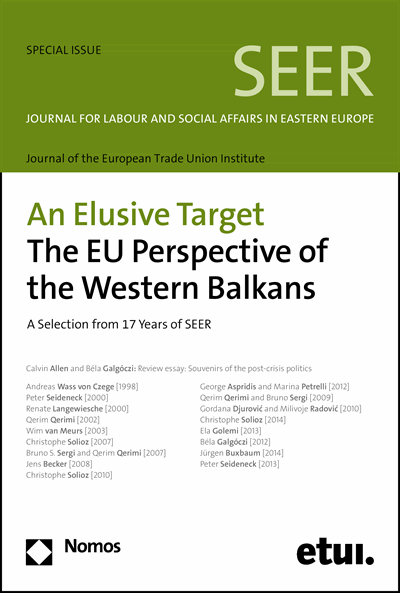
An Elusive Target: The EU Perspective of the Western Balkans
A Selection of 17 Years of SEER- Editors:
- Publisher:
- 2016
Summary
Der Sonderband der SEER versammelt Beiträge aus den vergangenen 17 Jahrgängen der Zeitschrift. Im Fokus stehen dabei die EU-Beitrittsperspektiven der westlichen Balkanstaaten. Fortwährende Hindernisse und neue Bruchlinien werden gleichermaßen deutlich. Der Band konstatiert den Abstieg der Region in die Sklerose. Es werden gleichwohl Möglichkeiten einer optimistischen Perspektivierung der EU-Erweiterung ausgelotet.
Search publication
Bibliographic data
- Edition
- 1/2016
- Copyright year
- 2016
- ISBN-Print
- 978-3-8487-3075-9
- ISBN-Online
- 978-3-8452-7218-4
- Publisher
- Nomos, Baden-Baden
- Language
- English
- Pages
- 259
- Product type
- Edited Book
Table of contents
ChapterPages
- Titelei/Inhaltsverzeichnis No access Pages 1 - 6
- Authors: |
- Introduction No accessAuthors: |
- 'Top-down' and 'bottom-up': accounting for the failures of a vision for ‘Europeanisation’ No accessAuthors: |
- Crises and reactions No accessAuthors: |
- Competing priorities No accessAuthors: |
- Reform within the EU No accessAuthors: |
- The faces of south-east Europe in response to the crises of Europe No accessAuthors: |
- Conclusion No accessAuthors: |
- Authors:
- Introduction No accessAuthors:
- The opportunity comes too late No accessAuthors:
- EU agricultural policy under fire No accessAuthors:
- Competition a bottleneck to entry No accessAuthors:
- Administrative reform the Achilles' heel No accessAuthors:
- Euro-scenarios No accessAuthors:
- European Economic Area politically obsolete No accessAuthors:
- Conclusion No accessAuthors:
- Authors:
- Reactions and resolutions of the ETUC regarding the Stability Pact – laying the basis for practical trade union politics No accessAuthors:
- The participation of trade unions in the Stability Pact No accessAuthors:
- Trade unions in the region: improving the responsibility of co-operation No accessAuthors:
- Authors:
- 1. Why this enlargement is special No accessAuthors:
- 2. Costs and benefits, winners and losers No accessAuthors:
- 3. Growth potential and labour markets No accessAuthors:
- 4. The challenges of building social partnership in the run-up to accession No accessAuthors:
- 5. Policy instruments at hand No accessAuthors:
- Authors:
- Introduction No accessAuthors:
- The enlargement process No accessAuthors:
- The advantages of European enlargement No accessAuthors:
- Authors:
- Towards a Stabilisation and Association Agreement No accessAuthors:
- Negotiating and implementing the Stabilisation and Association Agreements No accessAuthors:
- Assistance No accessAuthors:
- EU-Balkan perceptions No accessAuthors:
- Unresolved political questions – Kosova’s status and EU integration No accessAuthors:
- Integration processes within south-east Europe No accessAuthors:
- Regional co-operation No accessAuthors:
- Inter-ethnic reconciliation as a means for European integration No accessAuthors:
- Conclusions No accessAuthors:
- Authors:
- The Balkans 2003 No accessAuthors:
- Thessaloniki, June 2003 No accessAuthors:
- The European agenda No accessAuthors:
- Authors:
- European agenda No accessAuthors:
- Macroeconomic deficits and regional instability No accessAuthors:
- Functional co-operation No accessAuthors:
- Conclusion No accessAuthors:
- Authors:
- Introduction No accessAuthors:
- Authors:
- Main regional trends No accessAuthors:
- European integration process No accessAuthors:
- Authors:
- The necessity of a comprehensive framework No accessAuthors:
- South-eastern Europe’s key challenge No accessAuthors:
- The fate of regional initiatives in south-east Europe No accessAuthors:
- Conclusion No accessAuthors:
- Authors: |
- Introduction No accessAuthors: |
- The enlargement process No accessAuthors: |
- Authors: |
- Towards a Stabilisation and Association Agreement No accessAuthors: |
- Negotiating and implementing Stabilisation and Association Agreements No accessAuthors: |
- Assistance No accessAuthors: |
- EU-Balkan perceptions No accessAuthors: |
- One of the unresolved political questions No accessAuthors: |
- Regional co-operation and the new CEFTA No accessAuthors: |
- Authors:
- Introduction No accessAuthors:
- The dark sides of the Balkans – some western clichés No accessAuthors:
- The destruction of Yugoslavia No accessAuthors:
- European unity progress at war? No accessAuthors:
- The EU between globalisation and fragmentation No accessAuthors:
- The approach of the EU No accessAuthors:
- Stabilising the Balkans – the Stability Pact for South-Eastern Europe No accessAuthors:
- The Stability Pact at the micro level – the example of Bosnia and Herzegovina No accessAuthors:
- Fighting corruption No accessAuthors:
- Serbia and Montenegro – the EU as honest broker? No accessAuthors:
- Epilogue No accessAuthors:
- Authors:
- The broader picture – the SEE levels No accessAuthors:
- From Thessaloniki to Lisbon – the lost momentum No accessAuthors:
- Imbalance between the technical and political levels No accessAuthors:
- From Lisbon onwards No accessAuthors:
- What should be done need not wait No accessAuthors:
- Authors: |
- Introduction No accessAuthors: |
- Europeanisation hand-in-hand with enlargement: a literature review No accessAuthors: |
- Authors: |
- Albania (COM(2010)680; SEC(2010)1335; MEMO/10/553) No accessAuthors: |
- Bosnia and Herzegovina (SEC(2010)1331; MEMO/10/557; COM(2010)660 final) No accessAuthors: |
- Croatia (COM(2010)660 final; MEMO/10/558; SEC(2010)1326) No accessAuthors: |
- Former Yugoslav Republic of Macedonia (fYRoM) (COM(2010)660 final; MEMO/10/556; SEC(2010)1332) No accessAuthors: |
- Montenegro (COM(2010)670; MEMO/10/552; SEC(2010)1334) No accessAuthors: |
- Kosovo (COM(2010)660 final; MEMO/10/554; SEC(2010)1329) No accessAuthors: |
- Serbia (COM(2010)660 final; MEMO/10/560; SEC(2010)1330) No accessAuthors: |
- Sub-case study: Croatia vs. Kosovo No accessAuthors: |
- Conclusions No accessAuthors: |
- Authors: |
- 1. Introduction No accessAuthors: |
- 2. The broader context No accessAuthors: |
- 3. Principal challenges and prospects of further enlargement No accessAuthors: |
- 4. Economic growth and unemployment rates No accessAuthors: |
- 5. Areas to be revived: enterprise reforms and foreign investment No accessAuthors: |
- Authors: |
- 6.1 Corruption No accessAuthors: |
- 6.2 Organised crime No accessAuthors: |
- 6.3 Recommended policy directions No accessAuthors: |
- 7. Solutions and recommendations No accessAuthors: |
- Authors: |
- Introduction No accessAuthors: |
- Western Balkans region and the enlargement dynamic No accessAuthors: |
- The regional picture: lobbying for a faster integration track for the region as a whole No accessAuthors: |
- The ‘regatta’: lobbying for a faster integration track based on the ‘own-merit’ approach No accessAuthors: |
- The importance of lobbying No accessAuthors: |
- Concluding remarks No accessAuthors: |
- Authors:
- The EU: with divides or flexibility? No accessAuthors:
- Breaking the chains of weariness: a new EU in a new world order No accessAuthors:
- Enlargement: wider or/and deeper? No accessAuthors:
- Authors:
- Who No accessAuthors:
- When No accessAuthors:
- How not No accessAuthors:
- So how? No accessAuthors:
- Authors:
- Introduction No accessAuthors:
- Background No accessAuthors:
- Authors:
- Civil and political instability No accessAuthors:
- Low levels of economic development No accessAuthors:
- Shifts in the priorities of foreign policy as well as shrinking aid No accessAuthors:
- The debate on enlargement No accessAuthors:
- The importance of collaboration and co-ordination within the Balkans region for countries’ futures in the European Union No accessAuthors:
- Conclusion No accessAuthors:
- Authors:
- Introduction No accessAuthors:
- Authors:
- Authors:
- The main trends in wage developments in CEE of the past decade No accessAuthors:
- The 2009 crisis and central and east European economies No accessAuthors:
- The 2010-2012 crisis in the Eurozone No accessAuthors:
- Why central and east European countries are different to the Mediterranean countries most hit by the Eurozone crisis No accessAuthors:
- Lessons from the Eurozone crisis for central and eastern Europe No accessAuthors:
- Conclusions No accessAuthors:
- Authors:
- Introduction No accessAuthors:
- The breaking away of Republika Srpska No accessAuthors:
- Two subsequent scenarios No accessAuthors:
- Authors:
- At the start of the war – no chance of stopping it No accessAuthors:
- Dialogue and relations during the war No accessAuthors:
- Promoting bilateral relations between ETUC affiliates and Yugoslav trade unions No accessAuthors:
- Democracy – a precondition for a lasting peace No accessAuthors:
- 1995: ‘Trade union bridge in Mostar’ No accessAuthors:
- Meeting with Jacques Delors and Tadeusz Mazowiecki No accessAuthors:
- After Dayton: establishing new relations and promoting dialogue No accessAuthors:
- KSBiH: One confederation for Bosnia-Herzegovina No accessAuthors:
- Serbia: trade unions at the heart of the conflict No accessAuthors:
- Kosovo – the other war No accessAuthors:
- Solidarnost – a regional platform of trade union co-operation No accessAuthors:
- Regional reconnection No accessAuthors:
- What is urgent now? No accessAuthors:
- About the Authors No access Pages 258 - 259