Trust in the Sharing Economy
Table of contents
Bibliographic information
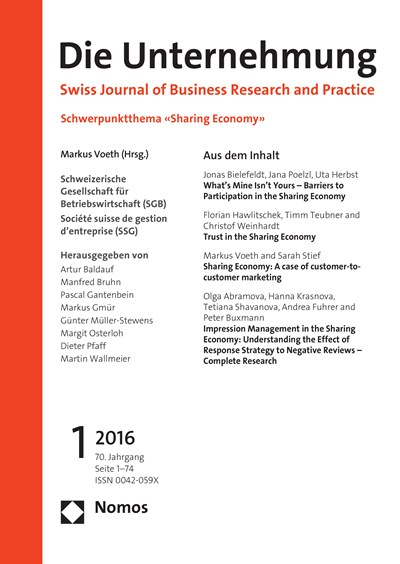
Die Unternehmung
Volume 70 (2016), Issue 1
- Authors:
- Publisher
- Nomos, Baden-Baden
- Copyright Year
- 2016
- ISSN-Online
- 0042-059X
- ISSN-Print
- 0042-059X
Chapter information
Volume 70 (2016), Issue 1
Trust in the Sharing Economy
- Authors:
- ISSN-Print
- 0042-059X
- ISSN-Online
- 0042-059X
- Preview:
Trust has been in the focus of research on business-to-consumer (B2C) e-commerce in the last decade. The rise of consumer-to-consumer (C2C) markets in the context of the sharing economy, however, has posed new challenges and questions regarding the dimensionality and role of trust in online transactions. We outline a conceptual research model for the role of trust with regard to the consumers’ and suppliers’ intentions to engage in this economy. Our model differentiates between three substantial targets of trust, that is, trust towards peer, platform, and product (3P). We propose and evaluate a questionnaire, which addresses these targets in their dimensions ability, integrity, and benevolence.
Bibliography
No match found. Try another term.
- Avital, M., et al. (2015). The Sharing Economy: Friend or Foe?, in: Carte, T., et al. (Hrsg.): Proceedings of the Thirty Sixth International Conference on Information Systems, Fort Worth. Open Google Scholar DOI: 10.5771/0042-059X-2016-1-26
- Bardhi, F./Eckhardt, G. M. (2012): Access-based Consumption: the Case of Car Sharing, in: Journal of Consumer Research, Vol. 39, No. 4, S. 881-898. Open Google Scholar DOI: 10.5771/0042-059X-2016-1-26
- Baker, L. B., et al. (2014): Alibaba Surges 38 Percent on Massive Demand in Market Debut, http://www.reuters.com/article/us-alibaba-ipo-idUSKBN0HD2CO20140919, 16.1.2016. Open Google Scholar DOI: 10.5771/0042-059X-2016-1-26
- Belk, R. (2010): Sharing, in: Journal of Consumer Research, Vol. 36, No. 5, S. 715-734. Open Google Scholar DOI: 10.5771/0042-059X-2016-1-26
- Belk, R. (2014). Sharing Versus Pseudo-Sharing in Web 2.0, in: The Anthropologist, Vol. 4, No. 2, S. 7-23. Open Google Scholar DOI: 10.5771/0042-059X-2016-1-26
- Botsman, R./Rogers, R. (2010): What’s Mine is Yours. The Rise of Collaborative Consumption, New York. Open Google Scholar DOI: 10.5771/0042-059X-2016-1-26
- Botsman, R. (2013): The Sharing Economy Lacks a Shared Definition, http://www.collaborativeconsumption.com/2013/11/22/the-sharing-economy-lacks-a-shared-definition/, 16.1.2016. Open Google Scholar DOI: 10.5771/0042-059X-2016-1-26
- Churchill, G. (1979): A Paradigm for Developing Better Measures of Marketing Constructs, in: Journal of Marketing Research, Vol. 16, No. 1, S. 64-73. Open Google Scholar DOI: 10.5771/0042-059X-2016-1-26
- Comer, J. M., et al. (1999): Methods in Sales Research: Perceived Trust in Business-to-Business Sales: a New Measure, in: Journal of Personal Selling & Sales Management Vol. 19, No. 3, S. 61-71. Open Google Scholar DOI: 10.5771/0042-059X-2016-1-26
- Costello, A. B./Osborne, J. W. (2005): Best Practices in Exploratory Factor Analysis: Four Recommendations for Getting the Most from Your Analysis, in: Practical Assessment, Research & Evaluation, Vol. 10, No. 7, S. 1-9. Open Google Scholar DOI: 10.5771/0042-059X-2016-1-26
- De Vellis, R. F. (2003): Scale Development, Thousand Oaks. Open Google Scholar DOI: 10.5771/0042-059X-2016-1-26
- Dinev, T./Hart, P. (2006): An Extended Privacy Calculus Model for E-Commerce Transactions, in: Information Systems Research, Vol. 17, No. 1, S. 61-8. Open Google Scholar DOI: 10.5771/0042-059X-2016-1-26
- Dohmen, T., et al. (2011): Individual Risk Attitudes: Measurement, Determinants, and Behavioral Consequences, in: Journal of the European Economic Association, Vol. 9, No. 3, S. 522–55. Open Google Scholar DOI: 10.5771/0042-059X-2016-1-26
- Feeney, M. (2015): Is Ridesharing Safe? In: Cato Policy Analysis, No. 767, http://www.memphistn.gov/Portals/0/pdf_forms/CATO.pdf, 16.1.2016. Open Google Scholar DOI: 10.5771/0042-059X-2016-1-26
- Gefen, D. (2000): E-Commerce: The Role of Familiarity and Trust, in: Omega, Vol. 28, No. 6, S. 725-737. Open Google Scholar DOI: 10.5771/0042-059X-2016-1-26
- Gefen, D. (2002): Customer Loyalty in E-Commerce, in: Journal of the Association for Information Systems, Vol. 3, No. 1, S. 27-51. Open Google Scholar DOI: 10.5771/0042-059X-2016-1-26
- Gefen, D., et al. (2008): A Research Agenda for Trust in Online Environments, in: Journal of Management Information Systems, Vol. 24, No. 4, S. 275-286. Open Google Scholar DOI: 10.5771/0042-059X-2016-1-26
- Gefen, D./Straub, D. W. (2004): Consumer Trust in B2C E-Commerce and the Importance of Social Presence: Experiments in E-Products and E-Services, in: Omega, Vol. 32, No. 6, S. 407-424. Open Google Scholar DOI: 10.5771/0042-059X-2016-1-26
- Gregg, D. G./Walczak, S. (2010): The Relationship between Website Quality, Trust and Price Premiums at Online Auctions. Electronic Commerce Research, Vol. 10, No. 1, S. 1-25. Open Google Scholar DOI: 10.5771/0042-059X-2016-1-26
- Harrison, D. A./McLaughlin, M. E. (1993): Cognitive Process in Self-Report Responses: Tests of Item Context Effects in Work Attitude Measures, in: Journal of Applied Psychology, Vol. 78, No. 1, S. 129-14. Open Google Scholar DOI: 10.5771/0042-059X-2016-1-26
- Hawlitschek, F., et al. (2016): Understanding the Sharing Economy – Drivers and Impediments for Participation in Peer-to-Peer Rental, in: Proceedings of the Hawaii International Conference on System Sciences, Vol. 49, Kauai, S. 4782-4791. Open Google Scholar DOI: 10.5771/0042-059X-2016-1-26
- Hayton, J. C., et al. (2004): Factor Retention Decisions in Exploratory Factor Analysis: A Tutorial on Parallel Analysis, in: Organizational Research Methods, Vol. 7, No. 2, S. 191–205. Open Google Scholar DOI: 10.5771/0042-059X-2016-1-26
- Hinkin, T. R. (1998): A Brief Tutorial on the Development of Measures for Use in Survey Questionnaires, in: Organizational Research Methods, Vol. 1, No. 1, S. 104-121. Open Google Scholar DOI: 10.5771/0042-059X-2016-1-26
- Joinson, A. N., et al. (2010): Privacy, Trust, and Self-Disclosure Online, in: Human–Computer Interaction, Vol. 25, No. 1, S. 1-24. Open Google Scholar DOI: 10.5771/0042-059X-2016-1-26
- Jones, K./Leonard, L. N. (2008): Trust in Consumer-to-Consumer Electronic Commerce, in: Information & Management Vol. 45, No. 2, S. 88-95. Open Google Scholar DOI: 10.5771/0042-059X-2016-1-26
- Keen, P., et al. (1999): Electronic Commerce Relationships: Trust by Design, Upper Saddle River. Open Google Scholar DOI: 10.5771/0042-059X-2016-1-26
- Koopman, C., et al. (2015): The Sharing Economy and Consumer Protection Regulation: The Case for Policy Change, in: The Journal of Business, Entrepreneurship & the Law, Vol. 8, No. 2, available at SSRN: http://ssrn.com/abstract=2535345. Open Google Scholar DOI: 10.5771/0042-059X-2016-1-26
- Krasnova, H., et al. (2012): Self-Disclosure and Privacy Calculus on Social Networking Sites: The Role of Culture, in: Business & Information Systems Engineering, Vol. 4, No. 3, S. 127-135. Open Google Scholar DOI: 10.5771/0042-059X-2016-1-26
- Lamberton, C. P./Rose, R. L. (2012): When is Ours Better Than Mine? A Framework for Understanding and Altering Participation in Commercial Sharing Systems, in: Journal of Marketing Vol. 76, No. 4, S. 109-125. Open Google Scholar DOI: 10.5771/0042-059X-2016-1-26
- Leonard, L. N. (2012): Attitude Influencers in C2C E-Commerce: Buying and Selling, in: Journal of Computer Information Systems Vol. 52, No. 3, S. 11-17. Open Google Scholar DOI: 10.5771/0042-059X-2016-1-26
- Lu, Y., et al. (2010): From Virtual Community Members to C2C E-Commerce Buyers: Trust in Virtual Communities and its Effect on Consumers’ Purchase Intention, in: Electronic Commerce Research and Applications Vol. 9, No.4, S. 346-36. Open Google Scholar DOI: 10.5771/0042-059X-2016-1-26
- MacKenzie, S. B., et. al. (2011), Construct Measurement and Validation Procedures in MIS and Behavioral Research: Integrating New and Existing Techniques, in: MIS Quarterly, Vol. 35, No. 2, S. 293-334. Open Google Scholar DOI: 10.5771/0042-059X-2016-1-26
- Mcknight, D. H./Chervany, N. L. (2002): What Trust Means in E-Commerce Customer Relationships: An Interdisciplinary Conceptual Typology, in: International Journal of Electronic Commerce, Vol. 6, No. 2, S. 35-59. Open Google Scholar DOI: 10.5771/0042-059X-2016-1-26
- Nunnally, J. C. (1978): Psychometric Theory, New York. Open Google Scholar DOI: 10.5771/0042-059X-2016-1-26
- Pavlou, P. A./Fygenson, M. (2006): Understanding and Predicting Electronic Commerce Adoption: An Extension of the Theory of Planned Behavior, in: MIS Quarterly, Vol. 30, No. 1, S. 115-143. Open Google Scholar DOI: 10.5771/0042-059X-2016-1-26
- PwC (2015): Share Economy: Repräsentative Bevölkerungsbefragung, https://www.pwc.de/de/digitale-transformation/assets/pwc-bevoelkerungsbefragung-share-economy.pdf, 16.1.2016. Open Google Scholar DOI: 10.5771/0042-059X-2016-1-26
- Ridings, C. M., et al. (2002): Some Antecedents and Effects of Trust in Virtual Communities, in: The Journal of Strategic Information Systems, Vol. 11, No. 3, S. 271-295. Open Google Scholar DOI: 10.5771/0042-059X-2016-1-26
- Sahlins, M. D. (1972): Stone Age Economics, New York. Open Google Scholar DOI: 10.5771/0042-059X-2016-1-26
- Strader, T. J./Ramaswami, S. N. (2002) The Value of Seller Trustworthiness in C2C Online Markets, in: Communications of the ACM, Vol. 45, No. 12, S. 45-49. Open Google Scholar DOI: 10.5771/0042-059X-2016-1-26
- Teubner, T. (2014): Thoughts on the Sharing Economy, in: Proceedings of the International Conference on Web Based Communities and Social Media, Vol. 11, Lisbon, S. 322-326. Open Google Scholar DOI: 10.5771/0042-059X-2016-1-26
- Teubner, T., et al. (2014). Understanding Resource Sharing in C2C Platforms: The Role of Picture Humanization, in: Proceedings of the Australasian Conference on Information Systems, Vol. 25, Auckland. Open Google Scholar DOI: 10.5771/0042-059X-2016-1-26
- Tourangeau, R., et al. (2000): The Psychology of Survey Response, Cambridge. Open Google Scholar DOI: 10.5771/0042-059X-2016-1-26
- Voeth, M., et al. (2015): Sharing Economy–Chancen, Herausforderungen und Erfolgsfaktoren für den Wandel vom Produktgeschäft zur interaktiven Dienstleistung am Beispiel des Car-Sharings, in: Bruhn, M./ Hadwich, K. (Hrsg.): Interaktive Wertschöpfung durch Dienstleistungen, S. 469-489. Open Google Scholar DOI: 10.5771/0042-059X-2016-1-26
- Weber, T. A. (2014): Intermediation in a Sharing Economy: Insurance, Moral Hazard, and Rent Extraction, in: Journal of Management Information Systems, Vol. 31, No. 3, S. 35-71. Open Google Scholar DOI: 10.5771/0042-059X-2016-1-26
- Yoon, H. S./Occeña, L.G. (2015): Influencing Factors of Trust in Consumer-To-Consumer Electronic Commerce with Gender and Age, in: International Journal of Information Management, Vol. 35, No. 3, S. 352-363. Open Google Scholar DOI: 10.5771/0042-059X-2016-1-26