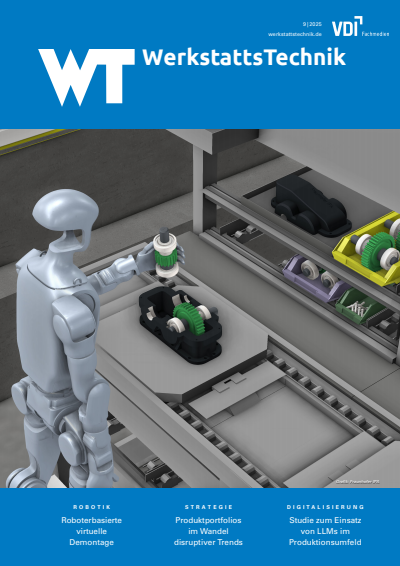
Roboterbasierte virtuelle Demontage/Robot-based virtual dissasembly
Table of contents
Bibliographic information
Open Access Full access
wt Werkstattstechnik online
Volume 115 (2025), Issue 09
- Authors:
- | | | | | | | | | | | | | | | | | | | | | | | | | | | | | |
- Publisher
- VDI fachmedien, Düsseldorf
- Copyright Year
- 2025
- ISSN-Online
- 1436-4980
- ISSN-Print
- 1436-4980
Chapter information
Open Access Full access
Volume 115 (2025), Issue 09
Roboterbasierte virtuelle Demontage/Robot-based virtual dissasembly
- Authors:
- | | |
- ISSN-Print
- 1436-4980
- ISSN-Online
- 1436-4980
- Preview:
Data from CAE-based vehicle development enables planning, validation, and execution of automated disassembly and sorting according to R-strategies (reuse, recycle, recover, etc.). This paper addresses automated disassembly simulation, based on engineering data within virtual commissioning. Data continuity is ensured by adapting and linking existing partial solutions for the specific use case.
Bibliography
No match found. Try another term.
- [1] Intergovernmental Panel on Climate Change (IPCC): Climate Change 2021 – The Physical Science Basis. Contribution of Working Group I to the Sixth Assessment Report of the Intergovernmental Panel on Climate Change. Cambridge: Cambridge University Press 2021 Open Google Scholar DOI: 10.37544/1436-4980-2025-09-6
- [2] Umweltbundesamt: Klimaschutz in Zahlen. Fakten, Trends und Impulse deutscher Klimapolitik. Stand: 2020. Internet: media.frag-den-staat.de/files/foi/699554/klimaschutz-in-zahlen-2020.pdf. Zugriff am 25.08.2025 Open Google Scholar DOI: 10.37544/1436-4980-2025-09-6
- [3] Europäische Kommission: Deal für eine saubere Industrie. Stand: 2025. Internet: commission.europa.eu/topics/eu-competitiveness/clean-industrial-deal_de. Zugriff am 14.08.2025 Open Google Scholar DOI: 10.37544/1436-4980-2025-09-6
- [4] Bundesministerium für Klimaschutz, Umwelt, Energie, Mobilität, Innovation und Technologie (BMK): Österreich auf dem Weg zu einer nachhaltigen und zirkulären Gesellschaft Die österreichische Kreislaufwirtschaftsstrategie. Stand: 2022. Internet: www.bmluk.gv.at/dam/jcr:baacfdef-c63e-49f5-ab8f-e4be8c0d7504/ Kreislaufwirtschaftsstrategie_2022_230215.pdf. Zugriff am 25.08.2025 Open Google Scholar DOI: 10.37544/1436-4980-2025-09-6
- [5] Fragapane, G.; Eleftheriadis, R.; Powell, D. et al.: A global survey on the current state of practice in Zero Defect Manufacturing and its impact on production performance. Computers in Industry 148 (2023), #103879 Open Google Scholar DOI: 10.37544/1436-4980-2025-09-6
- [6] Powell, D.; Magnanini, M. C.; Colledani, M. et al.: Advancing Zero Defect Manufacturing: A State-of-the-Art Perspective and Future Research Direction“. Computers in Industry 136 (2022), #103596, doi.org/10.1016/j.compind.2021.103596 Open Google Scholar DOI: 10.37544/1436-4980-2025-09-6
- [7] vom Brocke, J.; Simons, A.; Niehaves, B. et al.: Reconstructing the Giant: On the Importance of Rigour in Documenting the Literature Search Process. ECIS 2009 Proceedings, 2009, paper #161 Open Google Scholar DOI: 10.37544/1436-4980-2025-09-6
- [8] Cooper, H. M.: Organizing knowledge syntheses: A taxonomy of literature reviews. Knowledge in Society 1 (1988) 1, pp. 104–126, doi.org/10.1007/BF03177550 Open Google Scholar DOI: 10.37544/1436-4980-2025-09-6
- [9] Caiazzo, B.; Di Nardo, M.; Murino, T. et al.: Towards Zero Defect Manufacturing paradigm: A review of the state-of-the-art methods and open challenges. Computers in Industry 134 (2022), #103548 Open Google Scholar DOI: 10.37544/1436-4980-2025-09-6
- [10] Nazarenko, A. A.; Sarraipa, J.; Camarinha-Matos, L. M. et al.: Analysis of Manufacturing Platforms in the Context of Zero-Defect Process Establishment. IFIP Advances in Information and Communication Technology (2020), pp. 583–596, doi.org/10.1007/978–3–030–62412–5_48 Open Google Scholar DOI: 10.37544/1436-4980-2025-09-6
- [11] Psarommatis F.; Kiritsis D.: Identification of the Inspection Specifications for Achieving Zero Defect Manufacturing. IFIP Advances in Information and Communication Technology 566 (2019), pp. 267–273 Open Google Scholar DOI: 10.37544/1436-4980-2025-09-6
- [12] Panagiotopoulou V. C.; Papacharalampopoulos A.; Stavropoulos P.: Developing a Manufacturing Process Level Framework for Green Strategies KPIs Handling. Lecture Notes in Mechanical Engineering (2023), pp. 1008–1015, doi.org/10.1007/978–3–031–28839–5_112 Open Google Scholar DOI: 10.37544/1436-4980-2025-09-6
- [13] Psarommatis, F.; Fraile, F.; Ameri, F.: Zero Defect Manufacturing ontology: A preliminary version based on standardized terms. Computers in Industry 145 (2023), #103832 Open Google Scholar DOI: 10.37544/1436-4980-2025-09-6
- [14] Tanane B. Dafflon B. Bentaha M.L. Moalla N. Ferreiro V.: Toward a Collaborative Sensor Network Integration for SMEs’ Zero-Defect Manufacturing. IFIP Advances in Information and Communication Technology 662 (2022), pp. 31–43, doi.org/10.1007/978–3–031–14844–6_3 Open Google Scholar DOI: 10.37544/1436-4980-2025-09-6
- [15] Adamson, G.; Gordon, D.: Industrial Strength Design: How Brooks Stevens Shaped Your World. Cambridge: MIT Press 2003 Open Google Scholar DOI: 10.37544/1436-4980-2025-09-6
- [16] Brondoni, S. M.: Planned Obsolescence, Total Quality, Zero Defects and Global Competition. Symphonya. Emerging Issues in Management (2018) 2, pp. 8–20, doi.org/10.4468/2018.2.02brondoni Open Google Scholar DOI: 10.37544/1436-4980-2025-09-6
- [17] Psarommatis, F.; May, G.; Azamfirei, V.: Envisioning maintenance 5.0: Insights from a systematic literature review of Industry 4.0 and a proposed framework. Journal of Manufacturing Systems 68 (2023), pp. 376–399 Open Google Scholar DOI: 10.37544/1436-4980-2025-09-6
- [18] Schmidbauer, C.; Zafari, S.; Hader, B. et al.: An Empirical Study on Workers’ Preferences in Human–Robot Task Assignment in Industrial Assembly Systems. IEEE Transactions on Human-Machine Systems 53 (2023) 2, pp. 293–302, doi.org/ 10.1109/THMS.2022.3230667 Open Google Scholar DOI: 10.37544/1436-4980-2025-09-6
- [19] Silva, B.; Marques, R.; Faustino, D. et al.: Enhance the Injection Molding Quality Prediction with Artificial Intelligence to Reach Zero-Defect Manufacturing. Processes 11 (2023) 1, p. 62, doi.org/10.3390/pr11010062 Open Google Scholar DOI: 10.37544/1436-4980-2025-09-6
- [20] Wan, P. K. L.; Leirmo T. L.: .: Human-centric zero-defect manufacturing: State-of-the-art review, perspectives, and challenges. Computers in Industry 144 (2023), #103792 Open Google Scholar DOI: 10.37544/1436-4980-2025-09-6
- [21] Serrano-Ruiz, J. C.; Mula, J.; Poler, R.: Smart manufacturing scheduling: A literature review. Journal of Manufacturing Systems 61 (2021), pp. 265–287 Open Google Scholar DOI: 10.37544/1436-4980-2025-09-6
- [22] Konstantinidis, F. K.; Mouroutsos, S. G.; Gasteratos, A.: The Role of Machine Vision in Industry 4.0: an automotive manufacturing perspective. 2021 IEEE International Conference on Imaging Systems and Techniques (IST), Kaohsiung/Taiwan, IEEE 2021, pp. 1–6 Open Google Scholar DOI: 10.37544/1436-4980-2025-09-6
- [23] Psarommatis, F.; Danishvar, M.; Mousavi, A. et al.: Cost-Based Decision Support System: A Dynamic Cost Estimation of Key Performance Indicators in Manufacturing. IEEE Transactions on Engineering Management 71 (2024), pp. 702–714, doi.org/10.1109/TEM.2021.3133619 Open Google Scholar DOI: 10.37544/1436-4980-2025-09-6
- [24] Lughofer, E.; Zavoianu, A. C.; Pollak, R. et al.: On-line anomaly detection with advanced independent component analysis of multi-variate residual signals from causal relation networks. Information Sciences 537 (2020), pp. 425–451 Open Google Scholar DOI: 10.37544/1436-4980-2025-09-6
- [25] Lughofer, E.; Eitzinger, C.; Guardiola, C.: Online Quality Control with Flexible Evolving Fuzzy Systems. In: Sayed-Mouchaweh, M.; Lughofer, E. (eds.): Learning in Non-Stationary Environments. New York/USA: Springer 2012, pp. 375–406 Open Google Scholar DOI: 10.37544/1436-4980-2025-09-6
- [26] Lughofer, E.; Pollak, R.; Zavoianu, A. C. et al.: Self-Adaptive Time-Series Based Forecast Models for Predicting Quality Criteria in Microfluidics Chip Production. 2017 3rd IEEE International Conference on Cybernetics (CYBCONF), pp. 1–8 Open Google Scholar DOI: 10.37544/1436-4980-2025-09-6
- [27] Zambal, S.; Eitzinger, C.; Clarke, M. et al.: A digital twin for composite parts manufacturing: Effects of defects analysis based on manufacturing data. 2018 IEEE 16th International Conference on Industrial Informatics (INDIN), pp. 803–808 Open Google Scholar DOI: 10.37544/1436-4980-2025-09-6
- [28] Zörrer, H.; Steringer, R.; Zambal, S. et al.: Using Business Analytics for Decision Support in Zero Defect Manufacturing of Composite Parts in the Aerospace Industry. IFAC-PapersOnLine 52 (2019) 13, pp. 1461–1466 Open Google Scholar DOI: 10.37544/1436-4980-2025-09-6
- [29] Zambal, S.; Heindl, C.; Eitzinger, C et al.: End-to-end defect detection in automated fiber placement based on artificially generated data. Fourteenth International Conference on Quality Control by Artificial Vision, SPIE 11172 (2019), pp. 371–378 Open Google Scholar DOI: 10.37544/1436-4980-2025-09-6
- [30] Isaja, M.; Nguyen, P.; Goknil, A. et al..: A blockchain-based framework for trusted quality data sharing towards zero-defect manufacturing. Computers in Industry 146 (2023), #103853 Open Google Scholar DOI: 10.37544/1436-4980-2025-09-6
- [31] Lindström, J.; Lejon, E.; Kyösti, P. et al.: Towards intelligent and sustainable production systems with a zero-defect manufacturing approach in an Industry 4.0 context. Procedia CIRP 81 (2019), pp. 880–885 Open Google Scholar DOI: 10.37544/1436-4980-2025-09-6
- [32] Psarommatis, F.; May, G.: Optimization of zero defect manufacturing strategies: A comparative study on simplified modeling approaches for enhanced efficiency and accuracy. Computers & Industrial Engineering 187 (2024), #109783, doi.org/10.1016/j.cie.2023.109783 Open Google Scholar DOI: 10.37544/1436-4980-2025-09-6
- [1] Minaee, S.; Mikolov, T.; Nikzad, N. et al.: Large Language Models: A Survey. ArXiv 2024, doi.org/10.48550/arXiv.2402.06196 Open Google Scholar DOI: 10.37544/1436-4980-2025-09-13
- [2] Roland Berger (ed.): GenAI-driven transformation. Preparing your company for success with GenAI on every level. Stand: 2024. Internet: content.rolandberger.com/hubfs/07_presse/Roland%20Berger%20GenAI-driven%20transformation%20final.pdf. Zugriff am 22.08.2025 Open Google Scholar DOI: 10.37544/1436-4980-2025-09-13
- [3] Buchholz, K.: Threads Shoots Past One Million User Mark at Lightning Speed. One Million Users. Statista. Stand: 07.07.2023. Internet: www.statista.com/chart/29174/time-to-one-million-users/. Zugriff am 22.08.2025 Open Google Scholar DOI: 10.37544/1436-4980-2025-09-13
- [4] Fletcher, R.; Nielsen, R. K.: What Does the Public in Six Countries Think of Generative AI in News? Stand: 28.05.2024. Internet: reutersinstitute.politics.ox.ac.uk/what-does-public-six-countries-think-generative- ai-news. Zugriff am 22.08.2025 Open Google Scholar DOI: 10.37544/1436-4980-2025-09-13
- [5] Singla, A.; Sukharevsky, A.; Yee, l. et al.: The state of AI in early 2024. Gen AI adoption spikes and stats to generate value. McKinsey. Stand: 2024. Internet: www.mckinsey.com/capabilities/quantumblack/our-insights/the-state-of-ai. Zugriff am 22.08.2025 11.06.2025 Open Google Scholar DOI: 10.37544/1436-4980-2025-09-13
- [6] Bick, A.; Blandin, A.; Deming, D. J.: The Rapid Adoption of Generative AI. National Bureau of Economic Research. Stand: 04.11.2024 Internet: papers.ssrn.com/sol3/papers.cfm?abstract_id=4965142. Zugriff am 22.08.2025 Open Google Scholar DOI: 10.37544/1436-4980-2025-09-13
- [7] Chui, M.; Roberts, R.; Yee, L. et al.: The economic potential of generative AI. The next productivity frontier. McKinsey & Company. Stand: 2023. Internet: www.mckinsey.com/capabilities/mckinsey-digital/our-insights/the-economic-potential-of-generative-ai-the-next-productivity-frontier#/. Zugriff am 22.08.2025 Open Google Scholar DOI: 10.37544/1436-4980-2025-09-13
- [8] Kurpicz-Briki, M.: Generative AI: was ist das und was kann sie bereits? SocietyByte – Wissenschaftsmagazin der Berner Fachhochschule. (2023), doi.org/10.24451/arbor.19044 Open Google Scholar DOI: 10.37544/1436-4980-2025-09-13
- [9] Bharathi Mohan, G.; Prasanna Kumar, R.; Vishal Krishh, P. et al.: An analysis of large language models: their impact and potential applications. Knowledge and Information Systems 66 (2024) 9 ,pp. 5047–5070 Open Google Scholar DOI: 10.37544/1436-4980-2025-09-13
- [10] Rahmanzadehgervi, P.; Bolton, L.; Taesiri, M. R. et al.: Vision language models are blind. ArXiv.2025, doi.org/10.48550/arXiv.2407.06581 Open Google Scholar DOI: 10.37544/1436-4980-2025-09-13
- [11] Ma, J.; Dai, D.; Sha, L. et al.: Large Language Models Are Unconscious of Unreasonability in Math Problems. ArXiv 2024, arxiv.org/html/2403.19346v2 Open Google Scholar DOI: 10.37544/1436-4980-2025-09-13
- [12] Ahn, J.; Verma, R.; Lou, R. et al.: Large Language Models for Mathematical Reasoning: Progresses and Challenges. ArXiv 2024, doi.org/10.48550/arXiv.2402.00157 Open Google Scholar DOI: 10.37544/1436-4980-2025-09-13
- [13] Xu, Z.; Jain, S.; Kankanhalli, M.: Hallucination is Inevitable: An Innate Limitation of Large Language Models. ArXiv 2024, doi.org/10.48550/ arXiv.2401.11817 Open Google Scholar DOI: 10.37544/1436-4980-2025-09-13
- [14] Huang, D.; Yan, C.; Li, Q. et al.: From Large Language Models to Large Multimodal Models: A Literature Review. Applied Sciences 14 (2024) 12, #5068 Open Google Scholar DOI: 10.37544/1436-4980-2025-09-13
- [15] Li, Y.; Zhao, H.; Jiang, H. et al.: Large Language Models for Manufacturing. ArXiv 2024, doi.org/10.48550/arXiv.2401.11817 Open Google Scholar DOI: 10.37544/1436-4980-2025-09-13
- [16] Milmo, D.: OpenAI launches ‘deep research’ tool that it says can match research analyst. The Guardian. Stand: 03.02.2025. Internet: www.theguardian.com/technology/2025/feb/03/openai-deep-research-agent-chatgpt-deepseek. Zugriff am 22.08.2025 Open Google Scholar DOI: 10.37544/1436-4980-2025-09-13
- [17] Pichai, S.; Hassabis, D.: Our next-generation model: Gemini 1.5. Stand: 15.02.2024. Internet: blog.google/technology/ai/google-gemini-next-generation-model-february-2024/. Zugriff am 22.08.2025 Open Google Scholar DOI: 10.37544/1436-4980-2025-09-13
- [18] Liu, A.; Feng, B.; Wang, B. et al.: DeepSeek-V2: A Strong, Economical, and Efficient Mixture-of-Experts Language Model. ArXiv 2024, doi.org/10.48550/arXiv.2405.04434 Open Google Scholar DOI: 10.37544/1436-4980-2025-09-13
- [19] Firat, M.; Kuleli, S.: What if GPT4 Became Autonomous: The Auto-GPT Project and Use Cases. Journal of Emerging Computer Technologies 3 (2024) 1, pp. 1–6 Open Google Scholar DOI: 10.37544/1436-4980-2025-09-13
- [20] Bruscia, M.; Manduzio, G. A.; Galatolo, F. A. et al.: An Overview On Large Language Models Across Key Domains: A Systematic Review. 2024 IEEE International Conference on Metrology for eXtended Reality, Artificial Intelligence and Neural Engineering (MetroXRAINE), St Albans, United Kingdom, 2024, pp. 125–130 Open Google Scholar DOI: 10.37544/1436-4980-2025-09-13
- [21] Wang, T.; Fan, J.; Zheng, P.: An LLM-based vision and language cobot navigation approach for Human-centric Smart Manufacturing. Journal of Manufacturing Systems 75 (2024), pp. 299–305 Open Google Scholar DOI: 10.37544/1436-4980-2025-09-13
- [22] Lim, J.; Patel, S.; Evans, A. et al.: Enhancing Human-Robot Collaborative Assembly in Manufacturing Systems Using Large Language Models. Stand: ArXiv 2024, doi.org/10.48550/arXiv.2406.01915 Open Google Scholar DOI: 10.37544/1436-4980-2025-09-13
- [23] Finkel, P.; Wurster, P.; Radler, R.: Large Language Models (LLM) im Produktionsumfeld. Eine Potenzialanalyse zur Transformation von Produktionsabläufen in modernen Fabriken. Industry 4.0 Science (2024) 40, S. 48–55 Open Google Scholar DOI: 10.37544/1436-4980-2025-09-13
- [24] Kernan Freire, S.; Wang, C.; Foosherian, M. et al.: Knowledge sharing in manufacturing using LLM-powered tools: user study and model benchmarking. Frontiers in artificial intelligence 7 (2024), #1293084, doi.org/10.3389/frai.2024.1293084 Open Google Scholar DOI: 10.37544/1436-4980-2025-09-13
- [25] Mustapha, K. B.: A survey of emerging applications of large language models for problems in mechanics, product design, and manufacturing. Advanced Engineering Informatics 64 (2025), #103066 Open Google Scholar DOI: 10.37544/1436-4980-2025-09-13
- [26] Xia, Y.; Jazdi, N.; Weyrich, M.: Applying Large Language Models for Intelligent Industrial Automation. ATP Magazin 66 (2024) 6–7, pp. 62–71 Open Google Scholar DOI: 10.37544/1436-4980-2025-09-13
- [27] Khanghah, K. N.; Patel, A.; Malhotra, R. et al.: Large Language Models for Extrapolative Modeling of Manufacturing Processes. ArXiv 2025, doi.org/10.48550/arXiv.2502.12185 Open Google Scholar DOI: 10.37544/1436-4980-2025-09-13
- [28] Makatura, L.; Foshey, M.; Wang, B. et al.: Large Language Models for Design and Manufacturing. An MIT Exploration of Generative AI (27.03.2024), doi.org/10.21428/e4baedd9.745b62fa Open Google Scholar DOI: 10.37544/1436-4980-2025-09-13
- [1] Degen, F.: Lithium-ion battery cell production in Europe: Scenarios for reducing energy consumption and greenhouse gas emissions until 2030. Journal of Industrial Ecology (2023) 3, pp. 964–976 Open Google Scholar DOI: 10.37544/1436-4980-2025-09-21
- [2] Stock, D.; Bauernhansl, T.; Weyrich, M. et al.: System Architectures for Cyber-Physical Production Systems enabling Self-X and Autonomy. IEEE International Conference on Emerging Technologies and Factory Automation (ETFA) 2020 (2020), pp. 148–155 Open Google Scholar DOI: 10.37544/1436-4980-2025-09-21
- [3] Bitkom: Financial damage from cybercrime in Germany in 2024 (in billion euros). Internet: www.statista.com/statistics/1360289/financial-damage-cyber-crimes-germany/. Zugriff am 12.08.2025 Open Google Scholar DOI: 10.37544/1436-4980-2025-09-21
- [4] Beerman, J.; Berent, D.; Falter, Z. et al.: A Review of Colonial Pipeline Ransomware Attack. International Symposium on Cluster, Cloud and Internet Computing Workshops (CCGridW) 2023 (2023) 23, pp. 8–15 Open Google Scholar DOI: 10.37544/1436-4980-2025-09-21
- [5] Kushner, D.: The Real Story of Stuxnet. IEEE Spectrum (2013) 50, pp. 48–53 Open Google Scholar DOI: 10.37544/1436-4980-2025-09-21
- [6] Adamov, A.; Carlsson, A.; Surmacz, T.: An Analysis of LockerGoga Ransomware. IEEE East-West Design & Test Symposium (EWDTS) (2019), pp. 1–5 Open Google Scholar DOI: 10.37544/1436-4980-2025-09-21
- [7] Mekdad, Y.; Bernieri, G.; Conti, M. et al.: A threat model method for ICS malware: the TRISIS case. ACM International Conference on Computing Frontiers (2021), pp. 221–228 Open Google Scholar DOI: 10.37544/1436-4980-2025-09-21
- [8] Scarfone, K.; Mell, P.: Guide to Intrusion Detection and Prevention Systems (IDPS). NIST Special Publication 800–94 (2007), doi.org/10.6028/NIST.SP.800–94 Open Google Scholar DOI: 10.37544/1436-4980-2025-09-21
- [9] DIN EN ISO/IEC 27001: Informationssicherheit, Cybersicherheit und Datenschutz – Informationssicherheitsmanagementsysteme – Anforderungen (ISO/IEC 27001:2022). Deutsche Fassung EN ISO/IEC 27001:2023, Ausgabe 2024–01 Open Google Scholar DOI: 10.37544/1436-4980-2025-09-21
- [10] Dhirani, L.; Armstrong, E.; Newe, T.: Industrial IoT, Cyber Threats, and Standards Landscape: Evaluation and Roadmap. Sensors 2021 (2021) 21, #3901 Open Google Scholar DOI: 10.37544/1436-4980-2025-09-21
- [11] European Union Agency for Cyber-Security: ENISA Threat Landscape for Industrial Control Systems 2024. Internet: www.enisa.europa.eu/publications/enisa-threat-landscape-2024 . Zugriff am 12.08.2025 Open Google Scholar DOI: 10.37544/1436-4980-2025-09-21
- [12] Cao, C.; Wang, F.; Lindley, L. et al.: Managing Linux servers with LLM-based AI agents: An empirical evaluation with GPT4. Machine Learning with Applications 17 (2024) #100570, doi.org/10.1016/j.mlwa.2024.100570 Open Google Scholar DOI: 10.37544/1436-4980-2025-09-21
- [13] Xu, H.; Wang, S.; Li, N. et al.: Large Language Models for Cyber Security: A Systematic Literature Review. arXiv preprint 2405.04760, doi.org/10.48550/arXiv.2405.04760 Open Google Scholar DOI: 10.37544/1436-4980-2025-09-21
- [14] Liu, O.; Fu, D.; Yogatama, D. et al.: DeLLMa: Decision Making Under Uncertainty with Large Language Models. arXiv preprint 2024, doi.org/10.48550/arXiv.2402.02392 Open Google Scholar DOI: 10.37544/1436-4980-2025-09-21
- [15] Li, S.; Puig, X.; Paxton, C. et al.: Pre-Trained Language Models for Interactive Decision-Making. arXiv preprint 2022, doi.org/10.48550/arXiv.2202.01771 Open Google Scholar DOI: 10.37544/1436-4980-2025-09-21
- [16] Gokcimen, T.; Das, B.: A novel system for strengthening security in large language models against hallucination and injection attacks with effective strategies. Alexandria Engineering Journal 123 (2025), pp. 71–90 Open Google Scholar DOI: 10.37544/1436-4980-2025-09-21
- [17] Wang, W.; Wang, Y.; Joty, S. et al.: RAP-Gen: Retrieval-Augmented Patch Generation with CodeT5 for Automatic Program Repair. ACM Joint Meeting European Software Engineering Conference and Symposium on the Foundations of Software Engineering (2023) 31, pp. 146–158 Open Google Scholar DOI: 10.37544/1436-4980-2025-09-21
- [18] Hou, X.; Zhao, Y.; Wang, S. et al.: Model Context Protocol (MCP): Landscape, Security Threats, and Future Research Directions. arXiv preprint 2025, doi.org/10.48550/arXiv.2503.23278 Open Google Scholar DOI: 10.37544/1436-4980-2025-09-21
- [19] Geyer, M.; Schwab, J.: Risk-Aware Autonomous Defence with Generative AI: Ethical and Accountability Challenges in Cyber-Physical Infrastructures. In: Workshop on AI in Security and Defense (AI4SD) at ECAI 2025, OpenHSU Proceedings, 2025 Open Google Scholar DOI: 10.37544/1436-4980-2025-09-21
- [20] Geyer, M.: Autonome IT-/OT-Verteidigung in der Intralogistik. Entwicklung eines resilienten KI-basierten Sicherheitssystems für die vernetzte Batteriezellenproduktion. Masterarbeit, Universität Stuttgart, 2025 Open Google Scholar DOI: 10.37544/1436-4980-2025-09-21
- [21] CrowdStrike: The 1/10/60 Minute Challenge: A Framework for Stopping Breaches Faster. Stand: 2025. Internet: https://www.crowdstrike.com/en-us/resources/crowdcasts/the-1–10–60-minute-challenge-a-framework-for-stopping-breaches-faster/. Zugriff am 12.08.2025 Open Google Scholar DOI: 10.37544/1436-4980-2025-09-21
- [22] Fraunhofer IPA: DigiBattPro 4.0 – BMBF: Digitalisierungslösungen und Materialentwicklung für die Batterieproduktion. Stand: 2025. Internet: www.ipa.fraunhofer.de/de/referenzprojekte/DigiBattPro40-BMBF.html. Zugriff am 12.08.2025 Open Google Scholar DOI: 10.37544/1436-4980-2025-09-21
- [1] Usuga Cadavid, J. P.; Lamouri, S.; Grabot, B. et al.: Machine learning applied in production planning and control: a state-of-the-art in the era of industry 4.0. Journal of Intelligent Manufacturing 31 (2020), pp. 1531–1558, doi.org/10.1007/s10845–019–01531–7 Open Google Scholar DOI: 10.37544/1436-4980-2025-09-26
- [2] Wuest, T.; Weimer, D.; Irgens, C. et al.: Machine learning in manufacturing: advantages, challenges, and applications. Production & Manufacturing Research 41 (2016), pp. 23–45, doi.org/10.1080/21693277.2016.1192517 Open Google Scholar DOI: 10.37544/1436-4980-2025-09-26
- [3] Peres, R. S.; Jia, X.; Lee, J. et al.: Industrial Artificial Intelligence in Industry 4.0 – Systematic Review, Challenges and Outlook. IEEE Access 8 (2020), pp. 220121–220139 Open Google Scholar DOI: 10.37544/1436-4980-2025-09-26
- [4] Radanliev, P.; Roure, D. de; van Kleek, M. et al.: Artificial intelligence in cyber physical systems. AI & society 36 (2021) 3, pp. 783–796 Open Google Scholar DOI: 10.37544/1436-4980-2025-09-26
- [5] Kreuzberger, D.; Kühl, N.; Hirschl, S.: Machine Learning Operations (MLOps): Overview, Definition, and Architecture. IEEE Access 11 (2023), pp. 31866–31879 Open Google Scholar DOI: 10.37544/1436-4980-2025-09-26
- [6] Rauh, L.; Süner, M.R.; Schel, D.: AI Asset Management for Manufacturing (AIM4M): Development of a Process Model for Operationalization. ArXiv, 2025 Open Google Scholar DOI: 10.37544/1436-4980-2025-09-26
- [7] Monostori, L.: Cyber-physical Production Systems: Roots, Expectations and R&D Challenges. Procedia CIRP 17 (2014), pp. 9–13 Open Google Scholar DOI: 10.37544/1436-4980-2025-09-26
- [8] Monostori, L.; Kádár, B.; Bauernhansl, T. et al.: Cyber-physical systems in manufacturing. CIRP Annals 65 (2016) 2, pp. 621–641 Open Google Scholar DOI: 10.37544/1436-4980-2025-09-26
- [9] Protschky, D.; Lämmermann, L.; Hofmann, P. et al.: What Gets Measured Gets Improved: Monitoring Machine Learning Applications in Their Production Environments. IEEE Access 13 (2025), pp. 34518–34538 Open Google Scholar DOI: 10.37544/1436-4980-2025-09-26
- [10] Faubel, L.; Schmid, K.; Eichelberger, H.: Is MLOps different in Industry 4.0? General and Specific Challenges. Proceedings of the 3rd International Conference on Innovative Intelligent Industrial Production and Logistics – IN4PL, 2025, pp. 161–167, doi.org/10.5220/0011589600003329 Open Google Scholar DOI: 10.37544/1436-4980-2025-09-26
- [11] Symeonidis, G.; Nerantzis, E.; Kazakis, A. et al.: MLOps – Definitions, Tools and Challenges. IEEE 12th Annual Computing and Communication Workshop and Conference (CCWC), Las Vegas, USA, 2022, doi.org/10.48550/arXiv.2201.00162 Open Google Scholar DOI: 10.37544/1436-4980-2025-09-26
- [12] Studer, S.; Bui, T. B.; Drescher, C. et al.: Towards CRISP-ML(Q): A Machine Learning Process Model with Quality Assurance Methodology, Machine Learning and Knowledge Extraction 3 (2021) 2, pp.:392–413, doi.org/10.3390/make3020020 Open Google Scholar DOI: 10.37544/1436-4980-2025-09-26
- [13] Del Rey, S.; Medina, A.; Franch, X. et al.: Addressing Quality Challenges in Deep Learning: The Role of MLOps and Domain Knowledge, 2025 IEEE/ACM 4th International Conference on AI Engineering – Software Engineering for AI (CAIN), Ottawa, ON, Canada, 2025, pp. 184–189, doi.org/10.1109/CAIN66642.2025.00029 Open Google Scholar DOI: 10.37544/1436-4980-2025-09-26
- [14] Kilian, R., Jäck, L.; Ebel, D.: European AI Standards: Technical Standardization and Implementation Challenges under the EU AI Act. Stand: 2025. Internet: www.aigl.blog/content/files/2025/04/European-AI-Standards-Technical-Standardization-and-Implementation-Challenges-under-the-EU-AI-Act.pdf. Zugriff am 12.08.2025 Open Google Scholar DOI: 10.37544/1436-4980-2025-09-26
- [15] Brajovic, D.; Renner, N.; Goebels, V. P. et al.: Model Reporting for Certifiable AI: A Proposal from Merging EU Regulation into AI Development. ArXiv, 2023, doi.org/10.48550/arXiv.2307.11525 Open Google Scholar DOI: 10.37544/1436-4980-2025-09-26
- [16] Theusch, F.; Seemann, L.; Guldner, A. et al.: Towards Machine Learning-based Digital Twins in Cyber-Physical Systems. Proceedings of The First Workshop on AI for Digital Twins and Cyber-Physical Applications in conjunction with 32nd International Joint Conference on Artificial Intelligence, 19 August 2023, Macao, S.A.R Open Google Scholar DOI: 10.37544/1436-4980-2025-09-26
- [17] Faubel, L.; Woudsma, T.; Methnani, L. et al.: A MLOps Architecture for XAI in Industrial Applications. 2024 IEEE 29th International Conference on Emerging Technologies and Factory Automation (ETFA), Padova, Italy, 2024, pp. 1–4 Open Google Scholar DOI: 10.37544/1436-4980-2025-09-26
- [18] Fitzner, A.; Hülsmann, T.; Ackermann, T. et al.: Machine learning pipeline for application in manufacturing. Conference paper, doi.org/10.24405/15309 Open Google Scholar DOI: 10.37544/1436-4980-2025-09-26
- [19] John, M. M.; Olsson, H. H.; Bosch, J.: Towards MLOps: A Framework and Maturity Model. 2021 47th Euromicro Conference on Software Engineering and Advanced Applications (SEAA), Palermo, Italy, 2021, pp. 1–8 Open Google Scholar DOI: 10.37544/1436-4980-2025-09-26
- [20] Tamburri, D. A.: Sustainable MLOps: Trends and Challenges. 2020 22nd International Symposium on Symbolic and Numeric Algorithms for Scientific Computing (SYNASC), Timisoara, Romania, 2020, pp. 17–23 Open Google Scholar DOI: 10.37544/1436-4980-2025-09-26
- [21] Alsagheer, D.; Xu, L.; Shi, W.: Decentralized Machine Learning Governance: Overview, Opportunities, and Challenges. IEEE Access 11 (2023), pp. 96718–96732 Open Google Scholar DOI: 10.37544/1436-4980-2025-09-26
- [22] Ranawana, R.; Karunananda, A. S.: An Agile Software Development Life Cycle Model for Machine Learning Application Development. 2021 5th SLAAI International Conference on Artificial Intelligence (SLAAI-ICAI), Colombo, Sri Lanka, 2021, pp. 1–6 Open Google Scholar DOI: 10.37544/1436-4980-2025-09-26
- [23] Jüngling, S.; Fetai, I.; Rogger, A. et al.: On the Track to Application Architectures in Public Transport Service Companies. Applied Sciences 12 (2022) 12, #6073 Open Google Scholar DOI: 10.37544/1436-4980-2025-09-26
- [24] Faubel, L.; Woudsma, T.; Kloepper, B. et al.: MLOps for Cyberphysical Production Systems: Challenges and Solutions. IEEE Software 42 (2025) 1, pp. 65–73 Open Google Scholar DOI: 10.37544/1436-4980-2025-09-26
- [1] Lasi, H.; Fettke, P.; Kemper, H.-G. et al.: Industrie 4.0. Wirtschaftsinformatik 56 (2014) 4, S. 261–264 Open Google Scholar DOI: 10.37544/1436-4980-2025-09-34
- [2] UN Trade and Development: Digital Economy Report 2019. Value Creation and Capture: Implications for Developing Countries. New York: United Nations Publications 2019 Open Google Scholar DOI: 10.37544/1436-4980-2025-09-34
- [3] Soori, M.; Jough, F. K. G.; Dastres, R. et al.: Robotical Automation in CNC Machine Tools: A Review. Acta Mechanica et Automatica 18 (2024) 3, pp. 434–450 Open Google Scholar DOI: 10.37544/1436-4980-2025-09-34
- [4] Brecher, C.; Breitbach, T.; Hoffmann, F. et al.: Hybrides Bearbeitungszentrum für den Werkzeug- und Formenbau. wt Werkstattstechnik online 98 (2008) 11–12, S. 893–898. Internet: www.werkstattstechnik.de. Düsseldorf: Springer-VDI-Verlag Open Google Scholar DOI: 10.37544/1436-4980-2025-09-34
- [5] Pfeifer, D.; Fauser, S.; Scheifele, C. et al.: Reusage of Extended Digital Twins from Virtual Commissioning for Dynamics-Based Trajectory Planning in CNC Controlled Robotics. International Conference on Flexible Automation and Intelligent Manufacturing, 2024, pp. 151–159 Open Google Scholar DOI: 10.37544/1436-4980-2025-09-34
- [6] DIN-Normenausschuss Werkzeugmaschinen: DIN 66025–1: Programmaufbau für numerisch gesteuerte Arbeitsmaschinen; Allgemeines. Deutsche Fassung, Januar 1983 Open Google Scholar DOI: 10.37544/1436-4980-2025-09-34
- [7] Zhou, Z.; Xiong, R.; Wang, Y. et al.: Advanced Robot Programming: a Review. Current Robotics Reports 1 (2020) 4, pp. 251–258 Open Google Scholar DOI: 10.37544/1436-4980-2025-09-34
- [8] Open Robotics: Open platforms for robotics. ROS. Stand: 2025. Internet: www.openrobotics.org/. Zugriff am 27.08.2025 Open Google Scholar DOI: 10.37544/1436-4980-2025-09-34
- [9] ROS: ROS – Robot Operating System. Stand: 2024. Internet: ros.org/. Zugriff am 27.08.2025 Open Google Scholar DOI: 10.37544/1436-4980-2025-09-34
- [10] Macenski, S.; Martin, F.; White, R. et al.: The Marathon 2: A Navigation System. IEEE/RSJ International Conference on Intelligent Robots and Systems (IROS), 2020, pp. 2718–2725, doi.org/10.1109/IROS45743.2020.9341207 Open Google Scholar DOI: 10.37544/1436-4980-2025-09-34
- [11] Coleman, D. T.; Sucan, I. A.; Chitta, S. et al.: Reducing the Barrier to Entry of Complex Robotic Software: a MoveIt! Case Study. AsXiv 2014, doi.org/10.48550/arXiv.1404.3785 Open Google Scholar DOI: 10.37544/1436-4980-2025-09-34
- [12] ROS: Acknowledgements — ROS2_Control: Rolling Jul 2025 documentation. Stand: 22.07.2025. Internet: control.ros.org/rolling/doc/acknowledgements/acknowledgements.html. Zugriff am 27.08.2025 Open Google Scholar DOI: 10.37544/1436-4980-2025-09-34
- [13] Github: ROS-Industrial: Tesseract. Motion Planning Environment. Stand: 22.07.2025. Internet: https://github.com/tesseract-robotics/tesseract. Zugriff am 27.08.2025 Open Google Scholar DOI: 10.37544/1436-4980-2025-09-34
- [14] Sucan, I. A.; Moll, M.; Kavraki, L. E.: The Open Motion Planning Library. IEEE Robotics & Automation Magazine 19 (2012) 4, pp. 72–82 Open Google Scholar DOI: 10.37544/1436-4980-2025-09-34
- [15] Ratliff, N.; Zucker, M.; Bagnell, J. A. et al.: CHOMP: Gradient optimization techniques for efficient motion planning. 2009 IEEE International Conference on Robotics and Automation (ICRA), Kobe, 2009, pp. 489–494 Open Google Scholar DOI: 10.37544/1436-4980-2025-09-34
- [16] Kalakrishnan, M.; Chitta, S.; Theodorou, E. et al.: STOMP: Stochastic trajectory optimization for motion planning. 2011 IEEE International Conference on Robotics and Automation (ICRA), Shanghai, China, 2011, pp. 4569–4574 Open Google Scholar DOI: 10.37544/1436-4980-2025-09-34
- [17] Mayoral-Vilches, V.; Pinzger, M.; Rass, S. et al.: Can ROS be used securely in industry? Red teaming ROS-Industrial. ArXiv 2020, doi.org/10.48550/arXiv.2009.08211 Open Google Scholar DOI: 10.37544/1436-4980-2025-09-34
- [18] Picknick: ROS 2 Compatible Hardware. Stand: 21.07.2025. Internet: picknik.ai/hardware-ecosystem/. Zugriff am 27.08.2025 Open Google Scholar DOI: 10.37544/1436-4980-2025-09-34
- [19] Franceschi, P.; Faroni, M.; Baraldo, S. et al.: ros2 fanuc interface: Design and Evaluation of a Fanuc CRX Hardware Interface in ROS2. ArXiv 2025, doi.org/10.48550/arXiv.2506.14487 Open Google Scholar DOI: 10.37544/1436-4980-2025-09-34
- [20] Arbo, M. H.; Eriksen, I.; Sanfilippo, F. et al.: Comparison of KVP and RSI for Controlling KUKA Robots Over ROS. IFAC-PapersOnLine 53 (2020) 2, pp. 9841–9846 Open Google Scholar DOI: 10.37544/1436-4980-2025-09-34
- [21] ROS 2 Documentation: Humble documentation: DDS implementations. Stand: 23.07.2025. Internet: docs.ros.org/en/humble/Installation/RMW-Implementations/DDS-Implementations.html. Zugriff am 27.08.2025 Open Google Scholar DOI: 10.37544/1436-4980-2025-09-34
- [22] Ye, Y.; Nie, Z.; Liu, X. et al.: ROS2 Real-time Performance Optimization and Evaluation. Chinese Journal of Mechanical Engineering 36 (2023) 1, #144 Open Google Scholar DOI: 10.37544/1436-4980-2025-09-34
- [23] Gutiérrez, C. S. V.; Juan, L. U. S.; Ugarte, I. Z. et al.: Towards a distributed and real-time framework for robots: Evaluation of ROS 2.0 communications for real-time robotic applications. ArXiv 2018, doi.org/10.48550/arXiv.1809.02595 Open Google Scholar DOI: 10.37544/1436-4980-2025-09-34
- [24] Barut, S.; Boneberger, M.; Mohammadi, P. et al.: Benchmarking Real-Time Capabilities of ROS 2 and OROCOS for Robotics Applications. 2021 IEEE International Conference on Robotics and Automation (ICRA), Xi’an, China, 2021, pp. 708–714 Open Google Scholar DOI: 10.37544/1436-4980-2025-09-34
- [25] Fresnillo, P. M.; Vasudevan, S.; Perez Garcia, J. A. et al.: An Open and Reconfigurable User Interface to Manage Complex ROS-Based Robotic Systems. IEEE Access 12 (2024), pp. 114601–114617 Open Google Scholar DOI: 10.37544/1436-4980-2025-09-34
- [26] Weber, A.; Eichelberger, H.; Hildebrand, J.: ADS Performance Revisited. ArXiv 2024, doi.org/10.48550/arXiv.2410.15853 Open Google Scholar DOI: 10.37544/1436-4980-2025-09-34
- [27] Malecha, M.; Gottardi, A.; Terreran, M. et al.: Human-robot collaboration for complex draping processes of Carbon-Fibre-Reinforced Polymers for aerospace part. International Conference on Mechanical and Aerospace Engineering, ICMAE 2024. 15th International Conference on Mechanical and Aerospace Engineering (ICMAE), 2024 Open Google Scholar DOI: 10.37544/1436-4980-2025-09-34
- [28] Liang, C.-J.; McGee, W.; Menassa, C. C. et al.: Real-time state synchronization between physical construction robots and process-level digital twins. Construction Robotics 6 (2022) 1, pp. 57–73 Open Google Scholar DOI: 10.37544/1436-4980-2025-09-34
- [29] Sterk-Hansen, A.; Saghaug, B. H.; Hagen, D. et al.: A ROS 2 and TwinCAT Based Digital Twin Framework for Mechatronics Systems. 2023 11th International Conference on Control, Mechatronics and Automation (ICCMA), 2023, pp. 485–490 Open Google Scholar DOI: 10.37544/1436-4980-2025-09-34
- [30] Terei, N.; Wiemann, R.; Raatz, A.: ROS-Based Control of an Industrial Micro-Assembly Robot. Procedia CIRP 130 (2024), pp. 909–914 Open Google Scholar DOI: 10.37544/1436-4980-2025-09-34
- [31] Beckhoff Automation GmbH & Co. KG: Beckhoff Information System. ADS. Stand: 2025. Internet: infosys.beckhoff.com/index.php?content=./content/1031/tcinfosys3/11291871243.html&id=. Zugriff am 27.08.2025 Open Google Scholar DOI: 10.37544/1436-4980-2025-09-34
- [32] Domingues, B.; Costa, T. L.; Meireles, M. et al.: Protocol Performance in Robotics: Analyzing ADS vs. UDP Protocols for ROS2 and TwinCAT Integration. 2025 Brazilian Conference on Robotics (CROS), Belo Horizonte, Brazil, 2025, pp. 1–6 Open Google Scholar DOI: 10.37544/1436-4980-2025-09-34
- [33] Liu, S.; Liu, P.: Benchmarking and optimization of robot motion planning with motion planning pipeline. The International Journal of Advanced Manufacturing Technology 118 (2022) 3–4, pp. 949–961 Open Google Scholar DOI: 10.37544/1436-4980-2025-09-34
- [34] Koubaa, A. (Hrsg.): Robot Operating System (ROS). The Complete Reference, Volume 1. Cham: Springer International Publishing 2016 Open Google Scholar DOI: 10.37544/1436-4980-2025-09-34
- [35] Beckhoff Automation: Funktionsbeschreibung. TF5200 | TwinCAT 3 CNC . Data Streaming. Internet: download.beckhoff.com/download/document/automation/twincat3/TF5200_data_streaming_de.pdf. Data Streaming. Zugriff am 01.09.2025 Open Google Scholar DOI: 10.37544/1436-4980-2025-09-34
- [36] Verl, A.; Röck, S.; Scheifele, C. (Hrsg.): Echtzeitsimulation in der Produktionsautomatisierung. Beiträge zu Virtueller Inbetriebnahme, Digitalem Engineering und Digitalen Zwillingen. Heidelberg: Springer Vieweg 2024 Open Google Scholar DOI: 10.37544/1436-4980-2025-09-34
- [37] ISG Industrielle Steuerungstechnik GmbH: ISG-VIRTUOS. Die Simulationsplattform für digitale Zwillinge zur virtuellen Inbetriebnahme. Stand: 2023. Internet: www.isg-stuttgart.de/produkte/softwareprodukte/isg-virtuos. Zugriff am 27.08.2025 Open Google Scholar DOI: 10.37544/1436-4980-2025-09-34
- [38] Pilz Industrial Motion Planner: MoveIt Documentation: Rolling documentation. Stand: 30.06.2025. Internet: moveit.picknik.ai/main/doc/how_to_guides/pilz_industrial_motion_planner/pilz_industrial_-motion_planner.html. Zugriff am 27.08.2025 Open Google Scholar DOI: 10.37544/1436-4980-2025-09-34
- [39] Larsen, L.: Auf dem Weg zu einer flexiblen Produktion: automatische und kollisionsfreie Bahnplanung für kooperierende Industrieroboter. Doktorarbeit, Universität Augsburg, 2019 Open Google Scholar DOI: 10.37544/1436-4980-2025-09-34
- [40] ROS 2 Documentation: Humble documentation. Installation. Stand: 22.07.2025. Internet: docs.ros.org/en/humble/Installation.html. Zugriff am 27.08.2025 Open Google Scholar DOI: 10.37544/1436-4980-2025-09-34
- [41] Macenski, S.; Foote, T.; Gerkey, B. et al.: Robot Operating System 2: Design, architecture, and uses in the wild. Science Robotics 7 (2022) 66, eabm6074 Open Google Scholar DOI: 10.37544/1436-4980-2025-09-34
- [1] Werner, A.; Schuseil, F.; Hämmerle, M. et al.: Modular Digital Twin – an approach for generating and exploiting product sustainability information towards service-oriented business models. International Journal of Production Research 63 (2024) 3, pp. 992–1010, doi.org/10.1080/00207543.2024.2366997 Open Google Scholar DOI: 10.37544/1436-4980-2025-09-41
- [2] Jungbluth, J.: Entwicklung eines intelligenten, robotergestützten Assistenzsystems für die Demontage industrieller Produkte. PhD Thesis, Unilu – University of Luxembourg, Luxembourg, 2019 Open Google Scholar DOI: 10.37544/1436-4980-2025-09-41
- [3] Tian, G.; Ren, Y.; Feng, Y. et al.: Modeling and Planning for Dual-Objective Selective Disassembly Using AND/OR Graph and Discrete Artificial Bee Colony. IEEE Transactions on Industrial Informatics 15 (2019) 4, pp. 2456–2468, doi.org/10.1109/TII.2018.2884845 Open Google Scholar DOI: 10.37544/1436-4980-2025-09-41
- [4] Smith, S. S.; Chen, W.-H.: Rule-based recursive selective disassembly sequence planning for green design. Advanced Engineering Informatics 25 (2011) 1, pp. 77–87 Open Google Scholar DOI: 10.37544/1436-4980-2025-09-41
- [5] Neb, A.: Methodik zur automatischen Generierung von Montagesequenzen aus einem 3D-Modell. Dissertation, Universität Stuttgart, 2023 Open Google Scholar DOI: 10.37544/1436-4980-2025-09-41
- [6] Asif, M. E.; Rastegarpanah, A.; Stolkin, R.: Robotic disassembly for end-of-life products focusing on task and motion planning: A comprehensive survey. Journal of Manufacturing Systems 77 (2024), pp. 483–524 Open Google Scholar DOI: 10.37544/1436-4980-2025-09-41
- [7] Scheifele, C.; Verl, A.; Riedel, O.: Real-time co-simulation for the virtual commissioning of production systems. Procedia CIRP 79 (2019), pp. 397–402 Open Google Scholar DOI: 10.37544/1436-4980-2025-09-41

- [1] Ghobakhloo, M.: Industry 4.0, digitization, and opportunities for sustainability. Journal of Cleaner Production 252 (2020), #119869 Open Google Scholar DOI: 10.37544/1436-4980-2025-09-47
- [2] Choi, T.-M.; Kumar, S.; Yue, X. et al.: Disruptive Technologies and Operations Management in the Industry 4.0 Era and Beyond. Production and Operations Management 31 (2022) 1, pp. 9–31 Open Google Scholar DOI: 10.37544/1436-4980-2025-09-47
- [3] Bresciani, S.; Huarng, K.-H.; Malhotra, A. et al.: Digital transformation as a springboard for product, process and business model innovation. Journal of Business Research 128 (2021), pp. 204–210 Open Google Scholar DOI: 10.37544/1436-4980-2025-09-47
- [4] Gramberg, T.; Bauernhansl, T.; Eggert, A.: Disruptive Factors in Product Portfolio Management: An Exploratory Study in B2B Manufacturing for Sustainable Transition. Sustainability 16 (2024) 11, #4402 Open Google Scholar DOI: 10.37544/1436-4980-2025-09-47
- [5] Eckert, T.; Hüsig, S.: Innovation portfolio management: a systematic review and research agenda in regards to digital service innovations. Management Review Quarterly 72 (2022) 1, pp. 187–230 Open Google Scholar DOI: 10.37544/1436-4980-2025-09-47
- [6] Wendt, S.: Strategisches Portfoliomanagement in dynamischen Technologiemärkten. Wiesbaden: Gabler Verlag 2013 Open Google Scholar DOI: 10.37544/1436-4980-2025-09-47
- [7] Højbjerg Clarke, A.; Freytag, P. V.; Zolkiewski, J.: Customer portfolios – challenges of internal and external alignment. IMP Journal 11 (2017) 1, pp. 109–126 Open Google Scholar DOI: 10.37544/1436-4980-2025-09-47
- [8] Snihur, Y.; Tarzijan, J.: Managing complexity in a multi-business-model organization. Long Range Planning 51 (2018) 1, pp. 50–63 Open Google Scholar DOI: 10.37544/1436-4980-2025-09-47
- [9] Kumaraswamy, A.; Garud, R.; Ansari, S.: Perspectives on Disruptive Innovations. Journal of Management Studies 55 (2018) 7, pp. 1025–1042 Open Google Scholar DOI: 10.37544/1436-4980-2025-09-47
- [10] Christensen, C. M.: The Innovator’s Dilemma: When New Technologies Cause Great Firms to Fail. Boston, MA: Harvard Business School Press 1997 Open Google Scholar DOI: 10.37544/1436-4980-2025-09-47
- [11] Yu, D.; Hang, C. C.: A Reflective Review of Disruptive Innovation Theory. International Journal of Management Reviews 12 (2010) 4, pp. 435–452 Open Google Scholar DOI: 10.37544/1436-4980-2025-09-47
- [12] Villamil, C.; Schulte, J.; Hallstedt, S.: Sustainability risk and portfolio management—A strategic scenario method for sustainable product development. Business Strategy and the Environment 31 (2022) 3, pp. 1042–1057 Open Google Scholar DOI: 10.37544/1436-4980-2025-09-47
- [13] Echterfeld, J.; Gausmeier, J.: Digitising Product Portfolios. In: Tidd, J. (Edit.): Digital disruptive innovation. New Jersey: World Scientific 2019, pp. 349–378 Open Google Scholar DOI: 10.37544/1436-4980-2025-09-47
- [14] Mais, F.; Gross, E.; Gramberg, T. et al.: Mass Personalization: Strategischer Einsatz und Trends. wt Werkstattstechnik online 113 (2023) 11–12, S. 531–537. Internet: www.werkstattstechnik.de. Düsseldorf: VDI Fachmedien Open Google Scholar DOI: 10.37544/1436-4980-2025-09-47
- [15] Keegan, W. J.; Brill, E. A.: Managing the Global Product Portfolio. In: Sheth, J.; Malhotra, N.; Sheth, J. N. et al. (edit.): Wiley international encyclopedia of marketing. Chichester: Wiley-Blackwell 2011 Open Google Scholar DOI: 10.37544/1436-4980-2025-09-47
- [16] Hannila, H.; Kuula, S.; Harkonen, J. et al.: Digitalisation of a company decision-making system: a concept for data-driven and fact-based product portfolio management. Journal of Decision Systems 31 (2022) 3, pp. 258–279 Open Google Scholar DOI: 10.37544/1436-4980-2025-09-47
- [17] Damm, W.; Kalmar, R.: Autonome Systeme. Informatik-Spektrum 40 (2017) 5, S. 400–408 Open Google Scholar DOI: 10.37544/1436-4980-2025-09-47
- [18] Weinreich, S.; Şahin, T.; Karig, M. et al.: Methodology for Managing Disruptive Innovation by Value-Oriented Portfolio Planning. Journal of Open Innovation: Technology, Market, and Complexity 8 (2022) 1, #48 Open Google Scholar DOI: 10.37544/1436-4980-2025-09-47
- [19] Cooper, R. G.; Sommer, A. F.: Value-Based Strategy-Reward-Win Portfolio Management for New Products. IEEE Engineering Management Review 51 (2023) 1, pp. 172–182 Open Google Scholar DOI: 10.37544/1436-4980-2025-09-47
- [20] Bakås, O.; Powell, D.; Resta, B. et al.: The Servitization of Manufacturing: A Methodology for the Development of After-Sales Services. In: Emmanouilidis, C.; Taisch, M.; Kiritsis, D. (Hrsg.): Advances in Production Management Systems. Competitive Manufacturing for Innovative Products and Services. Heidelberg: Springer 2013, pp. 337–344 Open Google Scholar DOI: 10.37544/1436-4980-2025-09-47
- [21] Lee, H.; Kim, C.; Park, Y.: Evaluation and management of new service concepts: An ANP-based portfolio approach. Computers & Industrial Engineering 58 (2010) 4, pp. 535–543 Open Google Scholar DOI: 10.37544/1436-4980-2025-09-47
- [22] Booth, A.; Martyn-St James, M.; Clowes, M. et al.: Systematic Approaches to a Successful Literature Review. Thousand Oaks, Cal./USA: Sage Publications Ltd 2021 Open Google Scholar DOI: 10.37544/1436-4980-2025-09-47
- [23] Moher, D.; Liberati, A.; Tetzlaff, J. et al.: Preferred reporting items for systematic reviews and meta-analyses: the PRISMA statement. BMJ (Clinical research ed.) 339 (2009), b2535 Open Google Scholar DOI: 10.37544/1436-4980-2025-09-47
- [1] Deutscher Industrie- und Handelskammertag e.V. (DIHK): Fachkräfteengpässe schon über Vorkrisenniveau. DIHK-Report Fachkräfte 2021. Stand: 2021. Internet: https://www.dihk.de/resource/blob/61638/9bde58258a88d4fce8cda7e2ef300b9c/dihk-report-fachkraeftesicherung-2021-data.pdf. Zugriff am 11.08.2025, S. 4–27 Open Google Scholar DOI: 10.37544/1436-4980-2025-09-55
- [2] Bundesministerium für Arbeit und Soziales (BMAS): Langfristprojektion des Langfristprojektion des Fachkräftebedarfs in Deutschland, 2021 – 2040. Szenario „Fortschrittliche Arbeitswelt“ (Annahmensetzung nach dem Koalitionsvertrag von 2021). Stand: 2023. Internet: https://www.bmas.de/DE/Service/Publikationen/Forschungsberichte/fb-617-langfristprojektion-des-fachkraeftebedarfs.html. Zugriff am 11.08.2025 Open Google Scholar DOI: 10.37544/1436-4980-2025-09-55
- [3] Mariano, S.: Mitigating the Disruptive Consequences of Knowledge Loss in Organizational Settings: Knowledge Loss Clusters and Potential Organizational Interventions. European Conference on Knowledge Management 24 (2023) 1, pp. 872–880 Open Google Scholar DOI: 10.37544/1436-4980-2025-09-55
- [4] Hulstijn, J. H.: Theoretical and empirical issues in the study of implicit and explicit second-language learning: Introduction. Studies in Second Language Acquisition 27 (2005) 02, pp. 129–140 Open Google Scholar DOI: 10.37544/1436-4980-2025-09-55
- [5] Neuweg, G.: Tacit knowing and implicit learning. In: Fischer, M.; Boreham, N.; Nyhan, B. (eds.): European perspectives on learning at work. The acquisition of work process knowledge. Luxembourg: Office for Official Publications of the European Communities 2004, pp. 130–147 Open Google Scholar DOI: 10.37544/1436-4980-2025-09-55
- [6] Johnson, T. L.; Fletcher, S. R.; Baker, W. et al.: How and why we need to capture tacit knowledge in manufacturing: Case studies of visual inspection. Applied ergonomics 74 (2019), pp. 1–9 Open Google Scholar DOI: 10.37544/1436-4980-2025-09-55
- [7] Titah, M.; Aitouche, S.; Mouss, M. D. et al.: Externalising and reusing of tacit knowledge in manufacturing task. International Journal of Knowledge Management Studies 8 (2017) 3/4, p. 351 Open Google Scholar DOI: 10.37544/1436-4980-2025-09-55
- [8] Feng, S. C.; Bernstein, W. Z.; Hedberg, T. et al.: Towards Knowledge Management for Smart Manufacturing. ASME Journal of computing and information science in engineering 17 (2017) 3, #JCISE-16–2051, doi.org/10.1115/1.4037178 Open Google Scholar DOI: 10.37544/1436-4980-2025-09-55
- [9] Kaur, H.; Rani, V.; Kumar, M.: Human activity recognition: A comprehensive review. Expert Systems 41 (2024) 11, doi.org/10.1111/exsy.13680 Open Google Scholar DOI: 10.37544/1436-4980-2025-09-55
- [10] Pirsiavash, H.; Vondrick, C.; Torralba, A.: Assessing the Quality of Actions. In: Fleet, D.; Pajdla, T.; Schiele, B. et al. (eds.): Computer Vision – ECCV 2014. Cham: Springer International Publishing 2014, pp. 556–571 Open Google Scholar DOI: 10.37544/1436-4980-2025-09-55
- [11] Patrona, F.; Chatzitofis, A.; Zarpalas, D. et al.: Motion analysis: Action detection, recognition and evaluation based on motion capture data. Pattern Recognition 76 (2018), pp. 612–622 Open Google Scholar DOI: 10.37544/1436-4980-2025-09-55
- [12] Yan, M.; Liu, X.; Li, Z. et al.: Evaluation of Human Action Based on Feature-Weighted Dynamic Time Warping. Applied Sciences 14 (2024) 23, #11130 Open Google Scholar DOI: 10.37544/1436-4980-2025-09-55
- [13] Zia, A.; Sharma, Y.; Bettadapura, V. et al.: Automated video-based assessment of surgical skills for training and evaluation in medical schools. International journal of computer assisted radiology and surgery 11 (2016) 9, pp. 1623–1636 Open Google Scholar DOI: 10.37544/1436-4980-2025-09-55
- [14] Zia, A.; Essa, I.: Automated surgical skill assessment in RMIS training. International journal of computer assisted radiology and surgery 13 (2018) 5, pp. 731–739 Open Google Scholar DOI: 10.37544/1436-4980-2025-09-55
- [15] Lei, Q.; Du, J.-X.; Zhang, H.-B. et al.: A Survey of Vision-Based Human Action Evaluation Methods. Sensors (Basel, Switzerland) 19 (2019) 19, #4129, doi.org/10.3390/s19194129 Open Google Scholar DOI: 10.37544/1436-4980-2025-09-55
- [1] Github: Model Context Protocol. Date: 2025. Internet: github.com/modelcontextprotoco. Accessed: 11.08.2025 Open Google Scholar DOI: 10.37544/1436-4980-2025-09-61
- [2] Agent2Agent (A2A) Protocol: A2A Protocol. Internet: a2a-protocol.org/latest/. Accessed: 06.08.2025 Open Google Scholar DOI: 10.37544/1436-4980-2025-09-61
- [3] Schmidt, S.; Beck, J.; Höltge, L. et al.: Humanoid Robots – Game Changer or hype? Study. Date: 2025. Internet: www.ipa.fraunhofer.de/content/dam/ipa/en/documents/Humanoid-Robots-Study_AI-Innovation-Center.pdf. Accessed: 06.08.2025 Open Google Scholar DOI: 10.37544/1436-4980-2025-09-61
- [4] Tong, Y.; Liu, H.; Zhang, Z.: Advancements in Humanoid Robots: A Comprehensive Review and Future Prospects. IEEE/CAA Journal of Automatica Sinica 11 (2024) 2, pp. 301–328 Open Google Scholar DOI: 10.37544/1436-4980-2025-09-61
- [5] Sheng, Q.; Zhou, Z.; Li, J. et al.: A Comprehensive Review of Humanoid Robots. SmartBot 1 (2025) 1, doi.org/10.1002/smb2.12008 Open Google Scholar DOI: 10.37544/1436-4980-2025-09-61
- [6] Brollo, F.; Dabla-Norris, E.; de Mooij, R. et al: Broadening the Gains from Generative AI: The Role of Fiscal Policies. IMF Staff Discussion Notes 2024 (2024) 002, doi.org/10.5089/9798400277177.006 Open Google Scholar DOI: 10.37544/1436-4980-2025-09-61
- [7] OECD: OECD-Bericht zu Künstlicher Intelligenz in Deutschland. Paris: OECD Publishing 2024, doi.org/10.1787/8fd1bd9d-de. Open Google Scholar DOI: 10.37544/1436-4980-2025-09-61
- [8] Reiser, U.; Connette, C.; Fischer, J. et al.: Care-O-bot ® 3 – creating a product vision for service robot applications by integrating design and technology. 2009 IEEE/RSJ International Conference on Intelligent Robots and Systems (IROS 2009), St. Louis, MO, USA, 2009, pp. 1992–1998 Open Google Scholar DOI: 10.37544/1436-4980-2025-09-61
- [9] Graf, B.; Reiser, U.; Hagele, M. et al.: Robotic home assistant Care-O-bot® 3 – product vision and innovation platform. 2009 IEEE Workshop on Advanced Robotics and its Social Impacts (ARSO), Tokyo/ Japan, 2009, pp. 139–144 Open Google Scholar DOI: 10.37544/1436-4980-2025-09-61
- [10] Nellis, S.: Nvidia CEO: Humanoid robot revolution is closer than you think. Date: 2025. Internet: www.reuters.com/technology/nvidia-ceo-humanoid-robot-revolution-is-closer-than-you-think-2025–03–19/. Accessed: 06.08.2025 Open Google Scholar DOI: 10.37544/1436-4980-2025-09-61
- [11] Yaman, A.; Schwab, J.; Nitsche, C. et al.: Comparison of Large Language Models for Deployment Requirements. Proceedings of the First International Conference on Generative Pre-trained Transformer Models and Beyond, 2024, pp. 41–44, doi.org/10.48550/arXiv.2508.00185 Open Google Scholar DOI: 10.37544/1436-4980-2025-09-61
- [12] Szot, A.; Mazoure, B.; Attia, O. et al.: From Multimodal LLMs to Generalist Embodied Agents: Methods and Lessons. arXiv 2024, doi.org/10.48550/arXiv.2412.08442 Open Google Scholar DOI: 10.37544/1436-4980-2025-09-61
- [13] Bargmann, D.; Kraus, W.; Huber, M. F.: Enabling Maintainablity of Robot Programs in Assembly by Extracting Compositions of Force- and Position-Based Robot Skills from Learning-from-Demonstration Models. 2024 IEEE/RSJ International Conference on Intelligent Robots and Systems (IROS), Abu Dhabi, United Arab Emirates, 2024, pp. 9227–9234 Open Google Scholar DOI: 10.37544/1436-4980-2025-09-61
- [14] Alt, B.; Aumann, F.; Gienger, L. et al.: Modulare, datengetriebene Roboterprogrammierung für die Lösung komplexer Handhabungsaufgaben in Alltagsumgebungen. Date: 2020, Internet: publica.fraunhofer.de/bitstreams/b488fed0–04d3–40d8–8a0e-004c1c0ba2d6/download. Accessed: 06.08.2025 Open Google Scholar DOI: 10.37544/1436-4980-2025-09-61
- [15] Albus, M.; Hornek, T.; Kraus, W. et al.: Towards scalability for resource reconfiguration in robotic assembly line balancing problems using a modified genetic algorithm. Journal of Intelligent Manufacturing 36 (2025) 2, pp. 1175–1199 Open Google Scholar DOI: 10.37544/1436-4980-2025-09-61
- [16] Surapaneni, R.; Jha, M.; Vakoc, M. et al.: Announcing the Agent2Agent Protocol (A2A). A new era of Agent Interoperability. Date: 09.04.2025. Internet: developers.googleblog.com/en/a2a-a-new-era-of-agent-interoperability/. Accessed: 06.08.2025 Open Google Scholar DOI: 10.37544/1436-4980-2025-09-61
- [17] GEAR @ NVIDIA Research: GEAR. Generalist Embodied Agent Research. Internet: research.nvidia.com/labs/gear/. Accessed: 06.08.2025 Open Google Scholar DOI: 10.37544/1436-4980-2025-09-61
- [18] Mosbach, M.; Moraw, K.; Behnke, S.: Accelerating Interactive Human-like Manipulation Learning with GPU-based Simulation and High-quality Demonstrations. ArXiv 2022, doi.org/10.48550/arXiv.2212.02126 Open Google Scholar DOI: 10.37544/1436-4980-2025-09-61
- [19] Zhu, X.; Liu, Y.; Li, H. et al.: Learning Generalizable Robot Policy with Human Demonstration Video as a Prompt. ArXiv 2025, doi.org/10.48550/arXiv.2505.20795 Open Google Scholar DOI: 10.37544/1436-4980-2025-09-61
- [20] He, T.; Luo, Z.; Xiao, W. et al.: Learning Human-to-Humanoid Real-Time Whole-Body Teleoperation. ArXiv 2024, doi.org/10.48550/arXiv.2403.04436 Open Google Scholar DOI: 10.37544/1436-4980-2025-09-61
- [21] NVidia: NVidia Omniverse. Develop the Next Generation of Physical AI-Enabled Applications. Internet: www.nvidia.com/en-us/omniverse/. Accessed: 06.08.2025 Open Google Scholar DOI: 10.37544/1436-4980-2025-09-61
- [22] Azhar, A.: The Rise of Intelligent Machines: Nvidia Accelerates Physical AI Progress. Stand: 20.03.2025. Internet: www.bigdatawire.com/2025/03/20/the-rise-of-intelligent-machines-nvidia-accelerates-physical-ai-progress/. Accessed: 06.08.2025 Open Google Scholar DOI: 10.37544/1436-4980-2025-09-61
- [23] Hitbot: Hitbot releases universal embodied intelligent operating system HITBOT OS, reshaping the robotics industry landscape. Internet: www.hitbotrobot.com/embodied-intelligence-operating-system/. Accessed: 06.08.2025 Open Google Scholar DOI: 10.37544/1436-4980-2025-09-61
- [24] CyberCortex Robotics: CyberCortex AI: Lightweight Robotics OS. Internet: cybercortex.ai/. Accessed: 06.08.2025 Open Google Scholar DOI: 10.37544/1436-4980-2025-09-61
- [25] Mori, M.: The Uncanny Valley. Energy 7 (1970) 4, pp. 33–35 Open Google Scholar DOI: 10.37544/1436-4980-2025-09-61
- [26] Fresz, B.; Dubovitskaya, E.; Brajovic, D. et al.: How Should AI Decisions Be Explained? Requirements for Explanations from the Perspective of European Law. Proceedings of the AAAI/ACM Conference on AI, Ethics, and Society 7 (2024), pp. 438–450 Open Google Scholar DOI: 10.37544/1436-4980-2025-09-61
- [27] Wagner, P.; Mehari, T.; Haverkamp, W. et al.: Explaining deep learning for ECG analysis: Building blocks for auditing and knowledge discovery. Computers in biology and medicine 176 (2024), #108525 Open Google Scholar DOI: 10.37544/1436-4980-2025-09-61
- [28] Letzgus, S.; Wagner, P.; Lederer, J. et al.: Toward Explainable Artificial Intelligence for Regression Models: A methodological perspective. IEEE Signal Processing Magazine 39 (2022) 4, pp. 40–58 Open Google Scholar DOI: 10.37544/1436-4980-2025-09-61
- [29] Wu, X.; Wedernikow, E.; Huber, M. F.: Data-Efficient Uncertainty-Guided Model-Based Reinforcement Learning with Unscented Kalman Bayesian Neural Networks. 2024 American Control Conference (ACC), Toronto, ON, Canada, 2024, pp. 104–110 Open Google Scholar DOI: 10.37544/1436-4980-2025-09-61
- [30] Wu, X.; Wagner, P.; Huber, M. F.: Quantification of Uncertainties in Neural Networks. In: Shajek, A.; Hartmann, E. A. (eds.): New Digital Work. Cham: Springer International Publishing 2023, pp. 276–287 Open Google Scholar DOI: 10.37544/1436-4980-2025-09-61
- [31] Chen, R.; Sun, Y.; Liu, C.: Dexterous Safe Control for Humanoids in Cluttered Environments via Projected Safe Set Algorithm. AxXiv 2025, doi.org/10.48550/arXiv.2502.02858 Open Google Scholar DOI: 10.37544/1436-4980-2025-09-61
- [32] Mickens, J.; Radway, S.; Netravali, R.: Guillotine: Hypervisors for Isolating Malicious AIs. ArXiv 2025, doi.org/10.48550/arXiv.2504.15499 Open Google Scholar DOI: 10.37544/1436-4980-2025-09-61
- [33] Scianca, N.; Ferrari, P.; Simone, D. de et al.: A behavior-based framework for safe deployment of humanoid robots. Autonomous Robots 45 (2021) 4, pp. 435–456 Open Google Scholar DOI: 10.37544/1436-4980-2025-09-61
- [34] Bauer, D.; Umgelter, D.; Schlereth, A. et al.: Complex Job Shop Simulation “CoJoSim”—A Reference Model for Simulating Semiconductor Manufacturing. Applied Sciences 13 (2023) 6, #3615, doi.org/10.3390/app13063615 Open Google Scholar DOI: 10.37544/1436-4980-2025-09-61
- [35] Fresz, B.; Göbels, V. P.; Omri, S. et al.: The Contribution of XAI for the Safe Development and Certification of AI: An Expert-Based Analysis. ArXiv 2024, doi.org/10.48550/arXiv.2408.02379 Open Google Scholar DOI: 10.37544/1436-4980-2025-09-61
- [36] Assran, M.; Bardes, A.; Fan, D. et al.: V-JEPA 2: Self-Supervised Video Models Enable Understanding, Prediction and Planning. ArXiv 2025, doi.org/10.48550/arXiv.2506.09985 Open Google Scholar DOI: 10.37544/1436-4980-2025-09-61
