Indirekte Selbstverteidigung
Table of contents
Bibliographic information
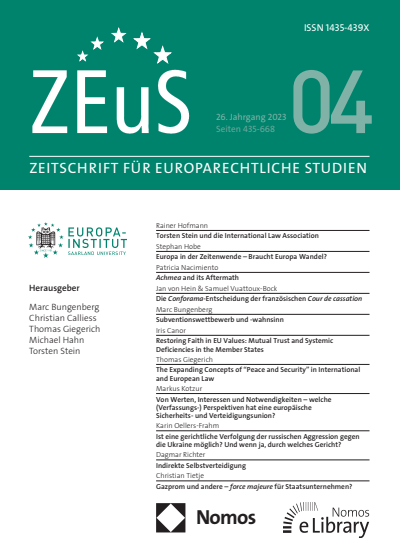
ZEuS Zeitschrift für Europarechtliche Studien
Volume 26 (2023), Issue 4
- Authors:
- Publisher
- Nomos, Baden-Baden
- Copyright Year
- 2023
- ISSN-Online
- 2942-3589
- ISSN-Print
- 1435-439X
Chapter information
Volume 26 (2023), Issue 4
Indirekte Selbstverteidigung
- Authors:
- ISSN-Print
- 1435-439X
- ISSN-Online
- 2942-3589
- Preview:
Is the right of self-defence (Art. 51 UN Charter), in equivalence to the prohibition of the use of force (Art. 2 No. 4 UN Charter), limited to forcible measures of counter-defence or can it also justify non-forcible measures (e.g. suspension of international treaties, confiscation of state assets), which in themselves violate international law? There is no such equivalence in the relationship between Article 51 and Article 2(4) of the UN Charter. However, it is decisive for the justification of non-military measures of self-defence that all requirements of Art. 51 UN Charter are fulfilled. In this context, the term “indirect self-defence” expresses the fact that such measures must also be aimed at the purpose of defence. More precise requirements can be found, among others, in the ILC Draft Articles on the effects of armed conflicts on treaties, the basic ideas of which can be applied to the suspension of other obligations under international law as well. If the requirements are observed, the aggressor state will not be put in a state of lawlessness, nor will the right of countermeasures or other international law be undermined. Nor does this make states participating in collective self-defence by non-military measures a party to the conflict. Rather, indirect self-defence expands the possibility of exerting direct pressure on the aggressor state, independent of countermeasures, as befits the dimension of violations of the prohibition on the use of force. At the same time, the veto rights of destructive powers in the Security Council run empty, because they must constructively form majorities in order to block measures of indirect self-defence.abstract en
Is the right of self-defence (Art. 51 UN Charter), in equivalence to the prohibition of the use of force (Art. 2 No. 4 UN Charter), limited to forcible measures of counter-defence or can it also justify non-forcible measures (e.g. suspension of international treaties, confiscation of state assets), which in themselves violate international law? There is no such equivalence in the relationship between Article 51 and Article 2(4) of the UN Charter. However, it is decisive for the justification of non-military measures of self-defence that all requirements of Art. 51 UN Charter are fulfilled. In this context, the term “indirect self-defence” expresses the fact that such measures must also be aimed at the purpose of defence. More precise requirements can be found, among others, in the ILC Draft Articles on the effects of armed conflicts on treaties, the basic ideas of which can be applied to the suspension of other obligations under international law as well. If the requirements are observed, the aggressor state will not be put in a state of lawlessness, nor will the right of countermeasures or other international law be undermined. Nor does this make states participating in collective self-defence by non-military measures a party to the conflict. Rather, indirect self-defence expands the possibility of exerting direct pressure on the aggressor state, independent of countermeasures, as befits the dimension of violations of the prohibition on the use of force. At the same time, the veto rights of destructive powers in the Security Council run empty, because they must constructively form majorities in order to block measures of indirect self-defence.
Bibliography
No match found. Try another term.
- BRANDL, ULRIKE, Die Beendigung oder Suspendierung völkerrechtlicher Verträge als Sanktion gegen menschenrechtsverachtende Regime, Archiv des Völkerrechts (AVR), 2003, Jahrgang 41, Heft 1, S. 101–129 Open Google Scholar DOI: 10.5771/1435-439X-2023-4-626
- BROWNLIE, IAN, International Law and the Use of Force by States, Oxford, 1963 Open Google Scholar DOI: 10.5771/1435-439X-2023-4-626
- BUCHAN, RUSSELL, Non-Forcible Measures and the Law of Self-Defence, International & Comparative Law Quarterly (ICLQ), 2023, Jg. 72, Heft 1, S. 1–33 Open Google Scholar DOI: 10.5771/1435-439X-2023-4-626
- BUCHAN, RUSSELL; TSAGOURIAS, NICHOLAS, Regulating the Use of Force in International Law: Stability and change, Cheltenham–Northampton, 2021 Open Google Scholar DOI: 10.5771/1435-439X-2023-4-626
- DINSTEIN, YORAM, War, Aggression and Self-Defence, Cambridge, 2017 Open Google Scholar DOI: 10.5771/1435-439X-2023-4-626
- FLETCHER, GEORGE P.; OHLIN, JENS DAVID, Defending Humanity: When Force Is Justified and Why, Oxford, 2008 Open Google Scholar DOI: 10.5771/1435-439X-2023-4-626
- GREEN, JAMES A., Self-Preservation, in: Max Planck Encyclopedia of Public International Law (MPEPIL), Oxford, 2009 Open Google Scholar DOI: 10.5771/1435-439X-2023-4-626
- GREENWOOD, CHRISTOPHER, Self-Defence, in: Max Planck Encyclopedia of Public International Law (MPEPIL), Oxford, 2011 Open Google Scholar DOI: 10.5771/1435-439X-2023-4-626
- KOKOTT, JULIANE, EU Sanctions against Russia and the Rule of Law, Zeitschrift für Europarechtliche Studien (ZEuS), 2023, 26. Jahrgang, Heft 1, S. 3–12 Open Google Scholar DOI: 10.5771/1435-439X-2023-4-626
- KOKOTT, JULIANE, Financing Ukraine’s reconstruction – Can the EU use Russian assets? – Part 1, Ukraine-Krieg und Recht (UKuR), 2022, 1. Jahrgang, Heft 12, S. 438–442 Open Google Scholar DOI: 10.5771/1435-439X-2023-4-626
- MURPHY, SEAN D., Self-Defense and the Israeli Wall Advisory Opinion: An Ipse Dixit from the ICJ?, American Journal of International Law (AJIL), 2005, Jg. 99, Heft 1, S. 62–76 Open Google Scholar DOI: 10.5771/1435-439X-2023-4-626
- NEFF, STEPHEN C., Justice Among Nations: A History of International Law, Harvard, 2014 Open Google Scholar DOI: 10.5771/1435-439X-2023-4-626
- NEFF, STEPHEN C., War and the Law of Nations: A General History, Cambridge, 2005 Open Google Scholar DOI: 10.5771/1435-439X-2023-4-626
- OELLERS-FRAHM, KARIN, Der IGH und die „Lücke“ zwischen Gewaltverbot und Selbstverteidigungsrecht – Neues im Fall „Kongo gegen Uganda“?, Zeitschrift für Europarechtliche Studien (ZEuS), 2007, 10. Jahrgang, Heft 1, S. 71–92 Open Google Scholar DOI: 10.5771/1435-439X-2023-4-626
- PADDEU, FEDERICA I., Self-Defence as a Circumstance Precluding Wrongfulness: understanding article 21 of the articles on state responsibility, British Yearbook of International Law (BYIL), 2015, Jg. 85, Heft 1, S. 90–132 Open Google Scholar DOI: 10.5771/1435-439X-2023-4-626
- ROSCINI, MARCO, On the ‘Inherent’ Character of the Right of States to Self-defence, Cambridge Journal of International and Comparative Law (CJICL), 2015, Jg. 4, Heft 3, S. 634–660 Open Google Scholar DOI: 10.5771/1435-439X-2023-4-626
- SARI, AUREL, The Mutual Assistance Clauses of the North Atlantic and EU Treaties: The Challenge of Hybrid Threats, Harvard National Security Journal (Harv. Nat’l Sec. J.), 2019, Jg. 10 Heft 2, S. 405–460 Open Google Scholar DOI: 10.5771/1435-439X-2023-4-626
- SCHACHTER, OSCAR, The Right of States to Use Armed Force, Michigan Law Review (Mich. L. Rev.), 1984, Jg. 82, Heft 5 & 6, S. 1620–1646 Open Google Scholar DOI: 10.5771/1435-439X-2023-4-626
- SENDER, OMRI, Coercion, in: Max Planck Encyclopedia of Public International Law (MPEPIL), Oxford, 2021 Open Google Scholar DOI: 10.5771/1435-439X-2023-4-626
- SICILIANOS, LINOS-ALEXANDRE, Les réactions décentralisées à l’illicite: Des contre-mesures à la légitime défense, Paris, 1990 Open Google Scholar DOI: 10.5771/1435-439X-2023-4-626
- SIMMA, BRUNO; KHAN, DANIEL-ERASMUS; NOLTE, GEORG; PAULUS, ANDREAS (Hrsg.), The Charter of the United Nations – A Commentary, Band 1 & 2, 3. Auflage, Oxford, 2012 Open Google Scholar DOI: 10.5771/1435-439X-2023-4-626
- STEIN, TORSTEN; VON BUTTLAR, CHRISTIAN; KOTZUR, MARKUS, Völkerrecht, 14. Auflage, München, 2016 Open Google Scholar DOI: 10.5771/1435-439X-2023-4-626
- TAMS, CHRISTIAN J., Light Treatment of a Complex Problem: The Law of Self-Defence in the Wall Case, European Journal of International Law (EJIL), 2005, Jg. 16, Heft 5, S. 963–978 Open Google Scholar DOI: 10.5771/1435-439X-2023-4-626
- TSAGOURIAS, NICHOLAS, Cyber attacks, self-defence and the problem of attribution, Journal of Conflict and Security Law, 2012, Jg. 17(2), S. 229–244 Open Google Scholar DOI: 10.5771/1435-439X-2023-4-626
- WENTKER, ALEXANDER, At War? Party status and the war in Ukraine, Leiden Journal of International Law (LJIL), 2023, Jg. 36, Heft 3, S. 643–656 Open Google Scholar DOI: 10.5771/1435-439X-2023-4-626
- WENTKER, ALEXANDER, Kriegspartei? Sicherheitspolitischer Diskurs und Völkerrecht im Ukraine-Krieg, Die Öffentliche Verwaltung (DÖV), 2022, Jahrgang 75, Heft 23, S. 988–994 Open Google Scholar DOI: 10.5771/1435-439X-2023-4-626
