ECJ’s Recent Case-Law on Criminal Matters: Protection of Fundamental Rights in EU Law and its Importance for Member States’ National Judiciary
Table of contents
Bibliographic information
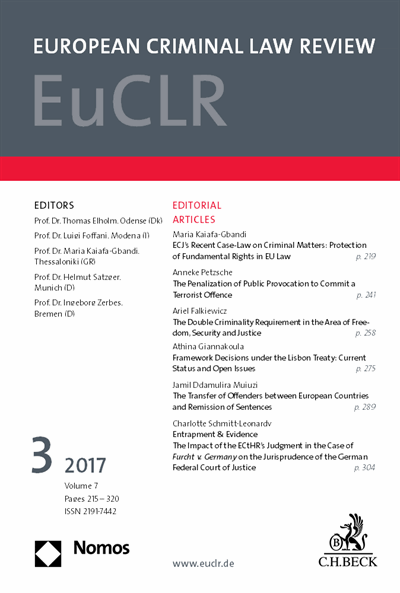
EuCLR European Criminal Law Review
Volume 7 (2017), Edition 3
- Authors:
- Publisher
- Nomos, Baden-Baden
- Copyright year
- 2017
- ISSN-Online
- 2193-5505
- ISSN-Print
- 2191-7442
Chapter information
Volume 7 (2017), Edition 3
ECJ’s Recent Case-Law on Criminal Matters: Protection of Fundamental Rights in EU Law and its Importance for Member States’ National Judiciary
- Authors:
- ISSN-Print
- 2191-7442
- ISSN-Online
- 2193-5505
- Preview:
This paper attempts to highlight the main features of ECJ case-law on safeguarding fundamental rights through an overview of the most nodal recent judgments in criminal cases. The objective is to specify their importance to member states’ judiciaries, intending to serve the proper administration of justice in an institutionally multilevel and highly sensitive judicial area. In this context, the paper discusses: (a) the Grand Chamber judgment in Åklagaren v. Hans Åkerberg Fransson (C-617/10, 26.2.2013) for the enforcement of the ne bis in idem principle between “administrative” and criminal sanctions, together with the recent convictions of Greece by the ECtHR and the relevant national Supreme Administrative Court case-law, (b) the Grand Chamber judgment in the Τaricco case (C-105/14, 8.9.2015) on the non-application of national provisions on the statute of limitations to ensure effective protection of the EU financial interests in view of the Union law primacy, and (c) the Grand Chamber judgment in joined cases Aranyosi, Căldăraru (C-404/15 and C-659/15, 5.4.2016) with regard to the restriction of the mutual recognition principle to ensure the warranty of fundamental rights while executing European Arrest warrants. The overview offers support to national judges for an effective protection of fundamental rights in their national laws, but also an opportunity for vigilance in their further activation to this direction in collaboration with the competent bodies of the EU legal order.