The Colonial Architecture of Exclusion: The Personal Law Exemption and the Institutionalisation of Gender Subordination in West Africa and the Caribbean
Table of contents
Bibliographic information
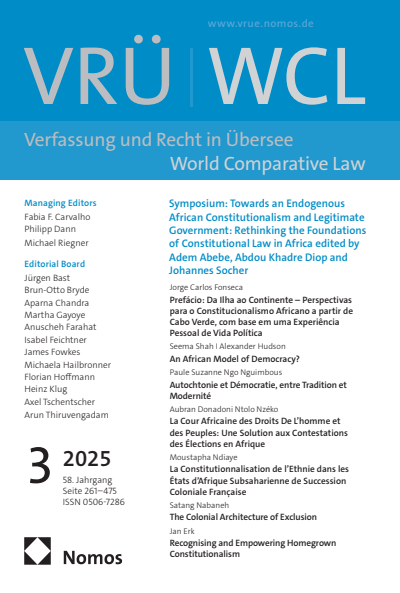
VRÜ Verfassung und Recht in Übersee
Volume 58 (2025), Issue 3
- Authors:
- Publisher
- Nomos, Baden-Baden
- Copyright Year
- 2026
- ISSN-Online
- 2941-9603
- ISSN-Print
- 0506-7286
Chapter information
Volume 58 (2025), Issue 3
The Colonial Architecture of Exclusion: The Personal Law Exemption and the Institutionalisation of Gender Subordination in West Africa and the Caribbean
- Authors:
- ISSN-Print
- 0506-7286
- ISSN-Online
- 2941-9603
- Preview:
This article investigates the enduring impact of colonialism on gender equality in post-colonial Commonwealth nations, focusing specifically on examples from West Africa and the Caribbean. It focuses on discriminatory provisions embedded in the constitutions of countries in the Caribbean and West Africa that routinely exempt personal and customary laws from non-discrimination protections. This uniformity is traceable to the “Neo-Nigerian Bill of Rights” model, which serves as the foundational template. This article uses process-tracing to show how this model established a structural approach that guaranteed a general right, while simultaneously authorising its suspension. The article argues that this flawed constitutional design constitutes a colonial suspension of women’s rights. Drawing on feminist legal theory and postcolonial studies, the analysis examines the enduring impact of colonialism on gender equality, particularly on the structural failure embedded in their founding documents, an issue that manifests differently in the plural legal systems of West Africa versus the common law systems of the Caribbean. By comparatively analysing The Gambia, Sierra Leone, The Bahamas, and Dominica, this article illustrates how colonial legacies continue to shape gender relations and legally institutionalise gender subordination.
