How Race Affects Simply Having versus Actually Choosing: Cross-Race Political Discussion Partners
Table of contents
Bibliographic information
Open Access Full access
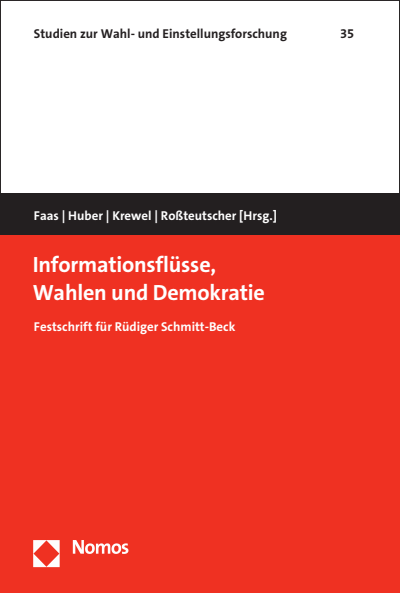
Informationsflüsse, Wahlen und Demokratie
Festschrift für Rüdiger Schmitt-Beck
- Authors:
- Series
- Studien zur Wahl- und Einstellungsforschung
- Volume
- 35
- Publisher
- Nomos, Baden-Baden
- Copyright year
- 2023
- ISBN-Print
- 978-3-7560-0800-1
- ISBN-Online
- 978-3-7489-1555-3
Chapter information
Open Access Full access
How Race Affects Simply Having versus Actually Choosing: Cross-Race Political Discussion Partners
- Authors:
- ISBN-Print
- 978-3-7560-0800-1
- ISBN-Online
- 978-3-7489-1555-3
- Preview:
Bibliography
No match found. Try another term.
- References Open Google Scholar doi.org/10.5771/9783748915553-137
- Allport, G. W. (1954). The nature of prejudice. Reading, MA: Addison-Wesley. Open Google Scholar doi.org/10.5771/9783748915553-137
- Amsalem, E., Merkley, E., and Loewen, P. J. (2022). Does talking to the other side reduce inter-party hostility? Evidence from three studies. Political Communication, 39, 61-78. Open Google Scholar doi.org/10.5771/9783748915553-137
- Appiah, O. (2018). Cultural voyeurism: A new framework for understanding race, ethnicity, and mediated intergroup interaction. Journal of Communication, 68, 233-242. Open Google Scholar doi.org/10.5771/9783748915553-137
- Appiah, O., Eveland, W., Jr., Bullock, O. M., and Coduto, K. D. (2022). Why we can’t talk openly about race: The impact of race and partisanship on respondents’ perceptions of intergroup conversations. Group Processes and Intergroup Relations, 25, 434-452. Open Google Scholar doi.org/10.5771/9783748915553-137
- Appiah, O., Knobloch-Westerwick, S., and Alter, S. (2013). Ingroup favoritism and outgroup derogation: Effects of news valence, character race, and recipient race on selective news reading. Journal of Communication, 63, 517-534. Open Google Scholar doi.org/10.5771/9783748915553-137
- Blau, P. M. (1977). A macrosocial theory of social structure. American Journal of Sociology, 83, 26-54. Open Google Scholar doi.org/10.5771/9783748915553-137
- Brundidge, J. (2010). Encountering “difference” in the contemporary public sphere: The contribution of the Internet to the heterogeneity of political discussion networks. Journal of Communication, 60, 680-700. Open Google Scholar doi.org/10.5771/9783748915553-137
- Carlson, T. N., Abrajano, M., and Bedolla, L. G. (2020). Talking politics: Political discussion networks & the new American electorate. New York: Oxford University Press. Open Google Scholar doi.org/10.5771/9783748915553-137
- Charles, C. Z. (2003). The dynamics of racial residential segregation. Annual Review of Sociology, 29, 167-207. Open Google Scholar doi.org/10.5771/9783748915553-137
- Cohn, N., and Quealy, K. (2020, June 10). How public opinion has moved on Black Lives Matter. New York Times. https://www.nytimes.com/interactive/2020/06/10/upshot/black-lives-matter-attitudes.html Open Google Scholar doi.org/10.5771/9783748915553-137
- Comas-Díaz, L., and Jacobsen, F. M. (2001). Ethnocultural allodynia. Journal of Psychotherapy Practice and Research, 10, 246-252. Open Google Scholar doi.org/10.5771/9783748915553-137
- Dys-Steenbergen, O., Wright, S. C., and Aron, A. (2016). Self-expansion motivation improves cross-group interactions and enhances self-growth. Group Processes & Intergroup Relations, 19, 60-71. Open Google Scholar doi.org/10.5771/9783748915553-137
- Echols, L., and Graham, S. (2013). Birds of a different feather: How do cross-ethnic friends flock together? Merrill-Palmer Quarterly, 59, 461-488. Open Google Scholar doi.org/10.5771/9783748915553-137
- Eddo-Lodge, R. (2020). Why I’m no longer talking to white people about race. Bloomsbury Publishing. Open Google Scholar doi.org/10.5771/9783748915553-137
- Enos, R. D. (2017). The space between us: Social geography and politics. New York: Cambridge University Press. Open Google Scholar doi.org/10.5771/9783748915553-137
- Eveland, W. P., Jr., and Appiah, O. (2021). A national conversation about race? Political discussion across lines of racial and partisan difference. Journal of Race, Ethnicity, and Politics, 6, 187-213. Open Google Scholar doi.org/10.5771/9783748915553-137
- Eveland, W. P., Jr., Appiah, O., and Beck, P. A. (2018). Americans are more exposed to difference than we think: Capturing hidden exposure to political and racial difference. Social Networks, 52, 192-200. Open Google Scholar doi.org/10.5771/9783748915553-137
- Eveland, W. P., Jr., Coduto, K. D., Appiah, O., and Bullock, O. M. (2020). Listening during political conversations: Traits and situations. Political Communication, 37, 656-677. Open Google Scholar doi.org/10.5771/9783748915553-137
- Eveland, W. P., Jr., and Hively, M. H. (2009). Political discussion frequency, network size, and “heterogeneity” of discussion as predictors of political knowledge and participation. Journal of Communication, 59, 205-224. Open Google Scholar doi.org/10.5771/9783748915553-137
- Eveland, W. P., Jr., Song, H., Hutchens, M. J., and Levitan, L. C. (2019). Not being accurate is not quite the same as being inaccurate: Variations in reported (in)accuracy of perceptions of political views of network members due to uncertainty. Communication Methods and Measures, 13, 305-311. Open Google Scholar doi.org/10.5771/9783748915553-137
- Gil de Zúñiga, H., and Valenzuela, S. (2011). The mediating path to a stronger citizenship: Online and offline networks, weak ties, and civic engagement. Communication Research, 38, 397-421. Open Google Scholar doi.org/10.5771/9783748915553-137
- Gilberstadt, H. (2020, June 5). A month before George Floyd’s death, black and white Americans differed sharply in confidence in the police. Pew Research Center. Available online: https://www.pewresearch.org/short-reads/2020/06/05/a-month-before-george-floyds-death-black-and-white-americans-differed-sharply-in-confidence-in-the-police/ Open Google Scholar doi.org/10.5771/9783748915553-137
- Goodreau, S. M., Kitts, J. A., and Morris, M. (2009). Birds of a feather, or friend of a friend? Using exponential random graph models to investigate adolescent social networks. Demography, 46, 103-125. Open Google Scholar doi.org/10.5771/9783748915553-137
- Heatherly, K. A., Lu, Y., and Lee, J. K. (2017). Filtering out the other side? Cross-cutting and like-minded discussions on social networking sites. New Media & Society, 19, 1271-1289. Open Google Scholar doi.org/10.5771/9783748915553-137
- Hofstra, B., Corten, R., van Tubergan, F., and Ellison, N. (2017). Sources of segregation in social networks: A novel approach using Facebook. American Sociological Review, 82, 625-656. Open Google Scholar doi.org/10.5771/9783748915553-137
- Hutchens, M. J., Hmielowski, J. D., and Beam, M. A. (2019). Reinforcing spirals of political discussion and affective polarization. Communication Monographs, 86, 357-376. Open Google Scholar doi.org/10.5771/9783748915553-137
- Huber, G. A., and Malhotra, N. (2017). Political homophily in social relationships: Evidence from online dating behavior. The Journal of Politics, 79, 269-283. Open Google Scholar doi.org/10.5771/9783748915553-137
- Huckfeldt, R., and Sprague, J. (1995). Citizens, politics, and social communication: Information and influence in an election campaign. New York: Cambridge University Press. Open Google Scholar doi.org/10.5771/9783748915553-137
- Huckfeldt, R. R., Johnson, P. E., and Sprague, J. D. (2004). Political disagreement: The survival of diverse opinions within communication networks. New York: Cambridge University Press. Open Google Scholar doi.org/10.5771/9783748915553-137
- Hutchens, M. J., Eveland, W. P., Jr., Morey, A. C., and Sokhey, A. (2018). Evaluating summary measures of heterogeneous political discussion: The critical roles of excluded cases and discussion with people holding extreme views. Communication Methods and Measures, 12, 276-294. Open Google Scholar doi.org/10.5771/9783748915553-137
- Iyengar, S., and Hahn, K. S. (2009). Red media, blue media: Evidence of ideological selectivity in media use. Journal of Communication, 59, 19-39. Open Google Scholar doi.org/10.5771/9783748915553-137
- Kim, Y., Hsu, S-H., and Gil de Zúñiga, H. (2013). Influence of social media use on discussion network heterogeneity and civic engagement: The moderating role of personality traits. Journal of Communication, 63, 498-516. Open Google Scholar doi.org/10.5771/9783748915553-137
- Kleinman, S. B., and Eveland, W. P., Jr. (2015, November). Communicating politics without talking: How people infer political preferences using limited visual information. Presented to the Communication and Social Cognition division of the National Communication Association, Las Vegas. Open Google Scholar doi.org/10.5771/9783748915553-137
- Klofstad, C. A., Sokhey, E. A., and McClurg, S. D. (2013). Disagreeing about disagreement: How conflict in social networks affects political behavior. American Journal of Political Science, 57, 120-134. Open Google Scholar doi.org/10.5771/9783748915553-137
- Kossinets, G., and Watts, D. J. (2009). Origins of homophily in an evolving social network. American Journal of Sociology, 115, 405-450. Open Google Scholar doi.org/10.5771/9783748915553-137
- Kreuter, F., Presser, S., and Tourangeau, R. (2008). Social desirability bias in CATI, IVR, and Web surveys. Public Opinion Quarterly, 72, 847-865. Open Google Scholar doi.org/10.5771/9783748915553-137
- Kubin, E., and von Sikorski, C. (2021). The role of (social) media in political polarization: A systematic review. Annals of the International Communication Association, 45, 188-206. Open Google Scholar doi.org/10.5771/9783748915553-137
- McGuire, W. J., McGuire, C. V., Child, P., and Fujioka, T. (1978). Salience of ethnicity in the spontaneous self-concept as a function of one’s ethnic distinctiveness in the social environment. Journal of Personality and Social Psychology, 36, 511-520. Open Google Scholar doi.org/10.5771/9783748915553-137
- Mendelberg, T., and Oleske, J. (2000). Race and public deliberation. Political Communication, 17, 169-191. Open Google Scholar doi.org/10.5771/9783748915553-137
- Merolla, J. L., Sellers, A. H., and Fowler, D. J. (2013). Descriptive representation, political efficacy, and African Americans in the 2008 presidential election. Political Psychology, 34, 863-875. Open Google Scholar doi.org/10.5771/9783748915553-137
- Mutz, D. C. (2006). Hearing the other side: Deliberative versus participatory democracy. New York: Cambridge University Press. Open Google Scholar doi.org/10.5771/9783748915553-137
- Pew Research Center. (2016). On views of race and inequality, Blacks and Whites are worlds apart. http://www.pewsocialtrends.org/wp-content/uploads/sites/3/2016/06/ST_2016.06.27_Race-Inequality-Final.pdf Open Google Scholar doi.org/10.5771/9783748915553-137
- Pew Research Center. (2018, March). Wide gender gap, growing educational divide in voters’ party identification. Available online: https://www.pewresearch.org/politics/wp-content/uploads/sites/4/2018/03/03-20-18-Party-Identification-CORRECTED.pdf Open Google Scholar doi.org/10.5771/9783748915553-137
- Pew Research Center. (2019, April). Race in America 2019. https://www.pewsocialtrends.org/2019/04/09/race-in-america-2019/ Open Google Scholar doi.org/10.5771/9783748915553-137
- Phinney, J. S. (1992). The multigroup ethnic identity measure: A new scale for use with diverse groups. Journal of Adolescent Research, 7, 156-176. Open Google Scholar doi.org/10.5771/9783748915553-137
- Quillian, L., and Campbell, M. E. (2003). Beyond black and white: The present and future of multiracial friendship segregation. American Sociological Review, 68, 540-566. Open Google Scholar doi.org/10.5771/9783748915553-137
- Rogers, E. M., and Bhowmik, D. K. (1970). Homophily-heterophily: Relational concepts for communication research. Public Opinion Quarterly, 34, 523-538. Open Google Scholar doi.org/10.5771/9783748915553-137
- Rojas, H. (2008). Strategy vs. understanding: How orientations toward political conversation influence political engagement. Communication Research, 35, 452-480. Open Google Scholar doi.org/10.5771/9783748915553-137
- Rule, N. O., and Ambady, N. (2010). Democrats and Republicans can be differentiated from their faces. PLoS ONE, 5, e8733. Open Google Scholar doi.org/10.5771/9783748915553-137
- Scheufele, D. A., Nisbet, M. C., Brossard, D., and Nisbet, E. C. (2004). Social structure and citizenship: Examining the impacts of social setting, network heterogeneity, and informational variables on political participation. Political Communication, 21, 315-338. Open Google Scholar doi.org/10.5771/9783748915553-137
- Schmitt-Beck, R., and Lup, O. (2013). Seeking the soul of democracy: A review of recent research into citizens’ political talk culture. Swiss Political Science Review, 19, 513-538. Open Google Scholar doi.org/10.5771/9783748915553-137
- Schmitt-Beck, R., and Schnaudt, C. (2023, online first). Everyday political talk with strangers: Evidence on a neglected arena of the deliberative system. Politische Vierteljahresschrift. Open Google Scholar doi.org/10.5771/9783748915553-137
- Scott, E. (2020, June 10). What’s different about this moment? Primarily the number of Americans supporting protests over racial justice. The Washington Post. https://www.washingtonpost.com/politics/2020/06/10/whats-different-about-this-moment-primarily-number-americans-supporting-protests-over-racial-injustice/ Open Google Scholar doi.org/10.5771/9783748915553-137
- Shafranek, R. M. (2021). Political considerations in nonpolitical decisions: A conjoint analysis of roommate choice. Political Behavior, 43, 271-300. Open Google Scholar doi.org/10.5771/9783748915553-137
- Smith, J. A., McPherson, M., and Smith-Lovin, L. (2014). Social distance in the United States: Sex, race, religion, age, and education homophily among confidants, 1985-2004. American Sociological Review, 79, 432-456. Open Google Scholar doi.org/10.5771/9783748915553-137
- Song, H., and Boomgaarden, H. (2017). Dynamic spirals put to test: An agent-based model of reinforcing spirals between selective exposure, interpersonal networks, and attitude polarization. Journal of Communication, 67, 256-281. Open Google Scholar doi.org/10.5771/9783748915553-137
- Trawalter, S., and Richeson, J. A. (2008). Let’s talk about race, Baby! When Whites’ and Blacks’ interracial contact experiences diverge. Journal of Experimental Social Psychology, 44, 1214-1217. Open Google Scholar doi.org/10.5771/9783748915553-137
- Walsh, K. C. (2007). Talking about race: Community dialogues and the politics of difference. Chicago: University of Chicago Press. Open Google Scholar doi.org/10.5771/9783748915553-137
- Wimmer, A., and Lewis, K. (2010). Beyond and below racial homophily: ERG models of a friendship network documented on Facebook. American Journal of Sociology, 116, 583-642. Open Google Scholar doi.org/10.5771/9783748915553-137
- Online Appendix Open Google Scholar doi.org/10.5771/9783748915553-137
- https://www.nomos-shop.de/shopfiles/anhang_978-3-7560-0800-1_mat_online_anhang.pdf Open Google Scholar doi.org/10.5771/9783748915553-137
- hit Open Google Scholar doi.org/10.5771/9783748915553-137