IFLA Library Reference Model (IFLA LRM)— Harmonisation of the FRBR Family
Table of contents
Bibliographic information
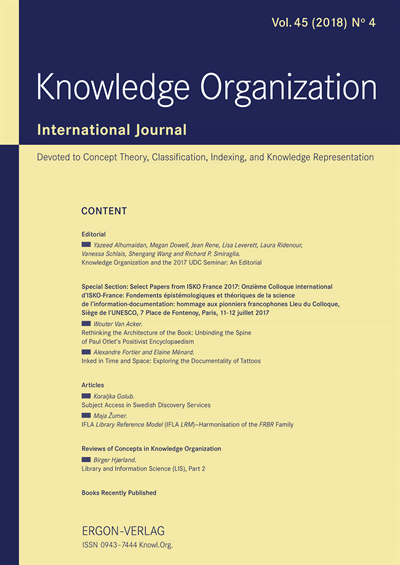
KO KNOWLEDGE ORGANIZATION
Volume 45 (2018), Edition 4
- Authors:
- Publisher
- Nomos, Baden-Baden
- Copyright year
- 2018
- ISSN-Online
- 2942-3309
- ISSN-Print
- 0943-7444
Chapter information
Volume 45 (2018), Edition 4
IFLA Library Reference Model (IFLA LRM)— Harmonisation of the FRBR Family
- Authors:
- ISSN-Print
- 0943-7444
- ISSN-Online
- 2942-3309
- Preview:
In 1998, the FRBR model (Functional Requirements for Bibliographic Records) was developed under the auspices of the International Federation of Library Associations and Institutions (IFLA). The library domain finally developed its conceptual model of the bibliographic universe and thus the basis for the development of novel bibliographic information systems. In 2017, the IFLA Library Reference Model (Riva, LeBoeuf and Žumer 2017) was formally accepted as an IFLA standard. The FRBR family of models as well as LRM all start from the user tasks that need to be enabled and supported by bibliographic information systems. The consolidation process included a detailed analysis of all entities, attributes and relationships defined by the FRBR family. In this paper, the main features of the model are presented and described. With IFLA LRM, we finally have a modern model, compatible with the semantic web.
Bibliography
No match found. Try another term.
- Beak, Jihee, Inkyung Choi, Sukwon Lee, Hyoungjoo Park, Laura Ridenour and Richard P. Smiraglia. 2014. “Knowledge Organization and the 2013 UDC Seminar: An Editorial.” Knowledge Organization 41: 191-4. Open Google Scholar doi.org/10.5771/0943-7444-2018-4-273
- Cai, Xin, Melissa Davey Castillo, Musa Dauda Hassan, Ann Graf, Hyoungjoo Park and Richard P. Smiraglia. 2016. “Knowledge Organization and the 2015 UDC Seminar: An Editorial.” Knowledge Organization 43: 395-402. Open Google Scholar doi.org/10.5771/0943-7444-2018-4-273
- Classification Research Group (CRG). (1997 [1955]) The need for a faceted classification as the basis of all methods of information retrieval: Memorandum of the Classification Research Group: received, for information, by the L. A. Library Research Committee, May 1955. In: From classification to “knowledge organization: Dorking revisited or “past is prelude”. Edited by A. Gilchrist. The Hague: FID, 1997. (FID 714), 1-9. Open Google Scholar doi.org/10.5771/0943-7444-2018-4-273
- Slavic, Aida and Claudio Gnoli, eds. 2017. Faceted Classification Today: Theory, Technology and End Users: Proceedings of the International UDC Seminar, 14-15 September, London, United Kingdom, organized by UDC Consortium, The Hague. Würzburg: Ergon Verlag. Open Google Scholar doi.org/10.5771/0943-7444-2018-4-273
- Smiraglia, Richard P. 2017. “Facets as Discourse: How Facets and Facet Analytical Theory Reveal Cultural Dimensions in 21st Century Knowledge Organization Systems.” In Faceted Classification Today—Theory, Technology and End Users: Proceedings of the International UDC Seminar, 14-15 September 2017, London, United Kingdom, ed. Aida Slavic and Claudio Gnoli. Würzburg: Ergon Verlag, 3-22. Open Google Scholar doi.org/10.5771/0943-7444-2018-4-273
- Banks E. C. 2004. “The Philosophical Roots of Ernst Mach’s Economy of Thought.” Synthese 139: 23-53. Open Google Scholar doi.org/10.5771/0943-7444-2018-4-281
- Bernstein, Richard J. 1985. Beyond Objectivism and Relativism: Science, Hermeneutics and Praxis. Philadelphia: University of Pennsylvania Press. Open Google Scholar doi.org/10.5771/0943-7444-2018-4-281
- Blackmore, John T. 1972. Ernst Mach: His Work, Life, and Influence. Berkeley, CA: University of California Press. Open Google Scholar doi.org/10.5771/0943-7444-2018-4-281
- Bryant, Christopher G. A. 1985. Positivism in Social Theory and Research. Contemporary Social Theory: Theoretical Traditions in the Social Sciences. Houndmills, Basingstoke, Hampshire: Macmillan. Open Google Scholar doi.org/10.5771/0943-7444-2018-4-281
- Comte, Auguste. (1851) 1875. System of Positive Polity. Vol. 1, General View of Positivism and, Introductory Principles, trans. J.H. Bridges. London: Longmans, Green. Open Google Scholar doi.org/10.5771/0943-7444-2018-4-281
- Copleston, Frederick Charles. (1975) 2003. A History of Philosophy. New ed. London: Continuum. Open Google Scholar doi.org/10.5771/0943-7444-2018-4-281
- Crombois, Jean-François. 1997. “Énergétisme et productivisme: La pensée morale, sociale et politique d’Ernest Solvay.” In Ernest Solvay et son temps, ed. Andrée Despy-Meyer and Didier Devriese. Brussels: Archives de l’Université de Bruxelles, 209-20. Open Google Scholar doi.org/10.5771/0943-7444-2018-4-281
- Day, Ron. 1997. “Paul Otlet’s Book and the Writing of Social Space.” Journal of the American Society for Information Science 48: 310-17. Open Google Scholar doi.org/10.5771/0943-7444-2018-4-281
- Daston, Lorraine and Peter Galison. 2007. Objectivity. New York: Zone. Open Google Scholar doi.org/10.5771/0943-7444-2018-4-281
- Eco, Umberto. 1996. “Afterword.” In The Future of the Book, ed. Geoffrey Nunberg. Berkeley, CA: University of California Press, 295-306. Open Google Scholar doi.org/10.5771/0943-7444-2018-4-281
- Foucault, Michel. (1969) 2002. The Archeology of Knowledge, trans. A.M. Sheridan Smith. Routledge Classics. London: Routledge. Translation of L'archeologie du savoir. Open Google Scholar doi.org/10.5771/0943-7444-2018-4-281
- Fouillée, Alfred. 1875. Histoire de la philosophie. Paris: Librarie CH. Delagrave. Open Google Scholar doi.org/10.5771/0943-7444-2018-4-281
- Fouillée, Alfred. 1890. L’evolutionnisme des idées-forces. Paris: Felix Alcan. Open Google Scholar doi.org/10.5771/0943-7444-2018-4-281
- Fouillée, Alfred. 1896. Le mouvement idéaliste et la réaction contre la science positive. Bibliothèque de philosophie contemporaine. Paris: Felix Alcan. Open Google Scholar doi.org/10.5771/0943-7444-2018-4-281
- Fouillée, Alfred. 1908. Morale des idées-forces, 2e éd. Bibliothèque de philosophie contemporaine 267. Paris: Felix Alcan. Open Google Scholar doi.org/10.5771/0943-7444-2018-4-281
- Fouillée, Alfred. 1913. Esquisse d’une interpretation du monde. Bibliothèque de philosophie contemporaine. Paris: Felix Alcan. Open Google Scholar doi.org/10.5771/0943-7444-2018-4-281
- Frohmann, Bernd. 2001. “Discourse and Documentation: Some Implications for Pedagogy and Research.” Journal of Library and Information Science Education 42: 12-26. Open Google Scholar doi.org/10.5771/0943-7444-2018-4-281
- Frohmann, Bernd. 2004. Deflating Information: From Science Studies to Documentation. Toronto: University of Toronto Press. Open Google Scholar doi.org/10.5771/0943-7444-2018-4-281
- Frohmann, Bernd. 2008. “The Role of Facts in Paul Otlet’s Modernist Project of Documentation.” In European Modernism and the Information Society: Informing the Present, Understanding the Past, ed. W. Boyd Rayward. Aldershot: Ashgate, 75-88. Open Google Scholar doi.org/10.5771/0943-7444-2018-4-281
- Gunn, J. Alexander. (1921) 2011. Modern French Philosophy: A Study of the Development since Comte. Miami: HardPress Publishing. Open Google Scholar doi.org/10.5771/0943-7444-2018-4-281
- Haeckel Ernst. (1895) 2004. Monism as Connecting Religion and Science, trans. J. Gilchrist. Whitefish, MT: Kessinger Publishing. Translation of Monismus als Band zwischen Religion und Wissenschaft. Open Google Scholar doi.org/10.5771/0943-7444-2018-4-281
- Hakfoort, Casper. 1992. “Science Deified: Wilhelm Ostwald’s Energeticist World-View and the History of Scientism.” Annals of Science 49: 525-44. Open Google Scholar doi.org/10.5771/0943-7444-2018-4-281
- Hapke, Thomas. “Roots of Mediating Information: Aspects of the German Information Movement.” In European Modernism and the Information Society: Informing the Present, Understanding the Past, ed. W. Boyd Rayward. Aldershot: Ashgate, 307-27. Open Google Scholar doi.org/10.5771/0943-7444-2018-4-281
- Johnson, Mark. 1987. The Body in The Mind: The Bodily Basis of Meaning, Imagination, and Reason. Chicago: University of Chicago Press, Open Google Scholar doi.org/10.5771/0943-7444-2018-4-281
- Landow, George. 1996. “Twenty Minutes into the Future: Or, How Are We Moving Beyond the Book?” In The Future of the Book, ed. Geoffrey Nunberg. Turnhout: Brepols, 209–37. Open Google Scholar doi.org/10.5771/0943-7444-2018-4-281
- Ostwald, Wilhelm. 1910. Les fondements énergétiques de la science de la civilisation, trans. E. Philippi. Bibliothèque sociologique internationale. Paris: V. Giard & E. Brière. Translation of Energetische Grundlagen der Kulturwissenschaft. Open Google Scholar doi.org/10.5771/0943-7444-2018-4-281
- Ostwald, Wilhelm. 1912. Der energetische Imperativ. Leipzig: Akademische Verlagsgesellschaft. Open Google Scholar doi.org/10.5771/0943-7444-2018-4-281
- Ostwald, Wilhelm. 1913. Monism as the Goal of Civilization. Hamburg: International Committee of Monism. Open Google Scholar doi.org/10.5771/0943-7444-2018-4-281
- Otlet, Paul. 1903. “Les Sciences bibliographiques et la documentation.” Bulletin de l'Institut international de bibliographie 8: 125-47. Open Google Scholar doi.org/10.5771/0943-7444-2018-4-281
- Otlet, Paul. 1911. L’avenir du livre et de la bibliographie. Institut International de Bibliographie publication 117. Brussels: Institut International de Bibliographie. Open Google Scholar doi.org/10.5771/0943-7444-2018-4-281
- Otlet, Paul. 1934a. Traité de documentation: Le livre sur le livre, théorie et pratique. Bruxelles: Editiones Mundaneum. Open Google Scholar doi.org/10.5771/0943-7444-2018-4-281
- Otlet, Paul. 1934b. “La documentation personnelle.” March 11, 1934. MS nr. 3745. Funds Encylopaedia universalis Mundaneum. Personal Papers Paul Otlet. Mundaneum. Mons. Open Google Scholar doi.org/10.5771/0943-7444-2018-4-281
- Otlet, Paul. 1935. Monde: Essai d'universalisme: Connaissance du monde, sentiment du monde, action organisée et plan du monde. Brussels: Mundaneum. Open Google Scholar doi.org/10.5771/0943-7444-2018-4-281
- Otlet, Paul. 1938. “Le livre universel: Le livre de demain; Encyclopédie mondiale; Réseau de documentation.” In Atlas de documentation, ed. Paul Otlet, Note no. 8338, 8 December 1938, Personal Papers Paul Otlet, Mundaneum, Mons. Open Google Scholar doi.org/10.5771/0943-7444-2018-4-281
- Parodi, Dominique. 1920. La philosophie contemporaine en France: Essai de classification des doctrines, 2.éd revue. Paris: Felix Alcan. Open Google Scholar doi.org/10.5771/0943-7444-2018-4-281
- Pearson, Karl. 1892 The Grammar of Science. The Contemporary Science Series. London: Walter Scott. Open Google Scholar doi.org/10.5771/0943-7444-2018-4-281
- Rayward, W. Boyd. 1994a. “Some Schemes for Restructuring and Mobilising Information in Documents: A Historical Perspective.” Information Processing & Management 30: 163-75. Open Google Scholar doi.org/10.5771/0943-7444-2018-4-281
- Rayward, W. Boyd. 1994b. “Visions of Xanadu: Paul Otlet (1968-1944) and Hypertext.” Journal of the American Society for Information Science 45: 235-50. Open Google Scholar doi.org/10.5771/0943-7444-2018-4-281
- Rayward, W. Boyd. 1997. “The Origins of Information Science and the International Institute of Bibliography/International Federation for Information and Documentation (FID).” Journal of the American Society for Information Science 48: 289-300. Open Google Scholar doi.org/10.5771/0943-7444-2018-4-281
- Rieusset-Lemarié, Isabelle. 1997. “Otlet’s Mundaneum and the International Perspective in the History of Documentation and Information Science.” Journal of the American Society of Information Science 48: 301-9. Open Google Scholar doi.org/10.5771/0943-7444-2018-4-281
- Simon, Walter Michael. 1963. European Positivism in the Nineteenth Century: An Essay in Intellectual History. Ithaca: Cornell University Press. Open Google Scholar doi.org/10.5771/0943-7444-2018-4-281
- Schneiders, Paul. 1982. De bibliotheek- en documentatiebeweging 1880-1914: Bibliografische ondernemingen rond 1900. PhD diss., Universiteit van Amsterdam. Open Google Scholar doi.org/10.5771/0943-7444-2018-4-281
- Turner J.H. 2000. “The Origins of Positivism: The Contributions of Auguste Comte and Herbert Spencer.” In Handbook of Social Theory, ed. George Ritzer and Barry Smart. London: SAGE, 30-42. Open Google Scholar doi.org/10.5771/0943-7444-2018-4-281
- Adams, Josh. 2010. “Cleaning Up the Dirty Work: Professionalization and the Management of Stigma in the Cosmetic Surgery and Tattoo Industries.” Deviant Behavior 33: 149-67. Open Google Scholar doi.org/10.5771/0943-7444-2018-4-292
- Briet, Suzanne. 1951. Qu’est-ce que la documentation? Collection de documentologie 1. Paris: Éditions documentaires. Open Google Scholar doi.org/10.5771/0943-7444-2018-4-292
- Buckland, Michael K. 1997. “What is a ‘Document’?” Journal of the American Society for Information Science 48: 804-9. Open Google Scholar doi.org/10.5771/0943-7444-2018-4-292
- Buckland, Michael K. 1999. “The Landscape of Information Science: The American Society for Information Science at 62.” Journal of the American Society for Information Science 50: 970-4. Open Google Scholar doi.org/10.5771/0943-7444-2018-4-292
- Buckland, Michael K. 2015. “Document Theory: An Introduction.” In Records, Archives and Memory: Selected Papers from the Conference and School on Records, Archives and Memory Studies, University of Zadar, Croatia, May 2013, ed. Mirna Willer, Anne J. Gilliland, and Marijana Tomić. Studije iz knjižnične i informacijske znanosti 3. Zadar: University of Zadar Press, 233-8. Open Google Scholar doi.org/10.5771/0943-7444-2018-4-292
- Corbin, Juliet M. and Anselm Strauss. 1990. “Grounded Theory Research: Procedures, Canons, and Evaluative Criteria.” Qualitative Sociology 13: 3-21. Open Google Scholar doi.org/10.5771/0943-7444-2018-4-292
- Corbin, Juliet M. and Anselm Strauss. 2015. Basics of Qualitative Research: Techniques and Procedures for Developing Grounded Theory, 4th ed. Los Angele: SAGE. Open Google Scholar doi.org/10.5771/0943-7444-2018-4-292
- DeMello, Margo. 1995. “The Carnivalesque Body: Women and Tattoos.” In Pierced Hearts and True Love: A Century of Drawings for Tattoos, organized by Don Ed Hardy and The Drawing Center. New York: Drawing Center, 73-9. Open Google Scholar doi.org/10.5771/0943-7444-2018-4-292
- Dickson, Lynda, Richard L. Dukes, Hilary Smith, and Noel Strapko. 2015. “To Ink or Not to Ink: The Meaning of Tattoos Among College Students.” College Student Journal 49: 106-20. Open Google Scholar doi.org/10.5771/0943-7444-2018-4-292
- Dundes, Lauren and Antonia Francis. 2016. “Inking and Thinking: Honors Students and Tattoos.” College Student Journal 50 (2): 219-23. Open Google Scholar doi.org/10.5771/0943-7444-2018-4-292
- Firmin, Michael, Luke Tse, Janna Foster and Tammy Angelini. 2012. “External Dynamics Influencing Tattooing Among College Students: A Qualitative Analysis.” Journal of College Student Development 53: 76-90. Open Google Scholar doi.org/10.5771/0943-7444-2018-4-292
- French, Michael T., Johanna Catherine Maclean, Philip K. Robins, Bisma Sayed, and Leah Shiferaw. 2016. “Tattoos, Employment, and Labor Market Earnings: Is There a Link in the Ink?” Southern Economic Journal 82: 1212-46. Open Google Scholar doi.org/10.5771/0943-7444-2018-4-292
- Glaser, Barney G. and Anselm L. Strauss. 1967. The Discovery of Grounded Theory: Strategies for Qualitative Research. Chicago: Aldine Publishing. Open Google Scholar doi.org/10.5771/0943-7444-2018-4-292
- Gorichanaz, Tim. 2015. “For Every Document, a Person: A Co-Created View of Documents.” In Proceedings from the Document Academy 2 (1): Article 9. Open Google Scholar doi.org/10.5771/0943-7444-2018-4-292
- Gorichanaz, Tim and Kiersten F. Latham. 2016. “Document Phenomenology: A Framework for Holistic Analysis.” Journal of Documentation 72: 1114-33. Open Google Scholar doi.org/10.5771/0943-7444-2018-4-292
- Hawkes, Daina, Charlene Y. Senin, and Chantal Thorn. 2004. “Factors that Influence Attitudes Toward Women with Tattoos.” Sex Roles 50: 593-604. Open Google Scholar doi.org/10.5771/0943-7444-2018-4-292
- Kang, Miliann and Katherine Jones. 2007. “Why Do People Get Tattoos?” Contexts 6: 42-7. Open Google Scholar doi.org/10.5771/0943-7444-2018-4-292
- Kosut, Mary. 2000. “Tattoo Narratives: The Intersection of the Body, Self-Identity and Society.” Visual Studies 15: 79-100. Open Google Scholar doi.org/10.5771/0943-7444-2018-4-292
- Lund, Niels Windfeld. 2004. “Documentation in a Complementary Perspective.” In Aware and Responsible: Papers of the 2001 Nordic-International Colloquium on Social and Cultural Awareness and Responsibility in Library, Information and Documentation Studies (SCARLID), ed. W. Boyd Rayward. Lanham, MD: Scarecrow Press, 93-102. Open Google Scholar doi.org/10.5771/0943-7444-2018-4-292
- Lund, Niels Windfeld. 2009. “Document Theory.” Annual Review of Information Science and Technology 43: 399-432. Open Google Scholar doi.org/10.5771/0943-7444-2018-4-292
- O’Connor, Brian C., Jodi Kearns, and Richard L. Anderson. 2008. Doing Things with Information: Beyond Indexing and Abstracting. Westport, CT: Libraries Unlimited. Open Google Scholar doi.org/10.5771/0943-7444-2018-4-292
- Otlet, Paul. 1934. Traité de documentation: Le livre sur le livre. Brussels: Mundaneum. Open Google Scholar doi.org/10.5771/0943-7444-2018-4-292
- Patton, Michael Quinn. 2015. Qualitative Research & Evaluation Methods: Integrating Theory and Practice. 4th ed. Thousand Oaks, CA: SAGE. Open Google Scholar doi.org/10.5771/0943-7444-2018-4-292
- Paveau, Marie-Anne. 2009. “Une énonciation sans communication: Les tatouages scripturaux.” In Corpographèse: Corps écrits, corps inscrits, ed. Marie-Anne Paveau and Pierre Zoberman. Itinéraires: littérature, textes, cultures 2009, 1. Paris: Harmattan, 81-105. Open Google Scholar doi.org/10.5771/0943-7444-2018-4-292
- Pitts, Victoria L. 1998. “Reclaiming the Female Body: Embodied Identity Work, Resistance and the Grotesque.” Body & Society 4, no. 3: 67-84. Open Google Scholar doi.org/10.5771/0943-7444-2018-4-292
- Silver, Eric, Matthew VanEseltine, and Stacy J. Silver. 2009. Tattoo Acquisition: A Prospective Longitudinal Study of Adolescents.” Deviant Behavior 30: 511-38. Open Google Scholar doi.org/10.5771/0943-7444-2018-4-292
- Skare, Roswitha. 2009. “Complementarity: A Concept for Document Analysis?” Journal of Documentation 65: 834-40. Open Google Scholar doi.org/10.5771/0943-7444-2018-4-292
- Balíková, Marie. 2011. “Focusing on User Needs: New Ways of Subject Access in Czechia,” In Subject Access: Preparing for the Future, ed. Patrice Landry, Leda Bultrini, Edward T. O’Neill, and Sandra K. Roe. IFLA Series on Bibliographic Control 42. Berlin: De Gruyter Saur, 7-24. Open Google Scholar doi.org/10.5771/0943-7444-2018-4-297
- Barton, Joshua and Lucas Mak. 2012. “Old Hopes, New Possibilities: Next-Generation Catalogues and the Centralization of Access.” Library Trends 61: 83-106. Open Google Scholar doi.org/10.5771/0943-7444-2018-4-297
- Borgman, Christine L. 1996. “Why Are Online Catalogs Still Hard to Use?” Journal of the American Society for Information Science 47: 493-503. Open Google Scholar doi.org/10.5771/0943-7444-2018-4-297
- Casson, Emanuela, Andrea Fabbrizzi, and Aida Slavic. 2011. “Subject Search in Italian OPACs: An Opportunity in Waiting?” In Subject Access: Preparing for the Future, ed. Patrice Landry, Leda Bultrini, Edward T. O’Neill, and Sandra K. Roe. Berlin: De Gruyter Saur, 37-50. Open Google Scholar doi.org/10.5771/0943-7444-2018-4-297
- Chickering, F. William and Sharon Q. Yang. 2014. “Evaluation and Comparison of Discovery Tools: An Update.” Information Technology and Libraries 33, no. 2: 5-30. Open Google Scholar doi.org/10.5771/0943-7444-2018-4-297
- Cossham, Amanda F. 2013. “Bibliographic Records in an Online Environment.” Information Research 18, no. 3: paper C42. http://www.informationr.net/ir/18-3/colis/paperC42.html Open Google Scholar doi.org/10.5771/0943-7444-2018-4-297
- Cutter, Charles A. 1876. Rules for a Printed Dictionary Catalogue. Washington: Government Printing Office. Open Google Scholar doi.org/10.5771/0943-7444-2018-4-297
- Dempsey, Lorcan. 2012. “Thirteen Ways of Looking at Libraries, Discovery, and the Catalog: Scale, Workflow, Attention.” EDUCAUSE Review. https://er.educause.edu/articles/2012/12/thirteen-ways-of-looking-at-libraries-discovery-and-the-catalog-scale-workflow-attention Open Google Scholar doi.org/10.5771/0943-7444-2018-4-297
- Ellero, Nadine P. 2013. “Integration or Disintegration: Where Is Discovery Headed?” Journal of Library Metadata 13: 311-29. Open Google Scholar doi.org/10.5771/0943-7444-2018-4-297
- Emanuel, Jennifer. 2011. “Usability of the VuFind Next-generation Online Catalog.” Information Technology and Libraries 30, no. 1: 44-52. https://ejournals.bc.edu/ojs/index.php/ital/article/view/3044/2666 Open Google Scholar doi.org/10.5771/0943-7444-2018-4-297
- Fagan, Jody Condit. 2011. “Discovery Tools and Information Literacy.” Journal of Web Librarianship 5: 171-8. Open Google Scholar doi.org/10.5771/0943-7444-2018-4-297
- Golub, Koraljka. 2003. Predmetno pretraživanje u knjižničnim katalozima s web-sučeljem. Master’s thesis, University of Zagreb. http://koraljka.info/publ/Magisterij-hrv.pdf Open Google Scholar doi.org/10.5771/0943-7444-2018-4-297
- Hildreth, Charles. 1984. “Pursuing the Ideal: Generations of Online Catalogs.” In Online Catalogs, Online Reference, Converging Trends: Proceedings of a Library and Information Technology Association Preconference Institute, June 23-24, 1983, Los Angeles, ed. Brian Aveney and Brett Butler. Library and Information Technology Series 2. Chicago: American Library Association, 31-56. Open Google Scholar doi.org/10.5771/0943-7444-2018-4-297
- Hunter, Rhonda N. 1991. “Successes and Failures of Patrons Searching the Online Catalog at a Large Academic Library: A Transaction Log Analysis.” RQ 30: 395-402. Open Google Scholar doi.org/10.5771/0943-7444-2018-4-297
- IFLA Working Group on the Functional Requirements for Subject Authority Records (FRSAR). 2011. Functional Requirements for Subject Authority Data (FRSAD): A Conceptual Model, ed. Marcia Lei Zeng, Maja Žumer, and Athena Salaba. IFLA Series on Bibliographic Control 43. Munich: De Gruyter Saur. http://www.ifla.org/files/assets/classification-and-indexing/functional-requirements-for-subject-authority-data/frsad-final-report.pdf. Errata for section 5.4.2, October 2011, http://www.ifla.org/files/assets/cataloguing/frsad/FRSADerrata2011.pdf Open Google Scholar doi.org/10.5771/0943-7444-2018-4-297
- Kuhagen, Judith A. 2015. Subject Relationship Element in RDA Chapter 23. http://www.rda-jsc.org/archivedsite/docs/6JSC-ALA-31-rev-Sec-final.pdf Open Google Scholar doi.org/10.5771/0943-7444-2018-4-297
- Landry, Patrice, Leda Bultrini, Edward T. O’Neill, and Sandra K. Roe, eds. 2011. Subject Access: Preparing for the Future. Berlin: De Gruyter Saur. Open Google Scholar doi.org/10.5771/0943-7444-2018-4-297
- Lee, Boram and Eunkyung Chung. 2016. “An Analysis of Web-scale Discovery Services from the Perspective of User’s Relevance Judgment.” Journal of Academic Librarianship 42:529-34. Open Google Scholar doi.org/10.5771/0943-7444-2018-4-297
- Majors, Rice. 2012. “Comparative User Experiences of Next-Generation Catalogue Interfaces.” Library Trends 61, no. 1: 186-207. Open Google Scholar doi.org/10.5771/0943-7444-2018-4-297
- Markey, Karen. 2007. “The Online Library Catalogue: Paradise Lost and Paradise Regained?” D-Lib Magazine 13, no. 1/2. http://www.dlib.org/dlib/january07/markey/01markey.html Open Google Scholar doi.org/10.5771/0943-7444-2018-4-297
- Meadow, Kelly and James Meadow. 2012. "Search Query Quality and Web-Scale Discovery: A Qualitative and Quantitative Analysis.” College & Undergraduate Libraries 19: 163-75. Open Google Scholar doi.org/10.5771/0943-7444-2018-4-297
- National Information Standards Organization. 2018. “ODI: Open Discovery Initiative.” http://www.niso.org/standards-committees/odi Open Google Scholar doi.org/10.5771/0943-7444-2018-4-297
- Olson, Nasrine. 2010. Taken for Granted: The Construction of Order in the Process of Library Management System Decision Making. Skrifter från Valfrid 45. Borås: Valfrid. Open Google Scholar doi.org/10.5771/0943-7444-2018-4-297
- Osborne, Hollie M. and Andrew Cox. 2015. “An Investigation into the Perceptions of Academic Librarians and Students towards Next-generation OPACs and Their Features.” Program: Electronic Library and Information Systems 49: 23-45. Open Google Scholar doi.org/10.5771/0943-7444-2018-4-297
- Riva, Pat, Patrick LeBoeuf, and Maja Žumer. 2017. IFLA Library Reference Model: A Conceptual Model for Bibliographic Information. https://www.ifla.org/files/assets/cataloguing/frbr-lrm/ifla-lrm-august-2017_rev201712.pdf Open Google Scholar doi.org/10.5771/0943-7444-2018-4-297
- Salaba, Athena and Yin Zhang. 2007. “Functional Requirements for Bibliographic Records: From a Conceptual Model to Application and System Development.” Bulletin of the American Society for Information Science and Technology 33, no. 6: 17–23. Open Google Scholar doi.org/10.5771/0943-7444-2018-4-297
- Tarulli, Laurel. 2016. “Managing Outsourced Metadata in Discovery Systems.” In Managing Metadata in Web-scale Discovery Systems, ed. Lousie F. Spiteri. London: Facet. 137-64. Open Google Scholar doi.org/10.5771/0943-7444-2018-4-297
- Walker, Jenny. 2015. “The NISO Open Discovery Initiative: Promoting Transparency in Discovery.” Insights 28, no. 1: 85–90. Open Google Scholar doi.org/10.5771/0943-7444-2018-4-297
- Villén-Rueda, Luis, Jose A. Senso, and Félix De Moya-Anegón. 2007. “The Use of OPAC in a Large Academic Library: A Transactional Log Analysis Study of Subject Searching.” Journal of Academic Librarianship 33: 327-37. Open Google Scholar doi.org/10.5771/0943-7444-2018-4-297
- Yang, Sharon Q. and Melissa A. Hofmann. 2011. “Next Generation or Current Generation? A Study of the OPACs of 260 Academic Libraries in the USA and Canada.” Library Hi Tech 29: 266-300. Open Google Scholar doi.org/10.5771/0943-7444-2018-4-297
- IFLA Study Group on the Functional Requirements for Bibliographic Records. (1998) 2009. Functional Requirements for Bibliographic Records: Final Report. UBCIM Publications n.s. 19. Munich: K.G. Saur. As amended and corrected through February 2009. http://www.ifla.org/files/assets/cataloguing/frbr/frbr_2008.pdf Open Google Scholar doi.org/10.5771/0943-7444-2018-4-310
- IFLA Working Group on Aggregates. 2011. Final Report of the Working Group on Aggregates. https://www.ifla.org/files/assets/cataloguing/frbrrg/AggregatesFinalReport.pdf Open Google Scholar doi.org/10.5771/0943-7444-2018-4-310
- IFLA Working Group on FRBR/CRM Dialogue. 2016. Definition of FRBRoo: A Conceptual Model for Bibliographic Information in Object-Oriented Formalism, ed. Chryssoula Bekiari, Martin Doerr, Patrick Le Bœuf, and Pat Riva. Version 2.4. http://www.ifla.org/files/assets/cataloguing/FRBRoo/frbroo_v_2.4.pdf Open Google Scholar doi.org/10.5771/0943-7444-2018-4-310
- IFLA Working Group on Functional Requirements and Numbering of Authority Records (FRANAR). 2009. Functional Requirements for Authority Data: A Conceptual Model, ed. Glenn E. Patton. IFLA Series on Bibliographic Control 34. Munich: K.G. Saur. As amended and corrected through July 2013. http://www.ifla.org/files/assets/cataloguing/frad/frad_2013.pdf Open Google Scholar doi.org/10.5771/0943-7444-2018-4-310
- IFLA Working Group on the Functional Requirements for Subject Authority Records (FRSAR). 2011. Functional Requirements for Subject Authority Data (FRSAD): A Conceptual Model, ed. Marcia Lei Zeng, Maja Žumer, and Athena Salaba. IFLA Series on Bibliographic Control 43. Munich: De Gruyter Saur. http://www.ifla.org/files/assets/classification-and-indexing/functional-requirements-for-subject-authority-data/frsad-final-report.pdf. Errata for section 5.4.2, October 2011, http://www.ifla.org/files/assets/cataloguing/frsad/FRSADerrata2011.pdf Open Google Scholar doi.org/10.5771/0943-7444-2018-4-310
- O’Neill, Ed T., Maja Žumer, and Jeff Mixter. 2015. “FRBR Aggregates: Their Types and Frequency in Library Collections.” Library Resources & Technical Services 59: 120-9. Open Google Scholar doi.org/10.5771/0943-7444-2018-4-310
- Pisanski, Jan and Maja Žumer. 2010a. “Mental Models of the Bibliographic Universe. Part 1: Mental Models of Descriptions.” Journal of Documentation 66: 643-67. Open Google Scholar doi.org/10.5771/0943-7444-2018-4-310
- Pisanski, Jan and Maja Žumer. 2010b. “Mental Models of the Bibliographic Universe. Part 2: Comparison Task and Conclusions.” Journal of Documentation 66: 668-80. Open Google Scholar doi.org/10.5771/0943-7444-2018-4-310
- Riva, Pat, Patrick LeBoeuf and Maja Žumer. 2017. IFLA Library Reference Model: A Conceptual Model for Bibliographic Information. https://www.ifla.org/files/assets/cataloguing/frbr-lrm/ifla-lrm-august-2017_rev201712.pdf Open Google Scholar doi.org/10.5771/0943-7444-2018-4-310
- Žumer, Maja and Pat Riva. 2017. "IFLA LRM—Finally here.” In Advancing Metadata Practice: Quality, Openness, Interoperability; 2017 Proceedings of the International Conference on Dublin Core and Metadata Applications, 26-29 October 2017. N.p.: Dublin Core Metadata Initiative, 13-23. http://dcpapers.dublincore.org/pubs/article/view/3852/2037 Open Google Scholar doi.org/10.5771/0943-7444-2018-4-310
- Åström, Fredrik. 2002. “Visualizing Library and Information Science Concept Spaces through Keyword and Citation Based Maps and Clusters.” In Emerging Frameworks and Methods: CoLIS4; Proceedings of the Fourth International Conference on Conceptions of Library and Information Science, Seattle, WA, USA, July 21-25, 2002, ed. Harry Bruce, Raya Fidel, Peter Ingwersen, and Pertti Vakkari. Greenwood Village, CO: Libraries Unlimited, 185-97. Open Google Scholar doi.org/10.5771/0943-7444-2018-4-319
- Åström, Fredrik. 2007. “Changes in the LIS Research Front: Time-Sliced Co-Citation Analyses of LIS Journal Articles, 1990–2004.” Journal of the American Society for Information Science and Technology 58: 947-57. Open Google Scholar doi.org/10.5771/0943-7444-2018-4-319
- Albrechtsen, Hanne and Birger Hjørland. 1997. “Information Seeking and Knowledge Organization: The Presentation of a New Book.” Knowledge Organization 24: 136-44. Open Google Scholar doi.org/10.5771/0943-7444-2018-4-319
- Andersen, Hanne, Peter Barker, and Xiang Chen. 2006. The Cognitive Structure of Scientific Revolutions. Cambridge: Cambridge University Press. Open Google Scholar doi.org/10.5771/0943-7444-2018-4-319
- Andersen, Jack. 2004. “Analyzing the Role of Knowledge Organization in Scholarly Communication: An Inquiry into the Intellectual Foundation of Knowledge Organization.” PhD diss., Royal School of Library and Information Science. http://curis.ku.dk/ws/files/47069480/jack_andersen_phd.pdf Open Google Scholar doi.org/10.5771/0943-7444-2018-4-319
- Andersen, Jack. 2011. Homepage (with information about teaching and research). http://www.webcitation.org/6rA7KInzW Open Google Scholar doi.org/10.5771/0943-7444-2018-4-319
- Angere, Staffan. 2012. Review of The Philosophy of Information, by Luciano Floridi. Theoria 78: 80-3. Open Google Scholar doi.org/10.5771/0943-7444-2018-4-319
- Baeza-Yates, Ricardo and Berthier Ribeiro-Neto. 2011. Modern Information Retrieval: The Concepts and Technology Behind Search, 2nd ed. New York: Addison Wesley. Open Google Scholar doi.org/10.5771/0943-7444-2018-4-319
- Bates, Marcia J. 1999. “The Invisible Substrate of Information Science.” Journal of the American Society for Information Science 50: 1043-50. Open Google Scholar doi.org/10.5771/0943-7444-2018-4-319
- Bawden, David and Lyn Robinson. 2012. Introduction to Information Science. London: Facet. Open Google Scholar doi.org/10.5771/0943-7444-2018-4-319
- Bawden, David and Lyn Robinson. 2018. “Curating the Infosphere: Luciano Floridi’s Philosophy of Information as the Foundation for Library and Information Science.” Journal of Documentation 74, no. 1: 2-17. Open Google Scholar doi.org/10.5771/0943-7444-2018-4-319
- Belkin, Nicholas J. 1984. “Cognitive Models and Information Transfer.” Social Science Information Studies 4: 111-29. Open Google Scholar doi.org/10.5771/0943-7444-2018-4-319
- Belkin, Nicholas J. 1990. “The Cognitive Viewpoint in Information Science.” Journal of Information Science 16: 11-5. Open Google Scholar doi.org/10.5771/0943-7444-2018-4-319
- Belkin, Nicholas J., Robert N. Oddy and Helen M. Brooks. 1982. “ASK for Information Retrieval. Part 1: Background and Theory.” Journal of Documentation 38: 61-71. Open Google Scholar doi.org/10.5771/0943-7444-2018-4-319
- Bemis, Michael F. 2014. Library and Information Science: A Guide to Key Literature and Sources. Chicago: American Library Association. Open Google Scholar doi.org/10.5771/0943-7444-2018-4-319
- Blair, D. C. 1990. Language and Representation in Information Retrieval. Amsterdam: Elsevier. Open Google Scholar doi.org/10.5771/0943-7444-2018-4-319
- Bonnici, Laurie J., Manimegalai M. Subramaniam, and Kathleen Burnett. 2009. “Everything Old is New Again: The Evolution of Library and Information Science Education from LIS to iField.” Journal of Education for Library and Information Science 50: 263-74. Open Google Scholar doi.org/10.5771/0943-7444-2018-4-319
- Borgman, Christine L. and Ronald E. Rice. 1992. “The Convergence of Information Science and Communication: A Bibliometric Analysis.” Journal of the American Society for Information Science 43: 397-411. Open Google Scholar doi.org/10.5771/0943-7444-2018-4-319
- Borup Larsen, Jeannie. 2005. “A Survey of Library and Information Science Schools in Europe.” In European Curriculum Reflections on Library and Information Science Education, ed. Leif Kajberg and Leif Lørring. [Copenhagen?]: The Royal School of Library and Information Science, 232-41. Open Google Scholar doi.org/10.5771/0943-7444-2018-4-319
- Bradford, S. C. 1948. Documentation. London: Crosby Lockwood. Open Google Scholar doi.org/10.5771/0943-7444-2018-4-319
- Bradford, S. C. 1953. Documentation. With an introduction by Jesse H. Shera and Margaret E. Egan, 2nd ed. London: Crosby Lockwood. Open Google Scholar doi.org/10.5771/0943-7444-2018-4-319
- Brasseur, Lee E. 2003. Visualizing Technical Information: A Cultural Critique. Amityville, NY: Baywood. Open Google Scholar doi.org/10.5771/0943-7444-2018-4-319
- Brier, Søren. 1996. “Cybersemiotics: A New Interdisciplinary Development Applied to the Problems of Knowledge Organisation and Document Retrieval in Information Science.” Journal of Documentation 52: 296-344. Open Google Scholar doi.org/10.5771/0943-7444-2018-4-319
- Brier, Søren. 1997. “The Necessity of an Alternative Metatheory to the Information Processing Paradigm in LIS Context.” Journal of Documentation 53: 316-21. Open Google Scholar doi.org/10.5771/0943-7444-2018-4-319
- Brookes, Bertram C. 1980. “The Foundations of Information Science. Part I: Philosophical Aspects.” Journal of Information Science 2: 125-33. Open Google Scholar doi.org/10.5771/0943-7444-2018-4-319
- Buckland, Michael K. 2012. “What Kind of Science Can Information Science Be?” Journal of the American Society for Information Science and Technology 63: 1-7. Open Google Scholar doi.org/10.5771/0943-7444-2018-4-319
- Buckland, Michael K. 2017. Information and Society. The MIT Press Essential Knowledge Series. Cambridge, MA: MIT Press. Open Google Scholar doi.org/10.5771/0943-7444-2018-4-319
- Case, Donald O. and Lisa M. Given. 2016. Looking for Information: A Survey of Research on Information Seeking, Needs, and Behavior, 4th ed. Bingley: Emerald. Open Google Scholar doi.org/10.5771/0943-7444-2018-4-319
- Chua, Alton Y. K. and Christopher C. Yang. 2008. “The Shift towards Multi-Disciplinarity in Information Science.” Journal of the American Society for Information Science and Technology 59, no. 13: 2156-70. Open Google Scholar doi.org/10.5771/0943-7444-2018-4-319
- Connaway, Lynn Silipigni and Marie L. Radford. 2017. Research Methods in Library and Information Science. 6th ed. Library and Information Science Text Series. Santa Barbara, CA: Libraries Unlimited. Open Google Scholar doi.org/10.5771/0943-7444-2018-4-319
- Cornelius, Ian. 2004. “Information and Its Philosophy.” Library Trends 52, no. 3: 377-386. Open Google Scholar doi.org/10.5771/0943-7444-2018-4-319
- Cronin, Blaise. 2008. “The Sociological Turn in Information Science.” Journal of Information Science 34: 465-75. Open Google Scholar doi.org/10.5771/0943-7444-2018-4-319
- Cronin Blaise and Lokman I. Meho 2008. “The Shifting Balance of Intellectual Trade in Information Studies.” Journal of the American Society for Information Science and Technology 59: 551-64. Open Google Scholar doi.org/10.5771/0943-7444-2018-4-319
- Cronin, Blaise and Stephen Pearson. 1990. “The Export of Ideas from Information Science.” Journal of Information Science 16: 381-91. Open Google Scholar doi.org/10.5771/0943-7444-2018-4-319
- Dahlberg, Ingetraut. 1992. “Cognitive Paradigms in Knowledge Organization.” International Classification 19, no. 3: 125, 145. Open Google Scholar doi.org/10.5771/0943-7444-2018-4-319
- Davis, Charles H. and Debora Shaw, eds. 2011. Introduction to Information Science and Technology. ASIST Monograph Series. Medford, NJ: Information Today. Open Google Scholar doi.org/10.5771/0943-7444-2018-4-319
- Davis, Donald G. 1994. “Education for Librarianship.” In Encyclopedia of Library History, eds. Wayne A. Wiegand and Donald G. Davis. Garland Reference Library of Social Science 503. New York: Garland, 184-6. Open Google Scholar doi.org/10.5771/0943-7444-2018-4-319
- De Bellis, Nicola. 2009. Bibliometrics and Citation Analysis: From the Science Citation Index to Cybermetrics. Lanham, MD: Scarecrow. Open Google Scholar doi.org/10.5771/0943-7444-2018-4-319
- de Mey, Marc. 1977. “The Cognitive Viewpoint: Its Development and Its Scope.” In International Workshop on the Cognitive Viewpoint, University of Ghent, March 24-26 1977, eds. Marc de Mey, Rik Pinxten, M. Poriau, and Fernand Vandamme. Gent: Gent University, xiv-xxxii. Open Google Scholar doi.org/10.5771/0943-7444-2018-4-319
- Dodebei, Vera. 2014. 13th ISKO International Conference, 19-22 May 2014, Cracóvia, Polônia: Relatório da participação da ISKO-Brasil, May 2014. http://isko-brasil.org.br/wp-content/uploads/2014/06/relat_iskoCrac%C3%B3via2014.pdf Open Google Scholar doi.org/10.5771/0943-7444-2018-4-319
- Egan, Margaret E. and Jesse H. Shera. 1952. “Foundations of a Theory of Bibliography.” The Library Quarterly 22: 125-37. Open Google Scholar doi.org/10.5771/0943-7444-2018-4-319
- Ellis, David. 1992. “The Physical and Cognitive Paradigms in Information Retrieval Research.” Journal of Documentation 48: 45-64. Open Google Scholar doi.org/10.5771/0943-7444-2018-4-319
- Ellis, David, David Allen, and Tom Wilson. 1999. “Information Science and Information Systems: Conjunct Subjects Disjunct Disciplines.” Journal of the American Society for Information Science 50: 1095-107. Open Google Scholar doi.org/10.5771/0943-7444-2018-4-319
- Figuerola, Carlos G., Francisco Javier García Marco, and María Pinto. 2017. “Mapping the Evolution of Library and Information Science (1978–2014) Using Topic Modeling on LISA.” Scientometrics 112: 1507-35. Open Google Scholar doi.org/10.5771/0943-7444-2018-4-319
- Floridi, Luciano. 2002. “On Defining Library and Information Science as Applied Philosophy of Information.” Social Epistemology 16: 37-49. Open Google Scholar doi.org/10.5771/0943-7444-2018-4-319
- Floridi, Luciano. 2004a. “Afterword: LIS as Applied Philosophy of Information; A Reappraisal.” Library Trends 52, no. 3: 658-65. Open Google Scholar doi.org/10.5771/0943-7444-2018-4-319
- Floridi, Luciano. 2004b. “Open Problems in the Philosophy of Information.” Metaphilosophy 35: 554-82. Open Google Scholar doi.org/10.5771/0943-7444-2018-4-319
- Floridi, Luciano. 2010. Information: A Very Short Introduction. Very short introductions 225. Oxford: Oxford University Press. Open Google Scholar doi.org/10.5771/0943-7444-2018-4-319
- Floridi, Luciano. 2011. The Philosophy of Information. Oxford: Oxford University Press. Open Google Scholar doi.org/10.5771/0943-7444-2018-4-319
- Foskett, Douglas John. 1975. “Main Lines of Training in Library Science and Informatics: An Analysis of Textbooks by R.S. Giljarevskij.” International Forum on Information and Documentation 1, no. 1: 40-1. Open Google Scholar doi.org/10.5771/0943-7444-2018-4-319
- Frické, Martin 2009. “The Knowledge Pyramid: A Critique of the DIKW Hierarchy.” Journal of Information Science 35: 131-42. Open Google Scholar doi.org/10.5771/0943-7444-2018-4-319
- Frohmann, Bernd. 1990. “Rules of Indexing: A Critique of Mentalism in Information Retrieval Theory.” Journal of Documentation 46: 81-101. Open Google Scholar doi.org/10.5771/0943-7444-2018-4-319
- Frohmann, Bernd. 2004b. “Documentation Redux: Prolegomenon to (Another) Philosophy of Information.” Library Trends 52, no. 3: 387-407. Open Google Scholar doi.org/10.5771/0943-7444-2018-4-319
- Fuller, Steve, Marc de Mey, Terry Shinn, and Steve Woolgar eds. 1989. The Cognitive Turn: Sociological and Psychological Perspectives on Science. Sociology of the Sciences 13. Dordrecht: Kluwer Academic Publishers. Open Google Scholar doi.org/10.5771/0943-7444-2018-4-319
- Furner, Jonathan. 2004. “Information Studies without Information.” Library Trends 52, no. 3: 427-46. Open Google Scholar doi.org/10.5771/0943-7444-2018-4-319
- Gärdenfors, Peter. 1999. “Cognitive Science: From Computers to Anthills as Models of Human Thought.” Human IT: Journal for Information Technology Studies as a Human Science 3, no. 2: 9-36. http://etjanst.hb.se/bhs/ith/2-99/pg.htm Open Google Scholar doi.org/10.5771/0943-7444-2018-4-319
- Gardner, Tracy and Simon Inger. 2016. How Readers Discover Content in Scholarly Publications. Abingdon: Renew Training. http://www.simoningerconsulting.com/papers/How%20Readers%20Discover%20Content%20in%20Scholarly%20Publications.pdf Open Google Scholar doi.org/10.5771/0943-7444-2018-4-319
- Ginman, Mariam. 1995. “Paradigm och Trender inom Biblioteks- och Informationsvetenskap.” In Biblioteken, kulturen och den sociala intelligensen: aktuell forskning inom biblioteks- och informationsvetenskap, ed. Lars Höglund. Skrifter från Valfrid 5. Stockholm: Forskningsrådsnämnden, 9-18. Open Google Scholar doi.org/10.5771/0943-7444-2018-4-319
- Glushko, Robert J., ed. 2013. The Discipline of Organizing. Cambridge, MA: MIT Press. Open Google Scholar doi.org/10.5771/0943-7444-2018-4-319
- Golub, Koraljka, Joacim Hansson, and Lars Selden. 2017. “Cult of the ‘I’: Organizational Symbolism and Curricula in three Scandinavian iSchools with Comparison to three Americans.” Journal of Documentation 73: 48-74. Open Google Scholar doi.org/10.5771/0943-7444-2018-4-319
- Hessey, Rachel and Peter Willett. 2013. “Quantifying the Value of Knowledge Exports from Librarianship and Information Science Research.” Journal of Information Science 39: 141-50. Open Google Scholar doi.org/10.5771/0943-7444-2018-4-319
- Hjørland, Birger. 1997. Information Seeking and Subject Representation: An Activity Theoretical Approach to Information Science. New Directions in Information Management 34. Westport, CT: Greenwood. Open Google Scholar doi.org/10.5771/0943-7444-2018-4-319
- Hjørland, Birger. 2013a. “Facet Analysis: The Logical Approach to Knowledge Organization.” Information Processing and Management 49: 545-57. Open Google Scholar doi.org/10.5771/0943-7444-2018-4-319
- Hjørland, Birger. 2013b. “User-Based and Cognitive Approaches to Knowledge Organization: A Theoretical Analysis of the Research Literature.” Knowledge Organization 40: 11-27. Open Google Scholar doi.org/10.5771/0943-7444-2018-4-319
- Hjørland, Birger. 2015a. “Classical Databases and Knowledge Organization: A Case for Boolean Human Decision-making During Searches.” Journal of the Association for Information Science and Technology 66: 1559-75. Open Google Scholar doi.org/10.5771/0943-7444-2018-4-319
- Hjørland, Birger. 2016. “Informetrics Needs a Foundation in the Theory of Science.” In Theories of Informetrics and Scholarly Communication: A Festschrift in Honor of Blaise Cronin, ed. Cassidy Sugimoto. Berlin: Walter de Gruyter, 20-46. Open Google Scholar doi.org/10.5771/0943-7444-2018-4-319
- Hjørland, Birger. 2017a. “Classification.” Knowledge Organization 44: 97-128. Open Google Scholar doi.org/10.5771/0943-7444-2018-4-319
- Hjørland, Birger. 2017b. “Domain Analysis.” Knowledge Organization 44: 436-64. Open Google Scholar doi.org/10.5771/0943-7444-2018-4-319
- Hjørland, Birger. 2017c. Review of Theory Development in the Information Sciences, ed. by Dianne Open Google Scholar doi.org/10.5771/0943-7444-2018-4-319
- Huang, Mu-Hsuan and Yu-Wei Chang. 2012. “A Comparative Study of Interdisciplinary Changes between Information Science and Library Science.” Scientometrics 91: 789-803. Open Google Scholar doi.org/10.5771/0943-7444-2018-4-319
- Huymans, Frank and Carlien Hillebrink. 2008. The Future of the Dutch Public Library: Ten Years On. SCP-publicatie 2008/8. The Hague: Netherlands Institute for Social Research. Open Google Scholar doi.org/10.5771/0943-7444-2018-4-319
- Ingwersen, Peter. 1982. “Search Procedures in the Library: Analysed from the Cognitive Point of View.” Journal of Documentation 38: 165-91. Open Google Scholar doi.org/10.5771/0943-7444-2018-4-319
- Ingwersen, Peter. 1992. Information Retrieval Interaction. London: Taylor Graham. Open Google Scholar doi.org/10.5771/0943-7444-2018-4-319
- Ingwersen, Peter and Kalervo Järvelin. 2005. The Turn: Integration of Information Seeking and Retrieval in Context. Kluwer International Series on Information Retrieval. Berlin: Springer. Open Google Scholar doi.org/10.5771/0943-7444-2018-4-319
- Janssens, Frizo, Jacqueline Leta, Wolfgang Glänzel, and Bart De Moor. 2006. “Towards Mapping Library and Information Science.” Information Processing and Management 42: 1614-42. Open Google Scholar doi.org/10.5771/0943-7444-2018-4-319
- Järvelin, Kalervo and Pertti Vakkari. 1990. “Content Analysis of Research Articles in Library and Information Science.” Library & Information Science Research 12: 395-421. Open Google Scholar doi.org/10.5771/0943-7444-2018-4-319
- Järvelin, Kalervo and Pertti Vakkari. 1993. “The Evolution of Library and Information Science 1965-1985: A Content Analysis of Journal Articles.” Information Processing & Management 29: 129-44. Open Google Scholar doi.org/10.5771/0943-7444-2018-4-319
- Konrad, Allan Mark. 2007. “On Inquiry: Human Concept Formation and Construction of Meaning Through Library and Information Science Intermediation.” PhD diss., University of California, Berkeley. http://escholarship.org/uc/item/1s76b6hp Open Google Scholar doi.org/10.5771/0943-7444-2018-4-319
- Kuhn, Thomas S. 1962. The Structure of Scientific Revolutions. Chicago, IL: University of Chicago Press. Open Google Scholar doi.org/10.5771/0943-7444-2018-4-319
- Kwon, Hannah. 2016. “On the Social Epistemological Nature of Questions: A Comparison of Knowledge Domain’s Question Formulations on the Topic ‘Memory’.” PhD diss., Rutgers University. https://rucore.libraries.rutgers.edu/rutgers-lib/50032/PDF/1/ Open Google Scholar doi.org/10.5771/0943-7444-2018-4-319
- Larivière, Vincent, Cassidy R. Sugimoto, and Blaise Cronin. 2012. “A Bibliometric Chronicling of Library and Information Science's First Hundred Years.” Journal of the American Society for Information Science and Technology 63: 997-1016. Open Google Scholar doi.org/10.5771/0943-7444-2018-4-319
- Leckie, Gloria J., Lisa M. Given, and John E. Buschman, eds. 2010. Critical Theory for Library and Information Science: Exploring the Social from Across the Disciplines. Santa Barbara, CA: Libraries Unlimited. Open Google Scholar doi.org/10.5771/0943-7444-2018-4-319
- Leydesdorff, Loet and Lutz Bornmann. 2016. “The Operationalization of ‘Fields’ as WoS Subject Categories (WCs) in Evaluative Bibliometrics: The Cases of ‘Library and Information Science’ and ‘Science & Technology Studies’.” Journal of the Association for Information Science and Technology 67: 707-14. Open Google Scholar doi.org/10.5771/0943-7444-2018-4-319
- Lindsay, Peter H. and Donald A. Norman. 1977. Human Information Processing: An Introduction to Psychology. 2nd ed. New York: Academic Press. Open Google Scholar doi.org/10.5771/0943-7444-2018-4-319
- Liu, Ping, Qiong Wu, Xiangming Mu, Kaipeng Yu, and Yiting Guo. 2015. “Detecting the Intellectual Structure of Library and Information Science based on Formal Concept Analysis.” Scientometrics 104: 737-62. Open Google Scholar doi.org/10.5771/0943-7444-2018-4-319
- Luenberger, David G. 2006. Information Science. Princeton, NJ: Princeton University Press. Open Google Scholar doi.org/10.5771/0943-7444-2018-4-319
- Mai, Jens-Erik. 2013. “The Quality and Qualities of Information.” Journal of the American Society for Information Science and Technology 64: 675-88. Open Google Scholar doi.org/10.5771/0943-7444-2018-4-319
- Manning, Christopher D., Prabhakar Raghavan, and Hinrich Schütze. 2008. An Introduction to Information Retrieval. Cambridge: Cambridge University Press. Open Google Scholar doi.org/10.5771/0943-7444-2018-4-319
- Meho, Lokman I. and Kristina M. Spurgin. 2005. “Ranking the Research Productivity of Library and Information Science Faculty and Schools: An Evaluation of Data Sources and Research Methods.” Journal of the American Society for Information Science and Technology 56: 1314-31. Open Google Scholar doi.org/10.5771/0943-7444-2018-4-319
- Meyer, Terry and John Spencer. 1996. “A Citation Analysis Study of Library Science: Who Cites Librarians?” College & Research Libraries 57: 23-33. Open Google Scholar doi.org/10.5771/0943-7444-2018-4-319
- Miller, Carolyn R. 1984. “Genre as Social Action.” Quarterly Journal of Speech 70: 151-67. Open Google Scholar doi.org/10.5771/0943-7444-2018-4-319
- Milojević, Staša, Cassidy R. Sugimoto, Erjia Yan, and Ying Ding. 2011. “The Cognitive Structure of Library and Information Science: Analysis of Article Title Words.” Journal of the American Society for Information Science and Technology 62: 1933-53. Open Google Scholar doi.org/10.5771/0943-7444-2018-4-319
- Moya-Anégon, Félix, Victor Herrero-Solana, and Evaristo Jimenez-Contreras. 2006. “A Connectionist and Multivariate Approach to Science Maps: The SOM, Clustering and MDS Applied to Library and Information Science Research.” Journal of Information Science 32: 63-77. Open Google Scholar doi.org/10.5771/0943-7444-2018-4-319
- Nagel, Thomas. 1986. The View from Nowhere. Oxford: Oxford University Press. Open Google Scholar doi.org/10.5771/0943-7444-2018-4-319
- Nannicelli, Ted and Paul Taberham, eds. 2014. Cognitive Media Theory. AFI Film Readers. London: Routledge. Open Google Scholar doi.org/10.5771/0943-7444-2018-4-319
- Nersessian, Nancy. 2008. Creating Scientific Concepts. Cambridge, MA: MIT Press. Open Google Scholar doi.org/10.5771/0943-7444-2018-4-319
- Odell, Jere and Ralph Gabbard. 2008. “The Interdisciplinary Influence of Library and Information Science 1996–2004: A Journal-to-Journal Citation Analysis.” College & Research Libraries 69: 546-65. Open Google Scholar doi.org/10.5771/0943-7444-2018-4-319
- Ørom, Anders. 2000. “Information Science, Historical Changes and Social Aspects: A Nordic Outlook.” Journal of Documentation 56: 12-26. Open Google Scholar doi.org/10.5771/0943-7444-2018-4-319
- Ørom, Anders. 2003. “Knowledge Organization in the Domain of Art Studies: History, Transition and Conceptual Changes.” Knowledge Organization 30, nos. 3/4: 128-143. Open Google Scholar doi.org/10.5771/0943-7444-2018-4-319
- Parrochia, Daniel. 2017. “Mathematical Theory of Classification.” Knowledge Organization 44: 184-201. doi:10.5771/0943-7444-2018-2-184 Open Google Scholar doi.org/10.5771/0943-7444-2018-4-319
- Ratner, Carl. 2002. Cultural Psychology: Theory and Method. PATH in Psychology. Dordrecht: Kluwer Academic. Open Google Scholar doi.org/10.5771/0943-7444-2018-4-319
- Redmond-Neal, Alica and Marjorie M. K. Hlava, eds. 2005. ASIS & T Thesaurus of Information Science, Technology, and Librarianship. 3rd ed. ASIST Monograph Series. Medford, NJ: Information Today. Open Google Scholar doi.org/10.5771/0943-7444-2018-4-319
- Rowley, Jennifer and John Farrow. 2016. Organizing Knowledge: An Introduction to Managing Access to Information, 4th ed. London: Routledge. Open Google Scholar doi.org/10.5771/0943-7444-2018-4-319
- Rubin, Richard E. 2016. Foundations of Library and Information Science. 4th ed. London: Facet. Open Google Scholar doi.org/10.5771/0943-7444-2018-4-319
- Sampson, Edward E. 1981. “Cognitive Psychology as Ideology.” American Psychologist 36: 730-43. Open Google Scholar doi.org/10.5771/0943-7444-2018-4-319
- Schwartz, Charles A. 1997. “The Rise and Fall of Uncitedness.” College & Research Libraries 58: 19-29. Open Google Scholar doi.org/10.5771/0943-7444-2018-4-319
- Serrano-López, Antonio Eleazar, Peter Ingwersen, and Elias Sanz-Casado. 2017. “Wind Power Research in Wikipedia: Does Wikipedia Demonstrate Direct Influence of Research Publications and Can it be Used as Adequate Source in Research Evaluation?” Scientometrics 112: 1471–88. Open Google Scholar doi.org/10.5771/0943-7444-2018-4-319
- Shachaf, Pnina. 2009. “The Paradox of Expertise: Is the Wikipedia Reference Desk as Good as Your Library?” Journal of Documentation 65: 977-96. Open Google Scholar doi.org/10.5771/0943-7444-2018-4-319
- Shera, Jesse H. 1951. “Classification as the Basis of Bibliographic Organization.” In Bibliographic Organization: Papers Presented Before the Fifteenth Annual Conference of the Graduate Library School July 24-29, 1950, ed. Jesse H. Shera and Margaret E. Egan. The University of Chicago Studies in Library Science. Chicago: University of Chicago Press, 72-93. Open Google Scholar doi.org/10.5771/0943-7444-2018-4-319
- Shera, Jesse H. 1970. Sociological Foundations of Librarianship. Sarada Ranganathan Lectures 3. Ranganathan Series in Library Science 23. London: Asia Publishing House. Open Google Scholar doi.org/10.5771/0943-7444-2018-4-319
- Shera, Jesse H. 1971. “The Sociological Relationships of Information Science.” Journal of the American Society for Information Science 22: 76-80. Open Google Scholar doi.org/10.5771/0943-7444-2018-4-319
- Slife, Brent D. and Richard N. Williams 1995. What’s Behind the Research? Discovering Hidden Assumptions in the Behavioral Sciences. Thousand Oaks, CA: SAGE Publications. Open Google Scholar doi.org/10.5771/0943-7444-2018-4-319
- Small, Henry. 1981. “The Relationship of Information Science to the Social Sciences: A Co-citation Analysis.” Information Processing and Management 17: 39-50. Open Google Scholar doi.org/10.5771/0943-7444-2018-4-319
- Stock, Wolfgang G. and Mechtild Stock. 2013. Handbook of Information Science, translated by Paul Becker. Berlin: de Gruyter. Open Google Scholar doi.org/10.5771/0943-7444-2018-4-319
- Sugimoto, Cassidy R., Daifeng Li, Terrell G. Russell, S. Craig Finlay, and Ying Ding. 2010. “The Shifting Sands of Disciplinary Development: Analyzing North American Library and Information Science Dissertations Using Latent Dirichlet Allocation.” Journal of the American Society for Information Science and Technology 62: 185-204. Open Google Scholar doi.org/10.5771/0943-7444-2018-4-319
- Talja, Sanna. 1997. “Constituting ‘Information’ and ‘User’ as Research Objects: A Theory of Knowledge Formations as an Alternative to the Information Man-Theory.” In Information Seeking in Context: Proceedings of an International Conference on Research in Information Needs, Seeking and Use in Different Contexts, 14-16 August, 1996, Tampere, Finland, ed. Pertti Vakkari, Reijo Savolainen, and Brenda Dervin. London: Taylor Graham, 67-80. Open Google Scholar doi.org/10.5771/0943-7444-2018-4-319
- Talja, Sanna, Kimmo Tuominen, and Reijo Savolainen. 2005. “‘Isms’ in Information Science: Constructivism, Collectivism and Constructionism.” Journal of Documentation 61: 79-101. Open Google Scholar doi.org/10.5771/0943-7444-2018-4-319
- Tang, Rong. 2004. “Evolution of the Interdisciplinary Characteristics of Information and Library Science.” In ASIST 2004: Managing and Enhancing Information; Cultures and Conflicts; Proceedings of the 67th ASIST Annual Meeting, November 12-17, 2004, Providence, RI, ed. Linda Schamber and Carol L. Barry. Proceedings of the American Society for Information Science and Technology 41. Medford, NJ: Information Today, 54-63. Open Google Scholar doi.org/10.5771/0943-7444-2018-4-319
- Taylor, Arlene G. and Daniel N. Joudrey. 2009. The Organization of Information, 3rd. ed. Library and Information Science Text Series. Westport, CT.: Libraries Unlimited. Open Google Scholar doi.org/10.5771/0943-7444-2018-4-319
- Taylor, Lynsey and Peter Willett. 2017. “Comparison of US and UK rankings of LIS journals.” Aslib Journal of Information Management 69: 354-67. Open Google Scholar doi.org/10.5771/0943-7444-2018-4-319
- Tuomaala, Otto, Kalervo Järvelin, and Pertti Vakkari. 2014. “Evolution of Library and Information Science, 1965–2005: Content Analysis of Journal Articles.” Journal of the Association for Information Science and Technology 65: 1446-62. Open Google Scholar doi.org/10.5771/0943-7444-2018-4-319
- Varlejs, Jana. 2010. “Careers and Education in Library and Information Science.” In Encyclopedia of Library and Information Sciences, ed. Marcia J. Bates and Mary Niles Maack. 3rd ed. Boca Raton, FL: CRC Press, 1: 776-84. Open Google Scholar doi.org/10.5771/0943-7444-2018-4-319
- Warner, Amy J. 1991. “Quantitative and Qualitative Assessments of the Impact of Linguistic Theory on Information Science.” Journal of the American Society for Information Science 42: 64-71. Open Google Scholar doi.org/10.5771/0943-7444-2018-4-319
- Warner, Julian. 2010. Human Information Retrieval. History and Foundations of Information Science. Cambridge, MA: MIT Press. Open Google Scholar doi.org/10.5771/0943-7444-2018-4-319
- Wersig, Gernot. 1973. Informationssoziologie: Hinweise zu einem informationswissenschaftlichen Teilbereich. Frankfurt am Main: Athenäum Fischer Taschenbuch Verlag. Open Google Scholar doi.org/10.5771/0943-7444-2018-4-319
- White, Howard D. and Katherine W. McCain. 1998. “Visualizing a Discipline: An Author Co-Citation Analysis of Information Science, 1972-1995.” Journal of the American Society for Information Science 49: 327-55. Open Google Scholar doi.org/10.5771/0943-7444-2018-4-319
- Wiggins, Andrea and Steven Sawyer. 2012. “Intellectual Diversity and the Faculty Composition of iSchools.” Journal of the American Society for Information Science and Technology 63: 8-21. Open Google Scholar doi.org/10.5771/0943-7444-2018-4-319
- Wikgren, Marianne. 1998. Att förklara vetenskap: Forskningsinformation ur ett informationsvetenskapligt perspektiv. Finnish Information Studies 10. Tampere, Åbo, Oulu: Aabo Akademi. Open Google Scholar doi.org/10.5771/0943-7444-2018-4-319
- Wilson, Patrick. 1968. Two Kinds of Power: An Essay on Bibliographic Control. University of California Publications: Librarianship 5. Berkeley, CA: University of California Press. Open Google Scholar doi.org/10.5771/0943-7444-2018-4-319
- Wilson, Patrick. 1983. Second-hand Knowledge: An Inquiry into Cognitive Authority. Contributions in Librarianship and Information Science 44. Westport, CT: Greenwood. Open Google Scholar doi.org/10.5771/0943-7444-2018-4-319
- Winograd, Terry and Fernando Flores. 1987. Understanding Computers and Cognition: A New Foundation for Design. Reading, MA: Addison-Wesley. Open Google Scholar doi.org/10.5771/0943-7444-2018-4-319
- Yang, Siluo and Feifei Wang. 2015. “Visualizing Information Science: Author Direct Citation Analysis in China and around the World.” Journal of Informetrics 9: 208-25. Open Google Scholar doi.org/10.5771/0943-7444-2018-4-319
- Yang, Siluo, Ruizhen Han, Dietmar Wolfram, and Yuehua Zhao. 2016. “Visualizing the Intellectual Structure of Information Science (2006-2015): Introducing Author Keyword Coupling Analysis.” Journal of Informetrics 10: 132-50. Open Google Scholar doi.org/10.5771/0943-7444-2018-4-319
- Zhao, Dangzhiand Andreas Strotmann. 2008. “Information Science During the First Decade of the Web: An Enriched Author Co-Citation Analysis.” Journal of the American Society for Information Science and Technology 59: 916-37. Open Google Scholar doi.org/10.5771/0943-7444-2018-4-319
- Zhao, Dangzhi and Andreas Strotmann. 2014. “The Knowledge Base and Research Front of Information Science 2006-2010: An Author Co-Citation and Bibliographic Coupling Analysis.” Journal of the Association for Information Science and Technology 65: 995-1006. Open Google Scholar doi.org/10.5771/0943-7444-2018-4-319
- Bhattacharjee, Abhishek and Daniel Lustig. 2018. Architectural and Operating System Support for Virtual Memory. Synthesis Lectures on Computer Architecture 42. [San Rafael, CA]: Morgan & Claypool. Open Google Scholar doi.org/10.5771/0943-7444-2018-4-339
- Abram, Carolyn. 2018. Facebook for Dummies,7th ed. Newark: John Wiley. Open Google Scholar doi.org/10.5771/0943-7444-2018-4-339
- Bordogna, Gloria, and Paola Carrara, eds. 2018. Mobile Information Systems Leveraging Volunteered Geographic Information for Earth Observation. Earth Systems Data and Models 4. Cham: Springer. Open Google Scholar doi.org/10.5771/0943-7444-2018-4-339
- Cole, Timothy W., Myung-Ja K. Han, and Christine Schwartz. 2018. Coding with XML for Efficiencies in Cataloging and Metadata: Practical Applications of XSD, XSLT, and XQuery. An ALCTS Monograph. Chicago: ALA Editions. Open Google Scholar doi.org/10.5771/0943-7444-2018-4-339
- Cooper, Caren. 2018. Citizen Science: How Ordinary People Are Changing the Face of Discovery. New York: Overlook Press. Open Google Scholar doi.org/10.5771/0943-7444-2018-4-339
- Lathi, Bhagwandas Pannalal and R.A. Green. 2018. Linear Systems and Signals, 3rd ed. The Oxford Series in Electrical and Computer Engineering. New York: Oxford University Press. Open Google Scholar doi.org/10.5771/0943-7444-2018-4-339
- Mola, Francesco, Claudio Conversano, and Maurizio Vichi, eds. 2018. Classification, (Big) Data Analysis and Statistical Learning. Studies in Classification, Data Analysis, and Knowledge Organization. Cham: Springer. Open Google Scholar doi.org/10.5771/0943-7444-2018-4-339
- Osborn, Anna and Lynne Tarvit, contributors. 2018. Collins Children's Thesaurus. Glasgow: Collins. Open Google Scholar doi.org/10.5771/0943-7444-2018-4-339
- Stanton, Neville A., Paul M. Salmon, Guy H. Walker, and Daniel P. Jenkins, eds. 2018. Cognitive Work Analysis: Applications, Extensions, and Future Directions. Boca Raton: CRC Press. Open Google Scholar doi.org/10.5771/0943-7444-2018-4-339
- Uschold, Michael. 2018. Demystifying Owl for the Enterprise. Synthesis Lectures on the Semantic Web 17. [San Rafael, CA]: Morgan & Claypool. Open Google Scholar doi.org/10.5771/0943-7444-2018-4-339
- Zappavigna, Michele. 2018. Searchable Talk: Hashtags and Social Media Metadiscourse. London: Bloomsbury Academic. Open Google Scholar doi.org/10.5771/0943-7444-2018-4-339
- Zhang, Weigang. 2018. Signals and Systems. 2 vols. De Gruyter Graduate. Berlin: De Gruyter. Open Google Scholar doi.org/10.5771/0943-7444-2018-4-339