Bilder von Juden und Christen in der sīra und im normativen Hadith: Eine gattungsspezifische Untersuchung
Table of contents
Bibliographic information
Open Access Full access
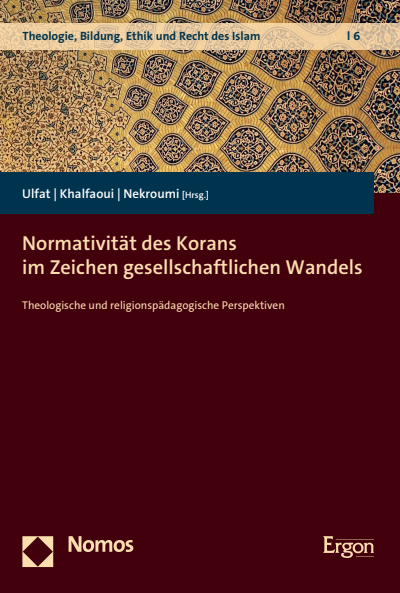
Normativität des Korans im Zeichen gesellschaftlichen Wandels
Theologische und religionspädagogische Perspektiven
- Authors:
- Series
- Theologie, Bildung, Ethik und Recht des Islam
- Volume
- 6
- Publisher
- Nomos, Baden-Baden
- Copyright year
- 2022
- ISBN-Print
- 978-3-8487-7481-4
- ISBN-Online
- 978-3-7489-3272-7
Chapter information
Open Access Full access
Bilder von Juden und Christen in der sīra und im normativen Hadith: Eine gattungsspezifische Untersuchung
- Authors:
- ISBN-Print
- 978-3-8487-7481-4
- ISBN-Online
- 978-3-7489-3272-7
- Preview:
Bibliography
No match found. Try another term.
- ʿAbd ar-Razzāq aṣ-Ṣanʿānī, Muṣannaf ʿAbd ar-Razzāq, ed. von Ḥabīb ar-Raḥmān al-Aʿẓamī, 12 Bde., Beirut: al-Maktab al-Islāmī, 1983. Open Google Scholar doi.org/10.5771/9783748932727-381
- Assmann, Jan, „Das kulturelle Gedächtnis“, in: Erwägen, Wissen, Ethik 13 (2002), S. 239-247. Open Google Scholar doi.org/10.5771/9783748932727-381
- ---, Religion und kulturelles Gedächtnis, München 2000. Open Google Scholar doi.org/10.5771/9783748932727-381
- ---, „Kollektives Gedächtnis und kulturelle Identität“, in: Kultur und Gedächtnis, hrsg. von Jan Assmann und Tonio Hölscher, Frankfurt am Main 1988, S. 9-19. Open Google Scholar doi.org/10.5771/9783748932727-381
- Ayoub, Mahmoud, „Dhimmah in Qurʾan and Hadith“, in: Arab Studies Quarterly 5.2 (1983), S. 172-191. Open Google Scholar doi.org/10.5771/9783748932727-381
- Ben Abdeljelil, Moncef, „What was Muhammad’s Religion before Islam? An Historical Attempt with Reference to Shiʿi Sources“, in: Historizität und Transzendenz im Islam: Offenbarung, Geschichte und Recht, hrsg. von Jameleddine Ben Abdeljelil, S. 81-100. Open Google Scholar doi.org/10.5771/9783748932727-381
- Berg, Herbert, „The ‘Isnād’ and the Production of Cultural Memory: Ibn ʿAbbās as a Case Study“, in: Numen 58.2 - 3 (2011), S. 259-283. Open Google Scholar doi.org/10.5771/9783748932727-381
- Brown, Jonathan, Hadith: Muhammadʼs Legacy in the Medieval and Modern World, Qxford 2009. Open Google Scholar doi.org/10.5771/9783748932727-381
- Cicero, Marcus Tullius, De Oratore: Über den Redner, ed. von Harald Merklin, Stuttgart 1991. Open Google Scholar doi.org/10.5771/9783748932727-381
- Cohen, Mark R., Under Crescent and Cross: The Jews in the Middle Ages, Princeton 1994. Open Google Scholar doi.org/10.5771/9783748932727-381
- Crone, Patricia/Michael Cook, Hagarism: The Making of the Islamic World, Cambridge/New York 1977. Open Google Scholar doi.org/10.5771/9783748932727-381
- Droysen, Johann G., Historik, hrsg. von Peter Leyh, Stuttgart 1977. Open Google Scholar doi.org/10.5771/9783748932727-381
- Egger, Wilhelm, „Semantische Analyse: Sinn durch Beziehung“, in: Methodenlehre zum Neuen Testament: Einführung in linguistische und historisch-kritische Methoden, Leipzig 1989, S. 138-191. Open Google Scholar doi.org/10.5771/9783748932727-381
- Erll, Astrid, Kollektives Gedächtnis und Erinnerungskulturen: Eine Einführung, Stuttgart 2017. Open Google Scholar doi.org/10.5771/9783748932727-381
- Fried, Johannes, Der Schleier der Erinnerung: Grundzüge einer historischen Memorik, München 2004. Open Google Scholar doi.org/10.5771/9783748932727-381
- Gudehus, Christian, „Was ist Gedächtnis/Erinnerung?“, in: Gedächtnis und Erinnerung: Ein interdisziplinäres Handbuch, hrsg. von Christian Gudehus, Ariane Eichenberg und Harald Welzer, Stuttgart 2010, S. 75-125. Open Google Scholar doi.org/10.5771/9783748932727-381
- Halbwachs, Maurice, Das kollektive Gedächtnis, aus dem Franz. von Holde Lhoest-Offermann, Frankfurt am Main 21991. Open Google Scholar doi.org/10.5771/9783748932727-381
- al-Ḫaṭīb al-Baġdādī, Abū Bakr, al-Kifāya fī ʿilm ar-riwāya, ed. von Abū ʿAbdallāh as-Sawraqī, Medina: Ǧamʿiyyat Dāʾirat al-Maʿārif al-ʿUṯmāniyya, 1938. Open Google Scholar doi.org/10.5771/9783748932727-381
- Hose, Martin, „Exzentrische Formen der Historiographie im Hellenismus“, in: Die Apostelgeschichte im Kontext antiker und frühchristlicher Historiographie, hrsg. von Jörg Frey, Clare K. Rothschild und Jens Schröter, Berlin 2009, S. 182-213. Open Google Scholar doi.org/10.5771/9783748932727-381
- Hoyland, Robert G., Seeing Islam as Others Saw it: A Survey and Evaluation of Christian, Jewish and Zoroastrian Writings on Early Islam, New Jersey 1997. Open Google Scholar doi.org/10.5771/9783748932727-381
- Ibn Abī Ḥātim, Tafsīr al-Qurʾān al-ʿaẓīm, ed. von Asʿad Muḥammad aṭ-Ṭayyib, 11 Bde., o. O.: Maktabat Nazzār Muṣṭafā al-Bāz, 1998. Open Google Scholar doi.org/10.5771/9783748932727-381
- Ibn Ḥanbal, Aḥmad, Musnad al-imām Aḥmad, ed. von Šuʿayb al-Arnaʾūt, 45 Bde., Beirut: Muʾassasat ar-Risāla, 2001. Open Google Scholar doi.org/10.5771/9783748932727-381
- Ibn Hišām, ʿAbd al-Malik, as-Sīra an-nabawiyya, ed. von Muṣṭafā as-Saqqā, Ibrāhīm al-Abyārī und ʿAbd al-Ḥafīẓ aš-Šalabī, 2 Bde., Kairo: Muṣṭafā al-Bābī al-Ḥalabī, 1955. Open Google Scholar doi.org/10.5771/9783748932727-381
- Ibn Isḥāq, Muḥammad, Sīrat Ibn Isḥāq, ed. von Zuhayl Zakkār, Beirut: Dār al-Fikr, 1978. Open Google Scholar doi.org/10.5771/9783748932727-381
- Kopp, Johannes/Bernhard Schäfers (Hgg.), Grundbegriffe der Soziologie, Wiesbaden 102010. Open Google Scholar doi.org/10.5771/9783748932727-381
- Leder, Stefan, „Spoken Word and Written Text: Meaning and Social Significance of the Institution of riwāya“, in: Islamic Area Studies Working Paper Series 31 (2002), S. 1-16. Open Google Scholar doi.org/10.5771/9783748932727-381
- ---, „Conventions of Fictional Narration in Learned Literature“, in: Story-Telling in the Framework of Non-Fictional Arabic Literature, hrsg. von dems., Wiesbaden 1998, S. 34-60. Open Google Scholar doi.org/10.5771/9783748932727-381
- Madhany, al-Husein N., „Pooh-Poohing Pluralism: Ijtihāding Ḥadīth to build a Theology of Exclusion“, in: The Muslim World 98.4 (2008), S. 407-422. Open Google Scholar doi.org/10.5771/9783748932727-381
- Mālik b. Anas, Muwaṭṭaʾ Mālik, ed. von Muḥammad Fuʾād ʿAbd al-Bāqī, 2 Bde., Beirut: Dār Iḥyāʾ at-Turāṯ al-ʿArabī, 1985. Open Google Scholar doi.org/10.5771/9783748932727-381
- Motzki, Harald, „The Murder of Ibn Abī Ḥuqayq: On the Origin and Reliability of Some Maghāzī-Reports“, in: The Biography of Muhammad: The Issue of the Sources, hrsg. von dems., Leiden 2000, S. 170-239. Open Google Scholar doi.org/10.5771/9783748932727-381
- Munt, Harry, „No Two Religions: Non-Muslims in the Early Islamic Ḥijāz“, in: Bulletin of the School of Oriental and African Studies 87.2 (2015), S. 249-269. Open Google Scholar doi.org/10.5771/9783748932727-381
- Patel, Youshaa, „The Islamic Treatises against Imitation (Tašabbuh): A Bibliographical History“, in: Arabica 65.5 - 6 (2018), S. 597-639. Open Google Scholar doi.org/10.5771/9783748932727-381
- Plessner, Martin, „Nāmūs“, in: Encyclopedia of Islam, Second Edition, Bd. 7, 1993, S. 953-955. Open Google Scholar doi.org/10.5771/9783748932727-381
- ar-Rāzī, Faḫr ad-Dīn, Mafātīḥ al-ġayb, o. Ed., 32 Bde., Dār Iḥyāʾ at-Turāṯ al-ʿArabī: Beirut 1999. Open Google Scholar doi.org/10.5771/9783748932727-381
- Reynolds, Gabriel S., „On the Quranic Accusation of Scriptural Falsification (taḥrīf) and Christian Anti-Jewish Polemic“, in: Journal of the American Oriental Society 130.2 (2010), S. 189-202. Open Google Scholar doi.org/10.5771/9783748932727-381
- Rippin, Andrew, „The Function of asbāb an-nuzūl in Qurʾanic Exegesis“, in: Bulletin of the School of Oriental and African Studies 51.1 (1988), S. 1-20. Open Google Scholar doi.org/10.5771/9783748932727-381
- ---, „The Exegetical Genre asbāb an-nuzūl: A Biographical and Terminological Survey“, in: Bulletin of the School of Oriental and African Studies 48.1 (1985), S. 1-15. Open Google Scholar doi.org/10.5771/9783748932727-381
- Rothschild, Clare K., Luke-Acts and the Rhetoric of History: An Investigation of Early Christian Historiography, Tübingen 2004. Open Google Scholar doi.org/10.5771/9783748932727-381
- Rubin, Uri, „The Assasination of Kaʿb b. al-Ašraf“, in: Oriens 32 (1990), S. 65-71. Open Google Scholar doi.org/10.5771/9783748932727-381
- Rüsen, Jörn, Zerbrechende Zeit: Über den Sinn der Geschichte, Berlin 2020. Open Google Scholar doi.org/10.5771/9783748932727-381
- ---, Zeit und Sinn: Strategien historischen Denkens, Frankfurt am Main 2012. Open Google Scholar doi.org/10.5771/9783748932727-381
- as-Samarqandī, Abū l-Layṯ, Baḥr al-ʿulūm, ed. von Asʿad Muḥammad at-Ṭayyib, 3 Bde., Kairo: Kulliyyat al-Luġa al-ʿArabiyya, Ǧāmiʿat al-Azhar. Open Google Scholar doi.org/10.5771/9783748932727-381
- Stetter, Eckart, Topoi und Schemata im Ḥadīṯ, Tübingen 1965. Open Google Scholar doi.org/10.5771/9783748932727-381
- Strecker, Georg, „Die historische und theologische Problematik der Jesusfrage“, in: ders., Eschaton und Historie: Aufsätze, Göttingen 1979, S. 159-182. Open Google Scholar doi.org/10.5771/9783748932727-381
- as-Suyūṭī, Ǧalāl ad-Dīn, al-Itqān fī ʿulūm al-Qurʾān, ed. von Muḥammad Abū l-Faḍl Ibrāhīm, 4 Bde., Kairo: al-Hayʾa al-Miṣriyya al-ʿĀmma li-l-Kitāb, 1974. Open Google Scholar doi.org/10.5771/9783748932727-381
- aṭ-Ṭabarī, Muḥammad b. Ǧarīr, Ǧāmiʿ al-bayān ʿan taʾwīl āy al-Qurʾān, ed. von Maḥmūd Muḥammad Šākir, 24 Bde., Mekka: Dār at-Tarbiya wa-t-Turāṯ, o. D. Open Google Scholar doi.org/10.5771/9783748932727-381
- Vajda, Georges, „Ahl al-Kitāb“, in: Encyclopedia of Islam, Second Edition, Bd. 1, 1960, S. 264-266. Open Google Scholar doi.org/10.5771/9783748932727-381
- Wansbrough, John, The Sectarian Milieu: Content and Composition of Islamic Salvation History, Oxford/New York 1978. Open Google Scholar doi.org/10.5771/9783748932727-381
- Watt, William Montgomery, „Ḥanīf“, in: Encyclopedia of Islam, Second Edition, Bd. 3, 1971, S. 165 f. Open Google Scholar doi.org/10.5771/9783748932727-381
- ---, Muhammad at Medina, Oxford 1956. Open Google Scholar doi.org/10.5771/9783748932727-381
- Welzer, Harald/Sabine Moller/Karoline Tschuggnall, Opa war kein Nazi: Nationalsozialismus und Holocaust im Familiengedächtnis, Berlin 2002. Open Google Scholar doi.org/10.5771/9783748932727-381
- Whittingham, Martin, A History of Muslim Views of the Bible: The First Four Centuries, Berlin/Boston 2021. Open Google Scholar doi.org/10.5771/9783748932727-381
- Yarbrough, Luke, „Upholding Godʼs Rule: Early Muslim Juristic Opposition to the State Employment of non-Muslims“, in: Islamic Law and Society 19.1 (2012), S. 11-85. Open Google Scholar doi.org/10.5771/9783748932727-381
- az-Zamaḫšarī, Abū l-Qāsim, al-Kaššāf ʿan ḥaqāʾiq ġawāmiḍ at-tanzīl, o. Ed., 4 Bde., Beirut: Dār al-Kitāb al-ʿArabī, 1987. Open Google Scholar doi.org/10.5771/9783748932727-381
- Zaman, Muhammad Qasim, „Maghāzī and the Muḥaddithūn: Reconsidering the Treatment of ‘Historical’ Materials in Early Collections of Hadith“, in: International Journal of Middle East Studies 28.1 (1996), S. 1-18. Open Google Scholar doi.org/10.5771/9783748932727-381