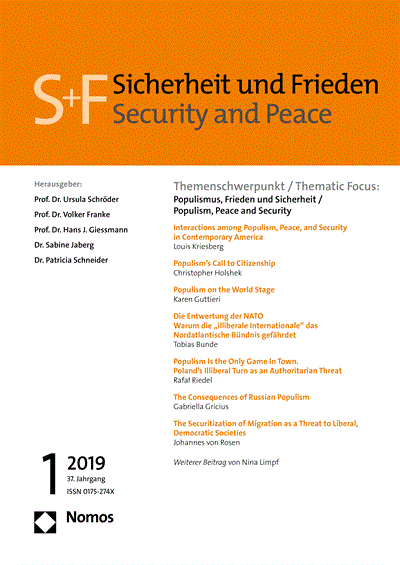
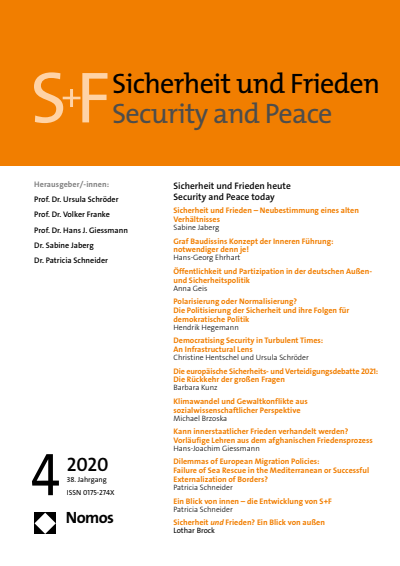
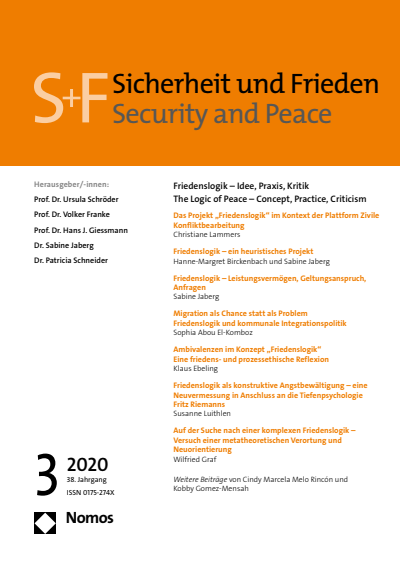
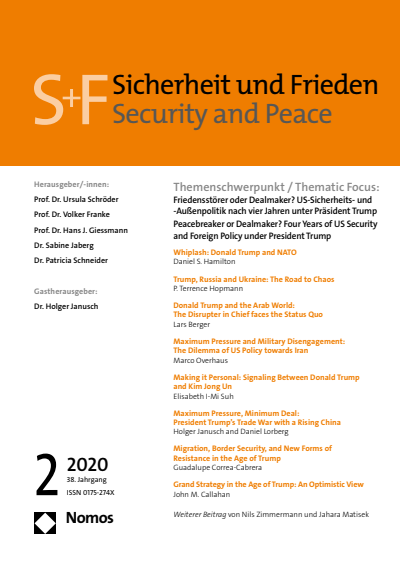
Die Zeitschrift versteht sich als Diskussionsforum für neuere Forschungsergebnisse und politische Entwicklungen auf dem Gebiet der Friedens- und Sicherheitspolitik. Durch Analysen, Stellungnahmen, Dokumente und Informationen sollen kontroverse Auffassungen und brisante Themen einer sachlichen Diskussion zugeführt werden. Homepage: www.sicherheit-und-frieden.nomos.de
For constructivists, NATO is not just another military alliance but the institutionalization of the transatlantic security community based on a collective identity of liberal democracies. The rise of illiberalism within NATO member states threatens...
Es wurden keine Treffer gefunden. Versuchen Sie einen anderen Begriff.
A., Graham. David. “’America First’: Donald Trump’s Populist Inaugural Address “ The Atlantic, https://www.theatlantic.com/politics/archive/2017/01/trump-inaugural-speech-analysis/513956/ 2017, https://www.theatlantic.com/politics/archive/2017/01/trump-inaugural-speech-analysis/513956/. Google Scholar öffnen doi.org/10.5771/0175-274X-2019-1-1
Farber, Henry S., Daniel Herbst, Ilyana Kuziemko, and Suresh Naidu. “Unions and Inequality over the Twentieth Century: New Evidence from Survey Data.” 1-93. Cambridge, MA: National Bureau of Economic Research, 2018. Google Scholar öffnen doi.org/10.5771/0175-274X-2019-1-1
Mudde Cas, Kaltwasser R. Cristobal (2018), Studying populism in Comparative Perspective: Reflections on the Contemporary and Future Research Agenda, “Comparative Political Studies, p. 1-27 Google Scholar öffnen doi.org/10.5771/0175-274X-2019-1-24
Rooduijn Matthijs, van der Brug Wouter, de Lange Sarah, (2016), Expressinf or fuelling discontent? The relationship between populist voting and political discontent, “Electoral Studies” 43, p. 32-40 Google Scholar öffnen doi.org/10.5771/0175-274X-2019-1-24
Stanley Ben (2017), Populism in Central and Eastern Europe, in: (eds) Rovira Kaltwasser Cristóbal, Taggart Paul, Espejo Ochoa Paulina, Ostiguy Pierre, The Oxford Handbook of Populism, Oxford Google Scholar öffnen doi.org/10.5771/0175-274X-2019-1-24
Stavrakakis Yannis (2014), The Return of the “People”: Populism and Anti-Populism in he Shadow of the Europea Crisis. “Constelations” An International Journal of Critical and Democratic Theory 21 (2), p. 505-528 Google Scholar öffnen doi.org/10.5771/0175-274X-2019-1-24
Woods Dwayne (2014), The Many Faces of Populism: Diverse but not Disparate, in Dwayne Woods , Barbara Wejnert (ed.) The Many Faces of Populism: Current Perspectives (Research in Political Sociology, Volume 22), p.1-25 Google Scholar öffnen doi.org/10.5771/0175-274X-2019-1-24
Arutunyan, Anna “Putin’s move on Crimea bolsters popularity back home” USA Today, 19 March 2014, accessed 2 November 2018 https://eu.usatoday.com/story/news/world/2014/03/18/crimea-ukraine-putin-russia/6564263/ Google Scholar öffnen doi.org/10.5771/0175-274X-2019-1-29
Baev, Pavel K “Russia’s Perilous Glorification of Militarism” The National Interest 10 May 2016, accessed 2 November 2018 https://nationalinterest.org/blog/the-buzz/russias-perilous-glorification-militarism-16129 Google Scholar öffnen doi.org/10.5771/0175-274X-2019-1-29
Batchelor, Tom “Russia launches unprecedented Crimea army drills to test rapid reaction force” The Independent, 20 March 2017, accessed 27 November 2018 https://www.independent.co.uk/news/world/europe/russia-crimea-army-deals-unprecedented-rapid-reaction-forces-nato-us-europe-ukraine-balkans-a7640326.html Google Scholar öffnen doi.org/10.5771/0175-274X-2019-1-29
France 24 “Russian MPs pass controversial bill to label NGOs ‘foreign agents’” France 24, 13 July 2018, accessed 21 July 2018 http://www.france24.com/en/20120713-russia-parliament-votes-label-ngos-foreign-agents Google Scholar öffnen doi.org/10.5771/0175-274X-2019-1-29
Galston, William “The Rise of European Populism and the Collapse of the Centre Left” Brookings, 8 March 2018, accessed 2 November 2018. https://www.brookings.edu/blog/order-from-chaos/2018/03/08/the-rise-of-european-populism-and-the-collapse-of-the-center-left/ Google Scholar öffnen doi.org/10.5771/0175-274X-2019-1-29
Lavrov, Sergei, Speech by the Russian Foreign Minister at the 50th Munich Security Conference, 1 February 2014, The Ministry of Foreign Affairs of the Russian Federation, accessed 2 November 2018 http://www.mid.ru/en/press_service/minister_speeches/-/asset_publisher/7OvQR5KJWVmR/content/id/2648249 Google Scholar öffnen doi.org/10.5771/0175-274X-2019-1-29
Manevich, Dorothy “4 charts on how Russians see their country’s place in the world” 21 June 2017, Pew Research Center, accessed 15 February 2019, http://www.pewresearch.org/fact-tank/2017/06/21/4-charts-on-how-russians-see-their-countrys-place-in-the-world/ Google Scholar öffnen doi.org/10.5771/0175-274X-2019-1-29
Ministry of Foreign Affairs of the Russian Federation (2013) T”he Foreign Policy Concept of the Russian Federation”, 18 February 2013, The Ministry of Foreign Affairs of the Russian Federation, accessed 2 November 2018 http://www.mid.ru/en/foreign_policy/official_documents/-/asset_publisher/CptICkB6BZ29/content/id/122186 Google Scholar öffnen doi.org/10.5771/0175-274X-2019-1-29
Morini, Mara (2013); “Old and New Populism in Russia,” In Contemporary Populism: A Controversial Concept and Its Diverse Forms; Newcastle upon Tyne, Cambridge Scholars Publishing, 365-370 Google Scholar öffnen doi.org/10.5771/0175-274X-2019-1-29
Putin, Vladimir, Speech and the Following Discussion at the Munich Conference on Security Policy, 10 February 2007, The Kremlin, accessed 2 November 2018 http://en.kremlin.ru/events/president/transcripts/24034 Google Scholar öffnen doi.org/10.5771/0175-274X-2019-1-29
Putin, Vladimir, “Vladimir Putin on Foreign Policy: Russia and the Changing World”, The Valdai Discussion Club, 27 February 2012, accessed 2 November 2018 http://valdaiclub.com/a/highlights/vladimir_putin_on_foreign_policy_russia_and_the_changing_world/ Google Scholar öffnen doi.org/10.5771/0175-274X-2019-1-29
Simpson, Helen, “Russia’s Foreign Agent Law: An HPR Explainer”, Harvard Political Review, 30 November 2017, accessed 2 November 2018 http://harvardpolitics.com/world/russias-foreign-agent-law-an-hpr-explainer/ Google Scholar öffnen doi.org/10.5771/0175-274X-2019-1-29
Stavrakakis, Yannis “Three challenges in contemporary populism research” 14 May 2014, London School of Economics and Political Science, accessed 2 November 2018 http://blogs.lse.ac.uk/europpblog/2018/05/14/three-challenges-in-contemporary-populism-research/ Google Scholar öffnen doi.org/10.5771/0175-274X-2019-1-29
The Moscow Times “10th Russian Governor Replaced Amid Falling Ratings for Ruling party” The Moscow Times, 12 October 2018, accessed 27 November 2018 https://themoscowtimes.com/news/10th-russian-governor-replaced-amid-falling-ratings-for-ruling-party-63173 Google Scholar öffnen doi.org/10.5771/0175-274X-2019-1-29
Bhabha, J. (2005) ‘Rights Spillovers: The Impact of Migration in the Legal System of Western States’. In: E. Guild & J. van Selm (eds.), International Migration and Security. Opportunity and Challenges. Abingdon-on-Thames: Routledge, pp.28-50. Google Scholar öffnen doi.org/10.5771/0175-274X-2019-1-35
Biermann, K. Jestadt, J. & Schmolke, N. (2016) ‘Die kalte Rechnung des Innenministers‘, Die Zeit, 17 November. Available at: https://www.zeit.de/politik/deutschland/2016-11/afghanistan-bamf-asyl-abschiebung-gefahr-innenministerium/komplettansicht (Accessed: 18 February 2019). Google Scholar öffnen doi.org/10.5771/0175-274X-2019-1-35
Bigo, D. (2005) ‘From Foreigners to “Abnormal Aliens”: How the Faces of the Enemy Have Changed Following September the 11th’. In: E. Guild & J. van Selm (eds.), International Migration and Security. Opportunity and Challenges. Abingdon-on-Thames: Routledge, pp.64-81. Google Scholar öffnen doi.org/10.5771/0175-274X-2019-1-35
Cordero, C. (2018) ‘Legal Considerations for Separating Families at the Border’, Lawfare Blog, 19 June. Available at: https://www.lawfareblog.com/legal-considerations-separating-families-border (Accessed: 18 February 2019). Google Scholar öffnen doi.org/10.5771/0175-274X-2019-1-35
European Migration Network (2014), The use of detention and alternatives to detention in the context of immigration policies – Synthesis Report for the EMN Focused Study 2014. Available at: http://emn.ie/cat_publication_detail.jsp?clog=1&itemID=2745&t=6 (Accessed: 18 February 2019). Google Scholar öffnen doi.org/10.5771/0175-274X-2019-1-35
EU Agency for Fundamental Rights (2016), Current migration situation in the EU: hate crime – November 2016. Available at: http://fra.europa.eu/sites/default/files/fra_uploads/fra-2016-november-monthly-focus-hate-crime_en.pdf (Accessed: 18 February 2019). Google Scholar öffnen doi.org/10.5771/0175-274X-2019-1-35
Faye, O. (2017) ‘Le Pen goes back to her roots on immigration as poll countdown begins’. Translated by J. Bamat. France24, 19 April. Available at: http://www.france24.com/en/20170418-france-le-pen-focus-roots-immigration-presidential-election-le-monde-eu (Accessed: 18 February 2019). Google Scholar öffnen doi.org/10.5771/0175-274X-2019-1-35
Galtung, J. (2007) ‘Introduction: Peace by Peaceful Conflict Transformation – The TRANSCEND Approach’. In: C. Webel & J. Galtung (eds.), Handbook of Peace and Conflict Studies. Abingdon-on-Thames: Routledge, pp.14-32. Google Scholar öffnen doi.org/10.5771/0175-274X-2019-1-35
Goodman, J. (2017) ‘Nationalism as a Social Movement’. In: R. Marlin-Bennett et al. (eds.) Oxford Research Encyclopedia of International Studies. Available at: http://internationalstudies.oxfordre.com/view/10.1093/acrefore/9780190846626.001.0001/acrefore-9780190846626-e-267?print=pdf (Accessed: 18 February 2019). Google Scholar öffnen doi.org/10.5771/0175-274X-2019-1-35
Pew Research Center (2016) 2016 Campaign: Strong Interest, Wide Dissatisfaction. Available at: http://assets.pewresearch.org/wp-content/uploads/sites/5/2016/07/07-07-16-Voter-attitudes-release.pdf (Accessed: 18 February 2019). Google Scholar öffnen doi.org/10.5771/0175-274X-2019-1-35
Trump, D. (2016) ‘Transcript of Donald Trump’s Immigration Speech’, The New York Times, 1 September 2016. Available at: https://www.nytimes.com/2016/09/02/us/politics/transcript-trump-immigration-speech.html?_r=0 (Accessed: 18 February 2019). Google Scholar öffnen doi.org/10.5771/0175-274X-2019-1-35
Waever, M. & Laville, S. (2016) ‘European embassies in UK log more alleged hate crimes since Brexit vote’, The Guardian, 19 September. Available at: https://www.theguardian.com/society/2016/sep/19/embassies-alleged-hate-crimes-since-brexit-vote (Accessed: 18 February 2019). Google Scholar öffnen doi.org/10.5771/0175-274X-2019-1-35
Yan, H., Sgueglia, K. & Walker, K. (2016) ‘‘Make America White Again’: Hate speech and crimes post-election’, CNN, 22 December. Available at: http://edition.cnn.com/2016/11/10/us/post-election-hate-crimes-and-fears-trnd/ (Accessed: 18 February 2019). Google Scholar öffnen doi.org/10.5771/0175-274X-2019-1-35
Bramsen, I., & Poder, P. (2018). Emotional dynamics in conflict and conflict transformation. Berghof Handbook for Conflict Transformation, Online Edition. Berlin: Berghof Foundation. Retrieved March 28, 2018, from https://www.berghof-foundation.org/fileadmin/redaktion/Publications/Handbook/Articles/bramsen_poder_handbook.pdf Google Scholar öffnen doi.org/10.5771/0175-274X-2019-1-41
Burns, M. A., Beti, B. N., Okuto, M. E., Muwanguzi, D., & Sanyu, L. (2015). Forum theatre for conflict transformation East Africa: The domain of the possible. African Conflict & Peacebuilding Review, 5(1), 136-151. Google Scholar öffnen doi.org/10.5771/0175-274X-2019-1-41
Chou, M., Gagnon, J., & Pruitt, L. (2015). Putting participation on stage: Examining participatory theatre as an alternative site for political participation. Policy Studies, 36(6), 607-622. Google Scholar öffnen doi.org/10.5771/0175-274X-2019-1-41
Estrada, C. A., Isen, A. M., & Young, M. J. (1997). Positive affect facilitates integration of information and decreases anchoring in reasoning among physicians. Organizational Behavior and Human Decision Processes, 72(1), 117–135. Google Scholar öffnen doi.org/10.5771/0175-274X-2019-1-41
Fredrickson, B. L. (2000). Cultivating positive emotions to optimize health and well-being. Prevention and Treatment, 3. Retrieved March 29, 2018, from http://www.wisebrain.org/papers/CultPosEmot.pdf Google Scholar öffnen doi.org/10.5771/0175-274X-2019-1-41
Fredrickson, B. L. (2003). The value of positive emotions: The emerging science of positive psychology is coming to understand why it’s good to feel good. American Scientist, 91(4), 330-335. Google Scholar öffnen doi.org/10.5771/0175-274X-2019-1-41
Fredrickson, B.L., Tugade, M.M., Waugh, C.E., & Larkin, G. (2003). What good are positive emotions in crisis?: A prospective study of resilience and emotions following the terrorist attacks on the United States on September 11th, 2001. Journal of Personality and Social Psychology, 84(2), 365-376. Google Scholar öffnen doi.org/10.5771/0175-274X-2019-1-41
Gerbner, G., Gross, L., Morgan, M., & Signorielli, N. (1986). Living with television: The dynamics of the cultivation process. In J. Bryant & D. Zillmann (Eds.), Perspectives on media effects (pp. 17–40). Mahwah, NJ: Erlbaum. Google Scholar öffnen doi.org/10.5771/0175-274X-2019-1-41
Goldfarb, M., Orlove, M., Schneider, C. (Panelists), & Sonenshine,T. (Moderator). (2017, May). The arts in peacebuilding and reconciliation: Emerging perspectives. Panel Discussion presented at The Middle East Institute, Washington, DC. Retrieved June 30, 2018, from http://www.mei.edu/events/arts-peacebuilding-and-reconciliation-emerging-perspectives Google Scholar öffnen doi.org/10.5771/0175-274X-2019-1-41
Green, M. C. (2005). Transportation into narrative worlds: Implications for the self. In A. Tesser, J. V. Wood, & D. A. Stapel (Eds.), On building, defending, and regulating the self: A pychological perspective (pp. 53-75). New York, NY: Pyschology Press. Google Scholar öffnen doi.org/10.5771/0175-274X-2019-1-41
Green, M. C., & Brock, T. C. (2002). In the mind’s eye: Transportation-imagery model of narrative persuasion. In M. C. Green, J. J. Strange, & T. C. Brock (Eds.), Narrative impact: Social and cognitive foundations (pp. 315–341). Mahwah, NJ: Lawrence Erlbaum Associates. Google Scholar öffnen doi.org/10.5771/0175-274X-2019-1-41
Greenberg, B. S., Salmon, S. T., Patel, D., Beck, V. & Cole, G. (2004). Evolution of an E-E research agenda. In A. Singhal, M. J. Cody, E. M. Rogers, & M. Sabido (Eds.), Entertainment-education and social change: History, research, and practice (pp. 191-206). New York, NY: Routledge. Google Scholar öffnen doi.org/10.5771/0175-274X-2019-1-41
Kreuter, M. W., Green, M. C., Cappella, J. N., …, Woolley, S. (2007). Narrative communication in cancer prevention and control: A framework to guide research and application. Annals of Behavioral Medicine, 33(3), 221-235. Google Scholar öffnen doi.org/10.5771/0175-274X-2019-1-41
Morgan, S. E., Movius, L., & Cody, M. J. (2009). The power of narratives: The effect of entertainment television organ donation storylines on the attitudes, knowledge, and behaviors of donors and nondonors. Journal of Communication, 59(1), 135–151. Google Scholar öffnen doi.org/10.5771/0175-274X-2019-1-41
Murphy, S. T., Frank, L. B., Chatterjee, J. S., & Baezconde-Garbanati, L. (2013). Narrative vs. nonnarrative: The role of identification, transportation, and emotion in reducing health disparities. Journal of Communication, 63(1), 116-137. Google Scholar öffnen doi.org/10.5771/0175-274X-2019-1-41
Murphy, S. T., Frank, L. B., Moran, M. B., & Patnoe-Woodley, P. (2011). Involved, transported, or emotional? Exploring the determinants of change in knowledge, attitudes, and behavior in entertainment-education. Journal of Communication, 61(3), 407–431. Google Scholar öffnen doi.org/10.5771/0175-274X-2019-1-41
Paffenholz, T. (2014). International peacebuilding goes local: Analysing Lederach’s conflict transformation theory and its ambivalent encounter with 20 years of practice. Peacebuilding, 2(1), 11-27. Google Scholar öffnen doi.org/10.5771/0175-274X-2019-1-41
Premaratna, N., & Bleiker, R. (2010). Art and peacebuilding: How theatre transforms conflict in Sri Lanka. In O.P. Richmond (Ed.), Palgrave advances in peacebuilding: Critical developments and approaches (pp. 376-391). London: Palgrave Macmillan. Google Scholar öffnen doi.org/10.5771/0175-274X-2019-1-41
Premaratna, N., & Bleiker, R. (2016). Arts and theatre for peacebuilding. In O.P. Richmond, S. Pogodda, & J. Ramović (Eds.), The Palgrave handbook of disciplinary and regional approaches to peace (pp. 82-94). London: Palgrave Macmillan. Google Scholar öffnen doi.org/10.5771/0175-274X-2019-1-41
Rogers, E. M., & Singhal, A. (1990). New perspectives on health communication: The academic perspective. In C. Atkins & E. Arkin (Eds.), Mass communication and public health (pp. 176-181). Newbury Park, CA: Sage. Google Scholar öffnen doi.org/10.5771/0175-274X-2019-1-41
Scharinger, J. (2013). Participatory theater, is it really? A critical examination of practices in Timor-Leste. ASEAS – Österreichische Zeitschrift für Südostasienwissenschaften, 6(1), 102-119. Google Scholar öffnen doi.org/10.5771/0175-274X-2019-1-41
Snyder-Young, D. (2011). Rehearsals for revolution? Theatre of the oppressed, dominant discourses, and democratic tensions. Research in Drama Education: The Journal of Applied Theatre and Performance, 16(1), 29-45. Google Scholar öffnen doi.org/10.5771/0175-274X-2019-1-41
Sonn, C. C., Quayle, A. F., Belanji, B., & Baker, A. M. (2015). Responding to racialization through arts practice: The case of participatory theater. Journal of Community Psychology, 43(2), 244-259. Google Scholar öffnen doi.org/10.5771/0175-274X-2019-1-41