Social Cohesion in Times of Forced Displacement. The Perspective of Youth in Jordan
Inhaltsverzeichnis
Bibliographische Infos
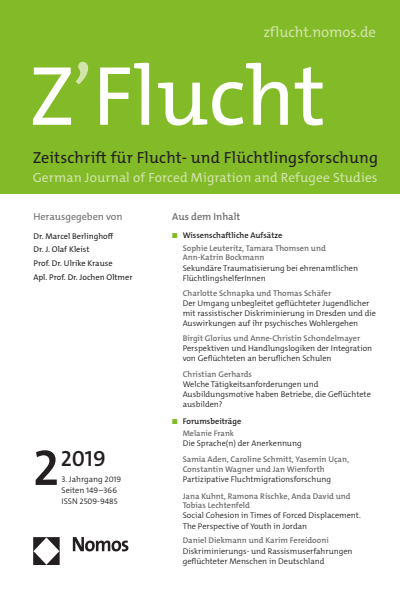
German Journal of Forced Migration and Refugee Studies
Jahrgang 3 (2019), Heft 2
- Autor:innen:
- , , , , , , , , , , , , , , , , , , , ,
- Verlag
- Nomos, Baden-Baden
- Erscheinungsjahr
- 2019
- ISSN-Online
- 2942-3597
- ISSN-Print
- 2509-9485
Kapitelinformationen
Jahrgang 3 (2019), Heft 2
Social Cohesion in Times of Forced Displacement. The Perspective of Youth in Jordan
- Autor:innen:
- , , ,
- ISSN-Print
- 2509-9485
- ISSN-Online
- 2942-3597
- Kapitelvorschau:
Dieser Artikel untersucht die Wahrnehmung des sozialen Zusammenhalts von in Jordanien lebenden jungen Erwachsenen (18-35 Jahre), sowie Veränderungen dieser Wahrnehmungen in Zeiten, in denen hohe und wachsende Zahlen syrischer Geflüchteter im Libanon leben. Ergebnisse einer Online-Umfrage weisen auf einen leichten Rückgang des sozialen Zusammenhalts in Jordanien hin. Junge Menschen wollen Akteur*innen des Wandels sein und haben ein klares Verlangen nach mehr sozialer Teilhabe. Unsere Ergebnisse weisen auf Möglichkeiten zur Stärkung des sozialen Zusammenhalts zwischen jungen Angehörigen der Mehrheitsgesellschaft und Geflüchteten sowie auf Hindernisse für die aktivere Teilnahme von jungen Menschen an der Gesellschaft hin.
Literaturverzeichnis
Es wurden keine Treffer gefunden. Versuchen Sie einen anderen Begriff.
- Alesina, Alberto/La Ferrara, Eliana (2005), Ethnic Diversity and Economic Performance, Journal of Economic Literature, 43 (3), 762–800. Google Scholar öffnen
- Alshoubaki, Wa’ed/Harris, Michael (2018), The Impact of Syrian Refugees on Jordan: A Framework for Analysis Journal of International Studies, 11 (2), 154–179. Google Scholar öffnen
- Assaad, Ragui/Ginn, Thomas/Saleh, Mohamed (2018), Impact of Syrian Refugees in Jordan on Education Outcomes for Jordanian Youth, Economic Research Forum Working Paper, No. 1214. Google Scholar öffnen
- Barone, Guglielmo/Mocetti, Sauro (2016), Inequality and Trust: New Evidence from Panel Data, Economic Inquiry, 54 (2), 794–809. Google Scholar öffnen
- Becchetti, Leonardo/Conzo, Pierluigi/Romeo, Alessandro (2014), Violence, trust, and Trustworthiness: Evidence from a Nairobi Slum, Oxford Economic Papers, 66 (1), 283–305. Google Scholar öffnen
- Block, Karen, et al. (2012), Addressing Ethical and Methodological Challenges in Research with Refugee-background Young People: Reflections from the Field, Journal of Refugee Studies, 26 (1), 69–87. Google Scholar öffnen
- De Bel-Air, Françoise (2016), Migration Profile: Jordan, Migration Policy Centre (MPC) Policy Brief, No. 2016/06. Google Scholar öffnen
- Delhey, Jan/Dragolov, Georgi (2016), Happier Together: Social Cohesion and Subjective Well-being in Europe, International Journal of Psychology, 51 (3), 163–176. Google Scholar öffnen
- Delhey, Jan/Newton, Kenneth (2005), Predicting Cross-National Levels of Social Trust: Global Pattern or Nordic Exceptionalism?, European Sociological Review, 21 (4), 311–327. Google Scholar öffnen
- Dragolov, Georgi, et al. (2013), Social Cohesion Radar Measuring Common Ground: An international Comparison of Social Cohesion Methods Report, Gütersloh. Google Scholar öffnen
- Fallah, Belal/ Krafft, Caroline/Wahba, Jackline (2018), The Impact of Refugees on Employment and Wages in Jordan, Economic Research Forum Working Paper, No. 1189. Google Scholar öffnen
- Giraud, Giraud C., et al. (2013), Relational Capability: A Multidimensional Approach. Research Center ESSEC Working Paper, No. 1306. Google Scholar öffnen
- GoJ (2015), Jordan Response Plan for the Syria Crisis 2016–2018, Amman. Google Scholar öffnen
- Jacobsen, Karen/Landau, Loren B. (2003), The Dual Imperative in Refugee Research: Some Methodological and Ethical Considerations in Social Science Research on Forced Migration, Disasters, 27 (3), 185–206. Google Scholar öffnen
- Kanbur, Ravi/Rajaram, Prem K./Varshney, Ashutosh (2011), Ethnic Diversity and Ethnic Strife, An Interdisciplinary Perspective, World Development, 39 (2), 147–158. Google Scholar öffnen
- Khattab, Farah (2018), Developing a Service Quality Model for Private Higher Education Institutions in Lebanon. J. Mgt. Mkt. Review, 3 (1), 24–33. Google Scholar öffnen
- Krause, Ulrike (2017), Researching Forced Migration: Critical Reflections on Research Ethics during Fieldwork, Oxford Refugee Study Centre Working Paper Series, No. 123. Google Scholar öffnen
- Langer, Arnim, et al. (2016), Conceptualising and Measuring Social Cohesion in Africa: Towards a Perceptions-Based Index, Social Indicators Research, 131 (1), 1–23. Google Scholar öffnen
- Lozi, Basem M. (2013), The Effect of Refugees on Host Country Economy, Evidence from Jordan, Interdisciplinary Journal of Contemporary Research in Business, 5 (3), 114–126. Google Scholar öffnen
- Mackenzie, Catriona/McDowell, Christopher/Pittaway, Eileen (2007), Beyond ‹Do No Harm›: The Challenge of Constructing Ethical Relationships in Refugee Research, Journal of Refugee Studies, 20 (2), 299–319. Google Scholar öffnen
- Mercy Corps (2013), Mapping of Host Community-Refugee Tensions in Mafraq and Ramtha, Jordan, Amman. Google Scholar öffnen
- Obijiofor, Levi/Colic-Peisker, Val/Hebbani, Aparna (2018), Methodological and Ethical Challenges in Partnering for Refugee Research: Evidence From Two Australian Studies, Journal of Immigrant & Refugee Studies, 16 (3), 217–234. Google Scholar öffnen
- OECD (2011), Perspectives on Global Development 2012: Social Cohesion in a Shifting World, Paris. Google Scholar öffnen
- Putnam, Robert D. (2007), E Pluribus Unum: Diversity and Community in the Twenty-First Century. The 2006 Johan Skytte Prize Lecture, Scandinavian Political Studies, 30 (2), 137–174. Google Scholar öffnen
- REACH (2014), Understanding Social Cohesion and Resilience in Jordanian Host Communities, Assessment Report June 2014, British Embassy Amman. Google Scholar öffnen
- REACH (2015), Social Cohesion in Host Communities in Northern Jordan, Assessment Report May 2015, British Embassy Amman. Google Scholar öffnen
- Rothstein, Bo/Stolle, Dietlind (2008), The State and Social Capital: An Institutional Theory of Generalized Trust, Comparative Politics, 40 (4), 441–459. Google Scholar öffnen
- Salemi, Colette/Bowman, Jay A./Compton, Jennifer (2018), Services for Syrian Refugee Children and Youth in Jordan: Forced Displacement, Foreign Aid, and Vulnerability, Economic Research Forum Working Paper Series, No. 1188. Google Scholar öffnen
- Sen, Amartya (1992), Inequality Re-examined, Oxford. Google Scholar öffnen
- Tiltnes, Åge A./Zhang, Huafeng/Pedersen, Jon (2019), The Living Conditions of Syrian Refugees in Jordan, Results from the 2017–2018 Survey of Syrian Refugees inside and outside Camps, Fafo-report, No. 2019:04. Google Scholar öffnen
- UNDP (2014), Municipal Needs Assessment Report: Mitigating the Impact of the Syrian Refugee Crisis on Jordanian Vulnerable Host Communities, New York City. Google Scholar öffnen
- UNHCR (2018), Jordan Vulnerability Assessment Framework: 2017 Population Survey Report, Sector Vulnerability Review, Geneva. Google Scholar öffnen
- UNHCR (2019), Operational Portal Refugee Situations, https://data2.unhcr.org/en/situations/syria/location/36, 13.3.2019. Google Scholar öffnen
- van Der Meer, Tom/Tolsma, Jochem (2014), Ethnic Diversity and Its Effects on Social Cohesion, Annual Review of Sociology, 40, 459–478. Google Scholar öffnen
- van Staveren, Irene/Pervaiz, Zahid (2017), Is it Ethnic Fractionalization or Social Exclusion, Which Affects Social Cohesion?, Social Indicators Research, 130 (2), 711–731. Google Scholar öffnen
- Vergolini, Loris (2011), Does Economic Vulnerability Affect Social Cohesion? Evidence from a Comparative Analysis, Canadian Journal of Sociology, 36 (1), 1–23. Google Scholar öffnen
- Verme, Paolo, et al. (2016), The Welfare of Syrian Refugees: Evidence from Jordan and Lebanon, Washington D.C. Google Scholar öffnen
- Wei, Lu/Gao, Fangfang (2017), Social Media, Social Integration and Subjective Well-being among New Urban Migrants in China, Telematics and Informatics, 34 (3), 786–796. Google Scholar öffnen
- World Bank (2016), Economic and Social Inclusion to Prevent Violent Extremism, MENA Economic Monitor, World Bank Middle East and North Africa Region, Washington D.C. Google Scholar öffnen