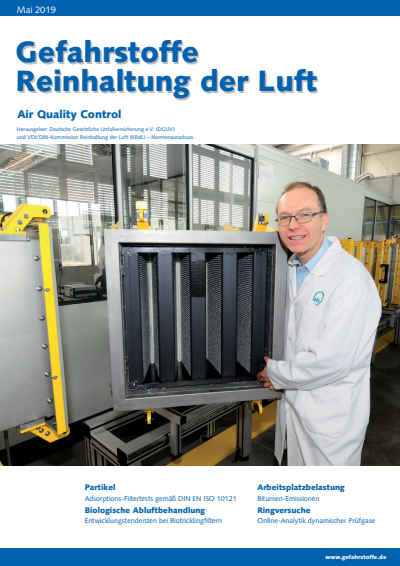
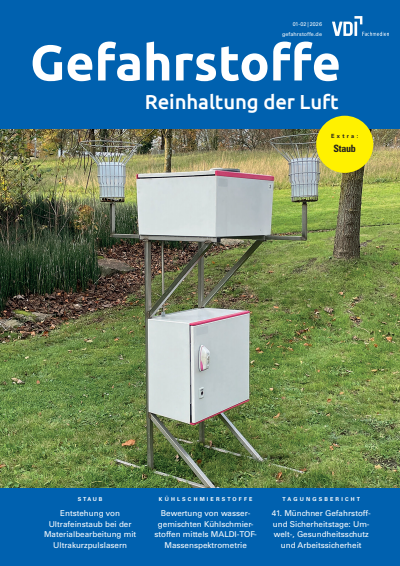
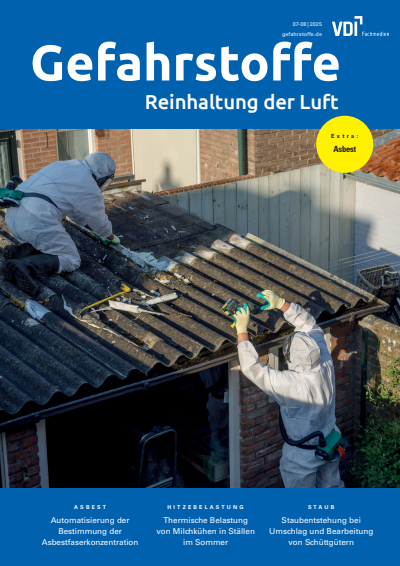
Die Gefahrstoffe ist die führende Fachzeitschrift für Luftreinhaltung, Emissionsschutz und -messung, sowie Messverfahren. Sie leistet seit Jahren Pionierarbeit und stellt daher eine Diskussionsplattform für Wirtschaft, Wissenschaft und Gesellschaft dar. Alle Beiträge vermitteln auf höchstem journalistischem Niveau Themen wie Emissionsgrenzwerte am Arbeitsplatz, Umweltmeteorologie, Innenraumluft, Biomonitoring und sicherer Umgang mit Gefahrstoffen. Sie liefert darüber hinaus Informationen zum aktuellen Regelwerk und dessen Umsetzung in die Praxis. Die Zeitschrift berichtet in fundierten Fachbeiträgen interdisziplinär über Schadstoffentstehung, -ausbreitung, -erfassung und -abscheidung, Probenahme und Messverfahren. Sie setzt sich mit technischen und persönlichen Schutzausrüstungen und der arbeitsmedizinischen Vorsorge auseinander. Das Themenspektrum reicht von Fragen des Arbeits- und Gesundheitsschutzes, über Grenzwertdiskussionen, neue Messverfahren, Emissionsminderungstechniken, Überwachungseinrichtungen für Luftverunreinigungen und Umweltmeteorologie.
Publikation durchsuchen
Bibliographische Angaben
ISSN-Print
0949-8036
ISSN-Online
0949-8036
Verlag
VDI fachmedien, Düsseldorf
Sprache
Deutsch
Produkttyp
Ausgabe
Artikel
Artikel
Kein Zugriff
Seite 1 - 2
VDI Fachmedien GmbH & Co. KG, Düsseldorf 2019
Artikel
Kein Zugriff
Seite 145 - 145
VDI Fachmedien GmbH & Co. KG, Düsseldorf 2019
Autor:innen: |
Artikel
Kein Zugriff
Seite 150 - 150
VDI Fachmedien GmbH & Co. KG, Düsseldorf 2019
Autor:innen:
Artikel
Kein Zugriff
Seite 151 - 158
Der Gesprächskreis BITUMEN führt seit vielen Jahren Arbeitsplatzmessungen bei Tätigkeiten mit heißem Bitumen durch. Anfangs wurden nur in Deutschland die Konzentrationen der Dämpfe und Aerosole aus Bitumen bei der Produktion von Bitumenbahnen...
VDI Fachmedien GmbH & Co. KG, Düsseldorf 2019
Autor:innen: | | |
Artikel
Kein Zugriff
Seite 158 - 158
VDI Fachmedien GmbH & Co. KG, Düsseldorf 2019
Autor:innen:
Artikel
Kein Zugriff
Seite 159 - 163
Die Quantifizierung gesundheitsschädlicher Substanzen an Arbeitsplätzen wurde in den letzten Jahrzehnten immer wichtiger und ist auch weiterhin von großem Interesse. Die Rahmenbedingungen für Gefahrstoffmessungen am Arbeitsplatz haben sich...
VDI Fachmedien GmbH & Co. KG, Düsseldorf 2019
Autor:innen: | | |
Artikel
Kein Zugriff
Seite 165 - 172
Etwa 10 bis 15 % aller industriellen Abluftsituationen sowie alle Emissionssituationen in der landwirtschaftlichen Tierhaltung können durch biologische Abluftbehandlungsverfahren ökonomisch und ökologisch effizient behandelt werden, tatsächlich...
VDI Fachmedien GmbH & Co. KG, Düsseldorf 2019
Autor:innen: |
Artikel
Kein Zugriff
Seite 173 - 175
In der Lebensmittelindustrie und speziell in Räuchereien werden VOC aus den Räucheröfen emittiert. Diese Emissionen können mit der UVC/Ozon-Technologie erfolgreich behandelt werden. Es wurde dazu ein Verfahren entwickelt, mit dem die...
VDI Fachmedien GmbH & Co. KG, Düsseldorf 2019
Autor:innen: |
Artikel
Kein Zugriff
Seite 176 - 180
Summary DIN EN ISO 16891:2016 “Test methods for evaluating the degradation of characteristics of cleanable filter media“ is the first standard in Germany that takes into account the thermal and chemical ageing of the filter media and stipulates...
VDI Fachmedien GmbH & Co. KG, Düsseldorf 2019
Autor:innen: | |
Artikel
Kein Zugriff
Seite 181 - 187
Da die Qualität von Innenraumluft in den vergangenen Jahren im Bewusstsein der Öffentlichkeit zunehmend an Bedeutung gewonnen hat, stieg auch die Nachfrage nach Raumluftfiltern, die gasförmige Schadstoffe durch Adsorption abscheiden. Seit 2013...
VDI Fachmedien GmbH & Co. KG, Düsseldorf 2019
Autor:innen: | | |
Literaturverzeichnis (91 Einträge)
Es wurden keine Treffer gefunden. Versuchen Sie einen anderen Begriff.
[40] Cheng, Z. W.; Zhang, L. L.; Chen, J. M.; Yu, J. M.; Gao, Z. L.; Jiang, Y. F.: Treatment of gaseous alpha-pinene by a combined system containing photo oxidation and aerobic biotrickling filtration. J. Hazard. Mater. 192 (2011), S. 1650-1658. https://dx.doi.org/10.1016/j.jhazmat.2011.06.092. Google Scholar öffnen doi.org/10.37544/0949-8036-2019-05-23
[51] Malhautier, L.; Soupramanien, A.; Bayle, S.; Rocher, J.; Fanlo, J. L.: Potentialities of coupling biological processes (biotrickler/biofilter) for the degradation of a mixture of sulphur compounds. Appl. Microbiol. Biotechnol. 99 (2015), S. 89-96. https://doi.org/10.1007/s00253–014–5842–0. Google Scholar öffnen doi.org/10.37544/0949-8036-2019-05-23
[50] Xi, J.; Saingam, P.; Gu, F.; Hu, H.; Zhao, X.: Effect of continuous ozone injection on performance and biomass accumulation of biofilters treating gaseous toluene. Appl. Microbiol. Biotechnol. 98 (2014), S. 9437-9446. Google Scholar öffnen doi.org/10.37544/0949-8036-2019-05-23
[49] Oda, T.; Yamaji, K.; Takahashi, T.: Decomposition of dilute trichloroethylene by nonthermal plasma processing – gas flow rate, catalyst, and ozone effect. In: IEEE T. Ind. Appl. 40 (2004), S. 430-436. https://dx.doi.org/10.1109/TIA.2004.824440. Google Scholar öffnen doi.org/10.37544/0949-8036-2019-05-23
[48] Brandenburg, R.; Kovacevic, V. V.; Schmidt, M.; Basner, R.; Kettlitz, M.; Sretenovic, G. B.; Obradovic, B. M.; Kuraica, M. M.; Weltmann, K. D.: Plasma-based pollutant degradation in gas streams: Status, examples and outlook. Contrib. Plasma Phys. 54 (2014), S. 202-214. https://dx.doi.org/10.1002/ctpp.201310059. Google Scholar öffnen doi.org/10.37544/0949-8036-2019-05-23
[47] Rene, E. R.; Veiga, M. C.; Kennes, C.: Combined biological and physiochemical waste-gas cleaning techniques. J. Environ. Sci. Health A 47 (2012), S. 920-939. https://dx.doi.org/10.1080/10934529.2012.667289. Google Scholar öffnen doi.org/10.37544/0949-8036-2019-05-23
[46] Zeng, P.; Li, J.; Liao, D.; Tu, X.; Xu, M.; Sun, G.: Performance of a combined system of biotrickling filter and photocatalytic reactor in treating waste gases from a paint-manufacturing plant. Environ. Technol. 37 (2016), S. 237-244. https://dx.doi.org/10.1080/09593330.2015.1068375. Google Scholar öffnen doi.org/10.37544/0949-8036-2019-05-23
[45] Schiavon, M.; Schiorlin, M.; Torretta, V.; Brandenburg, R.; Ragazzi, M.: Non-thermal plasma assisting the biofiltration of volatile organic compounds. J. Clean. Prod. 148 (2017), S. 498-508. https://doi.org/10.1016/j.jclepro.2017.02.008. Google Scholar öffnen doi.org/10.37544/0949-8036-2019-05-23
[44] Moussavi, G.; Mohseni, M.: Using UV pretreatment to enhance biofiltration of mixtures of aromatic VOCs. J. Hazard. Mater. 144 (2007), S. 59-66. https://dx.doi.org/10.1016/j.jhazmat.2006.09.086. Google Scholar öffnen doi.org/10.37544/0949-8036-2019-05-23
[43] Schiavon, M.; Scapinello, M.; Tosi, P.; Ragazzi, M.; Torretta, V.; Rada, E. C.: Potential of non-thermal plasmas for helping the biodegradation of volatile organic compounds (VOCs) release by waste management plants. J. Clean. Prod. 104 (2015), S. 211-219. https://dx.doi.org/10.1016/j.jclepro.2015.05.034. Google Scholar öffnen doi.org/10.37544/0949-8036-2019-05-23
[42] Holub, M.; Brandenburg, R.; Grosch, H.; Weinmann, S.; Hansel, B.: Plasma supported odour removal from waste air in water treatment plants: An industrial case study. Aerosol Air Qual. Res. 14 (2014), S. 697-707. https://dx.doi.org/10.4209/aaqr.2013.05.0171. Google Scholar öffnen doi.org/10.37544/0949-8036-2019-05-23
[41] Mäule, J.; Reiser, M.; Kranert, M.: Neue Techniken zur Abgasreinigung in der Abfallwirtschaft durch nichtthermische Plasmatechnologie: Verfahrenskombination aus Biofilter und NTP-Technologie. DBU-Abschlussbericht Nr. 17988 (2005). Google Scholar öffnen doi.org/10.37544/0949-8036-2019-05-23
[52] Gerl, T.; Engesser, K.-H.; Fischer, K.; Dobslaw, D.: Biological waste air cleaning for a dip spinning process using a combined process. Chem. Ing. Tech. 88 (2016), S. 1145-1150. https://dx.doi.org/10.1002/cite.201500050. Google Scholar öffnen doi.org/10.37544/0949-8036-2019-05-23
[39] Runye, Z.; Christian, K.; Zhuowei, C.; Lichao, L.; Jianming, Y.; Jianmeng, C.: Styrene removal in a biotrickling filter and a combined UV-biotrickling filter. Steady- and transient-state performance and microbial analysis. Chem. Eng. J. 275 (2015), S. 168-178. https://dx.doi.org/10.1016/j.cej.2015.04.016. Google Scholar öffnen doi.org/10.37544/0949-8036-2019-05-23
[38] Hinojosa-Reyes, M.; Rodríguez-González, V.; Arriaga, S.: Enhancing ethylbenzene vapors degradation in a hybrid system based on photocatalytic oxidation UV/TiO2-In and a biofiltration process. J. Hazard. Mater. 209/210 (2012), S. 365-371. https://dx.doi.org/10.1016/j.jhazmat. 2012.01.035. Google Scholar öffnen doi.org/10.37544/0949-8036-2019-05-23
[37] Wei, Z. S.; Li, H. Q.; He, J. C.; Ye, Q. H.; Huang, Q. R.; Luo, Y. W.: Removal of dimethyl sulfide by the combination of non-thermal plasma and biological process. Bioresource Technol. 146 (2013), S. 451-456. https://dx.doi.org/10.1016/j.biortech.2013.07.114. Google Scholar öffnen doi.org/10.37544/0949-8036-2019-05-23
[36] Yu, J. M.; Liu, W.; Cheng, Z. W.; Jiang, Y. F.; Cai, W. J.; Chen, J. M.: Dichloromethane removal and microbial variations in a combination of UV pretreatment and biotrickling filtration. J. Hazard. Mater. 268 (2014), S. 14-22. https://dx.doi.org/10.1016/j.jhazmat.2013.12.068. Google Scholar öffnen doi.org/10.37544/0949-8036-2019-05-23
[35] Jianming, Y.; Wei, L.; Zhuowei, C.; Yifeng, J.; Wenji, C.; Jianmeng, C.: Dichloromethane removal and microbial variations in a combination of UV pretreatment and biotrickling filtration. J. Hazard. Mater. 268 (2014), S. 14-22. https://dx.doi.org/10.1016/j.jhazmat.2013.12.068. Google Scholar öffnen doi.org/10.37544/0949-8036-2019-05-23
[34] Zhu, R.; Mao, Y.; Hiang, L.; Chen, J.: Performance of chlorobenzene removal in a nonthermal plasma catalysis reactor and evaluation of its byproducts. Chem. Eng. J. 279 (2015), S. 463-471. https://dx.doi.org/10.1016/j.cej.2015.05.043. Google Scholar öffnen doi.org/10.37544/0949-8036-2019-05-23
[33] Wang, C.; Xi, J.; Hu, H.; Kang, I.: Effects of design parameters on performance and cost analysis of combined ultraviolet-biofilter systems treating gaseous chlorobenzene based on mathematical modeling. Front. Env. Sci. Eng. 6 (2012), S. 588-594. https://dx.doi.org/10.1007/s11783-012-0433-8. Google Scholar öffnen doi.org/10.37544/0949-8036-2019-05-23
[32] Wang, C.; Xi, J. Y.; Hu, H. Y.; Yao ,Y.: Effects of UV pretreatment on microbial community structure and metabolic characteristics in a subsequent biofilter treating gaseous chlorobenzene. Bioresource Technol. 100 (2009), S. 5581-5587. https://dx.doi.org/10.1016/j.biortech.2009.05.074. Google Scholar öffnen doi.org/10.37544/0949-8036-2019-05-23
[31] Wang, C.; Xi, J. Y.; Hu, H. Y.; Yao, Y.: Advantages of combined UV photodegradation and biofiltration processes to treat gaseous chlorobenzene. J. Hazard. Mater. 171 (2009), S. 1120-1125. https://dx.doi.org/10.1016/j.jhazmat.2009.06.129. Google Scholar öffnen doi.org/10.37544/0949-8036-2019-05-23
[30] Datta, A.; Philip, L.: Performance of a rotating biological contactor treating VOC emissions from paint industry. Chem. Eng. J. 251 (2014), S. 269-284. https://dx.doi.org/10.1016/j.cej.2014.04.026. Google Scholar öffnen doi.org/10.37544/0949-8036-2019-05-23
[2] DIN EN ISO 16890-1:2017-08. Luftfilter für die allgemeine Raumlufttechnik – Teil 1: Technische Bestimmungen, Anforderungen und Effizienzklassifizierungssystem, basierend auf dem Feinstaubabscheidegrad (ePM). Berlin: Beuth 2017. Google Scholar öffnen doi.org/10.37544/0949-8036-2019-05-39
[12] Ghouma, I.; Jeguirim, M.; Sager, U.; Limousy, L.; Bennici, S.; Däuber, E.; Asbach, C.; Ligotski, R.; Schmidt, F.; Ouederni, A.: The potential of activated carbon made of agro-industrial residues in NOx immissions abatement. Energies 10 (2017), S.1508-1522. Google Scholar öffnen doi.org/10.37544/0949-8036-2019-05-39
[11] Petit, C.; Bandosz, T. J.: Role of surface heterogeneity in the removal of ammonia from air on micro/mesoporous activated carbons modified with molybdenum and tungtsen oxides. Microporous Mesoporous Mater. 118 (2009), S. 61-67. Google Scholar öffnen doi.org/10.37544/0949-8036-2019-05-39
[10] Sager, U.; Däuber, E.; Bathen, D.; Asbach, C.; Schmidt, W.; Weidenthaler, C.; Tseng, J. C.; Pommerin, A.: Sorptive Abscheidung von Ammoniak-Immissionen an Aktivkohle und deren Modifikationen bei Umgebungsbedingungen. Gefahrstoffe – Reinhalt. Luft 76 (2016) Nr. 9, S. 338-343. Google Scholar öffnen doi.org/10.37544/0949-8036-2019-05-39
[8] Zhang, P.; Sager, U.; Schmidt, F.; Wanko, H.; Ulrich, J.: Untersuchung des Adsorptionsverhaltens von Dünnschichtfiltern am Beispiel der Kfz-Innenraumfilter. Chem. Ing. Tech. 78 (2006) Nr. 12, S. 1837-1844. Google Scholar öffnen doi.org/10.37544/0949-8036-2019-05-39
[7] Energielabeling für Adsorptionsfilter: Erarbeitung von Kenngrößen zur Einstufung von Adsorptionsfiltern hinsichtlich Energieverbrauch und Abscheideleistung. AiF-FV 19146 N, 1.1.2017 bis 31.12.2018. https://www.iuta.de/vernetzung/igf-forschungsprojekte/aif-nummer/19146/ Google Scholar öffnen doi.org/10.37544/0949-8036-2019-05-39
[6] Ligotski, R.; Sager, U.; Schmidt, F.: Die Durchführung von Adsorptions-Filtertests gemäß DIN EN ISO 10121 – Teil 1: Adsorptionsversuche an Filtermedien. Gefahrstoffe – Reinhalt. Luft 78 (2018) Nr. 11/12, S. 466-474. Google Scholar öffnen doi.org/10.37544/0949-8036-2019-05-39
[5] Evaluierung und Optimierung praxisorientierter Prüfprozeduren für adsorptive Filtermedien und Einrichtungen zur Reinigung der Gasphase für die allgemeine Raumlüftung. AiF-FV 18516 N, 1.12.2014 bis 30.11.2017. https://www.iuta.de/vernetzung/igf-forschungsprojekte/aif-nummer/18516/ Google Scholar öffnen doi.org/10.37544/0949-8036-2019-05-39
[4] DIN EN ISO 10121-1:2015-10: Methode zur Leistungsermittlung von Medien und Vorrichtungen zur Reinigung der Gasphase für die allgemeine Lüftung – Teil 1: Medien zur Reinigung der Gasphase (GPACM). Berlin: Beuth 2015. Google Scholar öffnen doi.org/10.37544/0949-8036-2019-05-39
[3] DIN EN ISO 10121-2:2013-08: Methode zur Leistungsermittlung von Medien und Vorrichtungen zur Reinigung der Gasphase für die allgemeine Lüftung – Teil 2: Einrichtungen zur Reinigung der Gasphase (GPACD). Berlin: Beuth 2013. Google Scholar öffnen doi.org/10.37544/0949-8036-2019-05-39
[29] Khammar, N.; Malhautier, L.; Degrange, V.; Lensi, R.; Godon, J. J.; Fanlo, J. L.: Link between spatial structure of microbial communities and degradation of a complex mixture of volatile organic compounds in peat biofilter. J. Appl. Microbiol. 98 (2005), S. 476-490. https://dx.doi.org/10.1111/j.1365-2672.2004.02474.x. Google Scholar öffnen doi.org/10.37544/0949-8036-2019-05-23
[8] Tanthapanichakoon, W.; Hata, M.; Endoh, S.; Furuuchi M.; Otani, Y.: Mechanical degradation of filter polymer materials: Polyphenoylene sulfide. Polymer Degrad. Stability 91 (2006), p. 2614-2621 Google Scholar öffnen doi.org/10.37544/0949-8036-2019-05-34
[7] Tanthapanichakoon, W.; Furuuchi, M.; Nitta, K.-H.; Hata, M.; Endoh, S.; Otani, Y.: Degradation of semi-crystalline PPS bag-filter materials by NO and O2 at high temperature. Polymer Degrad. Stability 91 (2006), p. 1637-1644 Google Scholar öffnen doi.org/10.37544/0949-8036-2019-05-34
[6] Tanthapanichakoon, W.; Furuuchi, M.; Nitta, K.-H.; Hata, M.; Otani,Y.: Degradation of bag-filter non-woven fabrics by nitric oxide at high temperatures. Adv. Powder Technol. 18 (2007), p. 349-354 Google Scholar öffnen doi.org/10.37544/0949-8036-2019-05-34
[4] Weimann, J.; Schmidt, F.; Hugo, A.; Kreckel, S.; Mayer-Gall, T.: Tests for thermal, chemical and mechanical degradation characteristics of cleanable filter media. European Aerosol Conference (EAC), Zürich (2017). Google Scholar öffnen doi.org/10.37544/0949-8036-2019-05-34
[2] Junker, J.; Fischer, R.: Vliese, Filze, Membranen, Textile Filtermedien in der industriellen Entstaubungstechnik für unterschiedliche Filtersysteme. Wasser, Luft, Boden (2008). S. 32-34. Google Scholar öffnen doi.org/10.37544/0949-8036-2019-05-34
[1] VDI 2441: Prozessgas- und Abgasreinigung durch Kaltplasmaverfahren; Barriere-, Koronaentladung, UV-Strahlung (Process gas and waste gas cleaning by cold plasma; Barrier discharge, corona discharge, UV radiation). Ausg. 5/2016. Berlin: Beuth 2016. Google Scholar öffnen doi.org/10.37544/0949-8036-2019-05-31
[12] Technische Regeln für Gefahrstoffe: Verfahrens- und stoffspezifische Kriterien (VSK) für die Ermittlung und Beurteilung der inhalativen Exposition (TRGS 420). GMBl. (2014) Nr. 48, S. 997-1002, zul. geänd. u. erg. GMBl. (2019) Nr. 1, S. 6. Google Scholar öffnen doi.org/10.37544/0949-8036-2019-05-9
[6] Dobslaw, D.; Schulz, A.; Helbich, S.; Dobslaw, C.; Engesser, K.-H.: VOC removal and odor abatement by a low-cost plasma enhanced biotrickling filter process. J. Environ. Chem. Eng. 5 (2017) S. 5501-5511. https://dx.doi.org/10.1016/j.jece.2017.10.015. Google Scholar öffnen doi.org/10.37544/0949-8036-2019-05-23
[5] Gabriel, D.; Deshusses M. A.: Technical and economical analysis of the conversion of a full-scale scrubber to a biotrickling filter for odour control. Water Sci. Technol. 50 (2004) S. 309-318. https://dx.doi.org/10.2166/wst.2004.0292. Google Scholar öffnen doi.org/10.37544/0949-8036-2019-05-23
[4] Estrada, J. M.; Kraakman, N. J. R. B.; Muñoz, R.; Lebrero, R.: A comparative analysis of odour treatment technologies in wastewater treatment plants. Environ. Sci. Technol. 45 (2011) S. 1100-1106. https://dx.doi.org/10.1021/es103478j. Google Scholar öffnen doi.org/10.37544/0949-8036-2019-05-23
[3] Prado, O. J.; Gabriel, D.; Lafuente, J.: Economical assessment of the design, construction and operation of open-bed biofilters for waste gas treatment. J. Environ. Manage. 90 (2009) S. 2515-2523. https://dx.doi.org/10.1016/j.jenvman.2009.01.022. Google Scholar öffnen doi.org/10.37544/0949-8036-2019-05-23
[2] Estrada, J. M.; Kraakman, N. J. R. B.; Lebrero, R.; Muñoz, R.: A sensitivity analysis of process design parameters, commodity prices and robustness on the economics of odour abatement. Biotechnol Adv. 30 (2011) S. 1354-1363. https://dx.doi.org/10.1016/j.biotechadv.2012.02.010. Google Scholar öffnen doi.org/10.37544/0949-8036-2019-05-23
[4] Kohlenwasserstoffe, aliphatisch (Kennzahl 7732). In: IFA-Arbeitsmappe Messung von Gefahrstoffen. 34. Lfg. IV/05. Hrsg.: Deutsche Gesetzliche Unfallversicherung (DGUV), Berlin. Berlin: Erich Schmidt 1989. Losebl.-Ausg. www.ifa-arbeitsmappedigital.de/7732 Google Scholar öffnen doi.org/10.37544/0949-8036-2019-05-17
[3] Ringversuch Flüchtige Organische Verbindungen (VOC) mit Thermodesorption (Kennzahl 1630-3). In: IFA-Arbeitsmappe Messung von Gefahrstoffen. Lfg. 2/2017, XII/2017. Hrsg.: Deutsche Gesetzliche Unfallversicherung (DGUV), Berlin. Berlin: Erich Schmidt 1989, Losebl.-Ausg. www.ifa-arbeitsmappedigital.de/1630.3 Google Scholar öffnen doi.org/10.37544/0949-8036-2019-05-17
[2] Ringversuch organische Lösemittel (Kennzahl 1630-1). In: IFA-Arbeitsmappe Messung von Gefahrstoffen. Lfg. 2/12017, XII/2017. Hrsg.: Deutsche Gesetzliche Unfallversicherung (DGUV), Berlin. Berlin: Erich Schmidt 1989. Losebl.-Ausg. www.ifa-arbeitsmappedigital.de/1630.1 Google Scholar öffnen doi.org/10.37544/0949-8036-2019-05-17
[1] Raschick, F.; Monsé, C.; Gusbeth, K.; Maybaum, B; Giesen, Y.; Breuer, D.: Monz, C.: Ringversuche für innerbetriebliche und außerbetriebliche Messstellen an der Prüfgasstrecke des Instituts für Arbeitsschutz der Deutschen Gesetzlichen Unfallversicherung (IFA). Gefahrstoffe – Reinhalt. Luft 76 (2016) Nr. 3, S. 78-84. Google Scholar öffnen doi.org/10.37544/0949-8036-2019-05-17
[13] Übertragung der technischen Kapitel in der IARC-Monographie 103 „Bitumen und Emissionen aus Bitumen“. Hrsg.: Gesprächskreis BITUMEN, Februar 2018. https://www.bgbau.de/fileadmin/user_upload/ IARCUebertragung201801.pdf Google Scholar öffnen doi.org/10.37544/0949-8036-2019-05-9
[7] Nationale Trendtabellen für die deutsche Berichterstattung atmosphärische Emissionen 1990-2008. Hrsg.: Umweltbundesamt, Dessau-Roßlau 2010. https://www.umweltbundesamt.de/dokument/nationale-trendtabellen-fuer-die-deutsche-2 Google Scholar öffnen doi.org/10.37544/0949-8036-2019-05-23
[11] Sutter, B.; Langlois, E.; Pelletier, E.; Blaskowitz, M.; Breuer, D.: Comparison of French and German methods for bitumen fumes sampling and analysis. Ann. Work Expos. Health 62 (2018) Nr.6, S. 721-732. Google Scholar öffnen doi.org/10.37544/0949-8036-2019-05-9
[9] Kriech, A. J.; Emmel, C.; Osborne, L. V.; Breuer, D.; Adam, P.; Redman, A. P.; Höber, D.; Bochmann, F.; Rühl, R.: Side-by-side comparison of field monitoring methods for hot bitumen emission exposures: The German IFA Method 6305, U.S. NIOSH Method 5042, and the Total Organic Matter Method. J. Occup. Environ. Hyg. 7 (2010) Nr. 12, S. 712-725. Google Scholar öffnen doi.org/10.37544/0949-8036-2019-05-9
[8] Benzene-soluble fraction and total particulate (asphalt fume) (Method 5042). In: NIOSH Manual of analytical methods. 4th ed. Hrsg.: National Institute for Occupational Safety and Health (NIOSH), Cincinnati, Ohio 1998. Google Scholar öffnen doi.org/10.37544/0949-8036-2019-05-9
[7] Pohlmann, G.; Koch, W.; Levsen, K.; Fuhst, R.; Muhle, H.; Heinrich, U.: Sammlung von Kondensat aus Bitumendampf und Erzeugung von Atmosphären zur tierexperimentellen Inhalation. Gefahrstoffe – Reinhalt. Luft 61 (2001) Nr. 11/12, S. 507-509. Google Scholar öffnen doi.org/10.37544/0949-8036-2019-05-9
[6] Geräte zur Probenahme von Stoffen, die gleichzeitig partikel- und dampfförmig vorliegen (Kennzahl 3040). In: IFA-Arbeitsmappe Messung von Gefahrstoffen (Lfg. 1/2015, V/15). Hrsg.: Deutsche Gesetzliche Unfallversicherung (DGUV), Berlin. Berlin: Erich Schmidt 1989, Losebl.-Ausg. www.ifa-arbeitsmappedigital.de/3040 Google Scholar öffnen doi.org/10.37544/0949-8036-2019-05-9
[5] Breuer, D.; Engel, C.: Bitumen (vapor and aerosol) [Air Monitoring Methods, 2011]. In: The MAK collection for occupational health and safety. Part III: Air Monitoring Methods. Vol. 12 (2011) Method number 1, S. 37-47. Hrsg.: Parlar, H.; Hartwig, A.; Brock, H. DFG Deutsche Forschungsgemeinschaft. Wiley-VCH, Weinheim 1991 DOI: 10.1002/3527600418.am805242e0012 Google Scholar öffnen doi.org/10.37544/0949-8036-2019-05-9
[3] Technische Regeln für Gefahrstoffe: Risikobezogenes Maßnahmenkonzept für Tätigkeiten mit krebserzeugenden Gefahrstoffen (TRGS 910). GMBl. (2014) Nr. 12, S. 258-270, zul. geänd. u. erg. GMBl. (2018) Nr. 28, S. 545. Google Scholar öffnen doi.org/10.37544/0949-8036-2019-05-9
[2] Technische Regeln für Gefahrstoffe: Ermitteln und Beurteilen der Gefährdungen bei Tätigkeiten mit Gefahrstoffen: Inhalative Exposition (TRGS 402). GMBl. (2010) Nr. 12, S. 231-253, zul. geänd. u. erg. GMBl. (2016) Nr. 43, S. 843-846. Google Scholar öffnen doi.org/10.37544/0949-8036-2019-05-9
[18] Ramírez, M.; Gómez, J. M.; Aroca, G.; Cantero, D.: Removal of hydrogen sulfide by immobilized Thiobacillus thioparus in a biotrickling filter packed with polyurethane foam. Bioresource Technol. 100 (2009), S. 4989-4995. https://doi.org/10.1016/j.biortech.2009.05.022. Google Scholar öffnen doi.org/10.37544/0949-8036-2019-05-23
[28] Dumont, E.; Andrès, Y.; Le Cloirec, P.; Gaudin, F.: Evaluation of a new packing material for H2S removed by biofiltration. Biochem. Eng. J. 42 (2008), S. 120-127. https://dx.doi.org/10.1016/j.bej.2008.06.012. Google Scholar öffnen doi.org/10.37544/0949-8036-2019-05-23
[27] Gaudin, F.; Andrès, Y.; Le Cloirec, P.: Packing material formulation for odorous emission biofiltration. Chemosphere 70 (2008), S. 958-966. https://dx.doi.org/10.1016/j.chemosphere.2007.08.014. Google Scholar öffnen doi.org/10.37544/0949-8036-2019-05-23
[26] Dobslaw, D.; Schöller, J.; Krivak, D.; Helbich, S.; Engesser, K.-H.: Performance of different biological waste air purification processes in treatment of a waste gas mix containing tert-butyl alcohol and acetone: A comparative study. Chem. Eng. J. 355 (2019), S. 572-585. https://dx.doi.org/10.1016/j.cej.2018.08.140. Google Scholar öffnen doi.org/10.37544/0949-8036-2019-05-23
[25] Hernández, J.; Prado, O. J.; Almarcha, M.; Lafuente, J.; Gabriel, D.: Development and application of a hybrid inert/organic packing material biofiltration of composting off-gases mimics. J. Hazard. Mater. 178 (2010), S. 665-672. https://dx.doi.org/10.1016/j.jhazmat.2010.01.137. Google Scholar öffnen doi.org/10.37544/0949-8036-2019-05-23
[24] Dorado, A. D.; Baeza, J. A.; Lafuente, J.; Gabriel, D.; Gamisans, X.: Biomass accumulation in a biofilter treating toluene at high loads – Part 1: Experimental performance from inoculation to clogging. Chem. Eng. J. 209 (2012), S. 661-669. https://dx.doi.org/10.1016/j.cej.2012.08.018. Google Scholar öffnen doi.org/10.37544/0949-8036-2019-05-23
[23] Amin, M. M.; Rahimi, A.; Bina, B.; Heidari, M.; Moghadam, F. M.: Performance evaluation of a scortia-compost biofilter treating xylene vapors. J. Environ. Health Sci. 12, 140 (2014). https://dx.doi.org/10.1186/s40201-014-0140-4. Google Scholar öffnen doi.org/10.37544/0949-8036-2019-05-23
[22] Yang, C. P.; Yu, G.; Zeng, G.; Yang, H.; Chen, F.; Jin, C.: Performance of biotrickling filters packed with structured or cubic polyurethane sponges for VOC removal. J. Environ. Sci. 23 (2011), S. 1325-1333. https://dx.doi.org/10.1016/S1001-0742(10)60565-7. Google Scholar öffnen doi.org/10.37544/0949-8036-2019-05-23
[21] Wang, L.; Yang, C.; Cheng, Y.; Huang, J.; Yang, H.; Zeng, G.; Lu, L.; He, S.: Enhanced removal of ethylbenzene from gas streams in biotrickling filters by Tween-20 and Zn(II). J. Environ. Sci. 26 (2014), S. 2500-2507. https://dx.doi.org/10.1016/j.jes.2014.04.011. Google Scholar öffnen doi.org/10.37544/0949-8036-2019-05-23
[20] Dobslaw, D.; Woiski, C.; Dobslaw, C.; Bucher, H.; Engesser, K.-H.: Anti-Clogging-Maßnahmen PU-Schaum: Untersuchungen zu ‚Anti-Clogging‘ – Maßnahmen bei PU-Schaumträgern in Biotricklingfiltern zur Abluftreinigung. BMBF-Schlussbericht. https://dx.doi.org/10.2314/GBV:86523969X. Google Scholar öffnen doi.org/10.37544/0949-8036-2019-05-23
[19] Almenglo, F.; Bezerra, T.; Lafuente, J.; Gabriel, D.; Ramírez, M.; Cantero, D.: Effect of gas-liquid flow pattern and microbial diversity analysis of a pilot-scale biotrickling filter for anoxic biogas desulfurization. Chemosphere 157 (2016), S. 215-223. https://dx.doi.org/10.1016/ j.chemosphere.2016.05.016. Google Scholar öffnen doi.org/10.37544/0949-8036-2019-05-23
[1] Verordnung des Europäischen Parlaments und des Rates vom 18. Dezember 2006 zur Registrierung, Bewertung, Zulassung und Beschränkung chemischer Stoffe (REACH). ABl. EU (2007) Nr. L 136, S. 3-281. Google Scholar öffnen doi.org/10.37544/0949-8036-2019-05-9
[17] Dobslaw, D.; Woiski, C.; Winkler, F.; Engesser, K.-H.; Dobslaw, C.: Prevention of clogging in a polyurethane foam packed biotrickling filter treating emissions of 2-butoxyethanol. J. Clean. Prod. 200 (2018), S. 609-621. https://dx.doi.org/10.1016/j.jclepro.2018.07.248. Google Scholar öffnen doi.org/10.37544/0949-8036-2019-05-23
[16] Dobslaw, D.: Der bakterielle Abbau von halogen- und methylsubstitutierten Aromatengemischen und dessen technische Anwendung in der biologischen Abluftreinigung. Stuttgarter Berichte zur Abfallwirtschaft Band 97. München: Oldenbourg Industrieverlag 2009. Google Scholar öffnen doi.org/10.37544/0949-8036-2019-05-23
[15] La, H.; Hettiaratchi, J. P. A.; Achari, G.; Verbeke, T. J.; Dunfield, P. F.: Biofiltration of methane using hybrid mixtures of biochar, lava rock and compost. Environ. Pollut. 241 (2018) S. 45-54. https://dx.doi.org/10.1016/j.envpol.2018.05.039. Google Scholar öffnen doi.org/10.37544/0949-8036-2019-05-23
[13] Pettauer, D.: Stand und Perspektiven der biologischen Abluftreinigung in Österreich. In: Margesin, R.; Schneider, M.; Schinner, F. (Hrsg.): Praxis der biotechnologischen Abluftreinigung. Berlin: Springer 1996. S. 323-332. https://dx.doi.org/10.1007/978-3-642-79792-7. Google Scholar öffnen doi.org/10.37544/0949-8036-2019-05-23
[11] Umweltfreundliche Abluftreinigung für große Tierhaltungsanlagen in Thüringen. Hrsg.: Thüringer Ministerium für Umwelt, Energie und Naturschutz (TMUEN), Erfurt 2018. www.thueringen.de/th8/tmuen/umwelt/immissionsschutz/ filtererlass/index.aspx. Google Scholar öffnen doi.org/10.37544/0949-8036-2019-05-23
[10] Immissionsschutz rechtliche Anforderungen an Tierhaltungsanlagen und Einführung der Geruchs-Immissionsrichtlinie (GIRL) (sog. Filtererlass). Hrsg.: Thüringer Ministerium für Umwelt, Energie und Naturschutz (TMUEN), Erfurt 2016. Google Scholar öffnen doi.org/10.37544/0949-8036-2019-05-23
[8] Hahne, J.: Abluftreinigung – ein Weg zu einer emissionsarmen Tierhaltung. (2012) Forschungsreport des Thünen-Instituts 1/2012. https://www.thuenen.de/media/ti-themenfelder/ Klima_und_Luft/Abluftreinigung_in_Tierstaellen/ FoReport_1–2012_Abluft.pdf Google Scholar öffnen doi.org/10.37544/0949-8036-2019-05-23