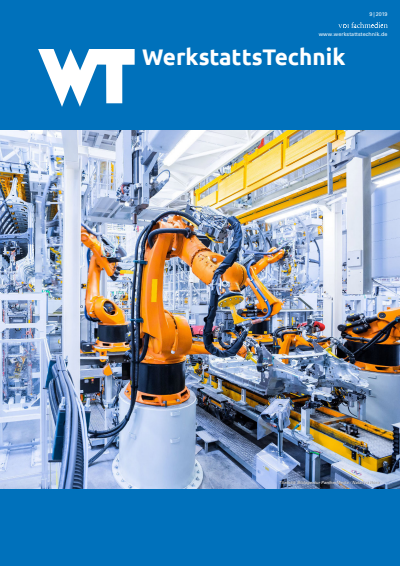
Cover der Ausgabe: wt Werkstattstechnik online Jahrgang 109 (2019), Heft 09
, um zu prüfen, ob Sie einen Vollzugriff auf diese Publikation haben.
Ausgabe Kein Zugriff

Jahrgang 109 (2019), Heft 09

wt Werkstattstechnik online
Autor:innen:
Zeitschrift:
wt Werkstattstechnik online
Verlag:
 2019

Über die Zeitschrift

In der Online-Zeitschrift für Forschung und Entwicklung in der Produktion – wt Werkstattstechnik online – werden die aktuellsten Forschungsergebnisse aus Wissenschaft, Technischer Hochschule und Industrie veröffentlicht - praxisbezogen und zukunftsorientiert. Die wt Werkstattstechnik online erscheint inklusive neun produktionsspezifischen Ausgaben pro Jahr unter der Internetadresse www.werkstattstechnik.de. Die in der wt Werkstattstechnik veröffentlichten Fachaufsätze sind wissenschaftlich-methodisch aufbereitet und grundsätzlich Erstveröffentlichungen. Viele Fachaufsätze sind peer-reviewed: von Experten auf diesem Gebiet – anonym sowie unabhängig von den Autoren – wissenschaftlich begutachtet und freigegeben. Die wt Werkstattstechnik online ist Organ der VDI-Gesellschaft Produktion und Logistik (GPL) sowie der wissenschaftlichen Gesellschaft für Produktionstechnik (WGP).

Publikation durchsuchen


Bibliographische Angaben

ISSN-Print
1436-4980
ISSN-Online
1436-4980
Verlag
VDI fachmedien, Düsseldorf
Sprache
Deutsch
Produkttyp
Ausgabe

Artikel

Cover der Ausgabe: wt Werkstattstechnik online Jahrgang 109 (2019), Heft 09
Artikel
Kein Zugriff

Seite 1 - 2
VDI Fachmedien GmbH & Co. KG, Düsseldorf 2019

Cover der Ausgabe: wt Werkstattstechnik online Jahrgang 109 (2019), Heft 09
Artikel
Kein Zugriff

Seite 617 - 617
Agilität in der industriellen Montage ist eine Antwort auf die Herausforderungen für den Erhalt der Wettbewerbsfähigkeit im Umgang mit zunehmender Komplexität in Produktdesign und Produktionsprozessen. Voraussetzung für die agile Montage ist...
VDI Fachmedien GmbH & Co. KG, Düsseldorf 2019
Autor:innen:

Cover der Ausgabe: wt Werkstattstechnik online Jahrgang 109 (2019), Heft 09
Artikel
Kein Zugriff

Seite 618 - 621
Individualisierung führt zu hohen Anforderungen an die Flexibilität und Produktivität von Montagesystemen. Als Alternative zur getakteten Linie, die diesen Anforderungen nicht gerecht wird, wird im Projekt „freeMoVe“ die...
VDI Fachmedien GmbH & Co. KG, Düsseldorf 2019
Autor:innen:

Cover der Ausgabe: wt Werkstattstechnik online Jahrgang 109 (2019), Heft 09
Artikel
Kein Zugriff

Seite 622 - 627
Produzierende Unternehmen intensivieren aufgrund zunehmend volatiler Kundenbedürfnisse die Anwendung agiler Produktentwicklungsansätze. Ziel des Beitrags ist die Einführung eines Konzepts zur Befähigung dieser dynamischen Produktentwicklung in...
VDI Fachmedien GmbH & Co. KG, Düsseldorf 2019
Autor:innen:

Cover der Ausgabe: wt Werkstattstechnik online Jahrgang 109 (2019), Heft 09
Artikel
Kein Zugriff

Seite 628 - 633
Im automobilen Prototypenbau werden starre Vorrichtungen genutzt, um Karosseriebauteile für Fügeprozesse zueinander auszurichten. Geringe Stückzahlen der Vorserie führen zu kurzen Nutzungsphasen der aufwendig aufgebauten und eingemessenen...
VDI Fachmedien GmbH & Co. KG, Düsseldorf 2019
Autor:innen:

Cover der Ausgabe: wt Werkstattstechnik online Jahrgang 109 (2019), Heft 09
Artikel
Kein Zugriff

Seite 634 - 638
Die Transformation zur digitalen und flexiblen Produktion ist für Unternehmen schwierig. Während die klassischen Wertschöpfungsprozesse ihrem Ende entgegensehen, müssen neue Produkte entwickelt und die Produktion geplant und vorbereitet werden....
VDI Fachmedien GmbH & Co. KG, Düsseldorf 2019
Autor:innen:

Cover der Ausgabe: wt Werkstattstechnik online Jahrgang 109 (2019), Heft 09
Artikel
Kein Zugriff

Seite 639 - 642
In diesem Beitrag wird eine Routine präsentiert, die einem mobilen Robotersystem in hochdynamischen Produktlinien hilft, seine Umgebung wahrzunehmen. Bewegte und unbewegte Objekte in der Umgebung müssen für einen reibungslosen Ablauf zuverlässig...
VDI Fachmedien GmbH & Co. KG, Düsseldorf 2019
Autor:innen:

Cover der Ausgabe: wt Werkstattstechnik online Jahrgang 109 (2019), Heft 09
Artikel
Kein Zugriff

Seite 643 - 649
Mit der Ankündigung auf der „SPS IPC Drives“ 2018, dass alle großen Feldbushersteller auf OPC UA over TSN als nächsten herstellerunabhängigen und interoperablen Feldbusstandard setzen, wird OPC UA over TSN immer wichtiger in der...
VDI Fachmedien GmbH & Co. KG, Düsseldorf 2019
Autor:innen:

Cover der Ausgabe: wt Werkstattstechnik online Jahrgang 109 (2019), Heft 09
Artikel
Kein Zugriff

Seite 650 - 655
Industrieroboter bieten eine große Flexibilität und einen großen Arbeitsraum bei verhältnismäßig geringen Investitionskosten. Gegenüber spanenden Werkzeugmaschinen sind die Steifigkeiten und Bahngenauigkeiten von Robotern jedoch geringer....
VDI Fachmedien GmbH & Co. KG, Düsseldorf 2019
Autor:innen:

Cover der Ausgabe: wt Werkstattstechnik online Jahrgang 109 (2019), Heft 09
Artikel
Kein Zugriff

Seite 656 - 661
Dieser Beitrag untersucht experimentell das dynamische Schwingverhalten eines „KR-500–3 MT“ von Kuka mittels eines elektromagnetischen Schwingerregers (Shaker) an insgesamt 28 Messposen im Arbeitsraum. Diese Untersuchungsmethode ist neuartig,...
VDI Fachmedien GmbH & Co. KG, Düsseldorf 2019
Autor:innen:

Cover der Ausgabe: wt Werkstattstechnik online Jahrgang 109 (2019), Heft 09
Artikel
Kein Zugriff

Seite 662 - 666
Die hohen Anforderungen an moderne Fertigungssysteme erfordern leistungsfähige Engineering-Lösungen. Wie man die Identifikation von Fehlerursachen in komplexen Anlagen erleichtert, wurde in einer Machbarkeitsstudie des Fraunhofer IPK im Auftrag...
VDI Fachmedien GmbH & Co. KG, Düsseldorf 2019
Autor:innen:

Cover der Ausgabe: wt Werkstattstechnik online Jahrgang 109 (2019), Heft 09
Artikel
Kein Zugriff

Seite 667 - 673
Der Werkzeugbau beeinflusst als Befähiger der Serienproduktion dessen Leistungsfähigkeit und Geschwindigkeit maßgeblich. Die immer kürzer werdende Time-to-Market hat zur Folge, dass Werkzeugbaubetriebe im Rahmen ihrer Leistungserstellung zu...
VDI Fachmedien GmbH & Co. KG, Düsseldorf 2019
Autor:innen:

Cover der Ausgabe: wt Werkstattstechnik online Jahrgang 109 (2019), Heft 09
Artikel
Kein Zugriff

Seite 674 - 678
Künstliche Intelligenz, Internet of Things und der Digitale Zwilling stehen als Schlagworte repräsentativ für den technologischen, aber auch organisatorischen Wandel in der Produktionstechnik, der keinesfalls verschlafen werden darf. Man möchte...
VDI Fachmedien GmbH & Co. KG, Düsseldorf 2019
Autor:innen:

Cover der Ausgabe: wt Werkstattstechnik online Jahrgang 109 (2019), Heft 09
Artikel
Kein Zugriff

Seite 679 - 683
In der Industrie werden hochflexible und kostengünstige Produktionstechnologien benötigt, die den Funktionalitätsgrad von Komponenten erhöhen. Digitale Druckverfahren erlauben das hierfür notwendige direkte Applizieren von Sensoren, Aktoren und...
VDI Fachmedien GmbH & Co. KG, Düsseldorf 2019
Autor:innen:

Cover der Ausgabe: wt Werkstattstechnik online Jahrgang 109 (2019), Heft 09
Artikel
Kein Zugriff

Seite 684 - 687
Im Rahmen eines vom BMBF (Bundesministerium für Bildung und Forschung) geförderten Projektes erforschte die Firma Optik-Elektro Huber GmbH in Zusammenarbeit mit dem Steinbeis-Transferzentrum für Produktion und Organisation ein neuartiges...
VDI Fachmedien GmbH & Co. KG, Düsseldorf 2019
Autor:innen:

Cover der Ausgabe: wt Werkstattstechnik online Jahrgang 109 (2019), Heft 09
Artikel
Kein Zugriff

Seite 688 - 693
Der Beitrag stellt eine neue Bewertungsmethode zur Priorisierung rationeller Energieeffizienzmaßnahmen in der Galvanik vor. Ziel ist eine optimale Einführung und Steuerung von Energieeffizienzmaßnahmen. Nach der Einordnung von Energiebedarfen in...
VDI Fachmedien GmbH & Co. KG, Düsseldorf 2019
Autor:innen:

Cover der Ausgabe: wt Werkstattstechnik online Jahrgang 109 (2019), Heft 09
Artikel
Kein Zugriff

Seite 694 - 698
Dieser Beitrag beschreibt eine Möglichkeit, den Faktor Mensch bei der Planung manueller Montagevorgänge in der Mensch-Roboter-Kollaboration (MRK) zu berücksichtigen. Das Ziel ist die echtzeitfähige Prädiktion der Dauer des Montageprozesses auf...
VDI Fachmedien GmbH & Co. KG, Düsseldorf 2019
Autor:innen:

Literaturverzeichnis (218 Einträge)

  1. [1] ElMaraghy, H.; Schuh. G.; ElMaraghy, W. et al.: Product variety management. CIRP Annals – Manufacturing Technology 62 (2013) 2, pp. 629–652 Google Scholar öffnen doi.org/10.37544/1436-4980-2019-09-4
  2. [2] Kampker, A.; Bartl, M.; Bertram S.: Agile Low-Cost Montage. Aachener Werkzeugmaschinen-Kolloquium 2017. Aachen: Apprimus Verlag 2017, S. 231–259 Google Scholar öffnen doi.org/10.37544/1436-4980-2019-09-4
  3. [3] Reinhart, G.; Backhaus, J.; Hüttner S. et al.: Wandlungsfähige Montagesysteme durch funktionsorientierte Modularisierung. Zeitschrift für wirtschaftlichen Fabrikbetrieb 107 (2012) 5, S. 339–334 Google Scholar öffnen doi.org/10.37544/1436-4980-2019-09-4
  4. [4] Hüttemann, G.; Göppert, A.; Lettmann, P. et al.: Dynamically Interconnected Assembly Systems. 7. WGP-Jahreskongress, Aachen, 2017. Aachen: Apprimus Wissenschaftsverlag, S. 261–268 Google Scholar öffnen doi.org/10.37544/1436-4980-2019-09-4
  5. [5] French, S.: Sequencing and Scheduling: An Introduction to the Mathematics of the Job-Shop. Chichester: Ellis Horwood Ltd. 1982 Google Scholar öffnen doi.org/10.37544/1436-4980-2019-09-4
  6. [6] Mohan, J.; Lanka, K.; Rao, A.: A Review of Dynamic Job shop Scheduling Techniques. 14th Global Congress on Manufacturing and Management, GCMM-2018, Brisbane/AU, 2018, pp. 34–39 Google Scholar öffnen doi.org/10.37544/1436-4980-2019-09-4
  7. [7] Pérez-Rodríguez R.; Hernández-Aguirre, A.: A hybrid estimation of distribution algorithm for flexible job-shop scheduling problems with process plan flexibility. Applied Intelligence 10 (2018), pp. 3707–3734 Google Scholar öffnen doi.org/10.37544/1436-4980-2019-09-4
  8. [8] Wang, W.; Wu, Q.: Intelligent Production Scheduling algorithm and its application. Peking: Science Press 2007 Google Scholar öffnen doi.org/10.37544/1436-4980-2019-09-4
  9. [9] Jung, S.; Grunert, D.; Schmitt, R.: Service-oriented Communication and Control System Architecture for Dynamically Interconnected Assembly Systems. 3. Kongress MHI. Berlin: Springer-Verlag 2018, pp. 223–229 Google Scholar öffnen doi.org/10.37544/1436-4980-2019-09-4
  10. [10] Jung, S.; Kulik, M.; König, N.: Design of a Modular Framework for the Integration of Machines and Devices into Service-oriented Production Networks. 7. WGP-Jahreskongress, Aachen, 2017. Aachen: Apprimus Wissenschaftsverlag, S. 167–174 Google Scholar öffnen doi.org/10.37544/1436-4980-2019-09-4
  11. [1] Abele, T.: Suchfeldbestimmung und Ideenbewertung – Methoden und Prozesse in den frühen Phasen des Innovationsprozesses. Wiesbaden: Springer Gabler Verlag 2013 Google Scholar öffnen doi.org/10.37544/1436-4980-2019-09-8
  12. [2] Kaas, H.-W.; Mohr, D.; Gao, P. et al.: Automotive revolution – perspective towards 2030. Stand: 2016. Internet: www.mckinsey.com/~/media/mckinsey/industries/high%20tech/our%20insights/disruptive%20trends%20that%20will%20transform%20the%20auto%20industry/auto%202030%20report%20jan%202016.ashx. Zugriff am 16.08.2019 Google Scholar öffnen doi.org/10.37544/1436-4980-2019-09-8
  13. [3] van Iwaarden, J.; van der Wiele, T.: The effects of increasing product variety and shortening product life cycles on the use of quality management systems. International Journal of Quality and Reliability Management 29 (2012) 5, pp. 470–500 Google Scholar öffnen doi.org/10.37544/1436-4980-2019-09-8
  14. [4] McKinsey & Company; VDMA e.V (Hrsg.): The future of German mechanical engineering. Operating successfully in a dynamic environment. Stand: 2014. Internet: www.festo.com/media/cms/media/en-us/editorial/downloads/future_of_mechanical_engineering.pdf. Zugriff am 15.08.2019 Google Scholar öffnen doi.org/10.37544/1436-4980-2019-09-8
  15. [5] Burggräf, P.: Wertorientierte Fabrikplanung. Dissertation, RWTH Aachen University, 2012 Google Scholar öffnen doi.org/10.37544/1436-4980-2019-09-8
  16. [6] Schuh, G.; Diels, F.; Ortlieb, C. et al.: Agile Produktentwicklung, In: Klocke, F.; Schmitt, R. H. (Hrsg.): Internet of Production für agile Unternehmen. 29. Aachener Werkzeugmaschinen-Kolloquium AWK 2017. Aachen, 18.–19. Mai. Aachen: Apprimus-Verlag 2017 Google Scholar öffnen doi.org/10.37544/1436-4980-2019-09-8
  17. [7] Schwaber K., Sutherland S.: Software in 30 Days: How Agile Managers Beat the Odds, Delight their Customers, and Leave Competitors in the Dust. New Jersey: Wiley 2012 Google Scholar öffnen doi.org/10.37544/1436-4980-2019-09-8
  18. [8] Kampker A.; Förstmann R.; Ordung M.; Haunreiter A.: Prototypen im agilen Entwicklungsmanagement. ATZ – Automobiltechnische Zeitschrift 118 (2016) 7/8, S. 72–77 Google Scholar öffnen doi.org/10.37544/1436-4980-2019-09-8
  19. [9] Schuh, G.; Prote, J.-P.; Dany, S. et al.: Process model for generative assembly planning in the highly iterative product development. Procedia CIRP 72 (2018), pp. 363–368 Google Scholar öffnen doi.org/10.37544/1436-4980-2019-09-8
  20. [10] Bertling, M.; Caroli, H.; Dannapfel, M.; Burggräf, P.: The Minimal Viable Production System (MVPS). An Approach for Agile (Automotive) Factory Planning in a Disruptive Environment. In: Schmitt, R.; Schuh, G. (Hrsg.): Advances in Production Research. Cham: Springer Verlag 2019, S. 24–33 Google Scholar öffnen doi.org/10.37544/1436-4980-2019-09-8
  21. [11] Schurig M.; Rabitsch C.; Ramsauer C.: Agile Produktion. Ein Produktionskonzept für volatile Zeiten. ZWF Zeitschrift für wirtschaftlichen Fabrikbetrieb 109 (2014) 12, S. 956–959 Google Scholar öffnen doi.org/10.37544/1436-4980-2019-09-8
  22. [12] Gunasekaran, A.; McGaughey, R.; Wolstencroft, V.: Agile Manufacturing: Concepts and Framework. In Gunasekaran, A. (Hrsg.): Agile Manufacturing: The 21st Century Competitive Strategy. Oxford: Elsevier 2001, pp. 25–49 Google Scholar öffnen doi.org/10.37544/1436-4980-2019-09-8
  23. [13] Westkämper, E.: Die Wandlungsfähigkeit von Unternehmen. wt Werkstattstechnik online, 89 (1999) 4, S. 131–140. Internet: www.werkstattstechnik.de. Düsseldorf: Springer-VDI-Verlag Google Scholar öffnen doi.org/10.37544/1436-4980-2019-09-8
  24. [14] Reinhart, G.; Berlak, J.; Effert, C.; Selke, C.: Wandlungsfähige Fabrikgestaltung. ZWF Zeitschrift für wirtschaftlichen Fabrikbetrieb, 97 (2002) 1/2, S. 18–22 Google Scholar öffnen doi.org/10.37544/1436-4980-2019-09-8
  25. [15] Zäh, M. F.; Müller, N.; Prasch, M.; Sudhoff, W.: Methodik zur Erhöhung der Wandlungsfähigkeit von Produktionssystemen. ZWF Zeitschrift für wirtschaftlichen Fabrikbetrieb, 99 (2004) 4, S. 173–177 Google Scholar öffnen doi.org/10.37544/1436-4980-2019-09-8
  26. [16] Hernàndez, R.: Systematik der Wandlungsfähigkeit in der Fabrikplanung. Dissertation, Leibniz Universität Hannover. Düsseldorf: VDI Verlag 2003 Google Scholar öffnen doi.org/10.37544/1436-4980-2019-09-8
  27. [17] Wiendahl, H.-P.: Wandlungsfähigkeit – Schlüsselbegriff der zukunftsfähigen Fabrik. wt Werkstattstechnik online 92 (2002) 4, S. 122–127. Internet: www.werkstattstechnik.de. Düsseldorf: Springer-VDI-Verlag Google Scholar öffnen doi.org/10.37544/1436-4980-2019-09-8
  28. [18] Cobb, C. G.: The project manager‘s guide to mastering Agile: Principles and practices for an adaptive approach. Hoboken: John Wiley & Sons 2015. Google Scholar öffnen doi.org/10.37544/1436-4980-2019-09-8
  29. [19] Stapleton, J. (Ed.): DSDM. Business focused development. The DSDM Consortium. London: Addison-Wesley 2002 Google Scholar öffnen doi.org/10.37544/1436-4980-2019-09-8
  30. [20] Fowler, M.; Highsmith, J.: The Agile Manifesto. Software Development 9 (2001) 8, pp. 28–35 Google Scholar öffnen doi.org/10.37544/1436-4980-2019-09-8
  31. [21] Larman, C.; Basili, V. R.: Iterative and incremental developments. A brief history. Computer 36 (2003) 6, pp. 47–56 Google Scholar öffnen doi.org/10.37544/1436-4980-2019-09-8
  32. [22] Schuh, G.; Riesener, M.; Diels, F.: Structuring Highly Iterative Product Development Projects by Using HIP-Indicators. IEEM Industrial Engineering and Engineering Management 2016. Bali/Indonesia, 2016, pp. 1171–1175 Google Scholar öffnen doi.org/10.37544/1436-4980-2019-09-8
  33. [23] Diels, F.; Rudolf, S.; Schuh, G.: Highly iterative product development process for engineering projects. Applied Mechanics and Materials 794 (2015), pp. 532–539 Google Scholar öffnen doi.org/10.37544/1436-4980-2019-09-8
  34. [24] Konold, P.; Reger, H.: Praxis der Montagetechnik. Produktdesign, Planung, Systemgestaltung. Wiesbaden: Vieweg Verlag 2003 Google Scholar öffnen doi.org/10.37544/1436-4980-2019-09-8
  35. [25] REFA Bundesverband e.V. (Hrsg.): REFA Methodenlehre der Betriebsorganisation. Teil 1, Planung und Gestaltung komplexer Produktionssysteme. München: Carl Hanser Verlag 1987 Google Scholar öffnen doi.org/10.37544/1436-4980-2019-09-8
  36. [26] Verein Deutscher Ingenieure VDI-Fachbereich Fabrikplanung und -betrieb: VDI 5200 Blatt1. Berlin: Beuth Verlag 2011 Google Scholar öffnen doi.org/10.37544/1436-4980-2019-09-8
  37. [27] Eversheim, W.: Organisation in der Produktionstechnik. Band 4. Heidelberg: Springer Verlag 1989 Google Scholar öffnen doi.org/10.37544/1436-4980-2019-09-8
  38. [28] Lotter, B.; Wiendahl, H.-P.: Montage in der industriellen Produktion. Ein Handbuch für die Praxis. Heidelberg: Springer Verlag 2006 Google Scholar öffnen doi.org/10.37544/1436-4980-2019-09-8
  39. [29] Sethi, A. K.; Sethi, S. P.: Flexibility in Manufacturing: A Survey. International Journal of Flexible Manufacturing Systems 4 (1990) 2, pp. 289–328 Google Scholar öffnen doi.org/10.37544/1436-4980-2019-09-8
  40. [30] De Toni, A.; Tonchia, S.: Manufacturing Flexibility: A Literature Review. International Journal of Production Research 36 (1998) 6, pp. 1587–1617 Google Scholar öffnen doi.org/10.37544/1436-4980-2019-09-8
  41. [31] Nyhuis, P.; Klemke, T.; Wagner, C.: Wandlungsfähigkeit – Ein systemischer Ansatz. In: Nyhuis, P. (Hrsg.): Wandlungsfähige Produktionssysteme. Berlin: Gito Verlag 2010, S. 3–21 Google Scholar öffnen doi.org/10.37544/1436-4980-2019-09-8
  42. [32] Wiendahl, H.-P.; ElMaraghy, H. A.; Nyhuis, P. et al.: Changeable Manufacturing – Classification, Design and Operation. CIRP Annals – Manufacturing Technology 56 (2007) 2, pp. 783–809 Google Scholar öffnen doi.org/10.37544/1436-4980-2019-09-8
  43. [33] Lanza, G.; Moser, R.; Ruhrmann, S.: Wandlungstreiber: Global agierender Produktionsunternehmen. wt Werkstattstechnik online 102 (2012) 4, S. 200–205. Internet: www.werkstattstechnik.de. Düsseldorf: Springer-VDI-Verlag Google Scholar öffnen doi.org/10.37544/1436-4980-2019-09-8
  44. [34] Reil, H.: Smart Faction. Dialoge Magazin – Smart Factory, S. 27–31, Stand: 2015. Internet: www.audi-mediacenter.com/de/publikationen/magazine/dialoge-smart-factory-2015–156. Zugriff am 15.08.2019 Google Scholar öffnen doi.org/10.37544/1436-4980-2019-09-8
  45. [35] Mayer, B.: Porsche Produktionsvorstand Reimold: „Wir ziehen alle Register“. Exklusiv-Interview. Automobil Produktion (2018) S. 1. Internet: https://www.automobil-produktion.de/ interviews-734/porsche-produktionsvorstand-reimold- wir-ziehen-alle-register-126.html. Zugriff am 15.08.2019 Google Scholar öffnen doi.org/10.37544/1436-4980-2019-09-8
  46. [36] Arena 2036 – Active Research Environment for the Next Generation of Automobiles. Stand: 2018. Internet: www.arena2036.de/de/. Zugriff am 15.08.2019 Google Scholar öffnen doi.org/10.37544/1436-4980-2019-09-8
  47. [37] freeMoVe: Wandlungsfähige Montage in frei vernetzten Montagesystemen. Stand: 2019. Internet: www.projekt-freemove.de/. Zugriff am 15.08.2019 Google Scholar öffnen doi.org/10.37544/1436-4980-2019-09-8
  48. [38] LoCoMo. Stand 2018. Internet: https: www.locomo.tech/. Zugriff am 16.08.2019 Google Scholar öffnen doi.org/10.37544/1436-4980-2019-09-8
  49. [39] Kampke, A.; Förstmann R.; Ordung, M.; Haunreiter, A.: Prototypen im agilen Entwicklungsmanagement. ATZ – Automobiltechnische Zeitschrift 118 (2016) 7–8, S. 72 Google Scholar öffnen doi.org/10.37544/1436-4980-2019-09-8
  50. [40] Molitor, M.; Prote, J.-P.; Dany, S. et al.: Conception of Generative Assembly Planning in the Highly Iterative Product Development. In: Schmitt, R. H.; Schuh, G. (Hrsg.): 7. WGP-Jahreskongress Aachen. 5.6. Oktober. Werkzeugmaschinenlabor WZL der RWTH Aachen. Aachen: Apprimus-Verlag 2017, S. 313–320 Google Scholar öffnen doi.org/10.37544/1436-4980-2019-09-8
  51. [41] Kampker, A.; Kreisköther, K.; Wagner, J.; Fluchs, S.: Mobile Assembly of Electric Vehicles: Decentralized, Low-Invest and Flexible. International Journal of Mechanical, Aerospace, Industrial, Mechatronic and Manufacturing Engineering 10 (2016) 12, pp. 1920–1926 Google Scholar öffnen doi.org/10.37544/1436-4980-2019-09-8
  52. [42] Kratzsch, S.: Prozess- und Arbeitsorganisation in Fließmontagesystemen. Dissertation, Technische Universität Carolo-Wilhelmina zu Braunschweig, 2000 Google Scholar öffnen doi.org/10.37544/1436-4980-2019-09-8
  53. [43] Miese, M.: Systematische Montageplanung in Unternehmen mit Einzel- und Kleinserienproduktion. Dissertation. Technische Hochschule Aachen, 1973 Google Scholar öffnen doi.org/10.37544/1436-4980-2019-09-8
  54. [44] Petersen, T.: Organisationsformen der Montage. Theoretische Grundlagen, Organisationsprinzipien und Gestaltungsansatz. Aachen: Shaker Verlag 2005 Google Scholar öffnen doi.org/10.37544/1436-4980-2019-09-8
  55. [45] Schimke, E.; Hoeschen, R.: Auswahl der geeigneten Organisationsform in der Montage für Unternehmen der Einzel- und Serienfertigung. TZ für praktische Metallbearbeitung 71 (1977) 4, S. 136–142 Google Scholar öffnen doi.org/10.37544/1436-4980-2019-09-8
  56. [46] Cooper, R. G.: Agile-Stage-Gate Hybrids. Research-Technology Management 59 (2016) 1, pp. 21–29 Google Scholar öffnen doi.org/10.37544/1436-4980-2019-09-8
  57. [47] Nöcker, J. C.: Zustandsbasierte Fabrikplanung. Dissertation, RWTH Aachen University, 2012 Google Scholar öffnen doi.org/10.37544/1436-4980-2019-09-8
  58. [48] Krunke, M.: Reifegradmanagement in der Fabrikplanung. Aachen: Apprimus-Verlag 2017 Google Scholar öffnen doi.org/10.37544/1436-4980-2019-09-8
  59. [48] Rodriguez, A.; Rodriguez, Y.; Metaphors for today’s leadership. VUCA world, millennial and “Cloud Leaders”. Journal of Management Development 34 (2015) 7, pp. 854–866 Google Scholar öffnen doi.org/10.37544/1436-4980-2019-09-8
  60. [50] Kampker, A.; Burggräf, P.; Krunke, M. et al.: Das Aachener Fabrikplanungsvorgehen. Agile Fabrikplanung im turbulenten Umfeld. wt Werkstattstechnik online 104 (4), S. 192–196. Internet: www.werkstattstechnik.de. Düsseldorf: Springer-VDI-Verlag Google Scholar öffnen doi.org/10.37544/1436-4980-2019-09-8
  61. [1] Fritzsche, R.; Richter, A.; Putz, M.: Automatic Adjustment of Car Body Fixtures Using Artificial Intelligence. Procedia CIRP 62 (2017), pp. 600–605 Google Scholar öffnen doi.org/10.37544/1436-4980-2019-09-14
  62. [2] Muelaner, J. E.; Martin, O. C.; Maropoulos, P. G.: Achieving Low Cost and High Quality Aero Structure Assembly through Integrated Digital Metrology Systems. Procedia CIRP 7 (2013), pp. 688–693 Google Scholar öffnen doi.org/10.37544/1436-4980-2019-09-14
  63. [3] Maropoulos, P. G.; Muelaner, J. E.; Summers, M. D. et al.: A new paradigm in large-scale assembly – research priorities in measurement-assisted assembly. The International Journal of Advanced Manufacturing Technology 70 (2014) 1, pp. 621–633 Google Scholar öffnen doi.org/10.37544/1436-4980-2019-09-14
  64. [4] Hansen, J. O.; Kampker, A.; Triebs, J.: Approaches for flexibility in the future automobile body shop. Results of a comprehensive cross-industry study. Procedia CIRP 72 (2018), pp. 995–1002 Google Scholar öffnen doi.org/10.37544/1436-4980-2019-09-14
  65. [5] Bi, Z. M.; Zhang, W. J.: Flexible fixture design and automation. Review, issues and future directions. International Journal of Production Research 39 (2001) 13, pp. 2867–2894 Google Scholar öffnen doi.org/10.37544/1436-4980-2019-09-14
  66. [6] Hoska, D.: Fixtureless Assembly Manufacturing. Manufacturing Engineering 100 (1988), pp. 49–54 Google Scholar öffnen doi.org/10.37544/1436-4980-2019-09-14
  67. [7] Bone, G. M.; Capson, D.: Vision-guided fixtureless assembly of automotive components. Robotics and Computer-Integrated Manufacturing 19 (2003) 1–2, pp. 79–87 Google Scholar öffnen doi.org/10.37544/1436-4980-2019-09-14
  68. [8] Tingelstad, L.; Capellan, A.; Thomessen, T.: Multi-Robot Assembly of High-Performance Aerospace Components. 10th IFAC Symposium on Robot Control 2012. IFAC Proceedings Volumes 45 (2012) 22, pp. 670–675 Google Scholar öffnen doi.org/10.37544/1436-4980-2019-09-14
  69. [9] Fleischer, J.; Lanza, G.; Dosch, S.: Fixtureless alignment of joining partners within the assembly of aluminium space frame structures. Procedia CIRP 18 (2014), pp. 221–225 Google Scholar öffnen doi.org/10.37544/1436-4980-2019-09-14
  70. [10] Gameros, A.; Lowth, S.; Axinte, D. et al.: State-of-the-art in fixture systems for the manufacture and assembly of rigid components. A review. International Journal of Machine Tools and Manufacture 123 (2017), pp. 1–21 Google Scholar öffnen doi.org/10.37544/1436-4980-2019-09-14
  71. [11] Kupzik, D.; Haas, S.; Stemler, D. et al.: Development of a manufacturing cell for fixtureless joining in car body assembly. In: Schüppstuhl, T.; Tracht, K.; Franke, J. (Hrsg.): Tagungsband des 3. Kongresses Montage Handhabung Industrieroboter. Heidelberg: Springer-Verlag 2018, S. 23–30 Google Scholar öffnen doi.org/10.37544/1436-4980-2019-09-14
  72. [12] Pfeifer, T.; Schmitt, R.: Fertigungsmesstechnik. München: Oldenbourg Verlag 2010 Google Scholar öffnen doi.org/10.37544/1436-4980-2019-09-14
  73. [1] Kushida, T.; Pingali, G. S.: Industry Cloud – Effective Adoption of Cloud Computing for Industry Solutions, IEEE 7th International Conference on Cloud Computing, Anchorage, AK, 2014, pp. 753–760 Google Scholar öffnen doi.org/10.37544/1436-4980-2019-09-20
  74. [2] Georgakopoulos, D.; Jayaraman, P. P.; Fazia, M.; Villari, M.; Ranjan, R.: Internet of Things and Edge Cloud Computing Roadmap for Manufacturing. In IEEE Cloud Computing, 3 (2016) 4, pp. 66–73 Google Scholar öffnen doi.org/10.37544/1436-4980-2019-09-20
  75. [3] Tsokalo, I. A.; Wu, H.; Nguyen, G. T.; Salah, H.; Fitzek, F. H. P.: Mobile Edge Cloud for Robot Control Services in Industry Automation. 16th IEEE Annual Consumer Communications & Networking Conference (CCNC), Las Vegas, NV, USA, 2019, pp. 1–2 Google Scholar öffnen doi.org/10.37544/1436-4980-2019-09-20
  76. [4] Kropp, A.; Schmoll, R.; Nguyen, G. T.; Fitzek, F. H. P.: Demonstration of a 5G Multi-access Edge Cloud Enabled Smart Sorting Machine for Industry 4.0. 16th IEEE Annual Consumer Communications & Networking Conference (CCNC), Las Vegas, NV, USA, 2019, pp. 1–2 Google Scholar öffnen doi.org/10.37544/1436-4980-2019-09-20
  77. [5] Zou, O.; Zhong, R. Y.: Automatic Logistics in a Smart Factory using RFID-enabled AGVs. IEEE/ASME International Conference on Advanced Intelligent Mechatronics (AIM), Auckland, 2018, pp. 822–826 Google Scholar öffnen doi.org/10.37544/1436-4980-2019-09-20
  78. [6] Sabattini, L.; Cardarelli, E.; Digani, V.; Secchi, C.; Fantuzzi, C.; Fuerstenberg, K.: Advanced sensing and control techniques for multi AGV systems in shared industrial environments. IEEE 20th Conference on Emerging Technologies & Factory Automation (ETFA), Luxembourg, 2015, pp. 1–7 Google Scholar öffnen doi.org/10.37544/1436-4980-2019-09-20
  79. [7] Lourenço, A.; Marques, F.; Mendonça, R.; Pinto, E.; Barata, J.: On the design of the Robo-Partner Intra-factory logistics autonomous robot. IEEE International Conference on Systems, Man, and Cybernetics (SMC), Budapest, 2016, pp. 002647–002652 Google Scholar öffnen doi.org/10.37544/1436-4980-2019-09-20
  80. [1] Fischler, M. A.; Bolles, R. C.: Random sample consensus: a paradigm for model fitting with applications to image analysis and automated cartography. Communications of the ACM, 24 (1981) 6, pp. 381–395 Google Scholar öffnen doi.org/10.37544/1436-4980-2019-09-25
  81. [2] Cantzler, H., Fisher, R. B.; Devy, M.: Quality enhancement of reconstructed 3D models using coplanarity and constraints. In: Joint Pattern Recognition Symposium pp. 34–41 Berlin, Heidelberg: Springer-Verlag 2002 Google Scholar öffnen doi.org/10.37544/1436-4980-2019-09-25
  82. [3] Yang, Q.; Fan, S.; Wang, L.; Wang, Y.: Road detection by RANSAC on randomly sampled patches with slanted plane prior. In: 2016 IEEE 13th International Conference on Signal Processing (ICSP) pp. 929–933 Google Scholar öffnen doi.org/10.37544/1436-4980-2019-09-25
  83. [4] Hoppe, H.; DeRose, T.; Duchamp, T.; McDonald, J.; Stuetzle, W.: Surface reconstruction from unorganized points 26 (1992) 2, pp. 71–78. ACM Google Scholar öffnen doi.org/10.37544/1436-4980-2019-09-25
  84. [5] He, Y.; Liang; B.; Yang, J.; Li, S.; He, J.: An iterative closest points algorithm for registration of 3D laser scanner point clouds with geometric features. Sensors, 17(2017) 8, p. 1862 Google Scholar öffnen doi.org/10.37544/1436-4980-2019-09-25
  85. [6] Han, J.; Kamber, M.; Tung, A. K.: Spatial clustering methods in data mining (2001) Geographic data mining and knowledge discovery, pp. 188–217 Google Scholar öffnen doi.org/10.37544/1436-4980-2019-09-25
  86. [7] Ester, M.; Sander, J.: Knowledge discovery in databases: Techniken und Anwendungen, Heidelberg: Springer-Verlag 2013 Google Scholar öffnen doi.org/10.37544/1436-4980-2019-09-25
  87. [8] Arslan, O.; Guralnik, D. P.; Koditschek, D. E.: Coordinated robot navigation via hierarchical clustering. IEEE Transactions on Robotics, 32 (2016) 2, pp. 352–371 Google Scholar öffnen doi.org/10.37544/1436-4980-2019-09-25
  88. [9] Klasing, K.; Wollherr, D.; Buss, M.: A clustering method for efficient segmentation of 3D laser data. In: 2008 IEEE International Conference on Robotics and Automation pp. 4043–4048 Google Scholar öffnen doi.org/10.37544/1436-4980-2019-09-25
  89. [10] Wang, X.; Yang, C.; Ju, Z.; Ma, H.; Fu, M.: Robot manipulator self-identification for surrounding obstacle detection. Multimedia Tools and Applications, 76 (2017) 5, pp. 6495–6520 Google Scholar öffnen doi.org/10.37544/1436-4980-2019-09-25
  90. [11] Wang, Z.; Jia, L.; Zhang, L.; Zhuang, C.: Pose Estimation with Mismatching Region Detection in Robot Bin Picking. In: International Conference on Intelligent Robotics and Applications 2017, pp. 36–47 Google Scholar öffnen doi.org/10.37544/1436-4980-2019-09-25
  91. [12] Ester, M.; Kriegel, H. P.; Sander, J.; Xu, X.: A density-based algorithm for discovering clusters in large spatial databases with noise. KDD‘96 Proceedings of the Second International Conference on Knowledge Discovery and Data Mining 1996) 34, pp. 226–231 Google Scholar öffnen doi.org/10.37544/1436-4980-2019-09-25
  92. [13] Rusu, R. B.; Cousins, S.: 3D Is Here: Point Cloud Library. In: 2011 IEEE International Conference on Robotics and Automation, pp. 1–4 Google Scholar öffnen doi.org/10.37544/1436-4980-2019-09-25
  93. [1] OPC Foundation, Major Automation Industry Players join OPC UA including TSN initiative. Available: https://opcfoundation.org/news/press-releases/major-automation-industry-players-join-opc-ua-including-tsn-initiative/ Google Scholar öffnen doi.org/10.37544/1436-4980-2019-09-29
  94. [2] Gogolev, A.; Mendoza, F.; Braun, R.: TSN-enabled OPC UA in field devices, In:IEEE ETFA 2018 in press. Google Scholar öffnen doi.org/10.37544/1436-4980-2019-09-29
  95. [3] Bruckner, D.; Blair, R.; Stanica, M-P.; Ademaj, A.; Skeffington, W.; Kutscher, D.; Schriegel, S.; Wilmes, R.; Wachswender, K.; Leurs, L.; Seewald, M.; Hummen, R.; Liu, E-C.; Ravikumar, S.: OPC UA TSN, 2019. Internet: https://www.automationworld.com/sites/default/files/opc_ua_tsn_whitepaper_1.pdf Google Scholar öffnen doi.org/10.37544/1436-4980-2019-09-29
  96. [4] ISW University Stuttgart, TSN for Automation. Available: https://www.isw-sites.de/tsn4automation2/en/home-2/ Google Scholar öffnen doi.org/10.37544/1436-4980-2019-09-29
  97. [5] OSADL Homepage. Available: https://www.osadl.org/ Google Scholar öffnen doi.org/10.37544/1436-4980-2019-09-29
  98. [6] OPC Foundation. Available: https://opcfoundation.org/ Google Scholar öffnen doi.org/10.37544/1436-4980-2019-09-29
  99. [7] OPC Foundation, OPC Unified Architecture Specification Part 14 PubSub Release 1.04. Available: https://opcfoundation.org/developer-tools/specifications-unified-architecture/part-14-pubsub/ Google Scholar öffnen doi.org/10.37544/1436-4980-2019-09-29
  100. [8] Bray, T.: The JavaScript Object Notation (JSON) Data Interchange Format: RFC Editor, 2017 Google Scholar öffnen doi.org/10.37544/1436-4980-2019-09-29
  101. [9] Nsaibi, S.; Leurs, L.: Abbildung von TDMA-basierten Industrial Ethernet Protokollen auf TSN am Beispiel von Sercos III. In: Technologien für die intelligente Automation, Kommunikation und Bildverarbeitung in der Automation, Jasperneite, J.; Lohweg, V. Berlin: Springer, 2018, pp. 122–135 Google Scholar öffnen doi.org/10.37544/1436-4980-2019-09-29
  102. [10] IEEE 802, 802.1AS – Timing and Synchronization Available: http://www.ieee802.org/1/pages/802.1as.html Google Scholar öffnen doi.org/10.37544/1436-4980-2019-09-29
  103. [11] Xilinx UltraScale+ MPSoCe. Available: https://www.xilinx.com/support/documentation/data_sheets/ds890-ultrascale-overview.pdf Google Scholar öffnen doi.org/10.37544/1436-4980-2019-09-29
  104. [12] Ethernet FMC. Available: http://ethernetfmc.com/specifications Google Scholar öffnen doi.org/10.37544/1436-4980-2019-09-29
  105. [13] Timestamping. Available: https://linux.die.net/ man/3/clock_gettime Google Scholar öffnen doi.org/10.37544/1436-4980-2019-09-29
  106. [14] Boost C++ library. Available: https://www.boost.org/ Google Scholar öffnen doi.org/10.37544/1436-4980-2019-09-29
  107. [15] PTP4L. Available: https://linux.die.net/man/8/ptp4l Google Scholar öffnen doi.org/10.37544/1436-4980-2019-09-29
  108. [1] Executive Summary World Robotics 2018 Industrial Robots, IFR, Frankfurt am Main, 2018 Google Scholar öffnen doi.org/10.37544/1436-4980-2019-09-36
  109. [2] Meißner, H.-R.; Bochum, U.; Pricelius, M.: Branchenanalyse Holzbearbeitungsmaschinenindustrie. Study / Hans-Böckler-Stiftung, Düsseldorf Google Scholar öffnen doi.org/10.37544/1436-4980-2019-09-36
  110. [3] Möhring, H.-C.: En route to intelligent wood machining. Current situation and future perspectives. CIRP Sponsored Conference on Supervising and Diagnostics of Machining Systems (2019) Google Scholar öffnen doi.org/10.37544/1436-4980-2019-09-36
  111. [4] Karim, A.; Waibel, A.; Lechler, A.: Experimentelle Posenanalyse am Bearbeitungsroboter. Ermittlung der Richtungs- sowie Posenabhängigkeit von Industrierobotern für die Fräsbearbeitung. wt Werkstatttechnik online 106 (2016), S. 347–353 Google Scholar öffnen doi.org/10.37544/1436-4980-2019-09-36
  112. [5] Rösch, O.: Steigerung der Arbeitsgenauigkeit bei der Fräsbearbeitung metallischer Werkstoffe mit Industrierobotern. Dissertation, Technische Universität München, 2014 Google Scholar öffnen doi.org/10.37544/1436-4980-2019-09-36
  113. [6] Karim, A.; Jäger, J.; Podewils, C. von et al.: Nachgiebigkeitsverhalten von Industrierobotern. Experimentelle Ermittlung der statischen Nachgiebigkeit in unterschiedlichen Posen. wt Werkstatttechnik online 108 (2018) 5, S. 364–370 Google Scholar öffnen doi.org/10.37544/1436-4980-2019-09-36
  114. [7] Cen, L.: Machining accuracy improvement and mode coupling chatter avoidance in robotic milling. Dissertation, Georgia Institute of Technology, 2017 Google Scholar öffnen doi.org/10.37544/1436-4980-2019-09-36
  115. [8] Abele, E.; Baier, C.; Tepper, C.: Zerspanung mit Industrierobotern. Hybride Fertigung mit Industrierobotern im Presswerkzeugbau. wt Werkstatttechnik online 108 (2018) 6, S. 429–434 Google Scholar öffnen doi.org/10.37544/1436-4980-2019-09-36
  116. [9] Weigold, M.: Kompensation der Werkzeugabdrängung bei der spanenden Bearbeitung mit Industrierobotern. Dissertation, Technische Universität Darmstadt, 2008 Google Scholar öffnen doi.org/10.37544/1436-4980-2019-09-36
  117. [10] Wang, J.; Zhang, H.; Fuhlbrigge, T.: Improving machining accuracy with robot deformation compensation. 2009 IEEE/RSJ International Conference on Intelligent Robots and Systems (IROS 2009), St. Louis, MO, USA, 2009, pp. 3826–3831 Google Scholar öffnen doi.org/10.37544/1436-4980-2019-09-36
  118. [11] Schneider, U. J.: Untersuchung von modellbasierter Fehlerkompensation und erweiterter Positionsregelung zur Genauigkeitssteigerung von roboterbasierten Zerspanungsprozessen. Dissertation, Universität Stuttgart, 2016 Google Scholar öffnen doi.org/10.37544/1436-4980-2019-09-36
  119. [12] Gottlöber, C.: Zerspanung von Holz und Holzwerkstoffen. München: Carl Hanser Verlag GmbH & Co. KG 2014 Google Scholar öffnen doi.org/10.37544/1436-4980-2019-09-36
  120. [13] Heisel, U.; Tröger, J.; Ivanova, S.: 5-Achs-Bearbeitung von Massivholz. Grundlagenuntersuchungen zur Herstellung von 3D-Formkörpern aus Massivholz mittels Kugelfräswerkzeugen und 5-Achs-Bearbeitungszentren – Einfluss der zerspanungstechnischen Parameter auf Bearbeitungsqualität, Schnittkräfte und Verschleiß (Teil 1). HOB Die Holzbearbeitung 2010 (2010) 5, S. 67–70 Google Scholar öffnen doi.org/10.37544/1436-4980-2019-09-36
  121. [14] Heisel, U.; Tröger, J.; Ivanova, S.: 5-Achs-Bearbeitung von Massivholz. Grundlagenuntersuchungen zur Herstellung von 3D-Formkörpern aus Massivholz mittels Kugelfräswerkzeugen und 5-Achs-Bearbeitungszentren -- Einfluss der zerspanungstechnischen Parameter auf Bearbeitungsqualität, Schnittkräfte und Verschleiß (Teil 2). HOB Die Holzbearbeitung 2010 (2010) 9, S. 68–71 Google Scholar öffnen doi.org/10.37544/1436-4980-2019-09-36
  122. [15] Brecher, C.; Lienenlüke, L.; Obdenbusch, M.: Spanende Bearbeitung mit Industrierobotern. Modellbasierte Planungsassistenz für die roboterbasierte Bearbeitung. wt Werkstatttechnik online 107 (2017) 5, S. 346–351 Google Scholar öffnen doi.org/10.37544/1436-4980-2019-09-36
  123. [16] Lienenluke, L.; Grundel, L.; Storms, S. et al.: Model-based process planning for milling operations using industrial robots. 2018 3rd International Conference on Control and Robotics Engineering (ICCRE), Nagoya, 2018, pp. 37–44 Google Scholar öffnen doi.org/10.37544/1436-4980-2019-09-36
  124. [17] Weck, M.; Brecher, C.: Werkzeugmaschinen 5. Messtechnische Untersuchung und Beurteilung, dynamische Stabilität. Berlin, Heidelberg: Springer Berlin Heidelberg; Springer-Verlag Berlin Heidelberg 2006 Google Scholar öffnen doi.org/10.37544/1436-4980-2019-09-36
  125. [1] Rösch, O.: Steigerung der Arbeitsgenauigkeit bei der Fräsbearbeitung metallischer Werkstoffe mit Industrierobotern. Dissertation, Technische Universität München, 2014. München: Herbert Utz Verlag 2014, Forschungsberichte IWB (Institut für Werkzeugmaschinen und Betriebswissenschaften) Technische Universität München, Band 302 Google Scholar öffnen doi.org/10.37544/1436-4980-2019-09-42
  126. [2] Bauer, J.: Methoden der Offline-Bahnkorrektur für die spanende Bearbeitung mit Industrierobotern. Dissertation, Technische Universität Darmstadt, 2011. Berlin: epubli-Verlag, Schriftenreihe des PTW 2011 Google Scholar öffnen doi.org/10.37544/1436-4980-2019-09-42
  127. [3] IFR Statistical Department (Ed.): Executive Summary World Robotics 2018 Industrial Robots. Internet: https://ifr.org/downloads/press2018/Executive_Summary_WR_2018_Industrial_Robots.pdf. Zugriff am 20.08.2019 Google Scholar öffnen doi.org/10.37544/1436-4980-2019-09-42
  128. [4] N. N.: Robots double worldwide by 2020. Stand: 2019. Internet: ifr.org/ifr-press-releases/news/robots-double-worldwide-by-2020; Zugriff am 20.08.2019 Google Scholar öffnen doi.org/10.37544/1436-4980-2019-09-42
  129. [5] Karim, A.; Verl, A.: Challenges and obstacles in robot-machining. 44th IEEE International Symposium on Robotics (ISR), 24.10.-26.10.2013, Seoul/Südkorea, 2013, pp. 1–4 Google Scholar öffnen doi.org/10.37544/1436-4980-2019-09-42
  130. [6] Karim, A.; Hitzer, J.; Lechler, A.; Verl, A.: Analysis of the dynamic behavior of a six-axis-industrial robot across the entire workspace in respect of machining tasks. IEEE International Conference on Advanced Intelligent Mechatronics (AIM), 2017. Piscataway/NJ: IEEE 2017a , S. 670-675 Google Scholar öffnen doi.org/10.37544/1436-4980-2019-09-42
  131. [7] Weigold, M.: Kompensation der Werkzeugabdrängung bei der spanenden Bearbeitung mit Industrierobotern. Dissertation, Technische Universität Darmstadt, 2008. Darmstadt: Shaker Verlag, Schriftenreihe des PTW „Innovation Fertigungstechnik“ 2008 Google Scholar öffnen doi.org/10.37544/1436-4980-2019-09-42
  132. [8] Merovci, P.; Karim, A.; Lechler, A.: Experimentelle Modalanalyse an Industrierobotern. VDI-Z 157 (2015) 10, S. 22–24 Google Scholar öffnen doi.org/10.37544/1436-4980-2019-09-42
  133. [9] Bisu, C. F.; Cherif, M.; Gérard, A.; K’nevez, J.-Y.: Dynamic Behavior Analysis for a Six Axis Industrial Machining Robot. Advanced Materials Research 423 (2011), pp. 65–76 Google Scholar öffnen doi.org/10.37544/1436-4980-2019-09-42
  134. [10] Puzik, A.: Genauigkeitssteigerung bei der spanenden Bearbeitung mit Industrierobotern durch Fehlerkompensation mit 3D-Piezo-Ausgleichsaktorik. Dissertation, Universität Stuttgart, 2011. Heimsheim : Jost-Jetter Verlag, IPA-IAO Forschung und Praxis; Band 513, 2011 Google Scholar öffnen doi.org/10.37544/1436-4980-2019-09-42
  135. [11] Karim, A.; Verl, A.; Höhne, R.: Schwingungsanalyse an Bearbeitungsrobotern. wt Werkstattstechnik online 104 (2014) 1/2, S. 49–54. Internet: www.werkstattstechnik.de. Düsseldorf: Springer-VDI-Verlag Google Scholar öffnen doi.org/10.37544/1436-4980-2019-09-42
  136. [12] Cen, L.; Melkote, S. N.: CCT-based mode coupling chatter avoidance in robotic milling. Journal of Manufacturing Processes 29 (2017), pp. 50–61 Google Scholar öffnen doi.org/10.37544/1436-4980-2019-09-42
  137. [13] Lienenluke, L.; Grundel, L.; Storms, S.; Brecher, C.: Model-based process planning for milling operations using industrial robots. 3rd International Conference on Control and Robotics Engineering (ICCRE) Nagoya/Japan, 2018, IEEE, pp. 37–44 Google Scholar öffnen doi.org/10.37544/1436-4980-2019-09-42
  138. [14] Mejri, S.; Gagnol, V.; Le, T.-P. et al.: Dynamic characterization of machining robot and stability analysis. The International Journal of Advanced Manufacturing Technology 82 (2016) 1, pp. 351–359 Google Scholar öffnen doi.org/10.37544/1436-4980-2019-09-42
  139. [15] Mousavi, S.; Gagnol, V.; Bouzgarrou, B. C.; Ray, P.: Stability optimization in robotic milling through the control of functional redundancies. Robotics and Computer-Integrated Manufacturing 50 (2018), pp. 181–192 Google Scholar öffnen doi.org/10.37544/1436-4980-2019-09-42
  140. [16] Baur, M.: Aktives Dämpfungssystem zur Ratterunterdrückung an spanenden Werkzeugmaschinen. Dissertation, Technische Universitöt München, 2014. München: Herbert Utz Verlag, 2014 Google Scholar öffnen doi.org/10.37544/1436-4980-2019-09-42
  141. [1] Söderberg, R.; Wärmefjord, K.; Carlson, J. S. et al.: Toward a Digital Twin for real-time geometry assurance in individualized production. CIRP Annals 66 (2017) 1, pp. 137–140 Google Scholar öffnen doi.org/10.37544/1436-4980-2019-09-48
  142. [2] Henke, C.; Michael, J.; Lankeit, C. et al.: A holistic approach for virtual commissioning of intelligent systems: Model-based systems engineering for the development of a turn-milling center. 2017 Annual IEEE International Systems Conference (SysCon), Montreal, QC, Canada, 2017, pp. 1–6 Google Scholar öffnen doi.org/10.37544/1436-4980-2019-09-48
  143. [3] Negri, E.; Fumagalli, L.; Macchi, M.: A Review of the Roles of Digital Twin in CPS-based Production Systems. Procedia Manufacturing 11 (2017), pp. 939–948 Google Scholar öffnen doi.org/10.37544/1436-4980-2019-09-48
  144. [4] Bumiller, H.; Burgmaier, M.; Eichler, W.: Fachkunde Elektrotechnik. Bearbeitet von Lehrern an beruflichen Schulen und von Ingenieuren. Haan-Gruiten: Verlag Europa-Lehrmittel Nourney Vollmer GmbH & Co. KG 2016 Google Scholar öffnen doi.org/10.37544/1436-4980-2019-09-48
  145. [5] Jünemann, R.; Beyer, A.: Steuerungsmittel. In: Jünemann, R.; Pfohl, H.-C.; Jünemann, R. et al. (Hrsg.): Steuerung von Materialfluß- und Logistiksystemen. Heidelberg: Springer-Verlag 1998, S. 151–189 Google Scholar öffnen doi.org/10.37544/1436-4980-2019-09-48
  146. [6] Bellagente, P.; Ferrari, P.; Flammini, A. et al.: Enabling PROFINET devices to work in IoT: Characterization and requirements. 2016 IEEE International Instrumentation and Measurement Technology Conference (I2MTC), Taipei/Taiwan, 2016, pp. 1–6 Google Scholar öffnen doi.org/10.37544/1436-4980-2019-09-48
  147. [7] Ferrari, P.; Flammini, A.; Marioli, D. et al.: Evaluation of timing characteristics of a prototype system based on Profinet IO RT_Class 3. 2007 IEEE Conference on Emerging Technologies & Factory Automation (EFTA 2007), Patras/Greece, 2007, pp. 1254–1261 Google Scholar öffnen doi.org/10.37544/1436-4980-2019-09-48
  148. [8] Heinrich, B.; Döring, P.; Klüber, L. et al.: Mechatronik. Grundlagen und Komponenten. Wiesbaden: Vieweg+Teubner Verlag 2004 Google Scholar öffnen doi.org/10.37544/1436-4980-2019-09-48
  149. [1] Schuh, G.; Kuhlmann, K.; Pitsch, M. et al.: Der ideale Werkzeugbau. Vernetzung statt statistischer Positionierung. FORM + Werkzeug (2013) 01, S. 14 Google Scholar öffnen doi.org/10.37544/1436-4980-2019-09-53
  150. [2] Schuh, G. (Hrsg.): Operative Exzellenz im Werkzeug- und Formenbau. Aachen: Apprimus, 2010 Google Scholar öffnen doi.org/10.37544/1436-4980-2019-09-53
  151. [3] Friedli, T.; Schuh, G.: Wettbewerbsfähigkeit der Produktion an Hochlohnstandorten. Berlin: Springer, 2012 Google Scholar öffnen doi.org/10.37544/1436-4980-2019-09-53
  152. [4] Frick, L.: Erfolgreiche Geschäftsmodelle im Werkzeugbau. Aachen: Shaker, 2006 Google Scholar öffnen doi.org/10.37544/1436-4980-2019-09-53
  153. [5] Varnhagen, V.; Schuh, G. (Hrsg.): Fokus Automobilindustrie. Digitale Wertschöpfungsnetzwerke im Werkzeugbau. Aachen: Apprimus, 2013 Google Scholar öffnen doi.org/10.37544/1436-4980-2019-09-53
  154. [6] Ritz, P.: Bewertung technischer Änderungen im Werkzeugbau. Aachen: Shaker, 1999 Google Scholar öffnen doi.org/10.37544/1436-4980-2019-09-53
  155. [7] Eckert, C.; Clarkson, P. J.; Zanker, W.: Change and customisation in complex engineering domains. Research in Engineering Design 15 (2004) 1, S. 1–21 Google Scholar öffnen doi.org/10.37544/1436-4980-2019-09-53
  156. [8] Terwiesch, C.; Loch, C. H.: Measuring the Effectiveness of Overlapping Development Activities. Management Science 45 (1999) 4, S. 455–465 Google Scholar öffnen doi.org/10.37544/1436-4980-2019-09-53
  157. [9] Schuh, G.; Boos, W.; Kelzenberg, C. et al.: Industrie 4.0: Implement it! Ein Leitfaden zur erfolgreichen Implementierung von Industrie 4.0-Lösungen. Aachen: Werkzeug-maschinenlabor WZL der RWTH Aachen, 2018 Google Scholar öffnen doi.org/10.37544/1436-4980-2019-09-53
  158. [10] Schuh, G.: Digital Connected Production. Werkzeugmaschinenlabor WZL der RWTH Aachen; Fraunhofer-Institut für Produktionstechnologie IPT. Aachen, 2017 Google Scholar öffnen doi.org/10.37544/1436-4980-2019-09-53
  159. [11] VDI: VDI-Richtlinie 4499. Digitale Fabrik. VDI-Verlag, 2008 Google Scholar öffnen doi.org/10.37544/1436-4980-2019-09-53
  160. [12] Brecher, C.; Klocke, F.; Schmitt, R.: Internet of Production für agile Unternehmen. AWK Aachener Werkzeugmaschinen-Kolloquium. Aachen: Apprimus, 2017 Google Scholar öffnen doi.org/10.37544/1436-4980-2019-09-53
  161. [13] Hoffmann, J.; Heimes, P.; Senel, S.: IoT Platforms for the Internet of Production. IEEE Internet of Things Journal (2018), S. 1 Google Scholar öffnen doi.org/10.37544/1436-4980-2019-09-53
  162. [14] Boos, W.; Salmen, M.; Begovic, A. et al.: Smart Tooling. Werkzeugmaschinenlabor WZL der RWTH Aachen, 2016 Google Scholar öffnen doi.org/10.37544/1436-4980-2019-09-53
  163. [15] Bauernhansl, T.; Hartleif, S.; Felix, T.: The Digital Shadow of production – A concept for the effective and efficient information supply in dynamic industrial environments. Procedia CIRP 72 (2018), S. 69–74 Google Scholar öffnen doi.org/10.37544/1436-4980-2019-09-53
  164. [16] Colangelo, E.; Hartleif, S.; Fulga-Beising, S.: Informationsmanagement in der Smart Factory. wt Werkstatttechnik online 109 (2019) 3, S. 148–152 Google Scholar öffnen doi.org/10.37544/1436-4980-2019-09-53
  165. [17] Bauernhansel et al.: WGP-Standpunkt Industrie 4.0 (2016), S. 23 Google Scholar öffnen doi.org/10.37544/1436-4980-2019-09-53
  166. [18] Okuda et al.: Technical Trend of ADAS and Autonomous Driving, 2014 Google Scholar öffnen doi.org/10.37544/1436-4980-2019-09-53
  167. [19] Knop, C.; Becker, T. (Hrsg.): Digitales Neuland. Warum Deutschlands Manager jetzt Revolutionäre werden. Wiesbaden: Springer Gabler, 2015 Google Scholar öffnen doi.org/10.37544/1436-4980-2019-09-53
  168. [20] Grösser, S.: Digitaler Zwilling. Stand: 19.02.2018. Internet: https://wirtschaftslexikon.gabler.de/definition/ digitaler-zwilling-54371/version-277410. Zugriff am 14.05.2019 Google Scholar öffnen doi.org/10.37544/1436-4980-2019-09-53
  169. [1] Ertel, W.: Grundkurs Künstliche Intelligenz. Wiesbaden: Springer Fachmedien 2016 Google Scholar öffnen doi.org/10.37544/1436-4980-2019-09-60
  170. [2] Sisinni, E.; Saifullah, A.; Han, S.; Jennehag, U.; Gidlund, M.: Industrial Internet of Things. Challenges, Opportunities, and Directions. In: IEEE Transactions on Industrial Informatics. 14 (2018) 11, pp. 4724–4734 Google Scholar öffnen doi.org/10.37544/1436-4980-2019-09-60
  171. [3] Schleich, B.; Anwer, N.; Mathieu, L.; Wartzack, S.: Shaping the digital twin for design and production engineering. In: CIRP Annals – Manufacturing Technology. 66 (2017) 1, pp. 141–144 Google Scholar öffnen doi.org/10.37544/1436-4980-2019-09-60
  172. [4] Porter, M.; Heppelmann, J.: Wie smarte Produkte den Wettbewerb verändern. Harvard Business Manager (2014) S. 12 Google Scholar öffnen doi.org/10.37544/1436-4980-2019-09-60
  173. [5] Heidel, R.; Hankel, M.; Döbrich, U.; Hoffmeister, M.: Basiswissen RAMI 4.0: Referenzarchitekturmodell und Industrie 4.0-Komponente Industrie 4.0, Berlin: Beuth Verlag 2017 Google Scholar öffnen doi.org/10.37544/1436-4980-2019-09-60
  174. [6] Kagermann, H.: Smart Service Welt. Umsetzungsempfehlungen für das Zukunftsprojekt Internetbasierte Dienste für die Wirtschaft. Acatech 2014. Internet: https://www.acatech.de/projekt/smart-service-welt/. Zugriff am 29.07.2019 Google Scholar öffnen doi.org/10.37544/1436-4980-2019-09-60
  175. [7] Eigner, M.; Koch, W.; Muggeo, C.: Modellbasierter Entwicklungsprozess cybertronischer Systeme. Wiesbaden: Springer Vieweg 2017 Google Scholar öffnen doi.org/10.37544/1436-4980-2019-09-60
  176. [8] Bitzer, M.; Eigner, M.; Faißt, K.-G. et al.: Framework of the Evolution in Virtual Product Modelling and Model Management Towards Digitized Engineering. 21st International Conference on Engineering Design, ICED17 (2017) Google Scholar öffnen doi.org/10.37544/1436-4980-2019-09-60
  177. [9] Bracht, U.; Geckler, D.; Wenzel, S.: Digitale Fabrik. Methoden und Praxisbeispiele. Berlin Heidelberg: Springer 2011 Google Scholar öffnen doi.org/10.37544/1436-4980-2019-09-60
  178. [10] Grunert, D.; Lettmann, P.; Löffler, P.; Hüttemann, G.; Schmitt, R.: Auftragsplanung und Informationsbereitstellung für die neue Montageorganisation. Industrie 4.0 Management 35 (2019), S. 35–38 Google Scholar öffnen doi.org/10.37544/1436-4980-2019-09-60
  179. [11] Pallasch, C.; Hoffmann, N.; Storms, S.; Standortübergreifendes Echtzeit-Assettracking. ZWF Zeitschrift für wirtschaftlichen Fabrikbetrieb 113 (2018) 10, S. 697–701 Google Scholar öffnen doi.org/10.37544/1436-4980-2019-09-60
  180. [1] Bochmann, L.: Entwicklung und Bewertung eines flexiblen und dezentral gesteuerten Fertigungssystems für variantenreiche Produkte. Dissertation, ETH Zürich, 2018 Google Scholar öffnen doi.org/10.37544/1436-4980-2019-09-65
  181. [2] Porter, M. E.; Heppelmann, J.: How Smart, Connected Products Are Transforming Companies. Harvard business review 93 (2015) 10, pp. 96–114 Google Scholar öffnen doi.org/10.37544/1436-4980-2019-09-65
  182. [3] Autohaus Wolfsburg Hotz und Heitmann GmbH & Co. KG: Blick unter die VW Golf 7 Karosserie: Über die Nervenbahnen der modernen Automobile Teil 2/2. Stand: 2017. Internet: blog.autohaus-wolfsburg.de/blick-unter-die-vw-golf-7-karosserie/. Zugriff am 18.07.2019 Google Scholar öffnen doi.org/10.37544/1436-4980-2019-09-65
  183. [4] Wünscher S.; Abbel R.; Perelaer J.; Schubert U. S.: Progress of alternative sintering approaches of inkjet-printed metal inks and their application for manufacturing of flexible electronic devices. Journal of Materials Chemistry C 2 (2014) 48, pp. 10232–10261 Google Scholar öffnen doi.org/10.37544/1436-4980-2019-09-65
  184. [5] Huang Y. et. al.: Assembly and applications of 3D conformal electronics on curvilinear surfaces. Materials Horizons 6 (2019) 4, pp. 642–683 Google Scholar öffnen doi.org/10.37544/1436-4980-2019-09-65
  185. [6] Eckert, M.; Weber, J.; Hecht, B. et al.: Automatic bead position calculation for hem flange bonding, Procedia Manufacturing 2 (2019) pp. 138–143 Google Scholar öffnen doi.org/10.37544/1436-4980-2019-09-65
  186. [7] Weber, W.: Industrieroboter – Methoden der Steuerung und Regelung. München: Carl Hanser Verlag 2002, S. 95–97 Google Scholar öffnen doi.org/10.37544/1436-4980-2019-09-65
  187. [1] Internet: https://de.wikipedia.org/wiki/Sinnerscher_Kreis. Zugriff am 10.08.2019 Google Scholar öffnen doi.org/10.37544/1436-4980-2019-09-70
  188. [2] Technische Sauberkeit von Bauteilen nach ISO 16232-2018. Berlin: Beuth-Verlag 2018 Google Scholar öffnen doi.org/10.37544/1436-4980-2019-09-70
  189. [3] Technische Sauberkeit: VDA 19 im Industrieverbund Technische Sauberkeit (TecSa 2.0) Google Scholar öffnen doi.org/10.37544/1436-4980-2019-09-70
  190. [1] Bayerisches Landesamt für Umweltschutz (Hrsg.): Effiziente Energienutzung in der Galvanikindustrie. Augsburg: BayLfU 2003 Google Scholar öffnen doi.org/10.37544/1436-4980-2019-09-74
  191. [2] Köse, E.; Sauer, A.; Thomas, B. et al.: Stromoptimierte KWK in der Galvanikbranche. wt Werkstattstechnik online 108 (2018) 7/8, S. 561–566. www.werkstattstechnik.de. Düsseldorf: Springer-VDI-Verlag Google Scholar öffnen doi.org/10.37544/1436-4980-2019-09-74
  192. [3] Bayerisches Landesamt für Umwelt (Hrsg.): Energiemanagement im Betrieb: Klima schützen – Kosten senken. Augsburg: LfU 2013 Google Scholar öffnen doi.org/10.37544/1436-4980-2019-09-74
  193. [4] Pye, M.; McKane, A.: Making a stronger case for industrial energy efficiency by quantifying non-energy benefits. Resources, Conservation and Recycling 28 (2000) 3–4, pp. 171–183 Google Scholar öffnen doi.org/10.37544/1436-4980-2019-09-74
  194. [5] Erlach, K.; Westkämper, E. (Hrsg.): Energiewertstrom: Der Weg zur energieeffizienten Fabrik. Stuttgart: Fraunhofer Verlag 2009 Google Scholar öffnen doi.org/10.37544/1436-4980-2019-09-74
  195. [6] Thiede, S.; Bogdanski, G.; Herrmann, C.: A Systematic Method for Increasing the Energy and Resource Efficiency in Manufacturing Companies. Procedia CIRP 2 (2012), pp. 28–33 Google Scholar öffnen doi.org/10.37544/1436-4980-2019-09-74
  196. [7] Krones, M.: A method to identify energy efficiency measures for factory systems based on qualitative modeling. Wiesbaden: Springer Vieweg Verlag 2017 Google Scholar öffnen doi.org/10.37544/1436-4980-2019-09-74
  197. [8] Giebel, M.: Wertsteigerung durch Qualitätsmanagement: Entwicklung eines Modells zur Beschreibung der Wirkmechanismen und eines Vorgehenskonzepts zu dessen Einführung. Dissertation, Universität Kassel, 2010. Kasseler Schriftenreihe Qualitätsmanagement 1. Kassel: Kassel University Press, 2011 Google Scholar öffnen doi.org/10.37544/1436-4980-2019-09-74
  198. [9] Gausemeier, J.; Fink, A.; Schlake, O.: Szenario-Management: Planen und Führen mit Szenarien. 2. Auflage. München: Carl Hanser Verlag 1996 Google Scholar öffnen doi.org/10.37544/1436-4980-2019-09-74
  199. [10] Baum, H.; Coenenberg, A.; Günther, T. et al.: Strategisches Controlling. 5. Auflage. Stuttgart: Schäffer-Poeschel Verlag 2013 Google Scholar öffnen doi.org/10.37544/1436-4980-2019-09-74
  200. [11] Jelinek, T.: Oberflächenbehandlung von Aluminium. Saulgau/Württemberg: Leuze Verlag 1997 Google Scholar öffnen doi.org/10.37544/1436-4980-2019-09-74
  201. [12] Kölle, S.; Schmid, K.; Metzner, M., et al.: Das ÖKOXAL-Verfahren: Verbesserte Energiausbeute beim Hartanodisieren. Michaelis, A.; Schneider, M. (Hrsg.): Symposium Anodisieren – Oxidschichten von hart bis smart 2016. Tagungsband 24.-25. November 2016, Dresden. Stuttgart: Fraunhofer Verlag 2016 Google Scholar öffnen doi.org/10.37544/1436-4980-2019-09-74
  202. [13] Unruh, J.: Tabellenbuch Galvanotechnik. 7. Auflage. Bad Saulgau: Leuze Verlag 2001 Google Scholar öffnen doi.org/10.37544/1436-4980-2019-09-74
  203. [14] topmotors.ch: Effizienzklassen IE1, IE2, IE3 und IE4. Wirkungsgrade. Stand: 2014. Internet: www.topmotors.ch/sites/default/files/2018–08/D_MB_13_Wirkungsgrade.pdf. Zugriff am 12.08.2019 Google Scholar öffnen doi.org/10.37544/1436-4980-2019-09-74
  204. [15] Falkner, H.: Lot 11 – Water Pumps: (in commercial buildings, drinking water pumping, food industry, agriculture). Didcot: AEA Energy & Environment 2008 Google Scholar öffnen doi.org/10.37544/1436-4980-2019-09-74
  205. [1] Onnasch, L.; Maier, X.; Jürgensohn, T.: Mensch-Roboter-Interaktion – Eine Taxonomie für alle Anwendungsfälle, Bundesanstalt für Arbeitsschutz und Arbeitsmedizin, Dortmund, 2016 Google Scholar öffnen doi.org/10.37544/1436-4980-2019-09-80
  206. [2] Müller-Abdelrazeq, S. L.; Stiehm, S.; Haberstroh, M. et al.: Perceived Effects of Cycle Time in Human-Robot-Interaction. IEEE Workshop on Advanced Robotics and its Social Impacts (ARSO), Genova, Italy, 2018, S. 25–30 Google Scholar öffnen doi.org/10.37544/1436-4980-2019-09-80
  207. [3] Shen, Q.; Dautenhahn, K.; Saunders, J. et al.: Can Real-Time, Adaptive Human–Robot Motor Coordination Improve Humans’ Overall Perception of a Robot? IEEE Transactions on Autonomous Mental Development 7 (2015) 1, S. 52–64 Google Scholar öffnen doi.org/10.37544/1436-4980-2019-09-80
  208. [4] Wit, J. de; Schodde, T.; Willemsen, B. et al.: The Effect of a Robot‘s Gestures and Adaptive Tutoring on Children‘s Acquisition of Second Language Vocabularies. the 2018 ACM/IEEE International Conference, Chicago, IL, USA, 2018, S. 50–58 Google Scholar öffnen doi.org/10.37544/1436-4980-2019-09-80
  209. [5] Nikolaidis, S.; Hsu, D.; Srinivasa, S.: Human-robot mutual adaptation in collaborative tasks: Models and experiments. The International Journal of Robotics Research 36 (2017) 5–7, S. 618–634 Google Scholar öffnen doi.org/10.37544/1436-4980-2019-09-80
  210. [6] Lasota, P. A.; Shah, J. A.: Analyzing the effects of human-aware motion planning on close-proximity human-robot collaboration. Human factors 57 (2015) 1, pp. 21–33 Google Scholar öffnen doi.org/10.37544/1436-4980-2019-09-80
  211. [7] Maynard, H. B.; Stegemerten, G. J.; Schwab, J. L.: Methods – time measurement. 1948 Google Scholar öffnen doi.org/10.37544/1436-4980-2019-09-80
  212. [8] Chryssolouris, G.; Mavrikios, D.; Fragos, D. et al.: A virtual reality-based experimentation environment for the verification of human-related factors in assembly processes. Robotics and Computer-Integrated Manufacturing 16 (2000) 4, S. 267–276 Google Scholar öffnen doi.org/10.37544/1436-4980-2019-09-80
  213. [9] Zhang, W.; Gen, M.: An efficient multiobjective genetic algorithm for mixed-model assembly line balancing problem considering demand ratio-based cycle time. Journal of Intelligent Manufacturing 22 (2011) 3, S. 367–378 Google Scholar öffnen doi.org/10.37544/1436-4980-2019-09-80
  214. [10] Kuhlenbäumer, F.; Przybysz, P.; Mütze-Niewöhner, S. et al.: Age-Differentiated Analysis of the Influence of Task Descriptions on Learning Sensorimotor Tasks. In: Schlick, C. M.; Duckwitz, S.; Flemisch, F. et al. (Edit.): Advances in Ergonomic Design of Systems, Products and Processes. Proceedings of the Annual Meeting of GfA 2016. Berlin, Heidelberg, s.l.: Springer Berlin Heidelberg 2017, pp. 159–175 Google Scholar öffnen doi.org/10.37544/1436-4980-2019-09-80
  215. [11] Krueger, G. P.: Sustained work, fatigue, sleep loss and performance: A review of the issues. Work & Stress 3 (1989) 2, S. 129–141 Google Scholar öffnen doi.org/10.37544/1436-4980-2019-09-80
  216. [12] Deutsche MTM-Vereinigung e.V.: Basis MTM. MTM-1 und MTM-UAS Lehrgangsunterlagen. Hamburg: Eigenverlag Deutsche MTM-Vereinigung e.V. 2016 Google Scholar öffnen doi.org/10.37544/1436-4980-2019-09-80
  217. [13] Petruck, H.; Mertens, A.: Predicting Human Cycle Times in Robot Assisted Assembly. In: Trzcielinski, S. (Edit.): Advances in ergonomics of manufacturing: managing the enterprise of the future. Proceedings of the AHFE 2017 International Conference on Human Aspects of Advanced Manufacturing, July 17–21, 2017, The Westin Bonaventure Hotel, Los Angeles, California, USA. Cham: Springer 2018, pp. 25–36 Google Scholar öffnen doi.org/10.37544/1436-4980-2019-09-80
  218. [14] Petruck, H.; Mertens, A.: Using Convolutional Neural Networks for Assembly Activity Recognition in Robot Assisted Manual Production. In: Kurosu, M. (Edit.): Human-computer interaction. Interaction in context : 20th International Conference, HCI International 2018, Las Vegas, NV, USA, July 15–20, 2018 : proceedings, part II. Cham: Springer International Publishing 2018, pp. 381–397 Google Scholar öffnen doi.org/10.37544/1436-4980-2019-09-80
Neuesten Ausgaben

wt Werkstattstechnik online
Alle Ausgaben anzeigen
Cover der Ausgabe: wt Werkstattstechnik online Jahrgang 116 (2026), Heft 01-02
Ausgabe Vollzugriff
Forschung und Entwicklung in der Produktion
Jahrgang 116 (2026), Heft 01-02
Cover der Ausgabe: wt Werkstattstechnik online Jahrgang 115 (2025), Heft 11-12
Ausgabe Vollzugriff
Forschung und Entwicklung in der Produktion
Jahrgang 115 (2025), Heft 11-12
Cover der Ausgabe: wt Werkstattstechnik online Jahrgang 115 (2025), Heft 10
Ausgabe Vollzugriff
Forschung und Entwicklung in der Produktion
Jahrgang 115 (2025), Heft 10
Cover der Ausgabe: wt Werkstattstechnik online Jahrgang 115 (2025), Heft 09
Ausgabe Vollzugriff
Forschung und Entwicklung in der Produktion
Jahrgang 115 (2025), Heft 09
Cover der Ausgabe: wt Werkstattstechnik online Jahrgang 115 (2025), Heft 07-08
Ausgabe Vollzugriff
Forschung und Entwicklung in der Produktion
Jahrgang 115 (2025), Heft 07-08