Vom Washington Consensus zum Flexiblen Keynesianismus – der Internationale Währungsfonds nach der Finanzkrise
Inhaltsverzeichnis
Bibliographische Infos
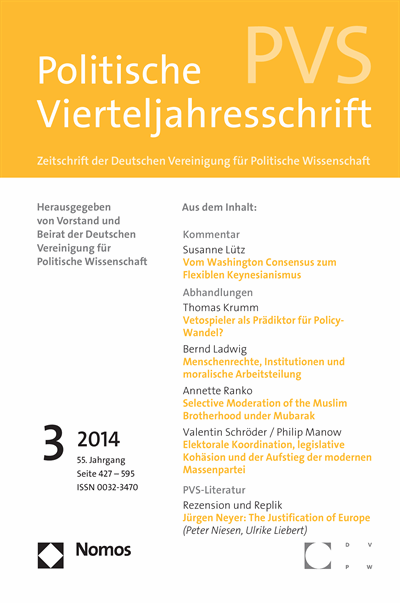
Zeitschrift der Deutschen Vereinigung für Politikwissenschaft
Jahrgang 55 (2014), Heft 3
- Autor:innen:
- Verlag
- Nomos, Baden-Baden
- Erscheinungsjahr
- 2014
- ISSN-Online
- 0032-3470
- ISSN-Print
- 0032-3470
Kapitelinformationen
Jahrgang 55 (2014), Heft 3
Vom Washington Consensus zum Flexiblen Keynesianismus – der Internationale Währungsfonds nach der Finanzkrise
- Autor:innen:
- ISSN-Print
- 0032-3470
- ISSN-Online
- 0032-3470
- Kapitelvorschau:
Der Internationale Währungsfonds kehrte im Zuge der jüngsten Finanzkrise wieder zu seinem Kerngeschäft – der Bereitstellung von Liquidität zur Überbrückung von Zahlungsbilanzungleichgewichten – zurück. Die Krise scheint jedoch auch eine ideologische Zäsur zu markieren. Auf dem Londoner G20 Gipfel 2009 erklärten führende Politiker den „Washington Consensus“ für beendet und antizyklische Wirtschaftspolitik für das Gebot der Stunde. Dieser Beitrag fragt nach Anzeichen eines Paradigmenwechsels in der Krisenpolitik des IWF und nach dessen Antriebskräften. Argumentiert wird, dass sich auf der programmatischen Ebene ein Wandel hin zu einer neuen Wirtschaftsphilosophie des „flexiblen Keynesianismus“ abzeichnet und dieser sowohl von großen Mitgliedsstaaten als auch vom Fachpersonal des IWF vorangetrieben wird.
Literaturverzeichnis
Es wurden keine Treffer gefunden. Versuchen Sie einen anderen Begriff.
- Babb, Sarah. 2003. The IMF in Sociological Perspective: A Tale of Organizational Slippage. Studies in Comparative International Development 38: 3-27. Google Scholar öffnen doi.org/10.1007/BF02686266
- Babb, Sarah. 2013. The Washington Consensus as transnational policy paradigm: Its origins, trajectory and likely successor. Review of International Political Economy 20: 268-297. doi: 10.1080/09692290.2011.640435. Google Scholar öffnen doi.org/10.1080/09692290.2011.640435
- Baldwin, Katherine. 2009. G20: France and Germany throw down the gauntlet. The Guardian (theguardian.com). http://www.theguardian.com/world/2009/apr/01/g20-summit-obama-brown. Zugegriffen: 25.11.2013. Google Scholar öffnen
- Barnett, Michael N., und Martha Finnemore. 1999. The Politics, Power and Pathologies of International Organizations. International Organization 53: 699-732. Google Scholar öffnen
- Barnett, Michael N., und Martha Finnemore. 2004. Rules for the World: International Organizations in Global Politics. Ithaca, N. Y.: Cornell University Press. Google Scholar öffnen
- BBC News, 25.6.2010: Geithner tells Europe to Focus on Growth. http://www.bbc.co.uk/news/10411167. Zugegriffen:18.3.2014. Google Scholar öffnen
- Bird, Graham. 2003. Restructuring the IMF’s Lending Facilities. The World Economy 26: 229-245. doi: 10.1111/1467-9701.00519. Google Scholar öffnen doi.org/10.1111/1467-9701.00519
- Bird, Graham. 2009. Reforming IMF Conditionality. From “streamlining” to “major overhaul”. World Economics 10: 81-104. Google Scholar öffnen
- Blanchard, Olivier, Giovanni Dell’Ariccia, und Paolo Mauro. 2010. Rethinking Macroeconomic Policy. IMF Staff Position Note SPN/10/03. Washington, D. C.: IMF. Google Scholar öffnen doi.org/10.5089/9781455224982.004.A001
- Blanchard, Olivier, Giovanni Dell’Ariccia, und Paolo Mauro. 2013. Rethinking Macro Policy II: Getting Granular. IMF Staff Discussion Note SDN/13/03. Washington, D. C.: IMF. Google Scholar öffnen doi.org/10.5089/9781484363478.006
- Catan, Thomas, und Ian Talley. 2013. Past Rifts Over Greece Cloud Talks on Rescue. Confidential Documents Reveal Deep Divisions at IMF Over 2010 Greek Bailout. Wall Street Journal (wsj.com). http://online.wsj.com/article/SB1000142405270230444140457911918.htm. Zugegriffen: 8.10.2013. Google Scholar öffnen
- Chwieroth, Jeffrey M. 2014. Controlling Capital: The International Monetary Fund and Transformative Incremental Change from Within International Organisations. New Political Economy 19: 445-469. doi: 10.1080/13563467.2013.796451. Google Scholar öffnen doi.org/10.1080/13563467.2013.796451
- Copelovitch, Mark S. 2010. Master or Servant? Common Agency and the Political Economy of IMF Lending. International Studies Quarterly 54: 49-77. doi: 10.1111/ Google Scholar öffnen doi.org/10.1111/j.1468-2478.2009.00577.x
- j.1468-2478.2009.00577.x. Google Scholar öffnen
- Elliot, Larry. 2009. Brown takes fight against protectionism to G20 summit. The Guardian (theguardian.com). http://www.theguardian.com/business/2009/feb/01/davos-brown-fights-protectionism-g20. Zugegriffen: 18.12.2013. Google Scholar öffnen
- G20. 2009a. London Summit – Leader’s Statement. 2 April 2009. http://www.imf.org/external/np/sec/pr/2009/pdf/g20_040209.pdf. Zugegriffen: 18.12.2013 Google Scholar öffnen
- G20. 2009b. G 20 Leaders Statement: The Pittsburgh Summit. September 24-25, 2009. http://www.g20.utoronto.ca/2009/2009communique0925.html. Zugegriffen: 29.11.2013. Google Scholar öffnen
- G20. 2011. Cannes Summit Final Declaration – Building Our Common Future: Renewed Collective Action for the Benefit of All. http://www.g20.utoronto.ca/2011/2011-cannes-declaration-111104-en.html. Zugegriffen: 29.11.2013 Google Scholar öffnen
- G20. 2013. G20 Leaders’ Declaration. St. Petersburg Summit, 5-6 September 2013. https://www.g20.org/sites/default/files/g20_resources/library/Saint_Petersburg_Declaration_ENG.pdf. Zugegriffen: 18.12.2013. Google Scholar öffnen
- Gallagher, Kevin. 2011. The IMF must heed G20 decisions. The Guardian (theguardian.com). http://www.theguardian.com/commentisfree/cifamerica/2011/nov/29/imf-must-heed-g20-decisions. Zugegriffen: 29.11.2013. Google Scholar öffnen
- Gallagher, Kevin P., und Jose Antonio Ocampo. 2013. IMF’s New View on Capital Controls. Economic & Political Weekly 48: 10-13. Google Scholar öffnen
- Giles, Christ. 2013a. IMF backs stimulus measures, but takes harder line on debt. Financial Times (ft.com). http://www.ft.com/intl/cms/s/0/a5ef16cc-1fa6-11e3-8861-00144feab7de.html#axzz2nox1Xfv3. Zugegriffen: 18.12.2013. Google Scholar öffnen
- Giles, Christ. 2013b. IMF adopts a more Keynesian line on deficits and stimulus. Financial Times (ft.com). http://www.ft.com/intl/cms/s/0/7dc8b574-29f4-11e3-9bc6-00144feab7de. Google Scholar öffnen
- html#axzz2nox1Xfv3. Zugegriffen: 18.12.2013. Google Scholar öffnen
- Grabel, Ilene. 2011. Not your grandfather’s IMF: global crisis, ‘productive incoherence’ and developmental policy space. Cambridge Journal of Economics 35: 805-830. doi: 10.1093/cje/ber012. Google Scholar öffnen doi.org/10.1093/cje/ber012
- Grabel, Ilene. 2013. The Rebranding of Capital Controls in an Era of Productive Incoherence. Working Paper Series No. 318. Amherst: Political Economy Research Institute, University of Massachusetts. Google Scholar öffnen
- Haas, Peter M. 1992. Introduction: Epistemic Communities and International Policy Coordination. International Organization 46: 1-35. Google Scholar öffnen doi.org/10.1017/S0020818300001442
- Hall, Peter A. 1993. Policy Paradigms, Social Learning, and the State: The Case of Economic Policy Making in Britain. Comparative Politics 25: 275-296. Google Scholar öffnen
- Hawkins, Darren G., David A. Lake, Daniel L. Nielson, und Michael J. Tierney (Hrsg.). 2006. Delegation and Agency in International Organizations. Cambridge: Cambridge University Press. Google Scholar öffnen doi.org/10.1017/CBO9780511491368.001
- Helleiner, Eric, und Bessma Momani. 2007. Slipping into Obscurity? Crisis and Reform at the IMF. CIGI Working Paper No. 16. Waterloo: Centre for International Governance Innovation. Google Scholar öffnen doi.org/10.2139/ssrn.964915
- Independent Evaluation Office (IEO). 2008. Structural Conditionality in IMF-supported Programs. IEO Evaluation Report January 03 2008. Washington, D. C.: IMF. Google Scholar öffnen
- Interview (1). 8. September 2009. Repräsentant Deutschlands im IWF-Exekutivdirektorium. Google Scholar öffnen
- International Monetary Fund (IMF). 2009a. IMF Implements Major Lending Policy Improvements. http://www.imf.org/external/np/pdr/fac/2009/pdf/032409.pdf. Zugegriffen: 30.10. 2013. Google Scholar öffnen
- International Monetary Fund (IMF). 2009b. IMF Overhauls Nonconcessional Lending Facilities and Conditionality. Public Information Notice (PIN) No. 09/40. Washington D. C.: IMF. http://www.imf.org/external/np/sec/pn/2009/pn0940.htm. Zugegriffen: 29.11.2013. Google Scholar öffnen
- International Monetary Fund (IMF). 2009c. IMF Executive Board’s Initial Discussion on the Review of Fund Facilities – Analytical Basis for Fund Lending and Reform Options. Public Information Notice (PIN), No. 09/41. Washington D. C.: IMF. http://www.imf.org/external/np/sec/pn/2009/pn0941.htm. Zugegriffen: 29.11.2013. Google Scholar öffnen
- International Monetary Fund (IMF). 2010. IMF Executive Board Approves Major Overhaul of Quotas and Governance. Press Release No. 10/418. Washington D. C.: IMF. http://www.imf.org/external/np/sec/pr/2010/pr10418.htm. Zugegriffen: 18.12.2013. Google Scholar öffnen doi.org/10.5089/9781455203482.002
- International Monetary Fund (IMF). 2012. The Liberalization and Management of Capital Flows: An Institutional View. Washington, D. C.: IMF. http://www.imf.org/external/np/pp/eng/2012/111412.pdf. Zugegriffen: 30.10.2013. Google Scholar öffnen
- International Monetary Fund (IMF). 2013a. Annual Report 2013. Promoting a More Secure and Stable Global Economy. Washington, D. C.: IMF. http://www.imf.org/external/pubs/ft/ar/2013/eng/pdf/ar13_eng.pdf. Zugegriffen: 18.12.2013. Google Scholar öffnen
- International Monetary Fund (IMF). 2013b. The IMF’s Extended Fund Facility (EFF). IMF Fact Sheet, September 2013. Washington, D. C.: IMF. http://www.imf.org/external/np/exr/facts/eff.htm. Zugegriffen: 22.11.2013. Google Scholar öffnen
- International Monetary Fund (IMF). 2013c. The IMF’s Precautionary and Liquidity Line. IMF Fact Sheet, 01.10.2013. Washington, D. C.: IMF. http://www.imf.org/external/np/exr/facts/pll.htm. Zugegriffen: 04.11.2013. Google Scholar öffnen
- Kiper, Esteban. 2010. Länder-Fact Sheet – Argentinien. In: Die G-20: Auf dem Weg zu einer »Weltwirtschaftsregierung«?, Hrsg. Christoph Pohlmann, Stephan Reichert und Hubert René Schillinger, 14-16. Berlin: Friedrich-Ebert-Stiftung. Google Scholar öffnen
- Killick, Tony. 1995. IMF Programmes in Developing Countries: design and Impact. London: Routledge. Google Scholar öffnen
- Lütz, Susanne, und Matthias Kranke. 2012. The Paradox of Weakness in Crisis Lending: How the European Commission Prevails over the IMF. Paper präsentiert beim Council of European Studies Meeting, 22.-24. März 2012, Boston. Google Scholar öffnen
- Lütz, Susanne, und Matthias Kranke. 2014. The European rescue of the Washington Consensus? EU and IMF lending to Central and Eastern European countries. Review of International Political Economy 21: 310-338. Google Scholar öffnen doi.org/10.1080/09692290.2012.747104
- Moreno, Pablo. 2013. The Metamorphosis of the IMF (2009-2011). Estudios económicos No.78. Madrid: Banco De Espana. Google Scholar öffnen
- Moschella, Manuela. 2011. Lagged Learning and the Response to Equilibrium Shock: The Global Financial Crisis and IMF Surveillance. Journal of Public Policy 31: 121-141. doi: http://dx.doi.org/10.1017/S0143814X11000043. Google Scholar öffnen doi.org/10.1017/S0143814X11000043
- Nielson, Daniel L., und Michael J. Tierney. 2003. Delegation to International Organizations. Agency Theory and World Bank Environmental Reform. International Organization 57: 241-276. doi: http://dx.doi.org/10.1017/S0020818303572010. Google Scholar öffnen doi.org/10.1017/S0020818303572010
- Ostry, Jonathan D., Atish R. Gosh, Karl Habermeier, Marcos Chamon, Mahvash S. Qureshi, und Dennis B. S. Reinhardt. 2010. Capital Inflows: The Role of Controls. IMF Staff Position Note SPN/10/04. Washington, D. C.: IMF. Google Scholar öffnen doi.org/10.5089/9781462347513.004
- Ostry, Jonathan D. 2012. Capital Controls: When Are Multilateral Considerations of the Essence? http://blog-imfdirect.imf.org/2012/09/07/capital-controls-when-are-multilateral-considerations-of-the-essence/. Zugegriffen: 18.12.2013. Google Scholar öffnen
- Ramos, Raquel Almeida, und Rathin Roy. 2012. Has IMF Advice Changed After the Crisis? One Pager No. 134. Brasilia: The International Policy Centre for Inclusive Growth. Google Scholar öffnen
- Stone, Randall W. 2002. Lending Credibility: the International Monetary Fund and the Post-Communist Transition. Princeton: Princeton University Press. Google Scholar öffnen
- Thacker, Strom C. 1999. The High Politics of IMF Lending. World Politics 52: 38-75. Google Scholar öffnen doi.org/10.1017/S0043887100020025
- Volkery, Carsten. 2013. Streit über Griechenland-Hilfe: Das falsche Spiel des IWF. Spiegel Online. http://www.spiegel.de/wirtschaft/iwf-und-eu-streiten-ueber-fehler-bei-der-griechenland-hilfe-a-904239.html. Zugegriffen 18.07.2013. Google Scholar öffnen
- Vreeland, James R. 2007. The International Monetary Fund: Politics of Conditional Lending. London: Routledge. Google Scholar öffnen
- Waeyenberge, Elisa van, Hannah Bargawi, und Terry McKinley. 2013. The IMF, Crises and Low-Income Countries: Evidence of Change? Review of Political Economy 25: 69-90. doi: 10.1080/09538259.2013.737125. Google Scholar öffnen doi.org/10.1080/09538259.2013.737125
- Wigglesworth, Robin. 2013. IMF warns Fed of QE exit spillovers. Financial Times Google Scholar öffnen
- (ft.com). http://www.ft.com/intl/cms/s/0/b367868e-2f66-11e3-8cb2-00144feab7de.html#axzz2nox1Xfv3. Zugegriffen: 18.12.2013. Google Scholar öffnen
- White House. 2009. News Conference by President Obama. ExCel Center. London, United Kingdom. http://www.whitehouse.gov/the-press-office/news-conference-president-obama-40209. Zugegriffen: 18.12.2013. Google Scholar öffnen
- Williamson, John. 1990. What Washington means by Policy Reform. In Latin American Adjustment: How Much Has Happened? Hrsg. John Williamson, 7-20. Washington D. C.: Institute for International Economics. Google Scholar öffnen