Umwelt – »Version 2b«: Das Programmieren ökologischer Fehlentscheidungen und Grundlagen für eine neue Umweltpolitik
Inhaltsverzeichnis
Bibliographische Infos
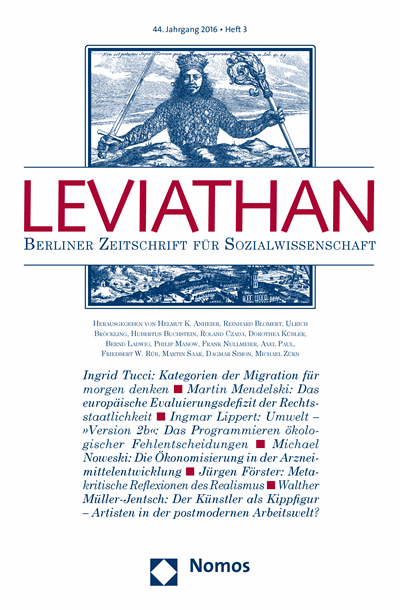
Vollzugriff
Leviathan
Jahrgang 44 (2016), Heft 3
- Autor:innen:
- Verlag
- Nomos, Baden-Baden
- Copyrightjahr
- 2016
- ISSN-Online
- 1861-8588
- ISSN-Print
- 0340-0425
Kapitelinformationen
Vollzugriff
Jahrgang 44 (2016), Heft 3
Umwelt – »Version 2b«: Das Programmieren ökologischer Fehlentscheidungen und Grundlagen für eine neue Umweltpolitik
- Autor:innen:
- ISSN-Print
- 0340-0425
- ISSN-Online
- 1861-8588
- Kapitelvorschau:
Herrschende Umweltpolitik will evidenzbasiert sein, will Umweltfakten nutzen. Auf Grundlage einer Ethnografie der Produktion betrieblicher CO2-Fußabdrücke werden Umweltfakten als Effekt von Arbeit und Datenverarbeitung analysiert. Arbeitspraktisch existiert Umwelt in einem hybriden und taktischen Datenraum. Daraus ergeben sich umweltpolitische Implikationen, die sowohl die Prämissen ökologischer Modernisierung wie auch staatlicher Umweltkontrolle infrage stellen.
Literaturverzeichnis
Es wurden keine Treffer gefunden. Versuchen Sie einen anderen Begriff.
- Asdal, Kristin 2011. „The office: the weakness of numbers and the production of non-authority“, in Accounting, Organizations and Society 36, 1, S. 1-9. Google Scholar öffnen doi.org/10.5771/0340-0425-2016-3-399
- BBC TopGear 2016. Emissions scandal latest: Mitsubishi president steps down, Suzuki involved. Update vom 26. April 2016. www.topgear.com/car-news/insider/emissions-scandal-latest-mitsubishi-president-steps-down-suzuki-involved (Zugriff vom 25.06.2016). Google Scholar öffnen doi.org/10.5771/0340-0425-2016-3-399
- Beene, Ryan 2015. „VW emissions ‚defeat device‘ isn’t the first“, in Autoweek vom 24. September 2015. http://autoweek.com/article/car-news/vw-emissions-defeat-device-isnt-first (Zugriff vom 26.06.2016). Google Scholar öffnen doi.org/10.5771/0340-0425-2016-3-399
- Bowker, Geoffrey C.; Star, Susan Leigh 2000. Sorting things out: classification and consequences. Cambridge: MIT Press Google Scholar öffnen doi.org/10.5771/0340-0425-2016-3-399
- Bumpus, Adam G.; Liverman, Diana M. 2008. „Accumulation by decarbonization and the governance of carbon offsets“, in Economic Geography 84, 2, S. 127-155. Google Scholar öffnen doi.org/10.5771/0340-0425-2016-3-399
- BUND (Bund für Umweltschutz und Naturschutz Deutschland); Miserior 1996. Zukunftsfähiges Deutschland: Ein Beitrag zu einer global nachhaltigen Entwicklung. Berlin: Birkhäuser. Google Scholar öffnen doi.org/10.5771/0340-0425-2016-3-399
- Callon, Michel 1998. „An essay on framing and overflowing: economic externalities revisited by sociology“, in The laws of the markets, hrsg. v. Callon, Michel, S. 244-269. Oxford, Malden: Blackwell. Google Scholar öffnen doi.org/10.5771/0340-0425-2016-3-399
- Carrington, Damian 2015. „Four more carmakers join diesel emissions row“, in The Guardian vom 9. Oktober 2015. www.theguardian.com/environment/2015/oct/09/mercedes-honda-mazda-mitsubishi-diesel-emissions-row (Zugriff vom 25.06.2016). Google Scholar öffnen doi.org/10.5771/0340-0425-2016-3-399
- Chan, Michelle 2009. Subprime carbon? Re-thinking the world’s largest new derivatives market. Technical Report. Washington: Friends of the Earth. Google Scholar öffnen doi.org/10.5771/0340-0425-2016-3-399
- Cronon, William J. 1996. Uncommon ground: rethinking the human place in nature. New York: Norton. Google Scholar öffnen doi.org/10.5771/0340-0425-2016-3-399
- Davies, Alex 2015. „The EPA opposes rules that could’ve exposed VW’s cheating“, in Wired vom 18. September 2015. www.wired.com/2015/09/epa-opposes-rules-couldve-exposed-vws-cheating (Zugriff vom 25.06.2016). Google Scholar öffnen doi.org/10.5771/0340-0425-2016-3-399
- Dingler, Johannes 2003. Postmoderne und Nachhaltigkeit: Eine diskurstheoretische Analyse der sozialen Konstruktion von nachhaltiger Entwicklung. München: ökom. Google Scholar öffnen doi.org/10.5771/0340-0425-2016-3-399
- Edwards, Julia; Prodhan, Georgina 2016. „VW faces billions in fines as U.S. sues for environmental violations“, in Reuters vom 5. Januar 2016. www.reuters.com/article/us-volkswagen-usa-idUSKBN0UI1QP20160105 (Zugriff vom 26.06.2016). Google Scholar öffnen doi.org/10.5771/0340-0425-2016-3-399
- Gad, Christopher; Jensen, Casper Bruun 2010. „On the consequences of post-ANT“, in Science, Technology & Human Values 35, 1, S. 55-80. Google Scholar öffnen doi.org/10.5771/0340-0425-2016-3-399
- Gilbertson, Tamra; Reyes, Oscar 2009. Carbon trading: how it works and why it fails. Critical Currents 7. Uppsala: Dag Hammarskjöld Foundation. Google Scholar öffnen doi.org/10.5771/0340-0425-2016-3-399
- Gitelman, Lisa 2013. Raw data is an oxymoron. Cambridge: MIT Press. Google Scholar öffnen doi.org/10.5771/0340-0425-2016-3-399
- Hajer, Maarten A. 1995. The politics of environmental discourse: ecological modernization and the policy process. Oxford: Clarendon Press. Google Scholar öffnen doi.org/10.5771/0340-0425-2016-3-399
- Huber, Joseph 1988. Die Regenbogen-Gesellschaft. Frankfurt a. M.: Fischer. Google Scholar öffnen doi.org/10.5771/0340-0425-2016-3-399
- ICCT (The International Council on Clean Transportation) 2015. From laboratory to road. A 2015 update of official and „real-world“ fuel consumption and CO2 values for passenger cars in Europe. Berlin. www.theicct.org/sites/default/files/publications/ICCT_LaboratoryToRoad_2015_Report_English.pdf (Zugriff vom 25.06.2016). Google Scholar öffnen doi.org/10.5771/0340-0425-2016-3-399
- IPCC (International Panel on Climate Change) 2013. „Summary for policymakers“, in Climate change 2013: the physical science basis. Contribution of working group I to the fifth assessment report of the Intergovernmental Panel on Climate Change, hrsg. v. Stocker, Thomas F. et al., S. 3-29. Cambridge: Cambridge University Press. Google Scholar öffnen doi.org/10.5771/0340-0425-2016-3-399
- Kalthoff, Herbert 2005. „Practices of calculation: economic representations and risk management“, in Theory, Culture & Society 22, 2, S. 69-97. Google Scholar öffnen doi.org/10.5771/0340-0425-2016-3-399
- Köhler, Benedikt 2010. „Macht der Zahlen, Herrschaft der Statistik – Eine machttheoretische Skizze“, in Macht und Herrschaft in der reflexiven Moderne, hrsg. v. Lau, Christoph; Bonß, Wolfgang, S. 330-357. Weilerswist: Velbrück. Google Scholar öffnen doi.org/10.5771/0340-0425-2016-3-399
- Latour, Bruno 1987. Science in action: how to follow scientists and engineers through society. Cambridge: Harvard University Press. Google Scholar öffnen doi.org/10.5771/0340-0425-2016-3-399
- Law, John; Hassard, John 1999. Actor network theory and after. Oxford, Malden: Blackwell. Google Scholar öffnen doi.org/10.5771/0340-0425-2016-3-399
- Lippert, Ingmar 2011. „Extended carbon cognition as a machine“, in Computational Culture 1, 1. http://computationalculture.net/article/extended-carbon-cognition (Zugriff vom 25.06.2016). Google Scholar öffnen doi.org/10.5771/0340-0425-2016-3-399
- Lippert, Ingmar 2012 a. „Carbon classified? Unpacking heterogeneous relations inscribed into corporate carbon emissions“, in Ephemera 12, 1/2, S. 138-161. Google Scholar öffnen doi.org/10.5771/0340-0425-2016-3-399
- Lippert, Ingmar 2012 b. „Carbon dioxide“, in Encyclopedia of consumption and waste: the social science of garbage, hrsg. v. Zimring, Carl; Rathje, William, S. 105-108. Thousand Oaks: Sage. Google Scholar öffnen doi.org/10.5771/0340-0425-2016-3-399
- Lippert, Ingmar 2013. Enacting environments: an ethnography of the digitalisation and naturalisation of emissions. Dissertation, Philosophisch-Sozialwissenschaftliche Fakultät, Universität Augsburg. Google Scholar öffnen doi.org/10.5771/0340-0425-2016-3-399
- Lippert, Ingmar 2014. „Studying reconfigurations of discourse: tracing the stability and materiality of ›Sustainability/Carbon‹“, in Zeitschrift für Diskursforschung 2, 1, S. 32-54. Google Scholar öffnen doi.org/10.5771/0340-0425-2016-3-399
- Lippert, Ingmar 2015. „Environment as datascape: enacting emission realities in corporate carbon accounting“, in Geoforum 66, S. 125-135. Google Scholar öffnen doi.org/10.5771/0340-0425-2016-3-399
- Lippert, Ingmar 2016 a. „Failing the market, failing deliberative democracy: how scaling up corporate carbon reporting proliferates information asymmetries“, in Big Data & Society (im Erscheinen). Google Scholar öffnen doi.org/10.5771/0340-0425-2016-3-399
- Lippert, Ingmar 2016 b. „Social emissions? Corporate carbon footprinting as techno-political practice“, in The carbon fix, hrsg. v. Fiske, Shirley; Paladino, Stephanie, Kapitel 6. Walnut Creek: Left Coast Press (im Erscheinen). Google Scholar öffnen doi.org/10.5771/0340-0425-2016-3-399
- Mol, Annemarie 2002. The body multiple: ontology in medical practice. Durham: Duke University Press. Google Scholar öffnen doi.org/10.5771/0340-0425-2016-3-399
- Mol, Arthur P. J. 2010. „Social theories of environmental reform: towards a third generation“, in Environmental sociology, hrsg. v. Gross, Matthias; Heinrichs, Harald, S. 19-38. Dordrecht: Springer. Google Scholar öffnen doi.org/10.5771/0340-0425-2016-3-399
- Morgan, Seth 2016. The Volkswagen scandal: a case of vanishing utility. http://policymatters.illinois.edu/the-volkswagen-scandal-a-case-of-vanishing-utility (Zugriff vom 26.06.2016). Google Scholar öffnen doi.org/10.5771/0340-0425-2016-3-399
- Nelson, Douglas 1996. „The political economy of U.S. automobile protection“, in The political economy of American trade policy, hrsg. v. Krueger, Anne O., S. 133-196. Chicago: Chicago University Press. Google Scholar öffnen doi.org/10.5771/0340-0425-2016-3-399
- OECD (Organisation für wirtschaftliche Zusammenarbeit und Entwicklung) 2002. Improving policy coherence and integration for sustainable development. Paris: OECD. Google Scholar öffnen doi.org/10.5771/0340-0425-2016-3-399
- Olwig, Kenneth R. 2002. Landscape, nature, and the body politic. From Britain’s renaissance to America’s new world. Madison: University of Wisconsin Press. Google Scholar öffnen doi.org/10.5771/0340-0425-2016-3-399
- Porter, Theodore 1995. Trust in numbers: the pursuit of objectivity in science and public life. Princeton: Princeton University Press. Google Scholar öffnen doi.org/10.5771/0340-0425-2016-3-399
- Power, Michael 1999. The audit society: rituals of verification. Oxford: Oxford University Press. Google Scholar öffnen doi.org/10.5771/0340-0425-2016-3-399
- RDE-LDV (Real-Driving Emissions-Light-Duty Vehicles Working Group) 2013. A complementary emissions test for light-duty vehicles: assessing the technical feasibility of candidate procedures. Report EUR 25572 EN. Ispra: European Commission, Joint Research Centre, Institute for Energy and Transport. http://publications.jrc.ec.europa.eu/repository/bitstream/JRC75998/ld-na-25572-en-n_online.pdf (Zugriff vom 25.06.2016). Google Scholar öffnen doi.org/10.5771/0340-0425-2016-3-399
- RFF (Ressources for the Future) 2016. Comparing US and EU approaches to regulating automotive emissions and fuel economy. Policy Brief No. 16-03. www.rff.org/files/document/file/RFF-PB-16-03.pdf (Zugriff vom 25.06.2016). Google Scholar öffnen doi.org/10.5771/0340-0425-2016-3-399
- Robson, Keith 1992. „Accounting numbers as inscription: action at a distance and the development of accounting“, in Accounting, Organizations and Society 17, 7, S. 685-708. Google Scholar öffnen doi.org/10.5771/0340-0425-2016-3-399
- Scott, James 1998. Seeing like a state: how certain schemes to improve the human condition have failed. New Haven: Yale University Press. Google Scholar öffnen doi.org/10.5771/0340-0425-2016-3-399
- Stern, Nicholas H. 2006. Stern review: the economics of climate change. Volume 30. London: HM Treasury. Google Scholar öffnen doi.org/10.5771/0340-0425-2016-3-399
- Suchman, Lucy 2007. Human-machine reconfigurations: plans and situated action. New York: Cambridge University Press. Google Scholar öffnen doi.org/10.5771/0340-0425-2016-3-399
- Suchman, Lucy 2012. „Configuration“, in Inventive methods: the happening of the social, hrsg. v. Lury, Celia; Wakeford, Nina, S. 48-60. London: Routledge. Google Scholar öffnen doi.org/10.5771/0340-0425-2016-3-399
- UBA (Umweltbundesamt) 2015. Umwelt, Haushalte und Konsum. Daten zur Umwelt. Dessau: UBA. Google Scholar öffnen doi.org/10.5771/0340-0425-2016-3-399
- VN (Vereinte Nationen) 1992. Agenda 21. Rio de Janeiro: VN. www.un.org/depts/german/conf/agenda21/agenda_21.pdf (Zugriff vom 23.06.2016). Google Scholar öffnen doi.org/10.5771/0340-0425-2016-3-399
- VN (Vereinte Nationen) 2016. COP 21. FCCC/CP/2015/10/Add.1. Paris: VN. http://unfccc.int/resource/docs/2015/cop21/eng/10a01.pdf (Zugriff vom 25.06.2016). Google Scholar öffnen doi.org/10.5771/0340-0425-2016-3-399
- Webel, Baird 2013. Troubled Asset Relief Program (TARP): implementation and status. Congressional Research Service 7-5700, R41427. www.fas.org/sgp/crs/misc/R41427.pdf (Zugriff vom 26.06.2016). Google Scholar öffnen doi.org/10.5771/0340-0425-2016-3-399
- Williams, Ryan 2011. „Do new fuel efficiency numbers add up? Assessing Obama’s new fuel efficiency standards for vehicles sold in the U.S.“, in In These Times vom 9. August 2011. http://inthesetimes.com/article/11812/do_new_fuel_efficiency_numbers_add_up (Zugriff vom 26.06.2016). Google Scholar öffnen doi.org/10.5771/0340-0425-2016-3-399