Refugee Law, Agency and Credibility in Refugee Status Determination in Nairobi, Kenya
Inhaltsverzeichnis
Bibliographische Infos
Vollzugriff
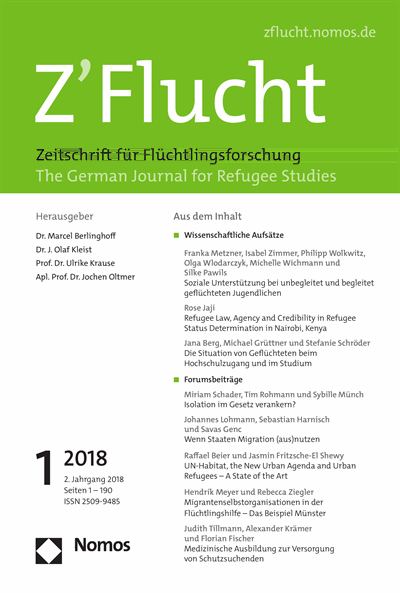
Z'Flucht. Zeitschrift für Flucht- und Flüchtlingsforschung
Jahrgang 2 (2018), Heft 1
- Autor:innen:
- Verlag
- Nomos, Baden-Baden
- Copyrightjahr
- 2018
- ISSN-Online
- 2942-3597
- ISSN-Print
- 2509-9485
Kapitelinformationen
Vollzugriff
Jahrgang 2 (2018), Heft 1
Refugee Law, Agency and Credibility in Refugee Status Determination in Nairobi, Kenya
- Autor:innen:
- ISSN-Print
- 2509-9485
- ISSN-Online
- 2942-3597
- Kapitelvorschau:
Literaturverzeichnis
Es wurden keine Treffer gefunden. Versuchen Sie einen anderen Begriff.
- Alfadhli, Khalifah/Drury, John (2016), Psychosocial support among refugees of conflict in developing countries: a critical literature review, Intervention, 14 (2), 128–141. Google Scholar öffnen doi.org/10.5771/2509-9485-2018-1-3
- Bean, Tammy et al. (2007), Comparing Psychological Distress, Traumatic Stress Reactions, and Experiences of Unaccompanied Refugee Minors With Experiences of Adolescents Accompanied by Parents, Journal of Nervous and Mental Disease, 195 (4), 288–297. Google Scholar öffnen doi.org/10.5771/2509-9485-2018-1-3
- Betancourt, Theresa S. et al. (2012), Connectedness, social support and internalizing emotional and behavioural problems in adolescents displaced by the Chechen conflict, Disasters, 36 (4), 635–655. Google Scholar öffnen doi.org/10.5771/2509-9485-2018-1-3
- Berthold, Megan S. (2000), The Effects of Exposure to Community Violence on Khmer Refugee Adolescents, Journal of Traumatic Stress, 12 (3), 455–471. Google Scholar öffnen doi.org/10.5771/2509-9485-2018-1-3
- Brewin, Chris R./Andrews, Bernice/Valentine, John D. (2000), Meta-Analysis of Risk Factors for Posttraumatic Stress Disorder in Trauma-Exposed Adults, Journal of Consoziale Unterstützunglting and Clinical Psychology, 68 (5), 748–766. Google Scholar öffnen doi.org/10.5771/2509-9485-2018-1-3
- Bronstein, Israel/Montgomery, Paul (2011), Psychological Distress in Refugee Children: A Systematic Review, Clinical Child and Family Psychology Review, (14), 44–56. Google Scholar öffnen doi.org/10.5771/2509-9485-2018-1-3
- Bundesamt für Migration und Flüchtlinge (BAMF) (2017), Das Bundesamt in Zahlen 2016. Asyl, Nürnberg. Google Scholar öffnen doi.org/10.5771/2509-9485-2018-1-3
- Burton, Charles L./Hatzenbuehler, Mark L./Bonanno, George A. (2014), Familial Social Support Predicts a Reduced Cortisol Response to Stress in Sexual Minority Young Adults, Psychoneuroendocrinology, (47), 241–245. Google Scholar öffnen doi.org/10.5771/2509-9485-2018-1-3
- Catani, Claudia (2010), Krieg im Zuhause – ein Überblick zum Zusammenhang zwischen Kriegstraumatisierung und familiärer Gewalt, Verhaltenstherapie, (20), 19–27. Google Scholar öffnen doi.org/10.5771/2509-9485-2018-1-3
- Cohen, Jacob (1988), Statistical Power Analysis for the Behavioral Sciences, 2. Aufl., Abingdon-on-Thames. Google Scholar öffnen doi.org/10.5771/2509-9485-2018-1-3
- Correa-Velez, Ignacio/Gifford, Sandra M./McMichael, Celia (2015), The persistence of predictors of wellbeing among refugee youth eight years after resettlement in Melbourne, Australia, Social Science & Medicine, (142), 163–168. Google Scholar öffnen doi.org/10.5771/2509-9485-2018-1-3
- Dilling, Horst/Mombour, Werner/Schmidt, Martin H. (2013), Internationale Klassifikation psychischer Störungen. ICD-10 Kapitel V(F). Klinisch-diagnostische Leitlinien, 6. Aufl., Bern. Google Scholar öffnen doi.org/10.5771/2509-9485-2018-1-3
- Ditzen, Beate/Heinrichs, Markus (2014), Psychobiology of social support: The social dimension of stress buffering, Restorative Neurology and Neuroscience, 32, 149–162. Google Scholar öffnen doi.org/10.5771/2509-9485-2018-1-3
- Ehntholt, Kimberly A./Yule, William (2006), Practitioner Review: Assessment and treatment of refugee children and adolescents who have experienced war-related trauma, Journal of Child Psychology and Psychiatry, 47 (12), 1197–1210. Google Scholar öffnen doi.org/10.5771/2509-9485-2018-1-3
- Elklit, Ask et al. (2012), Social support, coping and posttraumatic stress symptoms in young refugees, Torture Journal, 22 (1), 11–23. Google Scholar öffnen doi.org/10.5771/2509-9485-2018-1-3
- Fazel, Mina/Garcia, Jo/Stein, Alan (2016), The right location? Experiences of refugee adolescents seen by school-based mental health services, Clinical Child Psychology and Psychiatry, 21 (3), 368–380. Google Scholar öffnen doi.org/10.5771/2509-9485-2018-1-3
- Fydrich, Thomas/Sommer, Gert/Brähler, Elmar (2007), Fragebogen zur Sozialen Unterstützung (F-SozU). Manual, Göttingen. Google Scholar öffnen doi.org/10.5771/2509-9485-2018-1-3
- Hamburger Institut für Berufliche Bildung (HIBB) (2016), Flüchtlinge lernen künftig gleichzeitig in Schule und Betrieb, https://hibb.hamburg.de/2016/04/11/fluechtlinge-lernen-kuenftig-gleichzeitig-in-schule-und-betrieb_aktuelles/, 25.4.2017. Google Scholar öffnen doi.org/10.5771/2509-9485-2018-1-3
- Hensel, Thomas (Hrsg.) (2006), EMDR mit Kindern und Jugendlichen: Ein Handbuch, Göttingen. Google Scholar öffnen doi.org/10.5771/2509-9485-2018-1-3
- Hodes, Matthew/Jagdev, Daljit/Chandra, Navin/ Cunniff, Anna (2008), Risk and resilience for psychological distress amongst unaccompanied asylum seeking adolescents, Journal of Child Psychology and Psychiatry, 49 (7), 723–732. Google Scholar öffnen doi.org/10.5771/2509-9485-2018-1-3
- Hollins, Kathryn et al. (2007), The mental health and social circumstances of Kosovan Albanian and Albanian unaccompanied refugee adolescents living in London, Diversity in Health and Social Care, 4 (4), 277–286. Google Scholar öffnen doi.org/10.5771/2509-9485-2018-1-3
- Hostinar, Camelia E./Gunnar, Megan R. (2013), Future Directions in the Study of Social Relationships as Regulators of the HPA Axis across Development, Journal of Clinical Child and Adolescent Psychology, 42 (4), 564–575. Google Scholar öffnen doi.org/10.5771/2509-9485-2018-1-3
- Liamputtong, Pranee et al. (2016), Peer support groups, mobile phones and refugee women in Melbourne, Health Promotion International, 31 (3), 715–724. Google Scholar öffnen doi.org/10.5771/2509-9485-2018-1-3
- Lindert, Jutta et al. (2017), Angst, Depressionen und posttraumatische Belastungsstörungen bei Flüchtlingen – eine Bestandaufnahme, Psychotherapie, Psychosomatik, Medizinische Psychologie, 68 (1), 22–29. Google Scholar öffnen doi.org/10.5771/2509-9485-2018-1-3
- Lustig, Stuart L. et al. (2004), Review of Child and Adolscent Refugee Mental Health, Journal of the American Academy of Child and Adolscent Psychiatry, 43 (1), 24–36. Google Scholar öffnen doi.org/10.5771/2509-9485-2018-1-3
- Maercker, Andreas/Hecker, Tobias (2016), Trauma- und Gewaltfolgen – psychische Auswirkungen, Bundesgesundheitsblatt – Gesundheitsforschung – Gesundheitsschutz, 59, 28–34. Google Scholar öffnen doi.org/10.5771/2509-9485-2018-1-3
- Makwarimba, Edward et al. (2013), Sudanese and Somali Refugees in Canada: Social Support Needs and Preferences, International Migration, 51 (5), 106–119. Google Scholar öffnen doi.org/10.5771/2509-9485-2018-1-3
- McMichael, Celia/Gifford, Sandra/Correa-Velez, Ignacio (2011), Negotiating family, navigating resettlement: family connectedness amongst resettled youth with refugee backgrounds living in Melbourne, Australia, Journal of Youth Studies, 14 (2), 179–195. Google Scholar öffnen doi.org/10.5771/2509-9485-2018-1-3
- Mels, Cindy/Derluyn, Ilse/Broekaert, Eric (2008), Social support in unaccompanied asylum-seeking boys: a case study, Child: Care, Health and Development, 34 (6), 757–762. Google Scholar öffnen doi.org/10.5771/2509-9485-2018-1-3
- Metzner, Franka et al. (2016), Psychotherapeutische Versorgung von begleiteten und unbegleiteten minderjährigen Flüchtlingen und Asylbewerbern mit Traumafolgestörungen in Deutschland, Bundesgesundheitsblatt – Gesundheitsforschung – Gesundheitsschutz, 59 (5), 645–651. Google Scholar öffnen doi.org/10.5771/2509-9485-2018-1-3
- Nickerson, Angela et al. (2015), Emotion dysregulation mediates the relationship between trauma exposure, post-migration living difficulties and psychological outcomes in traumatized refugees, Journal of Affective Disorders, 173, 185–192. Google Scholar öffnen doi.org/10.5771/2509-9485-2018-1-3
- Oppedal, Brit/Idsoe, Thormod (2015), The role of social support in the acculturation and mental health of unaccompanied minor asylum seekers, Scandinavian Journal of Psychology, 56, 203–211. Google Scholar öffnen doi.org/10.5771/2509-9485-2018-1-3
- Ozer, Emily et al. (2003), Predictors of posttraumatic stress disorder and symptoms in adults: a meta-analysis, Psychological Bulletin, 129 (1), 52–73. Google Scholar öffnen doi.org/10.5771/2509-9485-2018-1-3
- Poppitt, Gillian/Frey, Ron (2007), Sudanese Adolescent Refugees: Acculturation and Acculturative Stress, Australian Journal of Guidance & Counselling, 17 (2), 160–181. Google Scholar öffnen doi.org/10.5771/2509-9485-2018-1-3
- Pynoos, Robert S./Steinberg, Alan M./Piacentini, John C. (1999), A developmental psychopathology model of childhood traumatic stress and intersection with anxiety disorders, Biological Psychiatry, 46 (11), 1542–1554. Google Scholar öffnen doi.org/10.5771/2509-9485-2018-1-3
- Reinelt, Tilman/Vasileva, Mira/Petermann, Franz (2016), Psychische Auffälligkeiten von Flüchtlingskindern. Eine Blickverengung durch die Posttraumatische Belastungsstörung?, Kindheit und Entwicklung, 25, 231–237. Google Scholar öffnen doi.org/10.5771/2509-9485-2018-1-3
- Renner, Walter/Laireiter, Anton-Rupert/Maier, Marco J. (2012), Social support as a moderator of acculturative stress among refugees and asylum seekers, Social Behavior and Personality: An international journal, 40, 129–146. Google Scholar öffnen doi.org/10.5771/2509-9485-2018-1-3
- Ruf-Leuschner, Martina/Roth, Maria/Schauer, Maggie (2014), Traumatisierte Mütter – traumatisierte Kinder? Eine Untersuchung des transgenerationalen Zusammenhangs von Gewalterfahrungen und Traumafolgestörungen in Flüchtlingsfamilien, Zeitschrift für Klinische Psychologie und Psychotherapie, 43, 1–16. Google Scholar öffnen doi.org/10.5771/2509-9485-2018-1-3
- Rücker, Stefan et al. (2017), Resilient oder Risikogruppe? Psychische Belastungen bei unbegleiteten minderjährigen Ausländern (umA) in Deutschland, Prax. Kinderpsychol. Kinderpsychiat, 66, 242–258. Google Scholar öffnen doi.org/10.5771/2509-9485-2018-1-3
- Schnurr, Paula P./Lunney, Carole A./Segupta, Anjana (2004), Risk factors for the development versus maintenance of posttraumatic stress disorder, Journal of Traumatic Stress, 17 (2), 85–95. Google Scholar öffnen doi.org/10.5771/2509-9485-2018-1-3
- Schweitzer, Robert et al. (2006), Trauma, post-migration living difficulties, and social support as predictors of psychological adjustment in resettled Sudanese refugees, Australian and New Zealand Journal of Psychiatry, 40 (2), 179–187. Google Scholar öffnen doi.org/10.5771/2509-9485-2018-1-3
- Sleijpen, Mariekem et al. (2016), Growing from experience: an exploratory study of posttraumatic growth in adolescent refugees, European Journal of Psychotraumatology, 7, 1–10. Google Scholar öffnen doi.org/10.5771/2509-9485-2018-1-3
- Stewart, Miriam et al. (2008), Multicultural Meanings of Social Support among Immigrants and Refugees, International Migration, 46 (3), 123–159. Google Scholar öffnen doi.org/10.5771/2509-9485-2018-1-3
- Stewart, Miriam J. (2010), Social support and health: immigrants' and refugees' perspectives, Diversity in Health & Care, 7 (2), 91–103. Google Scholar öffnen doi.org/10.5771/2509-9485-2018-1-3
- Uchino, Bert N. et al. (2012), Psychologial pathways linking social support to health outcomes: A vistit with the ghosts of research past, present and future, Social Science and Medicine, 74 (7), 949–957. Google Scholar öffnen doi.org/10.5771/2509-9485-2018-1-3
- United Nations High Commissioner for Refugees (2017), Global Trends. Forced Displacement in 2016, http://www.unhcr.org/5943e8a34.pdf, 10.5.2018. Google Scholar öffnen doi.org/10.5771/2509-9485-2018-1-3
- United Nation High Commissioner for Refugees (UNHCR)/Unicef/International Organization for Migration (IOM) (2017), Refugee and Migrant Children – Including Unaccompanied and Separated Children – in the EU, https://data2.unhcr.org/en/documents/download/55971, 25.4.2017. Google Scholar öffnen doi.org/10.5771/2509-9485-2018-1-3
- Wallin, Anne-Marie M./Ahlström, Gerd I. (2005), Unaccompanied young adult refugees in Sweden, experiences of their life situation and well-being: a qualitative follow-up study, Ethnicity & Health, 10 (2), 129–144. Google Scholar öffnen doi.org/10.5771/2509-9485-2018-1-3
- Walker, Rae et al. (2015), Social connectedness and mobile phone use among refugee women in Australia, Health & Social Care in the Community, 23 (3), 325–336. Google Scholar öffnen doi.org/10.5771/2509-9485-2018-1-3
- Wells, Karen (2011), The strength of weak ties: the social networks of young separated asylum seekers and refugees in London, Children’s Geographies, 9 (3–4), 319–329. Google Scholar öffnen doi.org/10.5771/2509-9485-2018-1-3
- Wiesner, Reinhard (2016), Hilfe für junge volljährige Flüchtlinge, Jugendhilfe, 54 (3), 236–244. Google Scholar öffnen doi.org/10.5771/2509-9485-2018-1-3
- Wolpe, Joseph (1973), The practice of behavior therapy, Oxford. Google Scholar öffnen doi.org/10.5771/2509-9485-2018-1-3
- Zindler, Areej/Metzner, Franka (2016), Die Geister der Flucht vertreiben, Projekt Psychotherapie, 3, 27–29. Google Scholar öffnen doi.org/10.5771/2509-9485-2018-1-3
- Amit, Roni (2011), No Refuge: Flawed Status Determination and the Failures of South Africa’s Refugee System to Provide Protection, International Journal of Refugee Law, 23 (3), 458–488. Google Scholar öffnen doi.org/10.5771/2509-9485-2018-1-32
- Behrman, Simon (2014), Legal Subjectivity and the Refugee, International Journal of Refugee Law, 26 (1), 1–21. Google Scholar öffnen doi.org/10.5771/2509-9485-2018-1-32
- Chimni, B. S. (1998), The Geopolitics of Refugee Studies: A View from the South, Journal of Refugee Studies, 11 (4), 350–374. Google Scholar öffnen doi.org/10.5771/2509-9485-2018-1-32
- Chimni, B. S. (2004), From Resettlement to Involuntary Repatriation: Towards a Critical History of Durable Solutions to Refugee Problems, Refugee Survey Quarterly, 23 (3), 55–73. Google Scholar öffnen doi.org/10.5771/2509-9485-2018-1-32
- Coffey, Guy (2003), The Credibility of Credibility Evidence at the Refugee Review Tribunal, International Journal of Refugee Law, 15 (3), 377–417. Google Scholar öffnen doi.org/10.5771/2509-9485-2018-1-32
- FAHAMU (2011), Rwanda: Cessation of Refugee Status is Unwarranted, Memorandum of Fact and Law, 22.9.2011, http://www.refugeelegalaidinformation.org/sites/srlan/files/fileuploads/Memo%20of%20and%20Law.pdf, 28.2.2015. Google Scholar öffnen doi.org/10.5771/2509-9485-2018-1-32
- France-Rwanda Tribune (2012), UNHCR Accused of Abandoning Rwandan Refugees, France-Rwanda Tribune, 20 January 2012, http://www.france-rwanda.info/article-unhcr-accused-of-abandoning-rwandan-refugees-97499862.html, 27.12.2017. Google Scholar öffnen doi.org/10.5771/2509-9485-2018-1-32
- Foucault, Michel (1977), Discipline and Punish: The Birth of the Prison, London. Google Scholar öffnen doi.org/10.5771/2509-9485-2018-1-32
- Foucault, Michel (1979), The History of Sexuality, Vol. 1: An Introduction, London. Google Scholar öffnen doi.org/10.5771/2509-9485-2018-1-32
- Foucault, Michel (1980), Power/Knowledge Selected Interviews and Other Writings 1972–1977, Hemel Hempstead. Google Scholar öffnen doi.org/10.5771/2509-9485-2018-1-32
- Gibb, Robert/Good, Anthony (2013), Do Facts Speak for Themselves? Country of Origin Information in French and British Refugee Status Determination Procedures, International Journal of Refugee Law, 25 (2), 291–322. Google Scholar öffnen doi.org/10.5771/2509-9485-2018-1-32
- Giddens, Anthony (1984), The Constitution of Society Outline of the Theory of Structuration, Cambridge. Google Scholar öffnen doi.org/10.5771/2509-9485-2018-1-32
- Gilboy, Janet A. (2005), Deciding who gets in: Decision-making by Immigration Inspectors, in: Moore, Sally F. (ed.), Law and Anthropology: A Reader, Malden, 289–302. Google Scholar öffnen doi.org/10.5771/2509-9485-2018-1-32
- Gorlick, Brian (2003), Common Burdens and Standards: Legal Eements in Assessing Claims to Refugee Status, International Journal of Refugee Law, 15 (3), 357–376. Google Scholar öffnen doi.org/10.5771/2509-9485-2018-1-32
- Harrell-Bond, Barbara E. (1986), Imposing Aid: Emergency Assistance to Refugees, Oxford. Google Scholar öffnen doi.org/10.5771/2509-9485-2018-1-32
- Harrell-Bond, Barbara E./Voutira, Eftihia/Leopold, Mark (1992), Counting the Refugees: Gifts, Givers, Patrons and Clients, Journal of Refugee Studies, 5 (3/4), 205–225. Google Scholar öffnen doi.org/10.5771/2509-9485-2018-1-32
- Herlihy, Jane/Gleeson, Kate/Turner, Stuart (2010), What Assumptions about Human Behaviour Underlie Asylum Judgements?, International Journal of Refugee Law, 22 (3), 351–366. Google Scholar öffnen doi.org/10.5771/2509-9485-2018-1-32
- Human Rights Watch (2009), From Horror to Hopelessness: Kenya’s Forgotten Somali Refugee Crisis, New York. Google Scholar öffnen doi.org/10.5771/2509-9485-2018-1-32
- Human Rights Watch (2013), »You are all Terrorists«: Kenyan Police Abuse of Refugees in Nairobi, New York. Google Scholar öffnen doi.org/10.5771/2509-9485-2018-1-32
- Inhetveen, Katharina (2006), Situative Fluchten. Mobilität und Macht in einem sambischen Flüchtlingslager, in Inhetveen, Katharina (Hg.), Flucht als Politik. Berichte von fünf Kontinenten, Köln, 81–102. Google Scholar öffnen doi.org/10.5771/2509-9485-2018-1-32
- IRIN (2011), Rwandan Refugees Reluctant to Repatriate, IRIN, 2.11.2011, http://irinnews.org/report794029/migration-rwandan-refugees-reluctant-to-repatriate>, 28.12.2017. Google Scholar öffnen doi.org/10.5771/2509-9485-2018-1-32
- Jaji, Rose (2009), Refugee Women and the Experiences of Local Integration in Nairobi, Kenya, PhD thesis, Bayreuth University. Google Scholar öffnen doi.org/10.5771/2509-9485-2018-1-32
- Jenkins, Richard (1992), Pierre Bourdieu, London. Google Scholar öffnen doi.org/10.5771/2509-9485-2018-1-32
- Juma, Monica K./Kagwanja, Peter M. (2003), Securing Refuge from Terror Refugee Protection in East Africa after September 11, in: Steiner, Niklaus/Loescher, Gil/Gibney, Mark (eds.), Problems of Protection The UNHCR, Refugees, and Human Rights, London, 225–236. Google Scholar öffnen doi.org/10.5771/2509-9485-2018-1-32
- Kibreab, Gaim (2004), Pulling the Wool over the Eyes of the Strangers: Refugee Deceit and Trickery in Institutionalised Settings, Journal of Refugee Studies, 17 (1), 1–26. Google Scholar öffnen doi.org/10.5771/2509-9485-2018-1-32
- Kingston, Lindsey N. (2017), Bringing Rwandan Refugees ›Home‹: The Cessation Clause, Statelessness, and Forced Repatriation, International Journal of Refugee Law, 2017, 29 (3), 417–437. Google Scholar öffnen doi.org/10.5771/2509-9485-2018-1-32
- Long, Norman (2001), Development Sociology Actor Perspectives, London. Google Scholar öffnen doi.org/10.5771/2509-9485-2018-1-32
- Malkki, Liisa M. (1995), Purity and Exile: Violence, Memory, and National Cosmology among Hutu Refugees in Tanzania, Chicago. Google Scholar öffnen doi.org/10.5771/2509-9485-2018-1-32
- Malkki, Liisa M. (1997), Speechless Emissaries: Refugees, Humanitarianism, and Dehistoricization, in: Olwig, Karen F./Hastrup Kirsten (eds.), Siting Culture the Shifting Anthropological Object, London, 223–254. Google Scholar öffnen doi.org/10.5771/2509-9485-2018-1-32
- McMillan, Kelly E, (2012), Uganda’s Invocation of Cessation regarding its Rwandan Refugee Caseload: Lessons for International Protection, International Journal of Refugee Law, 24 (2), 231–262. Google Scholar öffnen doi.org/10.5771/2509-9485-2018-1-32
- Moore, Sally F. (2000), Law as Process: An Anthropological Approach, Oxford. Google Scholar öffnen doi.org/10.5771/2509-9485-2018-1-32
- Shamir, Ronen (2005), Without Borders? Notes on Globalization as a Mobility Regime, Sociological Theory, 23 (2), 197–217. Google Scholar öffnen doi.org/10.5771/2509-9485-2018-1-32
- Scott, James (1985), Weapons of the Weak. Everyday Forms of Peasant Resistance, New Haven. Google Scholar öffnen doi.org/10.5771/2509-9485-2018-1-32
- Shandy, Dianna J. (2007), Nuer-American Passages. Globalizing Sudanese Migration, Florida. Google Scholar öffnen doi.org/10.5771/2509-9485-2018-1-32
- Smith-Khan, Laura (2017), Different in the Same Way? Language, Diversity, and Refugee Credibility, International Journal of Refugee Law, 29 (3), 389–416. Google Scholar öffnen doi.org/10.5771/2509-9485-2018-1-32
- The Citizen (2018), Ethiopia says 9 Civilians Killed in Accidental Shooting, The Citizen, 9.3.2018, http://www.thecitizen.co.tz/News/Ethiopia-says-9-civilians-killed-in-accidental-shooting/1840386-4339534-vf8d7dz/index.html, 10.3.2018. Google Scholar öffnen doi.org/10.5771/2509-9485-2018-1-32
- Turner, Simon (2006), Biopolitics and Bare Life in a Refugee Camp: Some Conceptual Reflections, in: Inhetveen, Katharina (Hg.), Flucht als Politik. Berichte von fünf Kontinenten, Köln, 39–62. Google Scholar öffnen doi.org/10.5771/2509-9485-2018-1-32
- Verdirame, Guglielmo (1999), Human Rights and Refugees: The Case of Kenya, Journal of Refugee Studies, 12 (1), 54–77. Google Scholar öffnen doi.org/10.5771/2509-9485-2018-1-32
- Verdirame, Guglielmo/Harrell-Bond, Barbara E. (2005), Rights in Exile Janus-Faced Humanitarianism, New York. Google Scholar öffnen doi.org/10.5771/2509-9485-2018-1-32
- Wagacha, John B./Guiney, John (2008), The Plight of Urban Refugees in Nairobi, Kenya, in: Hollenbach, David (ed.), Refugee Rights Ethics, Advocacy, and Africa, Washington D.C., 91–101. Google Scholar öffnen doi.org/10.5771/2509-9485-2018-1-32
- Zambelli, Pia (2017), Hearing Differently: Knowledge-Based Approaches to Assessment of Refugee Narrative, International Journal of Refugee Law, 29 (1), 10–41. Google Scholar öffnen doi.org/10.5771/2509-9485-2018-1-32
- Zetter, Roger (1991), Labelling Refugees: Forming and Transforming a Bureaucratic Identity, Journal of Refugee Studies, 4 (1), 39–62. Google Scholar öffnen doi.org/10.5771/2509-9485-2018-1-32
- Apolinarski, Beate/Poskowsky, Jonas (2013), Ausländische Studierende in Deutschland 2012. Ergebnisse der 20. Sozialerhebung des Deutschen Studentenwerks, Berlin. Google Scholar öffnen doi.org/10.5771/2509-9485-2018-1-57
- Bajwa, Jaswant Kaur, et al. (2017), Refugees, Higher Education, and Informational Barriers, Refuge: Canada's Journal on Refugees, 33 (2), 56–65. Google Scholar öffnen doi.org/10.5771/2509-9485-2018-1-57
- Baker, Sally, et al. (2017), ›Hot‹, ›Cold‹ and ›Warm‹ Supports. Towards Theorising where Refugee Students go for Assistance at University, Teaching in High¬er Education, 37 (1), 1–16. Google Scholar öffnen doi.org/10.5771/2509-9485-2018-1-57
- Behrensen, Birgit/Westphal, Manuela (2009), Beruflich erfolgreiche Migrantinnen. Rekonstruktion ihrer Wege und Handlungsstrategien, Osnabrück. Google Scholar öffnen doi.org/10.5771/2509-9485-2018-1-57
- Berg, Charles/Milmeister, Marianne (2008), Im Dialog mit den Daten das eigene Erzählen der Geschichte finden. Über die Kodierverfahren der Grounded-Theory-Methodologie, Forum: Qualitative Sozialforschung, 9 (2), Art. 13, http://nbnresolving.de/urn:nbn:de:0114-fqs0802138, 25.5.2018. Google Scholar öffnen doi.org/10.5771/2509-9485-2018-1-57
- Berg, Jana (2018), A new Aspect of Internationalization? Specific Challenges and Support Structures for Refugees on their Way to German Higher Education, in: Curaj, Adrian/ Deca, Ligia/ Pricopie, Remus (Hrsg.), European Higher Education Area: The Impact of Past and Future Policies, (im Druck). Google Scholar öffnen doi.org/10.5771/2509-9485-2018-1-57
- Binder, Susanne (2004), Kategorisch ausgeklammert. Die Kategorie gender in der Asylpolitik, L’Homme, 15 (2), 216–232. Google Scholar öffnen doi.org/10.5771/2509-9485-2018-1-57
- Blumenthal, Julia von, et al. (2017), Institutionelle Anpassungsfähigkeit von Hochschulen, in: Solidarität im Wandel?, Berlin, 226–249. Google Scholar öffnen doi.org/10.5771/2509-9485-2018-1-57
- BMFSFJ (2018), Hintergrundmeldung: Richtlinie ›Garantiefonds Hochschule‹, 15.1.2018, https://www.bmfsfj.de/bmfsfj/themen/kinder-und-jugend/integration-und-chancen-fuer-junge-menschen/garantiefonds-hochschule, 29.1.2018. Google Scholar öffnen doi.org/10.5771/2509-9485-2018-1-57
- Bogner, Alexander/Littig, Beate/Menz, Wolfgang (2014), Interviews mit Experten. Eine praxisorientierte Einführung, Wiesbaden. Google Scholar öffnen doi.org/10.5771/2509-9485-2018-1-57
- Brooker, Abi/Lawrence, Jeanette, A. (2012), Educational and Cultural Challenges of Bicultural Adult Immigrant and Refugee Students in Australia, Australian Journal of Adult Learning, 52 (1), 66–88. Google Scholar öffnen doi.org/10.5771/2509-9485-2018-1-57
- Brücker, Herbert/Rother, Nina/Schupp, Jürgen (2016), IAB-BAMF-SOEP-Befragung von Geflüchteten. Überblick und erste Ergebnisse, Berlin. Google Scholar öffnen doi.org/10.5771/2509-9485-2018-1-57
- Crea, Thomas M. (2016), Refugee Higher Education. Contextual Challenges and Implications for Program Design, Delivery, and Accompaniment, In¬ter¬na¬tion¬al Journal of Educational Development, 46, 12–22. Google Scholar öffnen doi.org/10.5771/2509-9485-2018-1-57
- DAAD/DZHW (2017), Integration von Flüchtlingen an deutschen Hochschulen. Erkenntnisse aus den Hochschulprogrammen für Flüchtlinge, Bonn. Google Scholar öffnen doi.org/10.5771/2509-9485-2018-1-57
- Earnest, Jaya, et al. (2010), Are Universities Responding to the Needs of Students from Refugee Backgrounds?, Australian Journal of Education, 54 (2), 155–174. Google Scholar öffnen doi.org/10.5771/2509-9485-2018-1-57
- Eppenstein, Thomas (2017), ›Geflüchtete‹ als Bildungsaspiranten und Flucht als Gegenstand für eine Bildung in der Weltgesellschaft, in: Ghaderi, Cinur/Eppenstein, Thomas (Hrsg.), Flüchtlinge, Wiesbaden, 147–168. Google Scholar öffnen doi.org/10.5771/2509-9485-2018-1-57
- Fortin, Nicole/Lemieux, Thomas/Torres, Javier (2016), Foreign Human Capital and the Earnings Gap between Immigrants and Canadian-born Workers, Labour Economics, 41, 104–119. Google Scholar öffnen doi.org/10.5771/2509-9485-2018-1-57
- Frank, Andrea/Sickendiek, Ursel (2016), Geflüchtete auf dem Weg ins Studium begleiten, http://www.forschung-und-lehre.de/wordpress/?p=21015, 29.1.2018. Google Scholar öffnen doi.org/10.5771/2509-9485-2018-1-57
- Gateley, Davina E. (2015), A Policy of Vulnerability or Agency? Refugee Young People‘s Opportunities in Accessing Further and Higher Education in the UK, Compare: A Journal of Comparative and International Education, 45 (1), 26–46. Google Scholar öffnen doi.org/10.5771/2509-9485-2018-1-57
- Hannah, Janet (1999), Refugee Students at College and University: Improving Access and Support, International Review of Education, 45 (2), 153–166. Google Scholar öffnen doi.org/10.5771/2509-9485-2018-1-57
- Harris, Anne/Ngum Chi Watts, Mimmie C./Spark, Ceridwen (2013), The Barriers that only you can see: African Australian Women thriving in Tertiary Education despite the Odds, Multidisciplinary Journal of Gender Studies, 2 (2), 182–202. Google Scholar öffnen doi.org/10.5771/2509-9485-2018-1-57
- Harris, Anne/Spark, C./Ngum Chi Watts, Mimmie C. (2015), Gains and Losses: African Australian Women and Higher Education, Journal of Sociology, 51 (2), 370–384. Google Scholar öffnen doi.org/10.5771/2509-9485-2018-1-57
- Harris, Vandra/Marlowe, Jay (2011), Hard Yards and High Hopes: The Educational Challenges of African Refugee University Students in Australia, International Journal of Teaching and Learning in Higher Education, 23 (2), 186–196. Google Scholar öffnen doi.org/10.5771/2509-9485-2018-1-57
- Hartog, Joop/Zorlu, Aslan (2009), How Important is Homeland Education for Refugees’ Economic Position in The Netherlands?, Journal of Population Economics, 22 (1), 219–246. Google Scholar öffnen doi.org/10.5771/2509-9485-2018-1-57
- Heublein, Ulrich (2015), Von den Schwierigkeiten des Ankommens. Überlegungen zur Studiensituation ausländischer Studierender an den deutschen Hochschulen, Die Neue Hochschule, (1), 14–17. Google Scholar öffnen doi.org/10.5771/2509-9485-2018-1-57
- Hirano, Eliana (2014), Refugees in first-year College: Academic Writing Challenges and Resources’, Journal of Second Language Writing, 23 (1), 37–52. Google Scholar öffnen doi.org/10.5771/2509-9485-2018-1-57
- Hirano, Eliana (2015), ›I read, I don‘t understand‹. Refugees Coping with Academic Reading, ELT Journal, 69 (2), 178–187. Google Scholar öffnen doi.org/10.5771/2509-9485-2018-1-57
- Iwers-Stelljes, Telse/Bosse, Elke/Heudorfer, Anna (2016), Universitäre Umgangsweisen mit den Herausforderungen von Flucht und Migration. Eine Fallanalyse, Gruppe Interaktion Organisation, 47 (3), 215–223. Google Scholar öffnen doi.org/10.5771/2509-9485-2018-1-57
- Joyce, Andrew, et al. (2010), The Experiences of Students from Refugee Backgrounds at Universities in Australia. Reflections on the Social, Emotional and Practical Challenges, Journal of Refugee Studies, 23 (1), 82–97. Google Scholar öffnen doi.org/10.5771/2509-9485-2018-1-57
- Kanno, Yasuko/Varghese, Manka M. (2010), Immigrant and Refugee ESL Students‘ Challenges to Accessing Four-Year College Education: From Language Policy to Educational Policy, Journal of Language, Identity, and Education, 9 (5), 310–328. Google Scholar öffnen doi.org/10.5771/2509-9485-2018-1-57
- Kao, Grace/Tienda, Marta (1995), Optimism and Achievement: the Educational Performance of Immigrant Youth, Social Science Quarterly, 76 (1), 1–19. Google Scholar öffnen doi.org/10.5771/2509-9485-2018-1-57
- Kiefer, Ute (2014), Erfahrungen marokkanischer Studierender an Hochschulen in Deutschland, Wiesbaden. Google Scholar öffnen doi.org/10.5771/2509-9485-2018-1-57
- Kosyakova, Yuliya/Sirries, Steffen (2017), Large-Scale Immigration and Labour Market Integration: First Lessons from the Recent Past in Germany, Intereconomics, 52 (5), 263–269. Google Scholar öffnen doi.org/10.5771/2509-9485-2018-1-57
- Lambert, Laura/Blumenthal, Julia von/Beigang, Steffen (2018), Flucht und Bildung: Hochschulen. State-of-Research Papier 8b, Verbundprojekt ›Flucht: Forschung und Transfer‹, https://flucht-forschung-transfer.de/flucht-und-bildung-hochschulen, 25.5.2018. Google Scholar öffnen doi.org/10.5771/2509-9485-2018-1-57
- Lenette, Caroline (2016), University Students from Refugee Backgrounds. Why Should We Care? Higher Education Research & Development, 35 (6), 1311–1315. Google Scholar öffnen doi.org/10.5771/2509-9485-2018-1-57
- Mangan, Doireann/Winter, Laura A. (2017), (In)validation and (Mis)recognition in Higher Education: the Experiences of Students from Refugee Backgrounds, International Journal of Lifelong Education, 36 (4), 486–502. Google Scholar öffnen doi.org/10.5771/2509-9485-2018-1-57
- McWilliams, Julia Ann/Bonet, Sally Wesley (2016), Continuums of Precarity. Refugee Youth Transitions in American High Schools, International Journal of Lifelong Education, 35 (2), 153–170. Google Scholar öffnen doi.org/10.5771/2509-9485-2018-1-57
- Moher, David, et al. (2009), Preferred Reporting Items for Systematic Reviews and Meta-Analyses: The PRISMA Statement, PLoS Medicine, 6 (7), 1–6. Google Scholar öffnen doi.org/10.5771/2509-9485-2018-1-57
- Morrice, Linda (2009), Journeys into Higher Education: The Case of Refugees in the UK, Teaching in Higher Education, 14 (6), 661–672. Google Scholar öffnen doi.org/10.5771/2509-9485-2018-1-57
- Morrice, Linda (2013), Refugees in Higher Education. Boundaries of Belonging and Recognition, Stigma and Exclusion, International Journal of Lifelong Education, 32 (5), 652–668. Google Scholar öffnen doi.org/10.5771/2509-9485-2018-1-57
- Morris-Lange, Simon (2017), Allein durch den Hochschuldschungel. Hürden zum Studienerfolg für internationale Studierende und Studierende mit Migrationshintergrund, Berlin. Google Scholar öffnen doi.org/10.5771/2509-9485-2018-1-57
- Naidoo, Loshini (2015), Educating Refugee-background Students in Australian Schools and Universities, Intercultural Education, 26, 210–217. Google Scholar öffnen doi.org/10.5771/2509-9485-2018-1-57
- Nohl, Arnd-Michael, et al. (Hrsg.) (2014), Work in Transition. Cultural Capital and Highly Skilled Migrants‘ Passades into the Labour Market, Toronto. Google Scholar öffnen doi.org/10.5771/2509-9485-2018-1-57
- Onsando, Gerald/Billett, Stephen (2009), African Students from Refugee Backgrounds in Australian TAFE Institutes: A Case for Transformative Learning Goals and Processes, International Journal of Training Research, 7 (2), 80–94. Google Scholar öffnen doi.org/10.5771/2509-9485-2018-1-57
- Plasterer, Robyn (2010), Investigating Integration. The Geographies of the WUSC Student Refugee Program at the University of British Columbia, Refuge: Canada's Journal on Refugees, 27 (1), 59–74. Google Scholar öffnen doi.org/10.5771/2509-9485-2018-1-57
- R Student/Kendall, Kathleen/Day, Lawrence (2017), Being a Refugee University Student: A Collaborative Auto-ethnography, Journal of Refugee Studies, 30 (4), 580–604. Google Scholar öffnen doi.org/10.5771/2509-9485-2018-1-57
- Schammann, Hannes (2015), Wenn Variationen den Alltag bestimmen. Unterschiede lokaler Politikgestaltung in der Leistungsgewährung für Asylsuchende, Zeitschrift für Vergleichende Politikwissenschaft, 9 (3), 161–182. Google Scholar öffnen doi.org/10.5771/2509-9485-2018-1-57
- Schammann, Hannes/Younso, Christin (2016), Studium nach der Flucht? Angebote deutscher Hochschulen für Studieninteressierte mit Fluchterfahrung, Hildesheim. Google Scholar öffnen doi.org/10.5771/2509-9485-2018-1-57
- Schammann, Hannes/Younso, Christin (2017), Endlich Licht in einer dunklen Ecke? Hürden und Angebote für Geflüchtete im tertiären Bildungsbereich, ZEP: Zeitschrift für internationale Bildungsforschung und Entwicklungspädagogik, 40 (1), 10–15. Google Scholar öffnen doi.org/10.5771/2509-9485-2018-1-57
- Sen, Amartya (1999), Development as Freedom, New York. Google Scholar öffnen doi.org/10.5771/2509-9485-2018-1-57
- Shakya, Yogendra B., et al. (2010), Aspirations for Higher Education among Newcomer Refugee Youth in Toronto: Expectations, Challenges, and Strategies, Refuge, 27 (2), 65–78. Google Scholar öffnen doi.org/10.5771/2509-9485-2018-1-57
- Shapiro, Shawna (2015), A ›Slippery Slope‘ toward too much Support‹? Ethical Quandaries among College Faculty/Staff Working with Refugee-background Students, in: Feuerherm, Emily M./Ramanathan, Vaidehi (Hrsg.), Refugee Resettlement in the United States: Language, Policy, Pedagogy, Bristol, 118–134. Google Scholar öffnen doi.org/10.5771/2509-9485-2018-1-57
- Sommer, Ilka (2015), Die Gewalt des kollektiven Besserwissens. Kämpfe um die Anerkennung ausländischer Berufsqualifikationen in Deutschland, Bielefeld. Google Scholar öffnen doi.org/10.5771/2509-9485-2018-1-57
- Spiteri, Damian (2015), Experiences of Young (Minor) Asylum Seekers in Further Education in Malta, International Journal of Lifelong Education, 34 (2), 156–171. Google Scholar öffnen doi.org/10.5771/2509-9485-2018-1-57
- Stevenson, Jacqueline/Willott, John (2007), The Aspiration and Access to Higher Education of Teenage Refugees in the UK, Compare: a Journal of Comparative Education, 37 (5), 671–687. Google Scholar öffnen doi.org/10.5771/2509-9485-2018-1-57
- Stevenson, Jacqueline/Willott, John (2010), Refugees: Home Students with International Needs, in: Jones, Elspeth (Hrsg.), Internationalisation and the Student Voice, New York, 193–202. Google Scholar öffnen doi.org/10.5771/2509-9485-2018-1-57
- Steward, Barbara (2004), Writing a Literature Review, British Journal of Occupational Therapy, 67 (11), 495–500. Google Scholar öffnen doi.org/10.5771/2509-9485-2018-1-57
- Täubig, Vicki (2009), Totale Institution Asyl: empirische Befunde zu alltäglichen Lebensführungen in der organisierten Desintegration, Weinheim. Google Scholar öffnen doi.org/10.5771/2509-9485-2018-1-57
- Thielen, Marc (2009), Freies Erzählen im totalen Raum? – Machtprozeduren des Asylverfahrens in ihrer Bedeutung für biografische Interviews mit Flüchtlingen, Forum: Qualitative Sozialforschung, 10 (1), Art. 39, http://nbnresolving.de/urn:nbn:de:0114-fqs0901393, 25.5.2018. Google Scholar öffnen doi.org/10.5771/2509-9485-2018-1-57
- Treibel, Annette (2010), Von der exotischen Person zur gesellschaftlichen Normalität: Migrantinnen in der soziologischen Forschung und Lehre, in: Hentges, Gudrun/Hinnenkamp, Volker/Zwengel, Almut (Hrsg.), Migrations- und Integrationsforschung in der Diskussion, Wiesbaden, 141–169. Google Scholar öffnen doi.org/10.5771/2509-9485-2018-1-57
- Van Hear, Nicholas/Brubaker, Rebecca/Bessa, Thais (2009), Managing Mobility for Human Development: the Growing Salience of Mixed Migration, New York. Google Scholar öffnen doi.org/10.5771/2509-9485-2018-1-57
- Van Hear, Nicholas (2012), Forcing the Issue: Migration Crises and the Uneasy Dialogue between Refugee Research and Policy, Journal of Refugee Studies, 25 (1), 2–24. Google Scholar öffnen doi.org/10.5771/2509-9485-2018-1-57
- Webster, Jane/Watson, Richard T. (2002), Analyzing the Past to Prepare for the Future: Writing a Literature Review, MIS Quarterly, 26 (2), xiii–xxiii. Google Scholar öffnen doi.org/10.5771/2509-9485-2018-1-57
- Weed, Mike (2005), ›Meta Interpretation‹. A Method for the Interpretive Synthesis of Qualitative Research, Forum: Qualitative Sozialforschung, 6 (1). Art. 37, http://nbn-resolving.de/urn:nbn:de:0114-fqs0501375, 25.5.2018. Google Scholar öffnen doi.org/10.5771/2509-9485-2018-1-57
- Alexandropoulou, Magdalini/Leucht, Christoph/Salimovska, Sabina (2016), Pilotstudie ›Gewährleistung der Kinderrechte in den Aufnahme- und Rückführungseinrichtungen für Asylbewerber mit geringer Bleibeperspektive‹, http://www.fluechtlingsrat-bayern.de/tl_files/2016_PDF-Dokumente/PILOT%20STUDIE%20Kinderrechte%20in%20ARE%202%20-%20final.pdf, 8.5.2018. Google Scholar öffnen doi.org/10.5771/2509-9485-2018-1-91
- Andrae, Agnes/Reiss, Tom (2017), There ARE Problems in Bavaria, Hinterland #35, http://www.hinterland-magazin.de/wp-content/uploads/2017/09/hinterland-magazin35-44-there-are-problems.pdf, 8.5.2018. Google Scholar öffnen doi.org/10.5771/2509-9485-2018-1-91
- Arbeitsgemeinschaft der kommunalen Spitzenverbände Niedersachsens (2016), 12. Bericht zur Finanzlage der kommunalen Gebietskörperschaften in Niedersachsen, Hannover, 21.9.2016. Google Scholar öffnen doi.org/10.5771/2509-9485-2018-1-91
- BAfF (2018), Stellungnahme zu den Ergebnissen der Sondierungsgespräche,, http://www.baff-zentren.org/news/stellungnahme-zu-den-ergebnissen-der-sondierungsgespraeche/, 19.1.2018. Google Scholar öffnen doi.org/10.5771/2509-9485-2018-1-91
- BAMF (2018a), Asylgeschäftsbericht für den Monat Februar 2018, http://www.bamf.de/SharedDocs/Anlagen/DE/Downloads/Infothek/Statistik/Asyl/201802-statistik-anlage-asyl-geschaeftsbericht.pdf?__blob=publicationFile, 8.5.2018. Google Scholar öffnen doi.org/10.5771/2509-9485-2018-1-91
- BAMF (2018b), Aktuelle Zahlen zu Asyl, Ausgabe: Februar 2018, http://www.bamf.de/SharedDocs/Anlagen/DE/Downloads/Infothek/Statistik/Asyl/aktuelle-zahlen-zu-asyl-februar-2018.pdf?__blob=publicationFile, 8.5.2018. Google Scholar öffnen doi.org/10.5771/2509-9485-2018-1-91
- Bayerischer Landtag (2017), Drucksache 17/17526, http://www1.bayern.landtag.de/www/ElanTextAblage_WP17/Drucksachen/Schriftliche%20Anfragen/17_0017526.pdf, 7.5.2018. Google Scholar öffnen doi.org/10.5771/2509-9485-2018-1-91
- Bayerischer Landtag (2018), Drucksache 17/20841, http://www1.bayern.landtag.de/www/ElanTextAblage_WP17/Drucksachen/Basisdrucksachen/0000014000/0000014107.pdf, 7.5.2018. Google Scholar öffnen doi.org/10.5771/2509-9485-2018-1-91
- Bayerisches Staatsministerium des Innern und für Integration (2015), Herrmann besucht Ankunfts- und Rückführungseinrichtung in Bamberg, http://www.innenministerium.bayern.de/med/aktuell/archiv/2015/151113besuchbamberg/, 8.5.2018. Google Scholar öffnen doi.org/10.5771/2509-9485-2018-1-91
- Bogumil, Jörg/Hafner, Jonas/Kastilan, André (2017), Städte und Gemeinden in der Flüchtlingspolitik. Welche Probleme gibt es – und wie kann man sie lösen?, https://www.stiftung-mercator.de/de/publikation/staedte-und-gemeinden-in-der-fluechtlingspolitik/, 7.5.2018. Google Scholar öffnen doi.org/10.5771/2509-9485-2018-1-91
- Bogumil, Jörg/Hafner, Jonas/Kuhlmann, Susanne (2016), Verwaltungshandeln in der Flüchtlingskrise, Verwaltung und Management, 22 (3), 126–136. Google Scholar öffnen doi.org/10.5771/2509-9485-2018-1-91
- BR-Autoren (2017), Transitzentrum Deggendorf. Angeblicher Hungerstreik: Regierung weist Kritik zurück, Bayerischer Rundfunk (BR), 18.12.2017, https://www.br.de/nachrichten/niederbayern/inhalt/angelicher-hungerstreik-fluechtlinge-kuendigen-demo-an-100.html, 8.5.2018. Google Scholar öffnen doi.org/10.5771/2509-9485-2018-1-91
- Deutscher Städtetag (2015), Aufnahme und Integration von Zuwanderern, Asylbewerbern und Flüchtlingen, http://www.staedtetag.de/presse/beschluesse/073198/index.html, 8.5.2018. Google Scholar öffnen doi.org/10.5771/2509-9485-2018-1-91
- Färber, Gisela/Köppen, Dominique (2017), Flüchtlingsaufnahme und -integration – Eine Frage des Geldes?, Sozialer Fortschritt, 66 (11), 759–787. Google Scholar öffnen doi.org/10.5771/2509-9485-2018-1-91
- Gewerkschaft der Polizei (2018), Ablehnung des Einsatzes der Bundespolizei in sogenannten ›AnKER‹-Zentren, 12.4.2018, http://www.fluechtlingsinfo-berlin.de/fr/pdf/GdP_180412_Ablehnung_AnKER-Zentren.pdf, 7.5.2018. Google Scholar öffnen doi.org/10.5771/2509-9485-2018-1-91
- Göttinger Tageblatt (2017), Auf der Siekhöhe am teuersten, 29.4.2017, http://www.goettinger-tageblatt.de/Die-Region/Goettingen/Kosten-Goettinger-Fluechtlingsunterkuenfte-Siekhoehe-am-teuersten, 29.4.2017. Google Scholar öffnen doi.org/10.5771/2509-9485-2018-1-91
- Heinhold, Hubert (2018), Presseerklärung: Regelbeschulung auch für Kinder des Transit-Zentrum Manching, http://www.fluechtlingsrat-bayern.de/tl_files/2018/pdf%20Dokumente%202018/PMHeinholdREgelbschung2018.pdf, 8.5.2018. Google Scholar öffnen doi.org/10.5771/2509-9485-2018-1-91
- Ibler, Martin (2017), Art. 87 GG, in: Maunz, Theodor/Dürig, Günter (Hrsg.), Grundgesetz: Kommentar, München, 1 236. Google Scholar öffnen doi.org/10.5771/2509-9485-2018-1-91
- INGA – Infobusautor*innen gegen Abschiebungen (2017), »Du kannst diese zwei Brotscheiben nicht mit nach draußen nehmen«, Hinterland #34, http://www.hinterland-magazin.de/wp-content/uploads/2017/05/hinterland-magazin34-du-kannst-diese-zwei-brotscheiben-nicht-28.pdf, 8.5.2018. Google Scholar öffnen doi.org/10.5771/2509-9485-2018-1-91
- Karakayali, Juliane, et al. (2016), Willkommensklassen: Mit separierter Beschulung zur Inklusion? (2/4) Präsentation der Forschungsergebnisse aus dem Projekt ›Die Beschulung neu zugewanderter und geflüchteter Kinder in Berlin – Praxis und Herausforderungen‹, Video-Mitschnitt, https://www.bim-fluchtcluster.hu-berlin.de/de/einblicke/einblicke, 13.12.2016. Google Scholar öffnen doi.org/10.5771/2509-9485-2018-1-91
- Kleff, Sanem (2016), Migration und Schule: Eine historische Einordnung, Kommentar zur Präsentation der Forschungsergebnisse aus dem Projekt ›Die Beschulung neu zugewandeter und geflüchteter Kinder in Berlin – Praxis und Herausforderungen‹, Video-Mitschnitt, https://www.bim-fluchtcluster.hu-berlin.de/de/einblicke/einblicke, 13.12.2016. Google Scholar öffnen doi.org/10.5771/2509-9485-2018-1-91
- Lobenstein, Caterina (2018), Asylpolitik. Müssen diese Menschen ins Ankerzentrum? Die Zeit, 16.5.2018, https://www.zeit.de/2018/21/asylpolitik-horst-seehofer-ankerzentren-abschiebungen, 16.5.2018. Google Scholar öffnen doi.org/10.5771/2509-9485-2018-1-91
- Müller, Andrea (2018), Polizei kritisiert Pläne für Abschiebezentren. Aufsicht in Anker-Zentren: »Mit uns nicht!«, Südwestrundfunk (SWR), 25.4.2018, https://www.swr.de/swraktuell/Bundespolizei-kritisiert-Plaene-fuer-Abschiebezentren-Wir-wollen-keine-Lagerpolizei-sein,ankerzentrum-100.html, 8.5.2018. Google Scholar öffnen doi.org/10.5771/2509-9485-2018-1-91
- Neukirch, Ralf/Pfister, René/Wiedmann-Schmidt, Wolf, »Ich bin für mehr Härte«, Der Spiegel, 21.4.2018, S. 34. Google Scholar öffnen doi.org/10.5771/2509-9485-2018-1-91
- NoDeportation.Nowhere (2017), Bayern, Land der Lager. Und der Proteste, Hinterland #35, http://www.hinterland-magazin.de/wp-content/uploads/2017/09/hinterland-magazin35-49-bayern-land-der-lager.pdf, 8.5.2018. Google Scholar öffnen doi.org/10.5771/2509-9485-2018-1-91
- Olmer, Michael (2018), Bayerns Asyl-Sonderzentren verfehlen wohl geltendes Gesetz, München, Bayerischer Rundfunk, 19.2.2018, https://www.br.de/nachrichten/bayerns-asyl-sonderzentren-verfehlen-wohl-geltendes-recht-100.html, 8.5.2018. Google Scholar öffnen doi.org/10.5771/2509-9485-2018-1-91
- Pieper, Tobias (2013), Die Gegenwart der Lager. Zur Mikrophysik der Herrschaft in der deutschen Flüchtlingspolitik, Münster. Google Scholar öffnen doi.org/10.5771/2509-9485-2018-1-91
- Sachs, Michael (2018), Art. 87 GG, in: Sachs, Michael (Hrsg.), Grundgesetz: Kommentar, München, 1743–1763. Google Scholar öffnen doi.org/10.5771/2509-9485-2018-1-91
- Schader, Miriam (i.E.), Total spontan? ›Krisen‹bearbeitung in der lokalen Aufnahme Geflüchteter, in: Bresselau, Agnes von (Hrsg.), Migration, Refugees and Asylum. Concepts, Actors, Practices since the Second World War in Global Perspective. Göttingen. Google Scholar öffnen doi.org/10.5771/2509-9485-2018-1-91
- Schammann, Hannes/Kühn, Boris (2016), Kommunale Flüchtlingspolitik in Deutschland, Bonn. Google Scholar öffnen doi.org/10.5771/2509-9485-2018-1-91
- Scheible, Jana A. (2018), Alphabetisierung und Deutscherwerb von Geflüchteten: Deutschkenntnisse und Förderbedarfe von Erst- und Zweitschriftlernenden in Integrationskursen, BAMF-Kurzanalyse, http://www.bamf.de/SharedDocs/Anlagen/DE/Publikationen/Kurzanalysen/kurzanalyse10_iab-bamf-soep-befragung-gefluechtete-alphabetisierung.pdf?__blob=publicationFile, 8.5.2018. Google Scholar öffnen doi.org/10.5771/2509-9485-2018-1-91
- Schweizerische Eidgenossenschaft, Sekretariat für Migration SEM, Evaluation Testbetrieb (2015), https://www.sem.admin.ch/dam/data/sem/asyl/beschleunigung/testbetrieb/ber-sem-ergebnisse-eval-testbetrieb-d.pdf, 7.5.2018. Google Scholar öffnen doi.org/10.5771/2509-9485-2018-1-91
- Thym, Daniel (2016), Die Auswirkungen des Asylpakets II, Neue Zeitschrift für Verwaltungsrecht, (7), 409–415. Google Scholar öffnen doi.org/10.5771/2509-9485-2018-1-91
- Vertovec, Steven, et al. (2017), Addressing the diversity of asylum-seekers’ needs and aspirations. A Report to the Volkswagen Foundation, MMG Working Papers, Nr. 17-05, http://www.mmg.mpg.de/fileadmin/user_upload/documents/wp/WP_17-05_Vertovec_Addressing%20the%20diversity%20of%20asylum-seekers%92%20.pdf, 8.5.2018. Google Scholar öffnen doi.org/10.5771/2509-9485-2018-1-91
- Weiß, Lisa (2017), Was zentrale Asylzentren für Flüchtlinge bedeuten können, München, Bayrischer Rundfunk, 10.10.2017, https://www.br.de/nachrichten/oberbayern/inhalt/was-zentrale-asylzentren-fuer-fluechtlinge-wie-manching-und-bamberg-bedeuten-100.html, 8.5.2018. Google Scholar öffnen doi.org/10.5771/2509-9485-2018-1-91
- Wendel, Kay (2014), Unterbringung von Flüchtlingen in Deutschland: Regelungen und Praxis der Bundesländer im Vergleich, https://www.proasyl.de/wp-content/uploads/2015/04/Laendervergleich_Unterbringung_2014-09-23_01.pdf, 8.5.2018 Google Scholar öffnen doi.org/10.5771/2509-9485-2018-1-91
- Ahmadoun, Souad (2014), Turkey’s Policy toward Syrian Refugees. Domestic Repercussions and the Need for International Support, https://www.swp-berlin.org/fileadmin/contents/products/comments/2014C47_ahmadoun.pdf, 3.11.2017. Google Scholar öffnen doi.org/10.5771/2509-9485-2018-1-108
- Anderson, Ruben (2014), Illegality, Inc. Clandestine Migration and the Business of Bordering Europe, Oakland. Google Scholar öffnen doi.org/10.5771/2509-9485-2018-1-108
- Barbero, Iker (2012), Expanding Acts of Citizenship. The Struggles of Sinpapeles Migrants, Social and Legal Studies, 21 (4), 529–547. Google Scholar öffnen doi.org/10.5771/2509-9485-2018-1-108
- Belton, Kristy (2012), Weapons of Mass Migration. Forced Displacement, Coercion, and Foreign Policy by Kelly M. Greenhill, Political Studies Review, 10 (2), 257–258. Google Scholar öffnen doi.org/10.5771/2509-9485-2018-1-108
- Berntsen, Lisa E. (2015), Agency of Labour in a Flexible Pan-European Labour Market. A Qualitative Study of Migrant Practices and Trade Union Strategies in the Netherlands, Jyväskylä. Google Scholar öffnen doi.org/10.5771/2509-9485-2018-1-108
- Bradley, Megan (2014), Rethinking Refugeehood. Statelessness, Repatriation, and Refugee Agency, Review of International Studies, 40 (1), 101–123. Google Scholar öffnen doi.org/10.5771/2509-9485-2018-1-108
- Castles, Stephen/de Haas, Hein/Miller, Mark. J. (2013), The Age of Migration. International Population Movements in the Modern World, Basingstoke. Google Scholar öffnen doi.org/10.5771/2509-9485-2018-1-108
- Carrera, Sergio/Hernández, Raül (2009), The Externalisation of the EU’s Labour Immigration Policy: Towards Mobility or Insecurity Partnerships, Centre for European Policy Studies Working Paper, Nr. 321. Google Scholar öffnen doi.org/10.5771/2509-9485-2018-1-108
- Cernadas, Pablo C. (2009), European Migration Control in the African Territory. The Omission of the Extraterritorial Character of Human Rights Obligations, Sur International Journal on Human Rights, 6 (10), 179–202. Google Scholar öffnen doi.org/10.5771/2509-9485-2018-1-108
- Collyer, Michael (2012), Migrants as Strategic Actors in the European Unions’s Global Approach to Migration and Mobility, Global Networks, 12 (4), 505–524. Google Scholar öffnen doi.org/10.5771/2509-9485-2018-1-108
- Choi, Seung-Whan/Salehyan, Idean (2013), No Good Deed Goes Unpunished. Refugees, Humanitarian Aid, and Terrorism, Conflict Management and Peace Science, 30 (1), 53–75. Google Scholar öffnen doi.org/10.5771/2509-9485-2018-1-108
- Corabatir, Metin (2016), Turkey’s Migration Governance and Development of Migration Policies, https://www.migrationpolicy.org/sites/default/files/publications/TCM-Dev-Corabatir-FINALWEB.pdf, 3.11.2017. Google Scholar öffnen doi.org/10.5771/2509-9485-2018-1-108
- Dedja, Sokol (2012), The Working of EU Conditionality in the Area of Migration Policy. The Case of Readmission of Irregular Migrants to Albania, East European Politics & Societies, 26 (1), 115–143. Google Scholar öffnen doi.org/10.5771/2509-9485-2018-1-108
- del Sarto, Raffaela A. (2010), Borderlands. The Middle East and North Africa as the EU’s Southern Buffer Zone, in: Bechev, Dimitar/Nicolaidis, Kalypso (Hrsg.), Mediterranean Frontiers. Borders, Conflicts and Memory in a Transnational World, London, 149–167. Google Scholar öffnen doi.org/10.5771/2509-9485-2018-1-108
- Die Welt (2016), Recep Erdogan erpresst Europa mit Flüchtlingen. Türkei droht, die Grenzübergänge wieder zu öffnen. Bundesregierung und EU reagieren verhalten, https://www.welt.de/print/die_welt/article159776074/Recep-Erdogan-erpresst-Europa-mit-Fluechtlingen.html, 24.10.2017. Google Scholar öffnen doi.org/10.5771/2509-9485-2018-1-108
- Duran, Jorge/Massey, Douglas/Parrado, Emilio A. (1999), The New Era of Mexican Migration to the United States, The Journal of American History, 86 (2), 518–536. Google Scholar öffnen doi.org/10.5771/2509-9485-2018-1-108
- Genc, Savas (2017), Analyse Türkei. Wende zur Diktatur, WeltTrends, 25 (132), 58–62. Google Scholar öffnen doi.org/10.5771/2509-9485-2018-1-108
- Greenhill, Kelly M. (2010), Weapons of Mass Migration. Forced Displacement, Coercion, and Foreign Policy, Ithaca. Google Scholar öffnen doi.org/10.5771/2509-9485-2018-1-108
- Greenhill, Kelly M. (2015), Demographic Bombing. People as Weapons in Syria and Beyond. https://www.foreignaffairs.com/articles/2015-12-17/demographic-bombing, 17.12.2015. Google Scholar öffnen doi.org/10.5771/2509-9485-2018-1-108
- Greenhill, Kelly M. (2016a), Massenmigration als Waffe. Vertreibung, Erpressung und Außenpolitik, Rottenburg a.N. Google Scholar öffnen doi.org/10.5771/2509-9485-2018-1-108
- Greenhill, Kelly M. (2016b), Migration as a Weapon in Theory and in Practice, Military Review, 96 (6), 23–36. Google Scholar öffnen doi.org/10.5771/2509-9485-2018-1-108
- Greenhill, Kelly M. (2016c), Open Arms Behind Barred Doors. Fear, Hypocrisy and Policy Schizophrenia in the European Migration Crisis, European Law Journal, 22 (3), 317–332. Google Scholar öffnen doi.org/10.5771/2509-9485-2018-1-108
- Greenhill, Kelly M. (2016d), Strategic Engineered Migration as a Weapon of War, Transnational Law Review, 39, 615–636. Google Scholar öffnen doi.org/10.5771/2509-9485-2018-1-108
- Greenhill, Kelly M. (2016e), When Virtues Become Vices. The Achilles' Heel of Migration Social Policy, in: Freemann, Gary. P./Mirilovic, Nikola (Hrsg.), Handbook on Migration and Social Policy, Northampton, 199–221. Google Scholar öffnen doi.org/10.5771/2509-9485-2018-1-108
- Hampshire, James (2016), Speaking With one Voice? The European Union’s Global Approach to Migration and Mobility and the Limits of International Migration Cooperation, Journal of Ethnic and Migration Studies, 42 (4), 571–586. Google Scholar öffnen doi.org/10.5771/2509-9485-2018-1-108
- H-Diplo (2013), ISSF Roundtable, 5 (3), https://issforum.org/ISSF/PDF/ISSF-Roundtable-5-3.pdf, 24.10.2017. Google Scholar öffnen doi.org/10.5771/2509-9485-2018-1-108
- Hofmann, Rainer/Schmidt, Adela (2016), Die Erklärung EU-Türkei vom 18.3.2016 aus rechtlicher Sicht, Neue Zeitschrift für Verwaltungsrecht, 35 (11), 1–9. Google Scholar öffnen doi.org/10.5771/2509-9485-2018-1-108
- Hollifield, James F./Wong Tom K. (2015), The Politics of International Migration. How can we „Bring the State Back In?“, in: Brettel, Caroline B./Hollifield, James F. (Hrsg.), Migration Theory. Talking Across Disciplines, London, 227–288. Google Scholar öffnen doi.org/10.5771/2509-9485-2018-1-108
- IOM – International Organisation of Migration (2016), Study on Migrants’ Profiles. Drivers of Migration and Migratory Trends, http://www.italy.iom.int/sites/default/files/news-documents/Migrants%20Study%20-%20FINAL%20ENG%20VERSION%20-%20ELEC.pdf, 3.11.2017. Google Scholar öffnen doi.org/10.5771/2509-9485-2018-1-108
- Jakob, Christian/Schlindwein, Simone (2017), Diktatoren als Türsteher Europas. Wie die EU ihre Grenzen nach Afrika verlagert, Berlin. Google Scholar öffnen doi.org/10.5771/2509-9485-2018-1-108
- Kingdon, John W. (1984), Agendas, Alternatives, and Public Policies, Boston. Google Scholar öffnen doi.org/10.5771/2509-9485-2018-1-108
- Loescher, Gil/Scanlan, John. A. (1986), Calculated Kindness. Refugees and America’s Half Open Door 1945 to the Present, New York. Google Scholar öffnen doi.org/10.5771/2509-9485-2018-1-108
- Luedtke, Adam (2012), Weapons of Mass Migration: Forced Displacement, Coercion and Foreign Policy by Kelly M. Greenhill, The Journal of Nationalism and Ethnicity, 40 (5), 818–819. Google Scholar öffnen doi.org/10.5771/2509-9485-2018-1-108
- Lutterbeck, Derek (2006), Policing Migration in the Mediterranean, Mediterranean Politics, 11 (1), 6–82. Google Scholar öffnen doi.org/10.5771/2509-9485-2018-1-108
- Mearsheimer, John (2011), Why Leaders Lie. The truth about Lying in In¬ter¬na¬tion¬al Politics, Oxford. Google Scholar öffnen doi.org/10.5771/2509-9485-2018-1-108
- Miller, Mark J. (1999), The Prevention of Unauthorized Migration, in: Bernstein, Ann/Weiner, Myron (Hrsg.), Migration and Refugee Policies. An Overview, London, 20–44. Google Scholar öffnen doi.org/10.5771/2509-9485-2018-1-108
- Morrow, James D. (1999), The Strategic Setting of Choices: Signaling, Commitment, and Negotiation in International Politics, in: Lake, David A./Powell, Robert (Hrsg.), Strategic Choice and International Relations, Princeton, 77–114. Google Scholar öffnen doi.org/10.5771/2509-9485-2018-1-108
- Rinelli, Lorenzo (2016), African Migrants and Europe. Managing the Ultimate Frontier, Abingdon. Google Scholar öffnen doi.org/10.5771/2509-9485-2018-1-108
- Rudolph, Christopher (2011), Book Review of Weapons of Mass Migration. Forced Displacement, Coercions and Foreign Policy by Kelly M. Greenhill, Perspectives on Politics, 9 (3), 673–674. Google Scholar öffnen doi.org/10.5771/2509-9485-2018-1-108
- Schulze Wessel, Julia (2017), Grenzfiguren. Zur politischen Theorie des Flüchtlings, Bielefeld. Google Scholar öffnen doi.org/10.5771/2509-9485-2018-1-108
- Spiegel (2015), Zynisches Spiel mit Flüchtlingen. Drohung aus Griechenland, http://www.spiegel.de/politik/ausland/griechenland-politiker-wollen-fluechtlinge-nach-deutschland-schicken-a-1022548.html, 24.10.2017. Google Scholar öffnen doi.org/10.5771/2509-9485-2018-1-108
- Stedman, John/Tanner, Fred (Hrsg.) (2003), Refugee Manipulation: War, Politics and the Abuse of Human Suffering, Washington, D.C. Google Scholar öffnen doi.org/10.5771/2509-9485-2018-1-108
- Stelzer, Irwin M. (2001), Immigration Policy for an Age of Mass Movement, Policy, 17 (4), 3–10. Google Scholar öffnen doi.org/10.5771/2509-9485-2018-1-108
- Taylor, Savitri (2005), From Border Control to Migration Management. The Chase for a Paradigm Change in the Western Response to Transborder Population Movement, Social Policy & Administration, 39 (6), 563–586. Google Scholar öffnen doi.org/10.5771/2509-9485-2018-1-108
- Toshkov, Dimiter/de Haan, Laura (2013), The Europeanization of Asylum Policy. An Assessment of the EU Impact on Asylum Applications and Recognitions Rates, Journal of European Public Policy, 20 (5), 661–83. Google Scholar öffnen doi.org/10.5771/2509-9485-2018-1-108
- Trauner, Florian/Turton, Jocelyn (2017), »Welcome Culture«. The Emergence and Transformation of a Public Debate on Migration, Austrian Journal of Political Science, 46 (1), 33–42. Google Scholar öffnen doi.org/10.5771/2509-9485-2018-1-108
- Tsoukala, Anastassia (2005), Looking at the Migrants as Enemies, in: Bigo, Didier/Guild, Elspeth (Hrsg.), Controlling Frontiers: Free Movements into and within Europe, Aldershot, 161–192. Google Scholar öffnen doi.org/10.5771/2509-9485-2018-1-108
- Vaughan-Williams, Nick (2015), Europe’s Border Crisis. Biopolitical Security and Beyond, Oxford. Google Scholar öffnen doi.org/10.5771/2509-9485-2018-1-108
- Waterfield, Bruno (2015), Greece's Defence Minister Threatens to Send Migrants Including Jihadists to Western Europe, The Telegraph, Online, 9.3.2015, http://www.telegraph.co.uk/news/worldnews/islamic-state/11459675/Greeces-defence-minister-threatens-to-send-migrants-including-jihadists-to-Western-Europe.html, 3.11.2017. Google Scholar öffnen doi.org/10.5771/2509-9485-2018-1-108
- Wonders, Nancy (2015), Transforming Borders from Below, in: Weber, Leanne (Hrsg.), Rethinking Border Control for a Globalising World. A Preferred Future, New York, 190–198. Google Scholar öffnen doi.org/10.5771/2509-9485-2018-1-108
- Yildiz, Ayzelin Gözde (2016), The European Union’s Immigration Policy. Managing Migration in Turkey and Morocco, London. Google Scholar öffnen doi.org/10.5771/2509-9485-2018-1-108
- Zaun, Natascha (2016), Why EU Asylum Standards Exceed the Lowest Common Denominator. The Role of Regulatory Expertise in EU Decision-making, Journal of European Public Policy, 23 (1), 136–154. Google Scholar öffnen doi.org/10.5771/2509-9485-2018-1-108
- Zogata-Kusz, Agnieska (2012), Theoretical Perspectives on Immigration Policy and Politics, Contemporary European Studies, 20 (1), 5–21. Google Scholar öffnen doi.org/10.5771/2509-9485-2018-1-108
- Annez, Patricia C./Buckley, Robert M. (2009), Urbanization and Growth. Setting the Context, in: Spence, Michael/Annez, Patricia C./Buckley, Robert M. (eds.), Urbanization and Growth, Washington, 1–45. Google Scholar öffnen doi.org/10.5771/2509-9485-2018-1-128
- Archer, Diane/Dodman, David (2017), Editorial: The Urbanization of Humanitarian Crises, Environment & Urbanization, 29 (2), 339–348. Google Scholar öffnen doi.org/10.5771/2509-9485-2018-1-128
- Beier, Raffael/Fritzsche, Jasmin (2017), Refugees and the City: UN-Habitat’s New Urban Agenda, Forced Migration Review, 55, 29–30. Google Scholar öffnen doi.org/10.5771/2509-9485-2018-1-128
- Bernstein, Jesse/Okello, Moses C. (2007), To Be or Not To Be: Urban Refugees in Kampala, Refuge, 24 (1), 46–56. Google Scholar öffnen doi.org/10.5771/2509-9485-2018-1-128
- Brenner, Neil/Schmid, Christian (2014), The ›Urban Age‹ in Question, In¬ter¬na¬tion¬al Journal of Urban and Regional Research, 38 (3), 731–755. Google Scholar öffnen doi.org/10.5771/2509-9485-2018-1-128
- Brenner, Neil/Schmid, Christian (2015), Towards a New Epistemology of the Urban? City, 19 (2–3), 151–182. Google Scholar öffnen doi.org/10.5771/2509-9485-2018-1-128
- Chaaban, Jad et al. (2010), Socio-Economic Survey of Palestinian Refugees in Lebanon, https://www.unrwa.org/userfiles/2011012074253.pdf, 22.12.2017. Google Scholar öffnen doi.org/10.5771/2509-9485-2018-1-128
- Cohen, Michael A. (2016), From Habitat II to Pachamama. A Growing Agenda and Diminishing Expectations for Habitat III, Environment & Urbanization, 28 (1), 35–48. Google Scholar öffnen doi.org/10.5771/2509-9485-2018-1-128
- Crisp, Jeff (2017), Finding Space for Protection: An Inside Account on the Evolution of UNHCR’s Urban Refugee Policy, Refuge, 33 (1), 87–96. Google Scholar öffnen doi.org/10.5771/2509-9485-2018-1-128
- Dalal, Ayham (2013), The Emergence of Habitat in Zaatari Camp in Jordan: Between Humanitarian and Socio-cultural Order, Trialog, 112/113 (1–2), 43–48. Google Scholar öffnen doi.org/10.5771/2509-9485-2018-1-128
- Doebele, William A. (1987), The Evolution of Concepts of Urban Land Tenure in Developing Countries, Habitat International, 11 (1), 7–22. Google Scholar öffnen doi.org/10.5771/2509-9485-2018-1-128
- Fawaz, Mona (2017), Planning and the Refugee Crisis. Informality as a Framework of Analysis and Reflection, Planning Theory, 16 (1), 99–115. Google Scholar öffnen doi.org/10.5771/2509-9485-2018-1-128
- Fox, Sean/Goodfellow, Tom (2016), Cities and Development, 2nd edition, Abingdon. Google Scholar öffnen doi.org/10.5771/2509-9485-2018-1-128
- Hardoy, Jorge/Satterthwaite, David (1989), Squatter Citizen. Life in the Urban Third World, London. Google Scholar öffnen doi.org/10.5771/2509-9485-2018-1-128
- Hovil, Lucy (2007), Self-settled Refugees in Uganda: An Alternative Approach to Displacement?, Journal of Refugee Studies, 20 (4), 599–620. Google Scholar öffnen doi.org/10.5771/2509-9485-2018-1-128
- Hovil, Lucy (2014), Local Integration, in Fiddian-Qasmyeh et al. (ed.) The Oxford Handbook of Refugee and Forced Migration Studies, Oxford, 488–498. Google Scholar öffnen doi.org/10.5771/2509-9485-2018-1-128
- Jacobsen, Karen (2002), Livelihoods in Conflict: The Pursuit of Livelihoods by Refugees and the Impact on the Human Security of Host Communities, International Migration, 40 (5), 95–123. Google Scholar öffnen doi.org/10.5771/2509-9485-2018-1-128
- Jacobsen, Karen (2006), Refugees and Asylum Seekers in Urban Areas: A Livelihoods Perspective, Journal of Refugee Studies, 19 (3), 273–286. Google Scholar öffnen doi.org/10.5771/2509-9485-2018-1-128
- Kibreab, Gaim (2007), Why Governments Prefer Spatially Segregated Settlement Sites for Urban Refugees, Refuge, 24 (1), 27–35. Google Scholar öffnen doi.org/10.5771/2509-9485-2018-1-128
- Krause, Ulrike (2016), Limitations of Development-oriented Assistance in Uganda, Forced Migration Review, 52, 51–53. Google Scholar öffnen doi.org/10.5771/2509-9485-2018-1-128
- Lefèbvre, Henri (1970), La révolution urbaine, Paris. Google Scholar öffnen doi.org/10.5771/2509-9485-2018-1-128
- Mangin, William (1967), Latin American Squatter Settlements: A Problem and a Solution, Latin American Research Review, 2 (3), 65–98. Google Scholar öffnen doi.org/10.5771/2509-9485-2018-1-128
- Merrifield, Andy (2013), The Urban Question under Planetary Urbanization, International Journal of Urban and Regional Research, 37 (3), 909–922. Google Scholar öffnen doi.org/10.5771/2509-9485-2018-1-128
- Schmidt-Kallert, Einhard (2017), Magnet Stadt. Urbanisierung im Globalen Süden, Bonn. Google Scholar öffnen doi.org/10.5771/2509-9485-2018-1-128
- Simmel, Georg (2010 [1903]), The Metropolis and Mental Life, in: Bridge, Gary/Watson, Sophie (eds.), The Blackwell City Reader, 2nd edition, Oxford, 103–110. Google Scholar öffnen doi.org/10.5771/2509-9485-2018-1-128
- Smart, Alan (2012), Squatter Settlement Clearance, in: Smith, Susan J. (ed.) International Encyclopedia of Housing and Home, Volume 7, Oxford, 11–15. Google Scholar öffnen doi.org/10.5771/2509-9485-2018-1-128
- Terada, Yuka/Evans, David/Mwaniki, Dennis (2017), Planning for the Integration of Refugee and Host Communities in Turkana County, Kenya, Forced Migration Review, 55, 52–54. Google Scholar öffnen doi.org/10.5771/2509-9485-2018-1-128
- Turner, John F.C. (1967), Barriers and Channels for Housing Development in Modernizing Countries, Journal of the American Institute of Planners, 33 (3), 167–181. Google Scholar öffnen doi.org/10.5771/2509-9485-2018-1-128
- Turner, John F.C. (1969), Uncontrolled Urban Settlement: Problems and Policies, in: Breese, Gerald W. (ed.), The City in Newly Developing Countries. Read¬ings on Urbanism and Urbanization, Englewood Cliffs, 507–534. Google Scholar öffnen doi.org/10.5771/2509-9485-2018-1-128
- Turner, John F.C. (1977), Housing by People: Towards Autonomy in Building Environments, New York. Google Scholar öffnen doi.org/10.5771/2509-9485-2018-1-128
- United Nations (1976), The Vancouver Declaration on Human Settlements, http://mirror.unhabitat.org/downloads/docs/The_Vancouver_Declaration.pdf, 22.12.2017. Google Scholar öffnen doi.org/10.5771/2509-9485-2018-1-128
- United Nations (UN) (1996), The Habitat Agenda, http://www.un-documents.net/hab-ag.htm, 22.12.2017. Google Scholar öffnen doi.org/10.5771/2509-9485-2018-1-128
- United Nations (UN) (2013), World Population Policies 2013, http://www.un.org/en/development/desa/population/publications/policy/world-population-policies-2013.shtml, 27.12.2017. Google Scholar öffnen doi.org/10.5771/2509-9485-2018-1-128
- United Nations (UN) (2017), New Urban Agenda, http://habitat3.org/the-new-urban-agenda/, 22.12.2017. Google Scholar öffnen doi.org/10.5771/2509-9485-2018-1-128
- United Nations High Commissioner for Refugees (UNHCR) (1997), UNHCR Comprehensive Policy on Urban Refugees, http://www.refworld.org/pdfid/41626fb64.pdf, 27.12.2017. Google Scholar öffnen doi.org/10.5771/2509-9485-2018-1-128
- United Nations High Commissioner for Refugees (UNHCR) (2009), UNHCR Policy on Refugee Protection and Solutions in Urban Areas, http://www.unhcr.org/protection/hcdialogue%20/4ab356ab6/unhcr-policy-refugee-protection-solutions-urban-areas.html, 27.12.2017. Google Scholar öffnen doi.org/10.5771/2509-9485-2018-1-128
- United Nations High Commissioner for Refugees (UNHCR) (2014), UNHCR Policy on Alternatives to Camps, http://www.unhcr.org/5422b8f09.pdf, 27.12.2017. Google Scholar öffnen doi.org/10.5771/2509-9485-2018-1-128
- United Nations High Commissioner for Refugees (UNHCR) (2016), Global forced displacement hits record high, http://www.unhcr.org/uk/news/latest/2016/6/5763b65a4/global-forced-displacement-hits-record-high.html, 22.1.2018. Google Scholar öffnen doi.org/10.5771/2509-9485-2018-1-128
- United Nations High Commissioner for Refugees (UNHCR)/Office of the United Nations High Commissioner for Human Rights (OHCHR)/International Organisation for Migration (IOM) (2016), Habitat III Issue Papers 2 – Migration and Refugees in Urban Areas, http://unhabitat.org/wp-content/uploads/2015/04/Habitat-III-Issue-Paper-2_2_Migration-and-Refugees-in-Urban-Areas-2.0.pdf, 22.12.2017. Google Scholar öffnen doi.org/10.5771/2509-9485-2018-1-128
- United Nations Human Settlements Programme (UN-Habitat) (2007), The State of the World’s Cities Report 2006/2007. 30 Years of Shaping the Habitat Agenda, London. Google Scholar öffnen doi.org/10.5771/2509-9485-2018-1-128
- United Nations Human Settlements Programme (UN-Habitat) (2016), Urbanization and Development. Emerging Futures. World Cities Report 2016, Nairobi. Google Scholar öffnen doi.org/10.5771/2509-9485-2018-1-128
- United Nations Human Settlements Programme (UN-Habitat) (2018), Lebanon, https://unhabitat.org/lebanon/lebanon-projects/, 22.1.2018. Google Scholar öffnen doi.org/10.5771/2509-9485-2018-1-128
- United Nations Human Settlements Programme (UN-Habitat)/United Nation High Commissioner for Refugees (UNHCR) (2014), Housing, Land & Property Issues in Lebanon. Implications of the Syrian Refugee Crisis, http://unhabitat.org/housing-land-and-property-issues-in-lebanon-implications-of-the-syrian-refugee-crisis-august-2014/, 3.1.2018. Google Scholar öffnen doi.org/10.5771/2509-9485-2018-1-128
- Wirth, Louis (1938) Urbanism as a Way of Life, American Journal of Sociology, 44 (1), 1–24. Google Scholar öffnen doi.org/10.5771/2509-9485-2018-1-128
- Assimenios, Stamatis (2001), Migrantenselbstorganisationen und politische Partizipation, in: Assimenios, Stamatis/Gunst, Barbara (Hrsg.), Politische Beteiligung in der Migration: die Herausforderung. Einbürgerung, politische Rechte, Interessenvertretung, Duisburg, 14–22. Google Scholar öffnen doi.org/10.5771/2509-9485-2018-1-143
- Aumüller, Jutta (2009), Die kommunale Integration von Flüchtlingen, in: Gesemann, Frank/Roth, Roland (Hrsg.), Lokale Integrationspolitik in der Einwanderungsgesellschaft. Migration und Integration als Herausforderung von Kommunen, Wiesbaden, 111–130. Google Scholar öffnen doi.org/10.5771/2509-9485-2018-1-143
- Bartholdy, Fidel (2017), Projekte und Initiativen von islamischen Gemeinden und Organisationen, in: Schiffauer, Werner/Eilert, Anne/Rudloff, Marlene (Hrsg.), So schaffen wir das – eine Zivilgesellschaft im Aufbruch. 90 wegweisende Projekte mit Geflüchteten, Bielefeld, 316–340. Google Scholar öffnen doi.org/10.5771/2509-9485-2018-1-143
- Bertelsmann-Stiftung (Hrsg.) (2018), Fördermittel in der Flüchtlingshilfe. Was gebraucht wird – was ankommt. Eine Studie des Berliner Instituts für empirische Integrations- und Migrationsforschung, http://miz.org/downloads/dokumente/925/Broschu%CC%88re_Fo%CC%88rdermittel_in_der_Flu%CC%88chtlingshilfe.pdf, 1.3.2018. Google Scholar öffnen doi.org/10.5771/2509-9485-2018-1-143
- Bommes, Michael (2008), ›Integration findet vor Ort statt‹ – über die Neugestaltung kommunaler Integrationspolitik, in: Bommes, Michael/Krüger-Potratz, Marianne (Hrsg.), Migrationsreport 2008. Fakten – Analysen – Perspektiven, Frankfurt a.M., 159–194. Google Scholar öffnen doi.org/10.5771/2509-9485-2018-1-143
- Bundesministerium für Familie, Senioren, Frauen und Jugend (2016), Zweiter Engagementbericht 2016. Demografischer Wandel und bürgerschaftliches Engagement: Der Beitrag des Engagements zur lokalen Entwicklung, Freiburg i.Br. Google Scholar öffnen doi.org/10.5771/2509-9485-2018-1-143
- Die Beauftragte der Bundesregierung für Migration, Flüchtlinge und Integration (2012), 9. Bericht der Beauftragten der Bundesregierung für Migration, Flüchtlinge und Integration über die Lage der Ausländerinnen und Ausländer in Deutschland, Berlin. Google Scholar öffnen doi.org/10.5771/2509-9485-2018-1-143
- Elwert, Georg (1982), Probleme der Ausländerintegration. Gesellschaftliche Integration durch Binnenintegration? Kölner Zeitschrift für Soziologie und Sozialpsychologie, 34, 717–731. Google Scholar öffnen doi.org/10.5771/2509-9485-2018-1-143
- Enquete-Kommission ›Zukunft des Bürgerschaftlichen Engagements‹ des Deutschen Bundestags (2002), Bürgerschaftliches Engagement: Auf dem Weg in eine zukunftsfähige Bürgergesellschaft, Opladen. Google Scholar öffnen doi.org/10.5771/2509-9485-2018-1-143
- Esser, Hartmut (1986), Ethnische Kolonien: ›Binnenintegration‹ oder gesellschaftliche Isolation? in: Hoffmann-Zlotnik, Jürgen H.P. (Hrsg.), Segregation oder Integration. Die Situation von Arbeitsmigranten im Aufnahmeland, Mannheim, 106–117. Google Scholar öffnen doi.org/10.5771/2509-9485-2018-1-143
- Fijalkowski, Jürgen/Gillmeister, Helmut (1997), Ausländervereine – ein Forschungsbericht. Über die Funktion von Eigenorganisationen für die Integration heterogener Zuwanderer in eine Aufnahmegesellschaft – am Beispiel Berlins, Berlin. Google Scholar öffnen doi.org/10.5771/2509-9485-2018-1-143
- Gissendanner, Scott Stock (2011), Kommunale Integrationspolitik, Aus Politik und Zeitgeschichte, (7–8), 39–46. Google Scholar öffnen doi.org/10.5771/2509-9485-2018-1-143
- Halm, Dirk, et al. (2012), Polish and Turkish Migrant Organizations in Germany, in: Pries, Ludger/Sezgin, Zeynep (Hrsg.), Cross Border Migrant Or¬gan¬i¬za¬tions in Comparative Perspective, Basingstoke, 37–98. Google Scholar öffnen doi.org/10.5771/2509-9485-2018-1-143
- Koordinierungsstelle für Migration und Interkulturelle Angelegenheiten (2018), Wer wir sind, http://www.stadt-muenster.de/zuwanderung/wer-wir-sind/koordinierungsstelle-fuer-migration-und-interkulturelle-angelegenheiten.html, 12.2.2018. Google Scholar öffnen doi.org/10.5771/2509-9485-2018-1-143
- Koordinierungsstelle für Migration und Interkulturelle Angelegenheiten (o.J.), Migrantinnen- und Migrantenselbstorganisationen – Datenbank, http://www.stadt-muenster.de/zuwanderung/migrantenselbstorganisationen/mso-datenbank.html, 23.2.2018. Google Scholar öffnen doi.org/10.5771/2509-9485-2018-1-143
- Kortmann, Matthias (2011), Migrantenselbstorganisationen in der Integrationspolitik. Einwandererverbände als Interessenvertreter in Deutschland und den Niederlanden, Münster. Google Scholar öffnen doi.org/10.5771/2509-9485-2018-1-143
- Köhnke, Jochen (2014), Kreative politische Konzepte der Flüchtlingsaufnahme in Münster. Analysen und Konzepte zur Wirtschafts- und Sozialpolitik der Friedrich-Ebert-Stiftung, http://library.fes.de/pdf-files/wiso/10949.pdf, 23.2.2018. Google Scholar öffnen doi.org/10.5771/2509-9485-2018-1-143
- Leinberger, Katharina (2006), Migrantenselbstorganisationen und ihre Rolle als politische Interessenvertreter. Am Beispiel zweier Dachverbände in der Region Berlin-Brandenburg, Münster. Google Scholar öffnen doi.org/10.5771/2509-9485-2018-1-143
- Löhlein, Harald (2009), Die Rolle der Wohlfahrtsverbände bei der Integration vor Ort, in: Mund, Petra/Theobald, Bernhard (Hrsg.), Kommunale Integration von Menschen mit Migrationshintergrund – ein Handbuch, Berlin, 130–149. Google Scholar öffnen doi.org/10.5771/2509-9485-2018-1-143
- Neüff, Marta/Müller-Thalheim, Katrin (2017), Einwanderungsgesellschaft gemeinsam gestalten. Die Rolle der Migrantenorganisationen bei der Aufnahme geflüchteter Menschen in Deutschland, Forschungsjournal Soziale Bewegungen, 30 (3), 101–105. Google Scholar öffnen doi.org/10.5771/2509-9485-2018-1-143
- Pries, Ludger (2010), (Grenzüberschreitende) Migrantenorganisationen als Gegenstand der sozialwissenschaftlichen Forschung: Klassische Problemstellungen und neuere Forschungsbefunde, in: Pries, Ludger/Sezgin, Zeynep (Hrsg.), Jenseits von ›Identität oder Integration‹. Grenzen überspannende Migrantenorganisationen, Wiesbaden, 15–60. Google Scholar öffnen doi.org/10.5771/2509-9485-2018-1-143
- Pries, Ludger (2013), Migrantenselbstorganisationen. Umfang, Strukturen, Bedeutung. Kurzdossier, http://www.b-b-e.de/fileadmin/inhalte/themen_materialien/migration_integration/Kurzdossier_MSOs_2013-1.pdf, 3.11.2017. Google Scholar öffnen doi.org/10.5771/2509-9485-2018-1-143
- Schiffauer, Werner/Eilert, Anne/Rudolff, Marlene (Hrsg.) (2017), So schaffen wir das. Eine Zivilgesellschaft im Aufbruch. 90 wegweisende Projekte mit Geflüchteten, Bielefeld. Google Scholar öffnen doi.org/10.5771/2509-9485-2018-1-143
- Stadt Münster (2014), Leitbild Migration und Integration Münster. Überarbeitete Auflage 2014, http://www.stadt-muenster.de/fileadmin//user_upload/stadt-muenster/v_zuwanderung/pdf/leitbild-auflage2014.pdf, 23.2.2018. Google Scholar öffnen doi.org/10.5771/2509-9485-2018-1-143
- Stadt Münster (2017), Geflüchtete Menschen in Münster – Handlungskonzept, http://www.stadt-muenster.de/fileadmin//user_upload/stadt-muenster/50_sozialamt/pdf/fluechtlingskonzept_2017.pdf, 23.2.2018. Google Scholar öffnen doi.org/10.5771/2509-9485-2018-1-143
- Stadt Münster (2018), Migrantinnen- und Migrantenselbstorganisationen. Tag der Migrantinnen- und Migrantenselbstorganisationen, https://www.stadt-muenster.de/zuwanderung/migrantenselbstorganisationen/mso-tag.html, 13.5.2018. Google Scholar öffnen doi.org/10.5771/2509-9485-2018-1-143
- Thränhardt, Dietrich (2013a), Integration und bürgerschaftliches Engagement – Ein Einblick in Geschichte und Theorie, in: Borchard, Michael/Senge, Katharina (Hrsg.), Neue Impulse für die Integrationspolitik. Publikation der Konrad-Adenauer-Stiftung, Sankt Augustin, 57–76, http://www.kas.de/wf/doc/kas_36845-544-1-30.pdf?140324153134, 13.5.2018. Google Scholar öffnen doi.org/10.5771/2509-9485-2018-1-143
- Thränhardt, Dietrich (2013b), Migrantenorganisationen. Engagement, Transnationalität und Integration, in: Schultze, Günther/Thränhardt, Dietrich (Hrsg.), Migrantenorganisationen. Engagement, Transnationalität und Integration. Tagungsdokumentation im Auftrag der Abteilung Wirtschafts- und Sozialpolitik der Friedrich-Ebert-Stiftung, Bonn, 5–20. Google Scholar öffnen doi.org/10.5771/2509-9485-2018-1-143
- Weiss, Karin (2013), Migrantenorganisationen und Staat. Anerkennung, Zusammenarbeit, Förderung, in: Schultze, Günther/Thränhardt, Dietrich (Hrsg.), Migrantenorganisationen. Engagement, Transnationalität und Integration. Tagungsdokumentation im Auftrag der Abteilung Wirtschafts- und Sozialpolitik der Friedrich-Ebert-Stiftung, Bonn, 21–31. Google Scholar öffnen doi.org/10.5771/2509-9485-2018-1-143
- Borde, Theda/David, Matthias (2003), Gut versorgt? Migrantinnen und Migranten im Gesundheits- und Sozialwesen, Frankfurt a.M. Google Scholar öffnen doi.org/10.5771/2509-9485-2018-1-163
- Bozorgmehr, Kayvan/Razum, Oliver (2016), Refugees in Germany – untenable Restrictions to Health Care, The Lancet, 388 (10058), 2351–2352. Google Scholar öffnen doi.org/10.5771/2509-9485-2018-1-163
- CDU/CSU/SPD (2013), Deutschlands Zukunft gestalten. Koalitionsvertrag zwischen CDU, CSU und SPD. 18. Legislaturperiode, https://www.cdu.de/sites/default/files/media/dokumente/koalitionsvertrag.pdf, 30.5.2018. Google Scholar öffnen doi.org/10.5771/2509-9485-2018-1-163
- Dogra, Nisha/Reitmanova, Sylvia/Carter-Pokras, Olivia (2010), Teaching Cultural Diversity: Current Status in U.K., U.S. and Canadian Medical Schools, Journal of General Internal Medicine, 25 (2), 164–168. Google Scholar öffnen doi.org/10.5771/2509-9485-2018-1-163
- Frank, Laura, et al. (2017), Gesundheit und gesundheitliche Versorgung von Asylsuchenden und Flüchtlingen in Deutschland, Journal of Health Monitoring, 2 (1), 24–47. Google Scholar öffnen doi.org/10.5771/2509-9485-2018-1-163
- Hausotter, Wolfgang/Schouler-Ocak, Meryam (2003), Begutachtung bei Menschen mit Migrationshintergrund, München. Google Scholar öffnen doi.org/10.5771/2509-9485-2018-1-163
- Ilkilic, Ilhan (2003), Begegnungen im Umgang mit muslimischen Patienten. Eine Handreichung für die Gesundheitsberufe, Tübingen. Google Scholar öffnen doi.org/10.5771/2509-9485-2018-1-163
- Ilkilic, Ilhan (2007), Medizinethische Aspekte im Umgang mit muslimischen Patienten, Deutsche Medizinische Wochenschrift, 132 (30), 1587–1590. Google Scholar öffnen doi.org/10.5771/2509-9485-2018-1-163
- Knipper, Michael/Akinci, Ahmet (2005), Wahlfach ›Migrantenmedizin‹ – Interdisziplinäre Aspekte der medizinischen Versorgung von Patienten mit Migrationshintergrund, GMS Zeitschrift für Medizinische Ausbildung, 22 (4), 1–5. Google Scholar öffnen doi.org/10.5771/2509-9485-2018-1-163
- Knipper, Michael/Bilgin, Yasar (2010), Medizin und ethnisch-kulturelle Vielfalt: Migration und andere Hintergründe, Deutsches Ärzteblatt, 107 (3), A-76 / B-64 / C-64. Google Scholar öffnen doi.org/10.5771/2509-9485-2018-1-163
- Kuehne, Anna/Huschke, Susann/Bullinger, Monika (2015), Subjective Health of Undocumented Migrants in Germany – a Mixed Methods Approach, BMC Public Health, 15, 1–12. Google Scholar öffnen doi.org/10.5771/2509-9485-2018-1-163
- Mohammadzadeh, Zahra/Jung, Felicitas/Lelgemann, Monika (2016), Gesundheit für Flüchtlinge – das Bremer Modell, Bundesgesundheitsblatt – Gesundheitsforschung – Gesundheitsschutz, 59 (5), 561–569. Google Scholar öffnen doi.org/10.5771/2509-9485-2018-1-163
- Muthny, Fritz A./Bermejo, Isaac (Hrsg.) (2005), Interkulturelle Medizin: Laientheorien, Psychosomatik und Migrationsfolgen, Köln. Google Scholar öffnen doi.org/10.5771/2509-9485-2018-1-163
- Napier, David A. et al. (2014), Culture and Health, The Lancet, 384 (9954), 1607–1639. Google Scholar öffnen doi.org/10.5771/2509-9485-2018-1-163
- Nationale Akademie der Wissenschaft Leopoldina/acatech Deutsche Akademie der Technikwissenschaften/Union der deutschen Akademien der Wissenschaften (2015), Zur Gesundheitsversorgung von Asylsuchenden, Halle. Google Scholar öffnen doi.org/10.5771/2509-9485-2018-1-163
- Peña Dolhun, Eduardo/Muñoz, Claudia/Grumbach, Kevin (2003), Cross-cultural Education in U.S. Medical Schools: Development of an Assessment Tool, Academic Medicine, 78 (6), 615–622. Google Scholar öffnen doi.org/10.5771/2509-9485-2018-1-163
- Razum, Oliver, et al. (2004), Gesundheitsversorgung von Migranten, Deutsches Ärzteblatt, 101 (43), 2882–2887. Google Scholar öffnen doi.org/10.5771/2509-9485-2018-1-163
- Robert Koch-Institut (2015), Konzept zur Umsetzung frühzeitiger Impfungen bei Asylsuchenden nach Ankunft in Deutschland, Epidemiologisches Bulletin, 41, 439–448. Google Scholar öffnen doi.org/10.5771/2509-9485-2018-1-163
- Ataç, Ilker/Rygiel, Kim/Stierl, Maurice (Hrsg.) (2017), The Contentious Politics of Refugee and Migrant Protest and Solidarity Movements. Remaking Citizenship from the Margins, London. Google Scholar öffnen doi.org/10.5771/2509-9485-2018-1-175
- Blume, Andreas (2017), »Also ich würde behaupten: das ist ein willkürliches System!« Die Situation von Flüchtlingen im Übergang von Gemeinschaftsunterkünften zu Anschlussunterbringung aus Sicht von haupt- und ehrenamtlichen Flüchtlingshelferinnen und -helfern am Beispiel Baden-Württembergs, in: Kunz, Thomas/Ottersbach, Markus (Hrsg.), Flucht und Asyl als Herausforderung und Chance der Sozialen Arbeit (Migration und Soziale Arbeit Sonderheft 2017), Weinheim, 87–98. Google Scholar öffnen doi.org/10.5771/2509-9485-2018-1-175
- Bonnycastle, Marleny M. (2017), What they Bring to the new Land. Stories of Colombian Refugee Women in Canada, International Social Work, 60 (3), 654–666. Google Scholar öffnen doi.org/10.5771/2509-9485-2018-1-175
- Dünnwald, Stephan (2011), Freiwillige Rückführungen. Rückkehrpolitik und Rückkehrunterstützung von MigrantInnen ohne Aufenthaltsrechte, Migration und Soziale Arbeit, 33 (2), 144–151. Google Scholar öffnen doi.org/10.5771/2509-9485-2018-1-175
- Eppenstein, Thomas (2017), Fluchtdynamiken im Spiegel von Aktions- und Reaktionsmustern Sozialer Arbeit, in: Kunz, Thomas/Ottersbach, Markus (Hrsg.), Flucht und Asyl als Herausforderung und Chance der Sozialen Arbeit, Weinheim, 11–21. Google Scholar öffnen doi.org/10.5771/2509-9485-2018-1-175
- Graf, Laura (2016), Freiwillig im Ausnahmezustand. Die ambivalente Rolle ehrenamtlichen Engagements in der Transformation des Asylregimes, Widersprüche,141, 87–96. Google Scholar öffnen doi.org/10.5771/2509-9485-2018-1-175
- Groenheim, Hannah von (2017), Vom Diskurs zur Praxis. Aktuelle Herausforderungen für die Soziale Arbeit als Menschenrechtsprofession, in: Kunz, Thomas/Ottersbach, Markus (Hrsg.), Flucht und Asyl als Herausforderung und Chance der Sozialen Arbeit, Weinheim, 43–53. Google Scholar öffnen doi.org/10.5771/2509-9485-2018-1-175
- Grote, Janne (2015), Irreguläre Migration und freiwillige Rückkehr – Ansätze und Herausforderungen der Informationsvermittlung. Fokus-Studie der deutschen nationalen Kontaktstelle für das Europäische Migrationsnetzwerk (EMN), Working Paper des Forschungszentrums des Bundesamtes für Migration und Flüchtlinge, Nr. 65. Google Scholar öffnen doi.org/10.5771/2509-9485-2018-1-175
- Hennig, Claudius/Wießner, Siegfried (Hrsg.) (1982), Lager und menschliche Würde. Die psychische und rechtliche Situation der Asylsuchenden im Sammellager Tübingen, Tübingen. Google Scholar öffnen doi.org/10.5771/2509-9485-2018-1-175
- Johansson, Susanne/Schiefer, David (2016), Die Lebenssituation von Flüchtlingen in Deutschland. Überblick über ein (bisheriges) Randgebiet der Migrationsforschung, in: Scherr, Albert/Yüksel, Gökcen (Hrsg.), Flucht, Sozialstaat und Soziale Arbeit, Lahnstein, 73–85. Google Scholar öffnen doi.org/10.5771/2509-9485-2018-1-175
- Jungk, Sabine (2016), Willkommenskultur: Von neuen Chancen, alten Fehlern und Versäumnissen, Widersprüche, 141, 99–108. Google Scholar öffnen doi.org/10.5771/2509-9485-2018-1-175
- Krause, Ulrike (2017), Konfliktbedingte Flucht und geschlechtsspezifische Auswirkungen, in: Kunz, Thomas/Ottersbach, Markus (Hrsg.), Flucht und Asyl als Herausforderung und Chance der Sozialen Arbeit, Weinheim, 99–107. Google Scholar öffnen doi.org/10.5771/2509-9485-2018-1-175
- Kunz, Thomas (2017), Geflüchtete – »neue« Zielgruppe der Sozialen Arbeit? Kontinuitäten und Brüche von Inanspruchnahme und Zuständigkeit Sozialer Arbeit angesichts der aktuellen Debatten, in: Kunz, Thomas/Ottersbach, Markus (Hrsg.), Flucht und Asyl als Herausforderung und Chance der Sozialen Arbeit, Weinheim, 35–42. Google Scholar öffnen doi.org/10.5771/2509-9485-2018-1-175
- Lamp, Fabian/Polat, Ayça (2017), Sozialarbeitswissenschaft und Migration: Zugänge nach Staub-Bernasconi, Thiersch und Böhnisch. in: Polat, Ayça (Hrsg.), Migration und Soziale Arbeit. Wissen, Haltung, Handlung, Stuttgart, 61–72. Google Scholar öffnen doi.org/10.5771/2509-9485-2018-1-175
- Lehmann, Tobias (2017), Machtlos mächtig – Wie asymmetrisch ist die Flüchtlingssozialarbeit?, in: Kunz, Thomas/Ottersbach, Markus (Hrsg.), Flucht und Asyl als Herausforderung und Chance der Sozialen Arbeit, Weinheim, 54–63. Google Scholar öffnen doi.org/10.5771/2509-9485-2018-1-175
- Mitschke, Diane B. et al. (2017), Listening to Refugees. How Traditional Mental Health Interventions May Miss the Mark, International Social Work, 60 (3), 588–600. Google Scholar öffnen doi.org/10.5771/2509-9485-2018-1-175
- Muy, Sebastian (2016): Interessenkonflikte Sozialer Arbeit in Sammelunterkünften gewerblicher Träger, in: Scherr, Albert/Yüksel, Gökcen (Hrsg.), Flucht, Sozialstaat und Soziale Arbeit, Lahnstein, 157–166. Google Scholar öffnen doi.org/10.5771/2509-9485-2018-1-175
- Nelson, Deborah/Price, Elizabeth/Zubrzycki, Joanna (2017), Restoring Hope, Agency and Meaning for the Client and Worker, International Social Work, 60 (3), 601–613. Google Scholar öffnen doi.org/10.5771/2509-9485-2018-1-175
- Polat, Ayça (Hrsg.) (2017), Migration und Soziale Arbeit. Wissen, Haltung, Handlung, Stuttgart. Google Scholar öffnen doi.org/10.5771/2509-9485-2018-1-175
- Rehklau, Christine (2017), Flüchtlinge als Adressat_innen Sozialer Arbeit?, in: Ghaderi, Cinur/Eppenstein, Thomas (Hrsg.), Flüchtlinge. Multiperspektivische Zugänge, Wiesbaden, 305–322. Google Scholar öffnen doi.org/10.5771/2509-9485-2018-1-175
- Sare, Semira (2017), Reaktionen des Gesetzgebers auf steigende Flüchtlingszahlen, in: Kunz, Thomas/Ottersbach, Markus (Hrsg.), Flucht und Asyl als Herausforderung und Chance der Sozialen Arbeit, Weinheim, 22–34. Google Scholar öffnen doi.org/10.5771/2509-9485-2018-1-175
- Scherr, Albert/Scherschel, Karin (2016), Soziale Arbeit mit Flüchtlingen im Spannungsfeld von Nationalstaatlichkeit und Universalismus. Menschenrechte – ein selbstevidenter normativer Bezugsrahmen der Sozialen Arbeit?, Widersprüche, 141, 121–129. Google Scholar öffnen doi.org/10.5771/2509-9485-2018-1-175
- Scherschel, Karin (2016), Aktivierende Arbeitsmarktpolitik im Asyl- und Fluchtkontext und die Rolle Sozialer Arbeit, in: Scherr, Albert/Yüksel, Gökcen (Hrsg.), Flucht, Sozialstaat und Soziale Arbeit, Lahnstein, 96–105. Google Scholar öffnen doi.org/10.5771/2509-9485-2018-1-175
- Schirilla, Nausikaa (2016), Migration und Flucht. Orientierungswissen für die Soziale Arbeit, Stuttgart. Google Scholar öffnen doi.org/10.5771/2509-9485-2018-1-175
- Slonim-Nevo, Vered/Lavie-Ajayi, Maya (2017), Refugees and Asylum Seekers from Darfur. The Escape and Life in Israel, International Social Work, 60 (3), 568–587. Google Scholar öffnen doi.org/10.5771/2509-9485-2018-1-175
- Steinhilper, Elias (2017), Politisiert in der Migration, vernetzt in der Stadt. Transnationaler politischer Protest von Geflüchteten in Berlin, Forschungsjournal Soziale Bewegungen, 30 (3), 77–87. Google Scholar öffnen doi.org/10.5771/2509-9485-2018-1-175
- Wipfler, Richard (1986), Asyl Konkret. Lageralltag als kritisches Lebensereignis, Berlin. Google Scholar öffnen doi.org/10.5771/2509-9485-2018-1-175
- Binder, Susanne (2017), Sozialanthropologische Flüchtlingsforschung: Begriffsbestimmungen, Kon-zepte und theoretische Perspektiven, in: Binder, Susanne/Fartacek, Gebhard (Hrsg.), Facetten von Flucht aus dem Nahen und Mittleren Osten, Wien, 124–149. Google Scholar öffnen doi.org/10.5771/2509-9485-2018-1-186
- Jäger, Margarete/Wamper, Regina (2017), Verengungen, Verschiebungen und Auslassungen. An-merkungen zum Fluchtdiskurs 2015/2016 in den Medien, in: Gruber, Bettina/Ratkovic, Viktorija (Hrsg.), Migration. Bildung. Frieden. Perspektiven für das Zusammenleben in der postmigrantischen Gesellschaft, Wien, 87–102. Google Scholar öffnen doi.org/10.5771/2509-9485-2018-1-186
- Kaulertz, Monique/Holz, Anna-Lisa/Chakkarath (2017), Reden über Flucht. Eine kurze Bestandsauf-nahme zu Perspektiven, Defiziten und Möglichkeiten der Forschung, psychosozial, 40 (4), 5–18. Google Scholar öffnen doi.org/10.5771/2509-9485-2018-1-186
- Kermani, Navid (2016), Einbruch der Wirklichkeit. Auf dem Flüchtlingstreck durch Europa, München. Google Scholar öffnen doi.org/10.5771/2509-9485-2018-1-186
- Rossmann, Eva/Scholl, Susanne (Hrsg.) (2016), Fluchtwege. Neue Texte über Fremdsein und Heimat, Wien. Google Scholar öffnen doi.org/10.5771/2509-9485-2018-1-186
- Sauer, Christoph (2017), Flüchtlingsdiskurse in der Bilderwelt. Fotos als erwünschte und uner-wünschte Repräsentation, in: Gross-Dinter, Ursula/Feuser, Florian/Ramos Méndez-Sahlender, Carmen (Hrsg.), Zum Umgang mit Migration. Zwischen Empörungsmodus und Lösungsorientie-rung, Bielefeld, 261–304. Google Scholar öffnen doi.org/10.5771/2509-9485-2018-1-186
- Scherling, Josefine (2017), Das Recht auf Bewegungsfreiheit goes global? Internationale Migration im Kontext der Menschenrechte, in: Gruber, Bettina/Ratkovic, Viktorija (Hrsg.), Migration. Bildung. Frieden. Perspektiven für das Zusammenleben in der postmigrantischen Gesellschaft, Münster, 31–45. Google Scholar öffnen doi.org/10.5771/2509-9485-2018-1-186