Zu diesem Heft – Geliebte Täuschungen
Inhaltsverzeichnis
Bibliographische Infos
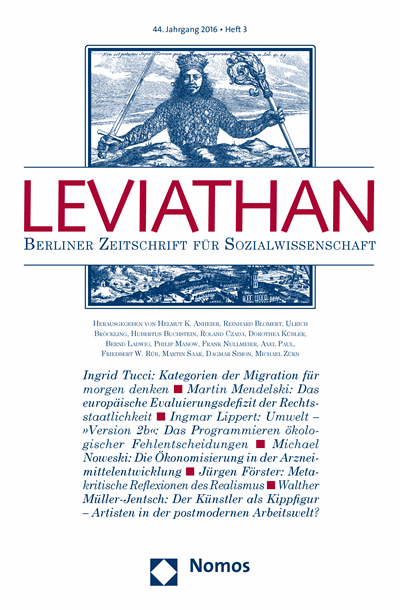
Teilzugriff
Leviathan
Jahrgang 44 (2016), Heft 3
- Autor:innen:
- Verlag
- Nomos, Baden-Baden
- Copyrightjahr
- 2016
- ISSN-Online
- 1861-8588
- ISSN-Print
- 0340-0425
Kapitelinformationen
Teilzugriff
Jahrgang 44 (2016), Heft 3
Zu diesem Heft – Geliebte Täuschungen
- Autor:innen:
- ISSN-Print
- 0340-0425
- ISSN-Online
- 1861-8588
- Kapitelvorschau:

Literaturverzeichnis
Es wurden keine Treffer gefunden. Versuchen Sie einen anderen Begriff.
- Antidiskriminierungsstelle des Bundes 2016. Diskriminierungserfahrungen in Deutschland. Erste Ergebnisse einer repräsentativen Erhebung und einer Betroffenenbefragung. Berlin. www.antidiskriminierungsstelle.de/SharedDocs/Downloads/DE/publikationen/Handout_Umfrage_Diskriminierung_in_Dtschl_2015.pdf?__blob=publicationFile&v=4 (Zugriff vom 24.07.2016). Google Scholar öffnen doi.org/10.5771/0340-0425-2016-3-351
- Beauchemin, Chris; Hamelle, Christelle; Simon, Patrick 2010. Trajectories and origins. Survey on population diversity in France. Document de Travail 168. Paris: INED. www.ined.fr/fichier/s_rubrique/19558/working_paper_2010_168_population.diversity.france.en.pdf (Zugriff vom 24.07.2016). Google Scholar öffnen doi.org/10.5771/0340-0425-2016-3-351
- Elrick, Jennifer; Schwartzman, Luisa Farah 2015. „From statistical category to social category: organized politics and official categorizations of ‚persons with a migration background‘ in Germany“, in Ethnic and Racial Studies 38, 9, S. 1539-1556. Google Scholar öffnen doi.org/10.5771/0340-0425-2016-3-351
- Foroutan, Naika 2016. „Postmigrantische Gesellschaften“, in Einwanderungsgesellschaft Deutschland, hrsg. v. Brinkmann, Heinz Ulrich; Sauer, Martina, S. 227-254. Wiesbaden: Springer Fachmedien. Google Scholar öffnen doi.org/10.5771/0340-0425-2016-3-351
- Le Bras, Hervé 2007. „Quelles statistiques ethniques?“, in L’homme 4, S. 7-24. Google Scholar öffnen doi.org/10.5771/0340-0425-2016-3-351
- Le Bras, Hervé 2009. „Les classifications se suivent mais ne se ressemblent pas“, in Le retour de la race. Contre les statistiques ethniques, hrsg. v. Badinter, Élisabeth et al., S. 97-107. La Tour d’Aigues: Editions de l’Aube. Google Scholar öffnen doi.org/10.5771/0340-0425-2016-3-351
- Le Bras, Hervé 2012. L’invention de l’immigré. La Tour d’Aigues: Editions de l’Aube. Google Scholar öffnen doi.org/10.5771/0340-0425-2016-3-351
- Liebau, Elisabeth; Tucci, Ingrid 2015. Migrations- und Integrationsforschung mit dem SOEP von 1984 bis 2012: Erhebung, Indikatoren und Potentiale. SOEP-Survey-Paper 270. http://panel.gsoep.de/soep-docs/surveypapers/diw_ssp0270.pdf (Zugriff vom 24.07.2016). Google Scholar öffnen doi.org/10.5771/0340-0425-2016-3-351
- Paulle, Bowen; Kalir, Barak 2014. „The integration matrix reloaded: from ethnic fixations to established versus outsiders dynamics in the Netherlands“, in Journal of Ethnic and Migration Studies 40, 9, S. 1354-1374. Google Scholar öffnen doi.org/10.5771/0340-0425-2016-3-351
- Salentin, Kurt; Wilkening, Frank 2003. „Ausländer, Eingebürgerte und das Problem einer realistischen Zuwanderer-Integrationsbilanz“, in Kölner Zeitschrift für Soziologie und Sozialpsychologie 55, 2, S. 278-298. Google Scholar öffnen doi.org/10.5771/0340-0425-2016-3-351
- Schnapper, Dominique 2008. „Les enjeux démocratiques de la statistique ethnique“, in Revue Française de Sociologie 49, 1, S. 133-139. Google Scholar öffnen doi.org/10.5771/0340-0425-2016-3-351
- Simon, Patrick 1999. „Nationality and origins in French statistics. Ambiguous categories“, in Population: An English Selection 11, S. 193-219. Google Scholar öffnen doi.org/10.5771/0340-0425-2016-3-351
- Simon, Patrick 2008. „The choice of ignorance. The debate on ethnic and racial statistics in France“, in French Politics, Culture & Society 26, 1, S. 7-31. Google Scholar öffnen doi.org/10.5771/0340-0425-2016-3-351
- Simon, Patrick; Clément, Martin 2006. Rapport de l’enquête „Mesure de la diversité“ – Une enquête expérimentale pour caractériser l’origine. Document de travail de l’INED 138. Paris: INED. www.ined.fr/fichier/s_rubrique/19489/139.fr.pdf (Zugriff vom 24.07.2016). Google Scholar öffnen doi.org/10.5771/0340-0425-2016-3-351
- Spire, Alexis 1999. „De l'étranger à l'immigré. La magie sociale d'une catégorie statistique“, in Actes de la recherche en sciences sociales 129, 1, S. 50-56. Google Scholar öffnen doi.org/10.5771/0340-0425-2016-3-351
- Statistisches Bundesamt 2009. Bevölkerung mit Migrationshintergrund. Ergebnisse des Mikrozensus 2005. www.destatis.de/GPStatistik/servlets/MCRFileNodeServlet/DEHeft_derivate_00003982/2010220057004.pdf (Zugriff vom 25.07.2016). Google Scholar öffnen doi.org/10.5771/0340-0425-2016-3-351
- Statistisches Bundesamt 2014. Bevölkerung mit Migrationshintergrund. Ergebnisse des Mikrozensus 2013. www.destatis.de/DE/Publikationen/Thematisch/Bevoelkerung/MigrationIntegration/Migrationshintergrund2010220137004.pdf?__blob=publicationFile (Zugriff vom 25.07.2016). Google Scholar öffnen doi.org/10.5771/0340-0425-2016-3-351
- Telles, Edward M.; Ortiz, Vilma 2008. Generations of exclusion: Mexican-Americans, assimilation, and race. New York: Russell Sage Foundation. Google Scholar öffnen doi.org/10.5771/0340-0425-2016-3-351
- Will, Anne-Kathrin 2016. „10 Jahre Migrationshintergrund in der Repräsentativstatistik: ein Konzept auf dem Prüfstand“, in Leviathan 44, 1, S. 9-35. Google Scholar öffnen doi.org/10.5771/0340-0425-2016-3-351
- Wimmer, Andreas 2008. „Ethnische Grenzziehungen in der Immigrationsgesellschaft. Jenseits des Herder’schen Commonsense“, in Kölner Zeitschrift für Soziologie und Sozialpsychologie 48, S. 57-80. Google Scholar öffnen doi.org/10.5771/0340-0425-2016-3-351
- Apeldoorn, Bastian van 2003. Transnational capitalism and the struggle over European integration. London: Routledge. Google Scholar öffnen doi.org/10.5771/0340-0425-2016-3-366
- Avery, Graham 2015. „Enlargement policy in perspective“, in EU member states and enlargement towards the Balkans. EPC Issue Paper No. 79, hrsg. v. Balfour, Rosa; Stratulat, Corina, S. 11-18. Brüssel: European Policy Centre. Google Scholar öffnen doi.org/10.5771/0340-0425-2016-3-366
- Belloni, Roberto; Strazzari, Francesco 2014. „Corruption in post-conflict Bosnia-Herzegovina and Kosovo: a deal among friends“, in Third World Quarterly 35, 5, S. 855-871. Google Scholar öffnen doi.org/10.5771/0340-0425-2016-3-366
- Beširević, Violeta 2014. „Governing without judges: the politics of the Constitutional Court in Serbia“, in International Journal of Constitutional Law 12, 4, S. 954-979. Google Scholar öffnen doi.org/10.5771/0340-0425-2016-3-366
- Blauberger, Michael 2016. „Europäischer Schutz gegen nationale Demokratiedefizite?“, in Leviathan 44, 2, S. 280-302. Google Scholar öffnen doi.org/10.5771/0340-0425-2016-3-366
- Blokker, Paul 2016. „EU democratic oversight and domestic deviation from the rule of law: sociological reflections“, in Reinforcing the rule of law oversight in the European Union, hrsg. v. Closa, Carlos; Kochenov, Dimitry, Kapitel 12. Cambridge: Cambridge University Press. Google Scholar öffnen doi.org/10.5771/0340-0425-2016-3-366
- Bobek, Michal; Kosar, David 2014. „Global solutions, local damages: a critical study in judicial councils in Central and Eastern Europe“, in German Law Journal 15, 2, S. 1257-1292. Google Scholar öffnen doi.org/10.5771/0340-0425-2016-3-366
- Bogdandy, Armin von; Sonnevend, Pál. Hrsg. 2015. Constitutional crisis in the European constitutional area: theory, law and politics in Hungary and Romania. Oxford: Hart. Google Scholar öffnen doi.org/10.5771/0340-0425-2016-3-366
- Börzel, Tanja A. 2015. „The noble west and the dirty rest? Western democracy promoters and illiberal regional powers“, in Democratization 22, 3, S. 519-535. Google Scholar öffnen doi.org/10.5771/0340-0425-2016-3-366
- Börzel, Tanja A. 2016. „Building member states: how the EU promotes political change in its new members, accession candidates, and Eastern neighbors“, in Geopolitics, History & International Relations 8, 1, S. 76-112. Google Scholar öffnen doi.org/10.5771/0340-0425-2016-3-366
- Börzel, Tanja A.; Pamuk, Yasemin 2012. „Pathologies of Europeanisation: fighting corruption in the Southern Caucasus“, in West European Politics 35, 1, S. 79-97. Google Scholar öffnen doi.org/10.5771/0340-0425-2016-3-366
- Börzel, Tanja A.; Hüllen, Vera van 2014. „One voice, one message, but conflicting goals: cohesiveness and consistency in the European neighbourhood policy“, in Journal of European Public Policy 21, 7, S. 1033-1049. Google Scholar öffnen doi.org/10.5771/0340-0425-2016-3-366
- Camp, Robert C. 1995. Business process benchmarking: finding and implementing best practices. Milwaukee: ASQC Quality Press Google Scholar öffnen doi.org/10.5771/0340-0425-2016-3-366
- Caplan, Richard 2005. „Who guards the guardians? International accountability in Bosnia“, in International Peacekeeping 12, 3, S. 463-476. Google Scholar öffnen doi.org/10.5771/0340-0425-2016-3-366
- Capussela, Andrea L. 2015. State-building in Kosovo: democracy, corruption and the EU in the Balkans. London: IB Tauris. Google Scholar öffnen doi.org/10.5771/0340-0425-2016-3-366
- Carothers, Thomas 2003. Promoting the rule of law abroad: the problem of knowledge. Rule of Law Series 34. Washington: Carnegie Endowment for International Peace. Google Scholar öffnen doi.org/10.5771/0340-0425-2016-3-366
- Carrera, Sergio; Guild, Elspeth; Hernanz, Nicholas 2013. The triangular relationship between fundamental rights, democracy and the rule of law in the EU: towards an EU Copenhagen mechanism. Brüssel: Centre for European Policy Studies. Google Scholar öffnen doi.org/10.5771/0340-0425-2016-3-366
- Channell, Wade 2006. „Lessons not learned: problems with Western aid for law reform in post-communist countries“, in Journal of Comparative Law 1, 2, S. 321-337. Google Scholar öffnen doi.org/10.5771/0340-0425-2016-3-366
- Closa, Carlos; Kochenov, Dimitry. Hrsg. 2016. Reinforcing rule of law oversight in the European Union. Cambridge: Cambridge University Press. Google Scholar öffnen doi.org/10.5771/0340-0425-2016-3-366
- Coman, Ramona 2014. „Quo vadis judicial reforms? The quest for judicial independence in Central and Eastern Europe“, in Europe-Asia Studies 66, 6, S. 892-924. Google Scholar öffnen doi.org/10.5771/0340-0425-2016-3-366
- Dimitrov, Georgi; Haralampiev, Kaloyan; Stoychev, Stoycho; Toneva-Metodieva, Linka 2014. The cooperation and verification mechanism: shared political irresponsibility between the European Commission and the Bulgarian governments. Sofia: St. Kliment Ohridski University Press. Google Scholar öffnen doi.org/10.5771/0340-0425-2016-3-366
- Di Puppo, Lili 2010. „Anti-corruption interventions in Georgia“, in Global Crime 11, 2, S. 220-236. Google Scholar öffnen doi.org/10.5771/0340-0425-2016-3-366
- Elbasani, Arolda. Hrsg. 2013. European integration and transformation in the western Balkans. Europeanization or business as usual? New York: Routledge. Google Scholar öffnen doi.org/10.5771/0340-0425-2016-3-366
- Elias, Norbert 1992. Studien über die Deutschen. Machtkämpfe und Habitusentwicklung im 19. und 20. Jahrhundert. Frankfurt a. M.: Suhrkamp. Google Scholar öffnen doi.org/10.5771/0340-0425-2016-3-366
- Europäische Kommission 2006. Romania. May 2006 Monitoring Report, SEC (2006) 596, 16.05.2006. Brüssel. Google Scholar öffnen doi.org/10.5771/0340-0425-2016-3-366
- Europäische Kommission 2008. Supporting document accompanying the report from The Commission to the European Parliament and the Council on Progress in Romania under the co-operation and verification mechanism. Romania: Technical Update. COM(2008) 494 final, 23.07.2008. Brüssel. Google Scholar öffnen doi.org/10.5771/0340-0425-2016-3-366
- Europäische Kommission 2012. Report from the Commission to the European Parliament and the Council on progress in Romania under the co-operation and verification mechanism. COM(2012) 410 final, 18.07.2012. Brüssel. Google Scholar öffnen doi.org/10.5771/0340-0425-2016-3-366
- Europäische Kommission 2014. Communication: a new EU framework to strengthen the rule of law. COM(2014) 158 Final. Brüssel. Google Scholar öffnen doi.org/10.5771/0340-0425-2016-3-366
- Fuller, Lon L. 1969. The morality of law. New Haven, London: Yale University Press. Google Scholar öffnen doi.org/10.5771/0340-0425-2016-3-366
- Garoupa, Nuno; Ginsburg, Tom 2009. „The comparative law and economics of judicial councils“, in Berkeley Journal of International Law 27, 1, S. 53-83. Google Scholar öffnen doi.org/10.5771/0340-0425-2016-3-366
- Ghiciusca, Andrei 2007. „Basescu incalca independenta Justitiei“, in Ziua vom 10. Juli 2007. Google Scholar öffnen doi.org/10.5771/0340-0425-2016-3-366
- Ginsburg, Tom 2003. Judicial review in new democracies: constitutional courts in Asian cases. New York: Cambridge University Press Google Scholar öffnen doi.org/10.5771/0340-0425-2016-3-366
- Goetz, Klaus H.; Zubek, Radowlaw 2007. „Government, parliament and law-making in Poland“, in The Journal of Legislative Studies 13, 4, S. 517-538. Google Scholar öffnen doi.org/10.5771/0340-0425-2016-3-366
- Greiffenhagen, Martin 1999. Kulturen des Kompromisses. Opladen: Leske + Budrich. Google Scholar öffnen doi.org/10.5771/0340-0425-2016-3-366
- Haas, Peter M. 1992. „Introduction: epistemic communities and international policy coordination“, in International Organization 46, 1, S. 1-35. Google Scholar öffnen doi.org/10.5771/0340-0425-2016-3-366
- Habermas, Jürgen 1992. Faktizität und Geltung: Beiträge zur Diskurstheorie des Rechts und des demokratischen Rechtsstaates. Frankfurt a. M.: Suhrkamp. Google Scholar öffnen doi.org/10.5771/0340-0425-2016-3-366
- Hayden, Robert M. 2005. „‚Democracy‘ without a demos? The Bosnian constitutional experiment and the intentional construction of nonfunctioning states“, in East European Politics & Societies 19, 2, S. 226-259. Google Scholar öffnen doi.org/10.5771/0340-0425-2016-3-366
- Hirschl, Ran 2009. Towards juristocracy: the origins and consequences of the new constitutionalism. Cambridge, London: Harvard University Press. Google Scholar öffnen doi.org/10.5771/0340-0425-2016-3-366
- Ivanova, Ivanka 2013. „Rule of law in Bulgaria and the influence of EU accession“, in The triangular relationship between fundamental rights, democracy and the rule of law in the EU: towards an EU Copenhagen mechanism, hrsg. v. Carrera, Sergio; Guild, Elspeth; Hernanz, Nicholas, S. 98-106. Brüssel: Center for European Policy Studies. Google Scholar öffnen doi.org/10.5771/0340-0425-2016-3-366
- Jakab, András; Kochenov, Dimitry. Hrsg. 2016. The enforcement of EU law and values. Oxford: Oxford University Press. Google Scholar öffnen doi.org/10.5771/0340-0425-2016-3-366
- Kantorowicz, Jaroslaw; Garoupa, Nuno 2016. „An empirical analysis of constitutional review voting in the polish constitutional tribunal, 2003-2014“, in Constitutional Political Economy 27, 1, S. 66-92. Google Scholar öffnen doi.org/10.5771/0340-0425-2016-3-366
- Kochenov, Dimitry 2008. EU enlargement and the failure of conditionality. Pre-accession conditionality in the fields of democracy and the rule of law. Alphen aan den Rijn: Wolters Kluwer. Google Scholar öffnen doi.org/10.5771/0340-0425-2016-3-366
- Kilpatrick, Claire 2015. „On the rule of law and economic emergency: the degradation of basic legal values in Europe’s bailouts“, in Oxford Journal of Legal Studies 35, 2, S. 325-353. Google Scholar öffnen doi.org/10.5771/0340-0425-2016-3-366
- Kostanyan, Hrant 2016. Why Moldova’s European integration is failing. CEPS Commentary vom 3. März 2016. Brüssel: Center for European Policy Studies. Google Scholar öffnen doi.org/10.5771/0340-0425-2016-3-366
- Kreuder‐Sonnen, Christian 2016. „Beyond integration theory: the (anti‐) constitutional dimension of European crisis governance“, in Journal of Common Market Studies (Online-Version). DOI: 10.1111/jcms.12379. Google Scholar öffnen doi.org/10.5771/0340-0425-2016-3-366
- Kuzmova, Yoana 2014. „Bulgarian specialized criminal court after one year: a misplaced transplant, an instrument of justice, or a tool of executive power?“, in Boston University International Law Journal 32, S. 227-262. Google Scholar öffnen doi.org/10.5771/0340-0425-2016-3-366
- Maatsch, Aleksandra 2015. Empowered or disempowered? The role of national parliaments during the reform of European economic governance. MPIfG Discussion Paper 15/10. Köln: Max-Planck-Institut für Gesellschaftsforschung. Google Scholar öffnen doi.org/10.5771/0340-0425-2016-3-366
- Magen, Amichai; Morlino, Leonardo 2009. International actors, democratization and the rule of law. Anchoring democracy? New York: Routledge. Google Scholar öffnen doi.org/10.5771/0340-0425-2016-3-366
- Maravall, José Maria 2003. „The rule of law as a political weapon“, in Democracy and the Rule of Law 5, S. 261-301. Google Scholar öffnen doi.org/10.5771/0340-0425-2016-3-366
- Matthijs, Matthias 2014. „Mediterranean blues: the crisis in Southern Europe“, in Journal of Democracy 25, 1, S. 101-115. Google Scholar öffnen doi.org/10.5771/0340-0425-2016-3-366
- Mendelski, Martin 2011. „Rule of law reforms in the shadow of clientelism: the limits of the EU’s transformative power in Romania“, in Polish Sociological Review 2, 174, S. 235-253. Google Scholar öffnen doi.org/10.5771/0340-0425-2016-3-366
- Mendelski, Martin 2012. „EU-driven judicial reforms in Romania: a success story?“, in East European Politics 28, 1, S. 23-42. Google Scholar öffnen doi.org/10.5771/0340-0425-2016-3-366
- Mendelski, Martin 2014. The limits of the European Union’s transformative power: pathologies of Europeanization and rule of law reform in Central and Eastern Europe. Doctoral thesis, University of Luxembourg. Google Scholar öffnen doi.org/10.5771/0340-0425-2016-3-366
- Mendelski, Martin 2015. „The EU’s pathological power: the failure of external rule of law promotion in South Eastern Europe“, in Southeastern Europe 39, 3, S. 318-346. Google Scholar öffnen doi.org/10.5771/0340-0425-2016-3-366
- Mendelski, Martin 2016. „Europeanization and the rule of law: Towards a pathological turn“, in Southeastern Europe (im Erscheinen). Google Scholar öffnen doi.org/10.5771/0340-0425-2016-3-366
- Michels, Robert 1915. Political parties: a sociological study of the oligarchical tendencies of modern democracy. New York: Hearst’s International Library Company. Google Scholar öffnen doi.org/10.5771/0340-0425-2016-3-366
- Morlino, Leonardo; Sadurski, Wojciech. Hrsg. 2010. Democratization and the European Union: comparing central and eastern European post-communist countries. New York: Routledge. Google Scholar öffnen doi.org/10.5771/0340-0425-2016-3-366
- Müller, Jan-Werner 2015. „Should the EU protect democracy and the rule of law inside member states?“, in European Law Journal 21, 2, S. 141-160. Google Scholar öffnen doi.org/10.5771/0340-0425-2016-3-366
- Mungiu-Pippidi, Alina 2014. „The transformative power of Europe revisited“, in Journal of Democracy 25, 1, S. 20-32. Google Scholar öffnen doi.org/10.5771/0340-0425-2016-3-366
- Natorski, Michal 2013. „Reforms in the judiciary of Ukraine: domestic practices and the EU’s policy instruments“, in East European Politics 29, 3, S. 358-375. Google Scholar öffnen doi.org/10.5771/0340-0425-2016-3-366
- North, Douglas C.; Wallis, John J.; Weingast, Barry R. 2009. Violence and social orders. A conceptual framework for interpreting recorded human history. Cambridge: Cambridge University Press. Google Scholar öffnen doi.org/10.5771/0340-0425-2016-3-366
- Parau, Cristina E. 2015. „Explaining governance of the judiciary in Central and Eastern Europe: external incentives, transnational elites and parliamentary inaction“, in Europe-Asia Studies 67, 3, S. 409-442. Google Scholar öffnen doi.org/10.5771/0340-0425-2016-3-366
- Pech, Laurent 2016. „The EU as a global rule of law promoter: the consistency and effectiveness challenges“, in Asia Europe Journal 14, 1, S. 7-24. Google Scholar öffnen doi.org/10.5771/0340-0425-2016-3-366
- Piana, Daniela; Dallara, Cristina 2015. Networking the rule of law: how change agents reshape judicial governance in the EU. Farnham: Ashgate Publishing. Google Scholar öffnen doi.org/10.5771/0340-0425-2016-3-366
- Polanyi, Karl 1944. The great transformation. The political and economic origins of our time. Boston: Beacon Press. Google Scholar öffnen doi.org/10.5771/0340-0425-2016-3-366
- Popova, Maria 2012. Politicized justice in emerging democracies: a study of courts in Russia and Ukraine. Cambridge: Cambridge University Press. Google Scholar öffnen doi.org/10.5771/0340-0425-2016-3-366
- Procházka, Radoslav 2002. Mission accomplished: on founding constitutional adjudication in Central Europe. Budapest: Central European University Press. Google Scholar öffnen doi.org/10.5771/0340-0425-2016-3-366
- Przeworski, Adam 1991. Democracy and the market: political and economic reforms in Eastern Europe and Latin America. Cambridge: Cambridge University Press. Google Scholar öffnen doi.org/10.5771/0340-0425-2016-3-366
- Radwan, Arkadiusz 2016. Chess-boxing around the rule of law – Polish constitutionalism at trial. Allerhand Working Paper 13/2016. http://papers.ssrn.com/sol3/papers.cfm?abstract_id=2748746 (Zugriff vom 07.06.2016). Google Scholar öffnen doi.org/10.5771/0340-0425-2016-3-366
- Risse, Thomas; Sikkink, Kathryn 1999. „The socialization of international human rights norms into domestic practices“, in The power of human rights: international norms and domestic change, hrsg. v. Ropp, Stephen C.; Sikkink, Kathryn, S. 1-38. Cambridge: Cambridge University Press. Google Scholar öffnen doi.org/10.5771/0340-0425-2016-3-366
- Risteska, Marija 2013. „The role of the EU in promoting good governance in Macedonia: towards efficiency and effectiveness or deliberative democracy?“, in Nationalities Papers 41, 3, S. 431-446. Google Scholar öffnen doi.org/10.5771/0340-0425-2016-3-366
- Robinson, William I. 2004. A theory of global capitalism. Baltimore, London: The Johns Hopkins University Press. Google Scholar öffnen doi.org/10.5771/0340-0425-2016-3-366
- Sadurski, Wojciech 2004. „Accession’s democracy dividend: the impact of the EU enlargement upon democracy in the new member states of Central and Eastern Europe“, in European Law Journal 10, 4, S. 371-401. Google Scholar öffnen doi.org/10.5771/0340-0425-2016-3-366
- Schedler, Andreas 1999. The self-restraining state: power and accountability in new democracies. Boulder: Lynne Rienner Publishers. Google Scholar öffnen doi.org/10.5771/0340-0425-2016-3-366
- Schimmelfennig, Frank 1997. „Rhetorisches Handeln in der internationalen Politik“, in Zeitschrift für internationale Beziehungen 4, 2, S. 219-254. Google Scholar öffnen doi.org/10.5771/0340-0425-2016-3-366
- Schimmelfennig, Frank 2001. „The community trap: liberal norms, rhetorical action, and the Eastern enlargement of the European Union“, in International Organization 55, 1, S. 47-80. Google Scholar öffnen doi.org/10.5771/0340-0425-2016-3-366
- Schimmelfennig, Frank 2012. „Europeanization beyond Europe“, in Living Reviews in European Governance 7, 1, S. 1-31. Google Scholar öffnen doi.org/10.5771/0340-0425-2016-3-366
- Schimmelfennig, Frank; Sedelmeier, Ulrich 2005. The Europeanization of Central and Eastern Europe. Ithaca: Cornell University Press. Google Scholar öffnen doi.org/10.5771/0340-0425-2016-3-366
- Schmitter, Philippe C. 2004. „The ambiguous virtues of accountability“, in Journal of Democracy 15, 4, S. 47-60. Google Scholar öffnen doi.org/10.5771/0340-0425-2016-3-366
- Schwartz, Herman 2000. The struggle for constitutional justice in post-communist Europe. Chicago: University of Chicago Press. Google Scholar öffnen doi.org/10.5771/0340-0425-2016-3-366
- Shapiro, Martin M. 1988. Who guards the guardians? Judicial control of administration. Athens: University of Georgia Press. Google Scholar öffnen doi.org/10.5771/0340-0425-2016-3-366
- Shklar, Judith N. 1987. „Political theory and the rule of law“, in The rule of law: ideal or ideology, hrsg. v. Hutchinson, Alan C.; Monahan, Patrick, S. 1-16. Toronto: Carswell. Google Scholar öffnen doi.org/10.5771/0340-0425-2016-3-366
- Slapin, Jonathan B. 2015. „How European Union membership can undermine the rule of law in emerging democracies“, in West European Politics 38, 3, S. 627-648. Google Scholar öffnen doi.org/10.5771/0340-0425-2016-3-366
- Streeck, Wolfgang 2015. „Heller, Schmitt and the Euro“, in European Law Journal 21, 3, S. 361-370. Google Scholar öffnen doi.org/10.5771/0340-0425-2016-3-366
- Tamanaha, Brian Z. 2004. On the rule of law: history, politics, theory. Cambridge: Cambridge University Press. Google Scholar öffnen doi.org/10.5771/0340-0425-2016-3-366
- Teodorescu, Bogdan; Sultanescu, Dan 2006. Revolutie portocalie in Romania. Bukarest: Fundatia PRO. Google Scholar öffnen doi.org/10.5771/0340-0425-2016-3-366
- Toneva-Metodieva, Linka 2014. „Beyond the carrots and sticks paradigm: rethinking the cooperation and verification mechanism experience of Bulgaria and Romania“, in Perspectives on European Politics and Society 15, 4, S. 534-551. Google Scholar öffnen doi.org/10.5771/0340-0425-2016-3-366
- Trochev, Alexei 2008. Judging Russia: the role of the constitutional court in Russian politics 1990-2006. Cambridge: Cambridge University Press. Google Scholar öffnen doi.org/10.5771/0340-0425-2016-3-366
- Tudoroiu, Theodor 2015. „Democracy and state capture in Moldova“, in Democratization 22, 4, S. 655-678. Google Scholar öffnen doi.org/10.5771/0340-0425-2016-3-366
- Venice Commission 2016. Opinion on Amendments to the Act of 25 June 2015 on the Constitutional Tribunal of Poland. Adopted by the Venice Commission at its 106th Plenary Session, Opinion no. 833/2015, Venedig, 11. März 2016. Google Scholar öffnen doi.org/10.5771/0340-0425-2016-3-366
- White, Jonathan 2015. „Emergency Europe“, in Political Studies 63, 2, S. 300-318. Google Scholar öffnen doi.org/10.5771/0340-0425-2016-3-366
- Asdal, Kristin 2011. „The office: the weakness of numbers and the production of non-authority“, in Accounting, Organizations and Society 36, 1, S. 1-9. Google Scholar öffnen doi.org/10.5771/0340-0425-2016-3-399
- BBC TopGear 2016. Emissions scandal latest: Mitsubishi president steps down, Suzuki involved. Update vom 26. April 2016. www.topgear.com/car-news/insider/emissions-scandal-latest-mitsubishi-president-steps-down-suzuki-involved (Zugriff vom 25.06.2016). Google Scholar öffnen doi.org/10.5771/0340-0425-2016-3-399
- Beene, Ryan 2015. „VW emissions ‚defeat device‘ isn’t the first“, in Autoweek vom 24. September 2015. http://autoweek.com/article/car-news/vw-emissions-defeat-device-isnt-first (Zugriff vom 26.06.2016). Google Scholar öffnen doi.org/10.5771/0340-0425-2016-3-399
- Bowker, Geoffrey C.; Star, Susan Leigh 2000. Sorting things out: classification and consequences. Cambridge: MIT Press Google Scholar öffnen doi.org/10.5771/0340-0425-2016-3-399
- Bumpus, Adam G.; Liverman, Diana M. 2008. „Accumulation by decarbonization and the governance of carbon offsets“, in Economic Geography 84, 2, S. 127-155. Google Scholar öffnen doi.org/10.5771/0340-0425-2016-3-399
- BUND (Bund für Umweltschutz und Naturschutz Deutschland); Miserior 1996. Zukunftsfähiges Deutschland: Ein Beitrag zu einer global nachhaltigen Entwicklung. Berlin: Birkhäuser. Google Scholar öffnen doi.org/10.5771/0340-0425-2016-3-399
- Callon, Michel 1998. „An essay on framing and overflowing: economic externalities revisited by sociology“, in The laws of the markets, hrsg. v. Callon, Michel, S. 244-269. Oxford, Malden: Blackwell. Google Scholar öffnen doi.org/10.5771/0340-0425-2016-3-399
- Carrington, Damian 2015. „Four more carmakers join diesel emissions row“, in The Guardian vom 9. Oktober 2015. www.theguardian.com/environment/2015/oct/09/mercedes-honda-mazda-mitsubishi-diesel-emissions-row (Zugriff vom 25.06.2016). Google Scholar öffnen doi.org/10.5771/0340-0425-2016-3-399
- Chan, Michelle 2009. Subprime carbon? Re-thinking the world’s largest new derivatives market. Technical Report. Washington: Friends of the Earth. Google Scholar öffnen doi.org/10.5771/0340-0425-2016-3-399
- Cronon, William J. 1996. Uncommon ground: rethinking the human place in nature. New York: Norton. Google Scholar öffnen doi.org/10.5771/0340-0425-2016-3-399
- Davies, Alex 2015. „The EPA opposes rules that could’ve exposed VW’s cheating“, in Wired vom 18. September 2015. www.wired.com/2015/09/epa-opposes-rules-couldve-exposed-vws-cheating (Zugriff vom 25.06.2016). Google Scholar öffnen doi.org/10.5771/0340-0425-2016-3-399
- Dingler, Johannes 2003. Postmoderne und Nachhaltigkeit: Eine diskurstheoretische Analyse der sozialen Konstruktion von nachhaltiger Entwicklung. München: ökom. Google Scholar öffnen doi.org/10.5771/0340-0425-2016-3-399
- Edwards, Julia; Prodhan, Georgina 2016. „VW faces billions in fines as U.S. sues for environmental violations“, in Reuters vom 5. Januar 2016. www.reuters.com/article/us-volkswagen-usa-idUSKBN0UI1QP20160105 (Zugriff vom 26.06.2016). Google Scholar öffnen doi.org/10.5771/0340-0425-2016-3-399
- Gad, Christopher; Jensen, Casper Bruun 2010. „On the consequences of post-ANT“, in Science, Technology & Human Values 35, 1, S. 55-80. Google Scholar öffnen doi.org/10.5771/0340-0425-2016-3-399
- Gilbertson, Tamra; Reyes, Oscar 2009. Carbon trading: how it works and why it fails. Critical Currents 7. Uppsala: Dag Hammarskjöld Foundation. Google Scholar öffnen doi.org/10.5771/0340-0425-2016-3-399
- Gitelman, Lisa 2013. Raw data is an oxymoron. Cambridge: MIT Press. Google Scholar öffnen doi.org/10.5771/0340-0425-2016-3-399
- Hajer, Maarten A. 1995. The politics of environmental discourse: ecological modernization and the policy process. Oxford: Clarendon Press. Google Scholar öffnen doi.org/10.5771/0340-0425-2016-3-399
- Huber, Joseph 1988. Die Regenbogen-Gesellschaft. Frankfurt a. M.: Fischer. Google Scholar öffnen doi.org/10.5771/0340-0425-2016-3-399
- ICCT (The International Council on Clean Transportation) 2015. From laboratory to road. A 2015 update of official and „real-world“ fuel consumption and CO2 values for passenger cars in Europe. Berlin. www.theicct.org/sites/default/files/publications/ICCT_LaboratoryToRoad_2015_Report_English.pdf (Zugriff vom 25.06.2016). Google Scholar öffnen doi.org/10.5771/0340-0425-2016-3-399
- IPCC (International Panel on Climate Change) 2013. „Summary for policymakers“, in Climate change 2013: the physical science basis. Contribution of working group I to the fifth assessment report of the Intergovernmental Panel on Climate Change, hrsg. v. Stocker, Thomas F. et al., S. 3-29. Cambridge: Cambridge University Press. Google Scholar öffnen doi.org/10.5771/0340-0425-2016-3-399
- Kalthoff, Herbert 2005. „Practices of calculation: economic representations and risk management“, in Theory, Culture & Society 22, 2, S. 69-97. Google Scholar öffnen doi.org/10.5771/0340-0425-2016-3-399
- Köhler, Benedikt 2010. „Macht der Zahlen, Herrschaft der Statistik – Eine machttheoretische Skizze“, in Macht und Herrschaft in der reflexiven Moderne, hrsg. v. Lau, Christoph; Bonß, Wolfgang, S. 330-357. Weilerswist: Velbrück. Google Scholar öffnen doi.org/10.5771/0340-0425-2016-3-399
- Latour, Bruno 1987. Science in action: how to follow scientists and engineers through society. Cambridge: Harvard University Press. Google Scholar öffnen doi.org/10.5771/0340-0425-2016-3-399
- Law, John; Hassard, John 1999. Actor network theory and after. Oxford, Malden: Blackwell. Google Scholar öffnen doi.org/10.5771/0340-0425-2016-3-399
- Lippert, Ingmar 2011. „Extended carbon cognition as a machine“, in Computational Culture 1, 1. http://computationalculture.net/article/extended-carbon-cognition (Zugriff vom 25.06.2016). Google Scholar öffnen doi.org/10.5771/0340-0425-2016-3-399
- Lippert, Ingmar 2012 a. „Carbon classified? Unpacking heterogeneous relations inscribed into corporate carbon emissions“, in Ephemera 12, 1/2, S. 138-161. Google Scholar öffnen doi.org/10.5771/0340-0425-2016-3-399
- Lippert, Ingmar 2012 b. „Carbon dioxide“, in Encyclopedia of consumption and waste: the social science of garbage, hrsg. v. Zimring, Carl; Rathje, William, S. 105-108. Thousand Oaks: Sage. Google Scholar öffnen doi.org/10.5771/0340-0425-2016-3-399
- Lippert, Ingmar 2013. Enacting environments: an ethnography of the digitalisation and naturalisation of emissions. Dissertation, Philosophisch-Sozialwissenschaftliche Fakultät, Universität Augsburg. Google Scholar öffnen doi.org/10.5771/0340-0425-2016-3-399
- Lippert, Ingmar 2014. „Studying reconfigurations of discourse: tracing the stability and materiality of ›Sustainability/Carbon‹“, in Zeitschrift für Diskursforschung 2, 1, S. 32-54. Google Scholar öffnen doi.org/10.5771/0340-0425-2016-3-399
- Lippert, Ingmar 2015. „Environment as datascape: enacting emission realities in corporate carbon accounting“, in Geoforum 66, S. 125-135. Google Scholar öffnen doi.org/10.5771/0340-0425-2016-3-399
- Lippert, Ingmar 2016 a. „Failing the market, failing deliberative democracy: how scaling up corporate carbon reporting proliferates information asymmetries“, in Big Data & Society (im Erscheinen). Google Scholar öffnen doi.org/10.5771/0340-0425-2016-3-399
- Lippert, Ingmar 2016 b. „Social emissions? Corporate carbon footprinting as techno-political practice“, in The carbon fix, hrsg. v. Fiske, Shirley; Paladino, Stephanie, Kapitel 6. Walnut Creek: Left Coast Press (im Erscheinen). Google Scholar öffnen doi.org/10.5771/0340-0425-2016-3-399
- Mol, Annemarie 2002. The body multiple: ontology in medical practice. Durham: Duke University Press. Google Scholar öffnen doi.org/10.5771/0340-0425-2016-3-399
- Mol, Arthur P. J. 2010. „Social theories of environmental reform: towards a third generation“, in Environmental sociology, hrsg. v. Gross, Matthias; Heinrichs, Harald, S. 19-38. Dordrecht: Springer. Google Scholar öffnen doi.org/10.5771/0340-0425-2016-3-399
- Morgan, Seth 2016. The Volkswagen scandal: a case of vanishing utility. http://policymatters.illinois.edu/the-volkswagen-scandal-a-case-of-vanishing-utility (Zugriff vom 26.06.2016). Google Scholar öffnen doi.org/10.5771/0340-0425-2016-3-399
- Nelson, Douglas 1996. „The political economy of U.S. automobile protection“, in The political economy of American trade policy, hrsg. v. Krueger, Anne O., S. 133-196. Chicago: Chicago University Press. Google Scholar öffnen doi.org/10.5771/0340-0425-2016-3-399
- OECD (Organisation für wirtschaftliche Zusammenarbeit und Entwicklung) 2002. Improving policy coherence and integration for sustainable development. Paris: OECD. Google Scholar öffnen doi.org/10.5771/0340-0425-2016-3-399
- Olwig, Kenneth R. 2002. Landscape, nature, and the body politic. From Britain’s renaissance to America’s new world. Madison: University of Wisconsin Press. Google Scholar öffnen doi.org/10.5771/0340-0425-2016-3-399
- Porter, Theodore 1995. Trust in numbers: the pursuit of objectivity in science and public life. Princeton: Princeton University Press. Google Scholar öffnen doi.org/10.5771/0340-0425-2016-3-399
- Power, Michael 1999. The audit society: rituals of verification. Oxford: Oxford University Press. Google Scholar öffnen doi.org/10.5771/0340-0425-2016-3-399
- RDE-LDV (Real-Driving Emissions-Light-Duty Vehicles Working Group) 2013. A complementary emissions test for light-duty vehicles: assessing the technical feasibility of candidate procedures. Report EUR 25572 EN. Ispra: European Commission, Joint Research Centre, Institute for Energy and Transport. http://publications.jrc.ec.europa.eu/repository/bitstream/JRC75998/ld-na-25572-en-n_online.pdf (Zugriff vom 25.06.2016). Google Scholar öffnen doi.org/10.5771/0340-0425-2016-3-399
- RFF (Ressources for the Future) 2016. Comparing US and EU approaches to regulating automotive emissions and fuel economy. Policy Brief No. 16-03. www.rff.org/files/document/file/RFF-PB-16-03.pdf (Zugriff vom 25.06.2016). Google Scholar öffnen doi.org/10.5771/0340-0425-2016-3-399
- Robson, Keith 1992. „Accounting numbers as inscription: action at a distance and the development of accounting“, in Accounting, Organizations and Society 17, 7, S. 685-708. Google Scholar öffnen doi.org/10.5771/0340-0425-2016-3-399
- Scott, James 1998. Seeing like a state: how certain schemes to improve the human condition have failed. New Haven: Yale University Press. Google Scholar öffnen doi.org/10.5771/0340-0425-2016-3-399
- Stern, Nicholas H. 2006. Stern review: the economics of climate change. Volume 30. London: HM Treasury. Google Scholar öffnen doi.org/10.5771/0340-0425-2016-3-399
- Suchman, Lucy 2007. Human-machine reconfigurations: plans and situated action. New York: Cambridge University Press. Google Scholar öffnen doi.org/10.5771/0340-0425-2016-3-399
- Suchman, Lucy 2012. „Configuration“, in Inventive methods: the happening of the social, hrsg. v. Lury, Celia; Wakeford, Nina, S. 48-60. London: Routledge. Google Scholar öffnen doi.org/10.5771/0340-0425-2016-3-399
- UBA (Umweltbundesamt) 2015. Umwelt, Haushalte und Konsum. Daten zur Umwelt. Dessau: UBA. Google Scholar öffnen doi.org/10.5771/0340-0425-2016-3-399
- VN (Vereinte Nationen) 1992. Agenda 21. Rio de Janeiro: VN. www.un.org/depts/german/conf/agenda21/agenda_21.pdf (Zugriff vom 23.06.2016). Google Scholar öffnen doi.org/10.5771/0340-0425-2016-3-399
- VN (Vereinte Nationen) 2016. COP 21. FCCC/CP/2015/10/Add.1. Paris: VN. http://unfccc.int/resource/docs/2015/cop21/eng/10a01.pdf (Zugriff vom 25.06.2016). Google Scholar öffnen doi.org/10.5771/0340-0425-2016-3-399
- Webel, Baird 2013. Troubled Asset Relief Program (TARP): implementation and status. Congressional Research Service 7-5700, R41427. www.fas.org/sgp/crs/misc/R41427.pdf (Zugriff vom 26.06.2016). Google Scholar öffnen doi.org/10.5771/0340-0425-2016-3-399
- Williams, Ryan 2011. „Do new fuel efficiency numbers add up? Assessing Obama’s new fuel efficiency standards for vehicles sold in the U.S.“, in In These Times vom 9. August 2011. http://inthesetimes.com/article/11812/do_new_fuel_efficiency_numbers_add_up (Zugriff vom 26.06.2016). Google Scholar öffnen doi.org/10.5771/0340-0425-2016-3-399
- Ahrens, Dieter 2007. „Ökonomisierung und Gesundheitsförderung“, in Gesundheitsförderung im aktivierenden Sozialstaat, hrsg. v. Schmidt, Bettina; Kolip, Petra, S. 45-55. Weinheim: Beltz Juventa. Google Scholar öffnen doi.org/10.5771/0340-0425-2016-3-428
- Alvesson, Mats; Sveningsson, Stefan 2011. „Management is the solution: now what was the problem? On the fragile basis for managerialism“, in Scandinavian Journal of Management 27, 4, S. 349-361. Google Scholar öffnen doi.org/10.5771/0340-0425-2016-3-428
- Amdam, Rolv Petter 1996. „Professional networks and the introduction of research in the British and Norwegian pharmaceutical industry in the inter‐war years“, in History and Technology 13, 2, S. 101-114. Google Scholar öffnen doi.org/10.5771/0340-0425-2016-3-428
- Bailey, Jeff 2014. Pharma patent cliff: why worst seems over. http://ycharts.com/analysis/story/pharma_patent_cliff_why_worst_seems_over (Zugriff vom 27.05.2016). Google Scholar öffnen doi.org/10.5771/0340-0425-2016-3-428
- Becker, Markus C.; Lillemark, Morten 2006. „Marketing/R&D integration in the pharmaceutical industry“, in Research Policy 35, 1, S. 105-120. Google Scholar öffnen doi.org/10.5771/0340-0425-2016-3-428
- Bode, Ingo 2010. „Der Zweck heil(ig)t die Mittel? Ökonomisierung und Organisationsdynamik im Krankenhaussektor“, in Die Ökonomie der Organisation − die Organisation der Ökonomie, hrsg. v. Endreß, Martin; Matys, Thomas, S. 63-92. Wiesbaden: VS Verlag für Sozialwissenschaften. Google Scholar öffnen doi.org/10.5771/0340-0425-2016-3-428
- Burhop, Carsten 2009. „Pharmaceutical research in Wilhelmine Germany: the case of E. Merck“, in Business History Review 83, 3, S. 475-503. Google Scholar öffnen doi.org/10.5771/0340-0425-2016-3-428
- Cavallito, C. J. 1974. „Interactions of science, economics and politics in drug discovery, development and delivery“, in Drug Development Communications 1, 4, S. 259-285. Google Scholar öffnen doi.org/10.5771/0340-0425-2016-3-428
- Chakravarty, Anindita; Grewal, Rajdeep 2011. „The stock market in the driver’s seat! Implications for R&D and marketing“, in Management Science 57, 9, S. 1594-1609. Google Scholar öffnen doi.org/10.5771/0340-0425-2016-3-428
- Church, Roy 2006. „Trust, Burroughs Wellcome & Co. and the foundation of a modern pharmaceutical industry in Britain, 1880-1914“, in Business History 48, 3, S. 376-398. Google Scholar öffnen doi.org/10.5771/0340-0425-2016-3-428
- Clarke, Thomas 2014. „Dangerous frontiers in corporate governance“, in Journal of Management & Organization 20, 3, S. 268-286. Google Scholar öffnen doi.org/10.5771/0340-0425-2016-3-428
- Coe, Neil M.; Lai, Karen P. Y.; Wójcik, Dariusz 2014. „Integrating finance into global production networks“, in Regional Studies 48, 5, S. 761-777. Google Scholar öffnen doi.org/10.5771/0340-0425-2016-3-428
- Cohen, Susan; Cosgrove, Christine 2009. Normal at any cost. Tall girls, short boys, and the medical industry’s quest to manipulate height. New York: Tarcher/Penguin. Google Scholar öffnen doi.org/10.5771/0340-0425-2016-3-428
- Davis, Courtney; Abraham, John 2013. Unhealthy pharmaceutical regulation. Innovation, politics and promissory science. Basingstoke: Palgrave Macmillan. Google Scholar öffnen doi.org/10.5771/0340-0425-2016-3-428
- Demir, Cengiz; Ayyildiz Unnu, Nazli A.; Erturk, Emel 2011. „Diagnosing the organizational culture of a Turkish pharmaceutical company based on the competing values framework“, in Journal of Business Economics and Management 14, 10, S. 197-217. Google Scholar öffnen doi.org/10.5771/0340-0425-2016-3-428
- Deppe, Hans-Ulrich 1998. „Neoliberalismus und Arzt-Patient-Beziehung“, in Medizin und wirtschaftlicher Wettbewerb, hrsg. v. Deppe, Hans-Ulrich, S. 125-134. Frankfurt a. M.: VAS. Google Scholar öffnen doi.org/10.5771/0340-0425-2016-3-428
- Eggert, Andreas; Thiesbrummel, Christoph; Deutscher, Christian 2014. „Differential effects of product and service innovations on the financial performance of industrial firms“, in Journal of Business Market Management 7, 3, S. 380-405. Google Scholar öffnen doi.org/10.5771/0340-0425-2016-3-428
- Forster, Simon P.; Stegmaier, Julia; Spycher, Rene; Seeger, Stefan 2014. „Virtual pharmaceutical companies: collaborating flexibly in pharmaceutical development“, in Drug Discovery Today 19, 3, S. 348-355. Google Scholar öffnen doi.org/10.5771/0340-0425-2016-3-428
- Frosch, Dominick L.; Krueger, Patrick M.; Hornik, Robert C.; Cronholm, Peter F.; Barg, Frances K. 2007. „Creating demand for prescription drugs. A content analysis of television direct-to-consumer advertising“, in Annals of Family Medicine 5, 1, S. 6-13. Google Scholar öffnen doi.org/10.5771/0340-0425-2016-3-428
- Gagnon, Marc-André 2013. „Corruption of pharmaceutical markets: addressing the misalignment of financial incentives and public health“, in Journal of Law, Medicine & Ethics 41, 3, S. 571-580. Google Scholar öffnen doi.org/10.5771/0340-0425-2016-3-428
- Garnier, Jean-Pierre 2008. „Rebuilding the R&D engine in big pharma“, in Harvard Business Review 86, 5, S. 68-76. Google Scholar öffnen doi.org/10.5771/0340-0425-2016-3-428
- Geppert, Mike; Dörrenbächer, Christoph 2011. „Politics and power in the multinational corporation: an introduction“, in Politics and power in the multinational corporation, hrsg. v. Dörrenbächer, Christoph; Geppert, Mike, S. 3-38. Cambridge: Cambridge University Press. Google Scholar öffnen doi.org/10.5771/0340-0425-2016-3-428
- Gerlinger, Thomas; Mosebach, Kai 2009. „Die Ökonomisierung des deutschen Gesundheitswesens. Ursachen, Ziele und Wirkungen wettbewerbsbasierter Kostendämpfungspolitik“, in Privatisierung von Krankenhäusern, hrsg. v. Böhlke, Nils; Gerlinger, Thomas; Mosebach, Kai; Schmucker, Rolf; Schulten, Thorsten, S. 10-40. Hamburg: VSA. Google Scholar öffnen doi.org/10.5771/0340-0425-2016-3-428
- Gleadle, Pauline; Parris, Stuart; Shipman, Alan; Simonetti, Roberto 2014. „Restructuring and innovation in pharmaceuticals and biotechs: the impact of financialisation“, in Critical Perspectives on Accounting 25, 1, S. 67-77. Google Scholar öffnen doi.org/10.5771/0340-0425-2016-3-428
- Grewal, Rajdeep; Chakravarty, Anindita; Ding, Min; Liechty, John 2008. „Counting chickens before the eggs hatch: associating new product development portfolios with shareholder expectations in the pharmaceutical sector“, in International Journal of Research in Marketing 25, 4, S. 261-272. Google Scholar öffnen doi.org/10.5771/0340-0425-2016-3-428
- Grimm, Manuela 2013. „Im Dienste der Pflege oder im Dienste der Ökonomie? Zur neuen Rolle der Pflegeleitungen in deutschen Krankenhäusern“, in Alte und neue Gesundheitsberufe, hrsg. v. Estermann, Josef; Page, Julie; Streckeisen, Ursula, S. 145-167. Wien: LIT Verlag. Google Scholar öffnen doi.org/10.5771/0340-0425-2016-3-428
- Hamburg, Margaret A.; Collins, Francis S. 2010. „The path to personalized medicine”, in New England Journal of Medicine 363, 4, S. 301-304. Google Scholar öffnen doi.org/10.5771/0340-0425-2016-3-428
- Heidenreich, Martin 2012. „The social embeddedness of multinational companies: a literature review“, in Socio-Economic Review 10, 3, S. 549-579. Google Scholar öffnen doi.org/10.5771/0340-0425-2016-3-428
- Kerschner, Svetlana 2011. S&P 500-Firmen mit der höchsten Dividendenrendite: Kommunikation und Pharma. www.dasinvestment.com/pdf.php?id=10683 (Zugriff vom 27.05.2016). Google Scholar öffnen doi.org/10.5771/0340-0425-2016-3-428
- Krippner, Greta R. 2005. „The financialization of the American economy“, in Socioeconomic Review 3, 2, S. 173-208. Google Scholar öffnen doi.org/10.5771/0340-0425-2016-3-428
- Langreth, Robert; Moukheiber, Zina 2003. „Medical merlins“, in Forbes 171, 13, S. 113-126. Google Scholar öffnen doi.org/10.5771/0340-0425-2016-3-428
- Lazonick, William 2013. „The financialization of the U.S. corporation: what has been lost, and how it can be regained“, in Seattle University Law Review 36, 2, S. 857-909. Google Scholar öffnen doi.org/10.5771/0340-0425-2016-3-428
- Liebenau, Jonathan 1988. „Ethical business: the formation of the pharmaceutical industry in Britain, Germany, and the United States before 1914“, in Business History 30, 1, S. 116-129. Google Scholar öffnen doi.org/10.5771/0340-0425-2016-3-428
- Montalban, Matthieu; Sakinç, Mustafa E. 2013. „Financialization and productive models in the pharmaceutical industry“, in Industrial and Corporate Change 22, 4, S. 981-1030. Google Scholar öffnen doi.org/10.5771/0340-0425-2016-3-428
- Muellerleile, Christopher M. 2009. „Financialization takes off at Boeing“, in Journal of Economic Geography 9, 5, S. 663-677. Google Scholar öffnen doi.org/10.5771/0340-0425-2016-3-428
- Noweski, Michael; Hoß, Katharina; Pouryamout, Laura; Biermann, Janine; Dahl, Helmut 2013. „Gesundheitsschutz“, in Medizinmanagement, hrsg. v. Wasem, Jürgen; Staudt, Susanne; Matusiewicz, David, S. 441-467. Berlin: Medizinisch Wissenschaftliche Verlagsgesellschaft. Google Scholar öffnen doi.org/10.5771/0340-0425-2016-3-428
- Pharmaceutical Research and Manufacturers of America 2013. 2013 profile. www.phrma.org/sites/default/files/pdf/PhRMA%20Profile%202013.pdf (Zugriff vom 27.05.2016). Google Scholar öffnen doi.org/10.5771/0340-0425-2016-3-428
- Pharmaceutical Research and Manufacturers of America 2014. Chart pack. Biopharmaceuticals in perspective. Spring 2014. www.phrma.org/sites/default/files/pdf/ChartPack_4%200_FINAL_2014MAR25.pdf (Zugriff vom 27.05.2016). Google Scholar öffnen doi.org/10.5771/0340-0425-2016-3-428
- Pharmaceutical Research and Manufacturers of America 2015. 2015 profile. www.phrma.org/sites/default/files/pdf/2015_phrma_profile.pdf (Zugriff vom 27.05.2016). Google Scholar öffnen doi.org/10.5771/0340-0425-2016-3-428
- Purvis, Leigh; Schondelmeyer, Stephen W. 2013. „Rx price watch case study: efforts to reduce the impact of generic competition for lipitor”, in AARP Public Policy Institute Report 83. www.aarp.org/content/dam/aarp/ppi/2015/lipitor-final-report-AARP-ppi-health-june-13.pdf (Zugriff vom 27.05.2016). Google Scholar öffnen doi.org/10.5771/0340-0425-2016-3-428
- Rasmussen, Nicolas 2004. „The moral economy of the drug company – medical scientist collaboration in interwar America“, in Social Studies of Science 34, 2, S. 161-185. Google Scholar öffnen doi.org/10.5771/0340-0425-2016-3-428
- Rockoff, Jonathan D.; Winslow, Ron 2013. „New medicines emerge, but few blockbusters”, in WSJ.com. Dec. 15, 2013 8:19 p.m. ET. www.wsj.com/articles/SB10001424052702304281004579222362098933226 (Zugriff vom 27.05.2016). Google Scholar öffnen doi.org/10.5771/0340-0425-2016-3-428
- Rogowski, Wolf H. 2013. „An economic theory of the fourth hurdle“, in Health Economics 22, 5, S. 600-610. Google Scholar öffnen doi.org/10.5771/0340-0425-2016-3-428
- Salento, Angelo; Masino, Giovanni; Berdicchia, Domenico 2013. „Financialization and organizational changes in multinational enterprises“, in Revue d’économie industrielle 144, S. 145-176. Google Scholar öffnen doi.org/10.5771/0340-0425-2016-3-428
- Sauermann, Henry; Roach, Michael 2014. „Not all scientists pay to be scientists: PhDs’ preferences for publishing in industrial employment“, in Research Policy 43, 1, S. 32-47. Google Scholar öffnen doi.org/10.5771/0340-0425-2016-3-428
- Scannell, Jack W.; Blanckley, Alex; Boldon, Helen; Warrington, Brian 2013. „Diagnosing the decline in pharmaceutical R&D efficiency“, in Nature Reviews Drug Discovery 11, 3, S. 191-200. Google Scholar öffnen doi.org/10.5771/0340-0425-2016-3-428
- Scharf, Bodo 1985. „Mehr Markt – mehr Wirtschaftlichkeit? Marktökonomische Illusionen konservativer Gesundheitspolitik“, in WSI-Mitteilungen 38, 10, S. 570-583. Google Scholar öffnen doi.org/10.5771/0340-0425-2016-3-428
- Schweiger, Petra 2011. Wir haben zwar Geduld, aber keine Zeit. Eine Ethnografie subjektivierter Arbeitsstile in der ökonomisierten Altenpflege. München: Utz. Google Scholar öffnen doi.org/10.5771/0340-0425-2016-3-428
- Vitols, Sigurt 2002. „Shareholder value, management culture and production regimes in the transformation of the German chemical-pharmaceutical industry“, in Competition and Change 6, 3, S. 309-325. Google Scholar öffnen doi.org/10.5771/0340-0425-2016-3-428
- Wolfe, Raymond M. 2013. Business R&D performance in the United States increased in 2011. InfoBrief September 2013, NSF 13-335, National Center for Science and Engineering Statistics. www.nsf.gov/statistics/infbrief/nsf13335/nsf13335.pdf (Zugriff vom 27.05.2016). Google Scholar öffnen doi.org/10.5771/0340-0425-2016-3-428
- Zeller, Christian 2002. „Project teams as means of restructuring research and development in the pharmaceutical industry“, in Regional Studies 36, 3, S. 275-289. Google Scholar öffnen doi.org/10.5771/0340-0425-2016-3-428
- Zwan, Natascha van der 2014. „Making sense of financialization“, in Socio-Economic Review 12, 1, S. 99-129. Google Scholar öffnen doi.org/10.5771/0340-0425-2016-3-428
- Adorno, Theodor W. 1997 a. Ästhetische Theorie. Gesammelte Schriften 7, hrsg. v. Tiedemann, Rolf. Frankfurt a. M.: Suhrkamp. Google Scholar öffnen doi.org/10.5771/0340-0425-2016-3-447
- Adorno, Theodor W. 1997 b. Dissonanzen. Einleitung in die Musiksoziologie. Gesammelte Schriften 14, hrsg. v. Tiedemann, Rolf. Frankfurt a. M.: Suhrkamp. Google Scholar öffnen doi.org/10.5771/0340-0425-2016-3-447
- Adorno, Theodor W. 1997 c. Kulturkritik und Gesellschaft I. Gesammelte Schriften 10.1, hrsg. v. Tiedemann, Rolf. Frankfurt a. M.: Suhrkamp. Google Scholar öffnen doi.org/10.5771/0340-0425-2016-3-447
- Adorno, Theodor W. 1997 d. Kulturkritik und Gesellschaft II. Gesammelte Schriften 10.2, hrsg. v. Tiedemann, Rolf. Frankfurt a. M.: Suhrkamp. Google Scholar öffnen doi.org/10.5771/0340-0425-2016-3-447
- Adorno, Theodor W. 1997 e. Minima moralia. Reflexionen aus dem beschädigten Leben. Gesammelte Schriften 4, hrsg. v. Tiedemann, Rolf. Frankfurt a. M.: Suhrkamp. Google Scholar öffnen doi.org/10.5771/0340-0425-2016-3-447
- Adorno, Theodor W. 1997 f. Negative Dialektik. Gesammelte Schriften 6, hrsg. v. Tiedemann, Rolf. Frankfurt a. M.: Suhrkamp. Google Scholar öffnen doi.org/10.5771/0340-0425-2016-3-447
- Adorno, Theodor W. 1997 g. Soziologische Schriften I. Gesammelte Schriften 8, hrsg. v. Tiedemann, Rolf. Frankfurt a. M.: Suhrkamp . Google Scholar öffnen doi.org/10.5771/0340-0425-2016-3-447
- Adorno, Theodor W. 2006. Zur Lehre von der Geschichte und von der Freiheit, hrsg. v. Tiedemann, Rolf. Frankfurt a. M.: Suhrkamp. Google Scholar öffnen doi.org/10.5771/0340-0425-2016-3-447
- Arendt, Hannah 1976. Gespräche mit Hannah Arendt, hrsg. v. Reif, Adelbert. München: Piper. Google Scholar öffnen doi.org/10.5771/0340-0425-2016-3-447
- Arendt, Hannah 1982. „Philosophie und Soziologie“, in Der Streit um die Wissenssoziologie, Band 2, hrsg. v. Meja, Volker; Stehr, Nico, S. 515-531. Frankfurt a. M.: Suhrkamp. Google Scholar öffnen doi.org/10.5771/0340-0425-2016-3-447
- Arendt, Hannah 1986. Über die Revolution. 3. Auflage. München: Piper. Google Scholar öffnen doi.org/10.5771/0340-0425-2016-3-447
- Arendt, Hannah 2000 a. In der Gegenwart. Übungen im politischen Denken II. München: Piper. Google Scholar öffnen doi.org/10.5771/0340-0425-2016-3-447
- Arendt, Hannah 2000 b. Zwischen Vergangenheit und Zukunft. Übungen im politischen Denken I. 2., durchgesehene Auflage. München: Piper. Google Scholar öffnen doi.org/10.5771/0340-0425-2016-3-447
- Arendt, Hannah 2003 a. Denktagebuch. 1950 bis 1973. 2. Auflage, hrsg. v. Ludtz, Ursula; Nordmann, Ingeborg. München: Piper. Google Scholar öffnen doi.org/10.5771/0340-0425-2016-3-447
- Arendt, Hannah 2003 b. Was ist Politik? Fragmente aus dem Nachlaß, hrsg. v. Ludtz, Ursula. München: Piper. Google Scholar öffnen doi.org/10.5771/0340-0425-2016-3-447
- Arendt, Hannah 2005. Essays in understanding, 1930-1954: formation, exile, and totalitarianism, hrsg. v. Kohn, Jerome. New York: Schocken Books. Google Scholar öffnen doi.org/10.5771/0340-0425-2016-3-447
- Berlin, Isaiah 1995. Das krumme Holz der Humanität. Kapitel der Ideengeschichte. Ungekürzte Ausgabe. Frankfurt a. M.: Fischer. Google Scholar öffnen doi.org/10.5771/0340-0425-2016-3-447
- Castoriadis, Cornelius 1990. Gesellschaft als imaginäre Institution. Entwurf einer politischen Philosophie. Frankfurt a. M.: Suhrkamp. Google Scholar öffnen doi.org/10.5771/0340-0425-2016-3-447
- Celikates, Robin 2009. Kritik als soziale Praxis. Gesellschaftliche Selbstverständigung und kritische Theorie. Frankfurt a. M.: Campus. Google Scholar öffnen doi.org/10.5771/0340-0425-2016-3-447
- Cooke, Maeve 2009. „Zur Rationalität der Gesellschaftskritik“, in Was ist Kritik?, hrsg. v. Jaeggi, Rahel; Wesche, Tilo, S. 117-133. Frankfurt a. M.: Suhrkamp. Google Scholar öffnen doi.org/10.5771/0340-0425-2016-3-447
- Dubiel, Helmut 1994. Ungewissheit und Politik. Frankfurt a. M.: Suhrkamp. Google Scholar öffnen doi.org/10.5771/0340-0425-2016-3-447
- Geuss, Raymond 1983. Die Idee einer Kritischen Theorie. Königsstein: Hain. Google Scholar öffnen doi.org/10.5771/0340-0425-2016-3-447
- Geuss, Raymond 2004. Glück und Politik. Potsdamer Vorlesungen, hrsg. v. Kern, Andrea; Menke, Christoph. Berlin: Berliner Wissenschaftsverlag. Google Scholar öffnen doi.org/10.5771/0340-0425-2016-3-447
- Geuss, Raymond 2010. „Realismus, Wunschdenken, Utopie“, in Deutsche Zeitschrift für Philosophie 58, 3, S. 419-429. Google Scholar öffnen doi.org/10.5771/0340-0425-2016-3-447
- Geuss, Raymond 2011. Kritik der politischen Philosophie. Eine Streitschrift. Hamburg: Hamburger Edition. Google Scholar öffnen doi.org/10.5771/0340-0425-2016-3-447
- Geuss, Raymond 2013. „Marxismus und das Ethos der Moderne“, in Nach Marx. Philosophie, Kritik, Praxis, hrsg. v. Jaeggi, Rahel; Loick, Daniel, S. 89-106. Berlin: Suhrkamp. Google Scholar öffnen doi.org/10.5771/0340-0425-2016-3-447
- Geuss, Raymond; Prinz, Janosch 2012. „Zwischen kritischer Reflexion und Handlungsorientierung. Gespräch mit Raymond Geuss zu seinem Ansatz in der politischen Philosophie“, in Zeitschrift für Politische Theorie 3, 1, S. 95-108. Google Scholar öffnen doi.org/10.5771/0340-0425-2016-3-447
- Habermas, Jürgen 1971 a. „Der Universalitätsanspruch der Hermeneutik“, in Hermeneutik und Ideologiekritik, hrsg. v. Apel, Karl-Otto et al., S. 120-159. Frankfurt a. M.: Suhrkamp. Google Scholar öffnen doi.org/10.5771/0340-0425-2016-3-447
- Habermas, Jürgen 1971 b. „Zu Gadamers ‚Wahrheit und Methode‘“, in Hermeneutik und Ideologiekritik, hrsg. v. Apel, Karl-Otto et al., S. 45-56. Frankfurt a. M.: Suhrkamp. Google Scholar öffnen doi.org/10.5771/0340-0425-2016-3-447
- Heins, Volker 2011. Beyond friend and foe. The politics of critical theory. Boston: Brill. Google Scholar öffnen doi.org/10.5771/0340-0425-2016-3-447
- Honneth, Axel 2005. Verdinglichung. Eine anerkennungstheoretische Studie. Frankfurt a. M.: Suhrkamp. Google Scholar öffnen doi.org/10.5771/0340-0425-2016-3-447
- Honneth, Axel 2007. „Idiosynkrasie als Erkenntnismittel. Gesellschaftskritik im Zeitalter des normalisierten Intellektuellen“, in Axel Honneth: Pathologien der Vernunft. Geschichte und Gegenwart der Kritischen Theorie, S. 219-234. Frankfurt a. M.: Suhrkamp. Google Scholar öffnen doi.org/10.5771/0340-0425-2016-3-447
- Horkheimer, Max 1987. „Dialektik der Aufklärung“ und Schriften 1940-1950. Frankfurt a. M.: Fischer. Google Scholar öffnen doi.org/10.5771/0340-0425-2016-3-447
- Horkheimer, Max 1988. Gesammelte Schriften, Band 4. Schriften 1936-1941. Frankfurt a. M.: Fischer. Google Scholar öffnen doi.org/10.5771/0340-0425-2016-3-447
- Howard, Dick 2000. „Politische Theorie, Kritische Theorie und der Ort der Frankfurter Schule. Würdigung und Aussicht“, in Kommune. Forum für Politik, Ökonomie, Kultur 18, 12. www.oeko-net.de/kommune/kommune12-00/dhoward.htm (Zugriff vom 27.07.2016). Google Scholar öffnen doi.org/10.5771/0340-0425-2016-3-447
- Jaeggi, Rahel 2009. „Was ist Ideologiekritik?“, in Was ist Kritik?, hrsg. v. Jaeggi, Rahel; Wesche, Tilo, S. 266-295. Frankfurt a. M.: Suhrkamp. Google Scholar öffnen doi.org/10.5771/0340-0425-2016-3-447
- Jaeggi, Rahel 2014. Kritik von Lebensformen. 2. Auflage. Berlin: Suhrkamp. Google Scholar öffnen doi.org/10.5771/0340-0425-2016-3-447
- Kohn, Jerome 2007. „Urteilen und eine gemeinsame Welt“, in Dichterisch Denken. Hannah Arendt und die Künste, hrsg. v. Heuer, Wolfgang; Lühe, Irmela von der, S. 136-161. Göttingen: Wallstein. Google Scholar öffnen doi.org/10.5771/0340-0425-2016-3-447
- König, Helmut 2012. „Die Bundesrepublik – eine Philosophiegeschichte“, in Merkur. Deutsche Zeitschrift für europäisches Denken 66, 759, S. 679-690. Google Scholar öffnen doi.org/10.5771/0340-0425-2016-3-447
- Lenk, Kurt. Hrsg. 1961. Ideologie, Ideologiekritik und Wissenssoziologie. Neuwied: Luchterhand. Google Scholar öffnen doi.org/10.5771/0340-0425-2016-3-447
- Lenk, Kurt 1971. Volk und Staat. Zum Strukturwandel politischer Ideologien im 19. und 20. Jahrhundert. Stuttgart: Kohlhammer. Google Scholar öffnen doi.org/10.5771/0340-0425-2016-3-447
- Lenk, Kurt 1972. Marx in der Wissenssoziologie. Studien zur Rezeption der Marxschen Ideologiekritik. Neuwied, Berlin: Luchterhand. Google Scholar öffnen doi.org/10.5771/0340-0425-2016-3-447
- Machiavelli, Niccolò 1977 [1531]. Discorsi. Gedanken über Politik und Staatsführung. 2., verbesserte Auflage, hrsg. v. Zorn, Rudolf. Stuttgart: Kröner. Google Scholar öffnen doi.org/10.5771/0340-0425-2016-3-447
- Machiavelli, Niccolò 1986 [1532]. Der Fürst/Il Principe, hrsg. v. Rippel, Philipp. Stuttgart: Reclam. Google Scholar öffnen doi.org/10.5771/0340-0425-2016-3-447
- Marcuse, Herbert 1973. Konterrevolution und Revolte. 2. Auflage. Frankfurt a. M.: Suhrkamp. Google Scholar öffnen doi.org/10.5771/0340-0425-2016-3-447
- Marx, Karl 1974 [1867]. Das Kapital. Kritik der politischen Ökonomie. Band 1. Berlin: Dietz. Google Scholar öffnen doi.org/10.5771/0340-0425-2016-3-447
- Marx, Karl; Engels, Friedrich 2006. Werke. Band 1. Berlin: Dietz. Google Scholar öffnen doi.org/10.5771/0340-0425-2016-3-447
- Menke, Christoph 2010. „Weder Rawls noch Adorno? Raymond Geuss’ Programm einer ‚realistischen‘ Philosophie“, in Deutsche Zeitschrift für Philosophie 58, 3, S. 445-455. Google Scholar öffnen doi.org/10.5771/0340-0425-2016-3-447
- Reijen, Willem van; Schmid Noer, Gunzelin 1987. „Vorwort“, in Vierzig Jahre Flaschenpost: „Dialektik der Aufklärung“, 1947-1987, hrsg. von Reijen, Willem van; Schmid Noerr, Gunzelin, S. 7-10. Frankfurt a. M.: Fischer. Google Scholar öffnen doi.org/10.5771/0340-0425-2016-3-447
- Sonderegger, Ruth 2009. „Wie diszipliniert ist (Ideologie-)Kritik? Zwischen Philosophie, Soziologie und Kunst“, in Was ist Kritik?, hrsg. v. Jaeggi, Rahel; Wesche, Tilo, S. 55-80. Frankfurt a. M.: Suhrkamp. Google Scholar öffnen doi.org/10.5771/0340-0425-2016-3-447
- Walzer, Michael 2009. „Gesellschaftskritik und Gesellschaftstheorie“, in Sozialphilosophie und Kritik, hrsg. v. Forst, Rainer et al., S. 588-607. Frankfurt a. M.: Suhrkamp. Google Scholar öffnen doi.org/10.5771/0340-0425-2016-3-447
- Young-Bruehl, Elisabeth 1996. Hannah Arendt. Leben, Werk und Zeit. Frankfurt a. M.: Fischer. Google Scholar öffnen doi.org/10.5771/0340-0425-2016-3-447
- Boltanski, Luc; Chiapello, Ève 2003. Der neue Geist des Kapitalismus. Konstanz: UVK. Google Scholar öffnen doi.org/10.5771/0340-0425-2016-3-476
- Borchardt, Stefan 2007. Heldendarsteller. Gustave Courbet, Edouard Manet und die Legende vom modernen Künstler. Berlin: Reimer. Google Scholar öffnen doi.org/10.5771/0340-0425-2016-3-476
- Bourdieu, Pierre 1999. Die Regeln der Kunst. Genese und Struktur des literarischen Feldes. Frankfurt a. M.: Suhrkamp. Google Scholar öffnen doi.org/10.5771/0340-0425-2016-3-476
- Enquete-Kommission 2007. Kultur in Deutschland. Schlussbericht. Bundestags-Drucksache 16/7000 vom 11.12.2007. Google Scholar öffnen doi.org/10.5771/0340-0425-2016-3-476
- Kris, Ernst; Kurz, Otto 1934. Die Legende vom Künstler. Ein geschichtlicher Versuch. Wien: Krystall-Verlag (Neuauflage 1995: Frankfurt a. M.: Suhrkamp). Google Scholar öffnen doi.org/10.5771/0340-0425-2016-3-476
- Loacker, Bernadette 2010. kreativ prekär. Künstlerische Arbeit und Subjektivität im Postfordismus. Bielefeld: transcript. Google Scholar öffnen doi.org/10.5771/0340-0425-2016-3-476
- Luhmann, Niklas 1985. Die Kunst der Gesellschaft. Frankfurt a. M.: Suhrkamp. Google Scholar öffnen doi.org/10.5771/0340-0425-2016-3-476
- Menger, Pierre-Michel 2006. Kunst und Brot. Die Metamorphosen des Arbeitnehmers. Konstanz: UVK. Google Scholar öffnen doi.org/10.5771/0340-0425-2016-3-476
- Warnke, Martin 2010. „Kunst als Lebensspiegel“, in Kunsthandeln, hrsg. v. Gludovatz, Karin et al., S. 105-121. Zürich: Diaphanes. Google Scholar öffnen doi.org/10.5771/0340-0425-2016-3-476
- Weber, Max 1994. Wissenschaft als Beruf. Studienausgabe der Max Weber-Gesamtausgabe, Band I/17. Tübingen: Mohr Siebeck. Google Scholar öffnen doi.org/10.5771/0340-0425-2016-3-476
- Weinhold, Kathrein 2005. Selbstmanagement im Kunstbetrieb. Handbuch für Kunstschaffende. Bielefeld: transcript. Google Scholar öffnen doi.org/10.5771/0340-0425-2016-3-476