Spielarten des Wissenskapitalismus - Die Kommodifizierung von Saatgut in den USA und in Deutschland
Inhaltsverzeichnis
Bibliographische Infos
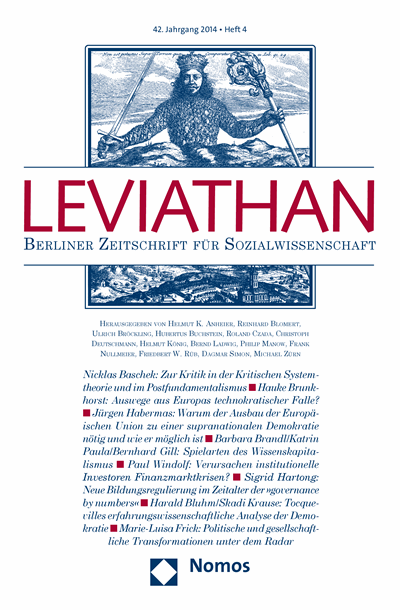
Leviathan
Jahrgang 42 (2014), Heft 4
- Autor:innen:
- Verlag
- Nomos, Baden-Baden
- Copyrightjahr
- 2014
- ISSN-Online
- 1861-8588
- ISSN-Print
- 0340-0425
Kapitelinformationen
Jahrgang 42 (2014), Heft 4
Spielarten des Wissenskapitalismus - Die Kommodifizierung von Saatgut in den USA und in Deutschland
- Autor:innen:
- ISSN-Print
- 0340-0425
- ISSN-Online
- 1861-8588
- Kapitelvorschau:
Die Verschränkung von Technologieentwicklung und nationalstaatlichen Institutionen, bisher nur unzureichend verstanden, wird hier unter einer politökonomischen Perspektive auf die Technologieentwicklung in Deutschland und den USA am Beispiel der Saatgutindustrie entwickelt. Es lassen sich drei institutionelle Arrangements zur Organisation des Wissen(schafts)systems erkennen, die entscheidenden Einfluss auf die Art der entwickelten Technologie haben: die Bereitstellung von Wissen als öffentliches oder als privates Gut in liberalen Ökonomien und die Bereitstellung von Wissen als Clubgut in koordinierten Ökonomien. Als Ergebnis zeigt sich, dass unter den institutionellen Bedingungen liberaler Konkurrenzmärkte (USA seit den 1980er Jahren) eine starke Verwissenschaftlichung, eine deutliche Unternehmenskonzentration sowie eine Einengung der Entwicklungsbemühungen auf wenige, kommerziell interessante Kulturarten und agronomische Eigenschaften erfolgt. In koordinierten Ökonomien wie Deutschland sind diese Tendenzen schwächer ausgeprägt, die Wissensentwicklung im Saatgutsektor ist nach wie vor überwiegend mittelständisch und handwerklich geprägt.
Literaturverzeichnis
Es wurden keine Treffer gefunden. Versuchen Sie einen anderen Begriff.
- Abel, Wilhelm 1967. Agrarpolitik. Göttingen: Vandenhoeck & Ruprecht. Google Scholar öffnen DOI: 10.5771/0340-0425-2014-4-539
- Arrow, Kenneth J. 1962. „Economic welfare and the allocation of resources for invention“, in The rate and direction of inventive activity: economic and social factors. A conference of the Universities-National Bureau Committee for Economic Research and the Committee on Economic Growth of the Social Science Research Council, hrsg. v. National Bureau Committee for Economic Research, S. 609-626. Princeton: Princeton University Press. Google Scholar öffnen DOI: 10.5771/0340-0425-2014-4-539
- Arrow, Kenneth J. 2000. „Increasing returns: historiographic issues and path dependence“, in The European Journal of the History of Economic Thought 7, 2, S. 171-180. Google Scholar öffnen DOI: 10.5771/0340-0425-2014-4-539
- Barth, Regine et al. 2004. „Rechts- und Institutionenentwicklung“, in Agrobiodiversität entwickeln! Handlungsstrategien für eine nachhaltige Tier- und Pflanzenzucht, hrsg. v. Barth, Regine et al., Kapitel 4. Berlin: Institut für ökologische Wirtschaftsforschung. Google Scholar öffnen DOI: 10.5771/0340-0425-2014-4-539
- Baumol, William J.; Nelson, Richard R; Wolff, Edward N. 1994. Convergence of productivity: cross-national studies and historical evidence. Oxford: Oxford University Press. Google Scholar öffnen DOI: 10.5771/0340-0425-2014-4-539
- Becker, Heiko 2009. Pflanzenzüchtung. Stuttgart: UTB. Google Scholar öffnen DOI: 10.5771/0340-0425-2014-4-539
- Bijman, Jos 2001. „AgrEvo: from crop protection to crop production“, in AgBioForum 4, S. 20-25. Google Scholar öffnen DOI: 10.5771/0340-0425-2014-4-539
- Bliss, Fredrick 2007. „Education and preparation of plant breeders for careers in global crop improvement“, in Crop Sci 47, S. 250-261. Google Scholar öffnen DOI: 10.5771/0340-0425-2014-4-539
- Böschen, Stefan et al. 2013. „Innovationsförderung durch geistiges Eigentum? Passungsprobleme zwischen unternehmerischen Wissensinvestitionen und den Schutzmöglichkeiten durch Patente“, in Neue Governance der Wissenschaften, hrsg. v. Grande, Edgar et al., S. 183-211. Bielefeld: transcript. Google Scholar öffnen DOI: 10.5771/0340-0425-2014-4-539
- Boyer, Robert 2005. „How and why capitalism differ“, in Economy and Society 34, 4, S. 509-557. Google Scholar öffnen DOI: 10.5771/0340-0425-2014-4-539
- Brandl, Barbara 2012. „Industrialisierung und Konzentration. Die Analyse eines Zusammenhangs am Beispiel des Saatgutmarkts“, in PROKLA 169, 4, S. 601-618. Google Scholar öffnen DOI: 10.5771/0340-0425-2014-4-539
- Braverman, Harry 1974. Labor and monopoly capital. The degredation of work in the 20. century. New York: Monthly Review Press. Google Scholar öffnen DOI: 10.5771/0340-0425-2014-4-539
- Buchanan, James 1965. „An economic theory of clubs“, in Economica 32, 125, S. 1-14. Google Scholar öffnen DOI: 10.5771/0340-0425-2014-4-539
- Buss, Klaus-Peter; Wittke, Volker 2001. „Wissen als Ware. Überlegungen zum Wandel der Modi gesellschaftlicher Wissensproduktion am Beispiel der Biotechnologie“, in Neue Formen der Wissenserzeugung, hrsg. v. Bender, Gerd, S. 123-146. Frankfurt a. M.: Campus. Google Scholar öffnen DOI: 10.5771/0340-0425-2014-4-539
- Casper, Steven; Soskice, David W. 2004. „Sectoral systems of innovation and varieties of capitalism: explaining the development of high-technology entrepreneurship in Europe“, in Sectoral systems of innovation. Concepts, issues and analyses of six major sectors in Europe, hrsg. v. Malerba, Franco, S. 348-387. Cambridge: Cambridge University Press. Google Scholar öffnen DOI: 10.5771/0340-0425-2014-4-539
- Coriat, Benjamin; Orsi, Fabienne; Weinstein, Oliver 2003. „Does biotech reflect a new science-based innovation regime?“, in Industry and Innovation 10, 3, S. 231-253. Google Scholar öffnen DOI: 10.5771/0340-0425-2014-4-539
- Daele, Wolfgang van den; Sukopp, Herbert; Pühler; Alfred 2008. Grüne Gentechnik im Widerstreit: Modell einer partizipativen Technikfolgenabschätzung zum Einsatz transgener herbizidresistenter Pflanzen. Hoboken: John Wiley & Sons. Google Scholar öffnen DOI: 10.5771/0340-0425-2014-4-539
- Dolata, Ulrich 1996. Politische Ökonomie der Gentechnik: Konzernstrategien, Forschungsprogramme, Technologiewettläufe. Berlin: edition sigma. Google Scholar öffnen DOI: 10.5771/0340-0425-2014-4-539
- Dolata, Ulrich 2001. „Innovationswettbewerb. Risse im Netz - Macht, Konkurrenz und Kooperation in der Technikentwicklung und Regulierung“, in Politik und Technik. Analysen zum Verhältnis von technologischem, politischem und staatlichem Wandel am Anfang des 21. Jahrhunderts. Politische Vierteljahresschrift, Sonderband 31/2000, hrsg. v. Simonis, Georg et al., S. 37-54. Opladen: Westdeutscher Verlag. Google Scholar öffnen DOI: 10.5771/0340-0425-2014-4-539
- Durand-Morat, Alvaro; Wailes, Eric; Chavez, Eddie 2011. Hybrid rice and its impact on food security and the pattern of global production and trade. Corpus Christi: Southern Agricultural Economics Association. Annual Meeting. http://econpapers.repec.org/paper/agssaea11/98845.htm (Zugriff vom 15.09.2014). Google Scholar öffnen DOI: 10.5771/0340-0425-2014-4-539
- Etzkowitz, Henry; Leydesdorff, Loet 2000. „The dynamics of innovation: from national systems and ‚mode 2‘ to a triple helix of university-industry-government relations“, in Research Policy 29, 2, S. 109-123. Google Scholar öffnen DOI: 10.5771/0340-0425-2014-4-539
- Fernandez-Cornejo, Jorge 2004. The seed industry in U.S. agriculture: an exploration of data and information on crop seed markets, regulation, industry structure, and research and development. Agriculture Information Bulletin 786. Washington D.C. Google Scholar öffnen DOI: 10.5771/0340-0425-2014-4-539
- Fernandez-Cornejo, Jorge; Just, Richard E. 2007. „Researchability of modern agricultural input markets and growing concentration“, in American Journal of Agricultural Economics 89, 5, S. 1269-1275. Google Scholar öffnen DOI: 10.5771/0340-0425-2014-4-539
- Foray, Dominique 2004. Economics of knowledge. Cambridge: MIT Press. Google Scholar öffnen DOI: 10.5771/0340-0425-2014-4-539
- Friedmann, Harriet 1978. „World market, state, and family farm: social bases of household production in an era wage labor“, in Comparative Studies in Society and History 22, S. 545-586. Google Scholar öffnen DOI: 10.5771/0340-0425-2014-4-539
- Galison, Peter; Hevly, Bruce W. 1992. Big science: the growth of large-scale research. Stanford: Stanford University Press. Google Scholar öffnen DOI: 10.5771/0340-0425-2014-4-539
- Gerschenkron, Alexander 1989. Bread and democracy in Germany. Cornell: Cornell University Press. Google Scholar öffnen DOI: 10.5771/0340-0425-2014-4-539
- Gibbons, Michael 1994. The new production of knowledge. The dynamics of science and research in contemporary societies. London: Sage. Google Scholar öffnen DOI: 10.5771/0340-0425-2014-4-539
- Gill, Bernhard; Brandl, Barbara 2014. „Legitimität von Sortenschutz und Sortenzulassung aus soziologischer Sicht“, in Rechtsschutz von Pflanzenzüchtungen. Eine kritische Bestandsaufnahme des Sorten-, Patent- und Saatgutrechts, hrsg. v. Metzger, Axel, S. 163-186. Tübingen: Mohr Siebeck. Google Scholar öffnen DOI: 10.5771/0340-0425-2014-4-539
- Gill, Bernhard et al. 2012. „Autorisierung. Eine wissenschafts- und wirtschaftssoziologische Perspektive auf geistiges Eigentum“, in Berliner Journal für Soziologie 22, 3, S. 407-440. Google Scholar öffnen DOI: 10.5771/0340-0425-2014-4-539
- Gill, Bernhard, Schneider, Michael 2014. „Die Grüne Gentechnik in den Fesseln der Chemischen Industrie. Oder: Ist ihr Einsatz im Rahmen einer holistischen Agrarwissenschaft möglich?“, in Projektion Natur. Grüne Gentechnik im Fokus der Wissenschaften, hrsg. v. Meyer, Annette; Schleissing, Stephan, S. 13-32. Göttingen: Vandenhoeck & Ruprecht. Google Scholar öffnen DOI: 10.5771/0340-0425-2014-4-539
- Glenna, Leland L. et al. 2007. „University administrators, agricultural biotechnology, and academic capitalism: defining the public good to promote university industry relationships“, in The Sociological Quarterly 48, 1, S. 141-163. Google Scholar öffnen DOI: 10.5771/0340-0425-2014-4-539
- Glenna, Leland L. et al. 2014. „International political economy of agricultural research and development“, in Handbook of international political economy of agriculture and food, hrsg. v. Bennano, Alessandro; Bush, Lawrence. Cheltenham UK: Edward Elgar (im Erscheinen). Google Scholar öffnen DOI: 10.5771/0340-0425-2014-4-539
- Goure, William F. 2004. „Value creation and capture with transgenic plants“, in The GMO handbook: genetically modified animals, microbes, and plants in biotechnology, hrsg. v. Parekh, Sarad R., S. 263-296. Totowa: Humana Press. Google Scholar öffnen DOI: 10.5771/0340-0425-2014-4-539
- Graff, Gregory D.; Hochman, Gal; Zilberman, David 2009. „The political economy of agricultural biotechnology policies“, in AgBioForum 12, S. 34-36. Google Scholar öffnen DOI: 10.5771/0340-0425-2014-4-539
- Hall, Peter A.; Soskice, David W. 2001. Varieties of capitalism. The institutional foundations of comparative advantage. Oxford: Oxford University Press. Google Scholar öffnen DOI: 10.5771/0340-0425-2014-4-539
- Harwood, Jonathan 2012. Europe’s green revolution and others since the rise and fall of peasant-friendly plant breeding. Abingdon: Routledge. Google Scholar öffnen DOI: 10.5771/0340-0425-2014-4-539
- Haskell, Thomas 1988. „Professionalism versus capitalism: RH Tawney, Emile Durkheim, and CS Peirce on the disinterestedness of professional communities“, in Thomas Haskell: The authority of experts: studies in history and theory, S. 203-214. Bloomington: Indiana University Press. Google Scholar öffnen DOI: 10.5771/0340-0425-2014-4-539
- Hirsch, Joachim 1985. „Auf dem Weg zum Postfordismus? Die aktuelle Neuformierung des Kapitalismus und ihre politischen Folgen“, in Das Argument 151, S. 325-342. Google Scholar öffnen DOI: 10.5771/0340-0425-2014-4-539
- Hollingsworth, J. Rogers 1997. Contemporary capitalism: the embeddedness of institutions. Cambridge: Cambridge University Press. Google Scholar öffnen DOI: 10.5771/0340-0425-2014-4-539
- Jessop, Bob; Sum, Ngai-Ling 2006. Beyond the regulation approach: putting capitalist economies in their place. Cheltenham: Edward Elgar. Google Scholar öffnen DOI: 10.5771/0340-0425-2014-4-539
- Kalaitzandonakes, Nicholas; Bjornson, Bruce 1997. „Vertical and horizontal coordination in the agro-biotechnology industry. Evidence and implications“, in Journal of Agriculture and Applied Economics 29, 1, S. 129-139. Google Scholar öffnen DOI: 10.5771/0340-0425-2014-4-539
- Kalaitzandonakes, Nicholas; Magnier, Alexandre; Miller, Douglas 2011. „A worrisome crop? Is there a market power in the US seed industry?“, in Regulation 20, S. 20-26. Google Scholar öffnen DOI: 10.5771/0340-0425-2014-4-539
- Kinchy, Abby J. 2012. Seeds, science, and struggle: the global politics of transgenic crops. Cambridge: MIT Press. Google Scholar öffnen DOI: 10.5771/0340-0425-2014-4-539
- King, John; Schimmelpfennig, David 2005. „Mergers, acquisitions, and stocks of agricultural biotechnology intellectual property“, in AgBioForum 8, S. 83-88. Google Scholar öffnen DOI: 10.5771/0340-0425-2014-4-539
- Kleinman, Daniel L. 1995. Politics on the endless frontier: postwar research policy in the United States. Durham: Duke University Press. Google Scholar öffnen DOI: 10.5771/0340-0425-2014-4-539
- Kloppenburg, Jack R. 1988. First the seed: the political economy of plant biotechnology. Cambridge: Cambridge University Press. Google Scholar öffnen DOI: 10.5771/0340-0425-2014-4-539
- Kraemer, Klaus 2008. „Charisma im ökonomischen Feld“, in Die Gesellschaft der Unternehmen - Die Unternehmen der Gesellschaft, hrsg. v. Maurer, Andrea; Schimank, Uwe, S. 63-77. Wiesbaden: VS Verlag für Sozialwissenschaften. Google Scholar öffnen DOI: 10.5771/0340-0425-2014-4-539
- Lutz, Burkhard 1989. Der kurze Traum immerwährender Prosperität. Frankfurt a. M.: Campus. Google Scholar öffnen DOI: 10.5771/0340-0425-2014-4-539
- Marco, Alan C; Rausser, Gordon 2008. „The role of patent rights in mergers: consolidation in plant biotechnology“, in American Journal of Agricultural Economics 90, 1, S. 133-151. Google Scholar öffnen DOI: 10.5771/0340-0425-2014-4-539
- McNutt, Patrick 2000. „Public Goods and Club Goods“, in Encyclopedia of law and economics, hrsg. v. Bouckaert, Boudewijn; Geest, Gerrit De, S. 927-951. Cheltenham: Edward Elgar. Google Scholar öffnen DOI: 10.5771/0340-0425-2014-4-539
- Metzger, Axel. Hrsg. 2013. Rechtsschutz von Pflanzenzüchtungen. Eine kritische Bestandsaufnahme des Sorten-, Patent- und Saatgutrecht. Tübingen: Mohr Siebeck. Google Scholar öffnen DOI: 10.5771/0340-0425-2014-4-539
- Mosca, Manuela 2008. „On the origins of the concept of natural monopoly: economies of scale and competition“, in The European Journal of the History of Economic Thought 15, 2, S. 317-353. Google Scholar öffnen DOI: 10.5771/0340-0425-2014-4-539
- Münch, Richard 2011. Akademischer Kapitalismus: Über die politische Ökonomie der Hochschulreform. Berlin: Suhrkamp. Google Scholar öffnen DOI: 10.5771/0340-0425-2014-4-539
- Nelson, Richard R. 1959. „The simple economics of basic scientific research“, in Journal of Political Economy 67, 3, S. 297-306. Google Scholar öffnen DOI: 10.5771/0340-0425-2014-4-539
- Nelson, Richard R. 1989. „What is private and what is public about technology?“, in Science, Technology et Human Values 14, S. 229-241. Google Scholar öffnen DOI: 10.5771/0340-0425-2014-4-539
- Nelson, Richard R.; Wright, Gavin 1994. „The erosion of U.S. technological leadership as a factor in postwar economic convergence“, in Convergence of productivity: cross-national studies and historical evidence, hrsg. v. Baumol, William J; Nelson Richard R; Wolff, Edward N., S. 129-163. Oxford: Oxford University Press. Google Scholar öffnen DOI: 10.5771/0340-0425-2014-4-539
- Nowotny, Helga 1999. Es ist so, es könnte auch anders sein. Über das veränderte Verhältnis von Wissenschaft und Gesellschaft. Frankfurt a. M.: Suhrkamp. Google Scholar öffnen DOI: 10.5771/0340-0425-2014-4-539
- Pal, Suresh; Byerlee, Derek 2006. „India: the funding and organization of agricultural R&D - evolution and emerging policy issues“, in Agricultural RetD in the developing world: too little, too late?, hrsg. v. Pardey, Philip; Alston, Julian; Piggott, Roley, S. 155-193. Washington D.C.: International Food Policy Research Institute. Google Scholar öffnen DOI: 10.5771/0340-0425-2014-4-539
- Perkins, John H. 1997. Geopolitics and the green revolution: wheat, genes, and the Cold War. Oxford: Oxford University Press. Google Scholar öffnen DOI: 10.5771/0340-0425-2014-4-539
- Polanyi, Michael 1985. Implizites Wissen. Frankfurt a. M.: Suhrkamp. Google Scholar öffnen DOI: 10.5771/0340-0425-2014-4-539
- Reynolds, David 2010. „Science, technology, and the Cold War“, in The Cambridge History of the Cold War 3, S. 378-399. Google Scholar öffnen DOI: 10.5771/0340-0425-2014-4-539
- Rhoten, Diana; Powell, Walter 2007. „The frontiers of intellectual property: expanded protection versus new models of open science“, in Annual Review of Law and Social Science 3, 1, S. 345-373. Google Scholar öffnen DOI: 10.5771/0340-0425-2014-4-539
- Rhoten, Diana; Powell, Walter 2011. „Public research universities. From land grant to patent grant institutions“, in Knowledge matters. The public mission of the research university, hrsg. v. Rhoten, Diana; Calhoun, Craig J., S. 319-345. New York: Columbia University Press. Google Scholar öffnen DOI: 10.5771/0340-0425-2014-4-539
- Ritzer, George 2006. Die McDonaldisierung der Gesellschaft. Konstanz: UVK. Google Scholar öffnen DOI: 10.5771/0340-0425-2014-4-539
- Samuelson, Paul 1954. „The pure theory of public expenditure“, in The Review of Economics and Statistics 36, 4, S. 387-389. Google Scholar öffnen DOI: 10.5771/0340-0425-2014-4-539
- Sauer, Matthias 1990. „Fordist modernization of German agriculture and the future of family farms“, in Sociologia Ruralis 30, 3/4, S. 260-279. Google Scholar öffnen DOI: 10.5771/0340-0425-2014-4-539
- Schenkelaars, Piet; Vriend, Huib; Kalaizandonakes, Nicholas 2011. Drivers of consolidation in the seed industry and its consequences for innovation. COGEM. www.cogem.net/showdownload.cfm?objectId=FD275A12-1517-64D9-CC68A79EAFEAABAA&objectType=mark.hive.contentobjects.download.pdf (Zugriff vom 18.09.2014). Google Scholar öffnen DOI: 10.5771/0340-0425-2014-4-539
- Schubert, Johannes; Gill, Bernhard; Böschen, Stefan 2011. „Having or doing intellectual property rights? Transgenic seed on the edge between refeudalisation and napsterisation“, in European Journal of Sociology 52, 1, S. 1-17. Google Scholar öffnen DOI: 10.5771/0340-0425-2014-4-539
- Schumpeter, Joseph Alois 1993. Kapitalismus, Sozialismus und Demokratie. Tübingen: UTB. Google Scholar öffnen DOI: 10.5771/0340-0425-2014-4-539
- Scotchmer, Susann 2004. „The political economy of intellectual property treaties“, in Journal of Law, Economics, and Organization 20, 2, S. 415-437. Google Scholar öffnen DOI: 10.5771/0340-0425-2014-4-539
- Shenggen, Fan; Qian, Keming; Xiaobo, Zhang 2006. „China: an unfinished reform agenda“, in Agricultural RetD in the developing world: too little, too late?, hrsg. v. Pardey, Philip G.; Alston, Julian; Piggott, Roley, S. 29-63. Washington D.C.: International Food Policy Research Institute. Google Scholar öffnen DOI: 10.5771/0340-0425-2014-4-539
- Shonfield, Andrew 1965. Modern capitalism: the changing balance of public and private power. Oxford: Oxford University Press. Google Scholar öffnen DOI: 10.5771/0340-0425-2014-4-539
- Slaughter, Sheila; Rhoades, Gary 1996. „The emergence of a competitiveness research and development policy coalition and the commercialization of academic science and technology“, in Science, Technology et Human Values 21, 3, S. 303-339. Google Scholar öffnen DOI: 10.5771/0340-0425-2014-4-539
- Soskice, David W. 1999. „Divergent production regimes: coordinated and uncoordinated market economies in the 1980s and 1990s“, in Continuity and change in contemporary capitalism, hrsg. v. Kitschelt, Herbert et al., S. 101-134. Cambridge: Cambridge University Press. Google Scholar öffnen DOI: 10.5771/0340-0425-2014-4-539
- Streeck, Wolfgang 2009. Re-forming capitalism: institutional change in the German political economy. Oxford: Oxford University Press. Google Scholar öffnen DOI: 10.5771/0340-0425-2014-4-539
- Uekötter, Frank 2010. Die Wahrheit liegt auf dem Feld. Eine Wissensgeschichte der deutschen Landwirtschaft. Göttingen: Vandenhoeck & Ruprecht. Google Scholar öffnen DOI: 10.5771/0340-0425-2014-4-539
- Unger, Corinna R. 2006. „Cold War Science: Wissenschaft, Politik und Ideologie im Kalten Krieg“, in Neue Politische Literatur 51, 1, S. 49-68. Google Scholar öffnen DOI: 10.5771/0340-0425-2014-4-539
- Varian, Hal 2001. Grundzüge der Mikroökonomie. München: Oldenbourg. Google Scholar öffnen DOI: 10.5771/0340-0425-2014-4-539
- Weber, Max 1922. Wirtschaft und Gesellschaft. Tübingen: Mohr. Google Scholar öffnen DOI: 10.5771/0340-0425-2014-4-539
- Weber, Max 1995 [1917]. Wissenschaft als Beruf. Stuttgart: Reclam. Google Scholar öffnen DOI: 10.5771/0340-0425-2014-4-539
- Weingart, Peter 2001. Die Stunde der Wahrheit? Zum Verhältnis der Wissenschaft zu Politik, Wirtschaft und Medien in der Wissensgesellschaft. Weilerswist: Velbrück. Google Scholar öffnen DOI: 10.5771/0340-0425-2014-4-539
- Welsh, Rick; Glenna, Leland 2006. „Considering the role of the university in conducting research on agri-biotechnologies“, in Social Studies of Science 36, 6, S. 929-942. Google Scholar öffnen DOI: 10.5771/0340-0425-2014-4-539
- Werle, Raymund 2007. „Pfadabhängigkeit“, in Handbuch Governance. Theoretische Grundlagen und empirische Anwendungsfelder, hrsg. v. Benz, Arthur et al., S. 119-131. Wiesbaden: VS Verlag für Sozialwissenschaften. Google Scholar öffnen DOI: 10.5771/0340-0425-2014-4-539
- Wieland, Thomas 2004. „Wie beherrschen wir den pflanzlichen Organismus besser, ...“: Wissenschaftliche Pflanzenzüchtung in Deutschland, 1889-1945. München: Deutsches Museum. Google Scholar öffnen DOI: 10.5771/0340-0425-2014-4-539
- Wieland, Thomas 2011. „Von springenden Genen und lachsroten Petunien. Epistemische, soziale und politische Dimensionen der gentechnischen Transformation der Pflanzenzüchtung“, in Technikgeschichte 78, 3, S. 255-278. Google Scholar öffnen DOI: 10.5771/0340-0425-2014-4-539
- Wieland, Thomas 2012. „Pfadabhängigkeit, Forschungskultur und die langsame Entfaltung der Biotechnologie in der Bundesrepublik Deutschland“, in Ungleiche Pfade? Innovationskulturen im deutsch-deutschen Vergleich, hrsg. v. Fraunholz, Uwe; Hänseroth, Thomas, S. 73-98. Münster: Waxmann. Google Scholar öffnen DOI: 10.5771/0340-0425-2014-4-539
- Wissen, Markus 2005. „Modernisierte Naturbeherrschung. Agrobiodiversität, Biotechnologie und die Krise der industriellen Landwirtschaft“, in PROKLA 35, 3, S. 445-461. Google Scholar öffnen DOI: 10.5771/0340-0425-2014-4-539
- Wright, Brian D. 2012. „Grand missions of agricultural innovation. The need for a new generation of policy instruments to respond to the grand challenges“, in Research Policy 41, 10, S. 1716-1728. Google Scholar öffnen DOI: 10.5771/0340-0425-2014-4-539
- Zedtwitz, Maximilian von; Gassmann, Oliver 2002. „Market versus technology drive in R&D internationalization: four different patterns of managing research and development“, in Research Policy 31, S. 569-588. Google Scholar öffnen DOI: 10.5771/0340-0425-2014-4-539
