Politische Dimensionen koranischer Normativität am Beispiel der Ausdrücke ḫalīfa und umma sowie des ǧizya-Gebots
Inhaltsverzeichnis
Bibliographische Infos
Open Access Vollzugriff
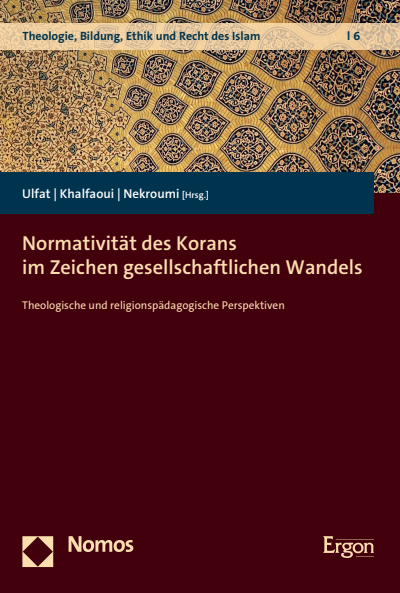
Normativität des Korans im Zeichen gesellschaftlichen Wandels
Theologische und religionspädagogische Perspektiven
- Autor:innen:
- Reihe
- Theologie, Bildung, Ethik und Recht des Islam
- Band
- 6
- Verlag
- Nomos, Baden-Baden
- Copyrightjahr
- 2022
- ISBN-Print
- 978-3-8487-7481-4
- ISBN-Online
- 978-3-7489-3272-7
Kapitelinformationen
Open Access Vollzugriff
Politische Dimensionen koranischer Normativität am Beispiel der Ausdrücke ḫalīfa und umma sowie des ǧizya-Gebots
- Autor:innen:
- ISBN-Print
- 978-3-8487-7481-4
- ISBN-Online
- 978-3-7489-3272-7
- Kapitelvorschau:

Literaturverzeichnis
Es wurden keine Treffer gefunden. Versuchen Sie einen anderen Begriff.
- Badawi, Elsaid M./Muhammad Abdel Haleem, Arabic-English Dictionary of Qurʾanic Usage, Leiden 2008. Google Scholar öffnen doi.org/10.5771/9783748932727-359
- al-Bayḍāwī, Nāṣir ad-Dīn, Anwār at-tanzīl wa-asrār at-taʾwīl, ed. von Muḥammad al-Marʿašlī, 5 Bde., Beirut: Dār Iḥyāʾ at-Turāṯ al-ʿArabī, 1997. Google Scholar öffnen doi.org/10.5771/9783748932727-359
- Berridge, Willow, Islamism in the Modern World: A Historical Approach, London/New York 2019. Google Scholar öffnen doi.org/10.5771/9783748932727-359
- Brown, Jonathan, Slavery and Islam, London 2019. Google Scholar öffnen doi.org/10.5771/9783748932727-359
- Cesari, Jocelyne, The Awakening of Muslim Democracy: Religion, Modernity, and the State, New York 2014. Google Scholar öffnen doi.org/10.5771/9783748932727-359
- Cole, Juan, Muhammad: Prophet of Peace Amid the Clash of Empires, New York 2018. Google Scholar öffnen doi.org/10.5771/9783748932727-359
- Crone, Patricia, „No Compulsion in Islam: Q. 2:256 in Medieval and Modern Interpretation“, in: Le shīʿisme imāmite quarante ans après: Hommage à Etan Kohlberg, hrsg. von Mohammad Amir Amir-Moezzi, Meir M. Bar-Asher und Simon Hopkins, Turnhout 2009, S. 131-178. Google Scholar öffnen doi.org/10.5771/9783748932727-359
- ---, „War“, in: Encyclopaedia of the Qurʾān, hrsg. von Jane D. McAuliffe, 6 Bde., Leiden 2001-2006, Bd. 5, 2006, S. 455-459. Google Scholar öffnen doi.org/10.5771/9783748932727-359
- Gascou, Jean, „Arabic Taxation in the Mid-Seventh Century Papyri“, in: Constructing the Seventh Century, hrsg. von Constantin Zuckerman, Paris 2013, S. 671-677. Google Scholar öffnen doi.org/10.5771/9783748932727-359
- Hallaq, Wael, The Impossible State: Islam, Politics, and Modernity’s Moral Predicament, New York 2013. Google Scholar öffnen doi.org/10.5771/9783748932727-359
- al-Ḫawārizmī, Abū ʿAbdallāh, Mafātīḥ al-ʿulūm, ed. von Ibrāhīm al-Abyārī, Beirut: Dār al-Kitāb al-ʿArabī, 21989. Google Scholar öffnen doi.org/10.5771/9783748932727-359
- Hirschkind, Charles, „What is Political Islam?“, in: Political Islam: A Critical Reader, hrsg. von Frédéric Volpi, New York 2011, S. 13-15. Google Scholar öffnen doi.org/10.5771/9783748932727-359
- Huwaydī, Fahmī, Muwāṭinūn lā ḏimmiyyūn, Kairo: Dār aš-Šurūq, 31999. Google Scholar öffnen doi.org/10.5771/9783748932727-359
- Ibn Taymiyya, Taqīy ad-Dīn, Maǧmūʿ fatāwā šayḫ al-islām Aḥmad Ibn Taymiyya, ed. von ʿAbd ar-Raḥmān b. Muḥammad b. Qāsim und Muḥammad b. ʿAbd ar-Raḥmān b. Qāsim, 37 Bde., Riad/Mekka: Maṭābiʿ ar-Riyāḍ, o. J. [1962-1967]. Google Scholar öffnen doi.org/10.5771/9783748932727-359
- Kadi, Wadad, „The Term ‘Khalīfa’ in Early Exegetical Literature“, in: Die Welt des Islams 28.1 - 4 (1988), S. 392-411. Google Scholar öffnen doi.org/10.5771/9783748932727-359
- ---/Aram Shahin, „Caliph, Caliphate“, in: The Princeton Encyclopedia of Islamic Political Thought, hrsg. von Gerhard Böwering, Princeton/Oxford 2013, S. 81-86. Google Scholar öffnen doi.org/10.5771/9783748932727-359
- Leaman, Oliver (Hg.), The Qurʾan: An Encyclopedia, London/New York 2010. Google Scholar öffnen doi.org/10.5771/9783748932727-359
- Lecker, Michael, „Constitution of Medina“, in: Encyclopaedia of Islam Three, hrsg. von Kate Fleet et al., Leiden 2012. Google Scholar öffnen doi.org/10.5771/9783748932727-359
- March, Andrew F., The Caliphate of Man: Popular Sovereignty in Modern Islamic Thought, Cambridge, MA 2019. Google Scholar öffnen doi.org/10.5771/9783748932727-359
- McAuliffe, Jane D. (Hg.), The Cambridge Companion to the Qurʾān, Cambridge 2014. Google Scholar öffnen doi.org/10.5771/9783748932727-359
- Noth, Albrecht, „Abgrenzungsprobleme zwischen Muslimen und Nicht-Muslimen: Die ‚Bedingungen Umars (aš-šurūṭ al-ʿumariyya)‘ unter anderem Aspekt gelesen“, in: Jerusalem Studies in Arabic and Islam 9 (1987), S. 290-315. Google Scholar öffnen doi.org/10.5771/9783748932727-359
- ar-Rāzī, Faḫr ad-Dīn, at-Tafsīr al-kabīr aw Mafātīḥ al-ġayb, ohne Ed., 32 Bde., Kairo: Maktabat al-Kulliyyāt al-Azhariyya, 1934-1964. Google Scholar öffnen doi.org/10.5771/9783748932727-359
- Rippin, Andrew (Hg.), The Wiley Blackwell Companion to the Qurʾan, Oxford 22017. Google Scholar öffnen doi.org/10.5771/9783748932727-359
- Rubin, Uri, „Quran and Tafsīr: The Case of ‘ʿan yadin’“, in: Der Islam 70 (1993), S. 133-144. Google Scholar öffnen doi.org/10.5771/9783748932727-359
- Sadan, Joseph, „‘Community’ and ‘Extra-Community’ as a Legal and Literary Problem“, in: Israel Oriental Studies 10 (1980), S. 102-115. Google Scholar öffnen doi.org/10.5771/9783748932727-359
- aṭ-Ṭabarī, Ibn Ǧarīr, Geschichte der Perser und Araber zur Zeit der Sasaniden: Aus der arabischen Chronik des Tabari, übers. von Theodor Nöldeke, Leiden 1879. Google Scholar öffnen doi.org/10.5771/9783748932727-359
- at-Tirmiḏī, Abū ʿĪsā, Sunan at-Tirmiḏī, 5 Bde., ed. von Aḥmad Šākir, Kairo: Muṣṭafā al-Bābī al-Ḥalabī, 1975. Google Scholar öffnen doi.org/10.5771/9783748932727-359
- Tlili, Sarra, Animals in the Qurʾan, Cambridge 2012. Google Scholar öffnen doi.org/10.5771/9783748932727-359
- Vacca, Alison, Non-Muslim Provinces under Early Islam: Islamic Rule and Iranian Legitimacy in Armenia and Caucasian Albania, New York 2017. Google Scholar öffnen doi.org/10.5771/9783748932727-359
- Wild, Stefan, „Politics and the Qurʾan“, in: The Oxford Handbook of Qurʾanic Studies, hrsg. von Mustafa Shah und Muhammad Abdel Haleem, Oxford 2020, S. 502-511. Google Scholar öffnen doi.org/10.5771/9783748932727-359
- Zafer, Hamza, Ecumenical Community: Language and Politics of the Ummah in the Qurʾan, Leiden/Boston 2020. Google Scholar öffnen doi.org/10.5771/9783748932727-359
- az-Zamaḫšarī, Ǧārallāh, Tafsīr al-Kaššāf ʿan ḥaqāʾiq at-tanzīl wa-ʿuyūn al-aqāwīl fī wuǧūh at-taʾwīl, ed. von Ḫalīl Maʾmūn Šīḥā, Beirut: Dār al-Kitāb al-ʿArabī, 2009. Google Scholar öffnen doi.org/10.5771/9783748932727-359