AI and its Opportunities for Decision-Making in Organizations: A Systematic Review of the Influencing Factors on the Intention to use AI
Inhaltsverzeichnis
Bibliographische Infos
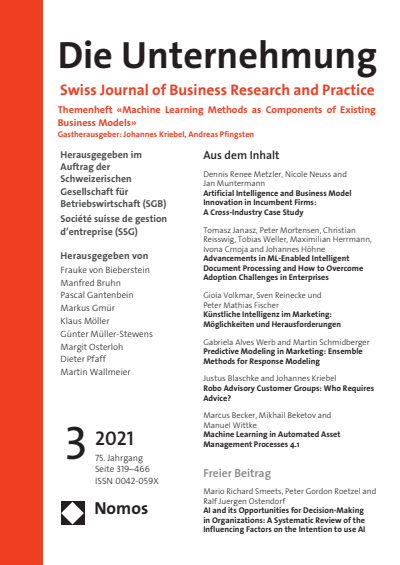
Die Unternehmung
Jahrgang 75 (2021), Heft 3
- Autor:innen:
- Verlag
- Nomos, Baden-Baden
- Copyrightjahr
- 2021
- ISSN-Online
- 0042-059X
- ISSN-Print
- 0042-059X
Kapitelinformationen
Jahrgang 75 (2021), Heft 3
AI and its Opportunities for Decision-Making in Organizations: A Systematic Review of the Influencing Factors on the Intention to use AI
- Autor:innen:
- ISSN-Print
- 0042-059X
- ISSN-Online
- 0042-059X
- Kapitelvorschau:
Ein Anwendungsbereich Künstlicher Intelligenz (KI) ist die Entscheidungsunterstützung, insbesondere im Management. Obwohl einzelne Forschungsbereiche das Zusammenspiel von KI und Mensch bereits untersuchen (z.B. die Forschung im Bereich "hybrider Intelligenz"), gibt es noch zahlreiche offene Forschungslücken - so fehlt z.B. ein umfassender Überblick darüber, welche Faktoren die Absicht, KI zu nutzen, begünstigen. Mittels einer systematischen Literatur-Analyse ermitteln wir eben diese Faktoren, die die Nutzungsbereitschaft von AI in organisationalen Entscheidungsprozessen potenziell positiv beeinflussen. Hieraus erstellen wir ein Framework, welches sowohl praktische Implikationen zur erfolgreichen Nutzung von AI in Entscheidungsprozessen in Organisationen als auch weitere Forschungsansätze liefert, beispielsweise zur Gültigkeit/ Nutzbarkeit erprobter IS-Adaptions-Modelle im vorliegenden Kontext.
Literaturverzeichnis
Es wurden keine Treffer gefunden. Versuchen Sie einen anderen Begriff.
- Balakrishnan, Tara; Chui, Michael; Hall, Bryce; Henke, Nicolaus (2020): The State of AI in 2020. Edited by McKinsey & Company. Available online at https://www.mckinsey.com/business-functions/mckinsey-analytics/our-insights/global-survey-the-state-of-ai-in-2020, checked on 4/29/2021. Google Scholar öffnen DOI: 10.5771/0042-059X-2021-3-319
- Candelon, François; Reichert, Tom; Duranton, Sylvain; Rodolphe, Charme di Carlo; Stokol, Georgie (2020): Deploying AI to Maximize Revenue. Edited by BCG Henderson Institute. Available online at https://www.bcg.com/de-de/publications/2020/deploying-ai-artificial-intelligence-to-maximize-revenue, checked on 4/29/2021. Google Scholar öffnen DOI: 10.5771/0042-059X-2021-3-319
- Chen, Hsinchun; Chiang, Roger H. L.; Storey, Veda C. (2012): Business Intelligence and Analytics: From Big Data to Big Impact. In MIS Quarterly 36 (4), pp. 1165–1188. DOI: 10.2307/41703503. Google Scholar öffnen DOI: 10.5771/0042-059X-2021-3-319
- Grover, Varun; Chiang, Roger H.L.; Liang, Ting-Peng; Zhang, Dongsong (2018): Creating Strategic Business Value from Big Data Analytics: A Research Framework. In Journal of Management Infor-mation Systems 35 (2), pp. 388–423. DOI: 10.1080/07421222.2018.1451951. Google Scholar öffnen DOI: 10.5771/0042-059X-2021-3-319
- International Data Group (2021): IDC Forecasts Improved Growth for Global AI Market in 2021. Available online at https://www.idc.com/getdoc.jsp?containerId=prUS47482321, checked on 4/29/2021. Google Scholar öffnen DOI: 10.5771/0042-059X-2021-3-319
- Kraus, Mathias; Feuerriegel, Stefan; Oztekin, Asil (2020): Deep Learning in Business Analytics and Operations Research: Models, Applications and Managerial Implications. In European Journal of Operational Research 281 (3), pp. 628–641. DOI: 10.1016/j.ejor.2019.09.018. Google Scholar öffnen DOI: 10.5771/0042-059X-2021-3-319
- Raisch, Sebastian; Krakowski, Sebastian (2020): Artificial Intelligence and Management: The Auto-mation-Augmentation Paradox. In Academy of Management Review. DOI: 10.5465/2018.0072. (forthcoming) Google Scholar öffnen DOI: 10.5771/0042-059X-2021-3-319
- Schilling, Melissa A. (2015): Technology Shocks, Technological Collaboration, and Innovation Out-comes. In Organization Science 26 (3), pp. 668–686. DOI: 10.1287/orsc.2015.0970. Google Scholar öffnen DOI: 10.5771/0042-059X-2021-3-319
- Wu, Lynn; Hitt, Lorin; Lou, Bowen (2020): Data Analytics, Innovation, and Firm Productivity. In Man-agement Science 66 (5), pp. 2017–2039. DOI: 10.1287/mnsc.2018.3281. Google Scholar öffnen DOI: 10.5771/0042-059X-2021-3-319
- Wu, Lynn; Lou, Bowen; Hitt, Lorin (2019): Data Analytics Supports Decentralized Innovation. In Ma-nagement Science 65 (10), pp. 4863–4877. DOI: 10.1287/mnsc.2019.3344. Google Scholar öffnen DOI: 10.5771/0042-059X-2021-3-319
- Agrawal, A. et al. (2017): What to Expect from Artificial Intelligence, in: MIT Sloan Management Review, Vol. 28, No. 3, pp. 23-27. Google Scholar öffnen DOI: 10.5771/0042-059X-2021-3-324
- Baden-Fuller, C./Haefliger, S. (2013): Business Models and Technological Innovation, in: Long Range Planning, Vol. 46, pp. 419–426. Google Scholar öffnen DOI: 10.5771/0042-059X-2021-3-324
- Baryannis, G. et al. (2019): Supply Chain Risk Management and Artificial Intelligence: State of the Art and Future Research Directions, in: International Journal of Production Research, Vol. 57, No. 7, pp. 2179–2202. Google Scholar öffnen DOI: 10.5771/0042-059X-2021-3-324
- Brock, J./von Wangenheim, F. (2019): Demystifying AI: What Digital Transformation Leaders Can Teach You About Realistic Artificial Intelligence, in: California Management Review, Vol. 61, No. 4, pp. 110–134. Google Scholar öffnen DOI: 10.5771/0042-059X-2021-3-324
- Burmeister, C. et al. (2016): Business Model Innovation for Industrie 4.0: Why the "Industrial Internet" Mandates a New Perspective on Innovation, in: Die Unternehmung, Vol. 70, No. 2, pp. 124–152. Google Scholar öffnen DOI: 10.5771/0042-059X-2021-3-324
- Chesbrough, H. (2007): Business Model Innovation: It's Not Just About Technology Anymore, in: Strategy & Leadership, Vol. 35, No. 6, pp. 12–17. Google Scholar öffnen DOI: 10.5771/0042-059X-2021-3-324
- Ciampi, F. et al. (2021): Exploring the Impact of Big Data Analytics Capabilities on Business Model Innovation: The Mediating Role of Entrepreneurial Orientation, in: Journal of Business Research, Vol. 123, pp. 1–13. Google Scholar öffnen DOI: 10.5771/0042-059X-2021-3-324
- Davenport, T./Ronanki, R. (2018): Artificial Intelligence for the Real World, in: Harvard Business Review, Vol. 96, No. 1, pp. 108–116. Google Scholar öffnen DOI: 10.5771/0042-059X-2021-3-324
- Eisenhardt, K. (1989): Building Theories from Case Study Research, in: The Academy of Management Review, Vol. 14, No. 4, pp. 532–550. Google Scholar öffnen DOI: 10.5771/0042-059X-2021-3-324
- Fjeldstad, Ø./Snow, C. (2018): Business Models and Organization Design, in: Long Range Planning, Vol. 51, No. 1, pp. 32–39. Google Scholar öffnen DOI: 10.5771/0042-059X-2021-3-324
- Foss, N. J./Saebi, T. (2017): Fifteen Years of Research on Business Model Innovation: How Far Have We Come, and Where Should We Go?, in: Journal of Management, Vol. 43, No. 1, pp. 200–227. Google Scholar öffnen DOI: 10.5771/0042-059X-2021-3-324
- Hamel, G. (2000): Leading the Revolution. Harvard Business School Press. Google Scholar öffnen DOI: 10.5771/0042-059X-2021-3-324
- Herriott, R./Firestone, W. (1983): Multisite Qualitative Policy Research: Optimizing Description and Generalizability, in: Educational Researcher, Vol. 12, pp. 14–19. Google Scholar öffnen DOI: 10.5771/0042-059X-2021-3-324
- Hildebrandt, B. et al. (2015): Entering the Digital Era – the Impact of Digital Technology-Related M&As on Business Model Innovations of Automobile OEMs, in: ICIS 2015 Proceedings. Google Scholar öffnen DOI: 10.5771/0042-059X-2021-3-324
- Hitt, L. M./Brynjolfsson, E. (1996): Productivity, Business Profitability, and Consumer Surplus: Three Different Measures of Information Technology Value, in: MIS Quarterly, Vol. 20, No. 2, pp. 121–142. Google Scholar öffnen DOI: 10.5771/0042-059X-2021-3-324
- Khamparia, A./Singh, K. M. (2019): A Systematic Review on Deep Learning Architectures and Applications, in: Expert Systems, Vol. 36, No. 3, pp. 1–22. Google Scholar öffnen DOI: 10.5771/0042-059X-2021-3-324
- Kshetri, N. (2020): Artificial Intelligence in Human Resource Management in the Global South, in: AMCIS 2020 Proceedings. Google Scholar öffnen DOI: 10.5771/0042-059X-2021-3-324
- Lee, A./Baskerville, R. (2003): Generalizing Generalizability in Information Systems Research, in: Information Systems Research, Vol. 14, No. 3, pp. 221–243. Google Scholar öffnen DOI: 10.5771/0042-059X-2021-3-324
- Lee, J. et al. (2019): Emerging Technology and Business Model Innovation: The Case of Artificial Intelligence, in: Journal of Open Innovation: Technology, Market, and Complexity, Vol. 5, No. 3, pp. 1–13. Google Scholar öffnen DOI: 10.5771/0042-059X-2021-3-324
- Levkovskyi, B. et al. (2020): Why Do Organizations Change? A Literature Review on Drivers and Measures of Success for Digital Transformation, in: AMCIS 2020 Proceedings. Google Scholar öffnen DOI: 10.5771/0042-059X-2021-3-324
- Lokuge, S. et al. (2020): The Next Wave of CRM Innovation: Implications for Research, Teaching, and Practice, in: Communications of the AIS, Vol. 46, No. 1, pp. 23–46. Google Scholar öffnen DOI: 10.5771/0042-059X-2021-3-324
- Markides, C./Charitou, C. D. (2004): Competing with Dual Business Models – a Contingency Approach, in: Academy of Management Perspectives, Vol. 18, No. 3, pp. 22–36. Google Scholar öffnen DOI: 10.5771/0042-059X-2021-3-324
- May, A. et al. (2020): Realizing Digital Innovation from Artificial Intelligence, in: ICIS 2020 Proceedings. Google Scholar öffnen DOI: 10.5771/0042-059X-2021-3-324
- Metzler, D. R./Muntermann, J. (2020): The Impact of Digital Transformation on Incumbent Firms: An Analysis of Changes, Challenges, and Responses at the Business Model Level, in: ICIS 2020 Proceedings. Google Scholar öffnen DOI: 10.5771/0042-059X-2021-3-324
- Myers, M. D. (2009): Qualitative Research in Business & Management. SAGE Publications. Google Scholar öffnen DOI: 10.5771/0042-059X-2021-3-324
- Neuhüttler, J. et al. (2020): Artificial Intelligence as Driver for Business Innovation in Smart Service Systems, in: AHFE 2020 Proceedings. Google Scholar öffnen DOI: 10.5771/0042-059X-2021-3-324
- Osmundsen, K./Bygstad, B. (2020): Patterns of Interaction: Making Sense of Digitalization in Incumbent Firms, in: SCIS 2020 Proceedings. Google Scholar öffnen DOI: 10.5771/0042-059X-2021-3-324
- Osterwalder, A./Pigneur, Y. (2010): Business Model Generation – a Handbook for Visionaries, Game Changers, and Challengers. John Wiley and Sons. Google Scholar öffnen DOI: 10.5771/0042-059X-2021-3-324
- Plastino, E./Purdy, M. (2018): Game Changing Value from Artificial Intelligence: Eight Strategies, in: Strategy & Leadership, Vol. 46, No. 1, pp. 16–22. Google Scholar öffnen DOI: 10.5771/0042-059X-2021-3-324
- Russell, S./Norvig, P. (2003): Artificial Intelligence: A Modern Approach, 2nd Ed. Prentice Hall. Google Scholar öffnen DOI: 10.5771/0042-059X-2021-3-324
- Sebastian, I. et al. (2017): How Big Old Companies Navigate Digital Transformation, in: MIS Quarterly Executive, Vol. 16, No. 3, pp. 201–213. Google Scholar öffnen DOI: 10.5771/0042-059X-2021-3-324
- Sharda, R. et al. (2021): Analytics, Data Science, and Artificial Intelligence: Systems for Decision Support, 11th Ed. Pearson Education. Google Scholar öffnen DOI: 10.5771/0042-059X-2021-3-324
- Sorescu, A. (2017): Data-Driven Business Model Innovation, in: Journal of Product Innovation Management, Vol. 34, No. 5, pp. 691–696. Google Scholar öffnen DOI: 10.5771/0042-059X-2021-3-324
- Soto Setzke, D. et al. (2020): Pathways to Successful Business Model Innovation in the Context of Digital Transformation, in: PACIS 2020 Proceedings. Google Scholar öffnen DOI: 10.5771/0042-059X-2021-3-324
- Stormi, K. et al. (2018): Feasibility of B2C Customer Relationship Analytics in the B2B Industrial Context, in: ECIS 2018 Proceedings. Google Scholar öffnen DOI: 10.5771/0042-059X-2021-3-324
- Svahn, F. et al. (2017): Embracing Digital Innovation in Incumbent Firms: How Volvo Cars Managed Competing Concerns, in: MIS Quarterly, Vol. 41, No. 1, pp. 239–253. Google Scholar öffnen DOI: 10.5771/0042-059X-2021-3-324
- Veit, D. et al. (2014): Business Models: An Information Systems Research Agenda, in: Business & Information Systems Engineering, Vol. 6, No. 1, pp. 45–53. Google Scholar öffnen DOI: 10.5771/0042-059X-2021-3-324
- Westerman, G./Bonnet, D. (2015): Revamping Your Business through Digital Transformation, in: MIT Sloan Management Review, Vol. 56, No. 3, pp. 10–15. Google Scholar öffnen DOI: 10.5771/0042-059X-2021-3-324
- Wirtz, B. et al. (2016): Business Models: Origin, Development and Future Research Perspectives, in: Long Range Planning, Vol. 49, No. 1, pp. 36–54. Google Scholar öffnen DOI: 10.5771/0042-059X-2021-3-324
- Yin, R. (2014): Case Study Research, 5th Ed. SAGE Publications. Google Scholar öffnen DOI: 10.5771/0042-059X-2021-3-324
- Zott, C. et al. (2011): The Business Model: Recent Developments and Future Research, in: Journal of Management, Vol. 37, No. 4, pp. 1019–1042. Google Scholar öffnen DOI: 10.5771/0042-059X-2021-3-324
- Amershi S., et al. (2019): Software Engineering for Machine Learning: A Case Study, at: 2019 IEEE/ACM 41st International Conference on Software Engineering: Software Engineering in Practice (ICSE-SEIP) (pp. 291–300), IEEE. Google Scholar öffnen DOI: 10.5771/0042-059X-2021-3-340
- Brynjolfsson, E./McAfee, A. (2017): The business of artificial intelligence, in: Harvard Business Review, 7, 3–11, URL: https://starlab-alliance.com/wp-content/uploads/2017/09/The-Business-of-Artificial-Intelligence.pdf, retrieved: March 11, 2021. Google Scholar öffnen DOI: 10.5771/0042-059X-2021-3-340
- Brynjolfsson, E./Mitchell, T. (2017): What can machine learning do? Workforce implications, in: Science, 358 (6370), 1530–1534. Google Scholar öffnen DOI: 10.5771/0042-059X-2021-3-340
- Canon Business Process Services (2019): Five Steps to Reducing Your Paper Processing Costs, URL: https://cbps.canon.com/insights/five-steps-to-reducing-your-paper-processing-costs, retrieved: December 22, 2020. Google Scholar öffnen DOI: 10.5771/0042-059X-2021-3-340
- Chen, H.-C., et al. (2012): Business Intelligence and Analytics: From Big Data to Big Impacts, in: MIS Quarterly, 36 (4), 1165–1188. Google Scholar öffnen DOI: 10.5771/0042-059X-2021-3-340
- Chui, M./Malhotra, S. (2018): AI adoption advances, but foundational barriers remain, URL: https://www.mckinsey.com/featured-insights/artificial-intelligence/ai-adoption-advances-but-foundational-barriers-remain, retrieved: March 11, 2021. Google Scholar öffnen DOI: 10.5771/0042-059X-2021-3-340
- Clark, M. (2020): Business Impact of Intelligent Document Processing (IDP), URL: https://www.infrrd.ai/blog/business-impact-of-intelligent-document-processing, retrieved: March 16, 2021. Google Scholar öffnen DOI: 10.5771/0042-059X-2021-3-340
- Corbin, J./Strauss, A. (2014): Basics of qualitative research: Techniques and procedures for developing grounded theory. Google Scholar öffnen DOI: 10.5771/0042-059X-2021-3-340
- Côrte-Real, N., et al. (2017): Assessing business value of Big Data Analytics in European firms, in: Journal of Business Research, 70, 379–390. Google Scholar öffnen DOI: 10.5771/0042-059X-2021-3-340
- Denk, T. I./Reisswig, C. (2019): BERTgrid: Contextualized Embedding for 2D Document Representation and Understanding, at: "Document Intelligence" workshop of 33rd NeurIPS 2019. Google Scholar öffnen DOI: 10.5771/0042-059X-2021-3-340
- Garncarek, Ł., et al. (2020): LAMBERT: Layout-Aware (Language) Modeling using BERT for information extraction, URL: https://arxiv.org/abs/2002.08087, retrieved: March 19, 2021. Google Scholar öffnen DOI: 10.5771/0042-059X-2021-3-340
- Hyland Software Inc. (2019): 10 Things You Need To Know About Intelligent Capture, URL: https://www.hyland.com/-/media/Files/hyland/ebooks/brainware-ebook-ten-things-intelligent-data-capture.pdf?la=en, retrieved: December 15, 2020. Google Scholar öffnen DOI: 10.5771/0042-059X-2021-3-340
- Jyoti, R., et al. (2019): IDC FutureScape: Worldwide Artificial Intelligence (AI) 2020 Predictions, IDC Corporate USA, URL: https://www.idc.com/getdoc.jsp?containerId=US45576319, retrieved: March 17, 2021. Google Scholar öffnen DOI: 10.5771/0042-059X-2021-3-340
- Katti, A. R., et al. (2018): Chargrid: Towards Understanding 2D Documents, at: EMNLP 2018. Google Scholar öffnen DOI: 10.5771/0042-059X-2021-3-340
- Koch, B. (2019): The e-invoicing journey 2019–2025, URL: https://compacer.com/wp-content/uploads/2019/05/Billentis_Report_compacer_single-sponsor.pdf, retrieved: March 16, 2021. Google Scholar öffnen DOI: 10.5771/0042-059X-2021-3-340
- Lample, G., et al. (2016): Neural Architectures for Named Entity Recognition, in: Proceedings of NAACL 2016. Google Scholar öffnen DOI: 10.5771/0042-059X-2021-3-340
- Levvel Research (2019): Pitching ROI for Accounts Payable Automation, URL: Levvel Research: https://cdn.levvel.io/reports/PitchingRIO_Report_Rebrand.pdf, retrieved: November 28, 2020. Google Scholar öffnen DOI: 10.5771/0042-059X-2021-3-340
- Liu, X., et al. (2019): Graph Convolution for Multimodal Information Extraction from Visually Rich Documents, at: NAACL 2019. Google Scholar öffnen DOI: 10.5771/0042-059X-2021-3-340
- Lorica, B./Nathan, P. (2019): AI Adoption in the Enterprise. How Companies Are Planning and Prioritizing AI Projects in Practice. Google Scholar öffnen DOI: 10.5771/0042-059X-2021-3-340
- Mansfield, E., et al. (1977): Social and Private Rates of Return From Industrial Innovation, in: Quarterly Journal of Economics, 91 (2), 221–240. Google Scholar öffnen DOI: 10.5771/0042-059X-2021-3-340
- Manyika, J., et al. (2017): A future that works: automation, employment, and productivity, URL: https://www.mckinsey.com/~/media/mckinsey/featured%20insights/Digital%20Disruption/Harnessing%20automation%20for%20a%20future%20that%20works/MGI-A-future-that-works-Full-report.ashx, retrieved: March 11, 2021. Google Scholar öffnen DOI: 10.5771/0042-059X-2021-3-340
- McAfee, A./Brynjolfsson, E. (2012): Big Data: The Management Revolution, URL: https://hbr.org/2012/10/big-data-the-management-revolution, retrieved March: 16, 2021. Google Scholar öffnen DOI: 10.5771/0042-059X-2021-3-340
- Mizik, N./Jacobsen, R. (2003): Trading Off Between Value Creation and Value Appropriation: The Financial Implications of Shifts in Strategic Emphasis, in: Journal of Marketing, 67 (1), 63–76. Google Scholar öffnen DOI: 10.5771/0042-059X-2021-3-340
- Ng, A. (2016): What AI Can and Can’t Do, from https://hbr.org/2016/11/what-artificial-intelligence-can-and-cant-do-right-now, retrieved: March 16, 2021. Google Scholar öffnen DOI: 10.5771/0042-059X-2021-3-340
- Osterwalder, A. (2004): The business model ontology: A proposition in a design science approach, URL: http://www.hec.unil.ch/aosterwa/PhD/Osterwalder_PhD_BM_Ontology.pdf, retrieved: August 21, 2020. Google Scholar öffnen DOI: 10.5771/0042-059X-2021-3-340
- Osterwalder, A./Pigneur, Y. (2010): Business Model Generation: A Handbook for Visionaries, Game Changers, and Challengers. Google Scholar öffnen DOI: 10.5771/0042-059X-2021-3-340
- Palm, R. B., et al. (2017): CloudScan – A configuration-free invoice analysis system using recurrent neural networks, ICDAR 2017. Google Scholar öffnen DOI: 10.5771/0042-059X-2021-3-340
- Parikh, A. P., et al. (2016): A Decomposable Attention Model for Natural Language Inference, in: Proceedings of the 2016 Conference on Empirical Methods in Natural Language Processing. Google Scholar öffnen DOI: 10.5771/0042-059X-2021-3-340
- Parisi, G. I., et al. (2019): Continual Lifelong Learning with Neural Networks: A Review, URL: https://arxiv.org/abs/1802.07569, retrieved March: 17, 2021. Google Scholar öffnen DOI: 10.5771/0042-059X-2021-3-340
- Prahalad, C. K./Hamel, G. (1990): The Core Competence of the Corporation, in: Harvard Business Review, 68 (3), 79–91, URL: https://hbr.org/1990/05/the-core-competence-of-the-corporation, retrieved: March 16, 2021. Google Scholar öffnen DOI: 10.5771/0042-059X-2021-3-340
- Prasad, S. (2020): How is Intelligent Document processing disrupting traditional workflows?, URL: https://www.klearstack.com/intelligent-document-processing-technology/, retrieved: November 29, 2020. Google Scholar öffnen DOI: 10.5771/0042-059X-2021-3-340
- Rai, A. (2020): Explainable AI: from black box to glass box, in: Journal of the Academy of Marketing Science, 48, 137–141. Google Scholar öffnen DOI: 10.5771/0042-059X-2021-3-340
- Reis, C., et al. (2020): Assessing the drivers of machine learning business value, in: Journal of Business Research, 117, 232–243. Google Scholar öffnen DOI: 10.5771/0042-059X-2021-3-340
- Reisswig, C., et al. (2019): Chargrid-OCR: End-to-end trainable Optical Character Recognition through Semantic Segmentation and Object Detection, at: Neur IPS 2019 Workshop Document Intelligence. Google Scholar öffnen DOI: 10.5771/0042-059X-2021-3-340
- Sanders, N. (2016): How to Use Big Data to Drive Your Supply Chain, in: California Management Review, 26–48. Google Scholar öffnen DOI: 10.5771/0042-059X-2021-3-340
- Schilling, M. A. (2015): Technology shocks, technological collaboration, and innovation outcomes, in: Organizational Science, 26 (3), 668–686. Google Scholar öffnen DOI: 10.5771/0042-059X-2021-3-340
- Strauss, A. (1987): Qualitative Analysis for Social Scientists, Cambridge University Press. Google Scholar öffnen DOI: 10.5771/0042-059X-2021-3-340
- Wei, M., et al. (2020): Robust Layout-aware IE for Visually Rich Documents with Pre-trained Language Models, in: Proceedings of the 43rd International ACM SIGIR Conference on Research and Development in Information Retrieval, 2367–2376, URL: https://arxiv.org/abs/2005.11017, retrieved: March 17, 2021. Google Scholar öffnen DOI: 10.5771/0042-059X-2021-3-340
- Xu, Y., et al. (2019): LayoutLM: Pre-training of Text and Layout for Document Image Understanding, in: Proceedings of the 26th ACM SIGKDD International Conference on Knowledge Discovery & Data Mining, 1192–1200, URL: https://arxiv.org/abs/1912.13318, retrieved: March 17, 2021. Google Scholar öffnen DOI: 10.5771/0042-059X-2021-3-340
- Yu, W., et al. (2020): PICK: Processing Key Information Extraction from Documents using Improved Graph Learning-Convolutional Networks, at: International Conference on Pattern Recognition 2020, URL: https://arxiv.org/abs/2004.07464, retrieved: March 17, 2021. Google Scholar öffnen DOI: 10.5771/0042-059X-2021-3-340
- Zhang P., et al. (2020): TRIE: End-to-End Text Reading and Information Extraction for Document Understanding, in: Proceedings of the 28th ACM International Conference on Multimedia, 1413–1422, URL: https://arxiv.org/abs/2005.13118, retrieved: March 17, 2021. Google Scholar öffnen DOI: 10.5771/0042-059X-2021-3-340
- Bellman, A. (1978): Artificial Intelligence: Can Computers Think? Thomson Course Technology. Google Scholar öffnen DOI: 10.5771/0042-059X-2021-3-359
- Charniak, E./McDermott, D. (1985): Introduction to Artificial Intelligence. Reading, MA: Addision-Wesley. Google Scholar öffnen DOI: 10.5771/0042-059X-2021-3-359
- Chui, M. et al. (2018): An executive’s guide to AI. Verfügbar unter https://www.mckinsey.com/business-functions/mckinsey-analytics/our-insights/an-executives-guide-to-ai (Zugriff am 21.08.2020). Google Scholar öffnen DOI: 10.5771/0042-059X-2021-3-359
- Colson, E. (2019): What AI-Driven Decision Making Looks Like. Harvard Business Review. Verfügbar unter https://hbr.org/2019/07/what-ai-driven-decision-making-looks-like (Zugriff am 14.08.2020). Google Scholar öffnen DOI: 10.5771/0042-059X-2021-3-359
- Davenport, H./Kirby, J. (2016): Just how smart are smart machines?. MIT Sloan Management Review, 57(3), S. 21. Google Scholar öffnen DOI: 10.5771/0042-059X-2021-3-359
- Davenport, T. et al. (2020): How artificial intelligence will change the future of marketing. Journal of the Academy of Marketing Science, 48(1), S. 24–42. Google Scholar öffnen DOI: 10.5771/0042-059X-2021-3-359
- Gentsch, P. (2019): Künstliche Intelligenz für Sales, Marketing und Service. New York, NY: Springer Publishing. Google Scholar öffnen DOI: 10.5771/0042-059X-2021-3-359
- Gioia, A. et al. (2013): Seeking qualitative rigor in inductive research: Notes on the Gioia methodology. Organizational research methods, 16(1), S. 15–31. Google Scholar öffnen DOI: 10.5771/0042-059X-2021-3-359
- Glaser, B./Strauss, L. (1967): The Discovery of Grounded Theory. Chicago: Aldine. Google Scholar öffnen DOI: 10.5771/0042-059X-2021-3-359
- Huang, H./Rust, T. (2018): Artificial intelligence in service. Journal of Service Research, 21(2), S. 155–172. Google Scholar öffnen DOI: 10.5771/0042-059X-2021-3-359
- Jaeger, U./Reinecke, S. (2009): Expertengespräch. In: Baumgarth, C. et al. (Hrsg.): Empirische Mastertechniken: eine anwendungsorientierte Einführung für die Marketing- und Managementforschung. Wiesbaden: Gabler, S. 29–76. Google Scholar öffnen DOI: 10.5771/0042-059X-2021-3-359
- Kaplan, A./Haenlein, M. (2019): Siri, Siri, in my hand: Who’s the fairest in the land? On the interpretations, illustrations, and implications of artificial intelligence. Business Horizons, 62(1), S. 15–25. Google Scholar öffnen DOI: 10.5771/0042-059X-2021-3-359
- Kietzmann, J. et al. (2018): Artificial intelligence in advertising: How marketers can leverage artificial intelligence along the consumer journey. Journal of Advertising Research, 58(3), S. 263–267. Google Scholar öffnen DOI: 10.5771/0042-059X-2021-3-359
- Kolbjørnsrud, V. et al. (2016): How artificial intelligence will redefine management. Harvard Business Review, 2. Google Scholar öffnen DOI: 10.5771/0042-059X-2021-3-359
- Kurzweil, R. (1990): The age of intelligent machines. MIT Press Cambridge, MA, USA. Google Scholar öffnen DOI: 10.5771/0042-059X-2021-3-359
- Liebold, R./Trinczek, R. (2009): Experteninterview. In: Kühl, S. et al. (Hrsg.): Handbuch der Organisationsforschung. Quantitative und Qualitative Methoden. Wiesbaden, S. 32–56. Google Scholar öffnen DOI: 10.5771/0042-059X-2021-3-359
- McCarthy, J. et al. (1955): A proposal for the Dartmouth Summer Research Project on Artificial Intelligence. Research Project on Artificial Intelligence. Verfügbar unter http://www-formal.stanford.edu/jmc/history/dartmouth/dartmouth.html (Zugriff am 20.07.2020). Google Scholar öffnen DOI: 10.5771/0042-059X-2021-3-359
- McCarthy, J. (2007): What is artificial intelligence? Basic Questions. Computer Science Department, Stanford University. Verfügbar unter https://stanford. io/2lSo373 (Zugriff am 20.07.2020). Google Scholar öffnen DOI: 10.5771/0042-059X-2021-3-359
- Morse, M., et al. (2002): Verification strategies for establishing reliability and validity in qualitative research. International journal of qualitative methods, 1(2), S. 13–22. Google Scholar öffnen DOI: 10.5771/0042-059X-2021-3-359
- Nilsson, J. (1998): Artificial Intelligence: A New Synthesis. Morgan Kaufmann Publishers. Google Scholar öffnen DOI: 10.5771/0042-059X-2021-3-359
- Palinkas, A. et al. (2015): Purposeful sampling for qualitative data collection and analysis in mixed method implementation research. Administration and policy in mental health and mental health services research, 42(5), S. 533–544. Google Scholar öffnen DOI: 10.5771/0042-059X-2021-3-359
- Rich, E./Knight, K. (1991): Artificial Intelligence. Artificial Intelligence Series. 2. Auflage. McGraw-Hill. Google Scholar öffnen DOI: 10.5771/0042-059X-2021-3-359
- Russell, S./Norvig, P. (2010): Artificial intelligence: A modern approach. Upper Saddle River: Prentice-Hall. Google Scholar öffnen DOI: 10.5771/0042-059X-2021-3-359
- Rust, T. (2020): The future of marketing. International Journal of Research in Marketing, 37(1), S. 15–26. Google Scholar öffnen DOI: 10.5771/0042-059X-2021-3-359
- Torra, V. et al. (2019): Artificial intelligence, In: Said, A./Torra, V. (Hrsg.): Data science in practice. Springer, S. 9–26. Google Scholar öffnen DOI: 10.5771/0042-059X-2021-3-359
- Traumer, F. et al. (2017): Towards a Future Reallocation of Work between Humans and Machines – Taxonomy of Tasks and Interaction Types in the Context of Machine Learning. International Conference on Information Systems (ICIS). Seoul, South Korea. Google Scholar öffnen DOI: 10.5771/0042-059X-2021-3-359
- Wassermann, S. (2015): Das qualitative Experteninterview. In: Niederberger, M./Wassermann, S. (Hrsg.): Methoden der Experten-und Stakeholdereinbindung in der sozialwissenschaftlichen Forschung, Springer VS, Wiesbaden, S. 51–67. Google Scholar öffnen DOI: 10.5771/0042-059X-2021-3-359
- Wilson, J./Daugherty, R. (2018): Collaborative intelligence: humans and AI are joining forces. Harvard Business Review, 96(4), S. 114–123. Google Scholar öffnen DOI: 10.5771/0042-059X-2021-3-359
- Wolan, M. (2020): Künstliche Intelligenz verändert alles. In: Wolan, M. (Hrsg.): Next Generation Digital Transformation. Springer Gabler, Wiesbaden, S. 25–50. Google Scholar öffnen DOI: 10.5771/0042-059X-2021-3-359
- Bauer, E./Kohavi, R. (1999): An Empirical Comparison of Voting Classification Algorithms: Bagging, Boosting, and Variants, in: Machine Learning, Vol. 36, No. 1, S. 105-139. Google Scholar öffnen DOI: 10.5771/0042-059X-2021-3-376
- Breiman, L. (1996): Bagging Predictors, in: Machine Learning, Vol. 24, No. 2, S. 123–140. Google Scholar öffnen DOI: 10.5771/0042-059X-2021-3-376
- Breiman, L. (2001): Random Forests, in: Machine Learning, Vol. 45, No. 1, S. 5–32. Google Scholar öffnen DOI: 10.5771/0042-059X-2021-3-376
- Breiman, L./Cutler, A. (2004): Random Forests. www.stat.berkeley.edu/~breiman/RandomForests/ (accessed 2020/06/07). Google Scholar öffnen DOI: 10.5771/0042-059X-2021-3-376
- Breiman, L./Friedman, J. H./Stone, C. J./Olshen, R. A. (1984): Classification and Regression Trees. Belmont, CA. Google Scholar öffnen DOI: 10.5771/0042-059X-2021-3-376
- Bughin, J./Seong, J./Manyika, J./Chui, M./Joshi, R. (2018): Notes from the AI Frontier: Modeling the Impact of AI on the World Economy. www.mckinsey.com (accessed 2020/01/02). Google Scholar öffnen DOI: 10.5771/0042-059X-2021-3-376
- Chen, T./Guestrin, C. (2016): XGBoost: A Scalable Tree Boosting System, in: Proceedings of the 22nd ACM SIGKDD International Conference on Knowledge Discovery and Data Mining, San Francisco, California, USA, Association for Computing Machinery, S. 785–794. Google Scholar öffnen DOI: 10.5771/0042-059X-2021-3-376
- Chen, T./He, T./Benesty, M./Khotilovich, V./Tang, Y. (2020): xgboost: eXtreme Gradient Boosting, in: R Package Version 0.4 – 2. Google Scholar öffnen DOI: 10.5771/0042-059X-2021-3-376
- De Bock, K. W./Poel, D. V. d. (2011): An Empirical Evaluation of Rotation-Based Ensemble Classifiers for Customer Churn Prediction, in: Expert Systems with Applications, Vol. 38, No. 10, S. 12293–12301. Google Scholar öffnen DOI: 10.5771/0042-059X-2021-3-376
- Freund, Y./Schapire, R. E. (1997): A Decision-Theoretic Generalization of On-Line Learning and an Application to Boosting, in: Journal of Computer and System Sciences, Vol. 55, No. 1, S. 119–139. Google Scholar öffnen DOI: 10.5771/0042-059X-2021-3-376
- Friedman, J. H. (2001): Greedy Function Approximation: A Gradient Boosting Machine, in: Annals of Statistics, Vol. 29, No. 5, S. 1189–1232. Google Scholar öffnen DOI: 10.5771/0042-059X-2021-3-376
- Gensler, S./Leeflang, P./Skiera, B. (2012): Impact of Online Channel Use on Customer Revenues and Costs to Serve: Considering Product Portfolios and Self-Selection, in: International Journal of Research in Marketing, Vol. 29, No. 2, S. 192–201. Google Scholar öffnen DOI: 10.5771/0042-059X-2021-3-376
- Gini, C. (1912): Variabilità e Mutabilità. Contributo allo Studio delle Distribuzioni e delle Relazioni Statistiche. Bologna. Google Scholar öffnen DOI: 10.5771/0042-059X-2021-3-376
- Goldstein, A./Kapelner, A./Bleich, J./Pitkin, E. (2015): Peeking Inside the Black Box: Visualizing Statistical Learning With Plots of Individual Conditional Expectation, in: Journal of Computational and Graphical Statistics, Vol. 24, No. 1, S. 44–65. Google Scholar öffnen DOI: 10.5771/0042-059X-2021-3-376
- Ha, K./Cho, S./MacLachlan, D. (2005): Response Models Based on Bagging Neural Networks, in: Journal of Interactive Marketing, Vol. 19, No. 1, S. 17–30. Google Scholar öffnen DOI: 10.5771/0042-059X-2021-3-376
- Kamakura, W. A./Ramaswami, S. N./Srivastava, R. K. (1991): Applying Latent Trait Analysis in the Evaluation of Prospects for Cross-Selling of Financial Services, in: International Journal of Research in Marketing, Vol. 8, No. 4, S. 329–349. Google Scholar öffnen DOI: 10.5771/0042-059X-2021-3-376
- Kim, Y./Street, W. N. (2004): An Intelligent System for Customer Targeting: a Data Mining Approach, in: Decision Support Systems, Vol. 37, No. 2, S. 215–228. Google Scholar öffnen DOI: 10.5771/0042-059X-2021-3-376
- Knott, A./Hayes, A./Neslin, S. A. (2002): Next-Product-to-Buy Models for Cross-Selling Applications, in: Journal of Interactive Marketing, Vol. 16, No. 3, S. 59–75. Google Scholar öffnen DOI: 10.5771/0042-059X-2021-3-376
- Kumar, V./George, M./Pancras, J. (2008): Cross-Buying in Retailing: Drivers and Consequences, in: Journal of Retailing, Vol. 84, No. 1, S. 15–27. Google Scholar öffnen DOI: 10.5771/0042-059X-2021-3-376
- Larivière, B./Van den Poel, D. (2005): Predicting Customer Retention and Profitability by Using Random Forests and Regression Forests Techniques, in: Expert Systems with Applications, Vol. 29, No. 2, S. 472–484. Google Scholar öffnen DOI: 10.5771/0042-059X-2021-3-376
- Lemmens, A./Gupta, S. (2020): Managing Churn to Maximize Profits, in: Marketing Science, Vol. 39, No. 5, S. 956–973. Google Scholar öffnen DOI: 10.5771/0042-059X-2021-3-376
- Lessmann, S./Haupt, J./Coussement, K./De Bock, K. W. (2021): Targeting Customers for Profit: An Ensemble Learning Framework to Support Marketing Decision-Making, in: Information Sciences, Vol. 557, No. 2021, S. 286–301. Google Scholar öffnen DOI: 10.5771/0042-059X-2021-3-376
- Li, S./Sun, B./Wilcox, R. T. (2005): Cross-Selling Sequentially Ordered Products: An Application to Consumer Banking Services, in: Journal of Marketing Research, Vol. 42, No. 2, S. 233–239. Google Scholar öffnen DOI: 10.5771/0042-059X-2021-3-376
- Liaw, A./Wiener, M. (2002): Classification and Regression by randomForest, in: R News, Vol. 2, No. 3, S. 18–22. Google Scholar öffnen DOI: 10.5771/0042-059X-2021-3-376
- Lundberg, S. M./Lee, S.-I. (2017): A Unified Approach to Interpreting Model Predictions, in: Proceedings of the 30th Conference on Advances in Neural Information Processing Systems, S. 4765–4774. Google Scholar öffnen DOI: 10.5771/0042-059X-2021-3-376
- Mende, M./Bolton, R. N./Bitner, M. J. (2013): Decoding Customer–Firm Relationships: How Attachment Styles Help Explain Customers' Preferences for Closeness, Repurchase Intentions, and Changes in Relationship Breadth, in: Journal of Marketing Research, Vol. 50, No. 1, S. 125–142. Google Scholar öffnen DOI: 10.5771/0042-059X-2021-3-376
- Prinzie, A./Van den Poel, D. (2008): Random Forests for Multiclass Classification: Random MultiNomial Logit, in: Expert Systems with Applications, Vol. 34, No. 3, S. 1721–1732. Google Scholar öffnen DOI: 10.5771/0042-059X-2021-3-376
- Reinartz, W./Kumar, V. (2002): The Mismanagement of Customer Loyalty, in: Harvard Business Review, Vol. 80, No. 7, S. 86–94, 125. Google Scholar öffnen DOI: 10.5771/0042-059X-2021-3-376
- Ribeiro, M. T./Singh, S./Guestrin, C. (2016): Why Should I Trust You? Explaining the Predictions of Any Classifier, in: Proceedings of the 22nd ACM SIGKDD International Conference on Knowledge Discovery and Data Mining, S. 1135–1144. Google Scholar öffnen DOI: 10.5771/0042-059X-2021-3-376
- Schwarz, B., [@xaprb]. (2019, February 19). When you’re fundraising, it’s AI. Twitter. https://twitter.com/xaprb. Google Scholar öffnen DOI: 10.5771/0042-059X-2021-3-376
- Shmueli, G./Koppius, O. R. (2011): Predictive Analytics in Information Systems Research, in: MIS Quarterly, Vol. 35, No. 3, S. 553–572. Google Scholar öffnen DOI: 10.5771/0042-059X-2021-3-376
- Steinhoff, L./Arli, D./Weaven, S./Kozlenkova, I. V. (2019): Online Relationship Marketing, in: Journal of the Academy of Marketing Science, Vol. 47, No. 3, S. 369–393. Google Scholar öffnen DOI: 10.5771/0042-059X-2021-3-376
- Therneau, T./Atkinson, B./Ripley, B. (2019): rpart: Recursive Partitioning and Regression Trees, in: R Package Version 4.1 – 15. Google Scholar öffnen DOI: 10.5771/0042-059X-2021-3-376
- Verhoef, P. C./Franses, P. H./Hoekstra, J. C. (2001): The Impact of Satisfaction and Payment Equity on Cross-Buying: A Dynamic Model for a Multi-Service Provider, in: Journal of Retailing, Vol. 77, No. 3, S. 359–378. Google Scholar öffnen DOI: 10.5771/0042-059X-2021-3-376
- Barber, B. M.; Odean, T. (2001): Boys will be boys: Gender, overconfidence, and common stock investment. In Quarterly Journal of Economics 116 (1), pp. 261–292. Google Scholar öffnen DOI: 10.5771/0042-059X-2021-3-397
- Beketov, M.; Lehmann, K.; Wittke, M. (2018): Robo advisors: quantitative methods inside the robots. In Journal of Asset Management 19 (6), pp. 363–370. Google Scholar öffnen DOI: 10.5771/0042-059X-2021-3-397
- Berk, R. A. (2020): Statistical learning from a regression perspective. 3rd ed. 2020. Cham: Springer International Publishing; Imprint: Springer (Springer Texts in Statistics). Google Scholar öffnen DOI: 10.5771/0042-059X-2021-3-397
- Breiman, L. (1996): Bagging predictors. In Machine Learning 24 (2), pp. 123–140. Google Scholar öffnen DOI: 10.5771/0042-059X-2021-3-397
- Breiman, L. (2001): Random forests. In Machine Learning 45 (1), pp. 5–32. Google Scholar öffnen DOI: 10.5771/0042-059X-2021-3-397
- Breiman, L.; Friedman, J.; Stone, C. J.; Olshen, R. A. (1984): Classification and regression trees. Boca Raton: CRC Press. Google Scholar öffnen DOI: 10.5771/0042-059X-2021-3-397
- Bruckes, M.; Westmattelmann, D.; Oldeweme, A.; Schewe, G. (2019): Determinants and barriers of adopting robo-advisory services. In Proceedings of the Fortieth International Conference on Information Systems, pp. 1–10. Google Scholar öffnen DOI: 10.5771/0042-059X-2021-3-397
- Bucher-Koenen, T.; Lusardi, A. (2011): Financial literacy and retirement planning in Germany. In Journal of Pension Economics and Finance 10 (4), pp. 565–584. Google Scholar öffnen DOI: 10.5771/0042-059X-2021-3-397
- Calcagno, R.; Monticone, C. (2015): Financial literacy and the demand for financial advice. In Journal of Banking & Finance 50, pp. 363–380. Google Scholar öffnen DOI: 10.5771/0042-059X-2021-3-397
- D’Acunto, F.; Prabhala, N.; Rossi, A. G. (2019): The promises and pitfalls of robo-advising. In Review of Financial Studies 32 (5), pp. 1983–2020. Google Scholar öffnen DOI: 10.5771/0042-059X-2021-3-397
- Dietterich, T. G. (2000): An experimental comparison of three methods for constructing ensem-bles of decision trees: Bagging, boosting, and randomization. In Machine Learning 40 (2), pp. 139–157.eng Google Scholar öffnen DOI: 10.5771/0042-059X-2021-3-397
- Eurostat (2020): Bevölkerung: Strukturindikation. http://appsso.eurostat.ec.europa.eu/nui/show.do?dataset=demo_pjanind&lang=de, checked on 12/29/2020. Google Scholar öffnen DOI: 10.5771/0042-059X-2021-3-397
- Faloon, M.; Scherer, B. (2017): Individualization of robo-advice. In Journal of Wealth Manage-ment 20 (1), pp. 30–36. Google Scholar öffnen DOI: 10.5771/0042-059X-2021-3-397
- Fan, L.; Chatterjee, S. (2020): The utilization of robo-advisors by individual investors: An analysis using diffusion of innovation and information search frameworks. In Journal of Financial Coun-seling and Planning 31 (1), pp. 130–145. Google Scholar öffnen DOI: 10.5771/0042-059X-2021-3-397
- Frank, E.; Bouckaert, R. R. (2009): Conditional density estimation with class probability estima-tors. Zhi-Hua Zhou, Takahi Washio (Eds.): Advances in machine learning. Berlin: Springer, pp. 65–81.eng Google Scholar öffnen DOI: 10.5771/0042-059X-2021-3-397
- Fulk, M.; Grable, J. E.; Watkins, K.; Kruger, M. (2018): Who uses robo-advisory services, and who does not? In Financial Services Review 27, pp. 173–188. Google Scholar öffnen DOI: 10.5771/0042-059X-2021-3-397
- Gentile, M.; Soccorso, P. (2016): Financial advice seeking, financial knowledge and overconfi-dence. Evidence from the Italian market. In CONSOB Discussion Papers (83), pp. 1–45. Google Scholar öffnen DOI: 10.5771/0042-059X-2021-3-397
- Gibson, R.; Michaylik, D.; van de Venter, G. (2013): Financial risk tolerance: An analysis of unex-plored factors. In Financial Services Review 22, pp. 23–50. Google Scholar öffnen DOI: 10.5771/0042-059X-2021-3-397
- Gregorutti, B.; Michel, B.; Saint-Pierre, P. (2017): Correlation and variable importance in random forests. In Stat Comput 27 (3), pp. 659–678. Google Scholar öffnen DOI: 10.5771/0042-059X-2021-3-397
- Hackethal, A.; Haliassos, M.; Jappelli, T. (2012): Financial advisors: A case of babysitters? In Journal of Banking & Finance 36 (2), pp. 509–524. Google Scholar öffnen DOI: 10.5771/0042-059X-2021-3-397
- Hohenberger, C.; Lee, C.; Coughlin, J. F. (2019): Acceptance of robo‐advisors: Effects of finan-cial experience, affective reactions, and self‐enhancement motives. In Financial Planning Review 2 (2), pp. 1–14. Google Scholar öffnen DOI: 10.5771/0042-059X-2021-3-397
- Joo, S.; Grable, J. E. (2001): Factors associated with seeking and using professional retirement-planning help. In Family and Consumer Sciences Research Journal 30 (1), pp. 37–63. Google Scholar öffnen DOI: 10.5771/0042-059X-2021-3-397
- Jung, D.; Erdfelder, E.; Glaser, F. (2018): Nudged to win: Designing robo-advisory to overcome decision inertia. In Proceedings of the 26th European Conference on Information Systems (ECIS 2018). https://aisel.aisnet.org/cgi/viewcontent.cgi?article=1018&context=ecis2018_rip, checked on 2/18/2020. Google Scholar öffnen DOI: 10.5771/0042-059X-2021-3-397
- McKinsey (2015): The fountain of growth – demographics and wealth management. https://www.mckinsey.com/~/media/McKinsey/Industries/Financial%20Services/PriceMetrix/Our%20Insights/The%20Fountain%20of%20Growth/The-Fountain-of-Growth-Screen-Final.pdf, checked on 1/4/2021. Google Scholar öffnen DOI: 10.5771/0042-059X-2021-3-397
- Menardi, G.; Torelli, N. (2014): Training and assessing classification rules with imbalanced data. In Data Mining and Knowledge Discovery 28 (1), pp. 92–122. Google Scholar öffnen DOI: 10.5771/0042-059X-2021-3-397
- Merkle, C. (2020): Robo-advice and the future of delegated investment. In Journal of Financial Transformation 51, pp. 20–27. Google Scholar öffnen DOI: 10.5771/0042-059X-2021-3-397
- Niehues, J.; Stockhausen, M. (2020): Einkommensverteilung in Deutschland: Wer zur Oberschicht gehört. https://www.iwkoeln.de/presse/pressemitteilungen/beitrag/judith-niehues-maximilian-stockhausen-wer-zur-oberschicht-gehoert.html, checked on 8/17/2020. Google Scholar öffnen DOI: 10.5771/0042-059X-2021-3-397
- Palczewska, A.; Palczewski, J.; Robinson, R. Marchese; Neagu, D. (2013): Interpreting random forest models using a feature contribution method. In 2013 IEEE 14th International Conference Proceedings, pp. 112–119. Google Scholar öffnen DOI: 10.5771/0042-059X-2021-3-397
- Robb, C.; Babiarz, P.; Woodyard, A. S. (2012): The demand for financial professionals' advice: The role of financial knowledge, satisfaction, and confidence. In Financial Services Review 21 (4), pp. 291–305. Google Scholar öffnen DOI: 10.5771/0042-059X-2021-3-397
- Ruf, C.; Back, A.; Bergmann, R.; Schlegel, M. (2015): Elicitation of requirements for the design of mobile financial advisory services – Instantiation and validation of the requirement data model with a multi-method approach. In 48th Hawaii International Conference on System Sciences. Google Scholar öffnen DOI: 10.5771/0042-059X-2021-3-397
- Siroky, D. S.; Banks, D.; Bustikova, L.; Lunagomez, S.; Wegman, E. (2009): Navigating random forests and related advances in algorithmic modeling. In Statistics Surveys 3, pp. 147–163. Google Scholar öffnen DOI: 10.5771/0042-059X-2021-3-397
- Sironi, P. (2016): FinTech innovation: From robo-advisors to goal based investing and gamification. Chichester, West Sussex: Wiley (Wiley finance series). http://onlinelibrary.wiley.com/book/10.1002/9781119227205. Google Scholar öffnen DOI: 10.5771/0042-059X-2021-3-397
- Statistisches Bundesamt (2020): Durchschnittsalter auf Grundlage des Zensus 2011 nach Ge-schlecht und Staatsangehörigkeit. https://www.destatis.de/DE/Themen/Gesellschaft-Umwelt/Bevoelkerung/Bevoelkerungsstand/Tabellen/durchschnittsalter-zensus-jahre.html, checked on 12/29/2020. Google Scholar öffnen DOI: 10.5771/0042-059X-2021-3-397
- Tertilt, M.; Scholz, P. (2018): To advise, or not to advise – How robo-advisors evaluate the risk preferences of private investors. In Journal of Wealth Management 21 (2), pp. 70–84. Google Scholar öffnen DOI: 10.5771/0042-059X-2021-3-397
- Woodyard, A. S.; Grable, J. E. (2018): Insights into the users of robo-advisory firms. In Journal of Financial Service Professionals 5, pp. 56–66. Google Scholar öffnen DOI: 10.5771/0042-059X-2021-3-397
- Adler, T./Kritzman, M. (2007): Mean-variance versus full-scale optimisation: In and out of sample, in: Journal of Asset Management Vol. 7, No. 5, S. 302–311. Google Scholar öffnen DOI: 10.5771/0042-059X-2021-3-411
- Admati, A. (1985): A Noisy Rational Expectations Equilibrium for Multiple Asset Securities Markets, in: Econometrica, Vol. 53, Nr. 3, S. 629–57. Google Scholar öffnen DOI: 10.5771/0042-059X-2021-3-411
- Baker, T./Dellaert, B. (2017): Regulating robo advice across the financial services industry, in: Iowa Law Review, Vol. 103, S. 713–750. Google Scholar öffnen DOI: 10.5771/0042-059X-2021-3-411
- Ban, G. Y./El Karoui, N./Lim, A. E. (2018): Machine learning and portfolio optimization, in: Management Science, Vol. 64, Mo. 3, S. 1136–1154. Google Scholar öffnen DOI: 10.5771/0042-059X-2021-3-411
- Bartov, E./Faurel, L./Mohanram, P. S. (2018): Can Twitter help predict firm-level earnings and stock returns?, in: The Accounting Review, Vol. 93, No. 3, S. 25–57. Google Scholar öffnen DOI: 10.5771/0042-059X-2021-3-411
- Beketov, M./Lehmann, K./Wittke, M. (2018): Robo Advisors – Quantitative Methods inside the Robots, in: Journal of Asset Management, Vol. 19, No. 6, S. 363–370. Google Scholar öffnen DOI: 10.5771/0042-059X-2021-3-411
- Biais, B./Bossaerts, P./Spatt, C. (2010): Equilibrium asset pricing and portfolio choice under asymmetric information, in: The Review of Financial Studies, Vol. 23, Nr. 4, S. 1503–1543. Google Scholar öffnen DOI: 10.5771/0042-059X-2021-3-411
- Black, F./Littermann, R. (1992): Global Portfolio Optimization, in: Financial Analysts Journal, Vol. 48, No. 5, S. 28–43. Google Scholar öffnen DOI: 10.5771/0042-059X-2021-3-411
- Bollerslev, T. (1986): Generalized Autoregressive Conditional Heteroskedasticity, in: Journal of Econometrics, Vol. 31, No. 3, S. 307–327. Google Scholar öffnen DOI: 10.5771/0042-059X-2021-3-411
- Calo, R. (2017): Artificial Intelligence policy: A primer and roadmap, in: UCDL Rev., Vol. 51, 399–427. Google Scholar öffnen DOI: 10.5771/0042-059X-2021-3-411
- Carhart, M. M. (1997): On Persistence in Mutual Fund Performance, in: The Journal of Finance, Vol. 52, No. 1, S. 57–82. Google Scholar öffnen DOI: 10.5771/0042-059X-2021-3-411
- Cremers, J. H./Kritzman, M./Page, S. (2005): Optimal hedge fund allocations, in: Journal of Portfolio Management, Vol. 31, No. 3, S. 70–81. Google Scholar öffnen DOI: 10.5771/0042-059X-2021-3-411
- Dafoe, A. (2018): AI governance: Research Agenda. Governance of AI Program, Future of Humanity Institute, University of Oxford: Oxford, UK. Google Scholar öffnen DOI: 10.5771/0042-059X-2021-3-411
- Daniel, K./Hirshleifer, D./Subrahmanyam, A. (1998): Investor Psychology and Security Market Under- and Overreactions, in: Journal of Finance, Vol. 53, No. 6, S. 1839–1886. Google Scholar öffnen DOI: 10.5771/0042-059X-2021-3-411
- Das, S./Chen, M. (2007): Yahoo! for Amazon: Sentiment extraction from small talk on the web, in: Management Science, Vol. 53, No. 9, S. 1375–1388. Google Scholar öffnen DOI: 10.5771/0042-059X-2021-3-411
- De Bondt, W.F.M./Thaler, R.H. (1995): Financial Decision-Making in Markets and Firms: A Behavioral Perspective, in: Handbooks in Operations Research and Management Science, Vol. 9, S. 385–410. Google Scholar öffnen DOI: 10.5771/0042-059X-2021-3-411
- DeepMind (2016): Google DeepMind: Ground-breaking AlphaGo masters the game of Go, url: https://www.youtube.com/watch?v=SUbqykXVx0A, accessed 21st November 2020. Google Scholar öffnen DOI: 10.5771/0042-059X-2021-3-411
- DEK (2019): Gutachten der Datenethikkommission der Bundesregierung, in: Datenethikkommission (DEK) der Bundesregierung Bundesministerium des Innern, für Bau und Heimat, Berlin, Oktober 2019. Google Scholar öffnen DOI: 10.5771/0042-059X-2021-3-411
- Delbaen, F./Schachermayer, W. (1994): A general version of the fundamental theorem of asset pricing, in: Mathematische Annalen, Vol. 300, Nr. 1, S. 463–520. Google Scholar öffnen DOI: 10.5771/0042-059X-2021-3-411
- Deville, L. (2008): Exchange Traded Funds, in: History, Trading and Research, C. Zopounidis, M. Doumpos, Handbook of Financial Engineering, Springer, S. 1–37. Google Scholar öffnen DOI: 10.5771/0042-059X-2021-3-411
- Engle, R.F. (1982): Autoregressive Conditional Heteroskedasticity with Estimates of the Variance of U.K. Inflation, in: Econometrica, Vol. 50, No. 4, S. 987–1007. Google Scholar öffnen DOI: 10.5771/0042-059X-2021-3-411
- Fama, E. F./French, K. R. (1993): Common Risk Factors in the Returns on Stocks and Bonds, in: Journal of Financial Economics, Vol. 33, No. 1, S. 3–56. Google Scholar öffnen DOI: 10.5771/0042-059X-2021-3-411
- Giudici, P. (2018): Fintech risk management: A research challenge for artificial intelligence in finance, in: Frontiers in Artificial Intelligence, Vol. 1, S. 1–6. Google Scholar öffnen DOI: 10.5771/0042-059X-2021-3-411
- Goertzel, B. (2010): Toward a formal characterization of real-world general intelligence, in: 3d Conference on Artificial General Intelligence, Atlantis Press, S. 74–79. Google Scholar öffnen DOI: 10.5771/0042-059X-2021-3-411
- Harrison, J. M./Pliska, S. R. (1981): Martingales and stochastic integrals in the theory of continuous trading, in: Stochastic processes and their applications, Vol. 11, No. 3, S. 215–260. Google Scholar öffnen DOI: 10.5771/0042-059X-2021-3-411
- Hochreiter, S./Schmidhuber, J. (1997): Long short-term memory. Neural computation, Vol. 9, No. 8, S. 1735–1780. Google Scholar öffnen DOI: 10.5771/0042-059X-2021-3-411
- Hotho, A./Nürnberger, A./Paaß, G. (2005): A brief survey of Text Mining, in: Ldv Forum, Vol. 20, No. 1, S. 19–62. Google Scholar öffnen DOI: 10.5771/0042-059X-2021-3-411
- IBM Research (2013): Watson and the Jeopardy! Challenge, url https://www.youtube.com/watch?v=P18EdAKuC1U, accessed 21st November 2020. Google Scholar öffnen DOI: 10.5771/0042-059X-2021-3-411
- Juditsky, A./Hjalmarsson, H./Benveniste, A./Delyon, B./Ljung/L., Sjöberg/J./Zhang, Q. (1995): Nonlinear black-box models in system identification: Mathematical foundations, in: Automatica, Vol. 31, No. 12, S. 1725–1750. Google Scholar öffnen DOI: 10.5771/0042-059X-2021-3-411
- Kim, H. Y./Won, C. H. (2018): Forecasting the volatility of stock price index: A hybrid model integrating LSTM with multiple GARCH-type models, in: Expert Systems with Applications, Vol. 103, S. 25–37. Google Scholar öffnen DOI: 10.5771/0042-059X-2021-3-411
- Lintner, J. (1965): The Valuation of Risk Assets and the Selection of Risky Investments in Stock Portfolios and Capital Budgets, in: The Review of Economics and Statistics, MIT Press, Vol. 47, No. 1, S. 13–37. Google Scholar öffnen DOI: 10.5771/0042-059X-2021-3-411
- Luo, X./Zhang, J./Duan, W. (2013): Social Media and Firm Equity Value, in: Information Systems Research, Vol. 24, No. 1, S. 146–163. Google Scholar öffnen DOI: 10.5771/0042-059X-2021-3-411
- Markowitz, H. M. (1952): Portfolio Selection, in: Journal of Finance, Vol. 7, No. 1, S. 77–91. Google Scholar öffnen DOI: 10.5771/0042-059X-2021-3-411
- Markowitz, H. M. (1959): Portfolio selection: Efficient diversification of investment, Wiley, New York. Google Scholar öffnen DOI: 10.5771/0042-059X-2021-3-411
- Mitchell, T. (1997): Machine Learning, McGraw Hill, New York. Google Scholar öffnen DOI: 10.5771/0042-059X-2021-3-411
- Montavon, G./Samek, W./Müller, K. R. (2018): Methods for interpreting and understanding deep neural networks, in: Digital Signal Processing, Vol. 73, S. 1–15. Google Scholar öffnen DOI: 10.5771/0042-059X-2021-3-411
- Mossin, J. (1966): Equilibrium in a Capital Asset Market, in: Econometrica, Vol. 34, No. 4, S. 768–783. Google Scholar öffnen DOI: 10.5771/0042-059X-2021-3-411
- Murphy, K. P. (2012): Machine learning: A probabilistic perspective, MIT Press. Google Scholar öffnen DOI: 10.5771/0042-059X-2021-3-411
- Odean, T. (1998): Are Investors Reluctant to Realize Their Losses?, in: Journal of Finance. Vol. 53, No. 5, S. 1775–1798. Google Scholar öffnen DOI: 10.5771/0042-059X-2021-3-411
- Omohundro, S. M. (2007): The nature of self-improving artificial intelligence, in: Singularity Summit, Palo Alto, California. Google Scholar öffnen DOI: 10.5771/0042-059X-2021-3-411
- Pearlmutter, B. A. (1995): Gradient calculations for dynamic recurrent neural networks: A survey. IEEE Transactions on Neural networks, Vol. 6, No. 5, S. 1212–1228. Google Scholar öffnen DOI: 10.5771/0042-059X-2021-3-411
- Pennachin, C./Goertzel, B. (2007): Contemporary approaches to artificial general intelligence, in: B. Goertzel & C. Pennachin (Hrsg.), Artificial General Intelligence: AGIRI – Artificial General Intelligence Research Institute, Springer, Berlin, S. 1–28. Google Scholar öffnen DOI: 10.5771/0042-059X-2021-3-411
- Rabiner, L.R. (1989): A tutorial on hidden Markov models and selected applications in speech recognition, in: Proceedings of the IEEE, Vol. 77, No. 2, S. 257–286. Google Scholar öffnen DOI: 10.5771/0042-059X-2021-3-411
- Ribeiro, M. T./Singh, S./Guestrin, C. (2016): "Why should I trust you?" Explaining the predictions of any classifier, in: Proceedings of the 22nd ACM SIGKDD international conference on knowledge discovery and data mining, S. 1135–1144. Google Scholar öffnen DOI: 10.5771/0042-059X-2021-3-411
- Roncalli, T. (2013): Introduction to risk parity and budgeting, in: Chapman & Hall/CRC financial mathematics series, CRC Press, Boca Raton. Google Scholar öffnen DOI: 10.5771/0042-059X-2021-3-411
- Ross, S. (1976): The Arbitrage Theory of Capital Asset Pricing, in: Journal of Economic Theory, Vol. 13, No. 3, S. 341–360. Google Scholar öffnen DOI: 10.5771/0042-059X-2021-3-411
- Searle, J. R. (1980): Minds, brains, and programs, in: The Behavioral and Brain Sciences, Vol. 3, No. 3, S. 417–457. Google Scholar öffnen DOI: 10.5771/0042-059X-2021-3-411
- Sharpe, W. F. (1964): Capital asset prices: A theory of market equilibrium under conditions of risks, in: The Journal of Finance, Vol. 19, No. 3, S. 425–442. Google Scholar öffnen DOI: 10.5771/0042-059X-2021-3-411
- Silver, David/Huang, Aja/Maddison, Chris J./Guez, Arthur/Sifre, Laurent/van den Driessche/George et al. (2016): Mastering the game of go with deep neural networks and tree search, in: Nature, Vol. 529, S. 484–489. Google Scholar öffnen DOI: 10.5771/0042-059X-2021-3-411
- Silver, David/Hubert, Thomas/Schrittwieser, Julian/Antonoglou, Ioannis/Lai, Matthew/Guez, Arthur et al. (2017): Mastering chess and Shogi by Self-Play with a general reinforcement learning algorithm, in: arXiv:1712.01815, https://arxiv.org/abs/1712.01815, accessed: 28th July 2020. Google Scholar öffnen DOI: 10.5771/0042-059X-2021-3-411
- Sjöberg, Jonas/Zhang, Qinghua/Ljung, Lennart/Benveniste, Albert/Delyon, Bernard/Glorennec, Pierre-Yves et al. (1995): Nonlinear black-box modeling in system identification: A unified overview, in: Automatica (Journal of IFAC), Vol. 31, No. 12, S. 1691–1724. Google Scholar öffnen DOI: 10.5771/0042-059X-2021-3-411
- Statista (2020): In-depth: FinTech 2020: Statista Dgital Market Outlook, Statista, in https://de.statista.com/statistik/studie/id/45602/dokument/statista-report-fintech/, accessed: 17th March 2021. Google Scholar öffnen DOI: 10.5771/0042-059X-2021-3-411
- Taylor, B. J. (2006): Methods and procedures for the verification and validation of artificial neural networks, Springer Science & Business Media. Google Scholar öffnen DOI: 10.5771/0042-059X-2021-3-411
- Tetlock, P. C. (2007): Giving content to investor sentiment: The role of media in the stock market, in: The Journal of Finance, Vol. 62, No. 3, S. 1139–1168. Google Scholar öffnen DOI: 10.5771/0042-059X-2021-3-411
- Thaler, R. (1993): Advances in behavioral finance, Russell Sage Foundation. Google Scholar öffnen DOI: 10.5771/0042-059X-2021-3-411
- Turing, A. (1950): Computing machinery and intelligence, in: Mind, Vol. 59, No. 236, S. 433–460. Google Scholar öffnen DOI: 10.5771/0042-059X-2021-3-411
- Weber, R. H./Rainer, B. (2016): Regulierung von Robo-Advice, Neue Herausforderungen für Finanzintermediäre und Finanzmarktaufsichtsbehörden im Kontext der digitalen Anlageberatung und Vermögensverwaltung, in: Aktuelle juristische Praxis, Nr. 8, S. 1065–1078. Google Scholar öffnen DOI: 10.5771/0042-059X-2021-3-411
- Abbasi, A./Sarker, S./Chiang, R. (2016): Big Data Research in Information Systems: Toward an Inclusive Research Agenda, in: Journal of the Association for Information Systems, Vol. 17, No. 2, S. I–XXXII. Google Scholar öffnen DOI: 10.5771/0042-059X-2021-3-432
- Anderson, J./ Rainie, L./Luchsinger, A. (2018): Artificial Intelligence and the Future of Humans. Pew Research Center. Google Scholar öffnen DOI: 10.5771/0042-059X-2021-3-432
- Acquisti, A./Grossklags, J. (2005): Privacy and rationality in individual decision-making, in: IEEE Security and Privacy Magazine, Vol 3, No.1, S. 26–33. Google Scholar öffnen DOI: 10.5771/0042-059X-2021-3-432
- Ajzen, I. (1991): The theory of planned behavior, in: Organizational Behavior and Human Decision Processes, Vol. 50, No. 2, S. 179–211. Google Scholar öffnen DOI: 10.5771/0042-059X-2021-3-432
- Ajzen, I./Fishbein, M. (1973): Attitudinal and normative variables as predictors of specific behavior, in: Journal of Personality and Social Psychology, Vol. 27, No. 1, S. 41–57. Google Scholar öffnen DOI: 10.5771/0042-059X-2021-3-432
- Antretter, T./Blohm, I./Siren, C./Grichnik, D./Malmstrom, M./Wincent, J. (2020): Do Algorithms Make Better — and Fairer — Investments Than Angel Investors?, in Harvard Business Review, https://hbr.org/2020/11/do-algorithms-make-better-and-fairer-investments-than-angel-investors. Google Scholar öffnen DOI: 10.5771/0042-059X-2021-3-432
- Arnold, V./Clark, N./Collier, P. A./Leech, S. A./Sutton, S. G. (2006): The Differential Use and Effect of Knowledge-Based System Explanations in Novice and Expert Judgment Decisions, in: MIS Quarterly, Vol. 30, No. 1, S. 79–97. Google Scholar öffnen DOI: 10.5771/0042-059X-2021-3-432
- Awad, E./Dsouza, S./Kim, R./Schulz, J./Henrich, J./Shariff, A.,... Rahwan, I. (2018): The Moral Machine experiment, in: Nature, Vol. 563, S. 59–64. Google Scholar öffnen DOI: 10.5771/0042-059X-2021-3-432
- Bao, W./Lianju, N./Yue, K. (2019): Integration of unsupervised and supervised machine learning algorithms for credit risk assessment, in: Expert Systems with Applications, Vol. 128, S. 301–315. Google Scholar öffnen DOI: 10.5771/0042-059X-2021-3-432
- Bhatt, G. D./Zaveri, J. (2002): The enabling role of decision support systems in organizational learning, in: Decision Support Systems, Vol 32, No. 3, S. 297–309. Google Scholar öffnen DOI: 10.5771/0042-059X-2021-3-432
- Briner, R. B./Denyer, D. (2012): Systematic Review and Evidence Synthesis as a Practice and Scholarship Tool, Oxford. Google Scholar öffnen DOI: 10.5771/0042-059X-2021-3-432
- Cath, C./Wachter, S./Mittelstadt, B./Taddeo, M./Floridi, L. (2018): Artificial Intelligence and the 'Good Society': The US, EU, and UK approach, in: Science and Engineering Ethics, Vol. 24, No. 2, S. 505–528. Google Scholar öffnen DOI: 10.5771/0042-059X-2021-3-432
- Chuang, T.‑T./Yadav, S. B. (1998): The development of an adaptive decision support system, in: Decision Support Systems, Vol. 24, No. 2, S. 73–87. Google Scholar öffnen DOI: 10.5771/0042-059X-2021-3-432
- Clark, T. D./Jones, M. C./Armstrong, C. P. (2007): The Dynamic Structure of Management Support Systems: Theory Development, Research Focus, and Direction, in: MIS Quarterly, Vol. 31, No. 3, S. 579–615. Google Scholar öffnen DOI: 10.5771/0042-059X-2021-3-432
- Constantiou, I. D./Kallinikos, J. (2015): New Games, New Rules: Big Data and the Changing Context of Strategy, in: Journal of Information Technology, Vol. 30, No. 1, S. 44–57. Google Scholar öffnen DOI: 10.5771/0042-059X-2021-3-432
- Davenport, T. H./Kirby J. (2016): Just How Smart Are Smart Machines?, in: MITSloan Management Review, Vol. 57, No. 3, S. 20–25. Google Scholar öffnen DOI: 10.5771/0042-059X-2021-3-432
- Davenport, T. H. (2018): The AI advantage: How to put the artificial intelligence revolution to work. Management on the cutting edge, Cambridge, Massachusetts. Google Scholar öffnen DOI: 10.5771/0042-059X-2021-3-432
- Davis, F. D. (1989): Perceived Usefulness, Perceived Ease of Use, and User Acceptance of Information Technology, in: MIS Quarterly, Vol. 13, No. 3, S. 319–340. Google Scholar öffnen DOI: 10.5771/0042-059X-2021-3-432
- Dellermann, D., Ebel, P., Söllner, M. et al. (2019): Hybrid Intelligence, in: Bus Inf Syst Eng Vol. 61, S. 637–643. Google Scholar öffnen DOI: 10.5771/0042-059X-2021-3-432
- Dhar, V. (2013): Data science and prediction, in: Communications of the ACM, Vol. 56, No. 12, S. 64–73. Google Scholar öffnen DOI: 10.5771/0042-059X-2021-3-432
- Druckenmiller, D./Acar, W. (2009): An Agent-Based Collaborative Approach to Graphing Causal Maps for Situation Formulation, in: Journal of the Association for Information Systems, Vol. 10, No. 3, S. 221–251. Google Scholar öffnen DOI: 10.5771/0042-059X-2021-3-432
- Duan, Y./Edwards, J. S./Dwivedi, Y. K. (2019): Artificial intelligence for decision-making in the era of Big Data – evolution, challenges and research agenda, in: International Journal of Information Management, Vol. 48, S. 63–71. Google Scholar öffnen DOI: 10.5771/0042-059X-2021-3-432
- Edwards, J. S./Duan, Y./Robins, P. C. (2000): An analysis of expert systems for business decision-making at different levels and in different roles, in: European Journal of Information Systems, Vol. 9, No. 1, S. 36–46. Google Scholar öffnen DOI: 10.5771/0042-059X-2021-3-432
- Faraj, S./Pachidi, S./Sayegh, K. (2018): Working and organizing in the age of the learning algorithm, in: Information and Organization, Vol. 28, No. 1, S. 62–70. Google Scholar öffnen DOI: 10.5771/0042-059X-2021-3-432
- Fountain, T./McCarthy B./Saleh T. (2019): Building the AI-Powered Organization Technology isn't the biggest challenge, Culture is, in: Harvard Business Review, July-August 2019. Google Scholar öffnen DOI: 10.5771/0042-059X-2021-3-432
- Giboney, J. S./Brown, S. A./Lowry, P. B./Nunamaker, J. F. (2015): User acceptance of knowledge-based system recommendations: Explanations, arguments, and fit, in: Decision Support Systems, Vol. 72, S. 1–10. Google Scholar öffnen DOI: 10.5771/0042-059X-2021-3-432
- Gregor, S./Benbasat, I. (1999): Explanations from Intelligent Systems: Theoretical Foundations and Implications for Practice, in: MIS Quarterly, Vol. 23, No. 4, S. 497–530. Google Scholar öffnen DOI: 10.5771/0042-059X-2021-3-432
- Hall, R. I. (1999): A Study of Policy Formation in Complex Organizations: Emulating Group Decision-Making with a Simple Artificial Intelligence and a System Model of Corporate Operations, in: Journal of Business Research, Vol. 45, No. 2, S. 157–171. Google Scholar öffnen DOI: 10.5771/0042-059X-2021-3-432
- Jacob, V. S./Moore, J. C./Whinston, A. B. (1988): Artificial Intelligence and the Management Science Practitioner: Rational Choice and Artificial Intelligence, in: Interfaces, Vol. 18, No. 4, S. 24–35. Google Scholar öffnen DOI: 10.5771/0042-059X-2021-3-432
- Jarrahi, M. H. (2018): Artificial intelligence and the future of work: Human-AI symbiosis in organizational decision-making, in: Business Horizons, Vol. 61, No. 4, S. 577–586. Google Scholar öffnen DOI: 10.5771/0042-059X-2021-3-432
- Jensen, M. L./Lowry, P. B./Burgoon, J. K./Nunamaker, J. F. (2010): Technology Dominance in Complex Decision-making: The Case of Aided Credibility Assessment, in: Journal of Management Information Systems, Vol. 27, No. 1, S. 175–202. Google Scholar öffnen DOI: 10.5771/0042-059X-2021-3-432
- Kahneman, D./Tversky, A. (1979): Prospect Theory: An Analysis of Decision under Risk, in: Econometrica, Vol. 47, No. 2, S. 263–291. Google Scholar öffnen DOI: 10.5771/0042-059X-2021-3-432
- Keding (2020): Understanding the interplay of artificial intelligence and strategic management: four decades of research in review, in: Management Review Quarterly, https://doi.org/10.1007/s11301-020-00181-x Google Scholar öffnen DOI: 10.5771/0042-059X-2021-3-432
- Kim, C. N./Yang, K. H./Kim, J. (2008): Human decision-making behavior and modeling effects, in: Decision Support Systems, Vol. 45, No. 3, S. 517–527. Google Scholar öffnen DOI: 10.5771/0042-059X-2021-3-432
- Kitchenham, B./Brereton, P. (2013): A systematic review of systematic review process research in software engineering, in: Information and Software Technology, Vol. 55, No. 12, S. 2049–2075. Google Scholar öffnen DOI: 10.5771/0042-059X-2021-3-432
- Kolbjørnsrud, V./Amico, R./Thomas, R. J. (2017): Partnering with AI: how organizations can win over skeptical managers, in: Strategy & Leadership, Vol. 45, No. 1, S. 37–43. Google Scholar öffnen DOI: 10.5771/0042-059X-2021-3-432
- Kratzwald, B./Ilić, S./Kraus, M./Feuerriegel, S./Prendinger, H. (2018): Deep learning for affective computing: Text-based emotion recognition in decision support, in: Decision Support Systems, Vol. 115, S. 24–35. Google Scholar öffnen DOI: 10.5771/0042-059X-2021-3-432
- Kuechler, W. L./Vaishnavi, V. (2006): So, Talk to Me: The Effect of Explicit Goals on the Comprehension of Business Process Narratives, in: MIS Quarterly, Vol. 30, No. 4, S. 961–979. Google Scholar öffnen DOI: 10.5771/0042-059X-2021-3-432
- Liao, S.‑h. (2003): Knowledge management technologies and applications—literature review from 1995 to 2002, in: Expert Systems with Applications, Vol. 25, No. 2, S. 155–164. Google Scholar öffnen DOI: 10.5771/0042-059X-2021-3-432
- Liebowitz, J. (2001): Knowledge management and its link to artificial intelligence, in: Expert Systems with Applications, Vol. 20, No. 1, S. 1–6. Google Scholar öffnen DOI: 10.5771/0042-059X-2021-3-432
- Limayem, M./DeSanctis, G. (2000): Providing Decisional Guidance for Multicriteria Decision-making in Groups, in: Information Systems Research, Vol. 11, No. 4, S. 386–401. Google Scholar öffnen DOI: 10.5771/0042-059X-2021-3-432
- Lismont, J./Vanthienen, J./Baesens, B./Lemahieu, W. (2017): Defining analytics maturity indicators: A survey approach, in: International Journal of Information Management, Vol. 37, No. 3, S. 114–124. Google Scholar öffnen DOI: 10.5771/0042-059X-2021-3-432
- Mahroof, K. (2019): A human-centric perspective exploring the readiness towards smart warehousing: The case of a large retail distribution warehouse, in: International Journal of Information Management, Vol. 45, S. 176–190. Google Scholar öffnen DOI: 10.5771/0042-059X-2021-3-432
- Martin, T. N. (2016): Smart Decisions, New York. Google Scholar öffnen DOI: 10.5771/0042-059X-2021-3-432
- McKinsey Global Institute (2018): Weltwirtschaft: Produktivitätskrise mit Digitalisierung und mehr Investitionen überwinden [Press release], Düsseldorf, Retrieved from https://www.mckinsey.de/~/media/McKinsey/Locations/Europe%20and%20Middle%20East/Deutschland/News/Presse/2018/2018-02-22/180222_pm_productivity.ashx, 20.01.2020 Google Scholar öffnen DOI: 10.5771/0042-059X-2021-3-432
- Miller, T. (2019): Explanation in artificial intelligence: Insights from the social sciences, in: Artificial Intelligence, Vol. 267, S. 1–38. Google Scholar öffnen DOI: 10.5771/0042-059X-2021-3-432
- Min, H. (2010): Artificial intelligence in supply chain management: theory and applications, in: International Journal of Logistics Research and Applications, Vol. 13, No. 1, S. 13–39. Google Scholar öffnen DOI: 10.5771/0042-059X-2021-3-432
- Moser, J. G. (1986): Integration of artificial intelligence and simulation in a comprehensive decision-support system, in: SIMULATION, Vol. 47, No. 6, S. 223–229. Google Scholar öffnen DOI: 10.5771/0042-059X-2021-3-432
- Moskowitz, H./Drnevich, P./Ersoy, O./Altinkemer, K./Chaturvedi, A. (2011): Using Real-Time Decision Tools to Improve Distributed Decision-Making Capabilities in High-Magnitude Crisis Situations, in: Decision Sciences, Vol. 42, No. 2, S. 477–493. Google Scholar öffnen DOI: 10.5771/0042-059X-2021-3-432
- Moualek, I. (1997): An interactive decision-making approach based on intelligent systems to redraw district boundaries in regional planning, in: European Journal of Operational Research, Vol. 102, No. 2, S. 347–363. Google Scholar öffnen DOI: 10.5771/0042-059X-2021-3-432
- Nemati, H. R./Steiger, D. M./Iyer, L. S./Herschel, R. T. (2002): Knowledge warehouse: an architectural integration of knowledge management, decision support, artificial intelligence and data warehousing, in: Decision Support Systems, Vol. 33, No. 2, S. 143–161. Google Scholar öffnen DOI: 10.5771/0042-059X-2021-3-432
- Nunes, I./Jannach, D. (2017): A systematic review and taxonomy of explanations in decision support and recommender systems, in: User Modeling and User-Adapted Interaction, Vol. 27, No. 3, S. 393–444. Google Scholar öffnen DOI: 10.5771/0042-059X-2021-3-432
- Parry, K./Cohen, M./Bhattacharya, S. (2016): Rise of the Machines, in: Group & Organization Management, Vol. 41, No. 5, S. 571–594. Google Scholar öffnen DOI: 10.5771/0042-059X-2021-3-432
- Phillips-Wren, G./Mora, M./Forgionne, G. A./Gupta, J. N.D. (2009): An integrative evaluation framework for intelligent decision support systems, in: European Journal of Operational Research, Vol. 195, No. 3, S. 642–652. Google Scholar öffnen DOI: 10.5771/0042-059X-2021-3-432
- Pieters, W. (2011): Explanation and trust: what to tell the user in security and AI?, in: Ethics and Information Technology, Vol. 13, No. 1, S. 53–64. Google Scholar öffnen DOI: 10.5771/0042-059X-2021-3-432
- Pomerol, J.‑C. (1997): Artificial intelligence and human decision-making, in: European Journal of Operational Research, Vol. 99, No. 1, S. 3–25. Google Scholar öffnen DOI: 10.5771/0042-059X-2021-3-432
- Quentin A. et al. (2018): Consumer Choice and Autonomy in the Age of Artificial Intelligence and Big Data, in: Customer Needs and Solutions, Vol. 5, No. 1, S. 28–37. Google Scholar öffnen DOI: 10.5771/0042-059X-2021-3-432
- Roetzel, P. G. (2019): Information overload in the information age: a review of the literature from business administration, business psychology, and related disciplines with a bibliometric approach and framework development, in: Business Research, Vol. 12, No. 2, S. 479–522. Google Scholar öffnen DOI: 10.5771/0042-059X-2021-3-432
- Russell, S./Norvig, P. (1995): A modern, agent-oriented approach to introductory artificial intelligence, in: ACM SIGART Bulletin, Vol. 6, No. 2, S. 24–26. Google Scholar öffnen DOI: 10.5771/0042-059X-2021-3-432
- Shapira, Z. (2010): Organizational Decision-making. Cambridge University Press. Google Scholar öffnen DOI: 10.5771/0042-059X-2021-3-432
- Sharma, R./Mithas, S./Kankanhalli, A. (2014): Transforming decision-making processes: a research agenda for understanding the impact of business analytics on organisations, in: European Journal of Information Systems, Vol. 23, No. 4, S. 433–441. Google Scholar öffnen DOI: 10.5771/0042-059X-2021-3-432
- SHAO, Y. P. (1998): Perceived Impact and Diffusion of Expert Systems in Banking: An Exploratory Investigation, in: International Journal of Information Management, Vol. 18, No. 2, S. 139–156. Google Scholar öffnen DOI: 10.5771/0042-059X-2021-3-432
- Shreshta, Y. R./Ben-Menahem, S. M./Krogh, G. von (2019): Organizational Decision-Making Structures in the Age of Artificial Intelligence, in: California Management Review, Vol. 61, No. 4, S. 66–83. Google Scholar öffnen DOI: 10.5771/0042-059X-2021-3-432
- Sohn, K./Kwon, O. (2020): Technology acceptance theories and factors influencing artificial Intelligence-based intelligent products, in: Telematics and Informatics, Vol. 47, S. 1–14. Google Scholar öffnen DOI: 10.5771/0042-059X-2021-3-432
- Stoica, I./Song, D./Popa, R. A./Patterson, D./Mahoney, M. W./Katz, R./Abbeel, P. (2017): A Berkeley View of Systems Challenges for AI. Retrieved from http://arxiv.org/pdf/1712.05855v1, 20.01.2020. Google Scholar öffnen DOI: 10.5771/0042-059X-2021-3-432
- Sutton, S. G./Holt, M./Arnold, V. (2016): “The reports of my death are greatly exaggerated”—Artificial intelligence research in accounting, in: International Journal of Accounting Information Systems, Vol. 22, S. 60–73. Google Scholar öffnen DOI: 10.5771/0042-059X-2021-3-432
- Watson, H. (2017): Preparing for the cognitive generation of decision support, in: MIS Quarterly Executive, Vol. 16, S. 153–169. Google Scholar öffnen DOI: 10.5771/0042-059X-2021-3-432
- Webster, J./Watson, R. T. (2002): Analyzing the Past to Prepare for the Future: Writing a Literature Review, in: MIS Quarterly, Vol. 26, No. 2, S. xiii–xxiii. Google Scholar öffnen DOI: 10.5771/0042-059X-2021-3-432
- Workman, M. (2005): Expert decision support system use, disuse, and misuse: a study using the theory of planned behavior, in: Computers in Human Behavior, Vol. 21, No. 2, S. 211–231. Google Scholar öffnen DOI: 10.5771/0042-059X-2021-3-432