On Loving Neighbours and Others: Effective Altruism and Christian Ethics in a Relational Models Theory Perspective
Inhaltsverzeichnis
Bibliographische Infos
Open Access Vollzugriff
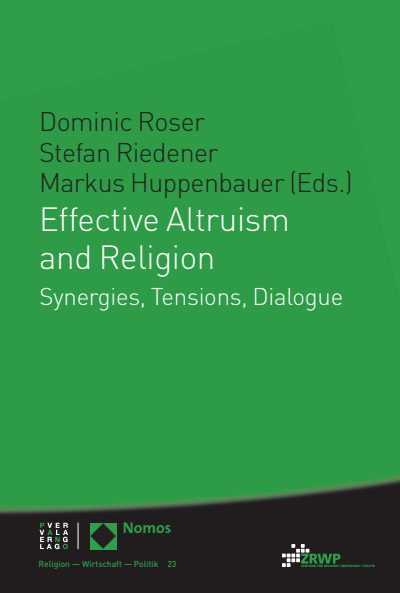
Effective Altruism and Religion
Synergies, Tensions, Dialogue
- Autor:innen:
- Reihe
- Religion - Wirtschaft - Politik
- Band
- 23
- Verlag
- Nomos, Baden-Baden
- Copyrightjahr
- 2022
- ISBN-Print
- 978-3-8487-8119-5
- ISBN-Online
- 978-3-7489-2536-1
Kapitelinformationen
Open Access Vollzugriff
On Loving Neighbours and Others: Effective Altruism and Christian Ethics in a Relational Models Theory Perspective
- Autor:innen:
- ISBN-Print
- 978-3-8487-8119-5
- ISBN-Online
- 978-3-7489-2536-1
- Kapitelvorschau:

Literaturverzeichnis
Es wurden keine Treffer gefunden. Versuchen Sie einen anderen Begriff.
- Biber, Pascal, Hupfeld, Jörg, and Meier, Laurenz L. “Personal Values and Relational Models.” European Journal of Personality 22, no. 7 (2008): 609-628. Google Scholar öffnen DOI: 10.5771/9783748925361-147
- Bolender, John. The Self-Organizing Social Mind. Cambridge: MIT Press, 2010. Google Scholar öffnen DOI: 10.5771/9783748925361-147
- Bolender, John. Digital Social Mind. Exeter: Imprint Academic, 2011. Google Scholar öffnen DOI: 10.5771/9783748925361-147
- Bolender, John. “Relational Models Theory.” In Internet Encyclopedia of Philosophy, n.d. Accessed 15 July 2019. <https://www.iep.utm.edu/r-models>. Google Scholar öffnen DOI: 10.5771/9783748925361-147
- Caralis, Dionyssios and Haslam, Nick. “Relational Tendencies Associated with Broad Personality Dimensions.” Psychology and Psychotherapy: Theory, Research and Practice 77, no. 3 (2004): 397-402. Google Scholar öffnen DOI: 10.5771/9783748925361-147
- Cooney, Nick. How to Be Great at Doing Good: Why Results Are What Count and How Smart Charity Can Change the World. Hoboken: Wiley, 2015. Google Scholar öffnen DOI: 10.5771/9783748925361-147
- Cosgrove, Charles H. “New Testament Ethics.” In Dictionary of Scripture and Ethics, ed. Joel B. Green. Grand Rapids: Baker Academic, 2011. Google Scholar öffnen DOI: 10.5771/9783748925361-147
- Earley, P. Christopher. Face, Harmony, and Social Structure: An Analysis of Organizational Behavior Across Cultures. New York: Oxford University Press, 1997. Google Scholar öffnen DOI: 10.5771/9783748925361-147
- Fiske, Alan P. “Relativity within Moose (‘Mossi’) Culture: Four Incommensurable Models for Social Relationships.” Ethos 18, no. 2 (1990): 180-204. Google Scholar öffnen DOI: 10.5771/9783748925361-147
- Fiske, Alan P. Structures of Social Life: The Four Elementary Forms of Human Relations. New York: Free Press, 1991. Google Scholar öffnen DOI: 10.5771/9783748925361-147
- Fiske, Alan P. “The Four Elementary Forms of Sociality: Framework for a Unified Theory of Social Relations.” Psychological Review 99, no. 4 (1992): 689-723. Google Scholar öffnen DOI: 10.5771/9783748925361-147
- Fiske, Alan P. “Four Modes of Constituting Relationships: Consubstantial Assimilation [CS]; Space, Magnitude, Time and Force [AR]; Concrete Procedures [EM]; Abstract Symbolism [MP].” In Relational Models Theory: A Contemporary Overview, ed. Nick Haslam, 61-146. Mahwah: Erlbaum, 2004. Google Scholar öffnen DOI: 10.5771/9783748925361-147
- Fiske, Alan P. “Relational Models Theory 2.0.” In Relational Models Theory: A Contemporary Overview, ed. Nick Haslam, 3-26. Mahwah: Erlbaum, 2004. Google Scholar öffnen DOI: 10.5771/9783748925361-147
- Fiske, Alan P. and Tage Shakti Rai. “Moral Psychology is Relationship Regulation: Moral Motives for Unity, Hierarchy, Equality, and Proportionality.” Psychological Review 118, no. 1 (2011): 57-75. Google Scholar öffnen DOI: 10.5771/9783748925361-147
- Fiske, Alan P. and Tage Shakti Rai. Virtuous Violence: Hurting and Killing to Create, Sustain, End, and Honor Social Relationships. Cambridge: Cambridge University Press, 2014. Google Scholar öffnen DOI: 10.5771/9783748925361-147
- Haslam, Nick. “Research on the Relational Models: An Overview.” In Relational Models Theory: A Contemporary Overview, ed. Nick Haslam, 27-57. Mahwah: Erlbaum, 2004. Google Scholar öffnen DOI: 10.5771/9783748925361-147
- Höschele, Stefan. “Interchurch Relations in Seventh-day Adventist History: A Study in Ecumenics.” Habilitation thesis, Charles University, Prague, 2017. Google Scholar öffnen DOI: 10.5771/9783748925361-147
- Houde, Leah D. et al. “The Four Faces of Trust: An Empirical Study of the Nature of Trust in Relational Forms.” In Relational Models Theory: A Contemporary Overview, ed. Nick Haslam, 287-306. Mahwah: Erlbaum, 2004. Google Scholar öffnen DOI: 10.5771/9783748925361-147
- MacAskill, William. Doing Good Better: Effective Altruism and a Radical New Way to Make a Difference. London: Guardian, 2016. Google Scholar öffnen DOI: 10.5771/9783748925361-147
- MacAskill, William. “What is Effective Altruism?” In The Effective Altruism Handbook, ed. Ryan Carey, 3-11. N.p.: n.p, 2015. Google Scholar öffnen DOI: 10.5771/9783748925361-147
- Malina, Bruce. The New Testament World: Insights from Cultural Anthropology. Louisville: Westminster John Knox, 2001. Google Scholar öffnen DOI: 10.5771/9783748925361-147
- McFee, Daniel E. “Values, Value Judgments.” In Dictionary of Scripture and Ethics, ed. Joel B. Green, 803-805. Grand Rapids: Baker Academic, 2011. Google Scholar öffnen DOI: 10.5771/9783748925361-147
- Merk, Otto. “Ethics - NT Ethics.” In The Encyclopedia of Christianity, vol. 2, ed. Erwin Fahlbusch et al. Grand Rapids: Eerdmans. Leiden: Brill, 2001. Google Scholar öffnen DOI: 10.5771/9783748925361-147
- Mühling, Markus. Systematische Theologie: Ethik. Eine christliche Theorie vorzuziehenden Handelns. Göttingen: Vandenhoeck & Ruprecht, 2012. Google Scholar öffnen DOI: 10.5771/9783748925361-147
- Rai, Tage Shakti. “Moral Psychology is Relationship Regulation.” Ph.D. Dissertation, University of California, Los Angeles, 2012. Google Scholar öffnen DOI: 10.5771/9783748925361-147
- Rosling, Hans with Rosling, Ola and Rosling Rönnlund, Anna. Factfulness: Ten Reasons We’re Wrong about the World - and Why Things are Better Than You Think. New York: Flatiron Books, 2018. Google Scholar öffnen DOI: 10.5771/9783748925361-147
- Schrage, Wolfgang. Ethik des Neuen Testaments. Berlin: Evangelische Verlagsanstalt, 1985. Google Scholar öffnen DOI: 10.5771/9783748925361-147
- Sheppard, Blair H. and Tuchinsky, Maria. “Interfirm Relationships: A Grammar of Pairs.” In Research in Organizational Behavior 18, ed. Barry M. Staw and L. L. Cummings, 331-373. Greenwich: JAI Press, 1996. Google Scholar öffnen DOI: 10.5771/9783748925361-147
- Simpson, Ain and Laham, Simon M. “Different Relational Models Underlie Prototypical Left and Right Positions on Social Issues.” European Journal of Social Psychology 45, no. 2 (2015): 204-217. Google Scholar öffnen DOI: 10.5771/9783748925361-147
- Singer, Peter. The Life You Can Save: How to Play Your Part in Ending World Poverty. London: Picador, 2009. Google Scholar öffnen DOI: 10.5771/9783748925361-147
- Singer, Peter. The Most Good You Can Do: How Effective Altruism Is Changing Ideas about Living Ethically. New Haven: Yale University Press, 2015. Google Scholar öffnen DOI: 10.5771/9783748925361-147
- Singer, Peter. and MacAskill, William. “Introduction.” In The Effective Altruism Handbook, ed. Ryan Carey. N.p.: n.p, 2015. Google Scholar öffnen DOI: 10.5771/9783748925361-147
- Todd, Benjamin and the 80,000 Hours Team. 80,000 Hours: Find a Fulfilling Career That Does Good. Oxford: Centre for Effective Altruism, 2016. Google Scholar öffnen DOI: 10.5771/9783748925361-147
- Wydick, Bruce. Shrewd Samaritan: Faith, Economics, and the Road to Loving Our Global Neighbor. Nashville: Nelson, 2019. Google Scholar öffnen DOI: 10.5771/9783748925361-147