Die Entwicklung des religiösen Urteils vom Urteilsspruch zum Textbeweis: Ḥukm-Konzepte im Koran und in der älteren islamischen Rechtsliteratur
Inhaltsverzeichnis
Bibliographische Infos
Open Access Vollzugriff
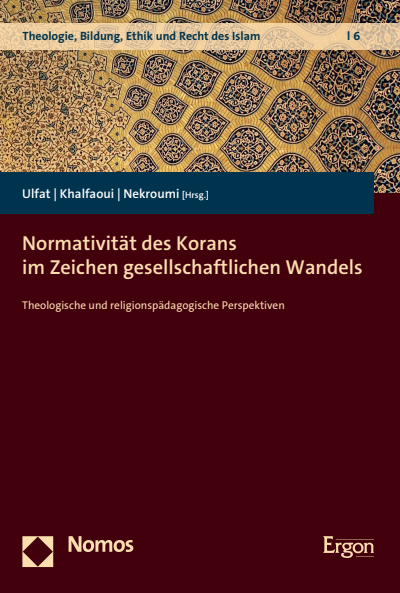
Normativität des Korans im Zeichen gesellschaftlichen Wandels
Theologische und religionspädagogische Perspektiven
- Autor:innen:
- Reihe
- Theologie, Bildung, Ethik und Recht des Islam
- Band
- 6
- Verlag
- Nomos, Baden-Baden
- Copyrightjahr
- 2022
- ISBN-Print
- 978-3-8487-7481-4
- ISBN-Online
- 978-3-7489-3272-7
Kapitelinformationen
Open Access Vollzugriff
Die Entwicklung des religiösen Urteils vom Urteilsspruch zum Textbeweis: Ḥukm-Konzepte im Koran und in der älteren islamischen Rechtsliteratur
- Autor:innen:
- ISBN-Print
- 978-3-8487-7481-4
- ISBN-Online
- 978-3-7489-3272-7
- Kapitelvorschau:

Literaturverzeichnis
Es wurden keine Treffer gefunden. Versuchen Sie einen anderen Begriff.
- ---, „From Religious to Social Conversion: How Muslim Scholars Conceived of the Rites de passage from Hinduism to Islam in Seventeenth-Century South Asia“, in: Journal of Beliefs & Values 32.1 (2011), S. 85-93. Google Scholar öffnen doi.org/10.5771/9783748932727-325
- ---, „Islamunterricht im europäischen Kontext: Gibt es einen ‚Euro-Islam‘ in der Schule?“, in: Kindheit und Jugend in muslimischen Lebenswelten: Aufwachsen und Bildung in deutscher und internationaler Perspektive, hrsg. von Christine Hunner-Kreisel und Sabine Andresen, Wiesbaden 2010, S. 235-253. Google Scholar öffnen doi.org/10.5771/9783748932727-325
- ---, LʼIslam indien, Frankfurt am Main 2008. Google Scholar öffnen doi.org/10.5771/9783748932727-325
- Malik, Jamal, Religious Pluralism in South Asia and Europe, Oxford 2005. Google Scholar öffnen doi.org/10.5771/9783748932727-325
- Masters, Bruce, The Arabs of the Ottoman Empire, 1516-1918: A Social and Cultural History, Cambridge 2013. Google Scholar öffnen doi.org/10.5771/9783748932727-325
- McAuliffe, Jane Dammen, „Quranic Hermeneutics: The Views of al-Ṭabarī and Ibn Kathīr“, in: Approaches to the History of the Interpretation of the Qurʾān, hrsg. von Andrew Rippin, Oxford 1988, S. 64-81. Google Scholar öffnen doi.org/10.5771/9783748932727-325
- al-Qurṭubī, Aḥmad, al-Ǧāmiʿ li-aḥkām al-Qurʾān, ed. von Hišām Samīr al-Buḫārī, 20 Bde., Beirut: Dār Iḥyāʾ at-Turāṯ al-ʿArabī, 2002. Google Scholar öffnen doi.org/10.5771/9783748932727-325
- Quṭb, Sayyid, Fī ẓilāl al-Qurʾān, 6 Bde., Kairo: Dār aš-Šurūq, 1972. Google Scholar öffnen doi.org/10.5771/9783748932727-325
- Sachedina, Abdulaziz, „The Qurʾān and Other Religions“, in: The Cambridge Companion to the Qurʾan, hrsg. von Jane Dammen McAuliffe, Cambridge 2006, S. 291-309. Google Scholar öffnen doi.org/10.5771/9783748932727-325
- Samir, Samir Khalil/Jørgen S. Nielsen (Hgg.), Christian Arabic Apologetics During the Abbasid Period (750-1258), Leiden 1994. Google Scholar öffnen doi.org/10.5771/9783748932727-325
- aš-Šarafī, ʿAbd al-Maǧīd, al-Fikr al-islāmī fī r-radd ʿalā n-naṣārā ilā nihāyat al-qarn ar-rābiʿ, Tunis: ad-Dār at-Tūnisiyya li-n-Našr, 1986. Google Scholar öffnen doi.org/10.5771/9783748932727-325
- Scharabi, Hischam, „Der Weg zur Moderne: Betrachtungen über die Macht, die Frau und die Armut“, in: Islam, Demokratie, Moderne: Aktuelle Antworten arabischer Denker, hrsg. von Erdmute Heller und Hassouna Mosbahi, München 1998, S. 211-217. Google Scholar öffnen doi.org/10.5771/9783748932727-325
- Šayḫ Niẓām et al., al-Fatāwā al-hindiyya al-ʿālamgīriyya, ohne Ed., 6 Bde., Beirut: Dār Ṣādir, 1991. Google Scholar öffnen doi.org/10.5771/9783748932727-325
- aṭ-Ṭabarī, Muḥammad b. Ǧarīr, Tafsīr aṭ-Ṭabarī, ed. von Aḥmad Ismāʿīl aš-Šakūkānī, 13 Bde., Beirut: Dār al-Kutub al-ʿIlmiyya, 2014. Google Scholar öffnen doi.org/10.5771/9783748932727-325
- Ṭarābīšī, Ǧūrǧ, Min an-nahḍa ilā r-ridda, Beirut: Dār as-Sāqī, 2000. Google Scholar öffnen doi.org/10.5771/9783748932727-325
- Tibi, Bassam, Europa und der Islam: Eine philosophische und religiöse Herausforderung, Vortrag am 8. Oktober 1997 in Erfurt, Weimar 2001. Google Scholar öffnen doi.org/10.5771/9783748932727-325
- van Ess, Josef, Theologie und Gesellschaft im 2. und 3. Jahrhundert Hidschra: Eine Geschichte des religiösen Denkens im frühen Islam, 6 Bde., Berlin 1991. Google Scholar öffnen doi.org/10.5771/9783748932727-325
- Badawi, Elsaid M./Muhammad Abdel Haleem, Arabic-English Dictionary of Qurʾanic Usage, Leiden 2008. Google Scholar öffnen doi.org/10.5771/9783748932727-359
- al-Bayḍāwī, Nāṣir ad-Dīn, Anwār at-tanzīl wa-asrār at-taʾwīl, ed. von Muḥammad al-Marʿašlī, 5 Bde., Beirut: Dār Iḥyāʾ at-Turāṯ al-ʿArabī, 1997. Google Scholar öffnen doi.org/10.5771/9783748932727-359
- Berridge, Willow, Islamism in the Modern World: A Historical Approach, London/New York 2019. Google Scholar öffnen doi.org/10.5771/9783748932727-359
- Brown, Jonathan, Slavery and Islam, London 2019. Google Scholar öffnen doi.org/10.5771/9783748932727-359
- Cesari, Jocelyne, The Awakening of Muslim Democracy: Religion, Modernity, and the State, New York 2014. Google Scholar öffnen doi.org/10.5771/9783748932727-359
- Cole, Juan, Muhammad: Prophet of Peace Amid the Clash of Empires, New York 2018. Google Scholar öffnen doi.org/10.5771/9783748932727-359
- Crone, Patricia, „No Compulsion in Islam: Q. 2:256 in Medieval and Modern Interpretation“, in: Le shīʿisme imāmite quarante ans après: Hommage à Etan Kohlberg, hrsg. von Mohammad Amir Amir-Moezzi, Meir M. Bar-Asher und Simon Hopkins, Turnhout 2009, S. 131-178. Google Scholar öffnen doi.org/10.5771/9783748932727-359
- ---, „War“, in: Encyclopaedia of the Qurʾān, hrsg. von Jane D. McAuliffe, 6 Bde., Leiden 2001-2006, Bd. 5, 2006, S. 455-459. Google Scholar öffnen doi.org/10.5771/9783748932727-359
- Gascou, Jean, „Arabic Taxation in the Mid-Seventh Century Papyri“, in: Constructing the Seventh Century, hrsg. von Constantin Zuckerman, Paris 2013, S. 671-677. Google Scholar öffnen doi.org/10.5771/9783748932727-359
- Hallaq, Wael, The Impossible State: Islam, Politics, and Modernity’s Moral Predicament, New York 2013. Google Scholar öffnen doi.org/10.5771/9783748932727-359
- al-Ḫawārizmī, Abū ʿAbdallāh, Mafātīḥ al-ʿulūm, ed. von Ibrāhīm al-Abyārī, Beirut: Dār al-Kitāb al-ʿArabī, 21989. Google Scholar öffnen doi.org/10.5771/9783748932727-359
- Hirschkind, Charles, „What is Political Islam?“, in: Political Islam: A Critical Reader, hrsg. von Frédéric Volpi, New York 2011, S. 13-15. Google Scholar öffnen doi.org/10.5771/9783748932727-359
- Huwaydī, Fahmī, Muwāṭinūn lā ḏimmiyyūn, Kairo: Dār aš-Šurūq, 31999. Google Scholar öffnen doi.org/10.5771/9783748932727-359
- Ibn Taymiyya, Taqīy ad-Dīn, Maǧmūʿ fatāwā šayḫ al-islām Aḥmad Ibn Taymiyya, ed. von ʿAbd ar-Raḥmān b. Muḥammad b. Qāsim und Muḥammad b. ʿAbd ar-Raḥmān b. Qāsim, 37 Bde., Riad/Mekka: Maṭābiʿ ar-Riyāḍ, o. J. [1962-1967]. Google Scholar öffnen doi.org/10.5771/9783748932727-359
- Kadi, Wadad, „The Term ‘Khalīfa’ in Early Exegetical Literature“, in: Die Welt des Islams 28.1 - 4 (1988), S. 392-411. Google Scholar öffnen doi.org/10.5771/9783748932727-359
- ---/Aram Shahin, „Caliph, Caliphate“, in: The Princeton Encyclopedia of Islamic Political Thought, hrsg. von Gerhard Böwering, Princeton/Oxford 2013, S. 81-86. Google Scholar öffnen doi.org/10.5771/9783748932727-359
- Leaman, Oliver (Hg.), The Qurʾan: An Encyclopedia, London/New York 2010. Google Scholar öffnen doi.org/10.5771/9783748932727-359
- Lecker, Michael, „Constitution of Medina“, in: Encyclopaedia of Islam Three, hrsg. von Kate Fleet et al., Leiden 2012. Google Scholar öffnen doi.org/10.5771/9783748932727-359
- March, Andrew F., The Caliphate of Man: Popular Sovereignty in Modern Islamic Thought, Cambridge, MA 2019. Google Scholar öffnen doi.org/10.5771/9783748932727-359
- McAuliffe, Jane D. (Hg.), The Cambridge Companion to the Qurʾān, Cambridge 2014. Google Scholar öffnen doi.org/10.5771/9783748932727-359
- Noth, Albrecht, „Abgrenzungsprobleme zwischen Muslimen und Nicht-Muslimen: Die ‚Bedingungen Umars (aš-šurūṭ al-ʿumariyya)‘ unter anderem Aspekt gelesen“, in: Jerusalem Studies in Arabic and Islam 9 (1987), S. 290-315. Google Scholar öffnen doi.org/10.5771/9783748932727-359
- ar-Rāzī, Faḫr ad-Dīn, at-Tafsīr al-kabīr aw Mafātīḥ al-ġayb, ohne Ed., 32 Bde., Kairo: Maktabat al-Kulliyyāt al-Azhariyya, 1934-1964. Google Scholar öffnen doi.org/10.5771/9783748932727-359
- Rippin, Andrew (Hg.), The Wiley Blackwell Companion to the Qurʾan, Oxford 22017. Google Scholar öffnen doi.org/10.5771/9783748932727-359
- Rubin, Uri, „Quran and Tafsīr: The Case of ‘ʿan yadin’“, in: Der Islam 70 (1993), S. 133-144. Google Scholar öffnen doi.org/10.5771/9783748932727-359
- Sadan, Joseph, „‘Community’ and ‘Extra-Community’ as a Legal and Literary Problem“, in: Israel Oriental Studies 10 (1980), S. 102-115. Google Scholar öffnen doi.org/10.5771/9783748932727-359
- aṭ-Ṭabarī, Ibn Ǧarīr, Geschichte der Perser und Araber zur Zeit der Sasaniden: Aus der arabischen Chronik des Tabari, übers. von Theodor Nöldeke, Leiden 1879. Google Scholar öffnen doi.org/10.5771/9783748932727-359
- at-Tirmiḏī, Abū ʿĪsā, Sunan at-Tirmiḏī, 5 Bde., ed. von Aḥmad Šākir, Kairo: Muṣṭafā al-Bābī al-Ḥalabī, 1975. Google Scholar öffnen doi.org/10.5771/9783748932727-359
- Tlili, Sarra, Animals in the Qurʾan, Cambridge 2012. Google Scholar öffnen doi.org/10.5771/9783748932727-359
- Vacca, Alison, Non-Muslim Provinces under Early Islam: Islamic Rule and Iranian Legitimacy in Armenia and Caucasian Albania, New York 2017. Google Scholar öffnen doi.org/10.5771/9783748932727-359
- Wild, Stefan, „Politics and the Qurʾan“, in: The Oxford Handbook of Qurʾanic Studies, hrsg. von Mustafa Shah und Muhammad Abdel Haleem, Oxford 2020, S. 502-511. Google Scholar öffnen doi.org/10.5771/9783748932727-359
- Zafer, Hamza, Ecumenical Community: Language and Politics of the Ummah in the Qurʾan, Leiden/Boston 2020. Google Scholar öffnen doi.org/10.5771/9783748932727-359
- az-Zamaḫšarī, Ǧārallāh, Tafsīr al-Kaššāf ʿan ḥaqāʾiq at-tanzīl wa-ʿuyūn al-aqāwīl fī wuǧūh at-taʾwīl, ed. von Ḫalīl Maʾmūn Šīḥā, Beirut: Dār al-Kitāb al-ʿArabī, 2009. Google Scholar öffnen doi.org/10.5771/9783748932727-359
- ʿAbd ar-Razzāq aṣ-Ṣanʿānī, Muṣannaf ʿAbd ar-Razzāq, ed. von Ḥabīb ar-Raḥmān al-Aʿẓamī, 12 Bde., Beirut: al-Maktab al-Islāmī, 1983. Google Scholar öffnen doi.org/10.5771/9783748932727-381
- Assmann, Jan, „Das kulturelle Gedächtnis“, in: Erwägen, Wissen, Ethik 13 (2002), S. 239-247. Google Scholar öffnen doi.org/10.5771/9783748932727-381
- ---, Religion und kulturelles Gedächtnis, München 2000. Google Scholar öffnen doi.org/10.5771/9783748932727-381
- ---, „Kollektives Gedächtnis und kulturelle Identität“, in: Kultur und Gedächtnis, hrsg. von Jan Assmann und Tonio Hölscher, Frankfurt am Main 1988, S. 9-19. Google Scholar öffnen doi.org/10.5771/9783748932727-381
- Ayoub, Mahmoud, „Dhimmah in Qurʾan and Hadith“, in: Arab Studies Quarterly 5.2 (1983), S. 172-191. Google Scholar öffnen doi.org/10.5771/9783748932727-381
- Ben Abdeljelil, Moncef, „What was Muhammad’s Religion before Islam? An Historical Attempt with Reference to Shiʿi Sources“, in: Historizität und Transzendenz im Islam: Offenbarung, Geschichte und Recht, hrsg. von Jameleddine Ben Abdeljelil, S. 81-100. Google Scholar öffnen doi.org/10.5771/9783748932727-381
- Berg, Herbert, „The ‘Isnād’ and the Production of Cultural Memory: Ibn ʿAbbās as a Case Study“, in: Numen 58.2 - 3 (2011), S. 259-283. Google Scholar öffnen doi.org/10.5771/9783748932727-381
- Brown, Jonathan, Hadith: Muhammadʼs Legacy in the Medieval and Modern World, Qxford 2009. Google Scholar öffnen doi.org/10.5771/9783748932727-381
- Cicero, Marcus Tullius, De Oratore: Über den Redner, ed. von Harald Merklin, Stuttgart 1991. Google Scholar öffnen doi.org/10.5771/9783748932727-381
- Cohen, Mark R., Under Crescent and Cross: The Jews in the Middle Ages, Princeton 1994. Google Scholar öffnen doi.org/10.5771/9783748932727-381
- Crone, Patricia/Michael Cook, Hagarism: The Making of the Islamic World, Cambridge/New York 1977. Google Scholar öffnen doi.org/10.5771/9783748932727-381
- Droysen, Johann G., Historik, hrsg. von Peter Leyh, Stuttgart 1977. Google Scholar öffnen doi.org/10.5771/9783748932727-381
- Egger, Wilhelm, „Semantische Analyse: Sinn durch Beziehung“, in: Methodenlehre zum Neuen Testament: Einführung in linguistische und historisch-kritische Methoden, Leipzig 1989, S. 138-191. Google Scholar öffnen doi.org/10.5771/9783748932727-381
- Erll, Astrid, Kollektives Gedächtnis und Erinnerungskulturen: Eine Einführung, Stuttgart 2017. Google Scholar öffnen doi.org/10.5771/9783748932727-381
- Fried, Johannes, Der Schleier der Erinnerung: Grundzüge einer historischen Memorik, München 2004. Google Scholar öffnen doi.org/10.5771/9783748932727-381
- Gudehus, Christian, „Was ist Gedächtnis/Erinnerung?“, in: Gedächtnis und Erinnerung: Ein interdisziplinäres Handbuch, hrsg. von Christian Gudehus, Ariane Eichenberg und Harald Welzer, Stuttgart 2010, S. 75-125. Google Scholar öffnen doi.org/10.5771/9783748932727-381
- Halbwachs, Maurice, Das kollektive Gedächtnis, aus dem Franz. von Holde Lhoest-Offermann, Frankfurt am Main 21991. Google Scholar öffnen doi.org/10.5771/9783748932727-381
- al-Ḫaṭīb al-Baġdādī, Abū Bakr, al-Kifāya fī ʿilm ar-riwāya, ed. von Abū ʿAbdallāh as-Sawraqī, Medina: Ǧamʿiyyat Dāʾirat al-Maʿārif al-ʿUṯmāniyya, 1938. Google Scholar öffnen doi.org/10.5771/9783748932727-381
- Hose, Martin, „Exzentrische Formen der Historiographie im Hellenismus“, in: Die Apostelgeschichte im Kontext antiker und frühchristlicher Historiographie, hrsg. von Jörg Frey, Clare K. Rothschild und Jens Schröter, Berlin 2009, S. 182-213. Google Scholar öffnen doi.org/10.5771/9783748932727-381
- Hoyland, Robert G., Seeing Islam as Others Saw it: A Survey and Evaluation of Christian, Jewish and Zoroastrian Writings on Early Islam, New Jersey 1997. Google Scholar öffnen doi.org/10.5771/9783748932727-381
- Ibn Abī Ḥātim, Tafsīr al-Qurʾān al-ʿaẓīm, ed. von Asʿad Muḥammad aṭ-Ṭayyib, 11 Bde., o. O.: Maktabat Nazzār Muṣṭafā al-Bāz, 1998. Google Scholar öffnen doi.org/10.5771/9783748932727-381
- Ibn Ḥanbal, Aḥmad, Musnad al-imām Aḥmad, ed. von Šuʿayb al-Arnaʾūt, 45 Bde., Beirut: Muʾassasat ar-Risāla, 2001. Google Scholar öffnen doi.org/10.5771/9783748932727-381
- Ibn Hišām, ʿAbd al-Malik, as-Sīra an-nabawiyya, ed. von Muṣṭafā as-Saqqā, Ibrāhīm al-Abyārī und ʿAbd al-Ḥafīẓ aš-Šalabī, 2 Bde., Kairo: Muṣṭafā al-Bābī al-Ḥalabī, 1955. Google Scholar öffnen doi.org/10.5771/9783748932727-381
- Ibn Isḥāq, Muḥammad, Sīrat Ibn Isḥāq, ed. von Zuhayl Zakkār, Beirut: Dār al-Fikr, 1978. Google Scholar öffnen doi.org/10.5771/9783748932727-381
- Kopp, Johannes/Bernhard Schäfers (Hgg.), Grundbegriffe der Soziologie, Wiesbaden 102010. Google Scholar öffnen doi.org/10.5771/9783748932727-381
- Leder, Stefan, „Spoken Word and Written Text: Meaning and Social Significance of the Institution of riwāya“, in: Islamic Area Studies Working Paper Series 31 (2002), S. 1-16. Google Scholar öffnen doi.org/10.5771/9783748932727-381
- ---, „Conventions of Fictional Narration in Learned Literature“, in: Story-Telling in the Framework of Non-Fictional Arabic Literature, hrsg. von dems., Wiesbaden 1998, S. 34-60. Google Scholar öffnen doi.org/10.5771/9783748932727-381
- Madhany, al-Husein N., „Pooh-Poohing Pluralism: Ijtihāding Ḥadīth to build a Theology of Exclusion“, in: The Muslim World 98.4 (2008), S. 407-422. Google Scholar öffnen doi.org/10.5771/9783748932727-381
- Mālik b. Anas, Muwaṭṭaʾ Mālik, ed. von Muḥammad Fuʾād ʿAbd al-Bāqī, 2 Bde., Beirut: Dār Iḥyāʾ at-Turāṯ al-ʿArabī, 1985. Google Scholar öffnen doi.org/10.5771/9783748932727-381
- Motzki, Harald, „The Murder of Ibn Abī Ḥuqayq: On the Origin and Reliability of Some Maghāzī-Reports“, in: The Biography of Muhammad: The Issue of the Sources, hrsg. von dems., Leiden 2000, S. 170-239. Google Scholar öffnen doi.org/10.5771/9783748932727-381
- Munt, Harry, „No Two Religions: Non-Muslims in the Early Islamic Ḥijāz“, in: Bulletin of the School of Oriental and African Studies 87.2 (2015), S. 249-269. Google Scholar öffnen doi.org/10.5771/9783748932727-381
- Patel, Youshaa, „The Islamic Treatises against Imitation (Tašabbuh): A Bibliographical History“, in: Arabica 65.5 - 6 (2018), S. 597-639. Google Scholar öffnen doi.org/10.5771/9783748932727-381
- Plessner, Martin, „Nāmūs“, in: Encyclopedia of Islam, Second Edition, Bd. 7, 1993, S. 953-955. Google Scholar öffnen doi.org/10.5771/9783748932727-381
- ar-Rāzī, Faḫr ad-Dīn, Mafātīḥ al-ġayb, o. Ed., 32 Bde., Dār Iḥyāʾ at-Turāṯ al-ʿArabī: Beirut 1999. Google Scholar öffnen doi.org/10.5771/9783748932727-381
- Reynolds, Gabriel S., „On the Quranic Accusation of Scriptural Falsification (taḥrīf) and Christian Anti-Jewish Polemic“, in: Journal of the American Oriental Society 130.2 (2010), S. 189-202. Google Scholar öffnen doi.org/10.5771/9783748932727-381
- Rippin, Andrew, „The Function of asbāb an-nuzūl in Qurʾanic Exegesis“, in: Bulletin of the School of Oriental and African Studies 51.1 (1988), S. 1-20. Google Scholar öffnen doi.org/10.5771/9783748932727-381
- ---, „The Exegetical Genre asbāb an-nuzūl: A Biographical and Terminological Survey“, in: Bulletin of the School of Oriental and African Studies 48.1 (1985), S. 1-15. Google Scholar öffnen doi.org/10.5771/9783748932727-381
- Rothschild, Clare K., Luke-Acts and the Rhetoric of History: An Investigation of Early Christian Historiography, Tübingen 2004. Google Scholar öffnen doi.org/10.5771/9783748932727-381
- Rubin, Uri, „The Assasination of Kaʿb b. al-Ašraf“, in: Oriens 32 (1990), S. 65-71. Google Scholar öffnen doi.org/10.5771/9783748932727-381
- Rüsen, Jörn, Zerbrechende Zeit: Über den Sinn der Geschichte, Berlin 2020. Google Scholar öffnen doi.org/10.5771/9783748932727-381
- ---, Zeit und Sinn: Strategien historischen Denkens, Frankfurt am Main 2012. Google Scholar öffnen doi.org/10.5771/9783748932727-381
- as-Samarqandī, Abū l-Layṯ, Baḥr al-ʿulūm, ed. von Asʿad Muḥammad at-Ṭayyib, 3 Bde., Kairo: Kulliyyat al-Luġa al-ʿArabiyya, Ǧāmiʿat al-Azhar. Google Scholar öffnen doi.org/10.5771/9783748932727-381
- Stetter, Eckart, Topoi und Schemata im Ḥadīṯ, Tübingen 1965. Google Scholar öffnen doi.org/10.5771/9783748932727-381
- Strecker, Georg, „Die historische und theologische Problematik der Jesusfrage“, in: ders., Eschaton und Historie: Aufsätze, Göttingen 1979, S. 159-182. Google Scholar öffnen doi.org/10.5771/9783748932727-381
- as-Suyūṭī, Ǧalāl ad-Dīn, al-Itqān fī ʿulūm al-Qurʾān, ed. von Muḥammad Abū l-Faḍl Ibrāhīm, 4 Bde., Kairo: al-Hayʾa al-Miṣriyya al-ʿĀmma li-l-Kitāb, 1974. Google Scholar öffnen doi.org/10.5771/9783748932727-381
- aṭ-Ṭabarī, Muḥammad b. Ǧarīr, Ǧāmiʿ al-bayān ʿan taʾwīl āy al-Qurʾān, ed. von Maḥmūd Muḥammad Šākir, 24 Bde., Mekka: Dār at-Tarbiya wa-t-Turāṯ, o. D. Google Scholar öffnen doi.org/10.5771/9783748932727-381
- Vajda, Georges, „Ahl al-Kitāb“, in: Encyclopedia of Islam, Second Edition, Bd. 1, 1960, S. 264-266. Google Scholar öffnen doi.org/10.5771/9783748932727-381
- Wansbrough, John, The Sectarian Milieu: Content and Composition of Islamic Salvation History, Oxford/New York 1978. Google Scholar öffnen doi.org/10.5771/9783748932727-381
- Watt, William Montgomery, „Ḥanīf“, in: Encyclopedia of Islam, Second Edition, Bd. 3, 1971, S. 165 f. Google Scholar öffnen doi.org/10.5771/9783748932727-381
- ---, Muhammad at Medina, Oxford 1956. Google Scholar öffnen doi.org/10.5771/9783748932727-381
- Welzer, Harald/Sabine Moller/Karoline Tschuggnall, Opa war kein Nazi: Nationalsozialismus und Holocaust im Familiengedächtnis, Berlin 2002. Google Scholar öffnen doi.org/10.5771/9783748932727-381
- Whittingham, Martin, A History of Muslim Views of the Bible: The First Four Centuries, Berlin/Boston 2021. Google Scholar öffnen doi.org/10.5771/9783748932727-381
- Yarbrough, Luke, „Upholding Godʼs Rule: Early Muslim Juristic Opposition to the State Employment of non-Muslims“, in: Islamic Law and Society 19.1 (2012), S. 11-85. Google Scholar öffnen doi.org/10.5771/9783748932727-381
- az-Zamaḫšarī, Abū l-Qāsim, al-Kaššāf ʿan ḥaqāʾiq ġawāmiḍ at-tanzīl, o. Ed., 4 Bde., Beirut: Dār al-Kitāb al-ʿArabī, 1987. Google Scholar öffnen doi.org/10.5771/9783748932727-381
- Zaman, Muhammad Qasim, „Maghāzī and the Muḥaddithūn: Reconsidering the Treatment of ‘Historical’ Materials in Early Collections of Hadith“, in: International Journal of Middle East Studies 28.1 (1996), S. 1-18. Google Scholar öffnen doi.org/10.5771/9783748932727-381
- Adeel, M. Ashraf, Epistemology of the Quran: Elements of a Virtue Approach to Knowledge and Understanding, Cham 2019. Google Scholar öffnen doi.org/10.5771/9783748932727-413
- Birnbacher, Dieter/Dieter Krohn, Das sokratische Gespräch, Stuttgart 2002. Google Scholar öffnen doi.org/10.5771/9783748932727-413
- Draz, Muhammad ʿAbd Allāh, The Moral World of the Qurʾan, London/New York 2008. Google Scholar öffnen doi.org/10.5771/9783748932727-413
- Fischer, Wolfdietrich, Grammatik des Klassischen Arabisch, Wiesbaden 42006. Google Scholar öffnen doi.org/10.5771/9783748932727-413
- Frey, Dieter/Katja Mayr, „Einleitung: Psychologie der Rituale und Bräuche“, in: Psychologie der Rituale und Bräuche: 30 Riten und Gebräuche wissenschaftlich analysiert und erklärt, ed. von Dieter Frey, Berlin 2018, S. 1-9. Google Scholar öffnen doi.org/10.5771/9783748932727-413
- Habermas, Jürgen, Zwischen Naturalismus und Religion: Philosophische Aufsätze, Frankfurt am Main 2019. Google Scholar öffnen doi.org/10.5771/9783748932727-413
- Ḥamūdī, Hādī Ḥasan, Qaṣaṣ al-Qurʾān min ar-ramz ilā l-wāqiʿ: Dirāsa taḥlīliyya šāmila, Beirut: Dār al-Kutub al-ʿIlmiyya, 2012. Google Scholar öffnen doi.org/10.5771/9783748932727-413
- al-Ḥillī, ʿAbd ar-Raḥmān, „Mafhūm at-taqwā wa-l-manẓūma al-aḫlāqiyya al- qurʾāniyya: al-Bunya wa-s-siyāq“, in: Journal of Islamic Ethics 5 (2021), S. 8-36, Google Scholar öffnen doi.org/10.5771/9783748932727-413
- al-Ḫūrī, Salīm Ǧibrāʾīl/Salīm Mīḫāʾīl Šaḥāda, Kitāb Āṯār al-adhār, 2 Bde., Beirut: al-Maṭbaʿa as-Sūriyya, 1877. Google Scholar öffnen doi.org/10.5771/9783748932727-413
- Heitger, Marian/Angelika Wenger (Hgg.), Kanzel und Katheder: Zum Verhältnis von Religion und Pädagogik seit der Aufklärung, Paderborn/München 1994. Google Scholar öffnen doi.org/10.5771/9783748932727-413
- Ibn Kaṯīr, Abū l-Fidāʾ Ismāʿīl b. ʿUmar, Tafsīr al-Qurʾān al-karīm, ed. von Sāmī b. Muḥammad as-Salāma, 8 Bde., Riad: Dār Ṭība, 1999. Google Scholar öffnen doi.org/10.5771/9783748932727-413
- ---, Qiṣaṣ al-anbiyāʾ, ed. von Muṣṭafā ʿAbd al-Wāḥid, Mekka: Maktabat aṭ-Ṭālib al-Ǧāmiʿī, 1988. Google Scholar öffnen doi.org/10.5771/9783748932727-413
- Izutsu, Toshihiko, Ethico-Religious Concepts in the Qurʾan, Québec 2002. Google Scholar öffnen doi.org/10.5771/9783748932727-413
- Klement, Karl, „Aneignungsdidaktik und Kompetenzorientierung: Didaktische und methodische Gestaltung von Prozessen des Lehrens und Lernens in einem kompetenzorientierten Unterricht“, in: Weißt du noch oder tust du schon? Impulse aus Theorie und Praxis für die Weiterentwicklung von Kompetenzen an Schulen, hrsg. von Olivia De Fontana, Brigitte Pelzmann und Hildegard Sturm, Wien 2016, S. 17-37. Google Scholar öffnen doi.org/10.5771/9783748932727-413
- Lütjen, Jutta, Das Bildungswegmodell zur Rehabilitation der sokratischen Mäeutik: Pädagogische und therapeutische Transformationsarbeit, Hamburg 2013. Google Scholar öffnen doi.org/10.5771/9783748932727-413
- Mendl, Hans, „Konstruktivismus, pädagogischer Konstruktivismus, konstruktivistische Religionspädagogik: Eine Einführung“, in: Konstruktivistische Religionspädagogik: Ein Arbeitsbuch, hrsg. von dems., Münster 2005, S. 9-28. Google Scholar öffnen doi.org/10.5771/9783748932727-413
- Mikhail, Thomas, Bilden und Binden: Zur religiösen Grundstruktur pädagogischen Handelns, Frankfurt am Main 2009. Google Scholar öffnen doi.org/10.5771/9783748932727-413
- Nelson, Leonard, Die sokratische Methode, Göttingen 1929. Google Scholar öffnen doi.org/10.5771/9783748932727-413
- Paul, Andreas, „Angst: eine evolutionsbiologische Perspektive“, in: Angst, Furcht und ihre Bewältigung, hrsg. von Gerhard Roth und Uwe Opolka, Oldenburg 2003, S. 11-30. Google Scholar öffnen doi.org/10.5771/9783748932727-413
- Petzelt, Alfred, Grundzüge systematischer Pädagogik, neu hrsg. von Thomas Mikhail und Jörg Ruhloff, Lambertus, Freiburg 2018. Google Scholar öffnen doi.org/10.5771/9783748932727-413
- ---, Von der Frage: Eine Studie zum Begriff der Bildung, Freiburg 1957. Google Scholar öffnen doi.org/10.5771/9783748932727-413
- Platon, Theätet Griechisch/Deutsch, übers. und hrsg. von Ekkehard Martens, Stuttgart 2012. Google Scholar öffnen doi.org/10.5771/9783748932727-413
- al-Qurṭubī, Abū ʿAbdallāh Muḥammad b. Aḥmad, Tafsīr al-Qurṭubī: al-Ǧāmiʿ li-aḥkām al-Qurʾān, ed. von Aḥmad al-Bardūnī und Ibrāhīm Aṭfīš, 20 Bde., Kairo: Dār al-Kutub al-Miṣriyya, 21964. Google Scholar öffnen doi.org/10.5771/9783748932727-413
- Rahman, Fazlur, Major Themes of the Qurʾan, Chicago/London 2009. Google Scholar öffnen doi.org/10.5771/9783748932727-413
- ---, „Some Key Ethical Concepts of the Qurʾān“, in: The Journal of Religious Ethics 11.2 (1983), S. 170-185. Google Scholar öffnen doi.org/10.5771/9783748932727-413
- Rawls, John, Political Liberalism, New York 2005. Google Scholar öffnen doi.org/10.5771/9783748932727-413
- ar-Rāzī, Faḫr ad-Dīn, Mafātīḥ al-ġayb, ohne Ed., 32 Bde., Beirut: Dār Iḥyāʾ at-Turāṯ al-ʿArabī, 31999. Google Scholar öffnen doi.org/10.5771/9783748932727-413
- aš-Šāfiʿī, Muḥammad b. Idrīs, at-Tawḍīḥ li-Šarḥ al-Ǧamīʿ aṣ-ṣaḥīḥ, ohne Ed., 36 Bde., Damaskus: Dār an-Nawādir, 2008. Google Scholar öffnen doi.org/10.5771/9783748932727-413
- aṭ-Ṭabarī, Muḥammad b. Ǧarīr, Ǧāmiʿ al-bayān ʿan taʾwīl āy al-Qurʾān, ed. von Maḥmūd Muḥammad Šākir und Aḥmad Muḥammad Šākir, 18 Bde., Kairo: Maktabat Ibn Taymiyya (Nachdruck von Dār al-Maʿārif), 2. Aufl., o.J. Google Scholar öffnen doi.org/10.5771/9783748932727-413
- Taylor, Charles, „Für einen neuen Säkularismus“, in: Transit 39 (2010), Säkularismus neu denken: Religion und Politik in Zeiten der Globalisierung, hrsg. von Krzysztof Michalski, S. 5-27. Google Scholar öffnen doi.org/10.5771/9783748932727-413
- -----, „Die Bedeutung des Säkularismus“ in: Sozialphilosophie und Kritik, hrsg. von Rainer Forst et al., Frankfurt am Main 2009, S. 672-696. Google Scholar öffnen doi.org/10.5771/9783748932727-413
- von Kügelgen, Anke, „Muslimische Theologen und Philosophen im Wett- und Widerstreit um die Ratio: Ein Thesenpapier zum Diktum der ‚Vernunftreligion‘ Islam im 11.-14. Jahrhundert“, in: Asiatische Studien 3 (2010), S. 601-648. Google Scholar öffnen doi.org/10.5771/9783748932727-413
- Wahler, Hendrik, „Sokratische Methode - Sokratischer Dialog - Sokratisches Gespräch: Zur Anwendung in Philosophischer Praxis, Pädagogik und Psychotherapie“, in: e-Journal Philosophie der Psychologie (2012), phps.at/texte/WahlerH1.pdf, letzter Abruf 3.5.2021. Google Scholar öffnen doi.org/10.5771/9783748932727-413
- az-Zamaḫšarī, Abū l-Qāsim Maḥmūd b. ʿUmar, al-Kaššāf ʿan ḥaqāʾiq at-tanzīl, ohne Ed., 4 Bde., Beirut: Dār al-Kitāb al-ʿArabī, 31986. Google Scholar öffnen doi.org/10.5771/9783748932727-413
- ʿAbd ar-Raḥmān, Ṭāhā, Buʾs ad-dahrāniyya: an-Naqd al-iʾtimānī li-faṣl al-aḫlāq ʿan ad-dīn, Beirut: aš-Šabaka al-ʿArabiyya li-l-Abḥāṯ wa-n-Našr, 2014. Google Scholar öffnen doi.org/10.5771/9783748932727-21
- ---, Rūḥ ad-dīn: Min ḍīq al-ʿalmāniyya ilā saʿat al-iʾtimāniyya, Casablanca: al-Markaz aṯ-Ṯaqāfī al-ʿArabī, 2012. Google Scholar öffnen doi.org/10.5771/9783748932727-21
- ʿAbd ar-Razzāq aṣ-Ṣanʿānī, Muṣannaf ʿAbd ar-Razzāq, ed. von Ḥabīb ar-Raḥmān al-Aʿẓamī, 12 Bde., Beirut: al-Maktab al-Islāmī, 1983. Google Scholar öffnen doi.org/10.5771/9783748932727-21
- Abū Yūsuf, Yaʿqūb b. Ibrāhīm, Kitāb al-Āṯār, ed. von Abū l-Wafāʾ al-Afġānī, Beirut: Dār al-Kutub al-ʿIlmiyya, o. J. Google Scholar öffnen doi.org/10.5771/9783748932727-21
- Abu Zaid, Nasr Hamid, Gottes Menschenwort: Für ein humanistisches Verständnis des Korans, übers. und eingel. von Thomas Hildebrandt, Freiburg 2008. Google Scholar öffnen doi.org/10.5771/9783748932727-21
- Assmann, Aleida, Erinnerungsräume: Formen und Wandlungen des kulturellen Gedächtnisses, München 2018. Google Scholar öffnen doi.org/10.5771/9783748932727-21
- Assmann, Jan, Religion und kulturelles Gedächtnis, München 2000. Google Scholar öffnen doi.org/10.5771/9783748932727-21
- ---, Das kulturelle Gedächtnis: Schrift, Erinnerung und politische Identität in frühen Hochkulturen, München 32000. Google Scholar öffnen doi.org/10.5771/9783748932727-21
- Auda Jasser, Einführung in die islamischen Rechtszwecke Maqāṣid al-Šarīʿa, Berlin 2015. Google Scholar öffnen doi.org/10.5771/9783748932727-21
- Baker, G. P./P. M. S. Hacker, Wittgenstein: Understanding and Meaning, Oxford 2005. Google Scholar öffnen doi.org/10.5771/9783748932727-21
- al-Bāqillānī, Abū Bakr, al-Inṣāf: Mā yaǧib iʿtiqāduhū wa-lā yaǧūz al-ǧahl bihī, ohne Ed., Kairo: Dār at-Tawfīq an-Namūḏaǧiyya, 22000. Google Scholar öffnen doi.org/10.5771/9783748932727-21
- Bauer, Wolfgang, Bausteine des Fiqh: Kernbereiche der ʾUṣūl al-Fiqh: Quellen und Methodik der Ergründung islamischer Beurteilungen, Frankfurt am Main 2013. Google Scholar öffnen doi.org/10.5771/9783748932727-21
- ---, Die Kultur der Ambiguität: Eine andere Geschichte des Islams, Berlin 2011. Google Scholar öffnen doi.org/10.5771/9783748932727-21
- al-Bayḍāwī, Nāṣir ad-Dīn, Anwār at-tanzīl wa-asrār at-taʾwīl, ed. von Muḥammad b. ʿAbd ar-Raḥmān al-Marʿašlī, 5 Bde., Beirut: Dār Iḥyāʾ at-Turāṯ al-ʿArabī, 1997. Google Scholar öffnen doi.org/10.5771/9783748932727-21
- al-Bayhaqī, Abū Bakr, as-Sunan aṣ-ṣaġīr, ed. von ʿAbd al-Muʿṭī Amīn Qalʿaǧī, 4 Bde., Karatschi: Ǧāmiʿat ad-Dirāsāt al-Islāmiyya, 1989. Google Scholar öffnen doi.org/10.5771/9783748932727-21
- Bedir, Murteza, „The Problem of Uṣūl al-Shāshī“, in: Islamic Studies 42.3 (2003), S. 415-436. Google Scholar öffnen doi.org/10.5771/9783748932727-21
- Ben Abdeljalil, Jameleddine/Serdar Kurnaz, Maqāṣid aš-Šarīʿa: Die Maximen des islamischen Rechts, Frankfurt am Main 2014. Google Scholar öffnen doi.org/10.5771/9783748932727-21
- Bianchi, Herman, Ethik des Strafens, Neuwied 1966. Google Scholar öffnen doi.org/10.5771/9783748932727-21
- Botz-Bornstein, Thorsten, „Can Memes play Games? Memetics and the Problem of Space“, in: Culture, Nature, Memes, hrsg. von dems., Newcastle 2008, S. 142-157. Google Scholar öffnen doi.org/10.5771/9783748932727-21
- Brown, Jonathan, Hadith: Muhammad’s Legacy in the Medieval and Modern World, Oxford 2009. Google Scholar öffnen doi.org/10.5771/9783748932727-21
- Burton, John, The Collection of the Qurʾân, Cambridge 1977. Google Scholar öffnen doi.org/10.5771/9783748932727-21
- Calder, Norman, „Uṣūl al-Fiḳh“, in: Encyclopedia of Islam, Second Edition, Bd. 10, 2000, S. 931-934. Google Scholar öffnen doi.org/10.5771/9783748932727-21
- ---, Studies in Early Muslim Jurisprudence, Oxford 1993. Google Scholar öffnen doi.org/10.5771/9783748932727-21
- Duderija Adis, „A Paradigm Shift in Assessing/Evaluating the Value of Significance and Ḥadīth in Islamic Thought: From ʿulūmu-l-isnād/rijāl to ʾuṣūlu-l-fiqh“, in: Arab Law Qarterly 23.2 (2009), S. 195-206. Google Scholar öffnen doi.org/10.5771/9783748932727-21
- Dutton, Yasin, „Orality, Literacy and the ‘Seven Aḥruf’ Ḥadīth“, in: Journal of Islamic Studies 32.1 (2012), S. 1-49. Google Scholar öffnen doi.org/10.5771/9783748932727-21
- al-Fayrūzābādī, Muḥammad b. Yaʿqūb, al-Qāmūs al-waḥīd, Beirut: Muʾassasat ar-Risāla, 2005. Google Scholar öffnen doi.org/10.5771/9783748932727-21
- Fadzil, Ammar, The Concept of Ḥukm in the Qurʾān, Edinburgh 1999. Google Scholar öffnen doi.org/10.5771/9783748932727-21
- al-Ǧaṣṣāṣ, Abū Bakr, al-Fuṣūl fī l-uṣūl, ed. von ʿUǧayl Ǧāsim an-Našmī, 4 Bde., Kuweit: Wizārat al-Awqāf al-Kuwaytiyya, 1994. Google Scholar öffnen doi.org/10.5771/9783748932727-21
- ---, Aḥkām al-Qurʾān, ed. von Muḥammad Ṣādiq al-Qamḥāwī, 5 Bde., Beirut: Dār Iḥyāʾ at-Turāṯ al-ʿArabī, 1985. Google Scholar öffnen doi.org/10.5771/9783748932727-21
- Goldziher, Ignaz, Die Richtungen der islamischen Koranauslegung, Leiden 1920. Google Scholar öffnen doi.org/10.5771/9783748932727-21
- Günther, Sebastian, „Fictional Narration and Imagination within an Authoritative Framework: Towards a New Understanding of Hadith“, in: Story-Telling in the Framework of Non-Fictional Arabic Literature, hrsg. von Stefan Leder, Wiesbaden 1998, S. 433-471. Google Scholar öffnen doi.org/10.5771/9783748932727-21
- Halbwachs, Maurice, Das kollektive Gedächtnis, Frankfurt am Main 1991. Google Scholar öffnen doi.org/10.5771/9783748932727-21
- Hallaq, Wael B., Authority, Continuity and Change in Islamic Law, Cambridge 2001. Google Scholar öffnen doi.org/10.5771/9783748932727-21
- ---, A History of Islamic Legal Theories: An Introduction to Sunni uṣūl al-fiqh, Cambridge 1997. Google Scholar öffnen doi.org/10.5771/9783748932727-21
- ---, „Was al-Shāfiʿī the Master Architect of Islamic Jurisprudence?“, in: International Journal of Middle East Studies 25.4 (1993), S. 587-605. Google Scholar öffnen doi.org/10.5771/9783748932727-21
- Havelock Eric A., The Muse Learns to Write: Reflections on Orality and Literacy from Antquity to the Present, New Haven/London 1986. Google Scholar öffnen doi.org/10.5771/9783748932727-21
- Ḥubballāh, Ḥaydar, „al-Madḫal ilā l-fiqh al-qurʾānī: al-Uṣūl wa-l-maʿālim al-awwaliyya“, in: Dirāsāt fī l-fiqh al-islāmī al-muʿāṣir, hrsg. von Ḥaydar Ḥubballāh, Wad Madani (Sudan) 2011, S. 1-177. Google Scholar öffnen doi.org/10.5771/9783748932727-21
- Ibn ʿAbd al-Barr, Muḥammad, al-Istīʿāb fī maʿrifat al-aṣḥāb, ed. von ʿAlī Muḥammad al-Baǧāwī, 4 Bde., Beirut: Dār al-Ǧīl, 1992. Google Scholar öffnen doi.org/10.5771/9783748932727-21
- Ibn al-ʿArabī, Abū Bakr, Aḥkām al-Qurʾān, ed. von Muḥammad ʿAbd al-Qādir ʿAṭā, 4 Bde., Beirut: Dār al-Kutub al-ʿIlmiyya, 2003. Google Scholar öffnen doi.org/10.5771/9783748932727-21
- Ibn Bāz, Muḥammad, „Mā maʿnā: {wa-man lam yaḥkum bimā anzala llāhu fa-ulāʾika hum al-kāfirūn}?“, binbaz.org.sa/fatwas/8985/ما-معنى-ومن-لم-يحكم-بما-انزل-الله-فاولىك-هم-الكافرون, letzter Abruf 24.1.2022. Google Scholar öffnen doi.org/10.5771/9783748932727-21
- Ibn al-Ǧawzī, Ǧamāl ad-Dīn, al-Muntaẓam fī tārīḫ al-umam wa-l-mulūk, ed. von Muḥammad ʿAbd al-Qādir ʿAṭā und Muṣṭafā ʿAbd al-Qādir ʿAṭā, 19 Bde., Beirut: Dār al-Kutub al-ʿIlmiyya, 1992. Google Scholar öffnen doi.org/10.5771/9783748932727-21
- Ibn Ḥanbal, Aḥmad, Musnad al-imām Aḥmad Ibn Ḥanbal, ed. von Šuʿayb al-Arnaʾūṭ, 45 Bde., Beirut: Muʾassasat ar-Risāla, 2001. Google Scholar öffnen doi.org/10.5771/9783748932727-21
- Ibn Ḥazm, Abū Muḥammad, al-Iḥkām fī uṣūl al-aḥkām, ed. von Iḥsān ʿAbbās, 8 Bde., Beirut: Dār al-Āfāq al-Ǧadīda, o. J. Google Scholar öffnen doi.org/10.5771/9783748932727-21
- Ibn Hišām, ʿAbd al-Malik, as-Sīra an-nabawiyya, ed. von Muṣṭafā as-Saqqā, Ibrāhīm al-Abyārī und ʿAbd al-Ḥafīẓ aš-Šalabī, 2 Bde., Kairo: Muṣṭafā al-Bābī al-Ḥalabī, 1955. Google Scholar öffnen doi.org/10.5771/9783748932727-21
- Jaraba, Mahmoud, Salafismus: Die Wurzeln des islamistischen Extremismus am Beispiel der Freitagspredigten in einer salafistischen Moschee in Deutschland, Stuttgart 2020. Google Scholar öffnen doi.org/10.5771/9783748932727-21
- Kamali, Muhammad, Crime and Punishment in Islam: A Fresh Interpretation, Oxford 2019. Google Scholar öffnen doi.org/10.5771/9783748932727-21
- Keller, Rudi/Ilja Kirschbaum, Bedeutungswandel: Eine Einführung, Berlin/New York 2003. Google Scholar öffnen doi.org/10.5771/9783748932727-21
- Kister, Meir J., „The Massacre of the Bany Qurayẓa: A Re-Examination of a Tradition“, in: Jerusalem Studies in Arabic and Islam 8 (1996), S. 61-96. Google Scholar öffnen doi.org/10.5771/9783748932727-21
- Koloska, Hannelies, Offenbarung, Ästhetik und Koranexegese: Zwei Studien zu Sure 18 (al-Kahf), Wiesbaden 2015. Google Scholar öffnen doi.org/10.5771/9783748932727-21
- Kött, Andreas, Systemtheorie und Religion: Mit einer Religionstypologie im Anschluss an Niklas Luhmann, Würzburg 2003. Google Scholar öffnen doi.org/10.5771/9783748932727-21
- Lecker, Michael, „On Arabs of the Banū Kilāb Executed Together with the Jewish Banū Qurayza“, in: Studies in Arabic and Islam 19 (1995), S. 66-72. Google Scholar öffnen doi.org/10.5771/9783748932727-21
- Madelung, Wilferd, The Succession to Muhammad: A Study of the Early Caliphate, Cambridge 1997. Google Scholar öffnen doi.org/10.5771/9783748932727-21
- Maǧmaʿ al-Luġa al-ʿArabiyya bi-l-Qāhira (Hg.), al-Muʿǧam al-wasīṭ, Kairo: Dār ad-Daʿwa, o. J. Google Scholar öffnen doi.org/10.5771/9783748932727-21
- Muqātil b. Sulaymān, Tafsīr Muqātil b. Sulaymān, ed. von ʿAbdallāh Maḥmūd Šaḥāta, Beirut: Dār Iḥyāʾ at-Turāṯ, 2002. Google Scholar öffnen doi.org/10.5771/9783748932727-21
- Muslim b. al-Ḥaǧǧāǧ, Ṣaḥīḥ Muslim, ed. von Muḥammad Fuʾād ʿAbd al-Bāqī, 5 Bde., Beirut: ʿĪsā al-Bābī al-Ḥalabī, 1955. Google Scholar öffnen doi.org/10.5771/9783748932727-21
- Nekroumi, Mohammed, Tugend und Gemeinwohl: Grundzüge hermeneutischen Denkens in der postklassischen koranischen Ethik am Beispiel der maqāṣid-Theorie von aš-Šāṭibī, Wiesbaden 2018. Google Scholar öffnen doi.org/10.5771/9783748932727-21
- Neuwirth, Angelika, Studien zur Komposition der mekkanischen Suren, Berlin 2007. Google Scholar öffnen doi.org/10.5771/9783748932727-21
- Ong, Walter, Oralität und Textualität: Die Technologisierung des Wortes, Wiesbaden 1987. Google Scholar öffnen doi.org/10.5771/9783748932727-21
- Quṭb, Sayyid, Maʿālim fī ṭ-ṭarīq, Beirut: Dār aš-Šurūq, 1979. Google Scholar öffnen doi.org/10.5771/9783748932727-21
- ar-Rāzī, Faḫr ad-Dīn, Mafātīḥ al-ġayb, ohne Ed., Beirut: Dār Iḥyāʾ at-Turāṯ al-ʿArabī, 1999. Google Scholar öffnen doi.org/10.5771/9783748932727-21
- Rippin, Andrew, „The Function of asbāb an-nuzūl in Qurʾanic Exegesis“, in: Bulletin of the School of Oriental and African Studies 51.1 (1988), S. 1-20. Google Scholar öffnen doi.org/10.5771/9783748932727-21
- Rohe, Mathias, Das islamische Recht: Geschichte und Gegenwart, München 2011. Google Scholar öffnen doi.org/10.5771/9783748932727-21
- Sardar, Ziauddin, „Weird science: According to some Muslim scholars, everything from genetic to robotics and space travel is described in the Quran: What nonsense“, in: New Statesman, 21.8.2008, newstatesman.com/long-reads/2008/08/quran-muslim-scientific, letzter Abruf 4.2.2022. Google Scholar öffnen doi.org/10.5771/9783748932727-21
- aš-Šāfiʿī, Muḥammad b. Idrīs, ar-Risāla, ed. von Aḥmad Šākir, Kairo: Maktabat al-Ḥalabī, 1940. Google Scholar öffnen doi.org/10.5771/9783748932727-21
- Šaḥrūr, Muḥammad, al-Kitāb wa-l-Qurʾān: Qirāʾa muʿāṣira, Damaskus: al-Ahālī, 2008. Google Scholar öffnen doi.org/10.5771/9783748932727-21
- aš-Šāšī, Abū ʿAlī Aḥmad, Uṣūl aš-Šāšī, ohne Ed., Beirut: Dār al-Kitāb al-ʿArabī, 1982. Google Scholar öffnen doi.org/10.5771/9783748932727-21
- aš-Šaybānī, Muḥammad b. al-Ḥasan, al-Mabsūṭ, ed. von Abū l-Wafāʾ al-Afġānī, 2 Bde., Karatschi: Idārat al-Qurʾān wa-l-ʿUlūm al-Islāmiyya, o. J. Google Scholar öffnen doi.org/10.5771/9783748932727-21
- Schacht, Joseph, The Origins of Muslim Jurisprudence, Oxford 1950. Google Scholar öffnen doi.org/10.5771/9783748932727-21
- Schoeler, Gregor, „Schreiben und Veröffentlichen: Zu Verwendung und Funktion der Schrift in den ersten islamischen Jahrhunderten“, in: Der Islam 69 (1992), S. 1-43. Google Scholar öffnen doi.org/10.5771/9783748932727-21
- ---, „Die Frage der mündlichen und schriftlichen Überlieferung der Wissenschaften im frühen Islam“, in: Der Islam 62 (1985), S. 201-230. Google Scholar öffnen doi.org/10.5771/9783748932727-21
- Schutte Jürgen, Einführung in die Literaturinterpretation, Stuttgart/Weimar 2005. Google Scholar öffnen doi.org/10.5771/9783748932727-21
- Seker, Nimet, Der Koran als Rede und Text: Hermeneutik sunnitischer Koranexegeten zwischen Textkohärenz und Offenbarungskontext, Frankfurt am Main 2019. Google Scholar öffnen doi.org/10.5771/9783748932727-21
- aṭ-Ṭabarī, Muḥammad b. Ǧarīr, Ǧāmiʿ al-bayān ʿan taʾwīl āy al-Qurʾān, ed. von Maḥmūd Muḥammad Šākir, 24 Bde., Mekka: Dār at-Tarbiya wa-t-Turāṯ, o.D. Google Scholar öffnen doi.org/10.5771/9783748932727-21
- ---, Tārīḫ al-umam wa-l-mulūk, ohne Ed., 11 Bde., Beirut: Dār at-Turāṯ, 1977. Google Scholar öffnen doi.org/10.5771/9783748932727-21
- aṭ-Ṭaḥāwī, Ǧaʿfar, Aḥkām al-Qurʾān al-karīm, ed. von Saʿdeddīn Ünal, 2 Bde., Istanbul: Diyanet, 1995-1998. Google Scholar öffnen doi.org/10.5771/9783748932727-21
- ʿUkāša, Maḥmūd, al-Ḥukm fī l-islām: Dirāsat dalālat al-mafhūm fī l-Qurʾān al-karīm wa-ʿaṣr an-nubuwwa wa-ʿaṣr al-ḫulafāʾ ar-rāšidīn, Kairo: Maktabat al-Ānǧlū al-Miṣriyya, 2002. Google Scholar öffnen doi.org/10.5771/9783748932727-21
- Vogel, Pierre, „1/2 ‚Wer nicht nach dem waltet, was Allah herabgesandt hat das sind die Ungläubigen‘“, youtube.com/watch?v=vtkvn63IYJA, letzter Abruf 30.1.2022. Google Scholar öffnen doi.org/10.5771/9783748932727-21
- Wagner, Mark S., „Ḥukm bi-mā anzala’llāh: The Forgotten Prehistory of an Islamic Slogan“, in: Journal of Qurʾanic Studies 18 (2016), S. 117-143. Google Scholar öffnen doi.org/10.5771/9783748932727-21
- al-Wāqidī, Muḥammad b. ʿUmar, al-Maġāzī, ed. von Marsden Jones, Beirut: Dār al-ʿAlamī 1989. Google Scholar öffnen doi.org/10.5771/9783748932727-21
- Watt, Wiliam Montgomery, Muhammad at Medina, Qxford 1956. Google Scholar öffnen doi.org/10.5771/9783748932727-21
- az-Zuḥaylī, Muḥammad Muṣṭafā, al-Waǧīz fī uṣūl al-fiqh al-islāmī, Damaskus: Dār al-Ḫayr, 2006. Google Scholar öffnen doi.org/10.5771/9783748932727-21
- Ali, Mohamed, Medieval Islamic Pragmatics: Sunni Legal Theorists’ Models of Textual Communication, London 2009. Google Scholar öffnen doi.org/10.5771/9783748932727-67
- Allen, Amy/Eduardo Mendieta (Hgg.), The Cambridge Habermas Lexicon, Cambridge 2019. Google Scholar öffnen doi.org/10.5771/9783748932727-67
- Aristoteles, Metaphysik, hrsg. und übers. von Franz Schwarz, Stuttgart 1970. Google Scholar öffnen doi.org/10.5771/9783748932727-67
- Böhler, Dietrich, Verbindlichkeit aus dem Diskurs: Denken und Handeln nach der Wende zur kommunikativen Ethik - Orientierung in der ökologischen Dauerkrise, Freiburg/München 2014. Google Scholar öffnen doi.org/10.5771/9783748932727-67
- Boyle, Joseph/Germain Grisez/Olaf Tollefsen, Free Choice: A Self-Referential Argument, Notre Dame 1976. Google Scholar öffnen doi.org/10.5771/9783748932727-67
- Castagnoli, Luca, Ancient Self-Refutation: The Logic and History of the Self-Refutation Argument from Democritus to Augustine, Cambridge 2010. Google Scholar öffnen doi.org/10.5771/9783748932727-67
- Damiani, Alberto, Handlungswissen, Freiburg/München 2013. Google Scholar öffnen doi.org/10.5771/9783748932727-67
- de Cillis, Maria, Free Will and Predestination in Islamic Thought: Theoretical Compromises in the Works of Avicenna, Ghazali and Ibn Arabi, London 2014. Google Scholar öffnen doi.org/10.5771/9783748932727-67
- Doyle, Bob, Free Will: The Scandal in Philosophy. Cambridge, MA 2011. Google Scholar öffnen doi.org/10.5771/9783748932727-67
- Epikur, „Gnomologium Vaticanum - Vatikanische Spruchsammlung“, in: ders., Wege zum Glück, hrsg. und übers. von Rainer Nickel, Mannheim ³2011. Google Scholar öffnen doi.org/10.5771/9783748932727-67
- Erlwein, Hannah, Arguments for God’s Existence in Classical Islamic Thought, Berlin/Boston 2019. Google Scholar öffnen doi.org/10.5771/9783748932727-67
- Frolov, Dmitry, „Freedom and Predestination“, in: Encyclopaedia of the Qurʾān, hrsg. von Jane D. McAuliffe, 6 Bde., Leiden 2001-2006, Bd. 2, 2002, S. 267-271. Google Scholar öffnen doi.org/10.5771/9783748932727-67
- Ghaly, Mohammed, „The Journal of Islamic Ethics: A Pressing Demand and a Promising Field“, in: Journal of Islamic Ethics 1.1 - 2 (2017), S. 1-5. Google Scholar öffnen doi.org/10.5771/9783748932727-67
- Gimaret, Daniel, Théories de l’acte humain en théologie musulmane, Paris 1980. Google Scholar öffnen doi.org/10.5771/9783748932727-67
- Habermas, Jürgen, „Das Sprachspiel verantwortlicher Urheberschaft und das Problem der Willensfreiheit: Wie lässt sich der epistemische Dualismus mit einem ontologischen Monismus versöhnen?“, in: Deutsche Zeitschrift für Philosophie 54.5 (2006), S. 669-707. Google Scholar öffnen doi.org/10.5771/9783748932727-67
- Hacker, Peter, Insight and Illusion: Themes in the Philosophy of Wittgenstein, Oxford 21986. Google Scholar öffnen doi.org/10.5771/9783748932727-67
- Haji, Ishtiyaque, The Obligation Dilemma, New York 2019. Google Scholar öffnen doi.org/10.5771/9783748932727-67
- Ibn Rušd (Averroès), Tafsīr mā baʿda ṭ-ṭabīʿa, ed. von Maurice Bouyges, Beirut: Dār al-Mašriq, 1938. Google Scholar öffnen doi.org/10.5771/9783748932727-67
- Jordan, James, „Determinism’s Dilemma“, in: The Review of Metaphysics 23.1 (1969), S. 48-66. Google Scholar öffnen doi.org/10.5771/9783748932727-67
- al-Kaʿbī, Abū l-Qāsim, Kitāb al-Maqālāt: Wa-maʿahū ʿUyūn al-masāʾil wa-l-ǧawābāt, ed. von Ḥusayn Ḫānṣū, Amman: Dār al-Fatḥ, 2018. Google Scholar öffnen doi.org/10.5771/9783748932727-67
- Kuhlmann, Wolfgang, „Reflexive Argumente gegen den Determinismus“, in: Sprachphilosophie - Hermeneutik - Ethik: Studien zur Transzendentalpragmatik, hrsg. von Wolfgang Kuhlmann, Würzburg 1992, S. 208-223. Google Scholar öffnen doi.org/10.5771/9783748932727-67
- Laufs, Adolf, „Der aktuelle Streit um das alte Problem der Willensfreiheit: Eine kritische Bestandsaufnahme aus juristischer Sicht“, in: Medizinrecht 29.1 (2011), S. 1-7. Google Scholar öffnen doi.org/10.5771/9783748932727-67
- Lockie, Robert, Free Will and Epistemology: A Defence of the Transcendental Argument for Freedom, New York 2018. Google Scholar öffnen doi.org/10.5771/9783748932727-67
- Ludwig, Bernd, „Was die Freiheitslehre mit der Straftheorie zu tun hat: Philosophische Voraussetzungen von Prävention (Verhinderung) und Retribution (Vergeltung)“, in: Das sogenannte Böse: Das Verbrechen aus interdisziplinärer Perspektive, hrsg. von Jörg-Martin Jehle, Baden-Baden 2020, S. 305-326. Google Scholar öffnen doi.org/10.5771/9783748932727-67
- ar-Rāzī, Faḫr ad-Dīn, al-Maṭālib al-ʿāliya, ed. von Aḥmad al-Ḥiǧāzī as-Saqqā, 9 Bde., Beirut: Dār al-Kitāb al-ʿArabī, 1987. Google Scholar öffnen doi.org/10.5771/9783748932727-67
- ---, at-Tafsīr al-kabīr aw Mafātīḥ al-ġayb, 32 Bde., Kairo: Maktabat al-Kulliyyāt al-Azhariyya, 1934-1964. Google Scholar öffnen doi.org/10.5771/9783748932727-67
- Schmitt, Dorothee, Das Selbstaufhebungsargument: Der Relativismus in der gegenwärtigen philosophischen Debatte, Berlin/Boston 2018. Google Scholar öffnen doi.org/10.5771/9783748932727-67
- Suleiman, Farid, „‚Fragen & Antworten‘ in der Islamischen Theologie: Eine Untersuchung am Beispiel des Problems der Willensfreiheit in der Koranexegese“, erscheint in: Fragen & Antworten: Verstehen und Erklären in den Wissenschaften, hrsg. von Verena Klappstein und Thomas Heiß. Google Scholar öffnen doi.org/10.5771/9783748932727-67
- ---, „The Philosophy of Taha Abderrahman: A Critical Study“, in: Die Welt des Islams 61.1 (2021), S. 39-71. Google Scholar öffnen doi.org/10.5771/9783748932727-67
- ---, „Schuldfähigkeit trotz fehlender Willensfreiheit? Eine Analyse der Position Ibn Taymiyyas. Mit einer Übersetzung seiner al-Qaṣīda at-tāʾiyya“, in: Der Islam 97.1 (2020), S. 172-202. Google Scholar öffnen doi.org/10.5771/9783748932727-67
- at-Tirmiḏī, Abū ʿĪsā, Sunan at-Tirmiḏī, 5 Bde., ed. von Aḥmad Šākir, Kairo: Muṣṭafā al-Bābī al-Ḥalabī, 1975. Google Scholar öffnen doi.org/10.5771/9783748932727-67
- Treiger, Alexander, „Origins of Kalām“, in: The Oxford Handbook of Islamic Theology, hrsg. von Sabine Schmidtke, Oxford/New York 2016, S. 27-43. Google Scholar öffnen doi.org/10.5771/9783748932727-67
- aṭ-Ṭūfī, Naǧm ad-Dīn, Ḥallāl al-ʿuqad fī bayān aḥkām al-muʿtaqad, ed. von Lejla Demiri und Islam Dayeh, Beirut: Orient-Institut Beirut, 2016. Google Scholar öffnen doi.org/10.5771/9783748932727-67
- van Ess, Josef, Theologie und Gesellschaft im 2. und 3. Jahrhundert Hidschra: Eine Geschichte des religiösen Denkens im frühen Islam, 6 Bde., Berlin/New York 1991. Google Scholar öffnen doi.org/10.5771/9783748932727-67
- von Kutschera, Franz, Einladung in die Philosophie, Münster 2016. Google Scholar öffnen doi.org/10.5771/9783748932727-67
- Würtz, Thomas, Islamische Theologie im 14. Jahrhundert: Auferstehungslehre, Handlungstheorie und Schöpfungsvorstellungen im Werk von Saʿd ad-Dīn at-Taftāzānī, Berlin/Boston 2016. Google Scholar öffnen doi.org/10.5771/9783748932727-67
- Abou El-Fadl, Khaled, Speaking in God’s Name: Islamic Law, Authority and Women, Oxford 2001. Google Scholar öffnen doi.org/10.5771/9783748932727-93
- Abū l-Ḥusayn al-Baṣrī, al-Muʿtamad fī uṣūl al-fiqh, ed. von Muḥammad Ḥamīd, 2 Bde., Damaskus: al-Maʿhad al-ʿIlmī li-d-Dirāsāt al-ʿArabiyya, 1964. Google Scholar öffnen doi.org/10.5771/9783748932727-93
- Abū Zahra, Muḥammad, Uṣūl al-fiqh, Kairo: Dār al-Fikr al-ʿArabī, 2006. Google Scholar öffnen doi.org/10.5771/9783748932727-93
- Ahmed, Rumee, „Islamic Law and Theology“, in: The Oxford Handbook of Islamic Law, hrsg. von Anver M. Emon und Rumee Ahmed, Oxford 2018, S. 105-132. Google Scholar öffnen doi.org/10.5771/9783748932727-93
- al-Āmidī, Sayf ad-Dīn, al-Iḥkām fī uṣūl al-aḥkām, ed. von ʿAbd ar-Razzāq ʿAfīfī, 4 Bde., Beirut: al-Maktab al-Islāmī, 21986. Google Scholar öffnen doi.org/10.5771/9783748932727-93
- Arslan, Hakki: „Verhältnisbestimmung zwischen Naturrecht und göttlichem Recht aus islamischer Perspektive“, in: Gibt Gott Gesetze? Ius divinum aus christlicher und muslimischer Perspektive, hrsg. von Nora Kalbarczyk, Timo Güzelmansur und Tobias Specker, Regensburg 2018, S. 179-218. Google Scholar öffnen doi.org/10.5771/9783748932727-93
- Berger, Lutz, „Interpretations of Ashʿarim and Maturīdism in Mamluk and Ottoman Times“, in: The Oxford Handbook of Islamic Theology, hrsg. von Sabine Schmidtke, Oxford 2016, S. 693-704. Google Scholar öffnen doi.org/10.5771/9783748932727-93
- ---, Die Entstehung des Islam: Die ersten hundert Jahre: Von Mohammed bis zum Weltreich der Kalifen, München 2016. Google Scholar öffnen doi.org/10.5771/9783748932727-93
- al-Buḫārī, ʿAlāʾ ad-Dīn ʿAbd al-ʿAzīz b. Aḥmad, Kašf al-asrār ʿan Uṣūl Faḫr al-Islām al-Bazdawī (mit dem Uṣūl al-Bazdawī), ohne Ed., 4 Bde., Kairo: Dār al-Kitāb al-Islamī, o. J. Google Scholar öffnen doi.org/10.5771/9783748932727-93
- Dhanani, Alnoor, The Physical Theory of Kalām: Atoms, Space and Void in Basrian Muʿtazilī Cosmology, Leiden 1994. Google Scholar öffnen doi.org/10.5771/9783748932727-93
- Frankfurt, Harry G., Freiheit und Selbstbestimmung: Ausgewählte Texte, hrsg. von Monika Betzler und Barbara Guckes, Berlin 2001. Google Scholar öffnen doi.org/10.5771/9783748932727-93
- al-Ġazālī, Abū Ḥāmid, al-Mustaṣfā min ʿilm uṣūl al-fiqh, ed. von Ḥamza b. Zuhayr Ḥāfiẓ, 4 Bde., Medina: Šarikat al-Madīna al-Munawwara, 1993. Google Scholar öffnen doi.org/10.5771/9783748932727-93
- Gimaret, Daniel, La doctrine d’al-Ashʿarī, Paris 1990. Google Scholar öffnen doi.org/10.5771/9783748932727-93
- al-Ǧuwaynī, ʿAbd al-Malik b. ʿAbdallāh, al-Burhān fī uṣūl al-fiqh, ed. von ʿAbd al-ʿAẓīm ad-Dīb, Katar: o. V., 1979. Google Scholar öffnen doi.org/10.5771/9783748932727-93
- Hallaq, Wael B., The Origins and Evolution of Islamic Law, Cambridge 2012. Google Scholar öffnen doi.org/10.5771/9783748932727-93
- Harras, Gisela, Handlungssprache und Sprechhandlung: Eine Einführung in die theoretischen Grundlagen, Berlin 22011. Google Scholar öffnen doi.org/10.5771/9783748932727-93
- Ibn Rušd, Abū l-Walīd Muḥammad b. Aḥmad, al-Kašf ʿan manāhiǧ al-adilla fī ʿaqāʾid al-milla, ohne Ed., Beirut: Markaz Dirāsāt al-Waḥda al-ʿArabiyya, 1998. Google Scholar öffnen doi.org/10.5771/9783748932727-93
- ---, Faṣl al-maqāl fīmā bayna l-ḥikma wa-š-šarīʿa min ittiṣāl, ohne Ed., Beirut: Markaz Dirāsāt al-Waḥda al-ʿArabiyya, 1997. Google Scholar öffnen doi.org/10.5771/9783748932727-93
- Ibrāhīm, Zakariyā, Muškilat al-ḥurriya, Kairo: Maktabat Miṣr, 1963. Google Scholar öffnen doi.org/10.5771/9783748932727-93
- Kurnaz, Serdar, Methoden zur Normderivation im islamischen Recht: Eine Rekonstruktion autoritativer textueller Quellen bei ausgewählten islamischen Rechtsschulen, Berlin 2016. Google Scholar öffnen doi.org/10.5771/9783748932727-93
- Mullā Ḫusraw, Mirʾāt al-uṣūl: Šarḥ Mirqat al-wuṣūl, ed. von İlyas Kaplan, Beirut: Dār Ṣādir, 2011. Google Scholar öffnen doi.org/10.5771/9783748932727-93
- al-Qarāfī, Aḥmad b. Idrīs, Šarḥ Tanqīḥ al-fuṣūl fī l-uṣūl, ohne Ed., Beirut: Dār al-Fikr, 2004. Google Scholar öffnen doi.org/10.5771/9783748932727-93
- ---, Kitāb al-Furūq: Anwār al-burūq fī anwāʿ al-furūq, ed. von Muḥammad Aḥmad Sarrāǧ und ʿAlī Ǧumʿa Muḥammad, 4 Bde., Kairo: Dār as-Salām, 2001. Google Scholar öffnen doi.org/10.5771/9783748932727-93
- ar-Rāzī, Faḫr ad-Dīn, al-Maḥṣūl fī ʿilm uṣūl al-fiqh, ed. von Ǧābir Fayyāḍ al-ʿAlwānī, 6 Bde., Beirut: Muʾassasat ar-Risāla, 21996. Google Scholar öffnen doi.org/10.5771/9783748932727-93
- ---, Muḥaṣṣal afkār al-mutaqaddimīn wa-l-mutaʾaḫḫirīn min al-ʿulamāʾ wa-l-ḥukamāʾ wa-l-mutakallimīn, ed. von ʿAbd ar-Raʾūf Saʿd, Kairo: Maktabat al-Kulliyyāt al-Azhariyya, o. J. Google Scholar öffnen doi.org/10.5771/9783748932727-93
- Reinhart, Kevin, Before Revelation: The Boundaries of Muslim Moral Thought, New York 1995. Google Scholar öffnen doi.org/10.5771/9783748932727-93
- aš-Šahrastānī, Muḥammad b. ʿAbd al-Karīm, al-Milal wa-n-niḥal, ed. von ʿAbd al-ʿAzīz Muḥammad al-Wakīl, 3 Bde., Kairo: Dār al-Ittiḥād al-ʿArabī, 1968. Google Scholar öffnen doi.org/10.5771/9783748932727-93
- as-Samarqandī, ʿAlāʾ ad-Dīn, al-Mīzān fī natāʾiǧ al-ʿuqūl, ed. von Muḥammad Zakī ʿAbd al-Barr, Doha: Maṭābiʿ ad-Dawḥa, 1984. Google Scholar öffnen doi.org/10.5771/9783748932727-93
- as-Saraḫsī, Muḥammad b. Aḥmad, Uṣūl as-Saraḫsī, ed. von Abū l-Wafāʾ al-Afġānī, 2 Bde., Hyderabad: Laǧnat Iḥyāʾ al-Maʿārif al-ʿUṯmāniyya, 1993. Google Scholar öffnen doi.org/10.5771/9783748932727-93
- aš-Šāṭibī, Abū Isḥāq, al-Muwāfaqāt fī uṣūl al-fiqh, ed. von Mašhūr b. Ḥasan Āl Sālmān, 6 Bde., Kairo: Dār Ibn ʿAffān, 1997. Google Scholar öffnen doi.org/10.5771/9783748932727-93
- at-Ṭabarī, Muḥammad b. Ǧarīr, Tafsīr aṭ-Ṭabarī min kitābihī Ǧāmiʿ al-bayān ʿan taʾwīl āy al-Qurʾān, ed. von Aḥmad Šākir und Maḥmūd Šākir, 24 Bde., Beirut: Muʾassasat ar-Risāla, 2000. Google Scholar öffnen doi.org/10.5771/9783748932727-93
- at-Taftāzānī, Masʿūd b. ʿUmar, Šarḥ al-ʿAqāʾid an-nasafiyya, ed. von ʿAlī Kamāl Beirut: Dār Iḥyāʾ at-Turāṯ al-ʿArabī, 2014. Google Scholar öffnen doi.org/10.5771/9783748932727-93
- ---, Šarḥ al-Maqāṣid, ed. von ʿAbd ar-Raḥmān ʿUmayra, 5 Bde., Beirut: ʿĀlam al-Kutub, 1998. Google Scholar öffnen doi.org/10.5771/9783748932727-93
- ---, Šarḥ at-Talwīḥ (mit dem Šarḥ at-Tawḍīḥ li-matn at-Tanqīḥ von ʿUbaydallāh b. Masʿūd al-Maḥbūbī), ohne Ed., Kairo: Dār al-Kutub al-ʿArabiyya al-Kubrā, 1909. Google Scholar öffnen doi.org/10.5771/9783748932727-93
- aṭ-Ṭūfī, Naǧm ad-Dīn, Šarḥ Muḫtaṣar ar-Rawḍa, ed. von ʿAbdallāh b. ʿAbd al-Muḥsin at-Turkī, 3 Bde., Beirut: Muʾassasat ar-Risāla, 21998. Google Scholar öffnen doi.org/10.5771/9783748932727-93
- van Ess, Josef, Theologie und Gesellschaft im 2. und 3. Jahrhundert Hidschra: Eine Geschichte des religiösen Denkens im frühen Islam, 6 Bde., Berlin 1991-1997. Google Scholar öffnen doi.org/10.5771/9783748932727-93
- Vishanoff, David, The Formation of Islamic Hermeneutics: How Sunni Legal Theorists Imagined a Revealed Law, New Haven 2011. Google Scholar öffnen doi.org/10.5771/9783748932727-93
- Weiss, Bernard, The Search for God’s Law: Islamic Jurisprudence in the Writings of Sayf al-Dīn al-Āmidī, Salt Lake City 1992. Google Scholar öffnen doi.org/10.5771/9783748932727-93
- Würtz, Thomas, „Der frühe Saʿd ad-Dīn at-Taftāzānī als māturīditischer Autor“, in: Rationalität in der Islamischen Theologie, Bd. 1: Die klassische Periode, hrsg. von Maha El Kaisy-Friemuth, Reza Hajatpour und Mohammed Abdel Rahem, Berlin 2019, S. 351-372. Google Scholar öffnen doi.org/10.5771/9783748932727-93
- az-Zuḥaylī, Wahba, Uṣūl al-fiqh al-islāmī, 2 Bde., Damaskus: Dār al-Fikr, 1986. Google Scholar öffnen doi.org/10.5771/9783748932727-93
- Zysow, Aron, The Economy of Certainty: An Introduction to the Typology of Islamic Legal Theory, Atlanta 2013. Google Scholar öffnen doi.org/10.5771/9783748932727-93
- Albert, Mathias/Klaus Hurrelmann/Gudrun Quenzel, Jugend 2019: Eine Generation meldet sich zu Wort, 18. Shell Jugendstudie, Hamburg 2019. Google Scholar öffnen doi.org/10.5771/9783748932727-117
- Becher, Ina/Yasemin El-Menouar, Geschlechterrollen bei Deutschen und Zuwanderern christlicher und muslimischer Religionszugehörigkeit, hrsg. vom Bundesamt für Migration und Flüchtlinge, Nürnberg 2014. Google Scholar öffnen doi.org/10.5771/9783748932727-117
- Behr, Harry Harun, „Du und Ich: Zur anthropologischen Signatur des Korans“, in: Zwischen Himmel und Erde: Bildungsphilosophische Verhältnisbestimmungen von Heiligem Text und Geist, hrsg. von Harry Harun Behr und Fahimah Ulfat, Münster 2014, S. 11-31. Google Scholar öffnen doi.org/10.5771/9783748932727-117
- ---, „Menschenbilder im Islam“, in: Handbuch Christentum und Islam in Deutschland: Grundlagen, Erfahrungen und Perspektiven des Zusammenlebens, hrsg. von Mathias Rohe et al., Freiburg 2014, S. 489-530. Google Scholar öffnen doi.org/10.5771/9783748932727-117
- Betz, Andrea/Hans-Georg Ziebertz, „Tradition und Geschlechterrolle. Eine qualitative Studie unter christlichen und muslimischen Jungen“, in: Gender in Islam und Christentum: Theoretische und empirische Studien, hrsg. von Hans G. Ziebertz, Berlin 2010, S. 249-77. Google Scholar öffnen doi.org/10.5771/9783748932727-117
- Bobzin, Hartmut, Der Koran: Eine Einführung, München 72007. Google Scholar öffnen doi.org/10.5771/9783748932727-117
- Boos-Nünning, Ursula/Yasemin Karakaşoğlu, Viele Welten leben: Zur Lebenssituation von Mädchen und jungen Frauen mit Migrationshintergrund, Münster 2006. Google Scholar öffnen doi.org/10.5771/9783748932727-117
- Brettfeld, Katrin/Peter Wetzels, Muslime in Deutschland: Integration, Integrationsbarrieren, Religion sowie Einstellungen zu Demokratie, Rechtsstaat und politisch-religiös motivierter Gewalt: Ergebnisse von Befragungen im Rahmen einer multizentrischen Studie in städtischen Lebensräumen, hrsg. vom Bundesministerium des Innern, Hamburg 2007. Google Scholar öffnen doi.org/10.5771/9783748932727-117
- Calmbach, Marc et al., Wie ticken Jugendliche? 2020: Lebenswelten von Jugendlichen im Alter von 14 bis 17 Jahren in Deutschland, hrsg. von der Bundeszentrale für Politische Bildung, Bonn 2020. Google Scholar öffnen doi.org/10.5771/9783748932727-117
- Chittick, William C., Sufism: A Beginner’s Guide, London 2007. Google Scholar öffnen doi.org/10.5771/9783748932727-117
- Cook, Bradley J., Classical Foundations of Islamic Educational Thought: A Compendium of Parallel English-Arabic Texts, Provo 2010. Google Scholar öffnen doi.org/10.5771/9783748932727-117
- Günther, Sebastian, „Bildung und Ethik im Islam“, in: Islam: Einheit und Vielfalt einer Weltreligion, hrsg. von Rainer Brunner, Stuttgart 2016, S. 210-236. Google Scholar öffnen doi.org/10.5771/9783748932727-117
- Hallaq, Wael, „Law and the Qurʾān“, in: Encyclopaedia of the Qurʾān, hrsg. von Jane D. McAuliffe, 6 Bde., Leiden 2001-2006, Bd. 3, 2003, S. 149-172. Google Scholar öffnen doi.org/10.5771/9783748932727-117
- Klafki, Wolfgang, Neue Studien zur Bildungstheorie und Didaktik: Zeitgemäße Allgemeinbildung und kritisch-konstruktive Didaktik, Weinheim u. a. 2007. Google Scholar öffnen doi.org/10.5771/9783748932727-117
- Mertol, Birol, „Männlichkeitskonzepte von Jungen mit türkischem Migrationshintergrund“, in: Junge Muslime in Deutschland: Lebenslagen, Aufwachsprozesse und Jugendkulturen, hrsg. von Hans-Jürgen von Wensierski und Claudia Lübcke, Opladen 2007, S. 173-194. Google Scholar öffnen doi.org/10.5771/9783748932727-117
- Mir-Hosseini, Ziba, „The Construction of Gender in Islamic Legal Thought and Strategies for Reform“, in: Hawwa 1.1 (2003), S. 1-28. Google Scholar öffnen doi.org/10.5771/9783748932727-117
- Müller, Annette, Die sexuelle Sozialisation in der weiblichen Adoleszenz: Mädchen und junge Frauen deutscher und türkischer Herkunft im Vergleich, Münster 2006. Google Scholar öffnen doi.org/10.5771/9783748932727-117
- Nökel, Sigrid, „‚Neo-Muslimas‘: Alltags- und Geschlechterpolitiken junger muslimischer Frauen zwischen Religion, Tradition und Moderne“, in: Junge Muslime in Deutschland: Lebenslagen, Aufwachsprozesse und Jugendkulturen, hrsg. von Hans-Jürgen von Wensierski und Claudia Lübcke, Opladen 2007, S. 135-154. Google Scholar öffnen doi.org/10.5771/9783748932727-117
- Pfündel, Katrin/Anja Stichs/Kerstin Tanis, Kurzfassung zur Studie „Muslimisches leben in Deutschland 2020“ Forschungsbericht, hrsg. vom Bundesamt für Migration und Flüchtlinge im Auftrag der Deutschen Islam Konferenz, Nürnberg 2021. Google Scholar öffnen doi.org/10.5771/9783748932727-117
- Rahmati, Fateme, Der Mensch als Spiegelbild Gottes in der Mystik Ibn ʿArabīs, Wiesbaden 2007. Google Scholar öffnen doi.org/10.5771/9783748932727-117
- Schäfer, Franziska/Melissa Schwarz, „Zwischen Tabu und Liberalisierung: Zur Sexualität junger Muslime“, in: Junge Muslime in Deutschland: Lebenslagen, Aufwachsprozesse und Jugendkulturen, hrsg. von Hans-Jürgen von Wensierski und Claudia Lübcke, Opladen 2007, S. 251-281. Google Scholar öffnen doi.org/10.5771/9783748932727-117
- Schweitzer, Friedrich/Fahimah Ulfat, Dialogisch - kooperativ - elementarisiert: Interreligiöse Einführung in die Religionsdidaktik aus christlicher und islamischer Sicht, Göttingen 2021. Google Scholar öffnen doi.org/10.5771/9783748932727-117
- Şen, Faruk/Martina Sauer, Islam in Deutschland: Einstellungen der türkischstämmigen Muslime: Religiöse Praxis und organisatorische Vertretung türkischstämmiger Muslime in Deutschland: Ergebnisse einer bundesweiten Befragung, hrsg. vom Zentrum für Türkeistudien, Essen 2006. Google Scholar öffnen doi.org/10.5771/9783748932727-117
- Toprak, Ahmet, Türkeistämmige Mädchen in Deutschland: Erziehung - Geschlechterrollen - Sexualität, Freiburg 2014. Google Scholar öffnen doi.org/10.5771/9783748932727-117
- Ulfat, Fahimah, „Theologisch-anthropologische Grundlagen religiöser Bildung aus islamisch-religionspädagogischer Perspektive“, in: Theologische Quartalschrift 2.199 (2019), S. 149-160. Google Scholar öffnen doi.org/10.5771/9783748932727-117
- Ziebertz, Hans G./Helene Coester/Andrea Betz, „Normierung von Sexualität und Autonomie: Eine qualitative Studie unter christlichen und muslimischen Mädchen“, in: Gender in Islam und Christentum: Theoretische und empirische Studie, hrsg. von Hans G. Ziebertz, Berlin 2010, S. 207-247. Google Scholar öffnen doi.org/10.5771/9783748932727-117
- Asad, Muhammad, Die Botschaft des Koran, Düsseldorf 2009. Google Scholar öffnen doi.org/10.5771/9783748932727-137
- Badawia, Tarek, „Konturen eines islamischen Gewissenskonzepts“, in: Zwischen Gewissen und Norm: Autonomie als Leitkategorie religiöser Bildung im Islam und Christentum, hrsg. von Tarek Badawia und Hansjörg Schmid, Berlin 2016, S. 77-96. Google Scholar öffnen doi.org/10.5771/9783748932727-137
- ---, „‚Sapere aude‘ - Anmerkungen zur religiösen Mündigkeit aus einer islamischen Perspektive“, in: Religion und Bildung: Antipoden oder Weggefährten? Diskurse aus historischer, systematischer und praktischer Sicht, hrsg. von Jochen Sautermeister und Elisabeth Zwick, Paderborn 2019, S. 293-308. Google Scholar öffnen doi.org/10.5771/9783748932727-137
- Badawia, Tarek/Said Topalović/Aida Tuhčić, „Von einer ‚Phantom-Lehrkraft‘ zum ‚Mister-Islam‘. Explorative Erkundungen strukturtheoretischer Professionalität von Islamlehrkräften an staatlichen Schulen“, erscheint in: Forum Islamisch-Theologische Studien 1 (2022), S. 25-46. Google Scholar öffnen doi.org/10.5771/9783748932727-137
- Bağraç, Musa, „Ist die islamische Religiosität mit der pädagogischen Mündigkeit verträglich? Die Herausforderung für den islamischen Religionsunterricht“, in: Jahrbuch für Islamische Theologie und Religionspädagogik, hrsg. von Milad Karimi und Mouhanad Khorchide, Freiburg 2018, S. 35-82. Google Scholar öffnen doi.org/10.5771/9783748932727-137
- Begović, Nedim, „Definiranje slobode religije u savremenoj islamskoj misli“ [dt.: „Definition der Religionsfreiheit im zeitgenössischen islamischen Denken“], in: Zbornik radova 18, hrsg. von Fakultet Islamskih Nauka, Sarajevo 2015, S. 115-134. Google Scholar öffnen doi.org/10.5771/9783748932727-137
- Behr, Harry Harun, „Streitfall Koran - Die Heilige Schrift des Islams als Gegenstand des pädagogischen Diskurses“, in: Buchstabe und Geist: Vom Umgang mit Tora, Bibel und Koran im Religionsunterricht, hrsg. von Bernd Schröder, Harry Harun Behr, Katja Boehme und Daniel Krochmalnik, Berlin 2017, S. 187-226. Google Scholar öffnen doi.org/10.5771/9783748932727-137
- ---, „Menschenbilder im Islam“, in: Handbuch Christentum und Islam in Deutschland: Erfahrungen, Grundlagen und Perspektiven im Zusammenleben, hrsg. von Mathias Rohe, Freiburg 2014, S. 489-529. Google Scholar öffnen doi.org/10.5771/9783748932727-137
- ---, „Muslim sein - eine Frage der Person: Gedanken zum Aspekt der Individualität im Islam“, in: Islamverherrlichung: Wenn die Kritik zum Tabu wird, hrsg. von Thorsten Gerald Schneiders, Wiesbaden 2010, S. 107-116. Google Scholar öffnen doi.org/10.5771/9783748932727-137
- Benner Dietrich/Friedhelm Brüggen, „Mündigkeit“, in: Historisches Wörterbuch der Pädagogik, hrsg. von Dietrich Benner und Jürgen Oelkers, Weinheim 2004, S. 687-699. Google Scholar öffnen doi.org/10.5771/9783748932727-137
- Böhm, Winfried/Sabine Seichter, Wörterbuch der Pädagogik, Stuttgart 2017. Google Scholar öffnen doi.org/10.5771/9783748932727-137
- Cerić, Mustafa, Korijeni sintetičke teologije u islamu: Ebu Mensur el-Maturidi (853-944) [dt.: Die Wurzeln der synthetischen Theologie im Islam: Abū Manṣūr al-Māturīdī], Sarajevo 2012. Google Scholar öffnen doi.org/10.5771/9783748932727-137
- Deutsche Islam Konferenz, Religiös begründete schulpraktische Fragen: Handreichung für Schule und Elternhaus, Berlin 2009. Google Scholar öffnen doi.org/10.5771/9783748932727-137
- Döhner, Saskia, „Fastende Schüler belasten Schulalltag nicht“, in: Hannoversche Allgemeine, 19.5.2019, haz.de/lokales/hannover/fastende-schueler-belasten-schulalltag-nicht-DMHFX5KXQOXGAOKEL3CAMOQFRQ.html, letzter Abruf 15.5.2022. Google Scholar öffnen doi.org/10.5771/9783748932727-137
- Đozo, Husein, „Post“ [dt.: „Das Fasten“], in: Glasnik 9 (1942), S. 233-236. Google Scholar öffnen doi.org/10.5771/9783748932727-137
- ---, „Sloboda vjerovanja“ [dt.: „Die Freiheit im Glauben“], in: Husein Đozo: Izabrana djela: Knjiga druga, hrsg. von Selim Jarkoč und Enes Karić, Sarajevo 2006, S. 188-189. Google Scholar öffnen doi.org/10.5771/9783748932727-137
- Engelhardt, Jan Felix/Fahimah Ulfat/Esra Yavuz, Islamischer Religionsunterricht in Deutschland: Qualität, Rahmenbedingungen und Umsetzung, Frankfurt am Main 2020. Google Scholar öffnen doi.org/10.5771/9783748932727-137
- Fatić, Almir, „Metodologija tematskog tefsira“ [dt.: „Die Methodologie des thematischen tafsīr“], in: Zbornik radova 23, hrsg. von Fakultet Islamskih Nauka, Sarajevo 2019, S. 71-84. Google Scholar öffnen doi.org/10.5771/9783748932727-137
- al-Ġazālī, Abū Ḥāmid, Knjiga o znanju, übers. von Salih Čolaković, Sarajevo 2004. Google Scholar öffnen doi.org/10.5771/9783748932727-137
- Gerhardt, Volker, Selbstbestimmung: Das Prinzip der Individualität, Ditzingen 2018. Google Scholar öffnen doi.org/10.5771/9783748932727-137
- ---, „Selbstbestimmung: Zur Aktualität eines Begriffs“, in: Fiph-Journal 8 (2006), S. 1-7. Google Scholar öffnen doi.org/10.5771/9783748932727-137
- Günther, Sebastian, „‚Eine Erkenntnis, durch die keine Gewissheit entsteht, ist keine sichere Erkenntnis‘: Arabische Schriften zur klassischen islamischen Pädagogik“, in: Aufbruch zu neuen Ufern: Aufgaben, Problemlagen und Profile einer Islamischen Religionspädagogik im europäischen Kontext, hrsg. von Yaşar Sarikaya und Franz-Josef Bäumer, Münster 2017, S. 69-94. Google Scholar öffnen doi.org/10.5771/9783748932727-137
- ---, „Bildungsauffassungen klassischer muslimischer Gelehrter: Von Abu Hanifa bis Ibn Khaldun (8.-15. Jh.)“, in: Islamische Theologie und Religionspädagogik in Bewegung: Neue Ansätze in Europa, hrsg. von Zekirija Sejdini, Bielefeld 2016, S. 51-72. Google Scholar öffnen doi.org/10.5771/9783748932727-137
- Hafizović, Rešid, „Osnove islamskog vjerskog morala“ [dt.: „Die Grundlagen der islamischen religiösen Moral“], in: Zbornik radova 2, hrsg. von Fakultet Islamskih Nauka, Sarajevo 1987, S. 137-154. Google Scholar öffnen doi.org/10.5771/9783748932727-137
- Hecke, Bernd, „Beim Thema Ramadan an der Schule hilft es, auch einmal Vorurteile zu fasten“, in: Kleine Zeitung, 20.5.2019, kleinezeitung.at/steiermark/5631040/Fastende-Schueler_Beim-Thema-Ramadan-an-der-Schule-hilft-es-auch, letzter Abruf 15.5.2022. Google Scholar öffnen doi.org/10.5771/9783748932727-137
- Ibn Isḥāq, Muḥammad, Das Leben des Propheten, übers. von Gernot Rotter, Kandern 2004. Google Scholar öffnen doi.org/10.5771/9783748932727-137
- Ibn Kaṯīr, Ismāʿīl b. ʿUmar, Tefsir Ibn-Kesir, hrsg. von Visoki Saudijski Komitet za Pomoć BiH [dt.: Hohes Saudisches Hilfskomitee für Bosnien-Herzegowina], Sarajevo 2002. Google Scholar öffnen doi.org/10.5771/9783748932727-137
- Işık, Tuba, „Prophetische Beheimatungsdidaktik - Ein Prophet im deutschen Religionsunterricht“, in: Prophetie in Islam und Christentum, hrsg. von Klaus von Stosch und Tuba Işık, Paderborn 2013, S. 165-182. Google Scholar öffnen doi.org/10.5771/9783748932727-137
- Jäckel, Lara/Franca Quecke, „So gehen Schulen mit fastenden Kindern um“, in: Spiegel Panorama, 14.5.2019, spiegel.de/lebenundlernen/schule/ramadan-im-klassenzimmer-so-gehen-schulen-mit-fastenden-schuelern-um-a-1267169.html, letzter Abruf 24.3.2022. Google Scholar öffnen doi.org/10.5771/9783748932727-137
- Kant, Immanuel, Denken wagen: Der Weg aus der selbstverschuldeten Unmündigkeit, Stuttgart 2017. Google Scholar öffnen doi.org/10.5771/9783748932727-137
- Karčić, Hikmet, Šerijat i pravni pluralizam u Evropi: Primjeri koegzistencije religijskog i sekularnog prava na starom kontinentu [dt.: Scharia und rechtlicher Pluralismus in Europa: Beispiele für Koexistenz von religiösem und säkularem Recht auf dem alten Kontinent], Sarajevo 2011. Google Scholar öffnen doi.org/10.5771/9783748932727-137
- Karić, Enes, „Syed Muhammad Naquib al-Attas: Život, ideje i djelo“ [dt.: „Muḥammad Naqīb al-ʿAṭṭās: Leben, Ideen und Werke“], in: Islam i sekularizam, hrsg. von Syed Muhammad Naquib al-Attas, Sarajevo 2003, S. 7-20. Google Scholar öffnen doi.org/10.5771/9783748932727-137
- Klattenhoff, Klaus, „Johann Friedrich Herbart (1776-1841): Begründer der Pädagogik als eigenständige Wissenschaft“, in: Klassiker der Pädagogik: Die Bildung der modernen Gesellschaft, hrsg. von Bernd Dollinger, Wiesbaden 2012, S. 101-126. Google Scholar öffnen doi.org/10.5771/9783748932727-137
- Klein, Mechthild, „Ramadan in der Schule/Fasten bis zum Umfallen“, in: Deutschlandfunk Online, 6.5.2019, deutschlandfunk.de/ramadan-in-der-schule-fasten-bis-zum-umfallen.886.de.html?dram:article_id=447790, letzter Abruf 24.3.2022. Google Scholar öffnen doi.org/10.5771/9783748932727-137
- Kluge, Christoph, „Lehrer sind ratlos: Immer mehr Kinder fasten an Ramadan“, in: Der Tagesspiegel Online, 9.5.2019, tagesspiegel.de/berlin/lehrer-sind-ratlos-immer-mehr-muslimische-kinder-fasten-an-ramadan/24322782.html, letzter Abruf 24.3.2022. Google Scholar öffnen doi.org/10.5771/9783748932727-137
- Langewand, Alfred, „Eine pädagogische Kritik der reinen praktischen Vernunft? Überlegungen zum Gehalt und historischen Ort von Herbarts ‚pädagogischer‘ Kant-Kritik in seiner ‚ästhetischen Darstellung der Welt als Hauptgeschäft der Erziehung“, in: Zeitschrift für Pädagogik 39.1 (1993), S. 135-158. Google Scholar öffnen doi.org/10.5771/9783748932727-137
- Meyer-Drawe, Käte, Leiblichkeit und Sozialität: Phänomenologische Beiträge zu einer pädagogischen Theorie der Inter-Subjektivität, München 2001. Google Scholar öffnen doi.org/10.5771/9783748932727-137
- Mohamed, Yasien, „Fitra und ihre Bedeutung für eine islamische Psychologie“, in: Islam und Psychologie: Beiträge zu aktuellen Konzepten in Theorie und Praxis, hrsg. von Ibrahim Rüschoff und Paul M. Kaplick, Münster 2018, S. 245-264. Google Scholar öffnen doi.org/10.5771/9783748932727-137
- Polat, Mizrap, „Koranische Narrationen als Grundlage für theologische und intellektuelle Gespräche im ‚Islamischen Religionsunterricht‘“, in: Österreichisches Religionspädagogisches Forum ÖRF 25.1 (2017), S. 117-125. Google Scholar öffnen doi.org/10.5771/9783748932727-137
- ---, „Religiöse Mündigkeit als Ziel des islamischen Religionsunterrichts“, in: Islamische Theologie und Religionspädagogik: Islamische Bildung als Erziehung zur Entfaltung des Selbst, hrsg. von Mizrap Polat und Cemal Tosun, Frankfurt am Main 2010, S. 185-202. Google Scholar öffnen doi.org/10.5771/9783748932727-137
- Pramenković, Almir, „Psiho-socijalni i zdravstveni aspekti Ramazanskog posta“ [dt.: „Psychosoziale und gesundheitliche Aspekte des Fastens im Ramadan“], in: Glas islama 296 (2019), S. 10. Google Scholar öffnen doi.org/10.5771/9783748932727-137
- Purdić, Ahmed, „Savremene fetve o postu bolesnika“ [dt.: „Zeitgemäße Fatwas über das Fasten einer kranken Person“], in: Novi Muallim 50 (2012), S. 40-45. Google Scholar öffnen doi.org/10.5771/9783748932727-137
- al-Qurṭubī, Muḥammad b. Aḥmad, Tefsir imama Kurtubija: Sveobuhvatni tumač kur’anskih poruka [dt.: Tafsīr von Imam al-Qurṭubī: Umfassende Exegese koranischer Botschaften], übers. von Zijad Dervić und Fahrudin Smailović, Sarajevo 2013. Google Scholar öffnen doi.org/10.5771/9783748932727-137
- Ramadan, Dunja, „Fasten während der Schulzeit? ‚Das war schon hart‘“, in: Süddeutsche Zeitung, 26.6.2017, sueddeutsche.de/bildung/muslimische-schueler-fasten-waehrend-der-schulzeit-das-war-schon-hart-1.3557676, letzter Abruf 15.5.2022. Google Scholar öffnen doi.org/10.5771/9783748932727-137
- Rudolph, Ulrich, Al-Māturīdī und die sunnitische Theologie in Samarkand, Leiden 1997. Google Scholar öffnen doi.org/10.5771/9783748932727-137
- Schweitzer, Friedrich/Fahimah Ulfat, Dialogisch - kooperativ - elementarisiert: Interreligiöse Einführung in die Religionsdidaktik aus christlicher und islamischer Sicht, Göttingen 2022. Google Scholar öffnen doi.org/10.5771/9783748932727-137
- Seddiqzai, Mansur, „Fasten, immer weiter fasten“, in: Zeit Online, 12.6.2018, zeit.de/gesellschaft/schule/2018-05/ramadan-schule-religion-fasten-gruppenzwang-leistung/komplettansicht, letzter Abruf 24.3.2022. Google Scholar öffnen doi.org/10.5771/9783748932727-137
- Sejdini, Zekirija, „Grundlagen eines theologiesensiblen und beteiligtenbezogenen Modells islamischer Religionspädagogik und Religionsdidaktik im deutschsprachigen Kontext“, in: Österreichisches Religionspädagogisches Forum 23 (2015), S. 21-28. Google Scholar öffnen doi.org/10.5771/9783748932727-137
- Spahić, Mustafa, „Socijalna dimenzija posta“ [dt.: „Soziale Dimension des Fastens“], in: Novi Muallim 66 (2016), S. 106-110. Google Scholar öffnen doi.org/10.5771/9783748932727-137
- Suleiman, Farid, „‚Fragen & Antworten‘ in der Islamischen Theologie: Eine Untersuchung am Beispiel des Problems der Willensfreiheit in der Koranexegese“, erscheint in: Fragen & Antworten: Verstehen und Erklären in den Wissenschaften, hrsg. von Verena Klappstein und Thomas Heiß. Google Scholar öffnen doi.org/10.5771/9783748932727-137
- Topalović, Said, „‚Wissen ohne Tat ist Torheit und eine Handlung ohne Wissen ist undenkbar‘: Der kompetenzorientierte Ansatz für den Islamunterricht“, erscheint in: Islamunterricht im Diskurs: Religionspädagogische und fachdidaktische Ansätze, hrsg. von Tarek Badawia und Said Topalović, Göttingen 2023, S. 195-212. Google Scholar öffnen doi.org/10.5771/9783748932727-137
- ---, „Der kompetenzorientierte Unterricht - Bausteine zur Entwicklung einer Didaktik für den Islamischen Religionsunterricht“, in: Hikma: Zeitschrift für Islamische Theologie und Religionspädagogik 10 (2019), S. 26-48. Google Scholar öffnen doi.org/10.5771/9783748932727-137
- ---, Selbstbestimmung als Ziel islamisch-religiöser Bildung. Religionspädagogische Grundlegung und didaktische Umsetzung im Rahmen des kompetenzorientierten Bildungsparadigmas, Münster 2023 (Publikation in Vorbereitung). Google Scholar öffnen doi.org/10.5771/9783748932727-137
- Ulfat, Fahimah, „Theologisch-anthropologische Grundlagen religiöser Bildung aus islamisch-religionspädagogischer Perspektive“, in: Theologische Quartalsschrift 2 (2019), S. 149-160. Google Scholar öffnen doi.org/10.5771/9783748932727-137
- ---, „Qualitative Untersuchungsergebnisse zur Gottesbeziehung von muslimischen Kindern als Basis für die theoretische Grundlegung einer Kindertheologie im Islamischen Religionsunterricht“, in: Hikma: Zeitschrift für Islamische Theologie und Religionspädagogik 2 (2017), S. 98-111. Google Scholar öffnen doi.org/10.5771/9783748932727-137
- Waldschmidt, Anne, „Selbstbestimmung als behindertenpolitisches Paradigma - Perspektiven der Disability Studies“, in: Aus Politik und Zeitgeschichte 8 (2003), S. 13-20. Google Scholar öffnen doi.org/10.5771/9783748932727-137
- Wehr, Hans, Arabisches Wörterbuch für die Schriftsprache der Gegenwart, Wiesbaden 51985. Google Scholar öffnen doi.org/10.5771/9783748932727-137
- ʿAlī, Ǧawād, al-Mufaṣṣal fī tārīḫ al-ʿarab qabla l-islām, 20 Bde., Beirut: Dār as-Sāqī, 2001. Google Scholar öffnen doi.org/10.5771/9783748932727-167
- Druart, Thérèse-Anne, „Al-Fārābī: Emanation and Metaphysics“, in: Neoplatonism and Islamic Thought, hrsg. von Parviz Morewedge, New York 1992, S. 127-148. Google Scholar öffnen doi.org/10.5771/9783748932727-167
- al-Ġazālī, Abū Ḥāmid, al-Mustaṣfā min ʿilm uṣūl al-fiqh, ed. von Ḥamza b. Zuhayr Ḥāfiẓ, 4 Bde., Medina: Šarikat al-Madīna al-Munawwara, 1993. Google Scholar öffnen doi.org/10.5771/9783748932727-167
- al-Ǧuwaynī, ʿAbd al-Malik b. ʿAbdallāh, al-Burhān fī uṣūl al-fiqh, ed. von ʿAbd al-ʿAẓīm ad-Dīb, Katar: o. V., 1979. Google Scholar öffnen doi.org/10.5771/9783748932727-167
- Ḫallāf, ʿAbd al-Wahhāb, ʿIlm uṣūl al-fiqh wa-ḫulāṣat at-tašrīʿ al-islāmī, Kairo: Dār al-Fikr al-ʿArabī, 71996. Google Scholar öffnen doi.org/10.5771/9783748932727-167
- Heer, Nicholas, „Al-Rāzī and al-Ṭūsī on Ibn Sinā’s Theory of Emanation“, in: Neoplatonism and Islamic Thought, hrsg. von Parviz Morewedge, New York 1992, S. 111-126. Google Scholar öffnen doi.org/10.5771/9783748932727-167
- Hüning, Dieter, „Christian Wolffs Konzeption der Verbindlichkeit: Eine Antizipation der Ethik Kants?“, in: Aufklärung: Interdisziplinäres Jahrbuch zur Erforschung des 18. Jahrhunderts und seiner Wirkungsgeschichte, Bd. 30: Pflicht und Verbindlichkeit bei Kant: Quellengeschichtliche, systematische und wirkungsgeschichtliche Beiträge, hrsg. von Gabriel Rivero, Hamburg 2019, S. 15-34. Google Scholar öffnen doi.org/10.5771/9783748932727-167
- Ibn ʿAbd as-Salām, ʿIzz ad-Dīn, Qawāʿid al-aḥkām fī maṣāliḥ al-anām, ed. von Ṭāhā ʿAbd ar-Raʾūf Saʿd, 2 Bde., Kairo: Maktabat al-Kulliyyāt al-Azhariyya, 1991. Google Scholar öffnen doi.org/10.5771/9783748932727-167
- Ibn ʿĀšūr, Muḥammad aṭ-Ṭāhir, Maqāṣid aš-šarīʿa al-islāmiyya, Kairo: Dār al-Kitāb al-Miṣrī, 2011. Google Scholar öffnen doi.org/10.5771/9783748932727-167
- ---, at-Taḥrīr wa-t-tanwīr, 30 Bde., Tunis: ad-Dār at-Tūnisiyya li-n-Našr, 1984. Google Scholar öffnen doi.org/10.5771/9783748932727-167
- Ibn Kaṯīr, Ismāʿīl b. ʿUmar, Tafsīr al-Qurʾān al-ʿaẓīm, ed. von Muḥammad Ḥusayn Šams, 9 Bde., Beirut: Dār al-Kutub al-ʿIlmiyya, 1999. Google Scholar öffnen doi.org/10.5771/9783748932727-167
- Ibn Qayyim al-Ǧawziyya, Muḥammad b. Abī Bakr, at-Tafsīr al-qayyim, ed. von Muḥammad Ḥāmid al-Fiqī, Beirut: Dār al-Kutub al-ʿIlmiyya, o. J. Google Scholar öffnen doi.org/10.5771/9783748932727-167
- Kamali, Mohammad Hashim, Shariʿah Law: An Introduction, Oxford 2012. Google Scholar öffnen doi.org/10.5771/9783748932727-167
- ---, Principles of Islamic Jurisprudence, Cambridge 2003. Google Scholar öffnen doi.org/10.5771/9783748932727-167
- Karimi, Ahmad Milad/Anselm Grün, Im Herzen der Spiritualität: Wie sich Muslime und Christen begegnen können, hrsg. von Rudolf Walter, Freiburg 2019. Google Scholar öffnen doi.org/10.5771/9783748932727-167
- Katz, Marion Holmes, Prayer in Islamic Thought and Practice, Cambridge 2013. Google Scholar öffnen doi.org/10.5771/9783748932727-167
- ---, Body of Text: The Emergence of the Sunnī Law of Ritual Purity, New York 2002. Google Scholar öffnen doi.org/10.5771/9783748932727-167
- Khorchide, Mouhanad, Gottes Offenbarung in Menschenwort: Der Koran im Lichte der Barmherzigkeit, Freiburg u. a. 2018. Google Scholar öffnen doi.org/10.5771/9783748932727-167
- Müller, Gottfried, „Die Barmherzigkeit Gottes: Zur Entstehungsgeschichte eines koranischen Symbols“, in: Die Welt des Islams 28.1/4 (1988), S. 334-362. Google Scholar öffnen doi.org/10.5771/9783748932727-167
- Muqātil b. Sulaymān, Kitāb Tafsīr al-ḫams miʾat āya min al-Qurʾān, ed. von Isaiha Goldfeld, Shefa-Amr: Dār al-Mašriq, 1980. Google Scholar öffnen doi.org/10.5771/9783748932727-167
- Nekroumi, Mohammed, Tugend und Gemeinwohl: Grundzüge hermeneutischen Denkens in der postklassischen koranischen Ethik am Beispiel der maqāṣid-Theorie von aš-Šāṭibī, Wiesbaden 2018. Google Scholar öffnen doi.org/10.5771/9783748932727-167
- Neuwirth, Angelika, Der Koran als Text der Spätantike: Ein Europäischer Zugang, Berlin 32013. Google Scholar öffnen doi.org/10.5771/9783748932727-167
- aš-Šāṭibī, Abū Isḥāq, al-Muwāfaqāt fī uṣūl al-fiqh, ed. von Mašhūr b. Ḥasan Āl Salmān, 6 Bde., Kairo: Dār Ibn ʿAffān, 1997. Google Scholar öffnen doi.org/10.5771/9783748932727-167
- aṭ-Ṭabarī, Muḥammad b. Ǧarīr, Tafsīr aṭ-Ṭabarī min kitābihī Ǧāmiʿ al-bayān ʿan taʾwīl āy al-Qurʾān, ed. von Aḥmad Šākir und Maḥmūd Šākir, 24 Bde., Beirut: Muʾassasat ar-Risāla, 2000. Google Scholar öffnen doi.org/10.5771/9783748932727-167
- al-Qaraḍāwī, Yūsuf, al-ʿIbāda fī l-islām, Kairo: Maktabat Wahba, 241995. Google Scholar öffnen doi.org/10.5771/9783748932727-167
- al-Qurṭubī, Muḥammad b. Aḥmad, al-Ǧāmiʿ li-aḥkām al-Qurʾān, ed. von Aḥmad al-Bardūnī und Ibrāhīm Aṭfīš, 20 Bde., Kairo: Dār al-Kutub al-Miṣriyya, 21964. Google Scholar öffnen doi.org/10.5771/9783748932727-167
- al-Raysuni, Ahmad, Imam al-Shatibi’s Theory of the Higher Objectives and Intents of Islamic Law, übers. von Nancy Roberts, London 2005. Google Scholar öffnen doi.org/10.5771/9783748932727-167
- Reinhart, Kevin, „What to Do with Ritual Texts: Islamic Fiqh Texts and the Study of Islamic Ritual“, in: Islamic Studies in the Twenty-First Century: Transformations and Continuities, hrsg. von Léon Buskens und Annemarie van Sandwijk, Amsterdam 2016, S. 67-86. Google Scholar öffnen doi.org/10.5771/9783748932727-167
- az-Zuḥaylī, Wahba, Uṣūl al-fiqh al-islāmī, 2 Bde., Damaskus: o. V., 1986. Google Scholar öffnen doi.org/10.5771/9783748932727-167
- ʿAbd al-Ǧabbār al-Hamaḏānī, Šarḥ al-uṣūl al-ḫamsa, ed. von ʿAbd al-Karīm ʿUṯmān, Kairo: Maktabat Wahba, 1996. Google Scholar öffnen doi.org/10.5771/9783748932727-189
- ʿAbd ar-Raḥmān, Ṭāhā, Suʾāl al-aḫlāq: Musāhama fī n-naqd al-aḫlāqī li-l-ḥadāṯa al-ġarbiyya, Casablanca: al-Markaz aṯ-Ṯaqāfī al-ʿArabī, 52013. Google Scholar öffnen doi.org/10.5771/9783748932727-189
- Abū l-Ḥusayn al-Baṣrī, al-Muʿtamad, ed. von Ḫalīl al-Mays, 2 Bde., Beirut: Dār al-Kutub al-ʿIlmiyya, o.J. Google Scholar öffnen doi.org/10.5771/9783748932727-189
- Abū Zahra, Muḥammad, al-Ǧarīma wa-l-ʿuqūba fī l-fiqh al-islāmī, Beirut: Dār al-Fikr al-ʿArabī, 1998. Google Scholar öffnen doi.org/10.5771/9783748932727-189
- Abū Zayd, Naṣr Ḥāmid, Mafhūm an-naṣṣ: Dirāsa fī ʿulūm al-Qurʾān, o. O.: Muʾminūn bi-lā Ḥudūd, 2017. Google Scholar öffnen doi.org/10.5771/9783748932727-189
- ʿAlī, Ǧawād, al-Mufaṣṣal fī tārīḫ al-ʿarab qabla l-islām, 10 Bde., Bagdad: Maktabat an-Nahḍa, 1970. Google Scholar öffnen doi.org/10.5771/9783748932727-189
- Amberg, Thomas, Auf dem Weg zu neuen Prinzipien islamischer Ethik, Würzburg 2009. Google Scholar öffnen doi.org/10.5771/9783748932727-189
- Arens, Edmund, „Kommunikative Vernunft, Religion und Gottesrede“, in: Habermas und die Religion, hrsg. von Klaus Viertbauer und Franz Gruber, Darmstadt, 2019, S. 252−276. Google Scholar öffnen doi.org/10.5771/9783748932727-189
- Aristoteles, Nikomachische Ethik, übers. von Ursula Wolf, Darmstadt 32013. Google Scholar öffnen doi.org/10.5771/9783748932727-189
- Arkoun, Mohammed, Ouvertures sur l’islam, Paris 1989. Google Scholar öffnen doi.org/10.5771/9783748932727-189
- ---, Lecture du Coran, Paris 1982. Google Scholar öffnen doi.org/10.5771/9783748932727-189
- ʿArūsī, Lasmar, at-Tašrīʿ al-islāmī wa-tadyīn al-ʿiqāb, Casablanca: Ifrīqiyā aš-Šarq, 2017. Google Scholar öffnen doi.org/10.5771/9783748932727-189
- ʿAwda, ʿAbd al-Qādir, at-Tašrīʿ al-ǧināʾī fī l-islām muqāranatan bi-l-qānūn al-waḍʿī, Kairo: Dār al-Ḥadīṯ, 2009. Google Scholar öffnen doi.org/10.5771/9783748932727-189
- Bruckmann, Florian, „Text als theologische Grösse“, in: Was ist Text?, hrsg. von Franz Wagner, Basel 2016, S. 133-158. Google Scholar öffnen doi.org/10.5771/9783748932727-189
- al-Buḫārī, Muḥammad b. Ismāʿīl, Ṣaḥīḥ al-Buḫārī, 18 Bde., Vaduz: Thesaurus Islamicus Foundation, 2000. Google Scholar öffnen doi.org/10.5771/9783748932727-189
- al-Farāhīdī, al-Ḫalīl b. Aḥmad, Kitāb al-ʿAyn, Kairo: Maktabat Lubnān, 2004. Google Scholar öffnen doi.org/10.5771/9783748932727-189
- al-Fāsī, Muḥammad ʿAllāl, Maqāṣid aš-šarīʿa al-islāmiyya wa-makārimuhā, Casablanca: Dār al-Ġarb al-Islāmī, 1993. Google Scholar öffnen doi.org/10.5771/9783748932727-189
- Foucault, Michel, Überwachen und Strafen: Die Geburt des Gefängnisses, Frankfurt am Main 1976. Google Scholar öffnen doi.org/10.5771/9783748932727-189
- al-Furǧānī, Muḥammad aš-Šarīf, as-Siyāsī wa-d-dīnī fī l-maǧāl al-islāmī, aus dem Franz. übers. von Muḥammad aṣ-Ṣaġīr Ǧanǧār, Casablanca: Muqaddimāt-Publications, 2008. Google Scholar öffnen doi.org/10.5771/9783748932727-189
- al-Ǧābirī, Muḥammad ʿĀbid, al-ʿAql al-aḫlāqī al-ʿarabī, Beirut/Casablanca: al-Markaz aṯ-Ṯaqafī al-ʿArabī, 2012. Google Scholar öffnen doi.org/10.5771/9783748932727-189
- ---, Binyat al-ʿaql al-ʿarabī, Beirut: Markaz Dirāsāt al-Waḥda al-ʿArabiyya, 52012. Google Scholar öffnen doi.org/10.5771/9783748932727-189
- ---, al-ʿAql as-siyāsī al-ʿarabī, Beirut/Casablanca: al-Markaz aṯ-Ṯaqafī al-ʿArabī, 1990. Google Scholar öffnen doi.org/10.5771/9783748932727-189
- al-Ǧawharī, Ismāʿīl b. Ḥammād, Muʿǧam aṣ-ṣiḥāḥ, Beirut: Dār al-Maʿrifa, 2012. Google Scholar öffnen doi.org/10.5771/9783748932727-189
- Graf, Friedrich Wilhelm, Moses Vermächtnis: Über göttliche und menschliche Gesetze, München 32006. Google Scholar öffnen doi.org/10.5771/9783748932727-189
- Hegel, Gottfried Wilhelm Friedrich, Grundlinien der Philosophie des Rechts, Hamburg 1955. Google Scholar öffnen doi.org/10.5771/9783748932727-189
- Ibn al-ʿArabī, Abū Bakr, Aḥkām al-Qurʾān, ed. von ʿAlī Muḥammad al-Buḫārī, 2 Bde., Beirut: Dār al-Ǧīl, 1988. Google Scholar öffnen doi.org/10.5771/9783748932727-189
- Ibn Qayyim al-Ǧawziyya, Muḥammad b. Abī Bakr, Iʿlām al-muwaqqiʿīn ʿan rabb al-ʿālamīn, ed. von Mašhūr b. Ḥasan Āl Salmān Abū ʿUbayda, 7 Bde., o. O.: Dār Ibn al-Ǧawzī ad-Dammām, 2013. Google Scholar öffnen doi.org/10.5771/9783748932727-189
- Ibn Taymiyya, Taqīy ad-Dīn, Tafsīr Sūrat an-Nūr, ed. von ʿAbd al-ʿAlīy ʿAbd al-Ḥamīd Ḥāmid, Mumbai: ad-Dār as-Salafiyya, 1987. Google Scholar öffnen doi.org/10.5771/9783748932727-189
- al-Ḥākim an-Naysābūrī, Muḥammad b. ʿAbdallāh, al-Mustadrak, ed. von Muṣtafā ʿAbd al-Qādir ʿAṭā, 5 Bde., Beirut: Dār al-Kutub al-ʿIlmiyya, 1990. Google Scholar öffnen doi.org/10.5771/9783748932727-189
- al-Kaffāwī, Abū l-Baqāʾ, al-Kulliyyāt: Muʿǧam fī l-muṣṭalaḥāt wa-l-furūq al-luġawiyya, ohne Ed., 5 Bde., Damaskus 1985. Google Scholar öffnen doi.org/10.5771/9783748932727-189
- Muqātil b. Sulaymān, Tafsīr Muqātil b. Sulaymān, ed. von ʿAbdallāh Maḥmūd Šaḥāta, 5 Bde., Kairo: al-Hayʾa al-Miṣriyya al-ʿĀmma li-l-Kitāb, 1979-1989. Google Scholar öffnen doi.org/10.5771/9783748932727-189
- Nagel, Tilman, Geschichte der islamischen Theologie, München 1994. Google Scholar öffnen doi.org/10.5771/9783748932727-189
- Nekroumi, Mohammed, „The Moving Word: The Intention of the Word of God“, in: Understanding and Believing, hrsg. von Mohammed Nekroumi und Lutz Edzard, Berlin 2020, S. 269-302. Google Scholar öffnen doi.org/10.5771/9783748932727-189
- ---, Tugend und Gemeinwohl: Grundzüge hermeneutischen Denkens in der postklassischen koranischen Ethik am Beispiel der maqāṣid-Theorie von aš-Šāṭibī, Wiesbaden 2018. Google Scholar öffnen doi.org/10.5771/9783748932727-189
- ---, Interrogation, polarité et argumentation: Vers une théorie structurale et enonciative de la modalité en arabe classique, Hamburg 2003. Google Scholar öffnen doi.org/10.5771/9783748932727-189
- ---/Arnulf von Scheliha, „Klug sein angesichts der Unergründlichkeit des Lebens“, in: Deutscher Evangelischer Kirchentag, hrsg. von Silke Lechner, Heide Stauff und Mario Zeißig, München 2016, S. 101-110. Google Scholar öffnen doi.org/10.5771/9783748932727-189
- Neuwirth, Angelika, „Einige Bemerkungen zum besonderen sprachlichen und literarischen Charakter des Koran“, in: 19. Deutscher Orientalistentag in Freiburg 1975: Vorträge, Wiesbaden 1977, S. 736-739. Google Scholar öffnen doi.org/10.5771/9783748932727-189
- al-Qaraḍāwī, Yūsuf, Dirāsa fī fiqh maqāṣid aš-šarīʿa, Kairo: Dār aš-Šurūq, 42012. Google Scholar öffnen doi.org/10.5771/9783748932727-189
- al-Qurṭubī, Aḥmad b. Abī Bakr, al-Ǧāmiʿ li-aḥkām al-Qurʾān, ed. von Hāšim Samīr al-Buḫārī, 20 Bde., Kairo: Dār aš-Šaʿb, o. J. Google Scholar öffnen doi.org/10.5771/9783748932727-189
- Ricoeur, Paul, „Interpretation des Strafmythos“, in: Der Konflikt der Interpretation: Ausgewählte Aufsätze (1960−1969), hrsg. von Daniel Creutz und Hans-Helmuth Gander, Freiburg/München 2010, S. 239-265. Google Scholar öffnen doi.org/10.5771/9783748932727-189
- Rusche, Georg/Otto Kirchheimer, Punishment and Social Structure, New York 1939, dt. als Sozialstruktur und Strafvollzug, Frankfurt/Köln 1974. Google Scholar öffnen doi.org/10.5771/9783748932727-189
- aš-Šāṭibī, Ibrāhīm b. Mūsā, al-Muwāfaqāt, ed. von ʿAbdallāh Dirāz, Muḥammad Dirāz und ʿAbd as-Salām ʿAbd aš-Šāfī Muḥammad, 4 Bde., Kairo: Dār al-Ḥadīṯ, 2006. Google Scholar öffnen doi.org/10.5771/9783748932727-189
- Schmidtke, Sabine, „Neuere Forschungen zur Muʿtazila unter besonderer Berücksichtigung der späteren Muʿtazila ab dem 4./10. Jahrhundert“, in: Arabica 45.4 (1998), S. 379-408. Google Scholar öffnen doi.org/10.5771/9783748932727-189
- Schreiner, Stefan, Die jüdische Bibel in islamischer Auslegung, Tübingen 2012. Google Scholar öffnen doi.org/10.5771/9783748932727-189
- Takeshita, Masataka, Ibn ʿArabī’s Theory of the Perfect Man and its Place in the History of Islamic Thought, Tokio 1987. Google Scholar öffnen doi.org/10.5771/9783748932727-189
- aṭ-Ṭūfī, Naǧm ad-Dīn, at-Taʿyīn fī šarḥ al-Arbaʿīn, ohne Ed., Beirut: ar-Rayyān und Mekka: al-Maktaba al-ʿIlmiyya, o. J. Google Scholar öffnen doi.org/10.5771/9783748932727-189
- Valsan, Michel, „Deux définitions de Muḥyī d-Dīn Ibn ʿArabī: La notion de ‘chariʿa’; la notion de ‘ḥaqīqa’“, in: Études Traditionnelles 67 (1966), S. 206−217. Google Scholar öffnen doi.org/10.5771/9783748932727-189
- Weiss, Bernard, The Search for God’s Law: Islamic Jurisprudence in the Writings of Saif al-Dīn al-Āmidī, Salt Lake City 1992. Google Scholar öffnen doi.org/10.5771/9783748932727-189
- az-Zamaḫšarī, Abū l-Qāsim, al-Minhāǧ fī uṣūl ad-dīn, ed. und übers. von Sabine Schmidtke, Stuttgart 1997. Google Scholar öffnen doi.org/10.5771/9783748932727-189
- Abū Zahra, Muḥammad, al-Ǧarīma wa-l-ʿuqūba fī l-fiqh al-islāmī, Kairo: Dār al-Fikr al-ʿArabī, 1998. Google Scholar öffnen doi.org/10.5771/9783748932727-229
- ---, Zahrat at-tafāsīr, 10 Bde., Kairo: Dār al-Fikr al-ʿArabī, o. J. Google Scholar öffnen doi.org/10.5771/9783748932727-229
- Alsoufi, Rana H., Strategies for the Justifications of Ḥudūd Allah and their Punishments in the Islamic Tradition, Dissertation der Universität Edinburgh 2012, hdl.handle.net/1842/7989, letzter Abruf 15.5.2022. Google Scholar öffnen doi.org/10.5771/9783748932727-229
- Amberg, Thomas, Auf dem Weg zu neuen Prinzipien islamischer Ethik: Muhammad Shahrour und die Suche nach religiöser Erneuerung in Syrien, Würzburg 2009. Google Scholar öffnen doi.org/10.5771/9783748932727-229
- al-ʿAwwā, Muḥammad Salīm, Fī uṣūl an-niẓām al-ǧināʾī fī l-islām, Kairo: Nahḍat Miṣr, 2006. Google Scholar öffnen doi.org/10.5771/9783748932727-229
- Bambale, Yahaya Yunusa, Crimes and Punishments Under Islamic Law, Lagos 2003. Google Scholar öffnen doi.org/10.5771/9783748932727-229
- Bauer, Wolfgang Johann, Bausteine des Fiqh: Kernbereiche der ʾUṣūl al-Fiqh: Quellen und Methodik der Ergründung islamischer Beurteilungen, Frankfurt 2013. Google Scholar öffnen doi.org/10.5771/9783748932727-229
- Campagna, Norbert, „Der Zweck der Strafe im islamischen Strafrecht“, in: Archiv für Rechts- und Sozialphilosophie 97.3 (2011), S. 360-377. Google Scholar öffnen doi.org/10.5771/9783748932727-229
- El Baradie, Adel, Gottes-Recht und Menschen-Recht: Grundlagen der islamischen Strafrechtslehre, Freiburg 1983. Google Scholar öffnen doi.org/10.5771/9783748932727-229
- Farahat, Omar, The Foundation of Norms in Islamic Jurisprudence and Theology, Cambridge 2019. Google Scholar öffnen doi.org/10.5771/9783748932727-229
- al-Ǧazīrī, ʿAbd ar-Raḥmān, al-Fiqh ʿalā l-maḏāhib al-arbaʿa, Kairo: Dār Ibn Ḥazm, 2010. Google Scholar öffnen doi.org/10.5771/9783748932727-229
- Ḫallāf, ʿAbd al-Wahhāb, ʿIlm uṣūl al-fiqh, Kairo: Maktabat ad-Daʿwa al-Islāmiyya, o. J. Google Scholar öffnen doi.org/10.5771/9783748932727-229
- Hallaq, Wael B., „Can the Shariʿa be Restored?“, in: Islamic Law and the Challenges of Modernity, hrsg. von Yvonne Yazbeck Haddad und Barbara Stowasser, Walnut Creek 2004, S. 21-53. Google Scholar öffnen doi.org/10.5771/9783748932727-229
- Ibn ʿĀšūr, Muḥammad aṭ-Ṭāhir, Maqāṣid aš-šarīʿa, Kairo: Dār al-Kitāb al-Miṣrī, 2010. Google Scholar öffnen doi.org/10.5771/9783748932727-229
- Kamali, Mohammad Hashim, Crime and Punishment in Islamic Law: A Fresh Interpretation, Oxford 2019. Google Scholar öffnen doi.org/10.5771/9783748932727-229
- Kirchhof, Reik, Grundlegung einer Soziologie der Scharia, Wiesbaden 2019. Google Scholar öffnen doi.org/10.5771/9783748932727-229
- Kriebaum, Ursula, „Menschenrechte und Scharia“, in: Favorita Papers 2 (2002), Österreichischer Völkerrechtstag 2001, hrsg. von I. Marboe, A. Reinisch und S. Wittich, Wien, S. 113-139. Google Scholar öffnen doi.org/10.5771/9783748932727-229
- Kuhn-Zuber, Gabriele, „Die Universalität der Menschenrechte und der Islam“, in: Sicherheit und Frieden: Security and Peace 19.1 (2001), S. 11-17. Google Scholar öffnen doi.org/10.5771/9783748932727-229
- Mutawallī, ʿAbd al-Ḥamīd, aš-Šarīʿa al-islāmiyya ka-maṣdar asāsī li-d-dustūr, Alexandria: Manšaʾat al-Maʿārif, 1975. Google Scholar öffnen doi.org/10.5771/9783748932727-229
- Peters, Rudolph, Crime and Punishment in Islamic Law: Theory and Practice from the Sixteenth to the Twenty-First Century, Cambridge 2005. Google Scholar öffnen doi.org/10.5771/9783748932727-229
- Rohe, Mathias, Das islamische Recht: Geschichte und Gegenwart, München 2011. Google Scholar öffnen doi.org/10.5771/9783748932727-229
- aṣ-Ṣaʿīdī, ʿAbd al-Mutaʿāl, al-Ḥurriyya ad-dīniyya fī l-islām, mit einer Einleitung von ʿIṣmat Naṣṣār, Kairo: Dār al-Kitāb al-Miṣrī, 2012. Google Scholar öffnen doi.org/10.5771/9783748932727-229
- --- Fī l-ḥudūd al-islāmiyya, unveröff. Manuskript, Bibliothek der Azhar-Universität, Kairo. Google Scholar öffnen doi.org/10.5771/9783748932727-229
- Schlabach, Jörg, Scharia im Westen: Muslime unter nicht-islamischer Herrschaft und die Entwicklung eines muslimischen Minderheitenrechts für Europa, Münster 2009. Google Scholar öffnen doi.org/10.5771/9783748932727-229
- Šaḥrūr, Muḥammad, The Qurʾan, Morality and Critical Reason: The Essential Muhammad Shahrur, übers. und hrsg. von Andreas Christmann, Leiden 2009. Google Scholar öffnen doi.org/10.5771/9783748932727-229
- ---, Naḥwa uṣūl ǧadīda li-l-fiqh al-islāmī, Damaskus: al-Ahālī, 2000. Google Scholar öffnen doi.org/10.5771/9783748932727-229
- ---, al-Kitāb wa-l-Qurʾān: Qirāʾa muʿāṣira, Damaskus: al-Ahālī, 1990. Google Scholar öffnen doi.org/10.5771/9783748932727-229
- Zakariyah, Luqman, Legal Maxims in Islamic Criminal Law: Theory and Applications, Leiden 2015. Google Scholar öffnen doi.org/10.5771/9783748932727-229
- Zehetgruber, Christoph, „Das Delikt des Diebstahls im ‚klassischen‘ islamischen Recht“, in: SIAK-Journal 4 (2014), S. 79-88. Google Scholar öffnen doi.org/10.5771/9783748932727-229
- Zeineddine, Nora, Die Methodik der islamischen Jurisprudenz - Uṣūl al-Fiqh, Baden-Baden 2019. Google Scholar öffnen doi.org/10.5771/9783748932727-229
- az-Zuḥaylī, Wahba, Uṣūl al-fiqh al-islāmī, 2 Bde., Damaskus: Dār al-Fikr, 1986. Google Scholar öffnen doi.org/10.5771/9783748932727-229
- Abbott, Nabia, Aishah: The Beloved of Mohammed, Chicago 1942. Google Scholar öffnen doi.org/10.5771/9783748932727-249
- ʿArafat, W., “Ḥassān b. Thābit”, in: Encyclopedia of Islam, Second Edition, 2012, dx.doi.org/10.1163/1573-3912_islam_SIM_2800, last accessed 25.7.2022. Google Scholar öffnen doi.org/10.5771/9783748932727-249
- Bell, Richard, The Qurʾān: Translated, with a Critical Re-Arrangement of the Surahs, Edinburgh 1937. Google Scholar öffnen doi.org/10.5771/9783748932727-249
- Bosworth, Charles E., “Zaynab bt. Djaḥsh”, in: Encyclopedia of Islam, Second Edition, 2012, dx.doi.org/10.1163/1573-3912_islam_SIM_8149, last accessed 11.5.2022. Google Scholar öffnen doi.org/10.5771/9783748932727-249
- Burton, John, Collection of the Qurʾān, Cambridge 1977. Google Scholar öffnen doi.org/10.5771/9783748932727-249
- al-Buḫārī, Muḥammad b. Ismāʿīl, Ṣaḥīḥ al-Buḫārī, no editor, Damascus: Dār Ibn Kaṯīr, 2002. Google Scholar öffnen doi.org/10.5771/9783748932727-249
- Chaudhry, Ayesha S./Shari Goldberg, “Policing Women: Virginity Checkers and the Sotah Ordeal as Sites of Women’s Agency”, in: Islamic and Jewish Legal Reasoning: Encountering Our Legal Other, ed. by Anver M. Emon, London 2016, pp. 113-154. Google Scholar öffnen doi.org/10.5771/9783748932727-249
- Fishbane, Michael, “Accusations of Adultery: A Study of Law and Scribal Practice in Numbers 5:11-31”, in: Hebrew Union College Annual 45 (1974), pp. 25-45. Google Scholar öffnen doi.org/10.5771/9783748932727-249
- Frymer-Kensky, Tikva, “The Strange Case of the Suspected Sotah (Numbers V 11-31)”, in: Vetus Testamentum 34.1 (1984), pp. 11-26. Google Scholar öffnen doi.org/10.5771/9783748932727-249
- Ibn Hišām, Kitāb Sīrat rasūl Allāh, ed. by Ferdinand Wüstenfeld, Göttingen 1858. Google Scholar öffnen doi.org/10.5771/9783748932727-249
- ---, The Life of Muhammad: A Translation of Ibn Isḥāqʼs Sīrat Rasūl Allāh, transl. by Alfred Guillaume, Karachi 2003. Google Scholar öffnen doi.org/10.5771/9783748932727-249
- Johansen, Baber, “Eigentum, Familie und Obrigkeit im hanafitischen Strafrecht: Das Verhältnis der privaten Rechte zu den Forderungen der Allgemeinheit in hanafitischen Rechtskommentaren”, in: Die Welt des Islams 19.1 (1979), pp. 1-73. Google Scholar öffnen doi.org/10.5771/9783748932727-249
- Justinian’s Novels, transl. by Fred H. Blume, uwyo.edu/lawlib/blume-justinian/ajc-edition-2/novels/index.html, last accessed 20.8.2022. Google Scholar öffnen doi.org/10.5771/9783748932727-249
- Khattab, Mustafa, The Clear Quran: A Thematic English Translation of the Message of the Final Revelation, Lombard 2016. Google Scholar öffnen doi.org/10.5771/9783748932727-249
- Lafont, Sophie, Femmes, droit et justice dans lʼantiquité orientale: Contribution à lʼétude du droit pénal au Proche-Orient ancient, Fribourg/Göttingen 1999. Google Scholar öffnen doi.org/10.5771/9783748932727-249
- Locher, Clemens, Die Ehre einer Frau in Israel: Exegetische und rechtsvergleichende Studien zu Deuteronomium 22,13-21, Fribourg/Göttingen 1986. Google Scholar öffnen doi.org/10.5771/9783748932727-249
- Matuszak, Jana, „Und du, du bist eine Frau?!“ Editio princeps und Analyse des sumerischen Streitgesprächs ‚Zwei Frauen B‘, Berlin/Boston 2021. Google Scholar öffnen doi.org/10.5771/9783748932727-249
- al-Māwardī, Abū l-Ḥasan, an-Nukat wa-l-ʿuyūn, ed. by as-Sayyid b. ʿAbd al-Maqṣūd b. ʿAbd ar-Raḥīm, 6 vols., Beirut: Dār al-Kutub al-ʿIlmiyya, n. d. Google Scholar öffnen doi.org/10.5771/9783748932727-249
- Nekroumi, Mohammed, “Offenbarung und Gesetz: Zur Hermeneutik der Strafnorm im Koran”, in this volume. Google Scholar öffnen doi.org/10.5771/9783748932727-249
- Neumann, Hans, “Schuld und Sühne: Zu den religiös-weltanschaulichen Grundlagen und Implikationen altmesopotamischer Gesetzgebung und Rechtsprechung”, in: Recht gestern und heute: Festschrift zum 85. Geburtstag von Richard Haase, ed. by Joachim Hengstl and Ulrich Sick, Wiesbaden 2006, pp. 27-43. Google Scholar öffnen doi.org/10.5771/9783748932727-249
- Nöldeke, Theodor/Friedrich Schwally, The History of the Qurʾān, ed. and transl. by Wolfgang H. Behn, Leiden 2013. Google Scholar öffnen doi.org/10.5771/9783748932727-249
- Ouf, Hossam, “Ḥudūd zwischen Normativität des Koran und Zwecken der Scharia: Zeitgenössische traditionalistische und modernistische Ansätze im Vergleich”, in this volume. Google Scholar öffnen doi.org/10.5771/9783748932727-249
- Paulus, Susanne, “Ordal statt Eid: Das Beweisverfahren in mittelbabylonischer Zeit”, in: Prozessrecht und Eid: Recht und Rechtsfindung in antiken Kulturen, ed. by Heinz Barta, Martin Lang, and Robert Rollinger, Wiesbaden 2015, pp. 207-226. Google Scholar öffnen doi.org/10.5771/9783748932727-249
- Phillips, Alison, “Another Look at Adultery”, in: Journal for the Study of the Old Testament 20 (1981), pp. 3-26. Google Scholar öffnen doi.org/10.5771/9783748932727-249
- Pressler, Carolyn, The View of Women Found in the Deuteronomic Family Laws, Berlin/New York 1993. Google Scholar öffnen doi.org/10.5771/9783748932727-249
- Rofé, Alexander, “Family and Sex Laws in Deuteronomy and the Book of Covenant”, in: Henoch 9 (1987), pp. 131-159. Google Scholar öffnen doi.org/10.5771/9783748932727-249
- Rohe, Mathias, Das islamische Recht: Geschichte und Gegenwart, Munich 2009. Google Scholar öffnen doi.org/10.5771/9783748932727-249
- Rosen-Zvi, Ishay, The Mishnaic Sotah Ritual: Temple, Gender and Midrash, Leiden 2012. Google Scholar öffnen doi.org/10.5771/9783748932727-249
- Roth, Martha, Law Collections from Mesopotamia and Asia Minor, Atlanta 1997. Google Scholar öffnen doi.org/10.5771/9783748932727-249
- Sachau, Eduard, Syrische Rechtsbücher, vol. 3: Corpus juris des persischen Erzbischofs Jesubocht, ed. and transl. by Eduard Sachau, Berlin 1914. Google Scholar öffnen doi.org/10.5771/9783748932727-249
- Schacht, Joseph, “Liʿān”, in: Encyclopedia of Islam, Second Edition, 2012, dx.doi.org/10.1163/1573-3912_islam_SIM_4665, last accessed 25.7.2022. Google Scholar öffnen doi.org/10.5771/9783748932727-249
- Schoeler, Gregor, Biography of Muḥammad: Nature and Authenticity, transl. by Uve Vagelpohl, New York/London 2014. Google Scholar öffnen doi.org/10.5771/9783748932727-249
- Schöller, Marco, Exegetisches Denken und Prophetenbiographie: Eine quellenkritische Analyse der Sīra-Überlieferung zu Muḥammads Konflikt mit den Juden, Wiesbaden 1998. Google Scholar öffnen doi.org/10.5771/9783748932727-249
- Selb, Walter/Hubert Kaufhold, Das syrisch-römische Rechtsbuch, 3 vols., Vienna 2002. Google Scholar öffnen doi.org/10.5771/9783748932727-249
- Spellberg, Denise A., Politics, Gender, and the Islamic Past: The Legacy of ʿAʾisha Bint Abi Bakr, New York 1994. Google Scholar öffnen doi.org/10.5771/9783748932727-249
- aš-Šāfiʿī, Muḥammad b. Idrīs, Kitāb al-Umm, ed. by Rifʿat Fawzī ʿAbd al-Muṭṭalib, 11 vols., Mansoura: Dār al-Wafāʾ, 2001. Google Scholar öffnen doi.org/10.5771/9783748932727-249
- aṭ-Ṭabarī, Muḥammad b. Ǧarīr, Ǧāmiʿ al-bayān ʿan taʾwīl āy al-Qurʾān, ed. by ʿAbdallāh b. ʿAbd al-Muḥsin at-Turkī, 26 vols., Giza: Dār Hiǧr, 2001. Google Scholar öffnen doi.org/10.5771/9783748932727-249
- ---, Tārīḫ ar-rusul wa-l-mulūk, ed. by Michael J. de Goeje et al., 3 vols., Leiden 1879-1901. Google Scholar öffnen doi.org/10.5771/9783748932727-249
- The Ante-Nicene Fathers: Translations of the Writings of the Fathers Down to A.D. 325, vol. 7: Lactantius, Venantius, Asterius, Victorinus, Dionysius, Apostolic Teaching and Constitutions, Homily, and Liturgies, transl. by James Donaldson, Edinburgh 1989. Google Scholar öffnen doi.org/10.5771/9783748932727-249
- The Didascalia Apostolorum in English: Translated from the Syriac, transl. by Margaret D. Gibson, London 1903. Google Scholar öffnen doi.org/10.5771/9783748932727-249
- The Holy Bible: New International Version, London 2011. Google Scholar öffnen doi.org/10.5771/9783748932727-249
- ʿUmar b. Šabba, Tārīḫ al-Madīna al-Munawwara, ed. by Fahīm Muḥammad Šaltūt, Beirut: Dār al-Kutub al-ʿIlmiyya, 1990. Google Scholar öffnen doi.org/10.5771/9783748932727-249
- van Soldt, Wilfried H., “Ordal A”, in: Reallexikon der Assyriologie und Vorderasiatischen Archäologie, ed. by Dietz Otto Edzard et al., Berlin 2003-2005, vol. 10, p. 124-129. Google Scholar öffnen doi.org/10.5771/9783748932727-249
- Walker, Ashley M./Michael A. Sells, “The Wiles of Women and Performative Intertextuality: ʿAʾisha, the Hadith of the Slander, and the Sura of Yusuf”, in: Journal of Arabic Literature 30.1 (1999), pp. 55-77. Google Scholar öffnen doi.org/10.5771/9783748932727-249
- Weitz, Lev E., Between Christ and Caliph: Law, Marriage, and Christian Community in Early Islam, Philadelphia 2018. Google Scholar öffnen doi.org/10.5771/9783748932727-249
- Wells, Bruce, “Sex, Lies, and Virginal Rape: The Slandered Bride and False Accusation in Deuteronomy”, in: Journal of Biblical Literature 124.1 (2005), pp. 41-72. Google Scholar öffnen doi.org/10.5771/9783748932727-249
- al-Yaʿqūbī, Aḥmad b. Isḥāq, Tārīḫ al-Yaʿqūbī, ed. by Martijn Theodoor Houtsma, 3 vols., Leiden 1883. Google Scholar öffnen doi.org/10.5771/9783748932727-249
- Zellentin, Holger M., Law Beyond Israel: From the Bible to the Qurʾan, Oxford 2022. Google Scholar öffnen doi.org/10.5771/9783748932727-249
- ---, “Gentile Purity Law from the Bible to the Qurʾan: The Case of Sexual Purity and Illicit Intercourse”, in: The Qurʾanʼs Reformation of Judaism and Christianity: Return to the Origins, ed. by Holger M. Zellentin, London 2019, pp. 115-215. Google Scholar öffnen doi.org/10.5771/9783748932727-249
- ---, The Qurʾān’s Legal Culture: The Didascalia Apostolorum as a Point of Departure, Tübingen 2013. Google Scholar öffnen doi.org/10.5771/9783748932727-249
- Zournatzi, Antigoni, “Coinage, Near East”, in: The Encyclopedia of Ancient History, doi.org/10.1002/9781444338386.wbeah06073, last accessed 7.8.2022. Google Scholar öffnen doi.org/10.5771/9783748932727-249
- Abdin, Eimen, Die Persistenz der Ordnung: Überlegungen zu einer Ontologie der Macht in Anschluss an Laclau und Heidegger, unveröff. MA-Arbeit, Universität Wien, 2021. Google Scholar öffnen doi.org/10.5771/9783748932727-277
- Adamson, Peter, Philosophy in the Islamic World, Oxford 2016. Google Scholar öffnen doi.org/10.5771/9783748932727-277
- Anders, Günther, Die Antiquiertheit des Menschen: Über die Seele im Zeitalter der zweiten industriellen Revolution, München 1961. Google Scholar öffnen doi.org/10.5771/9783748932727-277
- Arnăutu, Robert, Early Modern Philosophy of Technology: Bacon and Descartes, Bukarest 2017. Google Scholar öffnen doi.org/10.5771/9783748932727-277
- Bakar, Osman, „IIDS 36: Is There an Islamic Philosophy of Technology?“, in: YouTube (Kanal IIIT Online Classes), 26.2.2022, youtube.com/watch?v=ODorq17xtVA, letzter Abruf 7.4.2022. Google Scholar öffnen doi.org/10.5771/9783748932727-277
- Biohackinfo, Synthetic Telepathy, o. D., biohackinfo.com/telepathy, letzter Abruf 15.4.2022. Google Scholar öffnen doi.org/10.5771/9783748932727-277
- Bonnette, Rachel, Rethinking Technology’s Impact on Empathy, Loyola University Chicago, School of Law, 2014, Online-Paper, luc.edu/media/lucedu/law/centers/childlaw/childed/pdfs/2014studentpapers/Bonnette.pdf, letzter Abruf 7.4.2022. Google Scholar öffnen doi.org/10.5771/9783748932727-277
- al-Buḫārī, Muḥammad b. Ismāʿīl, Ṣaḥīḥ al-Buḫhārī, ohne Ed., Beirut/Damaskus: Dār Ibn Kaṯīr, 2002. Google Scholar öffnen doi.org/10.5771/9783748932727-277
- „Carl Mitcham: Philosophizing About Technology: Why Should We Bother?“, in: Ethix: Business, Technology and Ethics, 1.6.2001, ethix.org/2001/06/01/philosophizing-about-technology-why-should-we-bother, letzter Abruf 7.4.2022. Google Scholar öffnen doi.org/10.5771/9783748932727-277
- Carter, John, Sex and Rockets: The Occult World of Jack Parsons, Port Townsend 22004. Google Scholar öffnen doi.org/10.5771/9783748932727-277
- Cassirer, Ernst, Symbol, Technik, Sprache: Aufsätze aus den Jahren 1927-1933, Hamburg 1995. Google Scholar öffnen doi.org/10.5771/9783748932727-277
- Cook, David, Understanding Jihad, Berkeley u. a. 2005. Google Scholar öffnen doi.org/10.5771/9783748932727-277
- Craig, Emory, „Facebookʼs Brain-Computer Interface Project for AR Glasses“, in: Digital Bodies, 4.10.2019 (aktualisiert 14.2.2020), digitalbodies.net/augmented-reality/facebooks-brain-computer-interface-project-for-ar-glasses, letzter Abruf 7.4.2022. Google Scholar öffnen doi.org/10.5771/9783748932727-277
- „Designer Babies And Ethics Of Engineering Philosophy Essay“, in: UK Essays, 1.1.2015, ukessays.com/essays/philosophy/designer-babies-and-ethics-of-engineering-philosophy-essay.php, letzter Abruf 7.4.2022. Google Scholar öffnen doi.org/10.5771/9783748932727-277
- Doherty, Brian, „The Magical Father of American Rocketry“, in: Reason: Free Minds and Free Markets, 1.5.2005, reason.com/2005/05/01/the-magical-father-of-american-2, letzter Abruf 7.4.2022. Google Scholar öffnen doi.org/10.5771/9783748932727-277
- Flynn, Shannon, „Things to Consider about Brain-Computer Interface Tech“, in: TechAcute, 13.10.2020, techacute.com/brain-computer-interface-technology, letzter Abruf 15.4.2022. Google Scholar öffnen doi.org/10.5771/9783748932727-277
- al-Ġazālī, Abū Ḥāmid, Iḥyāʾ ʿulūm ad-dīn, 5 Bde., ohne Ed., Beirut: Dār al-Kutub al-ʿIlmiyya, 2008. Google Scholar öffnen doi.org/10.5771/9783748932727-277
- -----, al-Munqiḏ min aḍ-ḍalāl, ed. von Maḥmūd Bīğū, Beirut: Dār al-Andalus, 71967. Google Scholar öffnen doi.org/10.5771/9783748932727-277
- Gilroy, Stephen W. et al., „A Brain-Computer Interface to a Plan-Based Narrative“, in: Proceedings of the Twenty-Third International Joint Conference on Artificial Intelligence, August 2013, S. 1997-2004. Google Scholar öffnen doi.org/10.5771/9783748932727-277
- Heidegger, Martin: „Die Frage nach der Technik“, in: Martin Heidegger Gesamtausgabe: I. Abteilung: Veröffentlichte Schriften 1910-1976, Bd. 7: Vorträge und Aufsätze, Frankfurt am Main 2000. Google Scholar öffnen doi.org/10.5771/9783748932727-277
- -----, Gelassenheit, Tübingen 1959. Google Scholar öffnen doi.org/10.5771/9783748932727-277
- Honigsbaum, Mark, „The Future of Robotics: In a Transhuman World, the Disabled Will Be the Ones Without Prosthetic Limbs…“, in: The Guardian, 16.6.2013, theguardian.com/technology/2013/jun/16/future-robotics-bionic-limbs-disabled, letzter Abruf 7.4.2022. Google Scholar öffnen doi.org/10.5771/9783748932727-277
- Kallis, Giorgos, Degrowth, Newcastle upon Tyne 2018. Google Scholar öffnen doi.org/10.5771/9783748932727-277
- Kapp, Ernst, Grundlinien einer Philosophie der Technik: Zur Entstehungsgeschichte der Kultur aus neuen Gesichtspunkten, Hamburg 2015. Google Scholar öffnen doi.org/10.5771/9783748932727-277
- Keane, Philip, „Jack Parsons and The Occult Roots of JPL“, in: Space Safety Magazine, 2.8.2013, spacesafetymagazine.com/aerospace-engineering/rocketry/jack-parsons-occult-roots-jpl, letzter Abruf 7.4.2022. Google Scholar öffnen doi.org/10.5771/9783748932727-277
- Keeler, Ahmed Paul, Rethinking Islam & The West: A New Narrative for the Age of Crisis, Cambridge 2019. Google Scholar öffnen doi.org/10.5771/9783748932727-277
- Koch, Dietmar, „‚Das erbringende Eignen‘: Zu Heideggers Konzeption des Eigenwesens im ‚Ereignis-Denken‘“, in: Das Spätwerk Heideggers: Ereignis - Sage - Geviert, hrsg. von Damir Barbarić, Würzburg 2007, S. 95-108. Google Scholar öffnen doi.org/10.5771/9783748932727-277
- Lambert, Alexandra, The Heritage of Hermes: Alchemy in Contemporary British Literature, Berlin 2004. Google Scholar öffnen doi.org/10.5771/9783748932727-277
- Leslie, André, „Worldʼs ‘Most-connected’ Man Finds Better Life through Data“, Interview mit Chris Dancy, in: Deutsche Welle, 1.5.2014, dw.com/en/worlds-most-connected-man-finds-better-life-through-data/a-17600597, letzter Abruf 7.4.2022. Google Scholar öffnen doi.org/10.5771/9783748932727-277
- al-Marwazī, Nuʿaym b. Ḥammād, Kitāb al-Fitan wa-l-malāḥim, 2 Bde., ed. von Samīr b. Amīn az-Zuhrī, Kairo: Maktabat at-Tawḥīd, 1991. Google Scholar öffnen doi.org/10.5771/9783748932727-277
- al-Mašhūr, Abū Bakr al-ʿAdanī b. ʿAlī, an-Nubḏa aṣ-ṣuġrā li-maʿrifat ar-rukn ar-rābiʿ min arkān ad-dīn wa-ʿalāmātihī l-kubrā wa-l-wusṭā wa-ṣ-ṣuġrā, Tarim: Markaz al-Ibdāʿ aṯ-Ṯaqāfī li-d-Dirāsāt wa-Ḫidmat at-Turāṯ, 32013. Google Scholar öffnen doi.org/10.5771/9783748932727-277
- Macdonald, Duncan B., „Fiṭra“, in: Encyclopaedia of Islam, Second Edition, 2012, dx.doi.org/10.1163/1573-3912_islam_SIM_2391, letzter Abruf 8.4.2022. Google Scholar öffnen doi.org/10.5771/9783748932727-277
- McClellan III, James E./Harold Dorn, Science and Technology in World History: An Introduction, Baltimore 2006. Google Scholar öffnen doi.org/10.5771/9783748932727-277
- Peters, Otto et al. (Hgg.), Against the Tide: Critics of Digitalisation: Warners, Sceptics, Scaremongers, Apocalypticists: 20 Portraits, Oldenburg 2013. Google Scholar öffnen doi.org/10.5771/9783748932727-277
- Preus, Anthony, Historical Dictionary of Ancient Greek Philosophy, Lanham u. a. 2015. Google Scholar öffnen doi.org/10.5771/9783748932727-277
- Raquib, Amina, Islamic Ethics of Technology: An Objectives’ (Maqāṣid) Approach, unveröff. Diss., University of Queensland, Australien, 2013. Google Scholar öffnen doi.org/10.5771/9783748932727-277
- Ranish, Robert/Stefan Lorenz Sorgner (Hgg.), Post- and Transhumanism: An Introduction, Frankfurt am Main u. a. 2014. Google Scholar öffnen doi.org/10.5771/9783748932727-277
- Remmele, Bernd, Die Entstehung des Maschinenparadigmas: Technologischer Hintergrund und kategoriale Voraussetzungen, Wiesbaden 2003. Google Scholar öffnen doi.org/10.5771/9783748932727-277
- Richter, Solveig, „Ressourcenkonflikte“, in: Bundeszentrale für politische Bildung, 17.5.2018, bpb.de/themen/kriege-konflikte/dossier-kriege-konflikte/76755/ressourcenkonflikte, letzter Abruf 7.4.2022. Google Scholar öffnen doi.org/10.5771/9783748932727-277
- Robinson, William I., „Global Capitalism: Reflections on a Brave New World“, in: Great Transition Initiative, Juni 2017, greattransition.org/publication/global-capitalism, letzter Abruf 7.4.2022. Google Scholar öffnen doi.org/10.5771/9783748932727-277
- Rogers, S. A., „What Is Green Energy?“, in: Treehugger: Sustainability For All (25.4.2021), treehugger.com/what-is-green-energy-4864279, letzter Abruf 7.4.2022. Google Scholar öffnen doi.org/10.5771/9783748932727-277
- Safiai, Mohd Hafiz/Ibrahim, Ibnor Azli, „Tracing the History of Astrolabe Inventions Across Civilisations“, in: Islamic Perspectives on Science and Technology: Selected Conference Papers, hrsg. von Mohammad Hashim Kamali et al., Singapur u. a. 2016, S. 373-380. Google Scholar öffnen doi.org/10.5771/9783748932727-277
- Skowron, Michael, „Posthuman oder Übermensch: War Nietzsche ein Transhumanist?“, in: Nietzsche-Studien 42.1 (2013), S. 256-282. Google Scholar öffnen doi.org/10.5771/9783748932727-277
- The World Counts, „Depletion of Natural Resources“, o. D., theworldcounts.com/stories/Depletion-of-Natural-Resources, letzter Abruf 7.4.2022. Google Scholar öffnen doi.org/10.5771/9783748932727-277
- Tirosh-Samuelson, Hava, „Transhumanism as Contemporary Idolatry: A Judaic Critique“, in: YouTube (Kanal GraduateTheologicalU) (2.12.2021), youtube.com/watch?v=TR9jKS601W4, letzter Abruf 7.4.2022. Google Scholar öffnen doi.org/10.5771/9783748932727-277
- Welthungerhilfe, Naturkatastrophen und der Klimawandel, o. D., welthungerhilfe.de/informieren/themen/klimawandel/naturkatastrophen, letzter Abruf 7.4.2022. Google Scholar öffnen doi.org/10.5771/9783748932727-277
- ʿAbduh, Muḥammad, al-Aʿmāl al-kāmila, 5 Bde., ed. von Muḥammad ʿImāra, Kairo: Dār aš-Šurūq, 1993. Google Scholar öffnen doi.org/10.5771/9783748932727-307
- Abū Zahra, Muḥammad, Muḥāḍarāt fī ʿaqd az-zawāǧ wa-āṯārihī, Kairo: Dār al-Fikr al-ʿArabī, 21971. Google Scholar öffnen doi.org/10.5771/9783748932727-307
- ʿAlī, Kawṯar Kāmil, Niẓām taʿaddud az-zawǧāt fī l-islām, Kairo: Dār al-Iʿtiṣām, 1985. Google Scholar öffnen doi.org/10.5771/9783748932727-307
- al-ʿAṭṭār, ʿAbd an-Nāṣir Tawfīq, Taʿaddud az-zawǧāt fī š-šarīʿa al-islāmiyya, Kairo: al-Maktaba al-Azhariyya li-t-Turāṯ, 2012. Google Scholar öffnen doi.org/10.5771/9783748932727-307
- al-Buḫārī, Muḥammad b. Ismāʿīl, Ṣaḥīḥ al-Buḫārī: al-Ǧāmiʿ al-musnad aṣ-ṣaḥīḥ, ed. von Markaz al-Buḥūṯ wa-Tiqaniyyat al-Maʿlūmāt, 10 Bde., Kairo: Dār at-Taʾṣīl, 2014. Google Scholar öffnen doi.org/10.5771/9783748932727-307
- al-Buhūtī, Manṣūr b. Yūnus, ar-Rawḍ al-murbiʿ: Šarḥ Zād al-mustaqniʿ, ohne Ed., 3 Bde., Riad: Maktabat ar-Riyāḍ al-Ḥadīṯa, 1977. Google Scholar öffnen doi.org/10.5771/9783748932727-307
- Chusnayaini, Ayyus Sahidatul, „Dynamics of Tunisian Polygamy Law in Gender Perspective“, in: Jurisdictie: Jurnal Hukum dan Syariah 5.2 (2014), S. 127-141. Google Scholar öffnen doi.org/10.5771/9783748932727-307
- Çınar, Hüseyin İlker, „Eheschließung, Scheidung und ihre unterschiedlichen Formen bei den vorislamischen Arabern unter Berücksichtigung des frühislamischen Rechts“, in: Journal of Religious Culture 114 (2008), S. 1-14. Google Scholar öffnen doi.org/10.5771/9783748932727-307
- Dafir, Khalid, Der Koran - Pädagogische Reflexion in reformdidaktischer Hinsicht: Einführung in die Qurandidaktik I, Hamburg 2015. Google Scholar öffnen doi.org/10.5771/9783748932727-307
- El-Bahnassawi, Salim, Die Stellung der Frau zwischen Islam und weltlicher Gesetzgebung, München 1993. Google Scholar öffnen doi.org/10.5771/9783748932727-307
- al-Fāsī, ʿAllāl, an-Naqd aḏ-ḏātī, Kairo: al-Maṭbaʿa al-ʿĀlamiyya, 1952. Google Scholar öffnen doi.org/10.5771/9783748932727-307
- Freistaat Bayern, „Entwurf eines Gesetzes zur Bekämpfung der Mehrehe“, Gesetzesantrag Nr. 249/18 vom 5.6.2018, bundesrat.de/SharedDocs/drucksachen/2018/0201-0300/249-18.pdf, letzter Abruf 4.8.2022. Google Scholar öffnen doi.org/10.5771/9783748932727-307
- al-Ǧazīrī, ʿAbd ar-Raḥmān, al-Fiqh ʿalā l-maḏāhib al-arbaʿa, 5 Bde., Beirut: Dār al-Kutub al-ʿIlmiyya, 22003. Google Scholar öffnen doi.org/10.5771/9783748932727-307
- al-Ḥaddād, aṭ-Ṭāhir, Imraʾatunā fī š-šarīʿa wa-l-muǧtamaʿ, mit einem Vorwort von Muḥammad al-Ḥaddād, Kairo/Beirut: Dār al-Kitāb al-Miṣrī/Dār al-Kitāb al-Lubnānī, 2011. Google Scholar öffnen doi.org/10.5771/9783748932727-307
- Henninger, Joseph, „Polyandrie im vorislamischen Arabien“, in: Anthropos 1.2 (1954), S. 314-322. Google Scholar öffnen doi.org/10.5771/9783748932727-307
- Ibn ʿĀbidīn, Muḥammad Amīn, Radd al-muḥtār ʿalā d-Durr al-muḫtār: Šarḥ Tanwīr al-abṣār (Ḥāšiya), ed. von ʿĀdil Aḥmad ʿAbd al-Mawǧūd und ʿAlī Muḥammad Muʿawwaḍ, 12 Bde., Riad: Dār ʿĀlam al-Kutub, 2003. Google Scholar öffnen doi.org/10.5771/9783748932727-307
- Ibn ʿĀšūr, Muḥammad aṭ-Ṭāhir, at-Taḥrīr wa-t-tanwīr, 30 Bde., Tunis: ad-Dār at-Tūnisiyya li-n-Našr, 1984. Google Scholar öffnen doi.org/10.5771/9783748932727-307
- Jawad, Haifaa A., „Women and the Question of Polygamy in Islam“, in: Islamic Quarterly 35.3 (1991), S. 181-190. Google Scholar öffnen doi.org/10.5771/9783748932727-307
- Mir-Hosseini, Ziba, „Justice, Equality and Muslim Family Laws: New Ideas, New Prospects“, in: Lena Larsen et al. (Hgg.), Gender and Equality in Muslim Family Law: Justice and Ethics in the Islamic Legal Tradition, London/New York 2013, S. 7-34. Google Scholar öffnen doi.org/10.5771/9783748932727-307
- Muʾassasat Mawadda li-l-Ḥifāẓ ʿalā l-Usra, „Mašrūʿ qānūn bi-Miṣr: Lā taʿaddud bidūn muwāfaqat az-zawǧa wa-l-qaḍāʾ!!“, 12.4.2022, mwddah.com/Language/AR/Articles/ArticlesDetails?NewsID=4609, letzter Abruf 6.4.2022. Google Scholar öffnen doi.org/10.5771/9783748932727-307
- Mubarak, Hadia, Intersections: Modernity, Gender, and Qurʾanic Exegesis, Georgetown 2014. Google Scholar öffnen doi.org/10.5771/9783748932727-307
- Nurmila, Nina, Women, Islam and Everyday Life: Renegotiating Polygamy in Indonesia, London 2009. Google Scholar öffnen doi.org/10.5771/9783748932727-307
- Ritter, Oliver, Das islamische Familienrecht und seine Relevanz für in Deutschland lebende Muslime, Köln 2016. Google Scholar öffnen doi.org/10.5771/9783748932727-307
- Rohe, Mathias, Das islamische Recht: Geschichte und Gegenwart, München 32013. Google Scholar öffnen doi.org/10.5771/9783748932727-307
- ---/Mahmoud Jaraba, Paralleljustiz: Eine Studie im Auftrag des Landes Berlin, vertreten durch die Senatsverwaltung für Justiz und Verbraucherschutz, Berlin 2015. Google Scholar öffnen doi.org/10.5771/9783748932727-307
- Terre des Femmes, „Positionspapier von TERRE DES FEMMES - Menschenrechte für die Frau e. V. zu Polygamie in der Bundesrepublik Deutschland“, 15.2.2019, www.frauenrechte.de/images/downloads/allgemein/Positionspapier-Polygamie-Bundesrepublik-Deutschland.pdf, letzter Abruf 1.7.2022. Google Scholar öffnen doi.org/10.5771/9783748932727-307
- at-Tirmiḏī, Muḥammad b. ʿĪsā, Sunan at-Tirmiḏī, ed. von Markaz al-Buḥūṯ wa-Tiqaniyyat al-Maʿlūmāt, 5 Bde., Kairo: Dār at-Taʾṣīl, 22016. Google Scholar öffnen doi.org/10.5771/9783748932727-307
- UNO, Übereinkommen der Vereinten Nationen zur Beseitigung jeder Form von Diskriminierung der Frau (CEDAW) vom 18. Dezember 1979, bmfsfj.de/resource/blob/93360/3785562d5da761399c6f17c9abcbc94f/beseitigung-diskriminierung-der-frau-cedaw-broschuere-data.pdf, letzter Abruf 6.8.2022. Google Scholar öffnen doi.org/10.5771/9783748932727-307
- Yamani, Maha, Polygamy and Law in Contemporary Saudi Arabia, London 2008. Google Scholar öffnen doi.org/10.5771/9783748932727-307
- Abd ar-Râziq, Alî, Der Islam und die Grundlagen der Herrschaft, übers. von Hans-Georg Ebert und Assem Hefny, Frankfurt am Main 2010. Google Scholar öffnen doi.org/10.5771/9783748932727-325
- ʿAǧīna, Muḥammad, Mawsūʿat asāṭīr al-ʿarab ʿan al-ǧāhiliyya wa-dalālātuhā, Beirut: Dār al-Fārābī, 1994. Google Scholar öffnen doi.org/10.5771/9783748932727-325
- Ali, M. Athar, The Apparatus of the Empire: Awards of Ranks, Offices and Titles to the Mughal Nobility (1574-1658), Delhi/Oxford 1985. Google Scholar öffnen doi.org/10.5771/9783748932727-325
- El-Awa, Salwa, Textual Relations in the Qurʾan: Relevance, Coherence and Structure, London 2006. Google Scholar öffnen doi.org/10.5771/9783748932727-325
- Bauer, Thomas, Warum es kein islamisches Mittelalter gab: Das Erbe der Antike und der Orient, München 2011. Google Scholar öffnen doi.org/10.5771/9783748932727-325
- Brief an die Hebräer, Auflistung von Kommentaren auf www.bibelkommentare.de/kommentare/kategorien/62/hebraeer, letzter Abruf 23.5.2022. Google Scholar öffnen doi.org/10.5771/9783748932727-325
- Brugger, Winfried, Liberalismus, Pluralismus, Kommunitarismus: Studien zur Legitimation des Grundgesetzes, Baden-Baden 1999. Google Scholar öffnen doi.org/10.5771/9783748932727-325
- Cahen, Claude, „Dhimma“, in: Encyclopaedia of Islam, Second Edition, Bd. 2, 1965, S. 227-231. Google Scholar öffnen doi.org/10.5771/9783748932727-325
- Cohen, Marc, Under Crescent and Cross, Princeton 1994. Google Scholar öffnen doi.org/10.5771/9783748932727-325
- Cook, Michael, Early Muslim Dogma: A Source-Critical Study, London 1981. Google Scholar öffnen doi.org/10.5771/9783748932727-325
- Demichelis, Marco, Violence in Early Islam: Religious Narratives, the Arab Conquests and the Canonization of Jihad, London 2021. Google Scholar öffnen doi.org/10.5771/9783748932727-325
- Duden, das Stilwörterbuch, Mannheim 82001. Google Scholar öffnen doi.org/10.5771/9783748932727-325
- Emon, Anver M., Religious Pluralism and Islamic Law: Dhimmīs and Others in the Empire of Law, Oxford 2012. Google Scholar öffnen doi.org/10.5771/9783748932727-325
- Friedmann, Yohanan, Tolerance and Coercion in Islam: Interfaith Relations in the Muslim Tradition, Cambridge 2003. Google Scholar öffnen doi.org/10.5771/9783748932727-325
- al-Ǧazīrī, ʿAbd ar-Raḥmān, al-Fiqh ʿalā l-maḏāhib al-arbaʿa, 5 Bde., Beirut: Dār al-Kutub al-ʿIlmiyya, 2008. Google Scholar öffnen doi.org/10.5771/9783748932727-325
- Ibn ʿĀšūr, Muḥammad aṭ-Ṭāhir, Tafsīr at-Taḥrīr wa-t-tanwīr, 30 Bde., Tunis: ad-Dār at-Tūnisiyya li-n-Našr, 1984. Google Scholar öffnen doi.org/10.5771/9783748932727-325
- Ibn ʿAṭiyya, Muḥammad ʿAbd al-Ḥaqq, al-Muḥarrar al-waǧīz fī tafsīr al-Kitāb al-ʿazīz, ed. von ar-Raḥḥāla al-Fārūq et al., 8 Bde., Doha: Wizārat al-Awqāf, 2010. Google Scholar öffnen doi.org/10.5771/9783748932727-325
- Ibn Kaṯīr, Ismāʿīl, Tafsīr al-Qurʾān, ed. von Muṣṭafā as-Sayyid Muḥammad et al., 15 Bde., Riad: Dār ʿĀlam al-Kutub, 2004. Google Scholar öffnen doi.org/10.5771/9783748932727-325
- Johansen, Baber, „Entre révélation et tyrannie: Le droit des non-musulmans d’après les juristes musulmans“, in: Contingency in a Sacred Law, hrsg. von Baber Johansen, Leiden 1999, S. 219-237. Google Scholar öffnen doi.org/10.5771/9783748932727-325
- al-Kāsānī, Abū Bakr, Badāʾiʿ aṣ-ṣanāʾiʿ fī tartīb aš-šarāʾiʿ, 10 Bde., ed. von ʿAlī Muḥammad Muʿawwaḍ et al., Beirut: Dār al-Kutub al-ʿIlmiyya, 2010. Google Scholar öffnen doi.org/10.5771/9783748932727-325
- Khadduri, Majid, War and Peace in the Law of Islam, Baltimore 1955. Google Scholar öffnen doi.org/10.5771/9783748932727-325
- Khalfaoui, Mouez, Islamisches Recht, Scharia und Ethik: Eine europäische Perspektive, Baden-Baden 2022. Google Scholar öffnen doi.org/10.5771/9783748932727-325
- ---, Pluralism and Plurality in Muslim Legal Scholarship, Piscataway 2021. Google Scholar öffnen doi.org/10.5771/9783748932727-325
- ---, „Current Muslim Understandings of Classical Family Law in a Modern Secular Context: Germany as a Case Study“, in: Journal of Muslim Minority Affairs 40.1 (2020), S. 117-127. Google Scholar öffnen doi.org/10.5771/9783748932727-325
- ---, Islam und Muslime in Europa, Berlin/Münster 2016. Google Scholar öffnen doi.org/10.5771/9783748932727-325