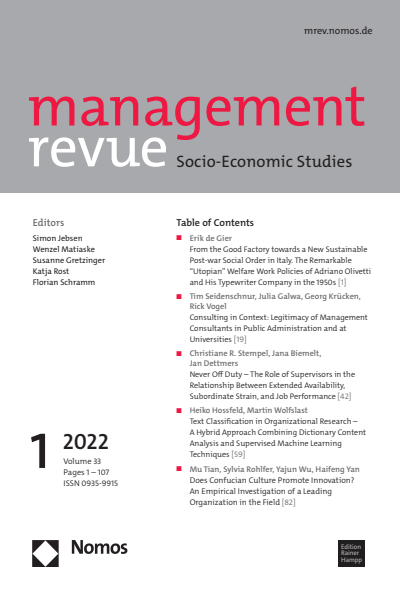
Consulting in Context: Legitimacy of Management Consultants in Public Administration and at Universities
Table of contents
Bibliographic information
Open Access Full access
mrev management revue
Volume 33 (2022), Issue 1
- Authors:
- Publisher
- Nomos, Baden-Baden
- Copyright Year
- 2022
- ISSN-Online
- 1861-9908
- ISSN-Print
- 0935-9915
Chapter information
Open Access Full access
Volume 33 (2022), Issue 1
Consulting in Context: Legitimacy of Management Consultants in Public Administration and at Universities
- Authors:
- ISSN-Print
- 0935-9915
- ISSN-Online
- 1861-9908
- Preview:
Bibliography
No match found. Try another term.
- Alvesson, M., & Empson, L. (2008). The construction of organizational identity: Comparative case studies of consulting firms. Scandinavian Journal of Management, 24(1), 1-16. Open Google Scholar DOI: 10.5771/0935-9915-2022-1-19
- Alvesson, M., Kärreman, D., Sturdy, A., & Handley, K. (2009). Unpacking the client(s). Constructions, positions and client–consultant dynamics. Scandinavian Journal of Management, 25(3), 253-263. Open Google Scholar DOI: 10.5771/0935-9915-2022-1-19
- Atkinson, R., & Flint, J. (2001). Accessing hidden and hard-to-reach populations: Snowball research strategies. Social Research Update, 33, 1-4. Open Google Scholar DOI: 10.5771/0935-9915-2022-1-19
- Baumann, J., & Krücken, G. (2019). Debated legitimacy: Accreditation in German higher education. Higher Education Policy, 32(1), 29-48. Open Google Scholar DOI: 10.5771/0935-9915-2022-1-19
- Bryson, J. M., Crosby, B. C., & Bloomberg, L. (2014). Public value governance: Moving beyond traditional public administration and the New Public Management. Public Administration Review, 74(4), 445-456. Open Google Scholar DOI: 10.5771/0935-9915-2022-1-19
- Clegg, S. R., Kornberger, M., & Rhodes, C. (2004). Noise, parasites and translation: Theory and practice in management consulting. Management Learning, 35(1), 31-44. Open Google Scholar DOI: 10.5771/0935-9915-2022-1-19
- DiMaggio, P. J., & Powell, W. W. (1983). The iron cage revisited: Institutional isomorphism and collective rationality in organizational fields. American Sociological Review, 48(2), 147-160. Open Google Scholar DOI: 10.5771/0935-9915-2022-1-19
- Esping-Andersen, G. (1990). Three worlds of welfare capitalism. Princeton, NJ: Princeton University Press. Open Google Scholar DOI: 10.5771/0935-9915-2022-1-19
- FEACO (2019). Survey of the European management consultancy 2018/2019. Retrieved 20.03.2020, from www.feaco.org/sites/default/files/sitepagefiles/Feaco.Survey%202018-2019.pdf. Open Google Scholar DOI: 10.5771/0935-9915-2022-1-19
- Fincham, R. (2012). The client in the client-consultant relationship. In: M. Kipping & T. Clark (eds.), The Oxford handbook of management consulting (pp. 411-426). Oxford: Oxford University Press. Open Google Scholar DOI: 10.5771/0935-9915-2022-1-19
- Frost, J., Hattke, F., & Reihlen, M. (eds.) (2016). Multi-level governance in universities: Strategy, structure, control. Dordrecht: Springer. Open Google Scholar DOI: 10.5771/0935-9915-2022-1-19
- Goodrick, E., & Reay, T. (2010). Florence Nightingale endures: Legitimizing a new professional role identity. Journal of Management Studies, 47(1), 55-84. Open Google Scholar DOI: 10.5771/0935-9915-2022-1-19
- Hampel, C. E., Lawrence, T., & Tracey, P. (2017). Institutional work: Taking stock and making it matter. In: R. Greenwood, C. Oliver, T. B. Lawrence & R. E. Meyer (eds.), The SAGE handbook of organizational institutionalism (pp. 558-590). London: Sage Publications. Open Google Scholar DOI: 10.5771/0935-9915-2022-1-19
- Hodge, G., & Bowman, D. (2006). Privatization and market development: Global movements in public policy ideas. In: G. A. Hodge (ed.), Privatization and market development: Global movements in public policy ideas (pp. 97-126). Cheltenham, UK: Edward Elgar Publishing. Open Google Scholar DOI: 10.5771/0935-9915-2022-1-19
- Hüther, O., & Krücken, G. (2018). Higher education in Germany – recent developments in an international perspective (Higher Education Dynamics, 49). Cham: Springer International Publishing AG. Open Google Scholar DOI: 10.5771/0935-9915-2022-1-19
- Hwang, H., & Colyvas, J.A. (2011). Problematizing actors and institutions in institutional work. Journal of Management Inquiry, 20(1), 62-66. Open Google Scholar DOI: 10.5771/0935-9915-2022-1-19
- Jepperson, R. L., & Meyer, J. (2021). Institutional theory: The cultural construction of organizations, states, and identities. Cambridge: Cambridge University Press. Open Google Scholar DOI: 10.5771/0935-9915-2022-1-19
- Karantinou, K. M., & Hogg, M. K. (2009). An empirical investigation of relationship development in profes-sional business services. Journal of Services Marketing, 23(4), 249-260. Open Google Scholar DOI: 10.5771/0935-9915-2022-1-19
- Krücken, G., & Serrano-Velarde, K. (2016). Der Berater als Fremder. Eine soziologische Studie zur Managementberatung in Universitäten. Kölner Zeitschrift für Soziologie und Sozialpsychologie, 68, 29-51. Open Google Scholar DOI: 10.5771/0935-9915-2022-1-19
- Lawrence, T. B., & Suddaby. R. (2006). Institutions and institutional work. In: S. R. Clegg, C. Hardy, T. B. Lawrence & W. R. Nord (eds.), Handbook of organization studies (2nd ed., pp. 215-254). London, UK: SAGE. Open Google Scholar DOI: 10.5771/0935-9915-2022-1-19
- Lawrence, T. B., Suddaby, R., & Leca, B. (2011). Institutional work: Refocusing institutional studies of organization. Journal of Management Inquiry, 20(1), 52-58. Open Google Scholar DOI: 10.5771/0935-9915-2022-1-19
- Maguire S., Hardy, C., & Lawrence T. B. (2004). Institutional entrepreneurship in emerging fields: HIV/AIDS treatment advocacy in Canada. The Academy of Management Journal, 47(5), 657-679. Open Google Scholar DOI: 10.5771/0935-9915-2022-1-19
- Mayring, P. (2000). Qualitative content analysis. Forum: Qualitative Social Research, 1(2), Art. 20. http://nbn-resolving.de/urn:nbn:de:0114-fqs0002204. Open Google Scholar DOI: 10.5771/0935-9915-2022-1-19
- Meyer, J. W., & Rowan, B. (1977). Institutionalized organizations: Formal structure as myth and ceremony. American Journal of Sociology, 83(2), 340-363. Open Google Scholar DOI: 10.5771/0935-9915-2022-1-19
- Meyer, J. W., & Jepperson, R. L. (2000). The ‘actors’ of modern society: The cultural construction of social agency. Sociological Theory, 18(1), 100-120. Open Google Scholar DOI: 10.5771/0935-9915-2022-1-19
- Meyer, R. E., & Hammerschmid, G. (2006). Changing institutional logics and executive identities: A managerial challenge to public administration in Austria. The American Behavioral Scientist, 7(49), 1000-1014. Open Google Scholar DOI: 10.5771/0935-9915-2022-1-19
- Meyer, R. E., Egger-Peitler, I., Höllerer, M., & Hammerschmid, G. (2014). Of bureaucrats and passionate public managers: Institutional logics, executive identities, and public service motivation. Public Administration, 92(4), 861-885. Open Google Scholar DOI: 10.5771/0935-9915-2022-1-19
- Meyer, R. E., & Höllerer, M. A. (2016). Laying a smoke screen: Ambiguity and neutralization as strategic responses to intra-institutional complexity. Strategic Organization, 14(4), 373-406. Open Google Scholar DOI: 10.5771/0935-9915-2022-1-19
- Nikolova, N., Reihlen, M., & Schlapfner, J.-F. (2009). Client–consultant interaction: Capturing social practices of professional service production. Scandinavian Journal of Management, 25(3), 289-298. Open Google Scholar DOI: 10.5771/0935-9915-2022-1-19
- Pemer, F., & Werr, A. (2013). The uncertain management consulting services client. International Studies of Management & Organization, 43(3), 22-40. Open Google Scholar DOI: 10.5771/0935-9915-2022-1-19
- Pollitt, C., & Bouckaert, G. (2017). Public management reform: A comparative analysis – into the age of austerity (4th ed.). Oxford, NY: Oxford University Press. Open Google Scholar DOI: 10.5771/0935-9915-2022-1-19
- Reay, T., & Hinings, C. R. (2009). Managing the rivalry of competing institutional logics. Organization Studies, 30(6), 629-652. Open Google Scholar DOI: 10.5771/0935-9915-2022-1-19
- Saint-Martin, D. (2004): Building the new managerialists state: Consultants and the politics of public sector reform in comparative perspective. Oxford: Oxford University Press. Open Google Scholar DOI: 10.5771/0935-9915-2022-1-19
- Seawright, J., & Gerring, J. (2008). Case selection techniques in case study research: A menu of qualitative and quantitative options. Political Research Quarterly, 61(2), 294-308. DOI: 10.1177/1065912907313077. Open Google Scholar DOI: 10.5771/0935-9915-2022-1-19
- Seidenschnur, T., & Krücken, G. (2019). Constructing the consultant as a legitimate actor: The role of active clients in universities. In: H. Hwang, J. A. Colyvas & G. S. Drori (eds.), Agents, Actors, Actorhood: Institutional Perspectives on the Nature of Agency, Action, and Authority (Research in the Sociology of Organizations, 58, pp. 111-133). Bingley: Emerald Publishing Limited. Open Google Scholar DOI: 10.5771/0935-9915-2022-1-19
- Serrano-Velarde, K. (2010). A fish out of water? Management consultants in academia. Minerva, 48(2), 125-144. Open Google Scholar DOI: 10.5771/0935-9915-2022-1-19
- Slack, T. (2014). The commercial impact of sport, the role of sport management. European Sport Management Quarterly, 14(5), 454-463. Open Google Scholar DOI: 10.5771/0935-9915-2022-1-19
- Sturdy, A. (1997). The consultancy process – An insecure business? Journal of Management Studies, 34(3), 389-413. Open Google Scholar DOI: 10.5771/0935-9915-2022-1-19
- Sturdy, A., Werr, A., & Buono, A. F. (2009). The client in management consultancy research: Mapping the territory. Scandinavian Journal of Management, 25(3), 247-252. Open Google Scholar DOI: 10.5771/0935-9915-2022-1-19
- Sturdy, A., & Wright, C. (2011). The active client: The boundary-spanning roles of internal consultants as gatekeepers, brokers and partners of their external counterparts. Management Learning, 42(5), 485-503. Open Google Scholar DOI: 10.5771/0935-9915-2022-1-19
- Suchman, M. C. (1995). Managing legitimacy: Strategic and institutional approaches. The Academy of Management Review, 20(3), 571-610. Open Google Scholar DOI: 10.5771/0935-9915-2022-1-19
- Suddaby, R., Bitektine, A., & Haack, P. (2017). Legitimacy. Academy of Management Annals, 11(1), 451-478. Open Google Scholar DOI: 10.5771/0935-9915-2022-1-19
- Thurlow, A., & Mills, J. H. (2015). Telling tales out of school. Sensemaking and narratives of legitimacy in an organizational change process. Scandinavian Journal of Management, 31(2), 246-254. Open Google Scholar DOI: 10.5771/0935-9915-2022-1-19
- Tracey, P., Dalpiaz, E., & Phillips, N. (2018). Fish out of water: Translation, legitimation, and new venture creation. Academy of Management Journal, 61(5), 1627-1666. Open Google Scholar DOI: 10.5771/0935-9915-2022-1-19
- Trank, C. Q., & Washington, M. (2009). Maintaining an institution in a contested organizational field: The work of AACSB and its constituents. In: T. B. Lawrence, R. Suddaby & B. Leca (eds.), Institutional work: Actors and agency in institutional studies of organizations (pp. 236-261). Cambridge, UK: University of Cambridge Press. Open Google Scholar DOI: 10.5771/0935-9915-2022-1-19
- Vogel, R. (2012). Framing and counter‐framing New Public Management: The case of Germany. Public Administration, 90(2), 370-392. Open Google Scholar DOI: 10.5771/0935-9915-2022-1-19
- Whetten, D. A. (2009). Organizational comparative analysis: Investigating similarities and differences among organizations. In: B. G. King, T. Felin & D. A. Whetten (eds.), Studying differences between organizations: Comparative approaches to organizational research (Research in the Sociology of Organizations, 26, pp. 63-87). Bingley: Emerald Group Publishing. Open Google Scholar DOI: 10.5771/0935-9915-2022-1-19
