Towards AI Governance in DAX40: A Typology of Organizational Guidelines for Self-Regulation
Table of contents
Bibliographic information
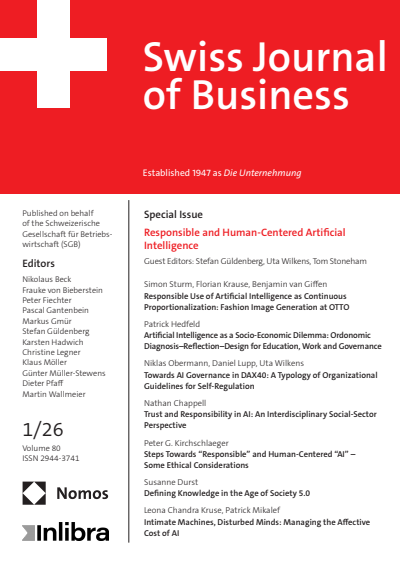
Swiss Journal of Business
Volume 80 (2026), Issue 1
- Authors:
- Publisher
- Nomos, Baden-Baden
- Copyright Year
- 2026
- ISSN-Online
- 2944-3741
- ISSN-Print
- 2944-3741
Chapter information
Volume 80 (2026), Issue 1
Towards AI Governance in DAX40: A Typology of Organizational Guidelines for Self-Regulation
- Authors:
- ISSN-Print
- 2944-3741
- ISSN-Online
- 2944-3741
- Preview:
In this article, we combine the discourse on the ethical challenges of using Artificial Intelligence (AI) with research perspectives on overarching AI governance. Although AI govenance is not yet institutionalized, an increasing number of organizations are formulating their own guidelines for the responsible use of AI. These self-regulatory approaches serve as guidance for customers and employees. At the same time, they serve to align organizational processes and control mechanisms. Little is known about the differences between self-regulatory approaches and how organizations anticipate the future direction of AI governance. Using DAX40 companies as an example, we examine how organizations design AI guidelines for self-regulation and which criteria of AI ethics they take into account. Based on a systematic search strategy and qualitative content analysis, we identify three different types of self-regulation: (1) non-codified self-regulation, (2) symbolic-technical self-regulation, and (3) comprehensive socio-technical self-regulation.
Bibliography
No match found. Try another term.
- Agarwal, A., & Nene, M. J. (2025). A five-layer framework for AI governance: Integrating regulation, standards, and certification. Transforming Government: People, Process and Policy, 19(3), 535–555. https://doi.org/10.1108/TG-03-2025-0065 Open Google Scholar DOI: 10.5771/2944-3741-2026-1-50
- Alanoca, S., Gur-Arieh, S., Zick, T., & Klyman, K. (2025). Comparing Apples to Oranges: A Taxonomy for Navigating the Global Landscape of AI Regulation. Proceedings of the 2025 ACM Conference on Fairness, Accountability, and Transparency, 914–937. https://doi.org/10.1145/3715275.3732059 Open Google Scholar DOI: 10.5771/2944-3741-2026-1-50
- Attard-Frost, B., & Walters, D. R. (o. J.). The Ethics of AI Business Practices: A Review of 47 AI Ethics Guidelines. AI Ethics 3, 389–406 (2023). https://doi.org/10.1007/s43681-022-00156-6 Open Google Scholar DOI: 10.5771/2944-3741-2026-1-50
- Bankins, S., & Formosa, P. (2023). The Ethical Implications of Artificial Intelligence (AI) For Meaningful Work. Journal of Business Ethics, 185(4), 725–740. https://doi.org/10.1007/s10551-023-05339-7 Open Google Scholar DOI: 10.5771/2944-3741-2026-1-50
- Batool, A., Zowghi, D., & Bano, M. (2025). AI governance: A systematic literature review. AI and Ethics. https://doi.org/10.1007/s43681-024-00653-w Open Google Scholar DOI: 10.5771/2944-3741-2026-1-50
- Berretta, S., Tausch, A., Ontrup, G., Gilles, B., Peifer, C., & Kluge, A. (2023). Defining human-AI teaming the human-centered way: A scoping review and network analysis. Frontiers in Artificial Intelligence, 6, 1250725. https://doi.org/10.3389/frai.2023.1250725 Open Google Scholar DOI: 10.5771/2944-3741-2026-1-50
- Birkstedt, T., Minkkinen, M., Tandon, A., & Mäntymäki, M. (2023). AI governance: Themes, knowledge gaps and future agendas. Internet Research, 33(7), 133–167. https://doi.org/10.1108/INTR-01-2022-0042 Open Google Scholar DOI: 10.5771/2944-3741-2026-1-50
- Brynjolfsson, E., Li, D., & Raymond, L. (2025). Generative AI at Work. The Quarterly Journal of Economics, 140(2), 889–942. https://doi.org/10.1093/qje/qjae044 Open Google Scholar DOI: 10.5771/2944-3741-2026-1-50
- Cabiddu, F., Lauro, S. D., Samaan, D., & Tursunbayeva, A. (o. J.). Governing AI in the World of Work: An International Review of 245 Ethics Guidelines. Available at SSRN. http://dx.doi.org/10.2139/ssrn.5397353 Open Google Scholar DOI: 10.5771/2944-3741-2026-1-50
- Camilleri, M. A. (2024). Artificial intelligence governance: Ethical considerations and implications for social responsibility. Expert Systems, 41(7), Article 7. https://doi.org/10.1111/exsy.13406 Open Google Scholar DOI: 10.5771/2944-3741-2026-1-50
- Corrêa, N. K., Galvão, C., Santos, J. W., Del Pino, C., Pinto, E. P., Barbosa, C., Massmann, D., Mambrini, R., Galvão, L., Terem, E., & De Oliveira, N. (2023). Worldwide AI ethics: A review of 200 guidelines and recommendations for AI governance. Patterns, 4(10), 100857. https://doi.org/10.1016/j.patter.2023.100857 Open Google Scholar DOI: 10.5771/2944-3741-2026-1-50
- Di Vito, J., & Trottier, K. (2022). A Literature Review on Corporate Governance Mechanisms: Past, Present, and Future*. Accounting Perspectives, 21(2), 207–235. https://doi.org/10.1111/1911-3838.12279 Open Google Scholar DOI: 10.5771/2944-3741-2026-1-50
- European Partliament (2024). Artificial Intelligence Act (Regulation (EU), 2024/1689) Open Google Scholar DOI: 10.5771/2944-3741-2026-1-50
- Floridi, L., Cowls, J., Beltrametti, M., Chatila, R., Chazerand, P., Dignum, V., Luetge, C., Madelin, R., Pagallo, U., Rossi, F., Schafer, B., Valcke, P., & Vayena, E. (2018). AI4People—An Ethical Framework for a Good AI Society: Opportunities, Risks, Principles, and Recommendations. Minds and Machines, 28(4), 689–707. https://doi.org/10.1007/s11023-018-9482-5 Open Google Scholar DOI: 10.5771/2944-3741-2026-1-50
- Hagendorff, T. (2020). The Ethics of AI Ethics: An Evaluation of Guidelines. Minds and Machines, 30(1), Article 1. https://doi.org/10.1007/s11023-020-09517-8 Open Google Scholar DOI: 10.5771/2944-3741-2026-1-50
- Herrmann, T., & Pfeiffer, S. (2023). Keeping the organization in the loop: A socio-technical extension of human-centered artificial intelligence. AI & SOCIETY, 38(4), 1523–1542. https://doi.org/10.1007/s00146-022-01391-5 Open Google Scholar DOI: 10.5771/2944-3741-2026-1-50
- Hickman, E., & Petrin, M. (2021). Trustworthy AI and Corporate Governance: The EU’s Ethics Guidelines for Trustworthy Artificial Intelligence from a Company Law Perspective. European Business Organization Law Review, 22(4), Article 4. https://doi.org/10.1007/s40804-021-00224-0 Open Google Scholar DOI: 10.5771/2944-3741-2026-1-50
- Hickok, M. (2021). Lessons learned from AI ethics principles for future actions. AI and Ethics, 1(1), Article 1. https://doi.org/10.1007/s43681-020-00008-1 Open Google Scholar DOI: 10.5771/2944-3741-2026-1-50
- Jarzabkowski, P., & Paul Spee, A. (2009). Strategy‐as‐practice: A review and future directions for the field. International Journal of Management Reviews, 11(1), 69–95. https://doi.org/10.1111/j.1468-2370.2008.00250.x Open Google Scholar DOI: 10.5771/2944-3741-2026-1-50
- Jobin, A., Ienca, M., & Vayena, E. (2019). The global landscape of AI ethics guidelines. Nature Machine Intelligence, 1(9), Article 9. https://doi.org/10.1038/s42256-019-0088-2 Open Google Scholar DOI: 10.5771/2944-3741-2026-1-50
- Leonardi, P. M., & Treem, J. W. (2020). Behavioral Visibility: A new paradigm for organization studies in the age of digitization, digitalization, and datafication. Organization Studies, 41(12), 1601–1625. https://doi.org/10.1177/0170840620970728 Open Google Scholar DOI: 10.5771/2944-3741-2026-1-50
- Lombard, M., Snyder-Duch, J., & Bracken, C. C. (2002). Content Analysis in Mass Communication: Assessment and Reporting of Intercoder Reliability. Human Communication Research, 28(4), 587–604. https://doi.org/10.1111/j.1468-2958.2002.tb00826.x Open Google Scholar DOI: 10.5771/2944-3741-2026-1-50
- Maman, L., & Feldman, Y. (2025). Compliance and Effectiveness of Industry Self-Regulation: A Systematic Literature Review. Available at SSRN. http://dx.doi.org/10.2139/ssrn.5233166 Open Google Scholar DOI: 10.5771/2944-3741-2026-1-50
- Mäntymäki, M., Minkkinen, M., Birkstedt, T., & Viljanen, M. (2022a). Putting AI Ethics into Practice: The Hourglass Model of Organizational AI Governance (No. arXiv:2206.00335; Nummer arXiv:2206.00335). arXiv. https://doi.org/10.48550/arXiv.2206.00335 Open Google Scholar DOI: 10.5771/2944-3741-2026-1-50
- Mäntymäki, M., Minkkinen, M., Birkstedt, T., & Viljanen, M. (2022b). Defining organizational AI governance. AI and Ethics, 2(4), Article 4. https://doi.org/10.1007/s43681-022-00143-x Open Google Scholar DOI: 10.5771/2944-3741-2026-1-50
- Mayring, P., & Fenzl, T. (2014). Qualitative Inhaltsanalyse. In N. Baur & J. Blasius (Eds.), Handbuch Methoden der empirischen Sozialforschung (pp. 543–556). Springer. https://doi.org/10.1007/978-3-531-18939-0_38 Open Google Scholar DOI: 10.5771/2944-3741-2026-1-50
- Mayring, P. (2019). Qualitative Inhaltsanalyse – Abgrenzungen, Spielarten, Weiterentwicklungen. Forum Qualitative Social Research, 20(3), 15. https://doi.org/10.17169/fqs-20.3.3343 Open Google Scholar DOI: 10.5771/2944-3741-2026-1-50
- Meske, C., Bunde, E., Schneider, J., & Gersch, M. (2022). Explainable Artificial Intelligence: Objectives, Stakeholders, and Future Research Opportunities. Information Systems Management, 39(1), 53–63. https://doi.org/10.1080/10580530.2020.1849465 Open Google Scholar DOI: 10.5771/2944-3741-2026-1-50
- Mueller, B. (2022). Corporate Digital Responsibility. Business & Information Systems Engineering, 64(5), 689–700. https://doi.org/10.1007/s12599-022-00760-0 Open Google Scholar DOI: 10.5771/2944-3741-2026-1-50
- Nitsch, V., Rick, V., Kluge, A., & Wilkens, U. (2024). Human-centered approaches to AI-assisted work: The future of work? Zeitschrift Für Arbeitswissenschaft, 78(3), 261–267. https://doi.org/10.1007/s41449-024-00437-2 Open Google Scholar DOI: 10.5771/2944-3741-2026-1-50
- Orlikowski, W. J., & Scott, S. V. (2008). 10 Sociomateriality: Challenging the Separation of Technology, Work and Organization. Academy of Management Annals, 2(1), 433–474. https://doi.org/10.5465/19416520802211644 Open Google Scholar DOI: 10.5771/2944-3741-2026-1-50
- Page, M. J., McKenzie, J. E., Bossuyt, P. M., Boutron, I., Hoffmann, T. C., Mulrow, C. D., Shamseer, L., Tetzlaff, J. M., Akl, E. A., Brennan, S. E., Chou, R., Glanville, J., Grimshaw, J. M., Hróbjartsson, A., Lalu, M. M., Li, T., Loder, E. W., Mayo-Wilson, E., McDonald, S., … Moher, D. (2021). The PRISMA 2020 statement: An updated guideline for reporting systematic reviews. BMJ, n71. https://doi.org/10.1136/bmj.n71 Open Google Scholar DOI: 10.5771/2944-3741-2026-1-50
- Papagiannidis, E., Mikalef, P., & Conboy, K. (2025). Responsible artificial intelligence governance: A review and research framework. The Journal of Strategic Information Systems, 34(2), 101885. https://doi.org/10.1016/j.jsis.2024.101885 Open Google Scholar DOI: 10.5771/2944-3741-2026-1-50
- Parker, S. K., & Grote, G. (2022). Automation, Algorithms, and Beyond: Why Work Design Matters More Than Ever in a Digital World. Applied Psychology, 71(4), 1171–1204. https://doi.org/10.1111/apps.12241 Open Google Scholar DOI: 10.5771/2944-3741-2026-1-50
- Prem, E. (2023). From ethical AI frameworks to tools: A review of approaches. AI and Ethics, 3(3), 699–716. https://doi.org/10.1007/s43681-023-00258-9 Open Google Scholar DOI: 10.5771/2944-3741-2026-1-50
- Prem, E. (2024). Approaches to Ethical AI. In H. Werthner, C. Ghezzi, J. Kramer, J. Nida-Rümelin, B. Nuseibeh, E. Prem, & A. Stanger (Hrsg.), Introduction to Digital Humanism (S. 225–239). Springer Nature Switzerland. https://doi.org/10.1007/978-3-031-45304-5_15 Open Google Scholar DOI: 10.5771/2944-3741-2026-1-50
- Schneider, J., Abraham, R., Meske, C., & Vom Brocke, J. (2023). Artificial Intelligence Governance For Businesses. Information Systems Management, 40(3), Article 3. https://doi.org/10.1080/10580530.2022.2085825 Open Google Scholar DOI: 10.5771/2944-3741-2026-1-50
- Schneider, J., Abraham, R., & Meske, C. (2024). Governance of generative artificial intelligence for companies. arXiv preprint arXiv:2403.08802. https://doi.org/10.48550/arXiv.2403.08802 Open Google Scholar DOI: 10.5771/2944-3741-2026-1-50
- Seidl, D., Ma, S., & Splitter, V. (2024). What makes activities strategic: Toward a new framework for strategy‐as‐practice research. Strategic Management Journal, 45(12), 2395–2419. https://doi.org/10.1002/smj.3668 Open Google Scholar DOI: 10.5771/2944-3741-2026-1-50
- Snyder, H. (2019). Literature review as a research methodology: An overview and guidelines. Journal of Business Research, 104, 333–339. https://doi.org/10.1016/j.jbusres.2019.07.039 Open Google Scholar DOI: 10.5771/2944-3741-2026-1-50
- Stahl, B. C., Antoniou, J., Ryan, M., Macnish, K., & Jiya, T. (2022). Organisational responses to the ethical issues of artificial intelligence. AI & SOCIETY, 37(1), Article 1. https://doi.org/10.1007/s00146-021-01148-6 Open Google Scholar DOI: 10.5771/2944-3741-2026-1-50
- Viljanen, M., & Parviainen, H. (2022). AI Applications and Regulation: Mapping the Regulatory Strata. Frontiers in Computer Science, 3, 779957. https://doi.org/10.3389/fcomp.2021.779957 Open Google Scholar DOI: 10.5771/2944-3741-2026-1-50
- Von Krogh, G. (2018). Artificial Intelligence in Organizations: New Opportunities for Phenomenon-Based Theorizing. Academy of Management Discoveries, 4(4), 404–409. https://doi.org/10.5465/amd.2018.0084 Open Google Scholar DOI: 10.5771/2944-3741-2026-1-50
- Whittington, R. (2006). Completing the Practice Turn in Strategy Research. Organization Studies, 27(5), 613–634. https://doi.org/10.1177/0170840606064101 Open Google Scholar DOI: 10.5771/2944-3741-2026-1-50
- Widder, D. G., & Nafus, D. (2023). Dislocated accountabilities in the “AI supply chain”: Modularity and developers’ notions of responsibility. Big Data & Society, 10(1), Article 1. https://doi.org/10.1177/20539517231177620 Open Google Scholar DOI: 10.5771/2944-3741-2026-1-50
- Wilkens, U., Lupp, D., & Langholf, V. (2023). Configurations of human-centered AI at work: Seven actor-structure engagements in organizations. Frontiers in Artificial Intelligence, 6, 1272159. https://doi.org/10.3389/frai.2023.1272159 Open Google Scholar DOI: 10.5771/2944-3741-2026-1-50
- Wirtz, B. W., Weyerer, J. C., & Kehl, I. (2022). Governance of artificial intelligence: A risk and guideline-based integrative framework. Government Information Quarterly, 39(4), 101685. https://doi.org/10.1016/j.giq.2022.101685 Open Google Scholar DOI: 10.5771/2944-3741-2026-1-50
