Schön gesagt! Aspekte der Gewandtheit der Nachrichtensprache: Ein empirischer Vergleich der sprachlichen Gewandtheit der Nachrichtensendungen von ARD, ZDF, SAT.1 und RTL
Table of contents
Bibliographic information
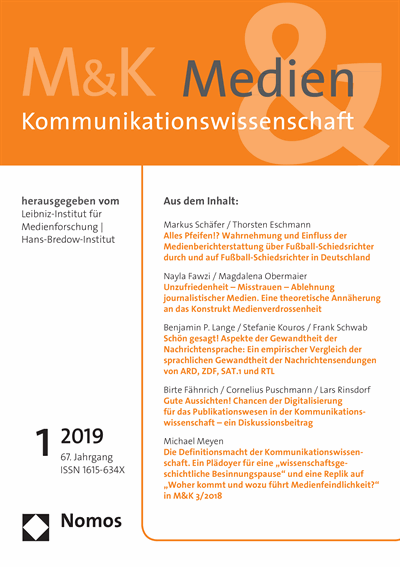
Open Access Full access
M&K Medien & Kommunikationswissenschaft
Volume 67 (2019), Edition 1
- Authors:
- Publisher
- Nomos, Baden-Baden
- Copyright year
- 2019
- ISSN-Online
- 2942-3317
- ISSN-Print
- 1615-634X
Chapter information
Open Access Full access
Volume 67 (2019), Edition 1
Schön gesagt! Aspekte der Gewandtheit der Nachrichtensprache: Ein empirischer Vergleich der sprachlichen Gewandtheit der Nachrichtensendungen von ARD, ZDF, SAT.1 und RTL
- Authors:
- ISSN-Print
- 1615-634X
- ISSN-Online
- 2942-3317
- Preview:
Bibliography
No match found. Try another term.
- Addington, D. W. (1971). The effect of vocal variations on ratings of source credibility. Speech Monographs, 38, 242–247. Open Google Scholar doi.org/10.5771/1615-634X-2019-1-45
- Barling, J. (1979). Verbal proficiency: A confounding variable in the reliability of children’s attitude scales. Child Development, 50, 1254–1256. Open Google Scholar doi.org/10.5771/1615-634X-2019-1-45
- Bartel, R. (1997). Fernsehnachrichten im Wettbewerb. Die Strategien der öffentlich-rechtlichen und privaten Anbieter. Köln: Böhlau. Open Google Scholar doi.org/10.5771/1615-634X-2019-1-45
- Bernstein, B. (1962). Social class, linguistic codes and grammatical elements. Language and Speech, 5(4), 221–240. Open Google Scholar doi.org/10.5771/1615-634X-2019-1-45
- Bernstein, B. (1972). Theoretical studies towards a sociology of language. London: Routledge & Paul. Open Google Scholar doi.org/10.5771/1615-634X-2019-1-45
- Bruck, P. A. & Stocker, G. (1996). Die ganz normale Vielfältigkeit des Lesens. Zur Rezeption von Boulevardzeitungen. Münster: LIT. Open Google Scholar doi.org/10.5771/1615-634X-2019-1-45
- Bruns, T. & Marcinkowski, F. (1997). Politische Information im Fernsehen. Eine Längsschnittstudie zur Veränderung der Politikvermittlung in Nachrichten und politischen Informationssendungen. Opladen: Leske + Budrich. Open Google Scholar doi.org/10.5771/1615-634X-2019-1-45
- Burger, H. & Luginbühl, M. (2014). Mediensprache. Eine Einführung in Sprache und Kommunikationsformen der Massenmedien (4. Auflage). Berlin: de Gruyter. Open Google Scholar doi.org/10.5771/1615-634X-2019-1-45
- Chomsky, N. (1965). Aspects of the theory of syntax. Cambridge, MA: MIT Press. Open Google Scholar doi.org/10.5771/1615-634X-2019-1-45
- Cohen, J. (1988). Statistical power analysis for the behavioral sciences (2nd ed.). Hillsdale, NJ: Erlbaum. Open Google Scholar doi.org/10.5771/1615-634X-2019-1-45
- Donsbach, W. & Büttner, K. (2005). Boulevardisierungstrend in deutschen Fernsehnachrichten. Publizistik, 50, 21–38. Open Google Scholar doi.org/10.5771/1615-634X-2019-1-45
- Ehrlich, M.-F. & Millet, J. F. (1979). The ability to memorize sentences and level of verbal proficiency of adult subjects. L’Annee Psychologique, 79(2), 443–464. Open Google Scholar doi.org/10.5771/1615-634X-2019-1-45
- Gscheidle, C. & Geese, S. (2017). Die Informationsqualität der Fernsehnachrichten aus Zuschauersicht. Media Perspektiven, 6, 310–324. Open Google Scholar doi.org/10.5771/1615-634X-2019-1-45
- Hackel-de Latour, R. (2015). „Lügenpresse“!? Über den Glaubwürdigkeitsverlust der Medien. Communicatio socialis, 48(2), 123–125. Open Google Scholar doi.org/10.5771/1615-634X-2019-1-45
- Hussy, W., Schreier, M. & Echterhoff, G. (2009). Forschungsmethoden in Psychologie und Sozialwissenschaften. Berlin: Springer. Open Google Scholar doi.org/10.5771/1615-634X-2019-1-45
- Kemper, S. & Sumner, A. (2001). The structure of verbal abilities in young and older adults. Psychology & Aging, 16(2), 312–322. Open Google Scholar doi.org/10.5771/1615-634X-2019-1-45
- Lange, B. P. (2012). Verbal proficiency as fitness indicator. Experimental and comparative research on the evolutionary psychology of language and verbal displays. Saarbrücken: Südwestdeutscher Verlag für Hochschulschriften. Open Google Scholar doi.org/10.5771/1615-634X-2019-1-45
- Lange, B. P. (2015). Kommunikative Geschlechterunterschiede aus evolutionärer Perspektive. Mitteilungen der Berliner Gesellschaft für Anthropologie, Ethnologie und Urgeschichte, 36, 83–100. Open Google Scholar doi.org/10.5771/1615-634X-2019-1-45
- Lange, B. P. (2016). Befunde zur Rolle sprachlicher Gewandtheit bei der Partnerwahl. In C. Hennighausen, B. P. Lange & F. Schwab (Hrsg.), Evolution des Sozialen (S. 128–143). Lengerich: Pabst Publishers. Open Google Scholar doi.org/10.5771/1615-634X-2019-1-45
- Lange, B. P., Bögemann, H. & Zaretsky, E. (2017). Ästhetische Dimensionen von Sprache, Sprechen, Stimme. In C. Schwender, B. P. Lange & S. Schwarz (Hrsg.), Evolutionäre Ästhetik (S. 225–246). Lengerich: Pabst Publishers. Open Google Scholar doi.org/10.5771/1615-634X-2019-1-45
- Lange, B. P., Hennighausen, C., Brill, M. & Schwab, F. (2016). Only cheap talk after all? New experimental psychological findings on the role of verbal proficiency in mate choice. Psychology of Language and Communication, 20(1), 1–22. doi: 10.1515/plc-2016-0001. Open Google Scholar doi.org/10.5771/1615-634X-2019-1-45
- Lange, B. P., Zaretsky, E., Schwarz, S. & Euler, H. A. (2014). Words won’t fail: Experimental evidence on the role of verbal proficiency in mate choice. Journal of Language and Social Psychology, 33(5), 482–499. doi: 10.1177/0261927x13515886. Open Google Scholar doi.org/10.5771/1615-634X-2019-1-45
- Luo, L., Luk, G. & Bialystok, E. (2010). Effect of language proficiency and executive control on verbal fluency performance in bilinguals. Cognition, 114(1), 29–41. Open Google Scholar doi.org/10.5771/1615-634X-2019-1-45
- Maaß, C. (2015). Leichte Sprache. Das Regelbuch. Band 1. Berlin: LIT Verlag. Open Google Scholar doi.org/10.5771/1615-634X-2019-1-45
- Matzen, N. (2009). Macht „Tagesschau“! In N. Matzen & C. Radler (Hrsg.), Die Tagesschau. Zur Geschichte einer Nachrichtensendung (S. 11–28). Konstanz: UVK. Open Google Scholar doi.org/10.5771/1615-634X-2019-1-45
- McCroskey, J. C. & Teven, J. J. (1999). Goodwill: A reexamination of the construct and its measurement. Communication Monographs, 66, 90–103. Open Google Scholar doi.org/10.5771/1615-634X-2019-1-45
- McQuail, D. (2001). Television news research: Retrospect and prospect. In K. Renckstorf, D. McQuail & N. Jankowski (Eds.), Television news research: Recent European approaches and findings (pp. 393–404). Berlin: Quintessenz-Verlag. Open Google Scholar doi.org/10.5771/1615-634X-2019-1-45
- Miller, N., Maruyama, G., Beaber, R. J. & Valone, K. (1976). Speed of speech and persuasion. Journal of Personality and Social Psychology, 34(4), 615–624. Open Google Scholar doi.org/10.5771/1615-634X-2019-1-45
- NDR (n.d.). Leichte Sprache im NDR. http://www.ndr.de/fernsehen/service/leichte_sprache/in dex.html [14.01.2019]. Open Google Scholar doi.org/10.5771/1615-634X-2019-1-45
- Nippold, M. A. (1993). Developmental markers in adolescent language: syntax, semantics, and pragmatics. Language, Speech and Hearing Services in Schools, 24, 21–28. Open Google Scholar doi.org/10.5771/1615-634X-2019-1-45
- Olson, W. K. (2004). Triangulation in social research: Qualitative and quantitative methods can really be mixed. Developments in Sociology, 20, 103–121. Open Google Scholar doi.org/10.5771/1615-634X-2019-1-45
- Paetzold, U. (1973). Wie objektiv können Nachrichten sein. Gewerkschaftliche Monatshefte, 24(8), 488–495. Open Google Scholar doi.org/10.5771/1615-634X-2019-1-45
- Pennebaker, J. W., Booth, R. J., Boyd, R. L. & Francis, M. E. (2015). Linguistic Inquiry and Word Count: LIWC 2015. Austin, TX: Pennebaker Conglomerates. Open Google Scholar doi.org/10.5771/1615-634X-2019-1-45
- Pennebaker, J., Chung, C., Ireland, M., Gonzales, A. & Booth, R. J. (2007). The development and psychometric properties of LIWC 2007. The University of Texas at Austin and The University of Auckland, New Zealand. Open Google Scholar doi.org/10.5771/1615-634X-2019-1-45
- Perrin, D. (2015). Medienlinguistik (3. Auflage). Konstanz: UVK. Open Google Scholar doi.org/10.5771/1615-634X-2019-1-45
- Salomon, G. (1984). Television is ‘easy’ and print is ‘tough’: The differential investment of mental effort in learning as a function of perceptions and attributions. Journal of Educational Psychology, 76(4), 647–658. Open Google Scholar doi.org/10.5771/1615-634X-2019-1-45
- Schaap, G., Renckstorf, K. & Wester, F. (2001). Three decades of television news research: An action theoretical inventory of issues and problems. In K. Renckstorf, D. McQuail & N. Jankowski (Eds.), Television news research: Recent European approaches and findings (S. 47–90). Berlin: Quintessenz. Open Google Scholar doi.org/10.5771/1615-634X-2019-1-45
- Schindler, I., Hosoya, G., Menninghaus, W., Beermann, U., Wagner, V., Eid, M. & Scherer, K. R. (2017). Measuring aesthetic emotions: A review of the literature and a new assessment tool. Plos One, 12(6), e0178899. doi:10.1371/journal.pone.0178899. Open Google Scholar doi.org/10.5771/1615-634X-2019-1-45
- Schulz von Thun, F. (1981). Miteinander reden: Störungen und Klärungen. Psychologie der zwischenmenschlichen Kommunikation. Reinbek: Rowohlt. Open Google Scholar doi.org/10.5771/1615-634X-2019-1-45
- Schwab, F. & Lange, B. P. (2016). Involvement. In N. C. Krämer, S. Schwan, D. Unz & M. Suckfüll (Hrsg.), Medienpsychologie: Schlüsselbegriffe und Konzepte (2., überarbeitete und erweiterte Auflage) (S. 253–260). Stuttgart: Kohlhammer. Open Google Scholar doi.org/10.5771/1615-634X-2019-1-45
- Schwiesau, D. & Ohler, J. (2016). Nachrichten – klassisch und multimedial. Wiesbaden: Springer. Open Google Scholar doi.org/10.5771/1615-634X-2019-1-45
- Semetko, H. & Valkenburg, P. M. (2000). Framing European politics: A content analysis of press and television news. Journal of Communication, 50(2), 93–109. Open Google Scholar doi.org/10.5771/1615-634X-2019-1-45
- Straßner, E. (1982). Fernsehnachrichten. Eine Produktions-, Produkt- und Rezeptionsanalyse. Tübingen: Niemeyer. Open Google Scholar doi.org/10.5771/1615-634X-2019-1-45
- Torrance, E. P. (1974). Torrance tests of creative thinking. Lexington, MA: Personnel Press. Open Google Scholar doi.org/10.5771/1615-634X-2019-1-45
- Unz, D. & Schwab, F. (2004). Nachrichten. In R. Mangold, P. Vorderer & G. Bente (Hrsg.), Lehrbuch der Medienpsychologie (S. 493–525). Göttingen: Hogrefe. Open Google Scholar doi.org/10.5771/1615-634X-2019-1-45
- Wahdat, A. (2009). Die Welt im Zeitraffer. Die Sprache und das Sprechen. In N. Matzen & C. Radler (Hrsg.), Die Tagesschau. Zur Geschichte einer Nachrichtensendung (S. 149–167). Konstanz: UVK. Open Google Scholar doi.org/10.5771/1615-634X-2019-1-45
- Wechsler, D. (1958). The measurement and appraisal of adult intelligence. Baltimore, MD: Williams and Wilkins. Open Google Scholar doi.org/10.5771/1615-634X-2019-1-45
- Wechsler, D. (1981). Manual for the Wechsler Adult Intelligence Scale – revised. New York: Psychological Corporation. Open Google Scholar doi.org/10.5771/1615-634X-2019-1-45
- Weischenberg, S. (2001). Nachrichten-Journalismus. Anleitungen und Qualitäts-Standards für die Medienpraxis. Wiesbaden: Westdeutscher Verlag. Open Google Scholar doi.org/10.5771/1615-634X-2019-1-45
- Weischenberg, S. & Scholl, A. (1998). Die Wahr-Sager. In K. Kamps et al. (Hrsg.), Fernsehnachrichten (S. 137–146). Wiesbaden: VS Verlag für Sozialwissenschaften. Open Google Scholar doi.org/10.5771/1615-634X-2019-1-45
- White, D. M. (1950). The Gate Keeper: A case study in the selection of news. Journalism Quarterly, 27, 383–390. Open Google Scholar doi.org/10.5771/1615-634X-2019-1-45
- Winterhoff-Spurk, P., Unz, D. & Schwab, F. (2005). Häufiger, schneller, variabler. Ergebnisse einer Längsschnittuntersuchung über Gewalt in TV-Nachrichten. Publizistik, 50(2), 225–237. Open Google Scholar doi.org/10.5771/1615-634X-2019-1-45
- Wittwen, A. (1995). Infotainment. Fernsehnachrichten zwischen Information und Unterhaltung. Bern: Lang. Open Google Scholar doi.org/10.5771/1615-634X-2019-1-45
- Wolf, M., Horn, A., Mehl, M., Haug, S., Pennebaker, J. W. & Kordy, H. (2008). Computergestützte quantitative Textanalyse: Äquivalenz und Robustheit der deutschen Version des Linguistic Inquiry and Word Count. Diagnostica, 2, 85–98. Open Google Scholar doi.org/10.5771/1615-634X-2019-1-45