Steps Towards “Responsible” and Human-Centered “AI” – Some Ethical Considerations
Table of contents
Bibliographic information
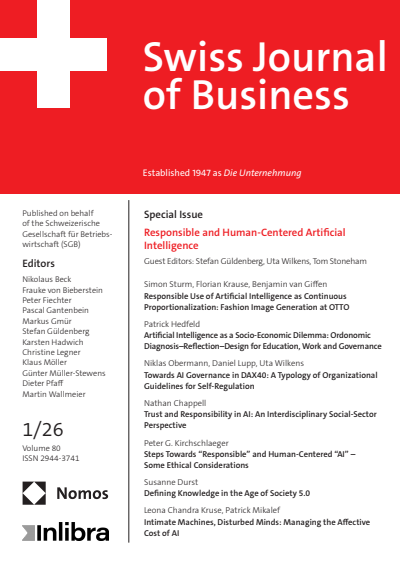
Swiss Journal of Business
Volume 80 (2026), Issue 1
- Authors:
- Publisher
- Nomos, Baden-Baden
- Copyright Year
- 2026
- ISSN-Online
- 2944-3741
- ISSN-Print
- 2944-3741
Chapter information
Volume 80 (2026), Issue 1
Steps Towards “Responsible” and Human-Centered “AI” – Some Ethical Considerations
- Authors:
- ISSN-Print
- 2944-3741
- ISSN-Online
- 2944-3741
- Preview:
So-called “artificial intelligence (AI)” – more adequately referred to as “data-based systems (DS)” – opens ethical downsides and upsides. There is a necessity to identify precisely the ethical opportunities and risks of DS in order to promote the former and in order to avoid the latter – for the benefit of all people and the planet earth. Companies can contribute to the realization of DS with ethics by, first, living up to the exclusive human responsibility for machines; second, while running innovation- and research-processes, by implementing always right from the start an interaction between ethics and technologies; third, by promoting global human rights-based regulation of DS as well as the establishment of an International Data-Based Systems Agency (IDA) at the UN enforcing this global regulation of DS.
Bibliography
No match found. Try another term.
- Heikkilae, M. (2022, December 12). The viral AI avatar app Lensa undressed me – without my consent. MIT Technology Review. https://www.technologyreview.com/2022/12/12/1064751/the-viral-ai-avatar-app-lensa-undressed-me-without-my-consent Open Google Scholar DOI: 10.5771/2944-3741-2026-1-77
- IDA. (2025). International Data-Based Systems Agency IDA at the UN: Supporters of IDA. IDA. Retrieved October 9, 2025, from https://idaonline.ch/supporters-of-ida/ Open Google Scholar DOI: 10.5771/2944-3741-2026-1-77
- Johnson, D. G. (2006). Computer systems: Moral entities but not moral agents. Ethics and Information Technology, 8(4), 195-204. https://doi.org/10.1007/s10676-006-9111-5 Open Google Scholar DOI: 10.5771/2944-3741-2026-1-77
- Kirchschlaeger, P. G. (2021). Digital Transformation and Ethics. Ethical Considerations on the robotization and automation of society and the economy and the use of Artificial Intelligence. Nomos. Open Google Scholar DOI: 10.5771/2944-3741-2026-1-77
- Kirchschlaeger, P. G. (2022). Ethische KI? Datenbasierte Systeme (DS) mit Ethik. HMD-Praxis der Wirtschaftsinformatik, 59(2), 482-494. https://doi.org/10.1365/s40702-022-00843-2 Open Google Scholar DOI: 10.5771/2944-3741-2026-1-77
- Kirchschlaeger, P. G. (2023). Ethical Decision-Making. Nomos. https://doi.org/10.5771/9783748918684 Open Google Scholar DOI: 10.5771/2944-3741-2026-1-77
- Kirchschlaeger, P. G. (2024a, April 11). In an era of digital disruptions, ethics can’t be an afterthought – Part 1. Business and Human Rights Journal Blog. Open Google Scholar DOI: 10.5771/2944-3741-2026-1-77
- https://www.cambridge.org/core/blog/2024/04/11/in-an-era-of-digital-disruptions-ethics-cant-be-an-afterthought/ Open Google Scholar DOI: 10.5771/2944-3741-2026-1-77
- Kirchschlaeger, P. G. (2024b, April 12). In an era of digital disruptions, ethics can’t be an afterthought – Part 2. Business and Human Rights Journal Blog. https://www.cambridge.org/core/blog/2024/04/12/in-an-era-of-digital-disruptions-ethics-cant-be-an-afterthought-part-2/ Open Google Scholar DOI: 10.5771/2944-3741-2026-1-77
- Kirchschlaeger, P. G. (2024c). Artificial intelligence and the complexity of ethics. Asian Horizons, 14(3), 375-389. https://dvkjournals.in/index.php/ah/article/view/4590/3752 Open Google Scholar DOI: 10.5771/2944-3741-2026-1-77
- Kirchschlaeger, P. G. (2024d, December 3). Protecting children from Anti-Social media. Project Syndicate. https://www.project-syndicate.org/commentary/australia-ban-on-children-using-social-media-should-be-emulated-by-peter-g-kirchschlager-2024-12 Open Google Scholar DOI: 10.5771/2944-3741-2026-1-77
- Kirchschlaeger, P. G. (2024e). The need for an International Data-Based Systems Agency (IDA) at the UN: governing “AI” globally by keeping the planet sustainably and protecting the weaker from the powerful. Journal of AI Humanities, 18, 213-248. Open Google Scholar DOI: 10.5771/2944-3741-2026-1-77
- Kirchschlaeger, P. G. (2024f). An International Data-Based Systems Agency IDA: striving for a peaceful, sustainable, and Human Rights-Based future. Philosophies, 9(3), 73. https://doi.org/10.3390/philosophies9030073 Open Google Scholar DOI: 10.5771/2944-3741-2026-1-77
- Kirchschlaeger, P. G. (2024g). Securing a peaceful, sustainable, and humane future through an International Data-based Systems Agency (IDA) at the UN. Data & Policy, 6(78). https://doi.org/10.1017/dap.2024.38 Open Google Scholar DOI: 10.5771/2944-3741-2026-1-77
- Kirchschlaeger, P.G. (2025). Artificial Intelligence – an Analysis from the Rights of the Child Perspective. Berkley Journal of International Law. https://www.berkeleyjournalofinternationallaw.com/post/artificial-intelligence-an-analysis-from-the-rights-of-the-child-perspective Open Google Scholar DOI: 10.5771/2944-3741-2026-1-77
- Lensa. (2025). Lensa AI: Influencers’ best kept secret. Lensa App. Retrieved October 9, 2025, from https://lensa.app/ Open Google Scholar DOI: 10.5771/2944-3741-2026-1-77
- Misselhorn, C. (2018). Grundfragen der Maschinenethik. Reclam. Open Google Scholar DOI: 10.5771/2944-3741-2026-1-77
- Snow, O. (2022, December 7). ‘Magic Avatar’ app Lensa generated nudes from my childhood photos. The dreamy picture-editing AI is a nightmare waiting to happen. Wired. https://www.wired.com/story/lensa-artificial-intelligence-csem/?bxid=5cc9e15efc942d13eb203f10 Open Google Scholar DOI: 10.5771/2944-3741-2026-1-77
- Yampolskiy, R.V. (2013). Artificial Intelligence Safety Engineering: Why Machine Ethics Is a Wrong Approach. In V. Müller (Ed), Philosophy and Theory of Artificial Intelligence. Studies in Applied Philosophy, Epistemology and Rational Ethics (pp. 389-396). Springer. https://doi.org/10.1007/978-3-642-31674-6_2 Open Google Scholar DOI: 10.5771/2944-3741-2026-1-77
