Never Off Duty – The Role of Supervisors in the Relationship Between Extended Availability, Subordinate Strain, and Job Performance
Table of contents
Bibliographic information
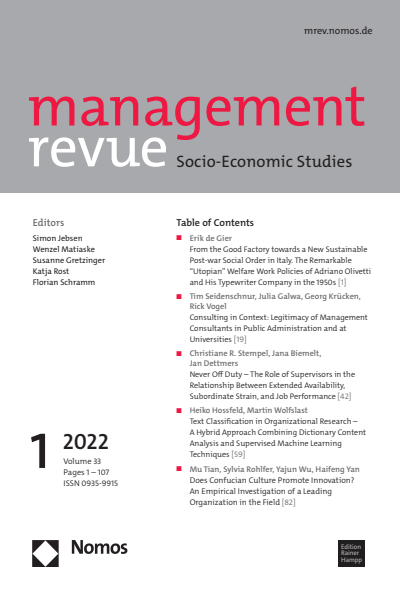
Open Access Full access
mrev management revue
Volume 33 (2022), Issue 1
- Authors:
- Publisher
- Nomos, Baden-Baden
- Copyright Year
- 2022
- ISSN-Online
- 1861-9908
- ISSN-Print
- 0935-9915
Chapter information
Open Access Full access
Volume 33 (2022), Issue 1
Never Off Duty – The Role of Supervisors in the Relationship Between Extended Availability, Subordinate Strain, and Job Performance
- Authors:
- ISSN-Print
- 0935-9915
- ISSN-Online
- 1861-9908
- Preview:
Bibliography
No match found. Try another term.
- Arlinghaus, A., & Nachreiner, F. (2013). When work calls – Associations between being contacted outside of regular working hours for work-related matters and health. Chronobiology International, 30(9), 1197–1202. https://doi.org/10.3109/07420528.2013.800089 Open Google Scholar DOI: 10.5771/0935-9915-2022-1-42
- Ashforth, B. E., Kreiner, G. E., & Fugate, M. (2000). All in a day’s work: Boundaries and micro role transitions. Academy of Management Review, 25(3), 472–491. https://doi.org/10.5465/AMR.2000.3363315 Open Google Scholar DOI: 10.5771/0935-9915-2022-1-42
- Bakker, A. B., & Demerouti, E. (2007). The job demands-resources model: State of the art. Journal of Managerial Psychology, 22(3), 309–328. https://doi.org/10.1108/02683940710733115 Open Google Scholar DOI: 10.5771/0935-9915-2022-1-42
- Bakker, A. B., & Demerouti, E. (2017). Job demands-resources theory: Taking stock and looking forward. Journal of Occupational Health Psychology, 22, 273–285. https://doi.org/10.1037/ocp0000056 Open Google Scholar DOI: 10.5771/0935-9915-2022-1-42
- Bamberg, E., Dettmers, J., Funck, H., Krähe, B., & Vahle-Hinz, T. (2012). Effects of on-call work on well-being: Results of a aaily survey. Applied Psychology: Health and Well-Being, 4(3), 299–320. https://doi.org/10.1111/j.1758-0854.2012.01075.x Open Google Scholar DOI: 10.5771/0935-9915-2022-1-42
- Bergman, A., & Gardiner, J. (2007). Employee availability for work and family: three Swedish case studies. Employee Relations, 29(4), 400–414. https://doi.org/10.1108/01425450710759226 Open Google Scholar DOI: 10.5771/0935-9915-2022-1-42
- Berkowsky, R. W. (2013). When you just cannot get away. Information, Communication & Society, 16(4), 519–541. https://doi.org/10.1080/1369118X.2013.772650 Open Google Scholar DOI: 10.5771/0935-9915-2022-1-42
- Binnewies, C., Sonnentag, S., & Mojza, E.J. (2009). Daily performance at work : feeling recovered in the morning as a predictor of day-level job performance. Journal of Organizational Behavior. 30(1), pp. 67–93. https://doi.org/10.1002/job.541 Open Google Scholar DOI: 10.5771/0935-9915-2022-1-42
- Carlson, D. S., Kacmar, K. M., & Williams, L. J. (2000). Construction and initial validation of a multidimensional measure of work-family conflict. Journal of Vocational Behavior, 56(2), 249–276. https://doi.org/10.1006/jvbe.1999.1713 Open Google Scholar DOI: 10.5771/0935-9915-2022-1-42
- Clark, S. C. (2000). Work/family border theory: A new theory of work/family balance. Human Relations, 53(6), 747–770. https://doi.org/10.1177/0018726700536001 Open Google Scholar DOI: 10.5771/0935-9915-2022-1-42
- Day, A., Paquet, S., Scott, N., & Hambley, L. (2012). Perceived information and communication technology (ICT) demands on employee outcomes: The moderating effect of organizational ICT support. Journal of Occupational Health Psychology, 17(4), 473–491. http://dx.doi.org/10.1037/a0029837 Open Google Scholar DOI: 10.5771/0935-9915-2022-1-42
- Derks, D., van Duin, D., Tims, M., & Bakker, A. B. (2015). Smartphone use and work-home interference: The moderating role of social norms and employee work engagement. Journal of Occupational and Organizational Psychology, 88(1), 155–177. https://doi.org/10.1111/joop.12083 Open Google Scholar DOI: 10.5771/0935-9915-2022-1-42
- Derks, D., Mierlo, H. van, & Schmitz, E. (2014). A diary study on work-related smartphone use, psychological detachment, and exhaustion: Examining the role of the perceived segmentation norm. Journal of Occupational Health Psychology, 19(1), 74–84. https://doi.org/10.1037/a0035076 Open Google Scholar DOI: 10.5771/0935-9915-2022-1-42
- Dettmers, J. (2017). How extended work availability affects well-being: The mediating roles of psychological detachment and work-family-conflict. Work & Stress, 31(1), 24–41. https://doi.org/10.1080/02678373.2017.1298164 Open Google Scholar DOI: 10.5771/0935-9915-2022-1-42
- Dettmers, J., Bamberg, E., & Seffzek, K. (2016a). Characteristics of extended availability for work: The role of demands and resources. International Journal of Stress Management. https://doi.org/dx.doi.org/10.1037/str0000014 Open Google Scholar DOI: 10.5771/0935-9915-2022-1-42
- Dettmers, J., & Biemelt, J. (2018). Always available – the role of perceived advantages and legitimacy. Journal of Managerial Psychology, 33, 497–510. https://doi.org/10.1108/JMP-02-2018-0095 Open Google Scholar DOI: 10.5771/0935-9915-2022-1-42
- Dettmers, J., Vahle-Hinz, T., Bamberg, E., Friedrich, N., & Keller, M. (2016b). Extended work availability and its relation with start-of-day mood and cortisol. Journal of Occupational Health Psychology, 21(1), 105–118. https://doi.org/10.1037/a0039602 Open Google Scholar DOI: 10.5771/0935-9915-2022-1-42
- Dewett, T., & Jones, G.R. (2001). The role of information technology in the organization: A review, model, and assessment. Journal of Management, 27, 313–346. https://doi.org/10.1177/014920630102700306 Open Google Scholar DOI: 10.5771/0935-9915-2022-1-42
- Diaz, I., Chiaburu, D., Zimmerman, R., & Boswell, W. (2012). Communication technology: Pros and cons of constant connection to work. Journal of Vocational Behavior, 80(2), 500–508. https://doi.org/10.1016/j.jvb.2011.08.007 Open Google Scholar DOI: 10.5771/0935-9915-2022-1-42
- Enzmann, D., & Kleiber, D. (1989). Helfer-Leiden. Asanger. Open Google Scholar DOI: 10.5771/0935-9915-2022-1-42
- Fahlén, S. (2014) Does gender matter? Policies, norms and the gender gap in work-to-home and home-to-work conflict across Europe. Community, Work & Family, 371–391, https://doi.org/10.1080/13668803.2014.899486 Open Google Scholar DOI: 10.5771/0935-9915-2022-1-42
- Glavin, P., & Schieman, S. (2012). Work-family role blurring and work-family conflict the moderating influence of job resources and job demands. Work and Occupations, 39(1), 71–98. https://doi.org/10.1177/0730888411406295 Open Google Scholar DOI: 10.5771/0935-9915-2022-1-42
- Golden, A. G., & Geisler, C. (2007). Work-life boundary management and the personal digital assistant. Human Relations, 60(3), 519–551. https://doi.org/10.1177/0018726707076698 Open Google Scholar DOI: 10.5771/0935-9915-2022-1-42
- Hammer, L. B., Kossek, E. E., Yragui, N. L., Bodner, T. E., & Hanson, G. C. (2009). Development and validation of a multidimensional measure of family-supportive supervisor behaviors (FSSB). Journal of Management, 35(4), 837–856. https://doi.org/10.1177/0149206308328510 Open Google Scholar DOI: 10.5771/0935-9915-2022-1-42
- Hecht, T. D., & Allen, N. J. (2009). A longitudinal examination of the work–nonwork boundary strength construct. Journal of Organizational Behavior, 30(7), 839–862. https://doi.org/10.1002/job Open Google Scholar DOI: 10.5771/0935-9915-2022-1-42
- Heißler, C.C. (2019). Working after hours, sharing availability expectations, and interrupting yourself: Extending perspectives on ICT-related concepts in research (doctorial dissertation). https://doi.org/10.17170/kobra-20190708588 Open Google Scholar DOI: 10.5771/0935-9915-2022-1-42
- Jex, S. M. (1998). Stress and job performance: Theory, research, and implications for managerial practice. Sage Publications Ltd. Open Google Scholar DOI: 10.5771/0935-9915-2022-1-42
- Koch, A. R., & Binnewies, C. (2015). Setting a good example: Supervisors as work-life-friendly role models within the context of boundary management. Journal of Occupational Health Psychology, 20(1), 82–92. https://doi.org/10.1037/a0037890 Open Google Scholar DOI: 10.5771/0935-9915-2022-1-42
- Kossek, E. E., Pichler, S., Bodner, T., & Hammer, L. B. (2011). Workplace social support and work-family conflict: A meta-analysis clarifying the influence of general and work-family-specific supervisor and organizational support. Personnel Psychology, 64(2), 289–313. https://doi.org/10.1111/j.1744-6570.2011.01211.x Open Google Scholar DOI: 10.5771/0935-9915-2022-1-42
- Kossek, E. E., Ruderman, M. N., Braddy, P. W., & Hannum, K. M. (2012). Work-nonwork boundary management profiles: A person-centered approach. Journal of Vocational Behavior, 81(1), 112–128. https://doi.org/10.1016/j.jvb.2012.04.003 Open Google Scholar DOI: 10.5771/0935-9915-2022-1-42
- Kranabetter, C., & Niessen, C. (2017). Managers as role models for health: Moderators of the relationship of transformational leadership with employee exhaustion and cynicism. Journal of Occupational Health Psychology, 22 (4). 492–502. http://dx.doi.org/10.1037/ocp0000044 Open Google Scholar DOI: 10.5771/0935-9915-2022-1-42
- Kuoppala, J., Lamminpää, A., Liira, J., & Vainio, H. (2008). Leadership, job well-being, and health effects—A systematic review and a meta-analysis. Journal of Occupational and Environmental Medicine, 50, 904–915. https://doi.org/10.1097/JOM.0b013e31817e918d Open Google Scholar DOI: 10.5771/0935-9915-2022-1-42
- Lapierre, L. M., & Allen, T. D. (2006). Work-supportive family, family-supportive supervision, use of organizational benefits, and problem-focused coping: implications for work-family conflict and employee well-being. Journal of Occupational Health Psychology, 11(2), 169–181. http://dx.doi.org/10.1037/1076-8998.11.2.169 Open Google Scholar DOI: 10.5771/0935-9915-2022-1-42
- Leung, L. (2011). Effects of ICT connectedness, permeability, flexibility, and negative spillovers on burnout and job and family satisfaction. Human Technology: An Interdisciplinary Journal on Humans in ICT Environments, 7(3), 250–267. https://doi.org/10.17011/ht/urn.2011112211714 Open Google Scholar DOI: 10.5771/0935-9915-2022-1-42
- Malhotra, N. K., Schaller, T. K., & Patil, A. (2017). Common Method Variance in Advertising Research: When to Be Concerned and How to Control for It. Journal of Advertising, 46(1), 193–212. https://doi.org/10.1080/00913367.2016.1252287 Open Google Scholar DOI: 10.5771/0935-9915-2022-1-42
- Maslach, C., & Jackson, S. E. (1986). Maslach Burnout Inventory. Manual (2nd ed.). Consulting Psychologists Press. Open Google Scholar DOI: 10.5771/0935-9915-2022-1-42
- Meijman, T. F., & Mulder, G. (1998). Psychological aspects of workload. In P. J. D. Drenth, H. Thierry, C. J. de Wolff, P. J. D. Drenth (Ed), H. Thierry (Ed), & C. J. de Wolff (Ed) (Eds.), Handbook of work and organizational: Work psychology. (pp. 5–33). Psychology Press/Erlbaum (UK) Taylor & Francis. Open Google Scholar DOI: 10.5771/0935-9915-2022-1-42
- Middleton, C. A. (2007). Illusions of balance and control in an always-on environment: A case study of BlackBerry users. Continuum, 21(2), 165–178. https://doi.org/10.1080/10304310701268695 Open Google Scholar DOI: 10.5771/0935-9915-2022-1-42
- Nohe, C., Michel, A., & Sonntag, K. (2013). Family–work conflict and job performance: A diary study of boundary conditions and mechanisms. Journal of Organizational Behavior, 35(3), 339–357. http://dx.doi.org/10.1002/job.1878 Open Google Scholar DOI: 10.5771/0935-9915-2022-1-42
- Nielsen, K., Randall, R., Yarker, J., & Brenner, S.-O. (2008). The effects of transformational leadership on followers’ perceived work characteristics and psychological well-being: A longitudinal study. Work & Stress, 22, 16–32. https://doi.org/10.1080/02678370801979430 Open Google Scholar DOI: 10.5771/0935-9915-2022-1-42
- Pangert, B., & Schüpbach, H. (2013). The effects of work-related extended availability on life-domain-balance and health. Bundesanstalt für Arbeitsschutz und Arbeitsmedizin. Open Google Scholar DOI: 10.5771/0935-9915-2022-1-42
- Piszczek, M. M. (2017). Boundary control and controlled boundaries: Organizational expectations for technology use at the work-family interface. Journal of Organizational Behavior, 38, 592–611. http://doi.wiley.com/10.1002/job.2153. Open Google Scholar DOI: 10.5771/0935-9915-2022-1-42
- Rau, R., & Göllner, M. (2019). Erreichbarkeit gestalten, oder doch besser die Arbeit? Zeitschrift für Arbeits- und Organisationspsychologie, 63 (1), 1–14. https://doi.org/10.1026/0932-4089/a000284 Open Google Scholar DOI: 10.5771/0935-9915-2022-1-42
- Siemsen, E., Roth, A., & Oliveira, P. (2010). Common method bias in regression models with linear, quadratic, and interaction effects. Organizational Research Methods, 13(3), 456–476. https://doi.org/10.1177/1094428109351241 Open Google Scholar DOI: 10.5771/0935-9915-2022-1-42
- Sonnentag, S., Kuttler, I., & Fritz, C. (2010). Job stressors, emotional exhaustion, and need for recovery: A multi-source study on the benefits of psychological detachment. Journal of Vocational Behavior, 76(3), 355–365. https://doi.org/10.1016/j.jvb.2009.06.005 Open Google Scholar DOI: 10.5771/0935-9915-2022-1-42
- Stein, M., Vincent-Höper, S., Deci, N., Gregersen, S., & Nienhaus, A. (2019). Compensatory coping through the extension of working hours: The buffering role of leader–member exchange. Zeitschrift für Arbeits- und Organisationspsychologie, 63(3), 115–128. https://doi.org/10.1026/0932-4089/a000285 Open Google Scholar DOI: 10.5771/0935-9915-2022-1-42
- Taris, T. W. (2006). Is there a relationship between burnout and objective performance? A critical review of 16 studies. Work & Stress, 20, 316–334. http://dx.doi.org/10.1080/02678370601065893 Open Google Scholar DOI: 10.5771/0935-9915-2022-1-42
- Trzcinski, E., & Holst, E. (2011). Gender differences in subjective well-being in and out of management positions. Social Indicators Research, 107, 449–463. https://doi.org/10.1007/s11205-011-9857-y Open Google Scholar DOI: 10.5771/0935-9915-2022-1-42
- Tuckey, M.R., Bakker, A.B. & Dollard, M.F. (2012). Empowering leaders optimize working conditions for engagement: A multilevel study. Journal of Occupational Health Psychology, 17, 15–27. https://doi.org/10.1037/a0025942 Open Google Scholar DOI: 10.5771/0935-9915-2022-1-42
- Vincent-Höper, S., & Stein, M.(2019). The role of leaders in designing employees’ work characteristics: Validation of the Health- and-Development-Promoting Leadership Behavior Questionnaire. Frontiers in Psychology, 10:1049. https://doi.org/10.3389/fpsyg.2019.01049 Open Google Scholar DOI: 10.5771/0935-9915-2022-1-42
- Voydanoff, P. (2005). Consequences of boundary-spanning demands and resources for work-to-family conflict and perceived stress. Journal of Occupational Health Psychology, 10(4), 491–503. https://doi.org/10.1037/1076-8998.10.4.491 Open Google Scholar DOI: 10.5771/0935-9915-2022-1-42
- Williams, L. J., & Anderson, S. E. (1991). Job satisfaction and organizational commitment as predictors of organizational citizenship and in-role behaviors. Journal of Management, 17(3), 601–617. https://doi.org/10.1177/014920639101700305 Open Google Scholar DOI: 10.5771/0935-9915-2022-1-42
- Wolff, H. G., & Höge, T. (2011). Konflikte zwischen Arbeit und Familie. Zeitschrift für Arbeits-und Organisationspsychologie A&O, 55, p. 143–152. https://doi.org/10.1026/0932-4089/a000053. Open Google Scholar DOI: 10.5771/0935-9915-2022-1-42
