A Bridge with Multiple Faces: Competing Identities in Turkish Parliamentary Debates (1988-2016)
Table of contents
Bibliographic information
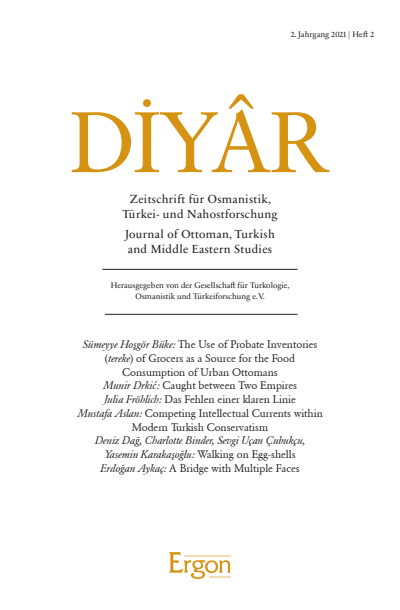
DIYÂR
Volume 2 (2021), Issue 2
- Authors:
- Publisher
- Ergon, Baden-Baden
- Copyright Year
- 2021
- ISSN-Online
- 2942-3155
- ISSN-Print
- 2625-9842
Chapter information
Volume 2 (2021), Issue 2
A Bridge with Multiple Faces: Competing Identities in Turkish Parliamentary Debates (1988-2016)
- Authors:
- ISSN-Print
- 2625-9842
- ISSN-Online
- 2942-3155
- Preview:
This article examines how Turkish parliamentarians continuously (re)shape Turkey’s identity and geopolitical role by using the metaphor of a bridge in parliamentary debates from 1988 to 2016. First, the article argues that parliamentarians use this metaphor in identity-formation processes to mediate between competing identities, thereby constituting Turkey’s liminal identity. Second, it illustrates how the bridge metaphor remained a dominant discourse even though parliamentarians constantly challenged and refilled the meaning of it. This constantly (re)shapes Turkey’s geopolitical role to function as a bridge between the West and East.
Bibliography
No match found. Try another term.
- Aksu, Kenan. 2014. Turkey: A Regional Power in the Making. Cambridge Scholars Publishing. Open Google Scholar DOI: 10.5771/2625-9842-2021-2-279
- Altunışık, Meliha. 2014. ‘Geopolitical Representations of Turkey’s Cuspness: Discourse and Practice’. In The Role, Position and Agency of Cusp States in International Relations, by Marc Herzog and Philip Robins. United Kingdom: Routledge. 25-41. Open Google Scholar DOI: 10.5771/2625-9842-2021-2-279
- Aras, Bülent, and Aylin Gorener. 2010. ‘National Role Conceptions and Foreign Policy Orientation: The Ideational Bases of the Justice and Development Party’s Foreign Policy Activism in the Middle East’. Journal of Balkan and Near Eastern Studies 12.1. 73-92. Open Google Scholar DOI: 10.5771/2625-9842-2021-2-279
- Arkan, Zeynep, and Müge Kınacıoğlu. 2016. ‘Enabling ‘ambitious Activism’: Davutoğlu’s Vision of a New Foreign Policy Identity for Turkey’. Turkish Studies 17.3. 381-405. Open Google Scholar DOI: 10.5771/2625-9842-2021-2-279
- Aydın-Düzgit, Senem. 2013. ‘European Security and the Accession of Turkey: Identity and Foreign Policy in the European Commission’. Cooperation and Conflict 48.4. 522-541. Open Google Scholar DOI: 10.5771/2625-9842-2021-2-279
- Benhaïm, Yohanan, and Kerem Öktem. 2015. ‘The Rise and Fall of Turkey’s Soft Power Discourse’. European Journal of Turkish Studies. Social Sciences on Contemporary Turkey. 21. 1-25. Open Google Scholar DOI: 10.5771/2625-9842-2021-2-279
- Bilgin, Pinar. 2007. ‘‘Only Strong States Can Survive in Turkey’s Geography’: The Uses of ‘geopolitical Truths’ in Turkey’. Political Geography 26.7. 740-56. Open Google Scholar DOI: 10.5771/2625-9842-2021-2-279
- Bucher, Bernd, and Ursula Jasper. 2017. ‘Revisiting ‘identity’ in International Relations: From Identity as Substance to Identifications in Action’. European Journal of International Relations 23.2. 391-415. Open Google Scholar DOI: 10.5771/2625-9842-2021-2-279
- Cameron, Lynne. 2011. ‘Metaphor in Spoken Discourse’. In Gee, James Paul and Handford, Michael (eds.). The Routledge Handbook of Discourse Analysis. London: Routledge. 342-355. Open Google Scholar DOI: 10.5771/2625-9842-2021-2-279
- Campbell, David. 1992. Writing Security: United States Foreign Policy and the Politics of Identity. University of Minnesota Press. Open Google Scholar DOI: 10.5771/2625-9842-2021-2-279
- Chilton, Paul A. 1996. Security Metaphors: Cold War Discourse from Containment to Common House. New York: Peter Lang International Academic Publishers. Open Google Scholar DOI: 10.5771/2625-9842-2021-2-279
- Davutoğlu, Ahmet. 2011. Teoriden Pratige: Turk Dis Politikasi Uzerine Konusmalar. Istanbul: Küre Yayınları. Open Google Scholar DOI: 10.5771/2625-9842-2021-2-279
- Doty, Roxanne Lynn. 1993. ‘Foreign Policy as Social Construction: A Post-Positivist Analysis of U.S. Counterinsurgency Policy in the Philippines’. International Studies Quarterly 37.3. 297-320. Open Google Scholar DOI: 10.5771/2625-9842-2021-2-279
- Durgun, Sezgin. 2011. Memalik-I Şahane’den Vatan’a. Istanbul: Iletisim Yayinlari. Open Google Scholar DOI: 10.5771/2625-9842-2021-2-279
- Flanik, William. 2011. ‘‘Bringing FPA Back Home:’ Cognition, Constructivism, and Conceptual Metaphor’. Foreign Policy Analysis 7.4. 423-446. Open Google Scholar DOI: 10.5771/2625-9842-2021-2-279
- Guillaume, Xavier. 2014. International Relations and Identity: A Dialogical Approach. 1st ed. New York: Routledge. Open Google Scholar DOI: 10.5771/2625-9842-2021-2-279
- Hansen, Lene. 2006. Security as Practice: Discourse Analysis and the Bosnian War. Taylor & Francis. Open Google Scholar DOI: 10.5771/2625-9842-2021-2-279
- Laclau, Ernesto, and Chantal Mouffe. 2001. Hegemony and Socialist Strategy: Towards a Radical Democratic Politics. Verso. Open Google Scholar DOI: 10.5771/2625-9842-2021-2-279
- Lesser, Ian O. 1992. ‘Bridge or Barrier? Turkey and the West After the Cold War’. Report R-4204-AF/A. RAND Corporation. Open Google Scholar DOI: 10.5771/2625-9842-2021-2-279
- Miles, Matthew B., A. Michael Huberman and Johnny Saldaña. 2013. Qualitative Data Analysis: A Methods Sourcebook. 3rd ed. Thousand Oaks, Califorinia: SAGE Publications, Inc. Open Google Scholar DOI: 10.5771/2625-9842-2021-2-279
- Müftüler-Baç, Meltem. 2000. ‘Through the Looking Glass: Turkey in Europe’. Turkish Studies 1.1. 21-35. Open Google Scholar DOI: 10.5771/2625-9842-2021-2-279
- Neumann, Iver B. 1999. Uses of the Other: “The East” in European Identity Formation. Manchester University Press. Open Google Scholar DOI: 10.5771/2625-9842-2021-2-279
- Öḡütçü, Mehmet. 1994. ‘Islam and the West: Can Turkey Bridge the Gap?’. Futures 26.8. 811-829. Open Google Scholar DOI: 10.5771/2625-9842-2021-2-279
- Ongur, Hakan Ovunc. 2015. ‘Identifying Ottomanisms: The Discursive Evolution of Ottoman Pasts in the Turkish Presents’. Middle Eastern Studies 51.3. 416-432. Open Google Scholar DOI: 10.5771/2625-9842-2021-2-279
- Öniş, Ziya. 2014. ‘Turkey and the Arab Revolutions: Boundaries of Regional Power Influence in a Turbulent Middle East’. Mediterranean Politics 19.2. 203-219. Open Google Scholar DOI: 10.5771/2625-9842-2021-2-279
- Öztürk, Murat, Yunus Emre Yüksel, and Nuri Özek. 2011. ‘A Bridge between East and West: Turkey’s Natural Gas Policy’. Renewable and Sustainable Energy Reviews 15.9. 4286-4294. Open Google Scholar DOI: 10.5771/2625-9842-2021-2-279
- Putz, Orsolya. 2019. Metaphor and National Identity: Alternative Conceptualization of the Treaty of Trianon. Cognitive Linguistic Studies in Cultural Contexts (CLSCC). Amsterdam: John Benjamins Publishing Company. Open Google Scholar DOI: 10.5771/2625-9842-2021-2-279
- Rumelili, Bahar. 2004. ‘Constructing Identity and Relating to Difference: Understanding the EU’s Mode of Differentiation’. Review of International Studies 30.1. 27-47. Open Google Scholar DOI: 10.5771/2625-9842-2021-2-279
- Rumelili, Bahar. 2007. Constructing Regional Community and Order in Europe and Southeast Asia. Palgrave Macmillan. Open Google Scholar DOI: 10.5771/2625-9842-2021-2-279
- Rumelili, Bahar. 2008. ‘Negotiating Europe: EU-Turkey Relations from an Identity Perspective’. Insight Turkey 10.1. 97-110. Open Google Scholar DOI: 10.5771/2625-9842-2021-2-279
- Rumelili, Bahar, and Rahime Suleymanoglu-Kurum. 2017. ‘Brand Turkey: Liminal Identity and Its Limits’. Geopolitics 22.3. 549-570. Open Google Scholar DOI: 10.5771/2625-9842-2021-2-279
- Šaric, Ljiljana, and Mateusz-Milan Stanojevic. 2019. Metaphor, Nation and Discourse. Discourse Approaches to Politics, Society and Culture. Amsterdam: John Benjamins Publishing Company. Open Google Scholar DOI: 10.5771/2625-9842-2021-2-279
- Tank, Pinar. 2006. ‘Dressing for the Occasion: Reconstructing Turkey’s Identity?’. Southeast European and Black Sea Studies 6.4. 463-478. Open Google Scholar DOI: 10.5771/2625-9842-2021-2-279
- Tezcür, Güneş Murat, and Alexandru Grigorescu. 2014. ‘Activism in Turkish Foreign Policy: Balancing European and Regional Interests’. International Studies Perspectives 15.3. 257-276. Open Google Scholar DOI: 10.5771/2625-9842-2021-2-279
- Tufekci, Ozgur. 2017. The Foreign Policy of Modern Turkey: Power and the Ideology of Eurasianism. London: I.B. Tauris. Open Google Scholar DOI: 10.5771/2625-9842-2021-2-279
- Váli, Ferenc A. 1971. Bridge Across the Bosphorus: The Foreign Policy of Turkey. London: The Johns Hopkins Press. Open Google Scholar DOI: 10.5771/2625-9842-2021-2-279
- Volfová, Gabriela Özel. 2016. ‘Turkey’s Middle Eastern Endeavors: Discourses and Practices of Neo-Ottomanism under the AKP’. Die Welt Des Islams 56.3-4. 489-510. Open Google Scholar DOI: 10.5771/2625-9842-2021-2-279
- Wodak, Ruth, Rudolf de Cillia, Martin Reisigl, Ruth Rodger, and Karin Liebhart. 2009. The Discursive Construction of National Identity. Open Google Scholar DOI: 10.5771/2625-9842-2021-2-279
- Yanık, Lerna K. 2009. “The Metamorphosis of Metaphors of Vision: ‘Bridging’ Turkey’s Location, Role and Identity After the End of the Cold War’. Geopolitics 14.3. 531-549. Open Google Scholar DOI: 10.5771/2625-9842-2021-2-279
- Yanık, Lerna K. 2011. ‘Constructing Turkish ‘exceptionalism’: Discourses of Liminality and Hybridity in Post-Cold War Turkish Foreign Policy’. Political Geography 30.2. 80-89. Open Google Scholar DOI: 10.5771/2625-9842-2021-2-279
- Yanık, Lerna K. 2012. ‘Atlantik Paktı’ndan NATO’ya: Türkiye Büyük Millet Meclisi’nde Türkiye’nin Konumu ve Uluslararası Rolü Tartışmalarından Bir Kesit’. Uluslararası İlişkiler 9.34. 29-50. Open Google Scholar DOI: 10.5771/2625-9842-2021-2-279
- Yanık, Lerna K. 2016. ‘Bringing the Empire Back In: The Gradual Discovery of the Ottoman Empire in Turkish Foreign Policy’. Die Welt Des Islams 56.3-4. 466-488. Open Google Scholar DOI: 10.5771/2625-9842-2021-2-279
