Assessing Yugoslavia’s Place in Western European Stabilisation Policies in Southern Europe, 1974-1976
Table of contents
Bibliographic information
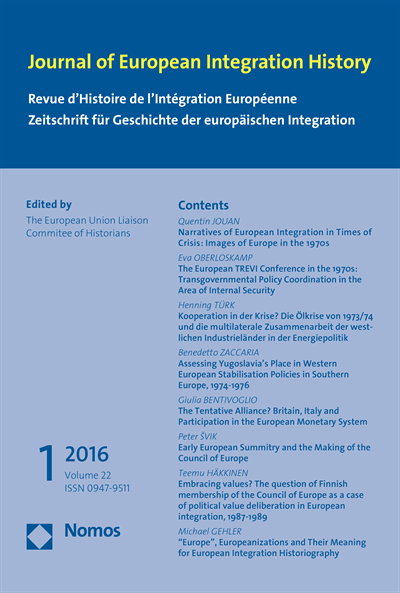
JEIH Journal of European Integration History
Volume 22 (2016), Issue 1
- Authors:
- Publisher
- Nomos, Baden-Baden
- Copyright Year
- 2016
- ISSN-Online
- 2942-321X
- ISSN-Print
- 0947-9511
Chapter information
Volume 22 (2016), Issue 1
Assessing Yugoslavia’s Place in Western European Stabilisation Policies in Southern Europe, 1974-1976
- Authors:
- ISSN-Print
- 0947-9511
- ISSN-Online
- 2942-321X
- Preview:
In recent years, historians have devoted much attention to the prominent role played by the major Western European powers - in primis France and the Federal Republic of Germany - in stabilising the troubled Southern European scenario of the mid-1970s through the power of economic and political attraction exerted by the European Economic Community (EEC). This chapter adds another element to this picture, offering a historical reappraisal of Western European stabilisation policy towards Yugoslavia between 1974 and 1976. This work argues that, mutatis mutandis, Western European goals towards Greece and Portugal - political stabilisation and strengthening of economic links with the Western system - also concerned Yugoslavia, whose independence vis-à-vis the Soviet Union was regarded as a major precondition for the stability of the whole Mediterranean region.
